“For you were once darkness, but now you are light in the Lord. Live as children of light…” Ephesians 5:8 (NIV)
My generation grew up living for Saturday mornings. For most children, we had only three major broadcast channels on television. Saturday mornings were when all three networks packed in their children’s programming. Every Saturday morning found me in my bean bag chair, on the shag carpeting, ready to binge cartoons for four hours.
It was during those years that ABC had a series of legendary educational music videos generally known as Schoolhouse Rock. The music videos taught basics in math, grammar, history, and civics with catchy, ear-worm tunes. I can still sing many of them. In fact, just a couple of weeks ago during breakfast I annoyed Wendy with my rendition of the preamble to the Declaration of Independence a la Schoolhouse Rock.
The best Schoolhouse Rock song was, however, Conjunction Junction, in which a train conductor taught us the grammar of conjunctions which are always “hookin’ up words phrases and clauses.” The conductor taught me that “and,” “but,” and “or” will get you pretty far.
Conjunction Junction came to mind this morning as I read the chapter, especially in continuation of yesterday’s chapter. The Apostle Paul spends a lot of time at Conjunction Junction, not just in today’s chapter, but in all of his letters. If you pay attention, you discover that he loved to contrast the old with the new, the. light with the darkness, and a life lived in the Spirit, following Jesus into God’s eternal Kingdom, with a life lived in the flesh, following the world to nowhere but the end of the earthly line.
Here are examples from today’s chapter:
“For you were once darkness, but now you are light…” “Have nothing to do with the fruitless deeds of darkness, but rather expose them.” “Be careful how you live, not as unwise, but as wise.” “Do not be foolish, but understand what the Lord’s will is.” “Do not get drunk on wine…[but] be filled with the Spirit…“
The message from Paul’s perpetual crossing at Conjunction Junction is simple, yet profound. Being an obedient disciple of Jesus will increasingly create spiritual, mental, relational, and behavioral contrasts to those who simply and mindlessly follow fallen human nature and its worldly appetites. To say “I believe in Jesus” yet otherwise remain on the track to nowhere but the end of the earthly line means I missed the spiritual junction where life’s railroad track to Dark Valley switches to the line leading up to Sonrise Mountain.
So, in the quiet this morning, I find myself pondering the implied question Paul is asking from Conjunction Junction. As I look at the landscape of my own life, which line am I on, and where is it leading?
One of the things I love about Jesus’ Message is that it’s never too late to make the switch.
If you know anyone who might be encouraged by today’s post, please share.
These chapter-a-day blog posts are also available via podcast on all major podcast platforms including Apple, Google, and Spotify! Simply go to your podcast platform and search for “Wayfarer Tom Vander Well.” If it’s not on your platform, please let me know!
“‘You must distinguish between the unclean and the clean, between living creatures that may be eaten and those that may not be eaten.’” Leviticus 11:47 (NIV)
I like to wear hats. I have a lot of them. Not the ubiquitous baseball cap, but actual hats like a pork pie and fedora. It’s funny how often people will comment to me about it. I suppose that it’s, in part, because I’m an Enneagram Type Four, the “Individualist,” and we actually like to be a little different. It’s a thing.
Beginning with today’s chapter, we’re entering a new section of the priestly instruction manual God gave his newly appointed high priest, Aaron, and his sons. It was also an instruction manual for the Hebrew people and how God wanted them to live. This section of the manual deals with being ritually clean and ritually unclean along with prescribed rituals for dealing with any uncleanness.
Today’s chapter begins with food. God tells the Hebrews that there are certain creatures they can eat and others that they cannot. In some cases, scholars have argued that the restrictions given had certain health benefits. For example, cud chewing animals tend to secrete the toxins of the food they chew so by the time it gets to their stomach, only the most nutritious part of the food is left and the meat of the animal is healthier. While this is true of cud chewing animals, this healthy versus unhealthy distinction is not clear through all of the various types of creatures God labels clean and unclean.
What is clear is that God has chosen the Hebrews to be His people. He’s already breaking all religious convention of that day by being the one and only God and by choosing a people to perpetually dwell with, lead, instruct, and provide for. With these instructions, God is ensuring that His people will be different from all of the other peoples around them. They eat differently, they have a completely different belief system, they behave differently, and live differently.
Hundreds of years later, when God’s Son, Jesus, shows up, He will instruct His followers that they are to be different, as well. He spoke of food, as well, but this time it was metaphorically. He said that everyone knows a plant or tree by the fruit it bears. Some bear good fruit you can eat. Some bear bad fruit you need to avoid. So, He expected His disciples to bear “good fruit” through our thoughts, words, actions, and relationships that are marked with love in all its positive varietal attributes. Jesus graduates the “difference” from dietary to spiritual, from food to behavior, from meat to love.
In both cases, the underlying mission is for the world to know God through His people, that they might see, believe, and follow. With his fledgling Hebrew tribes in the toddler stages of humanity, it begins with simple instructions for how to eat. It’s much like teaching a little child how to dress, eat, and wash their hands. God is taking baby steps in His relationship with humanity the way every parent does with a child.
So in the quiet this morning, I think back to my hats. It is a little different, which I confess that I like. Nevertheless, it’s not the different that Jesus asks of me, and of all His followers. The difference He wants people to notice in me is in the way I love them and others, the way He has loved me: generously, graciously, mercifully, humbly, and sacrificially. That’s a pretty “clean” and easy instruction. Lord, help me not dirty it up today.
If you know anyone who might be encouraged by today’s post, please share.
These chapter-a-day blog posts are also available via podcast on all major podcast platforms including Apple, Google, and Spotify! Simply go to your podcast platform and search for “Wayfarer Tom Vander Well.” If it’s not on your platform, please let me know!
I would like to learn just one thing from you: Did you receive the Spirit by the works of the law, or by believing what you heard? Galatians 3:2 (NIV)
I was a dormitory Resident Assistant (RA) through most of my college years. Being an RA came with the responsibility of checking on residents, making sure everyone was out for fire drills or fire alarms, doing room inspections, and making sure everyone was in by curfew. For these few responsibilities, I got my own room.
During my first year as an RA, I remember some stark differences in how other members of the team handled the rules. There was this one guy, in particular, who was rabid in enforcing the “letter of the law.” If a person was one second past curfew they were in trouble. He demanded that rooms be immaculate to pass inspection. He seemed to enjoy finding ways to catch rule breakers and punish them. As you can imagine, he quickly gained the reputation of being the worst RA in the dorm. No one wanted to live on his floor.
I have always generally been a rule follower, but I was a “spirit of the law” kind of guy as an RA. I figured that room inspections were intended to make sure nothing nasty was growing and no health hazards were being incubated. Likewise, when a guy came sprinting into the dorm a few minutes past curfew, I figured he was at least conscious enough of the rule to actually run back to the dorm. I let it slide.
In today’s chapter, Paul addresses the crux of a conflict that plagued the early years of the Jesus Movement. It’s about the rules God gave Moses and the Hebrew people after delivering them from Egypt. Known simply as “the Law,” there were those within the Jesus Movement who insisted that a person could not be a follower of Jesus without first being obedient to all the rules of the Law. God had already made clear to Peter, to Paul, and to the rest of the Apostles that non-Jewish Gentiles did not have to adhere to the Law to believe in Jesus and be filled with the Holy Spirit. Nevertheless, rabid rule-keepers like my RA friend had visited the local gatherings of Jesus’ followers in Galatia and started insisting otherwise.
Paul does not mince words. He calls his Galatian friends fools for being influenced by the rule-keeping tyrants. Salvation, Paul points out, is about simply believing. This isn’t a new concept. Paul goes all the way back to the “father” of the Jewish people, Abraham. Abraham “believed God and it was credited to him as righteousness.” Rule-keeping doesn’t produce righteousness. In fact, rule-keeping only results in proving that I’m imperfect. When religion becomes about rule-keeping it always results in powerful hypocrites tyrannizing weak followers in keeping up appearances of rule-keeping perfection.
Father Abraham, Paul argues, was the prototype that superseded the law. Abraham simply believed God and did what God told him. Abe was credited with righteousness, not by keeping rules but by believing and responding out of that belief. Because Jesus’ died for sin and rose from the dead, the tyranny of rule-keeping and the Law is over. The Abraham paradigm has been firmly established once and for all. As Paul would write to the believers in Rome: “If you declare with your mouth, “Jesus is Lord,” and believe in your heart that God raised him from the dead, you will be saved.”
In the quiet this morning, I find myself reflecting on some of the more fundamentalist experiences I’ve had along my spiritual journey. The tyranny of rule-keeping continues to be a pillar of fundamentalist groups and cults. You can find several documentaries about such groups streaming on your favorite platform. A form of the core issue Paul is addressing in today’s chapter is still with us. The “letter of the law” paradigm seems so simple, It’s so black-and-white, and it provides an easy-to-understand framework of behavior. And, it is typically accompanied by rabid letter-of-the-law tyrants to police the behaviors and punish the rule-breakers.
The “spirit of the law” paradigm of Abraham and Jesus gets rather messy at times. It requires me to believe. Not just a mental acknowledgment, but believing in such a way that I am motivated to think, speak, and act out of that belief. I am compelled to do so by the love of Jesus, who sacrificed Himself for my sin. It’s not about guilt but about gratitude. It’s not rule-keeping but responding to Jesus’ kindness. Righteousness isn’t earned, it’s credited.
That makes all the difference.
If you know anyone who might be encouraged by today’s post, please share.
[Abijah] committed all the sins his father had done before him. 1 Kings 15:3 (NIV)
Wendy and I have the joy of having our children and grandchildren stay with us for a few weeks. Because they currently live on the other side of the ocean, it’s always special to have this time together. The house is a mess, there’s lots of noise, and there’s a lot of activity. I love it.
Our grandson, Milo, turned five this past Sunday. It’s fascinating to watch his young personality emerge and develop. He feels big feels, and he expresses those emotions on a grand scale. He expresses things I would never expect from someone his age. I know many adults who are not as in tune with their feelings, nor can they express them the way five-year-old Milo does. I love watching him grow up and watching his parents deftly navigate the turbulent emotional waters. Their calm and peaceful influence is impressive to observe.
With today’s chapter, the author of Kings enters the back-and-forth reigns of the various kings of the Northern Kingdom of Israel and the Southern Kingdom of Judah. The author uses a repeated pattern. First, he identifies when the King ascended the throne in relation to who was on the throne in the other kingdom. Second, he establishes whether the King did good or evil in the eyes of the Lord based on his loyalty to God or pursuit of pagan religion and worship. There may be a mention of an important event during his reign (e.g. war or battle), or even a random trivial fact (e.g. King Asa’s feet were diseased in old age).
When I read this morning that Abijah, son of Jereboam, “committed all the sins his father had done before him,” I couldn’t help but conclude that he was “a chip off the old block.” Parents influence children. Children often do exactly what their parents model. Abijah did what his father did.
My thoughts in the quiet this morning are actually pretty simple. At this point on life’s road, parenting is more of an advisory position. That doesn’t mean, however, that I don’t have influence. Yesterday morning, Milo quietly opened the door to my office as I was reading and preparing to write my post. I beckoned for him to come and sit on my lap. Curious, he began asking me about the book I was reading and what I was doing in my office. I told him about my time in the quiet each morning reading, writing, and having conversations with God. He didn’t seem particularly interested in the details, which was fine. He was keenly interested to be on grandpa’s lap and get my assurance that I would be chasing him later in the day in a game we call “running around in a circle.” I assured him we would, and we did – multiple times.
Along my life journey, I’ve come to the realization that the influence I have on my children (and grandchildren) is in the person they see me being every day, over time along with the person I am with them in the relationship. They will have to make their own life choices. I will, however, give them a template to follow (or not follow) with my habits, my behaviors, my words, and my interactions with them.
If you know anyone who might be encouraged by today’s post, please share.
"This Chain That I Must Break" (CaD Jud 2) –
Wayfarer
After that whole generation had been gathered to their ancestors, another generation grew up who knew neither the Lord nor what he had done for Israel. Judges 2:10 (NIV)
He came up to me out of the blue. I was just sitting with Wendy when he tapped my shoulder and asked me to pray for him. “I’m drunk,” he said to me as I stood and put my arm around him. I didn’t really need him to tell me this. He reeked of it. It was a rather unconventional state to be in at a mid-morning worship service.
One of my favorite songs of all time is Bob Dylan’s Every Grain of Sand. It’s a song about those waypoints on life’s journey when I find myself utterly broken; That moment when I’ve hit rock bottom and I know that something has to change. And, it’s about the life-changing grace that is found in those moments. One of my favorite lines from the song says, “Like Cain, I now behold this chain of events that I must break.”
That line popped into my mind this morning as I read today’s chapter. The author of Judges continues his introduction to the book and introduces me to a chain of events, a systemic pattern, a repeated behavioral sequence that I will find recycled over and over again in the stories of the book of Judges.
Along this life journey, I have repeatedly found myself in negative cycles of both thought and behavior. I’ve faced trials along life’s journey that stemmed from difficult circumstances that were not of my own making. The truth, however, is that many of my rock bottom moments occurred because I put myself there.
That’s the overarching theme of these stories of the ancient Hebrew tribes and the period of their history known as the time of the Judges. They may be ancient stories, but they resonate with very immediate and personal lessons for me today. Civilization and culture may have changed in 3,000 years, but human nature has not. Bob Dylan sees himself in the story of Cain. I see myself in the stories of the Judges.
This brings me back to my new, intoxicated friend. I honestly wasn’t shocked by his drunken state. I immediately recognized that a man has to be at a rock bottom moment to show up for a worship service intoxicated and ask a complete stranger to pray for him. I was so glad he was there. I prayed for him and over him right there. Then I hugged him. With my arm still around him, I told him to look out over the group of people gathering in that room. I explained that we’re all broken people no different than himself, including me. I’ve had my own rock bottom moments when something needed to change. I welcomed him, and I encouraged him to keep joining us.
In the quiet this morning, I hear the lyric poetry of Bob Dylan in my head and heart:
I gaze into the doorway of temptation’s angry flame And every time I pass that way I always hear my name Then onward in my journey I come to understand That every hair is numbered like every grain of sand
If you know anyone who might be encouraged by today’s post, please share.
[Judah said to Joseph ] “Now then, please let your servant remain here as my lord’s slave in place of the boy, and let the boy return with his brothers. How can I go back to my father if the boy is not with me? No! Do not let me see the misery that would come on my father.” Genesis 44:33-34 (NIV)
During my family roots investigation that I’ve discussed in the last couple of posts, I was blessed to discover and correspond with my cousin, John, in the Netherlands. John and I are third-generation cousins. When my great-grandfather sailed for America he left his younger brother, John’s great-grandfather, behind. When Wendy and I traveled to London back in 2009, John joined us and we spent a very enjoyable day together.
Late that day, the three of us were sharing a pint together in a London Pub. I expressed my curiosity about what would make my great-grandfather leave everything, including his entire family, and make a new life in America by himself. I remember John not being surprised by this. He shared that getting angry and walking away was not uncommon in our family.
Along my journey, I’ve observed that certain themes are recurring in family systems. It could be sin that occurs in repeated generations or behavioral or relational patterns that repeat themselves. I remember one family member observing that when her husband left her she was the exact same age as her mother when her father left. I have found these types of patterns fascinating and meaningful in gaining both understanding and wisdom.
I continued to see these patterns in today’s chapter. Joseph deceives the brothers who wanted to kill him, then chose to sell him into slavery. This is just like his father, Jacob, deceiving his own father, Isaac. It’s just like Jacob’s Uncle Laban deceiving him. It’s just like Isaac and Abraham deceiving their hosts into thinking their wives were their sisters. It’s just like Joseph’s brothers deceiving their father into thinking Joseph had been eaten by a wild animal. It’s a pattern in the family system.
Yesterday I discussed that Judah, the fourth-born son of Jacob/Israel, has now ascended to the role of the leader, the position of the first-born. This is also a recurring theme as both his grandfather (Isaac) and father (Jacob) were second-born sons who ascended to the blessing and position of the first-born. This is a theme that will reoccur throughout the Great Story as an object lesson of God’s message: “My ways are not your ways.”
Faced with the prospect of fulfilling their father’s worst fears, Judah steps up to plead for Benjamin’s life and offers himself as a substitutionary slave in place of his little brother. Fascinating that it was Judah who saved Joseph’s life by pleading with his brothers not to kill Joseph but sell him into slavery back in chapter 37. Judah’s conscience is weighed down by what they did to Joseph and their father. He will do anything not to repeat the robbing of their father of his beloved son. He’s been down this road before. He doesn’t want to repeat the pattern.
Toxic patterns of thought, behavior, and relationship wreak havoc within a family system. These were the kinds of things I wanted to discover, process, and address in my own journey as I dug into the layers of stories, foibles, and flaws in my family’s root system. Did it succeed? One could easily argue not if perfection is the standard. Yet, I’ve observed that the pursuit and/or expectation of perfection is a toxic thought pattern in-and-of-itself. I did, however, discover invaluable lessons in the layers. It has been successful in imparting wisdom, allowing me to recognize certain patterns in other areas of life, and informing both my choices and how I manage relationships. I know that blind spots remain, but I doggedly pursue sight with each layer of blindness that’s revealed in my journey.
Perhaps the most important layer of lessons has been about grace. Abraham, Isaac, Jacob/Israel, Judah, and Joseph all had their faults and blind spots. They, too, were part of a very flawed, very human family system. It still didn’t disqualify them from being used by God in their leading roles within the opening chapters of the Great Story. So, I’ve learned (and am learning) to have grace with those flawed ancestors and family members in my own family system as I pray they and my descendants will have grace with me. It’s also teaching me that God’s amazing grace extends to, and through, very flawed human beings, and that includes me.
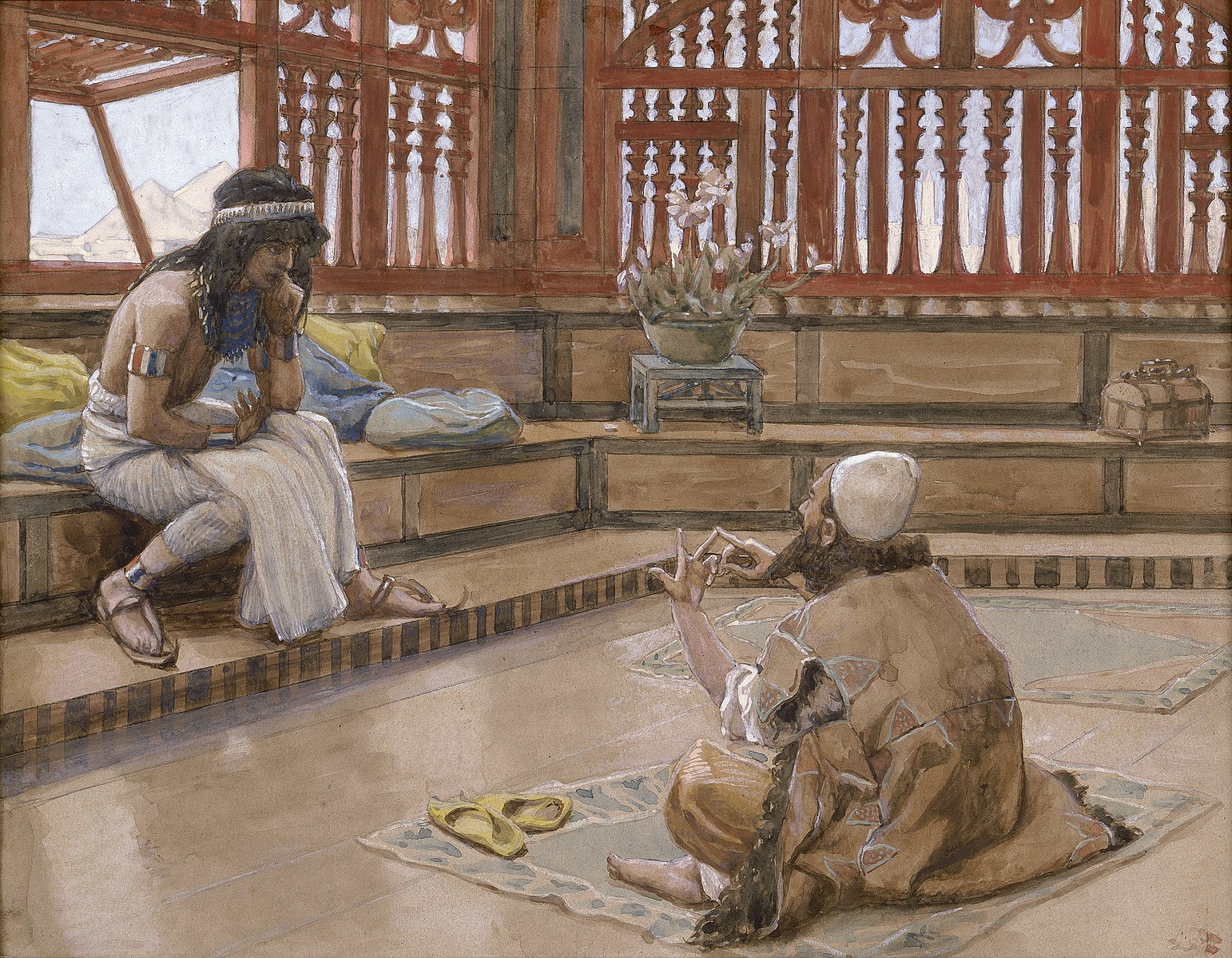
Featured image: Joseph Converses with Judah by Tissot. Public Domain.
If you know anyone who might be encouraged by today’s post, please share.
“If we let him go on like this, everyone will believe in him, and then the Romans will come and take away both our temple and our nation.” John 11:48 (NIV)
Yesterday afternoon I was sitting on the porch watching Milo playing with the garden hose. In his mind he was helping Papa water the landscape shrubs, but the truth was that he was playing with the nozzle on the hose that has a bunch of different types of spray. He would spray for a few seconds, then switch to the next setting, spray for a few seconds, then switch to the next setting, spray for a few seconds…you get the idea.
On the ground in front of me was Milo’s bubble gun. It’s a little battery operated toy into which you put soap solution into this small reservoir in the handle and it the shoots out a steady stream of bubbles. It’s pretty cool.
Holding the hose, Milo told me that he needed to put more water in the bubble gun as it was running low. It was obvious that he thought the hose nozzle in his hand was the perfect tool for the job. I agreed, but only if he let me help him. We selected the gentlest, most faucet-like spray setting, I unscrewed the reservoir and held it up as Milo pointed the nozzle toward the hole. Before I had a chance to help him gently open the flow of water, Milo cranked the sucker fully open. Water hit the edge of the reservoir and splattered everywhere, including all over Papa’s face.
Milo laughed hysterically at Papa.
Papa did not laugh. I very quietly and honestly said, “Papa’s not happy about that.”
What happened next was fascinating. Milo dropped the hose and ran about five feet away and turned away from me. He then sheepishly turned to look at me, brow furrowed. “I didn’t do it!” he cried emphatically.
Once again, in a soft and gentle voice I asked, “Well, if you didn’t do it, who did? You were the one holding the hose.”
He then slunk back to me with his head bowed. He picked up the hose.
“I didn’t mean to,” he said in almost a whisper.
I know little man. I know. It’s such a complex lesson for a three-year-old to grasp. Papa was unhappy about the consequences. As the adult in this situation, I fully knew the risk of filling a small, four ounce reservoir with a garden hose, and it was my choice to allow the calculated risk. Being frustrated with the outcome does not mean I am mad at you. I know you didn’t mean to, and I wasn’t mad at you. You misunderstood my reaction. There was no need to run in shame and deny pulling the trigger. To be honest, Papa’s observed many adults making the same basic misunderstanding as you just did without comprehending their reaction any more than you. You’re forgiven, little man, for misunderstanding.
Nevertheless, there was a spiritual lesson present in the moment.
Why do I do the things that I do? Why do I say the things that I say? Why do I make the choices I make?
Along my life journey, I’ve discovered that the answer to these questions is critically important both for my understanding of self and my understanding of others.
Today’s chapter is one of the most dramatic in the entire Great Story. The conflict between Jesus and the religious leaders has been escalating. Some had tried to stone him for blasphemy the last time He was in Jerusalem. The largest religious festival of the year, Passover, was just a week or two away. Jesus gets word that His friend, Lazarus, has died at his home in Bethany, just two miles from Jerusalem. Despite the disciples pleas to stay away from the area for Jesus’ own safety, Jesus returns to Bethany to find Lazarus dead four days, his body already entombed. Jesus raises Lazarus from the dead in front of a large crowd. Lazarus had been a prominent man, and Jews from Jerusalem had come to mourn with Lazarus’ sisters. They immediately report the astonishing miracle to the religious leaders in Jerusalem. This is a major event in driving the climactic events of Jesus betrayal, arrest, trials, and crucifixion.
There are so many great moments and spiritual lessons in today’s chapter that lie within the story of the miraculous raising of Lazarus. The verse that resonated most with me was that of the response of the religious leaders upon hearing the astonishing news of a man who was dead being brought back to life.
“What are we accomplishing?” they asked. “Here is this man performing many signs. If we let him go on like this, everyone will believe in him, and then the Romans will come and take away both our temple and our nation.”
In making this statement, they laid bare their motivation.
They are afraid.
Afraid of losing their worldly power. Afraid of their prestige being diminished. Afraid of losing face with the hated Romans occupiers. Afraid of life without the lucrative income of their religious racket. Afraid of change to their staunch traditions and what that mean.
They were supposed to be the spiritual leaders of the nation, but their fear of losing all that they were, all that they had, and their desire to cling to all of it, was far greater than the desire to acknowledge and accept what God was clearly doing and saying in and through Jesus.
What a contrast to Jesus’ followers who let go of everything to follow Him. Their desire to seek what God was doing overcame any fear of what they might be giving up or fear of the challenges they might face.
In the quiet this morning, I’m searching my own motivations. In the previous chapter’s post, I wrote: “Actions reveal identity.” They do, but the identity doesn’t lie in the actions themselves, but in the motivations that spawned them. The motivations that often remain hidden and/or ignored.
As I look back on my own journey, I can see how shame motivated so many of my actions and choices through so much of my life. Along my spiritual journey, I’d like to think that my desire to follow Jesus and discover who I was created to be and who I am yet called to be has overcome that long ignored shame that drove so many unhealthy thoughts, words, behaviors, and choices in my early years. And, if I’m honest, still creeps in more than I care to admit.
“Old things pass away,” Paul wrote to the followers of Jesus in Corinth in discussing the spiritual transformation that takes place when in relationship with Him. My own experience is that some “things” pass away like a swift execution while other “things” pass away in a long, painful, lingering, and palliative process.
If you know anyone who might be encouraged by today’s post, please share.
For the sake of your servant David, do not reject your anointed one. Psalm 132:10 (NIV)
Wendy and I are almost through the first season of Poldark, originally a 2015 Masterpiece Theater production. It’s been thoroughly enjoyable. The series is set in the late 18th century and tells the story of a headstrong and struggling English nobleman who returns from the American Revolution to find his father dead, his family estate in shambles, the love of his life engaged to his cousin, and the family business on the edge of bankruptcy.
The themes of the show include the clash between nobility and peasant, the long-held tradition of the entitlement of the first-born son, and the legacy of both family systems and family names.
Over the past year of Covid-19 with all its tension over masks, mandates, and lockdowns, one of the conversations I found fascinating was the individualistic spirit in Americans. From our break from mother England to today, we don’t like being told what to do. Along my life journey, I’ve come to believe that we don’t have a full realization of, nor appreciation for, just how deep the “rugged individualism” that fueled our country runs in our veins. In the entire history of human civilization, human rights and the freedom of self-determination are relatively new concepts. For thousands of years, an individual’s lot-in-life was pretty much fully established the moment they were born. It was completely dependent on your family, your gender, and your birth order.
Today’s chapter, Psalm 132, is a case-in-point. This ancient Hebrew song was used at the coronation of monarchs ascending to the throne of King David. Some scholars believe it was initially written to honor King David at the dedication ceremony of the Solomon’s Temple in Jerusalem. David’s family line was firmly established as the royal line of Judah, the prophets also pointed to the coming Messiah being from the same lineage, and the lyrics of today’s chapter would have been a clear reminder to the people not to forget it.
In the quiet this morning, I find myself meditating on the concept of determination. Growing up, I and my peers were told that we could be anything we wanted to be in life if we were willing to work hard, study hard, and pursue our dreams. Once again, I’m reminded that this very notion would have been ludicrous for the vast majority of human beings who ever lived. And yet, while I would argue that there are, in general, greater opportunities for self-determination than in any other time in human history, there are still those determining influences of life that I don’t control.
Among the teachings of Jesus that fueled the Jesus Movement of the first century was that everyone was welcome at the dining table where believers sat, listened, prayed, feasted, and “communed.” Men, women, slaves, slave owners, rich, poor, societies’ big shots, and social lepers. As Paul put it in his letter to the followers of Jesus in Galatia:
In Christ’s family there can be no division into Jew and non-Jew, slave and free, male and female. Among us you are all equal. That is, we are all in a common relationship with Jesus Christ. Also, since you are Christ’s family, then you are Abraham’s famous “descendant,” heirs according to the covenant promises.
In the quiet this morning, I find myself thinking about the things in this life that I can control, and the things that I can’t. When Jesus said to those seated around Him, “Here are my mother and my brothers! Whoever does God’s will is my brother and sister and mother” I believe that He was telling his followers that I don’t have to be enslaved to systems that formed me. When Paul said that for the believer “old things pass away” I believe that among the things that pass away are beliefs, patterns of thought, and behaviors that were instilled in me by the systems into which I was born and in which I was raised. I observe that the spiritual transformation I’ve experienced on my spiritual journey as a follower of Jesus has not only changed me, but it has led me to leverage the fruit of God’s Spirit to help transform the human systems I’m a part of for the better.
Hear the voice of my supplication, as I cry to you for help Psalm 28:2 (NRSVCE)
Back in the days before iPods, iPhones, and digital streaming, the only way one got music in a car was the radio. Since I spent a lot of time in rental cars for my job, I got used to spending the first part of any journey scanning “the dial” for the available stations and programming the stations I wanted to keep into the car’s radio.
One of the things I noticed as a young man scanning the airwaves was that it generally took me less than a second to identify the kind of music any station typically played as I quickly made my way across the dial:
There is a certain sound, pattern, cadence, and frequency to different types and styles of music.
As I read the psalm this morning, the thing that struck me was how similar it is to the previous few psalms. That’s because it is. David had patterns that he repeatedly used as he penned his songs. We do the same thing. Symphonies typically follow a pattern of four movements. Your basic popular song is typically structured verse, chorus, verse chorus, bridge, verse, chorus.
Those who compiled the anthology of song lyrics we call Psalms put the section we are reading through together with similarly structured songs. It is a simple, repeated pattern: They all start with a praise and plea for God to listen followed by a complaint and/or petition, and end with a proclamation of faith and assurance that God has or will hear and answer.
In the quiet this morning, this got me thinking about patterns. Almost everything in life falls into certain patterns. Almost everything in life has patterns. Good patterns can provide a sense of health, security, and surety to life. Bad patterns of thought and behavior result in destructive and unhealthy consequences in my life and relationships. That’s rather obvious. What’s not so obvious is that some patterns that were good and necessary for a time can actually become unhealthy for me without me really recognizing or realizing it.
Along my life journey, I’ve come to observe that spiritual progress always involves the breaking of old patterns and establishing new ones. A faith journey always requires that I leave behind something that is tangibly known and comfortable in order to pursue something that is not clearly evident and is only hoped for.
“You have heard it said,” Jesus would say to his followers before adding, “but I say…” In other words, there was an established pattern that Jesus was calling His followers to change. He called for old, established patterns to pass away so that new patterns could emerge. The word repentance is rooted in the word picture of changing direction. Whenever Jesus told someone “Follow me” it was always a call to leave things behind to pursue things to which He was leading.
What started out as good, even healthy, patterns can lead to stagnation. Stagnation leads to settling. Settling leads to spiritual atrophy. Spiritual atrophy leads to decay. Decay leads to death. That’s what Jesus was getting at when he told the religious people of His day:
“You’re hopeless… Frauds! You’re like manicured grave plots, grass clipped and the flowers bright, but six feet down it’s all rotting bones and worm-eaten flesh. People look at you and think you’re saints, but beneath the skin you’re total frauds.“
-Jesus, Matt 23:27-28 (MSG)
In the quiet this morning, I find myself meditating on my own patterns of thought, behavior, relationship, and spirit. The truth is that almost every pain-point I experience on life’s journey can be traced back to unhealthy patterns. Growth, progress, and maturity necessitate the breaking of unhealthy patterns and the establishment of healthier ones, even those patterns that were once good for me but have actually become unhealthy.
David’s song this morning felt familiar to the point of me being kind of bored with it after reading psalms with the same pattern every morning this week. C’est la vie. It happens. Having journeyed through the Psalms many times, I am mindful that when we get to Psalm 40 David writes that he is singing “a new song.” God called David “a man after my own heart.” Even he could get stuck in certain patterns that he had to break in order to move on where God wanted to lead him.
If you know anyone who might be encouraged by today’s post, please share.
Who shall ascend the hill of the Lord? And who shall stand in his holy place? Those who have clean hands and pure hearts, who do not lift up their souls to what is false… Psalm 24:3-4b (NRSVCE)
The further I get in my life journey, the more I’ve come to understand that the black-and-white behavioral rules of the most strictly religious groups are really about social control in which an institution or group exercise authority over another. The goal and benefit is a sense of order, collective security, and control. Within this type of system, the individual’s role is simple and strict obedience to the group’s behavioral rules (those written, and those insidiously unwritten but understood) under the threat of public shaming and being socially ostracized from the group. This type of system exists as religious fundamentalist sects and denominations, fraternal organizations, gangs, cults, secret societies, and the systemic equivalent can even exist in businesses, corporations, sports teams, and community organizations.
Systems like this have existed throughout history and continue to this day. It is this type of system with which Jesus conflicted in the Temple when he overturned the moneychangers’ tables and railed against the Temple’s religious cabal. It was this conflict that led them to treat Jesus as a threat who was to be ostracized and executed. It is the same system out of which Paul transitioned to becoming a follower of Jesus. Paul also was considered a threat they needed to ostracize and execute.
Please don’t read what I’m not writing. Don’t hear what I’m not saying. It doesn’t really matter which system we’re talking about. They all operate the same way and follow the same basic systemic rules.
The problem with this type of system is that it chains the individual to the group rather than freeing the individual from self. Behavior modification is not about spiritual health but of social order. The individual tries to control behaviors rather than be spiritually transformed. Paul recognized that all the behavioral rules of the system only created more rulebreakers sneaking around in the dark breaking the rules and trying not to get caught.
Scholars believe that today’s psalm was a song David wrote to be sung as the people entered God’s Temple in Jerusalem. If you read it and imagine the Hebrews carrying the Ark of the Covenant (cue: Raiders of the Ark Theme) into the Temple as they sing this song you get the gist. It starts by asking the question: “Who can ascend the hill of the Lord?” (That refers to Zion, on which the Temple was built) and then “Who can stand in his holy place?” (That would refer to the “Holy Place” within the Temple as designed and prescribed through Moses).
The lyric of the song then describes who may do these things. The description is that of a good person, but here’s where translation from the original language (Hebrew) to English can make a huge difference. In verse 4 the English phrase “do not lift up their souls” has an original Hebrew physiological imagery that references the throat. Some scholars argue that the word picture here is more like “nursing an appetite” and the Hebrew word translated “false” is rooted in the idea of “empty” or “vain.” So it’s really about those who don’t nurse their appetites for things that are empty.
In the quiet this morning, that’s what really struck me. What I’ve learned along my journey is that all the religious and systemic rule keeping does not address the real issues of Spirit that lead to transformation. Keeping the rules so as to appease my church leaders, parents, college, pastors, teachers, and peer group in the attempt to avoid being shamed and ostracized did not transform my soul.
What really led to transformation for me was when I realized that all my human appetites were good and created within in me by God. Paul realized it too when he said “Nothing is unlawful for me. It’s just that some things aren’t beneficial.” My appetite for food, for drink, for pleasure, for rest, for sex, for relationship, for security, for peace, for affirmation…all of them are good and part of what God created in me. It’s when I “nurse my appetite,” any one of them, and indulge my good and healthy appetites in empty and unhealthy ways that I hurt myself. And, I bring the unhealthy results to every relationship and system in which I am a part.
It’s not about me behaving for acceptance in a system. It’s about me being the person, the true and healthy self, God created me to be. It’s about what Jesus said when He told His followers to nurse their appetites for the things of God, and not for the things of this earth (including the safety and acceptance of a human system). How can I “love my neighbor as myself” if my unhealthy indulgence of natural appetites is leading to my continual self-injury and disrupting my relationships, my work, my family, and my life?
What appetite am I going to nurse today? That’s the question as I head into the weekend.
Have a great weekend.
If you know anyone who might be encouraged by today’s post, please share.