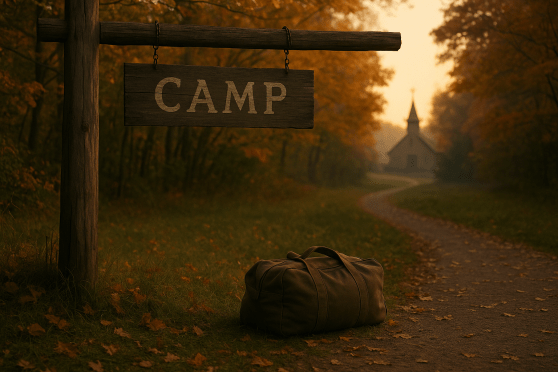
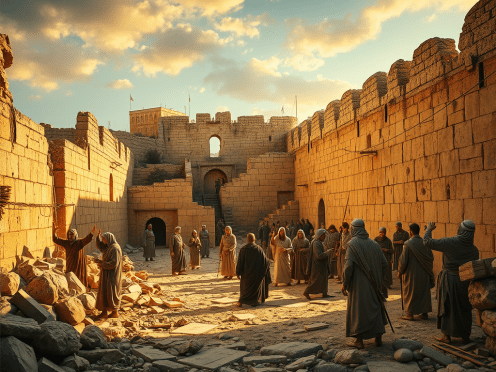
Last Day of Camp

Keep your lives free from the love of money and be content with what you have, because God has said,
“Never will I leave you;
    never will I forsake you.”
Hebrews 13:5 (NIV)

Summer camp is always a special place to be. Both as a camper, and later as a leader, and guest speaker, I have such fond memories of the laughter, adventure, friendships, and fun. For some, that fun never ends. There are entire summer camp communities where adults and families spend summers “at camp” where worship, studies, activities, and relationships become part of the rhythm of summer their entire lives.

Nevertheless, summer always ends. There is always that final day of camp. The camp fires become the embers of memory. The guitars are in their cases. The cabins have been emptied. The beds stripped. The close friendships forged in the intense togetherness (and maybe even a sparked romance) must come to an abrupt end. Cars arrive to take campers back to their disparate hometowns. Campers return to their daily routines. It is the death throes of summer, when in one moment the fun seems to end with gut punch. As you hug these people who have come to mean so much to you in such a short period of time, you know autumn’s descent is imminent. All of the real life activities and responsibilities that come with it await.

I have a very vivid memory of lying in the backseat of our family’s Mercury Marquis station wagon (yes, complete with wood paneling on the side) driving home from camp. Tears streamed down my cheeks. They dripped down on the car’s brown carpet littered with gum wrappers and spilled McDonald’s french fries. I didn’t want to go back. I wanted to live at camp forever.

Today’s final chapter of Hebrews reads like the last day of camp. No lofty theology now—no soaring angels, no mysterious Melchizedek, no blazing heavenly tabernacle. Here at the end, the gospel comes home, rolls its sleeves up, and gets practical. Earthy. Intimate.

The car is running. Your duffel bag of dirty clothes and life-long memories is already in “the way back” of the station wagon. Mom and Dad are waiting as you say your good-byes. The camp counselor who has become like a big brother or sister leans down to face you intimately. Lovingly taking your face gently in both hands, looking directly into your eyes, your counselor whispers, “Everything we’ve journeyed through together? Everything we learned? Everything we talked about in our cabin’s middle-of-the-night heart-to-hearts? Now live it.”

Today’s chapter is a heart-felt list of loving marching orders from a camp counselor to a tearful camper who doesn’t want to return to “real life.”

Love as everyday liturgy

“Keep on loving one another as brothers and sisters.”

The Greek implies continually, habitually—love not as an emotion but as a practice. Prisoners become kin. Marriage is honored, not as a cage, but as a covenant shelter. The chapter opens like it believes the mundane moments are sacred ground.

Life free from fear

“Be content… for God has said, ‘Never will I leave you; never will I forsake you.’”

It’s God whispering,
“Even if the world shakes, I’m not going anywhere.”

Remember your leaders

The writer encourages the church to imitate the faith of leaders whose lives embody Jesus.

Not heroes on pedestals—humble guides whose walk matches their talk. Like the camp counselor who was just a college kid making less money than he could have behind a fast-food counter.

Jesus: yesterday, today, and forever

It’s the spine-tingling line. The center of gravity for the whole letter.

Everything changes—priesthoods, covenants, temple curtains, seasons in the heart. And summer, too. There’s always a last day of camp.

But Jesus?
Steady as the sun.
Always the same warm presence, the same mercy, the same fierce love.

The strange altar of grace

The author points to Christ as our once-for-all offering outside the camp.
Outside the religious system. Outside the institutions and walls of the church. Outside the boundaries of status and purity.

There’s an invitation and encouragement for unkempt daily life:
“Meet Him where it’s messy. Worship Him with your life, not rituals.”

The Benediction

“May the God of peace… equip you with everything good for doing His will.”

There is no demand from a tyrannical God. It’s not a shaming you into obedience. Equip you. Like handing you warm gloves for the road home and the inevitability of autumn’s cold winds and the impending winter you know follows right behind it.

Finally: “May He work in us what is pleasing to Him.”

Not me working for God.
God working inside me.

It’s divine intimacy—God and me, heart-to-heart, breath-to-breath.

In the quiet, as I meditate on these things, Holy Spirit takes my face lovingly into both hands and looks me in the eye. Returning to the words:

“Never will I leave you;
    never will I forsake you.”

The original Greek in which this was written has no English equivalent for the structure. It’s a triple negative. It’s like repeating the word “never” three times. One source I found paraphrased it like Jesus saying this:

“I will never ever ever let you go—nope, not happening, not now, not ever.”

And so, with that encouragement from Holy Spirit, my camp counselor, I slip into the back seat of life’s Mercury Marquis station wagon and head into the real life of this new day. Some days, I just don’t want to do it.

But I have my marching orders, and I’m never alone.

If you know anyone who might be encouraged by today’s post, please share.

Run

Therefore, since we are surrounded by such a great cloud of witnesses, let us throw off everything that hinders and the sin that so easily entangles. And let us run with perseverance the race marked out for us.
Hebrews 12:1 (NIV)

I was never much of a runner. I tried cross-country in high school but only made it half a season. Later, friends talked me into giving running another chance. I did… but the passion never ignited. I like variety when it comes to exercise—different movements, different forms of exertion that trip my trigger.

Still, those handful of forays into running, and the many friends who’ve kept at it with lifelong devotion, taught me a few things.

I was in high school when my hardcore cross-country friends trained for their first marathon. I don’t recall any of them making it to the finish line. What I do remember is how they compared notes afterward—each one describing the exact point on the course where they ‘hit the wall.’

It was the first time I’d heard the phrase. It’s that moment when physical exhaustion breaks the mind. The brain can’t will the body to push through the pain. The finish line—the very thing that motivated their months of training—suddenly seems meaningless. The wall isn’t only physical. It’s mental. Even spiritual.

The author of Hebrews is writing to an audience of believers in the middle of a grueling real-life marathon. Thus far they have been socially ostracized by friends, family, and community. They have been publicly insulted and persecuted. Their homes and possessions have been confiscated. They have watched fellow believers imprisoned, beaten, stoned, and executed. Then came exile. They fled everything familiar to find refuge.

They are at risk of hitting the wall. The author knows it. It is the primary purpose of his entire letter, and it crescendos in today’s chapter. As I meditated on the text in the quiet this morning, I found four key movements in this climactic passage.

Remember

Yesterday’s post/podcast was all about those individuals in the Great Story who already ran their earthly race—men and women who stumbled, suffered, persevered. Today the author tells us to remember them. To let their lives whisper courage into our weariness. They ran with faith and perseverance. Today’s chapter begins with the author telling us to remember this cloud of witnesses. The Greek word is martyrōn from which we get the word martyr.

They suffered as you are.
They kept the faith.
They finished their earthly race.
They are right here. Living examples. Cheering you on.

Race

The author then lays down the metaphor for this entire capstone chapter. The race set before us. This life is not a sprint. It’s a marathon, just like the ones our cloud of witnesses endured. They weren’t perfect—they were beautifully, stubbornly human. They had their weaknesses and flaws. What they did have, was faith.

Fix your eyes on Jesus. It isn’t merely gazing at Jesus—it’s deliberately refusing every distraction, like a transfixed lover choosing to gaze on one face in a crowded room.

Consider all Jesus endured for us. The garden, the sweating of blood, the tears, the trials, the scourging, the mocking, the crown of thorns, the bloodied walk to Calvary, the nails, the cross.

Don’t think for a second that you can’t do this.

Run.

Rigor

The author then moves into discussing the rigor required of anyone in this race. Suffering produced endurance and perseverance. There is progress in the pain. The discipline a parent instills in a child is not easy in the moment, but it’s good and necessary. In the same way, the discipline called upon to gut-it-out in life’s most difficult seasons is never easy. But it is also good and necessary.

It pushes me to shake off the weight of bitterness and hatred.
It forces me to dig deeper to tap into the spiritual resources I need.
It tests my faith and develops my endurance.
It develops levels of maturity within that I can’t get any other way.
It teaches me how to lean into hope.
It leads to depths of joy found only on the other side of suffering.

Reception

The author then describes the finish line with an interesting contrast. He begins by looking back at Mount Sinai in the book of Exodus when Moses climbed the mountain and God met him there to deliver the Law. Fire, thunder, smoke, fear, and trembling.

That was the beginning of the Law that the author has stated has been completed and is obsolete. Old things pass away. New things come.

He then points us to a new mountain. It’s an eternal and heavenly Mount Zion and the New Jerusalem John describes in Revelation 21. This mountain is an unimaginable finish-line reception. Angels and celebration—movement, music, and unspeakable joy.

There will be shaking and there will be fire, because “Our God is a consuming fire,” but it’s not like the former. Not a fire meant to burn me up, but to burn away everything that keeps me from being who I truly am.

Tom—pure gold, refined through the flame.
Tom—unshakable, when the shaking ends.
Tom—welcomed on Zion’s festival-drenched mountain.

And so, once again I set out into another day of the race. This race doesn’t belong to the swift, but to those who keep running.

Press on, my friend.
Press on.

If you know anyone who might be encouraged by today’s post, please share.

Promotional graphic for Tom Vander Well's Wayfarer blog and podcast, featuring icons of various podcast platforms with a photo of Tom Vander Well.
These chapter-a-day blog posts are also available via podcast on all major podcast platforms including Apple, Google, and Spotify! Simply go to your podcast platform and search for “Wayfarer Tom Vander Well.” If it’s not on your platform, please let me know!

Seduced by the Unseen

Now faith is confidence in what we hope for and assurance about what we do not see.
Hebrews 11:1 (NIV)

Unseen.

That’s the word that leapt off the page again and again this morning as I meditated on the well-known chapter. It’s known as faith’s Hall of Fame.

The author starts by saying that faith is assurance of what we do not see. The word faith in Greek (pistis) was a term from relationship and politics: loyalty, trustworthiness, fidelity. In Roman culture, it was the glue of friendships and alliances. When the author of Hebrews repeatedly pens the words “by faith,” he’s whispering: “They aligned their lives with God. They trusted His character enough to follow, to act.”

And with each example, the author points out that they are following and acting upon the “unseen.”

Creation that came into being from unseen nothingness.
Enoch, who walked so intimately with God he was no longer seen.
Noah, who built a boat in the desert in preparation for unseen storms.
Abraham, who followed God to a land promised but not yet seen.

The author is speaking at once on a grand eternal scale and a dusty, earthly one. He points out that this entire temporal life journey is leading to a City, a home, an eternal reality that we do not see. In this we are sharing the same journey with all of these well-known characters in the Great Story who have gone before us.

At the same time, it’s that assurance of the unseen that shapes the way I enter and traverse my 21,759th day walking through this world. Everyone mentioned in today’s chapter had their own mundane days to trek through. These people aren’t flawless, they’re faith-full. A drunk, a murderer, a vain self-centered jock, a liar, an adulterer. They are remembered for their trust, not their perfection. What God was looking for was faith amidst the rough edges of their very human flaws, not a polished religious finish meant to hide them. They each pressed on daily toward promises unseen.

I love that Rahab is chosen for mention. A woman, a Canaanite, and a sex worker. The author could have chosen Miriam, Deborah, or Hannah. He chooses Rahab and breaks every box of religiosity. Faith loves people with a past.

As I sat in the quiet and meditated on this, it struck me that all these ancient lovers of God are not far away. They’re not marble statues in a faith hall of fame. They’re close. A cloud of witnesses pressed up around me like warm bodies in a crowded room, whispering, “Keep going, Tom.
Don’t stop. We’ve walked this way too.”

So, in the quiet this morning, I realize that I am seduced by the unseen. God wired me for wonder. My spirit is tuned to that point-of-tension between what is and what’s still just beyond the veil. When today’s chapter speaks of the unseen — of walking toward a country you’ve never seen, of trusting a God that cannot be measured — it presses all my deepest buttons:

My longing for meaning.
My hunger to taste the divine in every bland task.
My desire to be drawn into something bigger, riskier, holier.

And so, on this Monday of a short work week leading to an annual day of gratitude, I’m lacing up my walking boots. I’m pressing on in the journey towards an earthly future and an eternal City that are both unseen. But I feel it in my spirit. It burns in my bones. It continues to seduce me to press on while an unseen cloud of witnesses whisper their encouragement.

Have a great week friends.

If you know anyone who might be encouraged by today’s post, please share.

Promotional graphic for Tom Vander Well's Wayfarer blog and podcast, featuring icons of various podcast platforms with a photo of Tom Vander Well.
These chapter-a-day blog posts are also available via podcast on all major podcast platforms including Apple, Google, and Spotify! Simply go to your podcast platform and search for “Wayfarer Tom Vander Well.” If it’s not on your platform, please let me know!
An icon representing an open book with a stylized design, symbolizing access to scripture or religious texts.

Earthly Woes, Eternal Realities

The law is only a shadow of the good things that are coming—not the realities themselves. For this reason it can never, by the same sacrifices repeated endlessly year after year, make perfect those who draw near to worship.
Hebrews 10:1 (NIV)

Yesterday morning Wendy and I were in our closet putting away folded laundry that was stacked on our dresser.

“Doesn’t it feel like we just did this a few days ago?” Wendy asked.

“That’s because we did just do it a few days ago,” I laughed.

Laundry never ends. It is the liturgy of the ordinary. Things get dirty. They have to be made clean. Over and over and over again.

This is exactly the point the author of Hebrews is making in today’s chapter. The spiritual problem is the stain that sin had made on the human soul and the human condition since Eden. Through Moses, God prescribed a spiritual laundry system. The offerings and sacrifices that the Hebrews offered at the temple were prescribed to spiritually cleanse those making the sacrifices. But, like the laundry, it had to be done over and over and over again.

Until Jesus.

The author has already stated quite clearly in previous chapters, that the sacrifice Jesus made on the cross was a “once for all” sacrifice. God Himself doing for us what we, and the old sacrificial system, could never accomplish. He washed the stain away for good – clean forever.

Yet, there lies within this spiritual reality a mystery. There is an eternal spiritual reality that lies beyond our temporary earthly reality. The author touches on it in today’s chapter. He says that the resurrected Jesus has entered heaven’s eternal temple “and since that time he waits for his enemies to be made his footstool” (vs. 13).

Jesus said on the eve of His execution that the Prince of this World “stands condemned” (John 16:11). But, for the moment, the Prince of this World continues to carry out evil in this world. The readers of Hebrews knew this all too well. Even in today’s chapter the author recounts their suffering, their homes and possessions confiscated, publicly insulted, imprisoned, and exiled.

Why the delay? God’s desire for everyone to experience the eternally cleaned and forgiven Life that Jesus made possible. The author reminds his readers that the Day is coming when all will be made right, even though in the midst of their suffering it seems slow in coming. Peter explained to the same audience: “The Lord is not slow in keeping his promise, as some understand slowness. Instead he is patient with you, not wanting anyone to perish, but everyone to come to repentance.” (2 Peter 3:9 NIV)

There is a spiritual reality and an earthly reality. Spiritually I am graciously and mercifully forgiven forever, eternally cleansed from sin’s stain. Physically, I am a wayfaring stranger continuing to make my way through this world of woe. Thankfully, I have not physically or mentally suffered as the author’s original readers had. Nevertheless, I’m still subject to all of the woes of this sin-stained world that remains, for the moment, the domain of the Prince of this World.

Holding this eternal reality aloft for his readers, the author then encourages them in their present earthly reality:

Have confidence (vs. 19)
Draw near to God (vs. 22)
Hold unswervingly to hope (vs. 23)
Spur one another to love (vs. 24)
Buddy up and encourage one another (vs. 25)
Persevere (vs. 36)

The chapter ends with a reminder of the activating ingredient required to cling to eternal realities amidst our earthly woes: Faith.

In the quiet this morning, as my mind struggles with my own version of earthly woes, I imagine myself taping Ted Lasso’s “Believe” sign on the wall of my heart. Daily defeats don’t negate eternal victory.

As Jesus said, “Don’t be afraid. Just believe.”

If you know anyone who might be encouraged by today’s post, please share.

Promotional graphic for Tom Vander Well's Wayfarer blog and podcast, featuring icons of various podcast platforms with a photo of Tom Vander Well.
These chapter-a-day blog posts are also available via podcast on all major podcast platforms including Apple, Google, and Spotify! Simply go to your podcast platform and search for “Wayfarer Tom Vander Well.” If it’s not on your platform, please let me know!
Logo for Bible Gateway with an open book icon. The background is orange.

Trust Amidst Troubles

This is an illustration for the present time, indicating that the gifts and sacrifices being offered were not able to clear the conscience of the worshiper. They are only a matter of food and drink and various ceremonial washings—external regulations applying until the time of the new order.
Hebrews 9:9-10 (NIV)

Troubled times.

Political corruption. Nationalism zealously on the rise. Assassinations increasingly common.

Political resentments. Religious fervor. Arrogance of the ruling class.

I’m not talking about today. This was Jerusalem and Judea as the author of Hebrews is writing to his audience. It is a time of increasing tension, political upheaval, and rising violence. Rome has forcefully appointed their own handpicked priests to serve in Jerusalem’s temple. They are, of course, corrupt and the Jews are livid. Angry young nationalists begin committing acts of terror, sparking Roman crackdowns. Then, a Roman procurator embezzles money from the temple’s bank accounts. When the news breaks protests erupt throughout the city. Jerusalem is a powder keg, and the fuse has just been lit.

For the Christians to whom the author is writing, the political situation is simply insult to injury. The persecution of Christians had already begun. Nero had already blamed the Christians for the burning of Rome. Paul, if he hasn’t already been executed, is languishing deep in the dungeons of Mamertine prison Rome. In Jerusalem, a prophetic oracle had spoken telling all the Christians to flee to a City of Refuge east of the Jordan River, a city named Pella. They listened. They fled, and it would ultimately mean the survival of the Jesus Movement.

Fear, anxiety, and uncertainty are the daily realities of any follower of Jesus. Rejected by Jews and despised by Rome, being a follower of Jesus was an invitation to suffering. For Jewish believers, there was the ever present temptation to simply renounce Jesus and return to the tradition they had known their entire lives. At least within Judaism there were still legal rights and social protections amidst the troubles. It was a matter of physical human survival.

Was being a follower of Jesus really worth it?

These are the people the author of Hebrews is addressing. It is possible that the Jewish believers now in Pella are his core audience. How easy it would be to simply walk away from the persecution, the threat suffering, and the constant fear. Just say, “I made a mistake. I don’t think I believe this Jesus stuff after all.”

If I place my feet into the sandals of a Jewish believer in Pella, the message of today’s chapter takes on an entirely new layer of meaning. The author is telling me that that the old order I’ve known my entire life, the religious tradition in which I was raised, is passing away. Jesus came to spiritually fulfill what the old order never could. Jesus’ ultimate sacrifice, once for all, completed the work of spiritual redemption for everyone for all eternity. The old system is now obsolete.

“Don’t go back,” the author is gently pleading with his readers. “It may seem like a pragmatic choice in the moment, but there’s nothing for you back there. Old things have passed away. Trust the Story that Jesus gave us. Out of this chaos, new things are coming – eternal things which will make our momentary earthly afflictions pale in comparison.

Then the author weaves in Christ as the eternal God in a trinity of “appearances.”

God who was

“But now once at the end of the ages He has appeared to put away sin by the sacrifice of Himself.” Hebrews 9:26

God who is

“Christ has entered… into heaven itself, now to appear in the presence of God for us.” Hebrews 9:24

God who is yet to come

“He will appear a second time, not to bear sin, but to bring salvation to those who eagerly wait for Him.” Hebrews 9:28

In the quiet this morning, I can’t help but find encouragement here in my own home office in a little city of refuge named Pella. In an hour or so I will sit with Wendy and we will peruse the headlines.

Political corruption. Nationalism zealously on the rise. Assassinations increasingly common. Political resentments. Religious fervor. Arrogance of the ruling class.

Within a few years of today’s chapter being penned, the author of Hebrews‘ readers would know for certain that he had been correct. Roman Legions would march on Jerusalem. The temple would be reduced to rubble, just as Jesus had prophesied. Jews would be scattered through the known world. All of the Jewish genealogical records required to determine who was a descendant of Aaron and therefore could be priest were utterly destroyed. The old sacrificial system was finished for good.

What remains?

A High Priest in heaven appearing right now in God’s presence to make intercession for me and you. One who will appear to bring salvation and redeem all things.

Like the believers in ancient Pella who first read the words of today’s chapter for the very first time, I just have to trust the Story.

If you know anyone who might be encouraged by today’s post, please share.

Promotional graphic for Tom Vander Well's Wayfarer blog and podcast, featuring icons of various podcast platforms with a photo of Tom Vander Well.
These chapter-a-day blog posts are also available via podcast on all major podcast platforms including Apple, Google, and Spotify! Simply go to your podcast platform and search for “Wayfarer Tom Vander Well.” If it’s not on your platform, please let me know!
Icon depicting an open book, symbolizing access to scripture and biblical teachings.

New Things Come

Now the main point of what we are saying is this: We do have such a high priest, who sat down at the right hand of the throne of the Majesty in heaven, and who serves in the sanctuary, the true tabernacle set up by the Lord, not by a mere human being.
Hebrews 8:1-2 (NIV)

He walked up to me after I’d given a message about Sabbath rest. He wasn’t mean or angry, but he was definitely not happy with me. I live amidst a culture that has traditionally been religiously rabid about Sabbath keeping. I have heard so many stories from adults who spent their Sundays growing up sitting in chairs in the living room. The entire family listening to the clock tick. Other stories recount hair-splitting legalism worthy of Jesus’ day. Tossing a football was okay, but organizing a game was work and that broke the Sabbath.

In my message, I taught that this kind of legalistic rule-keeping Sabbath worship was never the point, it was not what Jesus taught, nor does it resonate God’s intentions for us. Sabbath is about needing rest for our spiritual, mental, physical, relational, and communal health.

The man informed me that he held his family to strict Sabbath keeping and wanted me to know that I’d just thrown him under the bus in the minds of his children. I hope that the family conversation that afternoon was productive and healthy for all of them.

In today’s chapter, the author of Hebrews continues his discussion of Jesus as the cosmic, eternal High Priest of heaven. In fact, the author states that this is his main point. For the first-century Jewish believers to whom he is writing, this resonates deeply. It echoes their entire life experience. They intimately know the temple in Jerusalem, the priestly system of worship, offering, and sacrifice.

As a believer growing up in Protestant midwest Iowa, not so much.

And yet, this is part of a thread of the Great Story that is crucial to understanding all of it. If I miss this, it’s like watching the original Star Wars movie and thinking Luke and Darth Vader are unrelated antagonists. It’s like reading Harry Potter and the Sorcerer’s Stone and thinking Snape is a cookie cutter villain.

The metaphor of temple is woven into the tapestry of the Great Story itself:

  • In Eden, the whole world was God’s temple.
  • In Exodus, God compresses His presence into a tent tabernacle.
  • In Solomon’s day, that becomes a stone temple.
  • In the prophets, God promises a greater dwelling.
  • In Jesus, the temple becomes flesh.
  • At Pentecost, the temple becomes the people. You and me.
  • In Revelation, the temple becomes the entire renewed creation—
    a holy city that is a Holy of Holies, illuminated from within by the Lamb who is the sanctuary.

Everything is moving toward union, presence, intimacy…
and the erasure of every barrier between God and humanity.

Notice, however, the changes that come with the progression. My legalist Sabbath keeper brothers and sisters want to live in an Exodus paradigm, when Jesus changed all of that. The author of Hebrews says it plaining in the chapter. First in quoting the prophet Jeremiah:

“The days are coming, declares the Lord,
    when I will make a new covenant…


It will not be like the covenant
    I made with their ancestors
when I took them by the hand
    to lead them out of Egypt…


I will put my laws in their minds
    and write them on their hearts.”

No longer a legal written code to be kept like a rule book. The new covenant Jesus made put God’s Spirit into our very bodies, minds, and hearts. It’s not about behavior modification from adherence to an outside set rules, but life transformation from God’s holy presence within me.

The author ends the chapter writing:

By calling this covenant “new,” he has made the first one obsolete; and what is obsolete and outdated will soon disappear.

Old things pass away. New things come. The story of Scripture is not God demanding a temple and religious rule keeping.

It is God refusing to live without me.

It is God shrinking Himself from cosmos → tent → body → Spirit
so that He might enlarge me from dust → disciple → temple → bride → city of God.

Jesus said He was the temple. It was God saying:

“Where I dwell is not a building.
It is with you. It is in you.
And one day, my beloved,
it will be the whole world again.”

If you know anyone who might be encouraged by today’s post, please share.

Promotional graphic for Tom Vander Well's Wayfarer blog and podcast, featuring icons of various podcast platforms with a photo of Tom Vander Well.
These chapter-a-day blog posts are also available via podcast on all major podcast platforms including Apple, Google, and Spotify! Simply go to your podcast platform and search for “Wayfarer Tom Vander Well.” If it’s not on your platform, please let me know!
A logo featuring an open book icon with an orange background, representing a spiritual or religious theme.

My Forever High Priest

Therefore [Jesus] is able to save completely those who come to God through him, because he always lives to intercede for them.
Hebrews 7:25 (NIV)

I ran into an acquaintance the other day who I hadn’t seen in months. Immediately upon seeing them I felt shame pouring out of my soul and filling every nook and cranny of my mind and body.

The last time I’d run into this person, I greeted them and called them by the wrong name. They said nothing and didn’t react negatively in any way, but by the time I realized my mistake it was too late. It was out there and there was nothing I could do about it. The flood of shame poured through me like a tidal wave whispering its toxic messages…

“Tom, you’re such an idiot.”
“You’ve just embarrassed yourself.”
“They’re going to forever remember this mistake.”
“You’re terrible with names, you dolt. Seriously, major flaw.”

As soon as I saw this person the other day, my shame brought me right back to that moment from months ago and flooded me with the same reminders of my hopelessly flawed worthlessness.

Welcome to the inner world of a shame-based person.

Today’s chapter is thick with theology and history. At the heart of it the author of Hebrews is addressing a Jewish religious issue. The Messiah was supposed to be both King and Priest. But the royal line came from King David who was from the tribe of Judah. The priestly line in the Law of Moses came from Aaron who was from the tribe of Levi. So, how can the Messiah be both?

The author explains that the priesthood of Aaron was a human priesthood tied to the Law of Moses. The Law of Moses was a set of rules and regulations. Rules and regulations don’t perfect a person. Laws may dictate social behavior, but it doesn’t spiritually transform a person within. The Law may dictate that I not steal, and you certainly won’t catch me shoplifting. That same Law does nothing to address the greed that motivates me to cheat on my tax return or be miserly in tipping those who serve me at the restaurant.

And, as a shame-based person, I can tell you that shame will doggedly remind me what a worthless wretch I am. I shared with you how bad it was when I simply forgot an acquaintance’s name. Imagine what shame does with my life-long list of tragic mistakes from stealing the Christmas cash off the Christmas tree when I was a child to cheating on my first wife to the failure of my first marriage. And those are just the high points. Trust me, there’s a lot more.

The author of Hebrews explains that Jesus is the High-Priest from an older, mysterious, eternal priesthood that predates Moses and Aaron. The royal priesthood of Melchizedek (which means “King of Righteousness”) who was King of Salem (from “shalom” meaning “Peace.”).

The priesthood of Aaron made repeated temporal sacrifices.
Jesus made the ultimate eternal sacrifice once for all.

The priesthood of Aaron was tied to human genealogy.
Jesus was part of a priesthood tied to eternity.

The priesthood of Aaron was “weak and useless” at dealing with sin.
Jesus’ sacrifice graciously paid for sin.

The priests of Aaron all died, their priesthood ended.
Jesus lives eternally to intercede perpetually on my behalf.

For someone constantly plagued by the shame of never being enough, the truth of this means everything.

I have a forever-advocate.

Not a priest I wore out with my mistakes.
Not a spiritual leader who retires, moves away, burns out, and dies.
Not a friend who tries to carry my burdens and eventually buckles.

But Christ —
holy and tender,
pure and powerful,
alive and attentive —
always interceding for me.

Every breath:
“Father, this one is mine.”

Every stumble:
“I’ve already covered that.”

Every anxious heartbeat:
“I am here. Still. Always.”

In a world of revolving doors, shifting loyalties, and fragile leaders, Hebrews 7 invites me to rest the weight of my shame on the only One who never steps away from His post.

I am held.
I am represented.
I am beloved, eternally.

And this morning, I walk into my day knowing Christ is already interceding on my behalf.

A better covenant.
A better hope.
A forever priest who doesn’t quit.

If you know anyone who might be encouraged by today’s post, please share.

Promotional graphic for Tom Vander Well's Wayfarer blog and podcast, featuring icons of various podcast platforms with a photo of Tom Vander Well.
These chapter-a-day blog posts are also available via podcast on all major podcast platforms including Apple, Google, and Spotify! Simply go to your podcast platform and search for “Wayfarer Tom Vander Well.” If it’s not on your platform, please let me know!
A logo featuring an open book icon, symbolizing scripture or religious content.

Attention and Maintenance

Land that drinks in the rain often falling on it and that produces a crop useful to those for whom it is farmed receives the blessing of God. But land that produces thorns and thistles is worthless and is in danger of being cursed. In the end it will be burned.
Hebrews 6:7-8 (NIV)

When Wendy and I built our house ten years ago, it became a long-term lesson for me in lawn care. In the division of labor here at Vander Well Manor, you’ll find my name at the top of the org chart when it comes to the outdoor lawn and landscaping. Looking back, there were so many things we would have done differently from the very beginning.

It took several years for us to get our lawn to a point where it looked decent, and it required regular treatments and on-going maintenance. Finally, it was beginning to look great and I was feeling better about it than ever. So, I decided to save a few pennies and take a year off of the treatments to see if it was healthy enough to simply perpetuate.

Weeds. Bare spots. Brown patches. It was awful. Ugh!

Today’s chapter contains a passage that has stirred controversy within the church for centuries:

It is impossible for those who have once been enlightened, who have tasted the heavenly gift, who have shared in the Holy Spirit, who have tasted the goodness of the word of God and the powers of the coming age and who have fallen away, to be brought back to repentance.
Hebrews 6:4-6a (NIV)

The question, of course, is whether salvation can be lost? Can a person be saved and then lose that salvation? My friends of pentecostal persuasion tend to say “yes.” My reformed, Calvinist friends say “absolutely not.”

In the quiet this morning, my heart finds no joy in wading into that debate. Instead, my meditations pulled back to look at the context of what the author of Hebrews is communicating to the weary, persecuted first century believers. He follows this passage about fallen away believers with his metaphor of land drinking in the rain.

There are two contextual references the author is tapping into. For his Jewish audience, his metaphor resonates with the Law of Moses in Deuteronomy 11 in which God promises that the land will be blessed in obedience but cursed if the people lose faith and are disobedient. He is also referencing Jesus in the Sermon on the Mount when He states that the rain is going to fall on the land, both good and bad. The question is what the land is going to produce.

The rain will fall. The sun will shine. When I was dutiful in tending my lawn, feeding it and mindfully tending it, the land produced a thick carpet of healthy grass. When I took a year off it began to produce weeds, bare spots, and brown spots in unhealthy ways.

That’s the simple spiritual lesson the author of Hebrews is trying to communicate to his readers. He is not harshly warning them of a bean counter God who holds salvation in the balance ready to yank it away based on who knows what infraction. The author is simply adding to the message he began in the previous chapter about his readers not spiritually growing into maturity. The seeds were planted, the lawn sprouted, and it even looked healthy for a while. Life will continue to happen. The rain will fall. The sun will shine. Without regular maintenance the land will not be healthy and fruitful, but rather filled with weeds, thorns, and thistles.

So, I am reminded in the quiet this morning that my spiritual life, just like my lawn, needs regular attention and maintenance if it’s going to be healthy, mature, and fruitful. The rain of grace keeps falling; what I tend determines what grows.

If you know anyone who might be encouraged by today’s post, please share.

Promotional graphic for Tom Vander Well's Wayfarer blog and podcast, featuring icons of various podcast platforms with a photo of Tom Vander Well.
These chapter-a-day blog posts are also available via podcast on all major podcast platforms including Apple, Google, and Spotify! Simply go to your podcast platform and search for “Wayfarer Tom Vander Well.” If it’s not on your platform, please let me know!
Logo of the Bible Gateway website, featuring an open book symbol and the site name.

Revelation

Son though he was, he learned obedience from what he suffered and, once made perfect, he became the source of eternal salvation for all who obey him and was designated by God to be high priest in the order of Melchizedek.
Hebrews 5:8-10 (NIV)

I have of late been making my way through all seven books of the Harry Potter epic. I just finished the fifth book, Harry Potter and the Order of the Phoenix, which I sometimes find to be the least enjoyable but have always found to be the most profound in its understanding and expression of the differences between good and evil.

The book concludes with a climactic battle. The evil antagonist, Voldemort, is doing everything in his power to escape death and achieve immortality. He even proclaims amidst the battle that “there is nothing worse than death.” To which the ever-wise sage, Dumbldore, replies, “Yes, there is.” Throughout the book, Harry suffers many things on many different levels from the agonies of a failed teen romance, to heinous oppression and physical suffering at the hands of institutional evil, to the death of the one person he cares for most in the world.

As Dumbledore debriefs with Harry at the conclusion of the book, he shares with Harry about a deep and ancient magic that the evil Voldemort fails to understand, the magic that Harry’s mother accessed the moment she sacrificed her own life for Harry’s when he was an infant. The wise headmaster then explains to Harry another paradoxical truth that evil fails to understand. It is Harry’s suffering that is his greatest strength.

Today’s very short chapter is so packed full of deep and important truths from the Great Story that I’ve sat in the quiet for a long time trying to discern how best to express them. The author speaks to his audience of Jewish believers in Jesus, themselves suffering at the hands of institutional evil, about Jesus who is the “Great High Priest.”

For the Jewish believers, the paradigm of a high priest was well-known to them. It was part of the religious ritual they’d known their whole lives. The high-priest was the only one who entered the most holy place in the temple once a year to make atonement for the sins of the people. The priests were always a descendant of Moses’ brother, Aaron.

But, the author reveals that there is mysterious, ancient priestly order that came before God gave the Law through Moses and the human priesthood was established. This mysterious ancient order is tied to an equally mysterious king-priest who appears momentarily in Genesis 14. His name was Melchizedek. Jesus, the Son of God, was not an earthly priest in the order of Aaron, but an eternal and royal high priest in the order of Melchizedek.

He then goes onto explain that what marked Jesus as the Great High Priest, was not power and glory. Power and glory are what evil and the Kingdoms of this world care about most. What marked Jesus as the Great High Priest of God’s Kingdom was his humility, obedience, and suffering.

The author then issues a gentle rebuke to his readers. There is so much more depth and spiritual truth to unpack in this, but his readers aren’t ready for it because they “no longer try to understand.” The Greek word hints at being sluggish and lazy. Along my journey, I’ve come to realize that there are certain spiritual truths that require effort, pursuit, experience, and even suffering in order for them to be revealed. Jesus said, after all, that the things of God’s Kingdom are not for the sluggish and lazy, but for those who ask, seek, and knock — even suffer.

It is at the end of Harry Potter and the Order of the Phoenix that the truth is finally revealed to Harry regarding his past, his scar, his place in the story that is unfolding, and the realities that await him in the battle against evil yet to come.

Sometimes the deepest and most important spiritual truths only reveal themselves in suffering.

If you know anyone who might be encouraged by today’s post, please share.

Promotional graphic for Tom Vander Well's Wayfarer blog and podcast, featuring icons of various podcast platforms with a photo of Tom Vander Well.
These chapter-a-day blog posts are also available via podcast on all major podcast platforms including Apple, Google, and Spotify! Simply go to your podcast platform and search for “Wayfarer Tom Vander Well.” If it’s not on your platform, please let me know!
An orange and white logo featuring an open book with the text 'Bible Gateway' below it.

Safe Harbor, Even Amidst the Storm

There remains, then, a Sabbath-rest for the people of God
Hebrews 4:9 (NIV)

As a child, my family would vacation every year at a family resort on Rainy Lake on the boundary waters of northern Minnesota. During our two-week vacation there was typically one day when the entire camp would all get in our boats like a big flotilla and head to a designated spot on the lake. Everyone would fish together, then cook up what was caught in the morning in a big shore lunch on one of the lake’s many islands. There would be more fishing in the afternoon before everyone returned to camp.

One year when I was still quite young, a violent afternoon storm rose unexpectedly. I and all of the younger children was placed in the largest boat for safety as we slowly made our way back to camp in very stormy seas. My father was alone in his john boat behind us and I still remember the fear of watching the bow of his boat climb high in the air as if it was about to flip completely over, then disappear below the next giant wave.

I was never so happy to return and dock at our camp’s safe little cove.

The Greek word used for “rest” in today’s chapter, katapausis, was used in Greek literature to describe safe harbor at the end of one’s travels. Meditating on that brought back my memory of that day on the lake, the storm, and the return to safe harbor. As I continued to meditate on that experience, the truth is that I experienced different layers of katapausis in the event.

On a grand scale, I was experiencing rest simply from being on vacation. Those two weeks were a climactic event every year when the normal grind of daily life gave way to two weeks of fun and adventure. On a micro-level, the adults’ decision to put me and the other children in the giant boat was shelter within the storm. I was never in fear for myself on that long boat ride through the stormy seas, just for my dad and the others in their little john boats. And then, there was the rest that came when we arrived at the safe harbor at the end of our voyage.

In today’s chapter, the author of Hebrews applies a similar layered approach to the theme of Sabbath rest. There is the original Sabbath rest that came at the finished work of God’s creation. He then alludes to the physical “rest” God intended for His people in the Promised Land, a promise His people refused to enter in their unbelief. There is then a spiritual “rest” that Jesus offers “Today” as shelter amidst the violent daily storms that arise unexpectedly on this earthly journey. There is also an eternal rest to which we look forward entering when this earthly journey is finished.

Jewish rabbis say “One who keeps Sabbath tastes a portion of the world to come.” I love that. As a disciple of Jesus, Lord of the Sabbath, and indwelled by His Spirit, that “taste” is readily available at any and every moment – even as shelter and safe harbor amidst the storms of life.

The author then reminds us that this “rest” is made available through Jesus, who suffered the same storms, suffered death, rose to Life and returned to the eternal safe harbor I will one day reach. In the meantime, there is “rest” available even as I strive to make my way there. The author reminds us to “approach God’s throne of grace with confidence, so that we may receive mercy and find grace to help us in our time of need.

Mercy for the wounds of yesterday.
Grace for the worries of today.
Rest for the weary tomorrow.

Praying you experience the shelter of His rest amidst your stormy seas today, my friend.

If you know anyone who might be encouraged by today’s post, please share.

Promotional graphic for Tom Vander Well's Wayfarer blog and podcast, featuring icons of various podcast platforms with a photo of Tom Vander Well.
These chapter-a-day blog posts are also available via podcast on all major podcast platforms including Apple, Google, and Spotify! Simply go to your podcast platform and search for “Wayfarer Tom Vander Well.” If it’s not on your platform, please let me know!
Orange icon with an open book symbol and the text 'Bible Gateway' underneath.