Tag Archives: Authority

An Open Invitation

Submit yourselves for the Lord’s sake to every human authority: whether to the emperor, as the supreme authority, or to governors, who are sent by him to punish those who do wrong and to commend those who do right.

 Show proper respect to everyone, love the family of believers, fear God, honor the emperor.
1 Peter 2:13-14, 17 (NIV)

I have for many years had a recurring brainstorm that returns every four years or so like the spring rains on the fields of Iowa. Every four years potential Presidential candidates from all political persuasions pass through Iowa for months in anticipation of the Iowa caucuses.

What if we invited them for dinner? We’d extend an invite to every one of them who passes through town. Just the candidate (and perhaps spouse) breaking bread and sharing a meal with just me and Wendy here in our dining room. Nothing fancy. No press. Just a meal and a private chat.

I think we’d learn a lot, not just about the candidate’s views, but the candidates themselves. Wendy and I have long held the position that we may not agree with a candidate’s politics, but we’d be willing to host any candidate – no matter their party or lack thereof – for a nice meal and respectful conversation. (For the record, I am not affiliated with any political party)

Today’s chapter is a head-on collision of Kingdom of God posture in human empire territory where the kingdoms of this world rule. Jesus’ counter-cultural kingdom ethic is on full display through the very man He once called ‘the rock..

First we have to understand the context of Peter’s letter which was written sometime around 60-64 A.D. Peter also references being in “Babylon” in his personal greetings (5:13). ‘Babylon’ was code for Rome.

Why does Peter use code? It is a time of rising hostility toward Christians. The storm clouds are gathering, and within a few short years Nero will unleash brutal persecution. It’s one of the reasons that the letter is being written in the first place. Referencing Rome as “Babylon” served multiple metaphorical purposes:

  • It protects believers if the letter is intercepted.
  • It frames Rome theologically: not merely a city, but an empire embodying exile and oppression.
  • It reminds Jewish believers of the first exile under literal Babylon.

And who is on the throne? Nero. That Nero. Corrupt. The one who will famously fiddle while Rome burns, then blame who? Christians.

Nero was volatile, self-indulgent, increasingly paranoid—and within a few years would unleash brutal violence against Christians.

Peter is not naïve. He knows who sits on the throne.

Which makes his instruction feel less like polite civic advice and more like defiant kingdom theology. Peter doesn’t tell believers to “burn it down.” He says, “honor (literally choose in your hearts to attach worth to him) the Emperor.”

Peter’s logic runs like this:

  • You are aliens and strangers (2:11).
  • Your loyalty is to Christ.
  • Therefore you are free.
  • Therefore you do not need to grasp for power.
  • Therefore you can show honor—even to flawed rulers.

This isn’t endorsement.
It’s witness.

The early Christians were not passive. They were faithful. And faithfulness sometimes meant suffering rather than seizing power.

Peter is not baptizing Nero.
He’s refusing to let Nero define conduct for followers of Jesus.

For me as a disciple of Jesus, this lands like a dagger in the heart of modern outrage culture: God through Peter commands honor in a world where the emperor will kill him. And Nero will have Peter crucified just a few years after this letter is written, the words of the risen Jesus echoing in his soul…

“Very truly I tell you, when you were younger you dressed yourself and went where you wanted; but when you are old you will stretch out your hands, and someone else will dress you and lead you where you do not want to go.”
John 21:18 (NIV)

As I meditate on these things in the quiet this morning, I find that God’s demand that I honor governing authorities is not a demand that I agree with them, approve of them, sanctify them, or remain silent about injustice. The demand is that I refuse to dehumanize them. In a culture that delights in contempt, Peter commands dignity.

That was radical under Nero.

It may be more radical now.

Which brings me back to my recurrent brewing brainstorm. If any candidates thinking about a run in 2028 find themselves coming through Pella on their Iowa Caucus tour, let Wendy and me know. You have an open invitation for dinner and a chat.

If you know anyone who might be encouraged by today’s post, please share.

Promotional graphic for Tom Vander Well's Wayfarer blog and podcast, featuring icons of various podcast platforms with a photo of Tom Vander Well.
These chapter-a-day blog posts are also available via podcast on all major podcast platforms including Apple, Google, and Spotify! Simply go to your podcast platform and search for “Wayfarer Tom Vander Well.” If it’s not on your platform, please let me know!
Icon featuring an open book on an orange background, symbolizing reading or education.

Authority with Ink-Stained Fingers

When [the king someday] takes the throne of his kingdom, he is to write for himself on a scroll a copy of this law, taken from that of the Levitical priests. It is to be with him, and he is to read it all the days of his life so that he may learn to revere the Lord his God and follow carefully all the words of this law and these decrees…
Deuteronomy 17:18-19 (NIV)

Just the other morning Wendy and I were stopped by friends who wanted to discuss a role I’d played on stage about ten years ago. It was a show that Wendy directed. It was one of my favorite roles ever, and it was fun to relive the memories with our friends.

One of the questions people repeatedly ask me when speaking of my various turns on stage is, “How do you memorize all those lines?” The truth is that the entire rehearsal process lends itself to the memory work. That said, there is a combination of both discipline and device required.

One of the mnemonic devices I use is to write my lines down. Literally, I will go through the script and transcribe my lines by hand on paper. There is a connection made between hand and brain when you write things by hand. The act of writing the words themselves allow the brain to catch things that the eyes alone don’t see on the page. The process takes time and forces the brain to consider and contemplate words, phrases, and sentences in ways that simple reading and reciting doesn’t.

In today’s chapter, Moses foreshadows a time when Israel asks for a king. Moses lays the foundation describing the person the king should be:

  • A person God chooses (God’s choice, not a human popularity contest)
  • No hoarding of horses (military might)
  • No accumulation of wives (political manipulation)
  • No stockpiling of silver and gold (economic domination)

Then Moses prescribes the most astonishing of tasks for every person appointed to the throne. Handwrite a copy of the Torah onto a single scroll – the entirety of Genesis, Exodus, Leviticus, Numbers, and Deuteronomy. Why? There is a connection between brain and hand. As you write words on paper, they penetrates the brain – they even seep into the heart.

But merely transcribing God’s Word was not the end of the prescription. The scroll is to be portable – able to fit in the king’s backpack. It is to be with him always. Having the scroll allowed the King to perpetually reference, read, meditate, and remember.

The scrolls very presence was a moral compass whispering, “Not so fast, mighty one.”

As I meditated on the chapter, two things struck me:

  • Being king requires being a student. Not delegating. Not outsourcing. Ink on fingers. Scroll on lap. Leadership begins as listening.
  • Limits are mercy. The prohibitions against excess aren’t anti-royalty; they’re anti-corruption. Torah assumes power will tempt—and lovingly cages it before it devours the soul.

The subversive whisper in today’s chapter is this: No one is above the Law—not even the one wearing the crown.

When I was discipled as a young man, the first task I was given was to memorize Joshua 1:8:

This Book of the Law shall not depart from your mouth, but you shall meditate on it day and night, so that you may be careful to do according to all that is written in it; for then you will make your way prosperous, and then you will achieve success. (NASB)

Notice the similarity? Meditate day and night. Let it penetrate. House it in your head and heart. Let it be an ever-present reminder, a reference, a voice of wisdom, a guardrail against foolish choices.

Which is why, my friend, I’m still here in the quiet each morning reading, meditating, writing, and hopefully letting it penetrate ever deeper. Just like an actor memorizing my lines.

After all, Shakespeare so poetically observed,

“All the world’s a stage,
And all the men and women merely players…”

On the stage of life, this Great Story between Genesis and Revelation is my script. If I’m going to play my role well, I had better know my lines—and listen for the Director’s cues.

And that reminder is a good cue with which to start this another day on this earthly journey.

If you know anyone who might be encouraged by today’s post, please share.

Promotional graphic for Tom Vander Well's Wayfarer blog and podcast, featuring icons of various podcast platforms with a photo of Tom Vander Well.
These chapter-a-day blog posts are also available via podcast on all major podcast platforms including Apple, Google, and Spotify! Simply go to your podcast platform and search for “Wayfarer Tom Vander Well.” If it’s not on your platform, please let me know!
Logo of a Bible app featuring an open book icon on an orange background.

Paul’s Pissing Match

Neither do we go beyond our limits by boasting of work done by others. Our hope is that, as your faith continues to grow, our sphere of activity among you will greatly expand, so that we can preach the gospel in the regions beyond you. For we do not want to boast about work already done in someone else’s territory.
2 Corinthians 10:15-16 (NIV)

I began my vocational journey back in the 1980s in full-time vocational church ministry. I shifted for a short time to full-time “para-church” ministry (a non-profit ministry organization outside of a church). I eventually was led in my vocational journey to the business world which is definitely a ministry, but my experience is that it is commonly not regarded as such within the ministry world of institutional churches. Nor was it regarded as such by my own mother who would have always preferred that I got my paycheck from a church rather than a corporation, God rest her soul.

For over 30 years I’ve served various roles in the institutional church as someone who is not a paid staff member, while spending the vast majority of my time and earning the vast majority of my income in the business world. What I’ve experienced as a result is occasional misunderstanding and mistrust. I don’t fit inside the normal paradigm, which I have learned makes people uncomfortable and/or there is confusion about motives, needs, paradigms, and boundaries. I’ve observed that human beings tend to like things operating within simple, well-defined boxes that fit their own comfortable expectations. When you factor in that we’re operating within an institution of faith it can take on all sorts of religious overtones.

Occasionally, the consequence is that I have found myself in an old-fashioned pissing contest prompted by individuals who have questioned my motives, credentials, authority, and sincerity.

I’ve equally observed that most people fail to understand that Paul was constantly experiencing identical struggles.

  • Paul was not part of The Twelve, so he constantly faced opposition from some who felt he didn’t measure up because he wasn’t part of the Movement from the beginning. He didn’t hang out with Jesus by the Sea of Galilee.
  • Before Jesus appeared to him and called him, Paul had been an enemy of the Jesus Movement. He imprisoned Jesus’ followers and oversaw their executions. For some individuals, no amount of repentance or evidence of Paul’s sincere faith were good enough to overcome their nagging mistrust.
  • Wherever he went, Paul didn’t behave like The Twelve and other leaders within the emerging church who were paid staff members vocationally focused on the Jesus Movement. Rather, Paul spent most of his day earning his income by plying his family’s tent-making trade. He learned the trade growing up. He became a full-time religious lawyer in the institutional Jewish establishment. After becoming a follower of Jesus, he went back to his childhood trade and made a living daily at “Paul’s Quality Tent & Awning, Inc.” while still serving the church ministry as an Apostle. Paul did this because 1) he believed and taught that everyone should work and earn their own way and 2) he didn’t want to be a financial burden on the church. People didn’t like this, however. It was strange and made him suspect. It wasn’t the normal way that Peter and the others “real” Apostles do it. I can hear it now: “If he was a real Apostle, he’d be on paid staff. I don’t know. There’s just something weird about it.”
  • Even within the broader circles of leaders within the Jesus Movement, there was a sense of those who were more acceptable, more polished, and more gifted at this or that than Paul. Paul confesses that he wasn’t much to look at, nor was he a particularly gifted speaker. At one point, a kid fell asleep listening to him, fell out a window, and died. Paul had to miraculously raise the boy from the dead (you can find the story in Acts 20). People seem to have perpetually remembered the bad sermon and forgot the miracle.

Today’s chapter is rife with an undercurrent of all these conflicts. Two, make that three, quick observations:

First, three times Paul references “some people.” He’s pointing at those who are questioning and criticizing him. Without naming names, he’s addressing the pissing match that he finds himself in that was not of his own making. It was “some people” within the Corinthian church who were promoting the authority and credentials of people like Peter, Apollos, and others while being mistrusting, critical, and dismissive of Paul. He didn’t ask for this, but he felt he needed to address it. Reading between the lines, Paul seems to have won the support and confidence of most of the Corinthian believers. That said, I’ve learned along my own life journey that there will always be “some people we must deal with.

Second, Paul speaks of not wanting to boast “about work already done in someone else’s territory.” The implication here is that different individuals had taken responsibility for different “territories.” Even when Paul was sent out by The Twelve in Jerusalem there was a distinctive territorial element. Paul was to go to the Gentiles outside of Israel and focused on Greece and Italy. Jesus’ brother, James, took leadership of the Jerusalem territory. Even around Corinth, there appears to have been some territorial designations of those sent to proclaim Jesus’ message and start churches. Even back in the early days of the Jesus Movement there were issues of boundaries, territory, and egos. People are people. There is nothing new under the sun.

Third, I couldn’t help notice that Paul continually uses the plural when referencing himself…

“We do not dare to…” (vs. 12)
“We, however, will not boast…” (vs. 13)
“We are not going too far…” (vs. 14)
“Neither do we go beyond our limits…” (vs. 15)
so that we can preach the gospel…” (vs. 16)

Paul has become a “we” that includes his colleagues Titus, Timothy, Luke, Barnabas, and others. This is subtle, but I also think it significant. Paul is not just representing himself in his letter, but an entire team of people dedicated to the spiritual well-being of the Corinthian believers. Today’s chapter begins with Paul referencing “the humility of Christ.” It strikes me that he exemplifies it in continually referencing that “he” is a “we.”

In the quiet this morning, I find in Paul a comrade who understands some of my own life experiences, like finding myself in pissing matches not of my own making. I also find in him an example to follow in how he handled them with humility and deference to the Lordship of Christ.

If you know anyone who might be encouraged by today’s post, please share.

These chapter-a-day blog posts are also available via podcast on all major podcast platforms including Apple, Google, and Spotify! Simply go to your podcast platform and search for “Wayfarer Tom Vander Well.” If it’s not on your platform, please let me know!

The Choice and the Outcome

Then Jesus came to them and said, “All authority in heaven and on earth has been given to me.
Matthew 28:18 (NIV)

Today’s brief and final chapter marks the end of Jesus’ physical ministry on Earth. Matthew shares that Jesus rose from the dead. He and the disciples then returned to Galilee “to the mountain” where He “told them to go.” There, on top of the mountain, He told them that “all authority in heaven and on earth” had been “given” to Him.

Just this past Sunday I gave the message among my local gathering of Jesus’ followers and talked about when Jesus was tempted by the enemy in the wilderness. It was just before the beginning of Jesus’ physical ministry on earth. Luke writes:

The devil led him up to a high place and showed him in an instant all the kingdoms of the world. And he said to him, “I will give you all their authority and splendor; it has been given to me, and I can give it to anyone I want to. If you worship me, it will all be yours.”

What a fascinating contrast on which to meditate in the quiet this morning. The beginning and end take place on mountains and the issue at hand is kingdom authority. Right before the beginning of His earthly ministry, Jesus was offered all the authority of the kingdoms of the world on earth. All He had to do was bow down to the enemy.

Jesus, however, chose to love His Father and love others rather than bowing and taking a shortcut to worldly power and riches. Jesus’ love for His Father and others led Him to choose to surrender His will to the will of His Father, take up a cross, and sacrifice Himself for sins of others. Having done so, He now stands on a different mountain and proclaims that all authority in heaven and earth has been given to Him.

Satan offered Jesus a shortcut to the limited authority he’s been granted over just the kingdoms of the earth. Jesus chose the path of sacrificial love and was given all authority of both heaven and earth (which includes authority over Satan). Jesus chose the path of eternal authority, and got both. It was the living embodiment of what He taught: “But seek first his kingdom and his righteousness, and all these things will be given to you as well.”

I know the choice Jesus made. I know the outcome.

I can’t help but to consider that Jesus told me that I have the same choice that He was given. I can focus on the earthly or the eternal. I can bow to the temporary authority of the kingdoms of this world and chase after their power, riches, fame, and splendor. Or, I can follow Jesus in choosing an eternal path having faith that in the end I will not only find something much greater, but “all these things” will be included (though I have a sneaking suspicion that they will pale in comparison).

Do I bow to the temporary authority of the kingdoms of the world, or to the eternal authority of heaven and earth?

I believe it is a choice that I make a thousand times every day.

If you know anyone who might be encouraged by today’s post, please share.

These chapter-a-day blog posts are also available via podcast on all major podcast platforms including Apple, Google, and Spotify! Simply go to your podcast platform and search for “Wayfarer Tom Vander Well.” If it’s not on your platform, please let me know!

Earthly Kingdoms

Go ahead, then, and complete what your ancestors started!
Matthew 23:32 (NIV)

The eyes of the world have shifted to Rome in recent weeks. Tomorrow, the Vatican’s College of Cardinals will begin their conclave to elect a new pope to succeed Pope Francis I. In my humble opinion, the Roman Catholic church is, in many ways, successor to the religious earthly kingdom that Jesus faced off against in His final days. The College of Cardinals in their fine robes and red hats will convene in all their pomp under the priceless artwork of Michelangelo in the Sistine Chapel to hold their secret election.

Make no mistake, it is an earthly kingdom. The Roman Catholic church is the largest land owner in the world. The Vatican is its own nation. In recent weeks I read of one Catholic bishop who spoke out about the rise of anti-immigrant sentiment and the need to minister to the world’s immigrants and refugees. In the next sentence he decried the fact that the Roman Catholic church does not have the funds to do so and requires the generosity of others to the support the efforts. That said, the Roman church is the owner of countless priceless works of art. The Vatican bank has billions in assets. Then there is all that land it owns.

It seems to me that the hypocrisy of the religious kingdom of the high priests and Pharisees in today’s chapter is an apt description of the Vatican kingdom.

That said, in today’s chapter Jesus concedes that the ones He criticizes “sit in Moses seat.” He begins His critical diatribe by telling His followers to submit to their authority. It is a similar conundrum when Paul tells the believers in Rome to submit to all governmental authority (Rom 13:1-7) when it is that same authority who will imprison Paul and chop off his head. Being a citizen of the eternal Kingdom of God while living this life of temporal earthly exile creates such fascinating and complex realities.

I continued meditate on the events of today’s chapter with the wide-angle lens I used in yesterday’s chapter when Jesus crushed His debate opponents, the pompous religious power brokers of the Temple in Jerusalem, 5-0 and left them licking their wounds of humiliation back in the locker room. Jesus now turns to the crowd and lets loose with a message of seven woes of criticism for the Temple religious leaders.

The most powerful of his opponents were not present, but his opponents and their political minions were as prevalent as priests and nuns in the Vatican. In the crowd were political spies. It was also true that within the powerful party of Pharisees were some who were loyal to Jesus like Nicodemus and Joseph of Arimathea. Perhaps they remained when their colleagues retreated to the locker room.

The seventh and final woe in Jesus complete list of hypocrisies is the fact that is was His opponents forebears who had martyred God’s righteous and His prophets “from Abel to Zechariah” which is like when I write “from Genesis to Revelation.” Jesus is once again making a huge and sweeping historical generalization. This religious system that is supposed to be God’s representatives on Earth, will instead execute God’s own Son. Jesus knows it is coming. He tells His opponents to “complete what your ancestors started.” He then foreshadows that the killing will not end with Him. They will execute the apostles, prophets, sages, and teachers that He will send to them after His ascension. His opponents will hunt them down and execute them, as well. The book of Acts bears witness to the veracity of Jesus’ prophetic words.

In the quiet this morning, I find myself once again pondering the complexity and conundrums of being a disciple of Jesus, a citizen and ambassador of God’s eternal Kingdom in this fallen world under the dominion of the condemned but very present Prince of this World. The realities Jesus faced in the conflicts of the final week of His earthly journey are still very real, still very present in our current human realities.

I am subject to corrupt human authorities in many different human systems from family, to religion, to government. My role as a disciple of Jesus and ambassador of heaven is to do the very thing Jesus told His followers in today’s chapter:

“So you must be careful to do everything they tell you. But do not do what they do.”

I don’t control large, complex human systems of government and religion, though I have tremendous influence on the small human systems of family, business, and local community. My role is to follow Jesus’ example in my circles of influence, cultivating and bearing the fruit of God’s Spirit in my daily words, actions, and relationships. As I do this, I mindfully pray for leaders, representatives, and a College of Cardinals in Rome. May they also be mindful of being fruitful disciples of Jesus in their much more powerful and influential circles of influence.

If you know anyone who might be encouraged by today’s post, please share.

These chapter-a-day blog posts are also available via podcast on all major podcast platforms including Apple, Google, and Spotify! Simply go to your podcast platform and search for “Wayfarer Tom Vander Well.” If it’s not on your platform, please let me know!

Amidst the Conflict

Amidst the Conflict (CaD Matt 12) Wayfarer

Anyone who speaks a word against the Son of Man will be forgiven, but anyone who speaks against the Holy Spirit will not be forgiven, either in this age or in the age to come.”
Matthew 12:32 (NIV)

My heart is heavy and sad this morning. I have recently found myself in the midst of many conflicts. I don’t like conflict. I confess that I don’t do it particularly well. I happen to be married to an Enneagram Type 8 for whom conflict is a form of intimacy. I, as an Enneagram Type 4, find that conflict triggers my deep sense of shame. It means we’ve had to learn some creative dance moves when it comes to conflict.

The conflict I’ve been experiencing lately is not with Wendy, however. It’s not really even with me. It’s within a human system of which I’m a part. Members of that system are drowning in negativity toward others. When I have to be around it I’m left feeling like my soul is soiled. It’s like I crave a spiritual and emotional shower. Even if I take one, I’m left with an acute sense of sadness as I’m drying off.

Perhaps it’s a bit of synchronicity that today’s chapter is focused on the conflict between Jesus and his most caustic critics. Ironically, it was the institutional religious establishment who led the opposition to Jesus. The Pharisees, in particular, were a powerful political constituency in the leadership of the Hebrew religious system of that day. Matthew offers a trinity (there’s that number three again from Matthew the Quirk) of episodes highlighting the conflict. Matthew focuses on the religious leaders motives:

“But the Pharisees went out and plotted how they might kill Jesus.”

“But when the Pharisees heard [that Jesus healed a demon possessed man], they said, “It is only by Beelzebul, the prince of demons, that this fellow drives out demons.”

“Then some of the Pharisees and teachers of the law said to him, ‘Teacher, we want to see a sign from you.'”

What Matthew makes obvious is that there was zero openness to Jesus’ teaching. They viewed Jesus as a threat. He was a wrench in the human religious system they controlled; A system that was the source of their personal power. Everything they did was motivated by a self-centered desire to maintain personal control of the system that fed their ego, social status, and religious self-righteousness. Theirs was a system of exclusivity and strict adherence to social, cultural, and traditional norms. Jesus was an outsider. He didn’t fit any of the norms, and He possessed both power and authority that threatened them. Whenever a fundamentalist system built on exclusivity encounters such as threat, it will always circle the wagons and declare the threat evil.

What struck me this morning as I read these three episodes is the contrast between Jesus’ actions and teachings and the reactions of his enemies. His disciples, hungry, simply and casually slid their hands over heads of grain as they walked through the field in order to have a snack. A man with a hand shriveled and disfigured is miraculously healed. A demon-possessed man is freed from the evil that had captured and kidnapped his body and soul.

These are all good things.

Jesus’ enemies declares them all evil.

In the midst of Jesus’ response, He famously mentions that there is one sin that is unforgivable, and that is to “speak against” the Holy Spirit. What does that mean? It means exactly what His opponents are doing. To look at something good and call it evil. To oppose what God is doing with selfish motives. To exclude those whom God loves and in whom God is working for personal gain and self-satisfaction.

Which brings me back to my sadness. The personal attacks. The whispered, salacious accusations. The threats used as systemic leverage. I’m reminded this morning that Jesus’ death and resurrection did not change evil. For now, evil remains and perpetuates the same systemic paradigms that Jesus faced in today’s chapter. What Jesus’ death and resurrection did change is me. As a disciple of Jesus, I am called to navigate, be present, and participate in broken human systems and the evil I find within them in order to bring the power and presence of God’s love and shalom as I best as I am able.

I confess that most of the time I don’t want to do so.

Did I mention that I hate conflict?

In the quiet this morning, God’s Spirit whispers to my spirit: “Whoever wants to be my disciple must deny themselves and take up their cross and follow me.” I guess that means following Him into unhealthy human systems in which evil wreaks havoc and perpetuates conflict.

The words of an old hymn rise from the memory banks in reply as I contemplate Holy Week next week, and as I think about Good Friday in seven days:

King of my life, I crown thee now.
Thine shall the glory be.
Lest I forget thy thorn-crowned brow
Lead me to Calvary.
Lest I forget Gethsemane.
Lest I forget Thine agony.
Lest I forget thy love for me,
Lead me to Calvary.

If you know anyone who might be encouraged by today’s post, please share.

These chapter-a-day blog posts are also available via podcast on all major podcast platforms including Apple, Google, and Spotify! Simply go to your podcast platform and search for “Wayfarer Tom Vander Well.” If it’s not on your platform, please let me know!

Paul & the Prisoners of Rome

Paul & the Prisoners of Rome (CaD 1 Cor 4) Wayfarer

We work hard with our own hands. When we are cursed, we bless; when we are persecuted, we endure it; when we are slandered, we answer kindly. We have become the scum of the earth, the garbage of the world—right up to this moment.
1 Corinthians 4:12-13 (NIV)

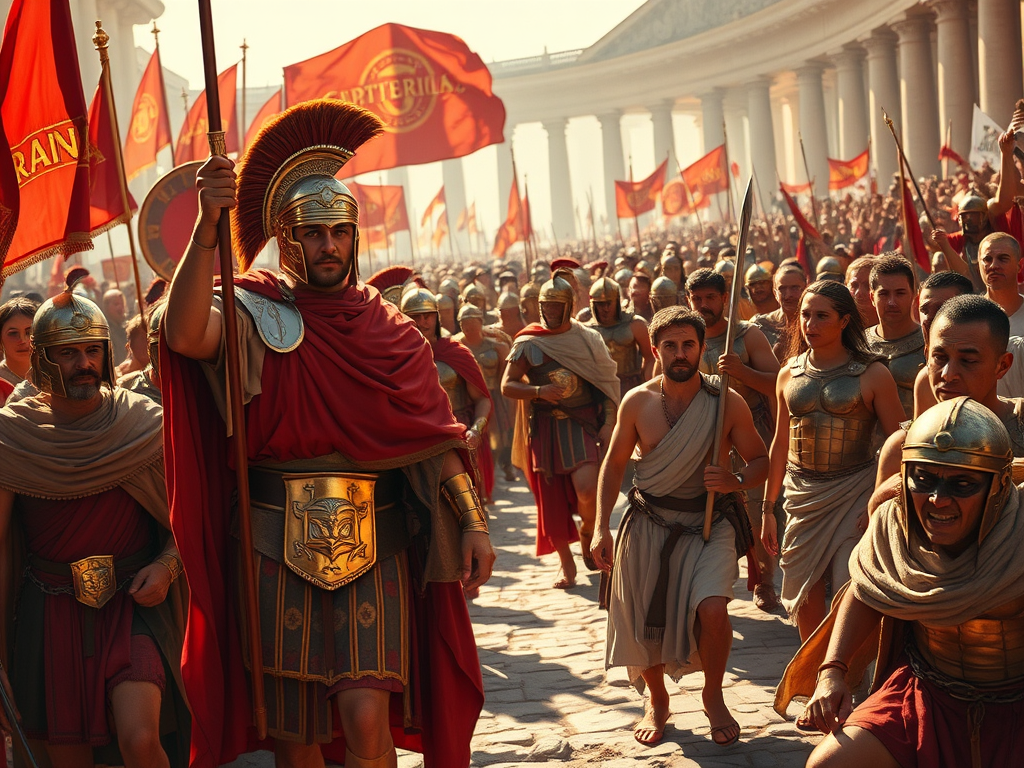
In ancient Rome, successful military conquests and campaigns ended with a triumphant homecoming parade. It was spectacle on a grand scale and the crowds loved it. The victorious general would lead his legion through the streets with their banners flying while the masses lined the streets and cheered.

Of course, every parade has to end, and in this case, at the end of the Roman victory parade were the prisoners of war, chained, beaten, and condemned. What a sharp contrast to the glorious, polished and pompous army who had just inspired and energized the adoring crowd. The prisoners provided the Roman masses with the opportunity to gloat in Roman greatness and bask in schadenfreude at their worthless enemies. The prisoners could be mocked, jeered, and pelted with whatever rocks or refuse was available along the street. In many cases, they’d already suffered abuse at the hands of their captors. They’d been ill-treated and marched for hundreds of miles against their will.

Ultimately, these prisoners would be marched to the Roman arena where, to the delight of the Roman crowds, they would face a horrific death. Among the most popular with the Roman masses was watching people getting ravaged and eaten by packs of wild beasts who had been starved in preparation for the occasion. But that wasn’t enough. The Romans would build contraptions that gave prisoners a false hope of being able to climb and escape from the beasts, but they were rigged to fall apart or fail, giving the crowds a little extra entertainment.

In yesterday’s post, I wrote about our human penchant for turning leaders into celebrities. In today’s chapter, Paul turns that entire notion on its head. He compares himself, and his fellow apostles to one of Roman prisoners being drug through the streets at the end of the parade. And, it wasn’t total hyperbole. When you study the persecution, punishment, and injustice that Paul and his fellow apostles endured, it’s both astounding and gut-wrenching.

Which makes his attitude even more amazing to me. “When we are cursed, we bless; when we are persecuted, we endure it; when we are slandered, we answer kindly.” Which, is not only what Jesus taught, but what Jesus exemplified as He was bound, beaten, mocked, and unjustly executed in a horrific way.

The struggle, of course, is to even connect with these realities here in my 21st century reality. I live in the most affluent country in the world in arguably the greatest time to be alive in human history. So, what am I supposed to take away from Paul’s reality and example?

First, I’m taking perspective with me into this day. I can list every single trouble, worry, or anxiety I might be feeling and then consider a Roman prisoner-of-war’s reality, Paul’s reality, and Jesus’ reality. Talk about a reality check. What am I complaining about?

Second, even in my own rather comfortable realities, I can think of specific instances of people being unkind towards me, unjustly accusing me of things, and using their power or influence against me. What’s my response?

Anger, vengeance, retribution, playing the victim card?

Or, like Paul, do I bless, endure, and answer kindly?

That, is a reminder I need every day.

If you know anyone who might be encouraged by today’s post, please share.

These chapter-a-day blog posts are also available via podcast on all major podcast platforms including Apple, Google, and Spotify! Simply go to your podcast platform and search for “Wayfarer Tom Vander Well.” If it’s not on your platform, please let me know!

Authority

Authority (CaD 1 Chr 23) Wayfarer

[David] also gathered together all the leaders of Israel, as well as the priests and Levites.
1 Chronicles 23:2 (NIV)

Authority. Who has the authority? From family systems to federal governments, our lives are governed by various authorities. As a disciple of Jesus, I consider God as my ultimate authority and am taught to follow Jesus’ example in being respectfully subject to the civic authorities over me.

In today’s chapter, the Chronicler continues to describe King David’s preparations for the Temple that his son, Solomon, would build. He begins by counting all of the descendants of the tribe of Levi and arranging them as to what the clans will do in service once the Temple is built.

A couple of thoughts.

First, when the people of Israel first asked for a King, God told Samuel that it was because they had rejected Him as their king. In essence, God recognized that they wanted a centralized human authority to lead them. When the people chose Saul, a tall, strapping, and handsome man, the results were disastrous. When God had Samuel anoint the king He chose to lead, it was a shepherd boy, the runt of his father’s litter, best known for being a gifted musician and songwriter. Of course, God’s choice grew up to be Israel’s greatest King.

The monarchy would ultimately lead to division, rebellion, secession, and bloody civil wars. God was not wrong in His prescient words to Samuel for how the monarchy would ultimately play out. David’s son Solomon was, at best, duplicitous in his commitment to God. After Solomon, the majority of Kings in David’s line served other gods, and all 19 of the kings of the northern tribes with faithless. David stands out, not only for being God’s anointed but also for his example of submitting himself to God’s authority.

And that’s what the Chronicler is focused on for the sake of himself and his contemporary readers. They are rebuilding the same Temple that David prepared for. They will have to arrange for Levites and priests to carry out sacrifices, offerings, and rituals that have not been performed for nearly 100 years. And, they have no king. They are now a vassal state of the Persian empire and will remain so. As the Chronicler and his colleagues prepare to restore the Temple and the worship system, he’s looking for an authoritative source to lay the groundwork for how it should be done. There is no better example than the one king known as a “man after God’s own heart” and the one king who submitted himself to God’s authority more than any other.

As I meditate on these things in the quiet this morning, I find myself thinking about the positions of leadership I have as a father, grandfather, employer, teacher, and Board member. I can, like so many of Israel’s ancient kings, divorce my civic life from my spiritual life. I can also follow David’s example in understanding that if God is my ultimate authority, then everything I do in my human positions of authority and leadership should be subject to how God expects me to think, speak, and act for the good of others in any system I lead.

If you know anyone who might be encouraged by today’s post, please share.

Jesus, the Impudent Dinner Guest

Jesus, the Impudent Dinner Guest (CaD Lk 11) Wayfarer

When Jesus had finished speaking, a Pharisee invited him to eat with him; so he went in and reclined at the table. But the Pharisee was surprised when he noticed that Jesus did not first wash before the meal.
Luke 11:37-38 (NIV)

Along my journey, I have found that people across the spectrum, from antagonistic critics to well-intentioned church members, have an ignorant perception of Jesus based on what others have said about Him or how religious institutions have portrayed Him. It’s one of the reasons I continue on this chapter-a-day journey. As I return again and again to the primary source material, it never fails to inform me in often mind-altering ways.

For example, in today’s chapter lies an episode about Jesus that I’ve never heard directly addressed in a sermon or a book.

Jesus is making His way toward Jerusalem, stopping in towns and villages along the way to do His thing. He teaches, heals the sick, and casts out demons from the possessed. He is, however, facing increasing criticism and opposition. The greatest opposition is coming from the institutional religious authority over the very faith Jesus is from and represents.

In one town, a Pharisee invites Jesus to dinner at his house. The Pharisees were a powerful organization within the larger Hebrew authority system. Made up mostly of prominent, wealthy, and connected businessmen, the Pharisees presided over local religious matters along with lawyers who were experts in the Law of Moses. Think of a cadre of the most wealthy and influential businessmen in your town or city having authority over commerce and religion and civil affairs. Being invited to a Pharisee’s home to dine with his lot would have been a huge deal.

Jesus accepts the dinner invite and becomes arguably the most impudent and offensive dinner guest in recorded history.

First, Jesus refuses to wash before dinner. To this day, you’ll find washbasins out in the open in the restaurants of Jerusalem for the orthodox to ritually wash before eating. Jesus’ refusal is a slap in the face of his host, and He does it in order to make a point. Jesus looks at this local cabal of mucky-mucks and says:

“Now then, you Pharisees clean the outside of the cup and dish, but inside you are full of greed and wickedness. You foolish people! Did not the one who made the outside make the inside also? But now as for what is inside you—be generous to the poor, and everything will be clean for you.”

This is rude. Jesus is insulting His host and his fellow dinner guests. In the culture of Jesus’ day, this was socially unacceptable. It’s hard to even put into today’s terms. It would be like taking your drink and throwing it into the face of your host. The Pharisee and his colleagues would have been appalled and immediately defensive, thinking “How can this country preacher from the sticks say I am not generous to the poor?! He doesn’t even know me! I always give exactly the tithe that God’s Law dictates I must give!”

Jesus raises the ante on His boorish behavior by reading their thoughts and continuing:

“Woe to you Pharisees! Yes, yes, I know you dutifully give God a tenth of your mint, rue and all other kinds of garden herbs to keep the letter of the law, but you neglect the heart of the law: justice and the love of God. You should have practiced the latter without leaving the former undone.

Jesus doesn’t wait for their reply to this before He raises the stakes even higher:

“Woe to you Pharisees! All you care about is having VIP seating in the synagogues and having people in town treat you like you’re all that and a bag of chips!”

There, dining with the Pharisee is a lawyer, who is not technically a card-carrying member of the Pharisee club, but a prominent colleague and social ally. The lawyer comes to his insulted host’s defense, calls Jesus to a social point-of-order, and informs Jesus that when He insults his Pharisee host, Jesus is insulting him as well.

Jesus quickly goes all-in to insult the lawyers as well.

“And you lawyers, woe to you! You load people down with your authoritative lists of ‘dos and don’ts’ that make their lives more difficult. You feel all powerful, telling people what to do, but then you sit there feeling smug and won’t lift one finger to help them.”

While Luke doesn’t provide the details, I don’t think Jesus got anything to eat. In fact, Luke implies that the Pharisee and his friends threw Jesus out of his house, or perhaps Jesus simply walked out, because the next thing the good doctor writes is: “When Jesus went outside, the Pharisees and the teachers of the law began to oppose him fiercely.”

In the quiet this morning, I find myself meditating on both the fact that Jesus acted in a rude and socially unacceptable manner and that in 2000 years since we rarely address or acknowledge this fact.

In His dinner party rant, Jesus provides a clue to both His anger and His impertinence. He states that from “Abel to Zechariah” (which is like me saying “From Genesis to Revelation”) it has been the institutional religious fundamentalism and authority thing that His host and friends represent that led to the murder of the prophets God sent to the Hebrew people throughout history. And, the handwriting is already on the wall. Jesus told His disciples in yesterday’s chapter: This same system will kill Him, as well.

I’ve observed along my life journey that the institutional religious fundamentalism and authority thing can be found amidst all of the world’s major religions. I believe that it’s what happens when sinful human beings turn religion into a kingdom of this world. I have always found it fascinating that it was the one thing that Jesus opposed so vehemently that He was willing to break every socially acceptable custom in order to call it out. Ironically, with acts like His impudent dinner behavior, Jesus pushes His opposition to call His bet, go all-in themselves, and kill Him.

The further I get in my journey, the more contrast the eyes of my heart see between the ways of God and the ways of the institutional religious fundamentalism and authority thing. And, the more my heart desires to pursue the former while joining Jesus in opposition to the latter.

If you know anyone who might be encouraged by today’s post, please share.

Jesus’ Way

Jesus' Way (CaD Lk 10) Wayfarer

[Jesus] replied, “I saw Satan fall like lightning from heaven. I have given you authority to trample on snakes and scorpions and to overcome all the power of the enemy; nothing will harm you. However, do not rejoice that the spirits submit to you, but rejoice that your names are written in heaven.”
Luke 10:18-20 (NIV)

Not long ago, I mentioned in a post that Jesus’ teaching was directed, not at nations or human institutions, but to individuals. It was directed to me. This is just one example of God’s message through Isaiah when He says, “Your ways are not my ways.”

Human institutions from Government to businesses to universities to churches operate on a system of top-down power structure. For human beings, this can work relatively well depending on the level of corruption, pride, and greed that exists in the upper levels of the system. The messiah that those of Jesus’ day were expecting was simply another version of this top-down paradigm. They expected the messiah to show up, wipe out evil through domination, put the Hebrews in charge, and exert salvation via righteous tyranny.

But, “your ways are not my ways” God had already proclaimed.

In today’s chapter, Jesus exemplifies the paradigm of His ways both via example and via parable.

Jesus appoints 72 more disciples and sends them out by two-by-two as as advance teams to the towns where He would be visiting. Their charge is to humbly stay with whoever will put them up and eat whatever they are given. No extra clothing. No purse full of money for emergencies. They are simply to do what Jesus did. Heal the sick, drive out demons, and proclaim the same teaching they’d heard from Jesus. If they were not welcomed, they simply wiped the dust off their feet and went to the next town. No demands. No force. No threats. Act humbly, live simply, and love mercifully.

Then a teacher of the law approaches Jesus. He is part of a human religious institution that operates like all human institutions. The elite and privileged at the top institutional food chain demand submission from the masses below. They drive obedience by threat of expulsion. They squash dissension and threats to the system (especially threats to the power and authority of the elites at the top of the system) with swift retribution, violence is used if needed.

The institutional lawyer asks Jesus what the law demands. Jesus quotes the two commandments that Jesus tells the crowds sum up God’s law: 1) Love God. 2) Love your neighbor. The institutional lawyer then asks Jesus to define “neighbor.” This prompts Jesus to launch into the famous story of the Good Samaritan.

What is lost on most casual readers is that Jesus deliberately describes those who pass by the robbed, bleeding, and injured man on the road as elite members of the very religious institution the lawyer represents. They are part of the human system which had, in top-down power fashion, exempted themselves from basic human compassion by dictating and justifying who was worthy of their precious time, energy, and resources both emotional and financial. In passing by the victim of assault and robbery lying on the road, these powerful figures of the religious institution were acting as they’d been taught and conditioned to behave by that system.

Jesus then chooses to describe the man who has compassion for the needy and helpless victim as a Samaritan. Samaritans were the enemy. Samaritans were excluded from the institutional religious system. The lawyer had been taught by the system to ignore, avoid, and treat Samaritans with prejudice, judgment, and contempt.

The Good Samaritan highlights Jesus’ ways, God’s ways. An individual acts with simply humility, compassion, mercy, and extravagant generosity towards another human being in need – even a stranger. This act is a bottom-up, subversive, human religious system disruptor, and it’s how Jesus intends His followers to change the world one humble act of charity at a time.

This bottom-up disruptor paradigm of God’s kingdom versus the world’s top-down power paradigm is highlighted once more by Jesus in today’s chapter. When the 36 advance teams return to Jesus, they report that they cast out demons and exercised power and authority over the powers of hell. Jesus quickly warns them not to let it go to their heads and infect their hearts. Rather, He tells them to humbly find joy that they have received love, mercy, and grace from God to be simple citizens and participants in God’s Kingdom.

In the quiet this morning, I find myself endeavoring to be a disruptor in this world. I don’t want to be a disruptor through power, politics, and protest. I want to be a disruptor Jesus’ way. I want to disrupt through bottom-up acts of love, humility, mercy, and generosity one needy person at a time.

If you know anyone who might be encouraged by today’s post, please share.