Tag Archives: Season

Not History – A Moment Relived

Three times a year all your men must appear before the Lord your God at the place he will choose: at the Festival of Unleavened Bread, the Festival of Weeks and the Festival of Tabernacles. No one should appear before the Lord empty-handed: Each of you must bring a gift in proportion to the way the Lord your God has blessed you.
Deuteronomy 16:16-17 (NIV)

Last week we enjoyed our Christmas celebration with family. I enjoyed going to the Christmas Eve candlelight service and marking the climactic end of the Advent season and welcoming the Christ-child, God-with-us.

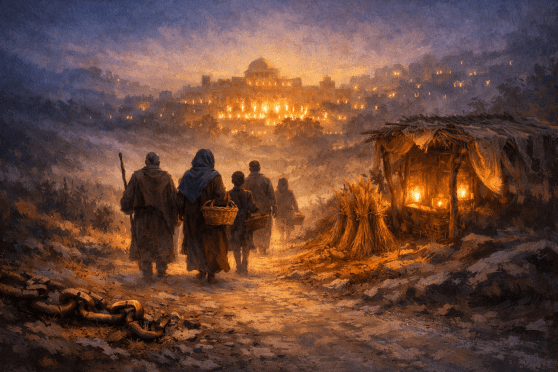
There is definitely a connection between the annual celebration of the Advent season and Christmas and today’s chapter. God through Moses reminds His people that when they settle in the Promised Land they are to have three great pilgrimage festivals. Everyone makes a pilgrimage to “the place God will choose” at three different times of year for three different purposes:

  1. Passover / Feast of Unleavened Bread – a remembering of liberation.
  2. Feast of Weeks (Shavuot) – a remembering of provision.
  3. Feast of Booths (Sukkot) – a remembering of dependence.

These festivals provided structure, not only for the calendar, but also for the soul.

My meditation on today’s chapter led me to a Hebrew word: Z’manim.

In its simple definition z’manim means “times” or “appointed moments.” But God’s base language is metaphor, and metaphors are layered with meaning. I’ve learned that this is especially true with the Hebrew language.

Z’manim gives breath to time.

Appointment (something set, not random)

Readiness (a moment that has ripened)

Intended timing (not just when, but why now)

This is not clock time. This is meaningful time. It is time with purpose stitched into it. Time that has been noticed. Claimed. Set apart.

God does not dwell just in places. He inhabits moments.

Which brings me back to Christmas Eve and the end of the Advent Season. Why do this every year? Why did God prescribe three festivals every year? The intention was never a rote, prescribed, go-through-the-motions religious activity. That’s dead religion not a Living God. Annual seasons and festivals were moments in time in which I commune with the divine and together we embrace a moment new and afresh.

Freedom from chains that bind me.
Gratitude for the abundance of my blessings.
Reminder that security is always borrowed.
The birth of God who became flesh and pitched His tent among us.

Along my spiritual journey I have been largely naive and ignorant of the ways God has historically revealed Himself in fullness. I understand more than ever how easy it is for institutional religion to become rote and repeated motions that are Spiritually empty and void of meaning. But from ancient days through this current day, God has invited me to meet him in z’manim – moments of time filled with His presence and a banquet of meaning on which my soul can feast and be satisfied.

On Christmas Eve, bathed in candlelight and singing Silent Night with loved ones, we welcomed a newborn baby, wrapped in swaddling clothes and lying in a manger. It wasn’t just a commemoration. It was not dusting off history. It was, once again, the event relived – together with God and with loved ones.

It was z’manim.

And in the next few days the z’manim shifts. Old things pass away with 2025. New things come with 2026.

In the quiet I am reminded that I dare not ponder what that means for me apart from the reality of “God with us.”

If you know anyone who might be encouraged by today’s post, please share.

Promotional graphic for Tom Vander Well's Wayfarer blog and podcast, featuring icons of various podcast platforms with a photo of Tom Vander Well.
These chapter-a-day blog posts are also available via podcast on all major podcast platforms including Apple, Google, and Spotify! Simply go to your podcast platform and search for “Wayfarer Tom Vander Well.” If it’s not on your platform, please let me know!
An orange icon featuring an open book symbol, representing learning or knowledge.

New Season, Big Challenge

When I heard these things, I sat down and wept. For some days I mourned and fasted and prayed before the God of heaven.
Nehemiah 1:4 (NIV)

It will forever be one of the most critical and difficult moments of my entire life journey. I still remember it like it was yesterday. I remember sitting in my home office. I remember my desk by the window and the afternoon sunlight streaming through the window. It was fall.

I had been through years of wilderness in so many ways. God had promised me so many times in so many ways that He had great plans on the other side of this wilderness. There was a Promised Land coming. I had been waiting. I had been slogging. I had been asking, seeking, and knocking.

On that fall afternoon I realized that it was time. This new season in life was about to begin. I thought that it would be a joyous moment. I thought that it would be triumphant and thrilling. It was none of those things.

For the new season to begin, my marriage had to end.

The setting of any story is important, and the story of Nehemiah cannot be fully appreciated without the setting.

We are in the ancient empire of Persia, in what today is southwest Iran. Over a century before, the city of Jerusalem had been destroyed. The Hebrew people had been taken into exile. In the game of thrones, theBabylonian empire fell to the emerging Persian empire. Some of the exiles had returned to Jerusalem, but others like Nehemiah remained and flourished.

Nehemiah finds himself at a critical inflection point in the Great Story. This is not a random moment. It’s been foreshadowed and foretold for centuries.

God through Moses initially made His covenant with the Hebrew people and told them that if they broke the covenant they would end up in exile among other nations. He goes on to promise that even then His love will not fail and He will bring them back. (see Deuteronomy 30:1-5)

The prophets later echoed this same warning and promise. Jeremiah repeatedly warned his people that they would end up in exile in Babylon if they didn’t repent. When it happened, Jeremiah wrote the exiles a letter and said:

“Build houses and settle down; plant gardens and eat what they produce. Marry and have sons and daughters; find wives for your sons and give your daughters in marriage, so that they too may have sons and daughters. Increase in number there; do not decrease. Also, seek the peace and prosperity of the city to which I have carried you into exile. Pray to the Lord for it, because if it prospers, you too will prosper.”

“This is what the Lord says: ‘When seventy years are completed for Babylon, I will come to you and fulfill my good promise to bring you back to this place. For I know the plans I have for you,’ declares the Lord, ‘plans to prosper you and not to harm you, plans to give you hope and a future. Then you will call on me and come and pray to me, and I will listen to you. You will seek me and find me when you seek me with all your heart. I will be found by you,’ declares the Lord, ‘and will bring you back from captivity.’”
Jeremiah 29:5-7, 10-14 (NIV)

As the book of Nehemiah opens, this is the moment. Nehemiah has done exactly what God commanded through Jeremiah. He has a great life. He’s an advisor and protector of the Persian emperor, Artaxerxes. He’s made a good life for himself and his family. He’s helped the Persian empire prosper and he has prospered in return. Now, it’s time to return from exile, to go home – back to the family’s land in Jerusalem.

Sometimes what seems like it should be a really joyous moment is actually a very painful one.

What precipitates Nehemiah’s return is word of just how bad things are back in Jerusalem. Yes, some exiles had returned but the situation is dire. The city’s walls were broken. There were no gates. It was defenseless chaos. There would be no prosperity for God’s people, they might not even survive, if something didn’t happen quickly.

The moment humbles Nehemiah and sends him to his knees. He remembers God’s love and promise, he repents, he prays for the guidance and inner resources he’ll need. The next season for Nehemiah will change the course of Israel’s history. It kick-start what is known as the Second Temple period that will be one of the most important in Jewish history. In that Second Temple period Jesus, the Messiah, will arrive. But the season starts with a challenge for which Nehemiah is not sure he’s ready.

Been there. Done that.

God had really great plans for me. Plans full of hope and a good future with Wendy, the girls, and each of their families. But sometimes the best seasons begin with the greatest challenges.

If you know anyone who might be encouraged by today’s post, please share.

Promotional graphic for Tom Vander Well's Wayfarer blog and podcast, featuring icons of various podcast platforms with a photo of Tom Vander Well.
These chapter-a-day blog posts are also available via podcast on all major podcast platforms including Apple, Google, and Spotify! Simply go to your podcast platform and search for “Wayfarer Tom Vander Well.” If it’s not on your platform, please let me know!

Time to Forget

Brothers and sisters, I do not consider myself yet to have taken hold of it. But one thing I do: Forgetting what is behind and straining toward what is ahead,  I press on toward the goal to win the prize for which God has called me heavenward in Christ Jesus.
Philippians 3:13-14 (NIV)

Over the past few years, Wendy and I have discovered a difference in the way we perceive and approach life. As we have dug into it, it’s allowed us to learn about ourselves and to better understand one another. It has to do with our orientation to time.

I have a strong orientation towards the past. I’m a lover of history. I have spent much of my life digging into I and my family’s genealogy. As I contemplate current events, I tend to seek the past for context. Even as I look to the future I tend to look to the past for patterns that might inform where things are headed.

Wendy, on the other hand, is very much future oriented. Her brain is constantly looking a step or two ahead and it informs both her present tasks and their relative priorities. Life for Wendy is a constant anticipation of what is next, while I give little thought to it.

Our very different orientations towards time often creates clashes in how we function both independently and in relationship. Knowing these differences has allowed us to be more empathetic and understanding towards one another.

This past week our local gathering of Jesus’ followers focused our thoughts on Jesus’ words in the Lord’s Prayer: “forgive us our sins as we forgive those who sin against us.” Wendy and I spent some time talking about forgiveness and resentment, exploring whether or not we have truly forgiven those who have hurt us in the past.

As we continued our conversation, Wendy began quizzing me about a couple of individuals in my own life story who have been the source of considerable struggle for me. As we discussed these individuals and I have continued to meditate on my relationship with them and their impact on my life, it has struck me that my time orientation towards the past might lend itself to unhealthy thought patterns.

In today’s chapter, Paul references his own past and as a disciple of Jesus he had a lot of baggage. Once the most rabid enemy of Jesus and His followers, Paul had the blood of martyrs on his hands. Paul oversaw the stoning of Stephen. It is unknown how many other individuals suffered, were imprisoned, or died as a result of Paul’s zealous persecution of the Jesus Movement, but it is certainly likely that at least some of the opposition he constantly faced linked back to the suffering he once inflicted on others.

This came to mind as I read Paul’s words in today’s chapter:

But one thing I do: Forgetting what is behind and straining toward what is ahead,  I press on toward the goal to win the prize for which God has called me heavenward in Christ Jesus.

I happen to be entering a new stretch of my life journey. Old things are passing away. New things are emerging. As this happens, I am reminded by Paul’s words that I need to spiritually strain against my natural time orientations which often keep me mentally, emotionally, and even spiritually mired in what lies behind. There are some things on the road behind me that I need to forget in order to focus my mental, emotional, and spiritual energies on straining toward what is ahead.

Fortunately, I’m married to a partner whose natural orientation toward time can help me with that.

If you know anyone who might be encouraged by today’s post, please share.

Promotional graphic for Tom Vander Well's Wayfarer blog and podcast, featuring icons of various podcast platforms with a photo of Tom Vander Well.
These chapter-a-day blog posts are also available via podcast on all major podcast platforms including Apple, Google, and Spotify! Simply go to your podcast platform and search for “Wayfarer Tom Vander Well.” If it’s not on your platform, please let me know!
Bible Gateway logo featuring an open book icon

Friends and Flow

Meanwhile a Jew named Apollos, a native of Alexandria, came to Ephesus. He was a learned man, with a thorough knowledge of the Scriptures.
Acts 18:24 (NIV)

Many years ago, I gave a message. I don’t even remember what the message was about, to be honest. What I do remember, however, is that in preparation for the message I made a list of key relationships in my life journey and charted them on a timeline of my life. These “key relationships” meant that they were friends who had a significant presence, role, and impact on my life and spiritual journey.

I remember that the exercise taught me a couple of major lessons. First, I realized that there are different types of relationships. Some relationships were significant for a key season of my journey, but then that relationship ended. I call these “relationships for a season.” Some relationships weave in and out of life in multiple seasons spread out across the journey. I think of these as “recurring relationships.” And then there are relationships that I’ve come to refer to as “Life” relationships because it doesn’t matter the time and space between correspondence, the relationship runs so deep that no amount of time or distance diminishes it.

The events of today’s chapter roughly take place around 51-52 AD. It’s been fifteen years since Paul’s fateful trip to Damascus with murderous intention to persecute the followers of Jesus there. Jesus appeared to him on the road and, in an instant, he went from being the disciples’ greatest adversary to becoming their greatest advocate. For fifteen years Paul has been traveling throughout Greece and Italy sharing Jesus’ Message to any and all who will listen to him.

What struck me about today’s chapter is that as the Jesus Movement expanded throughout the Roman Empire a new cast of characters entered the Story. We meet Priscilla and Aquila, believers from Rome who will become key relationships in Paul’s life and ministry. Then there’s Apollos, a man who simply shows up out of nowhere, but he will have a major, positive impact on the Jesus Movement and Paul will refer to him with great respect in his letters to the believers in Corinth.

In the quiet this morning, I find myself thinking about the lessons I’ve learned through these key relationships. First of all, hindsight allows me to see that there is a certain “flow” to relationships that weave in and out of life. It’s rare that a relationship begins with some type of conscious decision. I’ve never “chosen” a friend by looking at a person across the room and saying “I want that person to be a key relationship in my life!” There is life flow to key relationships in my story that I don’t control. Trust the Story.

This brings me to another lesson, which is that in trusting the Story, I’ve ceased to have expectations of friends and friendships with regard to what a relationship will be in my life. It may be for a season, it may be recurring, or it may be for Life, but that’s not really something I control. It is what it is. Trying to control it only leads to awkwardness, anxiety, and disappointment.

And, this leads to a third lesson I’ve learned, which is to accept and appreciate each type of key relationship for its role in both my life and spiritual journey. At times I have grieved that a relationship for a season was only for a season, but that doesn’t mean I can’t be grateful for that friend and that relationship that impacted me for that season.

And who knows? Perhaps today will be a day when a significant relationship flows into my life, my journey, my Story. I have no expectations, but I’m always open to how God wants to flow.

If you know anyone who might be encouraged by today’s post, please share.

The Wait

The Wait (CaD Lk 2) Wayfarer

Now there was a man in Jerusalem called Simeon, who was righteous and devout. He was waiting for the consolation of Israel, and the Holy Spirit was on him.
Luke 2:25 (NIV)

Here at Vander Well Manor, it’s beginning to look a little bit like Christmas. Wendy fractured her foot a few weeks ago, had surgery to repair it, and has been rolling around the house on a scooter. So, the decorations are not up yet, but there’s seasonal music playing in the kitchen each morning and boxes of toys and books and other Christmas gifts for the kids have begun to arrive daily. Our crew in Scotland is moving back to the States and will be with us, which has Yaya and Papa pretty excited for this year’s Christmas celebration.

As I looked at the latest delivery of children’s gifts on the counter yesterday, I thought about our grandson and the giddy excitement he must be feeling about Christmas. I suddenly had a nostalgic flood of memories from my own childhood. Back in the day, the Sears Christmas Wish Book catalog that arrived each year would be tattered and dog-eared as the toy section was perpetually reviewed daily. The list for Santa was endless. The anticipation of Christmas morning was excruciating.

This past Sunday, I gave a message among my local gathering of Jesus’ followers. My message was an unpacking of what’s known as the season of Advent. Among my local gathering are people of very diverse religious backgrounds, and many have no experience with or understanding of Advent. Among followers of Jesus around the world, there are those who follow a liturgical calendar in which there are seasons coinciding with key celebrations throughout the year. The season of Advent is the traditional season that leads up to the celebration of Jesus’ birth on Christmas Day.

Advent comes from the Latin word Adventus, meaning “coming or arrival.” It is a season of waiting that traditionally included an Advent calendar which counts down the days until Christmas. Advent calendars used to have little candies or pieces of chocolate for each day, helping children get a little daily fix before the main event arrives. Today, you can get Advent calendars with just about any kind of treat for each day before Christmas including different wine samples or a shot of a different brand of bourbon. Ya gotta love commercialism.

Today’s chapter is a traditional Christmas chapter. What is once again fascinating about Luke’s account is the detail he provides that you won’t find in Matthew, Mark, or John’s biographies of Jesus. As part of his investigation into Jesus’ story, tradition tells us that Luke spent time with Jesus’ mother, Mary. The first two chapters read like a recitation of what must have been Mary’s first-person account of the events surrounding Jesus’ birth.

Among those stories is a simple, but meaningful story of a man named Simeon. Simeon was a sincere believer in God, and he was waiting for God’s messiah, the savior, to arrive. God’s Spirit had assured him that he would not die until he had seen this messiah with his own eyes. Prompted and led by God’s Spirit, he goes to the courts of the Temple. The temple courts would have teeming with people like a shopping mall the week before Christmas. There among the crowd were Joseph, Mary, and 40-day-old baby Jesus. They were there to perform a traditional purification ritual prescribed in the Law of Moses.

Luke doesn’t go into details, but Simeon is led to the infant Jesus by the Spirit. That which he had been waiting for is finally fulfilled. He hold’s God’s promise, and speaks hard prophetic words to Mary. The waiting over, Simeon boldly proclaims that he is now ready to die, having seen “God’s salvation” with his own eyes.

In the quiet this morning, I can’t help but think about the stories of today’s chapter in connection to my message this past Sunday and the season of waiting that has commenced leading to Christmas. Christmas toys and Advent calendars filled with bourbon shots aside, the traditional season of Advent calls me back from the precipice of nostalgia and commercialism to something deeper, more personal, and more meaningful. Simeon provides the example.

Simeon’s wait was individual and personal. Simeon’s was connected to God’s Spirit which was both the source of the wait and its fulfillment. Once it was fulfilled, Simeon experienced a spiritual freedom, release, and satisfaction.

As a child, I remember the hangover that descended when all the presents had been opened and a few days had gone by for the newness to wear off. That’s bound to happen if my treasure is found in the Sears Wish Book. Simeon found something deeper and far more satisfying. Advent softly beckons me to join him, if I only can hear the whisper amidst Mariah Carey beckoning for the 100th time that all she wants for Christmas is me.

If you know anyone who might be encouraged by today’s post, please share.

Influence

Influence (CaD 1 Ki 15) Wayfarer

[Abijah] committed all the sins his father had done before him.
1 Kings 15:3 (NIV)

Wendy and I have the joy of having our children and grandchildren stay with us for a few weeks. Because they currently live on the other side of the ocean, it’s always special to have this time together. The house is a mess, there’s lots of noise, and there’s a lot of activity. I love it.

Our grandson, Milo, turned five this past Sunday. It’s fascinating to watch his young personality emerge and develop. He feels big feels, and he expresses those emotions on a grand scale. He expresses things I would never expect from someone his age. I know many adults who are not as in tune with their feelings, nor can they express them the way five-year-old Milo does. I love watching him grow up and watching his parents deftly navigate the turbulent emotional waters. Their calm and peaceful influence is impressive to observe.

With today’s chapter, the author of Kings enters the back-and-forth reigns of the various kings of the Northern Kingdom of Israel and the Southern Kingdom of Judah. The author uses a repeated pattern. First, he identifies when the King ascended the throne in relation to who was on the throne in the other kingdom. Second, he establishes whether the King did good or evil in the eyes of the Lord based on his loyalty to God or pursuit of pagan religion and worship. There may be a mention of an important event during his reign (e.g. war or battle), or even a random trivial fact (e.g. King Asa’s feet were diseased in old age).

When I read this morning that Abijah, son of Jereboam, “committed all the sins his father had done before him,” I couldn’t help but conclude that he was “a chip off the old block.” Parents influence children. Children often do exactly what their parents model. Abijah did what his father did.

My thoughts in the quiet this morning are actually pretty simple. At this point on life’s road, parenting is more of an advisory position. That doesn’t mean, however, that I don’t have influence. Yesterday morning, Milo quietly opened the door to my office as I was reading and preparing to write my post. I beckoned for him to come and sit on my lap. Curious, he began asking me about the book I was reading and what I was doing in my office. I told him about my time in the quiet each morning reading, writing, and having conversations with God. He didn’t seem particularly interested in the details, which was fine. He was keenly interested to be on grandpa’s lap and get my assurance that I would be chasing him later in the day in a game we call “running around in a circle.” I assured him we would, and we did – multiple times.

Along my life journey, I’ve come to the realization that the influence I have on my children (and grandchildren) is in the person they see me being every day, over time along with the person I am with them in the relationship. They will have to make their own life choices. I will, however, give them a template to follow (or not follow) with my habits, my behaviors, my words, and my interactions with them.

If you know anyone who might be encouraged by today’s post, please share.

Jesus: Unwanted

Then the people began to plead with Jesus to leave their region.

As Jesus was getting into the boat, the man who had been demon-possessed begged to go with him.
Mark 5:17-18 (NIV)

Wendy and I have a recurring conversation about life. There is no doubt in either of our minds that we were supposed to walk this journey together. It’s a story that I should write someday. Our relationship has been such a good thing that we often wonder: “What if we had experienced our younger adult years together?”

While the hypothetical question is a natural one, we both agree in this recurring conversation that the younger versions of ourselves (me the religious rule keeper and good little preacher boy, she the rebellious wild-child) would likely not have hitten it off. My personal journey, walking through my “Prodigal” years, the failure of my first marriage, becoming a father to Taylor and Madison, were all part of what prepared me for the waypoint in which our story could begin.

Yesterday I wrote about the fact that every follower of Jesus has a unique story. Some follow in one season of life, while it takes others until a later season and waypoint further down the road before they are at the right place to follow. Some don’t reach that waypoint until their final moments on this earth. There is a mystery to the flow of it.

As I read today’s chapter, I found a connected truth. Mark’s version of the Jesus Story continues. While Mark has previously alluded to the miracles Jesus is performing, in today’s chapter he gives three major illustrations: a man possessed by a legion of demons, a woman who is miraculously healed by Jesus without His conscious decision to do so, and a twelve-year-old girl raised from the dead. I feel like Mark is telling me “Look, Jesus wasn’t just healing people from a runny nose or a tummy ache. We’re talking dead people being raised back to life kind of stuff!”

In the midst of these three episodes is a curious event. The people in the towns where Jesus cast the demons out of the man begged him to leave their region. The very next sentence has Jesus getting into the boat to shove off. I am reminded that when Jesus sends out His disciples to do their own internship practicum (coming up in the next chapter) He tells them if they are not welcomed by the people in a town to “shake the dust off your feet” and leave. In today’s chapter, Jesus exemplifies what He will command His followers to do in the next chapter.

In the quiet this morning I find myself mulling over the notion that Jesus does not force His way in. Tell Him to stay away and He is perfectly willing to move along. To the point of yesterday’s post, it may not have been the right season for the people of that region. Curious that the demon-delivered man asks to follow Jesus and Jesus tells him to stay and tell everyone in the region his story. In doing so, Jesus scatters “the seed” through this man’s story and witness which may take root and bear fruit in a future season.

Through many years of my journey, I observed the institutional church often trying to force itself in where it was not welcome and to manufacture converts via what I would liken to a process of systemic spiritual cloning. As I read through the Jesus story, I find Jesus’ actual example to be far more natural, more organic, more authentic, and more trusting of what God’s Spirit is doing in the Great Story and in the story of individuals within it.

Which brings me back to the journey of Tom and Wendy that began when two very different lives found themselves in the right season and at the right waypoint on life’s road to become one.

Spiritual Seasons

Sluggards do not plow in season;
    so at harvest time they look but find nothing.

Proverbs 20:4 (NIV)

Here in the state of Iowa Spring is beginning to appear. The temperatures have been slowing creeping into in the 60s and 70s during the day. The last of the giant mountain of Winter’s snow piled up in front of our house was finally completely melted this week. Our brown lawn is starting to “green-up” and the bare trees will soon have a green hue as the leaves begin to bud.

Friends, clients, and colleagues who have never experienced life in the Midwest will often tell me that I’m crazy to live here. It’s like spending your Winter in the arctic and your Summer in Death Valley. There is some truth to the face that we get to experience weather in all of its extremes. But, we also get to experience all four seasons in their unique, diverse distinctions in ways my friends never will.

Along my Life journey, I’ve come to understand that there is a spiritual lesson to be gained in the seasons of a year. Life, death, resurrection, renewal, struggle, trial, perseverance, change, and contentment. They are all part of creation’s perpetual story from Spring to Summer to Autumn to Winter each year.

As I read the proverb above this morning, I was struck by the word “season.” If I’m not disciplined to put in the word and plow in the Spring, then when Autumn’s harvest arrives and I need what is necessary to survive Winter, I have nothing. This means I might not survive to the next Spring.

But it wasn’t nature here in the agrarian land of Iowa that the proverb made me think about.

God’s base language is metaphor. Metaphor is layered with meaning. Here is the layer of meaning that the proverb surfaced for me in the quiet this morning…

Even as a successful farmer is disciplined in cultivating, planting, weeding, pruning, harvesting and storing, so there are spiritual disciplines that are required throughout the seasons of Life to prepare for the unknowns of future seasons.

As a young man, I was taught and mentored in spiritual disciplines such as quiet, study, Word, contemplation, prayer, introspection, sacrament, worship, fellowship, generosity, and service. These disciplines in life’s Spring-like seasons when things are good and life is easy are spiritual seeds. It takes mindfulness, time and discipline to sow them, cultivate them, and tend to them daily. But, they eventually grow and bloom into spiritual fruit such as love, joy, peace, faith, perseverance, and self-control. This fruit will be required when, eventually, Life’s harsh seasons of death, trial, and tragedy blow in unexpectedly.

In the quiet this morning I find myself thankful for those who taught me, schooled me, mentored me, and exemplified for me spiritual disciplines. Along Life’s road, I’ve witnessed and walked along-side individuals who had no spiritual reserves when seasons of tragedy caught them by surprise. Winter gets long if I have nothing stored up. Spiritually, I might not survive.

Unaltered original photo by Scott Mcleod via Flickr

Sad Endings

Whoever would foster love covers over an offense,
    but whoever repeats the matter separates close friends.

Proverbs 17:9 (NIV)

I have been blessed with many great friends across this earthly journey. I consider them a huge part of the reason I am where I am on Life’s road. Even though our respective paths in life led us to different places, there are a number of friends that I can call at any moment and we can pick up right where we left off as if no time had passed and there was no distance between us. As I look back, however, I can also recount friendships that were important and special during a particular stretch of the journey, and then they ended.

In most of these cases, not all, there were things that I said, things I did, or things that I didn’t say or do, which offended or hurt my friend. In at least one instance, my friend repeatedly declined to tell me what it was that I had done to cause such pain. In every instance, my attempts at reconciliation in these friendships were rebuffed. Even ten, twenty, thirty years later, I still feel sad when I think about each one.

Jesus was adamant that His followers practice forgiveness. It was non-negotiable. When asked by Peter if forgiving a person who wronged you seven times was a righteous thing to do, Jesus doubled down and instructed Pete to forgive seventy-times-seven. The hyperbole was the point. Forgiveness is to be on-going and never-ending. Jesus then provided the example as He hung on a cross and said of His executioners: “Father, forgive them. They don’t know what they are doing.”

In today’s chapter, one proverb states that love “covers over” an offense. I couldn’t help but think of an old piece of furniture that is dinged and scratched up with constant use over time. A little sandpaper and a fresh coat of paint make it new again. The scratches and dings are covered over and forgotten.

The proverb goes on to state that “repeating a matter” separates friends. In this contrasting situation, there is no sanding over the scratches and no fresh coat of paint. One friend wants the other friend to view every scratch and see every ding, every time, and be continually reminded that they are there and not going away. There is no forgiveness, just power and leverage, and shame, and the continuation of relational pain.

I’ve come to realize that a relationship can not long survive in such circumstances, at least not with any degree of health. It is not a reciprocal, life-giving relationship.

In the quiet this morning, I begin my week thankful for friends both past and present. I’m thankful even for those who were friends for a season. The end of those relationships, with all their sadness, don’t take away the tremendous, positive impact those friends made in my life during that season. And, who knows? Perhaps reconciliation will yet occur down the road. I hope so.

Have a good week, my friend.

The Latest: Kick-Off to a Chaotic Season

Wendy and I knew that we were entering into a fall and winter 2019-2020 that was going to be jam packed with events and travel. We didn’t plan it that way. It just sort of evolved. So, we’re embracing it.

We considered last weekend the kick-off of the chaos. Long ago we’d planned a Twin Cities getaway. It just so happened that the Twins and Vikings had home games on the same weekend. Wendy and I got a hotel in between Target Field and U.S. Bank Stadium.

Friday night was unseasonably hot and humid as we trekked about a mile to Target Field. We had seats right behind home plate and found ourselves surrounded by professional baseball scouts with their stopwatches and clipboards. We had a fun evening watching the Twins beat the Royals.

Saturday was a day of simply being together. We walked about a mile to have a wonderful breakfast at Eggsy, then trekked back to the hotel where we hung out and watched the Iowa State football game. We dressed to the nines in the late afternoon and took an Uber to the Red Cow for dinner. There was a gorgeous, cool breeze and we walked back to the hotel, stopping at Finnegan’s Brewery for a pint.

Sunday morning we headed to the “mother ship,” U.S. Bank Stadium, and really enjoyed watching the Vikings beat the Raiders. It was a really fun getaway to launch a busy season.


Earlier this year we’d heard about an occasional event at one of Des Moines’ breweries, the Foundry, called “Hymns at the Hall.” We put it on our calendar to attend the next one, which was this past Thursday. We joined our friends, Kev and Beck, and ordered some food truck pizza for dinner as we waited for the festivities to begin. We didn’t realize that one of the organizers of the event is a good friend of Taylor and Clayton’s, and we ran into some of the kids’ peeps which was a lot of fun. A very festive evening of singing great hymns and enjoying some great craft brews.


Last night was our community theatre’s annual Awards Night. Last year Wendy was inducted to Union Street Players Walk of Fame. This year it was my turn. We were surrounded by our friends and I was given a wonderful, honoring introduction by Doug DeWolf. It was a really fun evening with our theatre community. Lots of laughter and reliving memories. I was both humbled and honored. We retired to the Vander Well Pub afterwards for some enjoyable conversation.