A Plethora of Prayer

And pray in the Spirit on all occasions with all kinds of prayers and requests. With this in mind, be alert and always keep on praying for all the Lord’s people.
Ephesians 6:18 (NIV)

There was a fantasy movie that came out when I was a teenager called Ladyhawke. It starred a very young Matthew Broderick who played the part of a young and mischievous monk. Throughout the movie, the young monk has a running conversation with God, often humorously explaining why it was necessary for him to behave in less than monk-like ways.

As silly as it seems, that movie taught me something about prayer. As a young believer, I had always been taught the formal mode of prayer. I assumed the prayer position by closing my eyes, bowed my head, and folding my hands together. I prayed formally, addressing God with voice and words that I would never use in conversation with anyone else. After watching Ladyhawke I asked myself the question, “If I am indwelt by the Holy Spirit as I’ve been taught, then why can’t I just have a running conversation with God? “

It was my first step into understanding that prayer is a spiritual discipline that takes many forms. There’s a veritable plethora of ways one can pray. One of my blog posts that continues to be among the most popular is about “popcorn prayers.” Through the years, I have found writing God my prayers like a letter to be one of my favorite and most powerful forms of prayer. I’ve spent seasons of life praying the Divine Hours in which prayers are recited at fixed times throughout the day and night. I sometimes repeat classic prayers that have been handed down through the ages like the prayers of St. Patrick, St. Brigid, and St. Francis. I sometimes pray silent prayers. Sometimes I pray breathing prayers. And sometimes, especially when I’m alone in the car, I will simply have a casual conversation with God, outloud, as if He is sitting in the passenger seat – just like Matthew Broderick’s character did in Ladyhawke.

I have always had a creative spirit, and I get bored easily. Finding creative ways to communicate with God and commune with His Spirit has been a worthwhile endeavor throughout my spiritual journey. In the quiet this morning, as I’ve been writing these words, I’ve been reminded of some of the forms of prayer I haven’t tapped into for a while and convicted to weave them into my day.

I think it fitting to end today’s post/podcast with a prayer.

God, I pray for any and all who read/hear these words, that you will bless them wherever they are with whatever it is they need in the moment, and I pray that they will in turn bless you by having a conversation with you. In Jesus name I pray this. So be it. Amen.

If you know anyone who might be encouraged by today’s post, please share.

Profound Simplicity

Profound Simplicity (CaD Eph 5) Wayfarer

Nor should there be obscenity, foolish talk or coarse joking, which are out of place, but rather thanksgiving.
Ephesians 5:4 (NIV)

I have a reminder set for later this morning to get the turkey out of the freezer so it can thaw before Thanksgiving Day on Thursday. A few weeks ago, Wendy and I weren’t sure what we were doing for Thanksgiving this year. We’d talked about a small, quiet affair with a couple of other family members. That suddenly swelled to a total of fourteen who will be gathering at our house for the feast. We are grateful for the opportunity to host members of both our families. It’s going to be wonderful day of love and feasting.

Thanksgiving was, no doubt, on my heart and mind in the quiet this morning as I read today’s chapter. Paul provides for the disciples of Jesus in Ephesus stark contrasts between how those in the world live and how disciples of Jesus should conduct themselves in life and relationships. Among the contrasts he provides is the difference between the “obscene,” “foolish,” and “coarse” conversations and “thanksgiving.” I found it interesting that the Greek word translated “thanksgiving” is eucharistia which is the root of the word eucharist that many followers of Jesus use to name the bread and cup of the sacrament of Communion.

In yesterday’s post/podcast I talked about how I invest my budget of words daily. Paul is, quite obviously, continuing this theme and providing contrasting examples. If I was “mic’d up” like players and coaches in the NFL and then all of my words for a day were run through AI to summarize and describe all of things I’d spoken yesterday, what would the result be? What adjectives would describe the flow of words that came out of my mouth? “Foolish,” “empty,” “coarse,” “obscene,” “negative,” “critical,” “mean,” “gossip?” Would the adjectives “grateful,” “gracious,” “kind,” or “encouraging” even make it on the list?

As I meditate on these things in the quiet this morning, my mind conjured up another contrast. This chapter-a-day journey just finished slogging through the 48 chapters of Ezekiel. To be honest, it’s a tough trek in which finding daily spiritual nuggets requires study, history, context, and deeper than average meditation. This quick trek through Ephesians has been almost a mental shock for me by contrast. An entire post could spring from almost every sentence Paul writes, and the truths he addresses are often profound in their simplicity.

Profound in its simplicity is what I’m taking from the chapters this week. Consider my words. Invest them wisely. Use them well. And there is perhaps no more worthy and useful purpose for my words than to express thanks to God and to others for all that they mean to me. And, dear reader, that includes you. I’m thankful for your companionship on this chapter-a-day journey – even you quiet lurkers out there I don’t even know. I’m going to begin Thanksgiving early this year, by practicing words of gratitude and thanksgiving today and tomorrow. You’re welcome to join me.

If you know anyone who might be encouraged by today’s post, please share.

Word Budget

Word Budget (CaD Eph 4) Wayfarer

Do not let any unwholesome talk come out of your mouths, but only what is helpful for building others up according to their needs, that it may benefit those who listen.
Ephesians 4:29 (NIV)

Yesterday, like most Sundays, Wendy and I were the last ones out of the Auditorium after worship. We were talking to people. It was more than just casual conversation. One friend is having surgery tomorrow, and it’s a rather complicated procedure to remove a cancerous mass. Another friend is having tests this week to identify what could be a different form of cancer. Another friend is struggling with a stubborn, aging parent. These are good conversations. We’re sharing the things of life with one another, encouraging one another, and bearing one another’s burdens.

Eventually the crowd thinned out and it was just Wendy and me with another couple. Our conversation continued as we walked out of the Auditorium. It continued on the steps outside the building.

I remember thinking to myself, “One of us needs to call an end to this conversation, or we’ll be standing here all afternoon!”

Talk about a good problem to have!

It is said that the average person speaks 16,000 words a day. I am going to say something today, but do I actually have something to say that’s worthwhile? The further I get in the journey, the more I find myself mindful of how I invest my words. I have a daily budget of words that I’m going to spend. How am I going to spend them? Will they be a worthy investment or will I waste them? Am I going to say things that are worthwhile and contribute to relationships and goodness to others? Are my conversations about the things of Life and Spirit or are they wasted on trivial nothingness? Are my words positive and encouraging or negative and critical?

In today’s chapter, Paul urges Jesus’ disciples in Ephesus to give consideration to the words that are coming out of their mouths. He wants them to invest their words so there is a return on investment. He wants them to speak the words others need to hear. He expects a beneficial outcome for the receiver of the words.

I’m reminded in the quiet this morning that Jesus said, “Everyone will have to give account on the day of judgment for every empty word they have spoken.” (Matthew 12:36) Funny, I’ve never seen that one plastered on trinkets at the Christian bookstore. Come to think of it, I’ve never heard a message preached on it either. I might have to do that when I’m given the opportunity to give a message someday. It seems to me that it would be a worthwhile investment of my words.

If you know anyone who might be encouraged by today’s post, please share.

Dwell

I pray that out of his glorious riches he may strengthen you with power through his Spirit in your inner being, so that Christ may dwell in your hearts through faith.
Ephesians 3:16b-17a (NIV)

When I was young, I was always on the go. I remember in high school getting up at 5:00 a.m. for swim practice before school. I then had practice again after school before going to play rehearsal that would sometimes last until 10:00 at night. My mom complained that I was never home. To her chagrin, that never really changed. Once I had my drivers license, it only allowed me more freedom and opportunity to spread my wings and fly wherever I wanted. And I loved being on the go.

It’s funny how life changes. I find myself these days feeling entirely the opposite. I love to be at home. I love our bed, my office, our kitchen, and our living area and pub on the lower floor. I love working from home and being where Wendy is always. I confess that sometimes feel pangs of grief that I have to run an errand. I don’t just love our house. I love to dwell in our home.

In today’s chapter, Paul states that he’s praying for the Ephesians that “Christ may dwell in your hearts through faith.” In Monday’s post, I mentioned the difference between growing up in the church and entering into a relationship with Jesus. But entering into a relationship with Jesus changes things entirely, because Jesus wants to dwell within me. I am His dwelling place the same way Wendy’s and my home is our dwelling place. The implications are life changing…

I don’t have to pray for God’s presence because He is always present in me.

Prayer can be an on-going inner conversation that I have with God at all times because He’s always present within me.

At any given moment I can be prompted, inspired, taught, convicted, challenged, soothed, encouraged, and/or motivated by the Spirit of Christ in me.

In the quiet this morning, I find myself encouraged by meditating on the fact that Christ loves to dwell in me the way that I like to dwell with Wendy in our home. Just last week I wrote about the shalom that God desires for all of us. This morning it strikes me that dwelling in my home is where I feel shalom even as Jesus’ shalom dwells within the home He has made in my heart.

If you know anyone who might be encouraged by today’s post, please share.

“The Why”

For it is by grace you have been saved, through faith—and this is not from yourselves, it is the gift of God— not by works, so that no one can boast. For we are God’s handiwork, created in Christ Jesus to do good works, which God prepared in advance for us to do.
Ephesians 2:8-10 (NIV)

On a shelf in my office you’ll find some notebooks. The notebooks contain character studies of different parts I’ve played as an actor. When I trained as an actor in college, I was taught that being an actor is not so much pretending to be a character (like putting on a costume, from outside in) but understanding a character so thoroughly that you transform into that person from the inside out. A great performance on stage begins, not on stage, but in my study with a notebook, the script, and all the resources I can muster. Understanding why my character makes certain choices, says the words he says, and does the things he does requires a cocktail of psychology, imagination, investigation, and meditation. The “why” is critical to the “what.”

Along my journey, I have found this to also be a spiritual truth.

Today’s chapter contains two verses that are foundational to an understanding what it means to be a disciple of Jesus. Ephesians 2:8-9 are well known verses:

For it is by grace you have been saved, through faith—and this is not from yourselves, it is the gift of God— not by works, so that no one can boast.

I have found, however, that this is one of the most difficult truths for people to truly believe. Not just cognitively understand, but experientially understand. Throughout my life journey I have continually observed believers who pressure themselves (and their children) to do the right things, say the right things, and keep up appearances of goodness in order to conform to religious social pressure, avoid being ashamed, and to hopefully live a good enough life to be welcomed into eternity with a “well done, my good and faithful servant.”

The problem with this scenario is not in the what but in the why.

As I meditated on the chapter in the quiet this morning, it struck me that I’ve heard Ephesians 2:8-9 quoted regularly my entire life. Not once, however, have I heard someone quote verse 10 with it:

For we are God’s handiwork, created in Christ Jesus to do good works, which God prepared in advance for us to do.

Yet this is a critical and essential context! The “good works” flow immediately out of being “saved by grace through faith.” If I were an actor doing a character study of a sincere disciple of Jesus, I would dig into the “why” of their good works and find that the motivation is gratitude for Jesus’ kindness, grace, and mercy. I have observed in others that their good works are motivated by ingratiation — both the hope of maintaining acceptance and social status among the religious set and also punching one’s ticket of admission into heaven.

This distinction of “the why” is critical for any true understanding of Jesus and His teaching. I make certain choices, say the words I say, and do the things I do “because of his great love for me, God, who is rich in mercy, made me alive with Christ even when I was dead in my transgressions.” The good works don’t flow into salvation but out of it.

If I, in my heart and soul, don’t get the “why” right, then all of my good works are simply a shitty performance on the stage of life.

If you know anyone who might be encouraged by today’s post, please share.

Better Knowing

Better Knowing (CaD Eph 1) Wayfarer

I keep asking that the God of our Lord Jesus Christ, the glorious Father, may give you the Spirit of wisdom and revelation, so that you may know him better.
Ephesians 1:17 (NIV)

I was a bit surprised when I received the email. It wasn’t like my friend to share with me details about his job. We’ve been friends for over 40 years, and not just casual friends. We’ve walked intimately with one another through the best and the worst of each other’s lives. When we get a chance to talk and catch up, we tend to go deep immediately. It’s that kind of relationship.

He emailed me with details about a project he was he was going to deliver and said that it likely the most important event in his career. I immediately read the subtext of his words. His literal words were stating mostly facts, but the message of his email was more than that. He was freaking out. He was anxious, afraid and in desperate need of encouragement and affirmation.

I know my friend.

I grew up in the Christian religion. I learned the stories, practiced the rituals, regularly attended the services, and went through the process of becoming a member of my childhood church. But it wasn’t until I entered into a relationship with Jesus that my life truly changed. A relationship is a completely different thing. Relationships are dynamic, with desires, expectations, the give and take of communication, and the process of knowing and being known.

Even relationships had varying degrees of depth. I have casual relationships with a million people, but only a relatively small number go intimately deep. Even fewer continue to grow deeper as we continue to share one another’s life journeys.

Today we begin a relatively short trek through Paul’s letter to Jesus’ disciples in Ephesus. In today’s chapter, Paul sets the tone for his letter and he tells his readers that he’s praying for their relationship with Jesus, that they might “know him better.” That’s what relationships are like. You know some people better than others.

When it comes to Jesus, I’ve observed that many people seem to be where I was growing up. They are going through the motions of adherence to the religion, but I don’t observe or sense that there’s any actual relationship with God. In others, I observe and sense that there is a relationship with God, but it appears to be more of a casual relationship. You know, running into one another every couple of Sundays but otherwise not giving it much thought, time, or energy.

In the quiet this morning, I find myself feeling grateful for the number of deep and intimate relationships I have experienced, and continue to experience, on this life journey. That includes my relationship with Jesus which has only grown deeper over time.

By the way, I found myself mindfully checking in with my friend in the days prior to, and on the day of, his project delivery. He knocked it out of the park, as I knew he would and continued to assure him. Sometimes, we need a friend who knows us well enough to give us the encouragement and affirmation we need, and who we know cares for us enough to give it.

If you know anyone who might be encouraged by today’s post, please share.

Farms and Feuds

Farms and Feuds (CaD Ezk 48) Wayfarer

“This is the land you are to allot as an inheritance to the tribes of Israel, and these will be their portions,” declares the Sovereign Lord.
Ezekiel 48:29 (NIV)

In recent posts I’ve mentioned that throughout human history land has meant life. Owning land means you have a place to put up permanent shelter, grow crops, and raise livestock. Land has tangible value. Land meant prosperity.

Living my entire life in Iowa, I perhaps understand this better than some. Iowa farmland is among the richest, most productive in the entire world which means that it is of great financial worth. Because of this, living in Iowa gives you a front row seat to what land can do to the human heart.

Land becomes the golden calf for many individuals and families. Many years ago I pastored a small rural church. In the back pew in one corner sat one man every Sunday. Every Sunday, in the opposite corner as far away as possible, sat his neighbor. They had a boundary dispute between their land decades before and so they never spoke and avoided one another like the plague. I did funerals for patriarchs of family farms in which one child and their family refused to be in the same room with another child and their family all because of dispute over how the land was distributed. I have watched bitterness and resentment over the inheritance of land shrivel men’s souls. And yes, it’s even driven individuals to take out their anger the way Cain did with Abel.

The ancient nation of Israel knew this same paradigm. Remember that the nation was originally 12 tribes from the same family. Moses originally allotted the land among the tribes.

Some tribes had more land. Others had far less. As history wore on, disputes arose. Civil War broke out. The nation fractured in two.

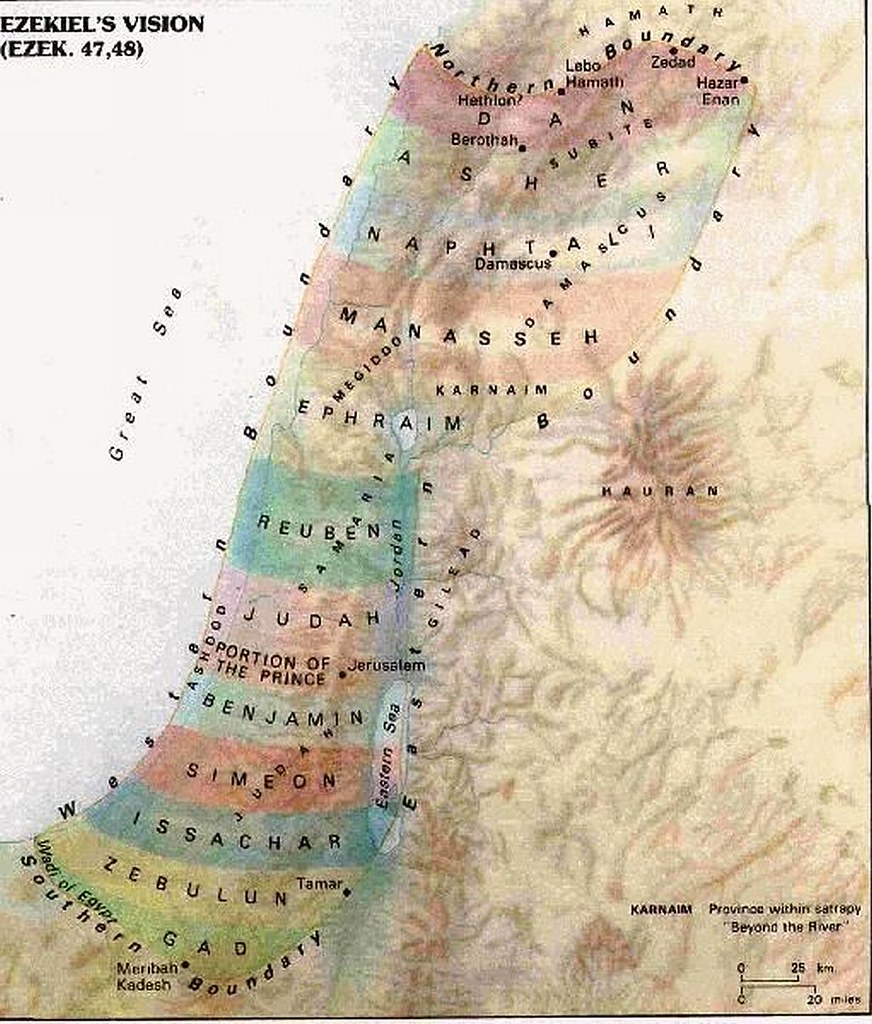
As Ezekiel pens his final chapters, there is no longer a nation of Israel. It was conquered. Its capital city and temple were destroyed. Zeke’s vision is of a restored Israel and a new allotment of a restored nation. No more division between north and south. He envisions one united nation in which each tribe gets an allotment of land that looks like a twelve-layered cake from top to bottom, north to south. Each tribe gets it’s own layer that’s roughly the same size as every other tribe. It is a vision of twelve family tribes living in peace and harmony. No disputes of bigger or smaller, there is equal inheritance. There is shalom.

And that brings me back to the fact that the entire Great Story from Genesis to Revelation is about God restoring shalom between Himself and humanity. It’s the way it was before a snake slithered into the Garden. It’s the way the Great Story ends with God and humanity living in perfect shalom in a new heaven, a new earth, and a new holy city. It is what God wants me to experience each day amidst the trials of living in a fallen world with other fallen individuals. It’s what God wants me to strive for and share with others.

In the quiet this morning, my spirit is reminding me of two men I know who grew up on family farms. Each of them got the shaft when it came time for the family farm to be passed to the next generation. Both men know the journey of grief, anger, and resentment that comes with that particular reality. Each of these men have shared with me their story, and they are both incredibly blessed, filled with joy in their lives and families. Both of them, disciples of Jesus, shared with me how they consciously and deliberately surrendered their will and desire to God. They let go of resentment, put their trust in God, and sought their inheritance from Him. Each of these men have ultimately prospered. Each has found and is experiencing shalom.

What Ezekiel is describing on a macro level as he finishes his prophetic book is what God wants me to experience on the micro level, right here, today.

Shalom, my friend. Have a good weekend.

If you know anyone who might be encouraged by today’s post, please share.

Shalom

Shalom! (CaD Ezk 47) Wayfarer

Then he led me back to the bank of the river.  When I arrived there, I saw a great number of trees on each side of the river. He said to me, “This water flows toward the eastern region and goes down into the Arabah, where it enters the Dead Sea. When it empties into the sea, the salty water there becomes fresh.
Ezekiel 47:6b-8 (NIV)

When most people hear the Hebrew word “Shalom” it is understood as a greeting like “Hello” or “Bonjour.” And that’s because “Shalom” is used as both a greeting and a departing salutation, more like “Aloha.” But what many people don’t know is that Shalom which is literally translated into English as “peace” has a meaning that cannot be simply contained by one comparable English word.

Shalom is a word that embodies a larger sense of wholeness, well-being, good health, rest and tranquility. It is both a greeting but also a blessing to the person to whom you say it. Shalom is derived from the root word “Shalam” which is used repeatedly in Exodus 21 and 22 regarding instructions for “making things right” between people when there has been material loss or injury. God was instructing his people to “make it right” (Shalam) which becomes the foundation for the wholeness, well-being, peace, rest, and tranquility of Shalom.

This is important in understanding what is being described in this vision Ezekiel is having of the restoration of his defeated and destroyed nation in these final chapters. On a macro level, everything Zeke is describing is the “making things right” on multiple levels. His vision is of ultimate Shalom.

In today’s chapter, there are three amazing concepts being communicated.

First, Zeke sees a river that flows out of the temple he’s just described. The temple is the source of a river of life that flows out of the temple into the Dead Sea and turns the Dead Sea into a living, flourishing source of life and provision for all. This foreshadows two things. First, it foreshadows Jesus, who says Himself that He is Living Water springing up to transform any who are dead in their sins to eternal life (or, you might say, ultimate Shalom!). It also foreshadows the vision John is given of the New Jerusalem in Revelation 21-22. In fact, I encourage you to read and compare the first part of today’s chapter with those last two chapters of the Great Story.

Second, in Zeke’s vision he’s given the general boundaries for the restored Promised Land that God had always promised to His people where they would find Shalom. Throughout the history of humanity, land means life. From the land we find security, shelter, provision, and prosperity.

Finally, and this is huge, God tells Zeke that “foreigners living among you” are to be considered “native-born Israelites.” In other words, there is no longer any distinction between Jews and the Gentile outsiders. God’s shalom is for everyone. Everyone becomes a child of Abraham. Everyone is given an inheritance of God. Everyone is an heir of the Divine. Everyone is given an allotment of God’s ultimate shalom.

In the quiet this morning, I am overwhelmed with God’s goodness and the desire He has expressed from the beginning for humanity to experience shalom. I’m reminded what Jesus told His followers just moments before His arrest and just hours before His execution. He told them that they can expect trouble and suffering in this world, but He also told them “Peace (Shalom) I leave with you; my peace (shalom) I give you. I do not give to you as the world gives. Do not let your hearts be troubled and do not be afraid.”

Yesterday morning, Wendy shared a song with me that I had never heard before (I’m really awful at keeping up with current culture!) by Jelly Roll called “I’m Not Okay“. I haven’t been able to get it out of my head. It gets to the heart of what Jesus was saying to His followers, to us, to me. Even when things are not okay, everything is going to be alright.

Shalom, my friend.

If you know anyone who might be encouraged by today’s post, please share.

Tearing Down Walls

Tearing Down Walls (CaD Ezk 46) Wayfarer

“‘The prince must not take any of the inheritance of the people, driving them off their property. He is to give his sons their inheritance out of his own property, so that not one of my people will be separated from their property.’”
Ezekiel 46:18 (NIV)

There was a fascinating article in the Wall Street Journal this past week about some of the political wrangling in the U.K. They have two “houses” in their government, too. However, their houses began with one being for the “common” people and the other being for those with a royal title. Today, the House of Lords does not look like it did when it was instituted but there is a certain percentage of members who are there because they inherited a royal title from a father or grandfather. There’s a push by the new Prime Minister to force them and push the old aristocracy into extinction.

This article came to mind this morning as I continued to read Ezekiel’s ideal vision of Israel’s restoration. Today’s chapter continues to provide instructions for how things are to function. There were two things that stand out with regard to “the Prince” and all the other people of Israel.

First, the Prince was to enter into the Temple with all of the other people, and he was to exit with all of the other people. No special entrances or VIP gate. The Prince is no different than any other person. In Ezekiel’s day, this was a radical idea.

A bit later in the chapter Zeke explains that the Prince has no power to take away anyone’s land and claim it for himself. This was a common practice in monarchies throughout history. In fact, hundreds of years before Ezekiel, the people of Israel wanted a king like all the other nations around them. The prophet Samuel warned them that a king would take whatever he wanted from them, whenever he wanted, including their land.

[A king] will take the best of your fields and vineyards and olive groves and give them to his attendants.
1 Samuel 8:14 (NIV)

In Zeke’s vision of how things can and should be, the Prince has his land that he can give to his descendants as he chooses, but he cannot take anyone else’s land “so that not one of my people will be separated from their property.’” This was a radical idea in Ezekiel’s day. The Prince is no different from the common every day citizen. Every family has their allotment that cannot be taken away.

In the quiet this morning, I think about this game that humanity has played throughout history. We divide people into distinctions of royal and common, aristocrats and bourgeoisie, Popular and losers, blue bloods and the masses, elites and the lower class. Even today, I can own my own land and have it taken away by eminent domain.

Not only that, but along my journey I’ve observed that even here in the States, where we supposedly have done away with old forms of monarchy and aristocracy, we still essentially turn our Presidents, politicians, and celebrities into royalty. What is it in humanity that perpetually builds these distinctions?

As a disciple of Jesus, I can’t help to think about the fact that Jesus came to build on this seed that Ezekiel’s vision is planting and do something new. Jesus came to tear down distinctions of race, class, and gender:

There is neither Jew nor Gentile, neither slave nor free, nor is there male and female, for you are all one in Christ Jesus.  If you belong to Christ, then you are Abraham’s seed, and heirs according to the promise.
Galatians 3:28-39 (NIV)

This begs two questions of me:

Where have I, or my culture, rebuilt a wall of distinction that Jesus purposefully tore down?

How can I personally tear it back down in my heart, mind, and actions?

If you know anyone who might be encouraged by today’s post, please share.

If Only…

If Only… (CaD Ezk 45) Wayfarer

“‘This is what the Sovereign Lord says: You have gone far enough, princes of Israel! Give up your violence and oppression and do what is just and right. Stop dispossessing my people, declares the Sovereign Lord.’
Ezekiel 45:9 (NIV)

When you live in Iowa your entire life and feel a civic responsibility, there’s a certain mindshare that politics and national issues take up. Certainly the Iowa Caucuses are a major part of that. A year ago you could meet and hear any number of the Presidential candidates right here in our little town. Usually the venue is packed.

Hearing the issues the candidates talk about and how they plan to address large scale, complex problems stirs thoughts about how one might re-order the world. Approach an issue one way and you create one negative consequence. Approach the same issue a different way and you create a different negative consequence. Pretty soon I begin to have “If only” thoughts and conversations in my head.

“If only we could eliminate the Tax Code and start from scratch.
“If only the Founding Fathers had included term limits.
“If only we could rid the entire system of corruption.”

In the past few chapters, Ezekiel envisioned an ideal new Temple that has , to this point in history, never been built. I discussed the various interpretations regarding why it has never been built in the post/podcast on Ezekiel 43 entitled The Mystery. In today’s chapter, Ezekiel’s vision now shifts to an idealized vision of the restoration of Israel. I have to remember that as Ezekiel is having this vision the nation had been conquered, Jerusalem and Solomon’s Temple had been destroyed. It’s as if there’s now an opportunity to envision how things could be “if only” they can return and start from scratch.

This idealized vision of their nation’s restoration begins with “when you allot the land” because security and prosperity begin with having land to build homes and grow crops and raise livestock necessary to survive and thrive. And the first allotment of the land described is God’s. It’s a giant, square sacred space at the center of everything and the center of that square is God’s sanctuary. Adjacent to it is a new square holy city within the giant square and Zeke says, “it will belong to all Israel.”

So we have a nation with this giant sacred space and God at the center. There’s also holy city. All of this land doesn’t belong to the king, land barons, property developers, oligarchs, or powerful blue blood families. It belongs to everyone.

Throughout the Great Story, beginning in Exodus, God has been trying to provide humanity with a vision for how things can and should be. But there’s a pesky issue that has to be addressed. Zeke addresses it right up front in verses 9-12. The princes of the past have been power hungry, greedy, and corrupt. And, this is always the problem when you begin to play “If only…” games in your head and dream up ideal situations.

People are not always ideal. We have pride and out of control appetites that make us hurt one-another with our selfishness, anger, jealousy, envy, and hard-hearted resentments. This the thing that I always find missing when candidates talk about systemic changes to fix complex problems. Solutions start with a change in the hearts and lives of people.

That’s what Jesus would come to tell us. Large, systemic changes begin with God changing me.

If only I will surrender and allow Him to do so.

If you know anyone who might be encouraged by today’s post, please share.