Tag Archives: Power

Revelation

Son though he was, he learned obedience from what he suffered and, once made perfect, he became the source of eternal salvation for all who obey him and was designated by God to be high priest in the order of Melchizedek.
Hebrews 5:8-10 (NIV)

I have of late been making my way through all seven books of the Harry Potter epic. I just finished the fifth book, Harry Potter and the Order of the Phoenix, which I sometimes find to be the least enjoyable but have always found to be the most profound in its understanding and expression of the differences between good and evil.

The book concludes with a climactic battle. The evil antagonist, Voldemort, is doing everything in his power to escape death and achieve immortality. He even proclaims amidst the battle that “there is nothing worse than death.” To which the ever-wise sage, Dumbldore, replies, “Yes, there is.” Throughout the book, Harry suffers many things on many different levels from the agonies of a failed teen romance, to heinous oppression and physical suffering at the hands of institutional evil, to the death of the one person he cares for most in the world.

As Dumbledore debriefs with Harry at the conclusion of the book, he shares with Harry about a deep and ancient magic that the evil Voldemort fails to understand, the magic that Harry’s mother accessed the moment she sacrificed her own life for Harry’s when he was an infant. The wise headmaster then explains to Harry another paradoxical truth that evil fails to understand. It is Harry’s suffering that is his greatest strength.

Today’s very short chapter is so packed full of deep and important truths from the Great Story that I’ve sat in the quiet for a long time trying to discern how best to express them. The author speaks to his audience of Jewish believers in Jesus, themselves suffering at the hands of institutional evil, about Jesus who is the “Great High Priest.”

For the Jewish believers, the paradigm of a high priest was well-known to them. It was part of the religious ritual they’d known their whole lives. The high-priest was the only one who entered the most holy place in the temple once a year to make atonement for the sins of the people. The priests were always a descendant of Moses’ brother, Aaron.

But, the author reveals that there is mysterious, ancient priestly order that came before God gave the Law through Moses and the human priesthood was established. This mysterious ancient order is tied to an equally mysterious king-priest who appears momentarily in Genesis 14. His name was Melchizedek. Jesus, the Son of God, was not an earthly priest in the order of Aaron, but an eternal and royal high priest in the order of Melchizedek.

He then goes onto explain that what marked Jesus as the Great High Priest, was not power and glory. Power and glory are what evil and the Kingdoms of this world care about most. What marked Jesus as the Great High Priest of God’s Kingdom was his humility, obedience, and suffering.

The author then issues a gentle rebuke to his readers. There is so much more depth and spiritual truth to unpack in this, but his readers aren’t ready for it because they “no longer try to understand.” The Greek word hints at being sluggish and lazy. Along my journey, I’ve come to realize that there are certain spiritual truths that require effort, pursuit, experience, and even suffering in order for them to be revealed. Jesus said, after all, that the things of God’s Kingdom are not for the sluggish and lazy, but for those who ask, seek, and knock — even suffer.

It is at the end of Harry Potter and the Order of the Phoenix that the truth is finally revealed to Harry regarding his past, his scar, his place in the story that is unfolding, and the realities that await him in the battle against evil yet to come.

Sometimes the deepest and most important spiritual truths only reveal themselves in suffering.

If you know anyone who might be encouraged by today’s post, please share.

Promotional graphic for Tom Vander Well's Wayfarer blog and podcast, featuring icons of various podcast platforms with a photo of Tom Vander Well.
These chapter-a-day blog posts are also available via podcast on all major podcast platforms including Apple, Google, and Spotify! Simply go to your podcast platform and search for “Wayfarer Tom Vander Well.” If it’s not on your platform, please let me know!
An orange and white logo featuring an open book with the text 'Bible Gateway' below it.

Earthly Kingdoms

Go ahead, then, and complete what your ancestors started!
Matthew 23:32 (NIV)

The eyes of the world have shifted to Rome in recent weeks. Tomorrow, the Vatican’s College of Cardinals will begin their conclave to elect a new pope to succeed Pope Francis I. In my humble opinion, the Roman Catholic church is, in many ways, successor to the religious earthly kingdom that Jesus faced off against in His final days. The College of Cardinals in their fine robes and red hats will convene in all their pomp under the priceless artwork of Michelangelo in the Sistine Chapel to hold their secret election.

Make no mistake, it is an earthly kingdom. The Roman Catholic church is the largest land owner in the world. The Vatican is its own nation. In recent weeks I read of one Catholic bishop who spoke out about the rise of anti-immigrant sentiment and the need to minister to the world’s immigrants and refugees. In the next sentence he decried the fact that the Roman Catholic church does not have the funds to do so and requires the generosity of others to the support the efforts. That said, the Roman church is the owner of countless priceless works of art. The Vatican bank has billions in assets. Then there is all that land it owns.

It seems to me that the hypocrisy of the religious kingdom of the high priests and Pharisees in today’s chapter is an apt description of the Vatican kingdom.

That said, in today’s chapter Jesus concedes that the ones He criticizes “sit in Moses seat.” He begins His critical diatribe by telling His followers to submit to their authority. It is a similar conundrum when Paul tells the believers in Rome to submit to all governmental authority (Rom 13:1-7) when it is that same authority who will imprison Paul and chop off his head. Being a citizen of the eternal Kingdom of God while living this life of temporal earthly exile creates such fascinating and complex realities.

I continued meditate on the events of today’s chapter with the wide-angle lens I used in yesterday’s chapter when Jesus crushed His debate opponents, the pompous religious power brokers of the Temple in Jerusalem, 5-0 and left them licking their wounds of humiliation back in the locker room. Jesus now turns to the crowd and lets loose with a message of seven woes of criticism for the Temple religious leaders.

The most powerful of his opponents were not present, but his opponents and their political minions were as prevalent as priests and nuns in the Vatican. In the crowd were political spies. It was also true that within the powerful party of Pharisees were some who were loyal to Jesus like Nicodemus and Joseph of Arimathea. Perhaps they remained when their colleagues retreated to the locker room.

The seventh and final woe in Jesus complete list of hypocrisies is the fact that is was His opponents forebears who had martyred God’s righteous and His prophets “from Abel to Zechariah” which is like when I write “from Genesis to Revelation.” Jesus is once again making a huge and sweeping historical generalization. This religious system that is supposed to be God’s representatives on Earth, will instead execute God’s own Son. Jesus knows it is coming. He tells His opponents to “complete what your ancestors started.” He then foreshadows that the killing will not end with Him. They will execute the apostles, prophets, sages, and teachers that He will send to them after His ascension. His opponents will hunt them down and execute them, as well. The book of Acts bears witness to the veracity of Jesus’ prophetic words.

In the quiet this morning, I find myself once again pondering the complexity and conundrums of being a disciple of Jesus, a citizen and ambassador of God’s eternal Kingdom in this fallen world under the dominion of the condemned but very present Prince of this World. The realities Jesus faced in the conflicts of the final week of His earthly journey are still very real, still very present in our current human realities.

I am subject to corrupt human authorities in many different human systems from family, to religion, to government. My role as a disciple of Jesus and ambassador of heaven is to do the very thing Jesus told His followers in today’s chapter:

“So you must be careful to do everything they tell you. But do not do what they do.”

I don’t control large, complex human systems of government and religion, though I have tremendous influence on the small human systems of family, business, and local community. My role is to follow Jesus’ example in my circles of influence, cultivating and bearing the fruit of God’s Spirit in my daily words, actions, and relationships. As I do this, I mindfully pray for leaders, representatives, and a College of Cardinals in Rome. May they also be mindful of being fruitful disciples of Jesus in their much more powerful and influential circles of influence.

If you know anyone who might be encouraged by today’s post, please share.

These chapter-a-day blog posts are also available via podcast on all major podcast platforms including Apple, Google, and Spotify! Simply go to your podcast platform and search for “Wayfarer Tom Vander Well.” If it’s not on your platform, please let me know!

Recitation and Relationships

Recitation and Relationships (CaD Matt 18) Wayfarer

“This is how my heavenly Father will treat each of you unless you forgive your brother or sister from your heart.”
Matthew 18:35 (NIV)

Every week our local gathering of Jesus’ followers says The Lord’s Prayer together. As we do, Wendy and I tend to paraphrase the traditional language a bit on our own. I think it’s funny and fascinating that the institutional church chooses to update the wording of certain things (music, translation of the Bible, the wording of the Apostle’s Creed, and etc.) but not others. Please don’t read what I’m not writing. I don’t think there’s anything particularly wrong or right. It’s the kind of ecclesiastical hair-splitting that have, for too long, gotten people’s undies in a bunch and caused more harm than good.

I see both sides of traditional words and phrasing for well-worn passages. Sometimes the traditional, yet out-of-date, wording is like a comfy old sweatshirt that wraps you in the warmth and comfort of something familiar which has been with you and seen you through long stretches of life’s journey. On the other hand, I have often found that as I press into new and unfamiliar stretches of life’s journey, I am challenged to address new and extraordinary circumstances that require me to find new layers of wisdom in traditional thoughts and meditations.

And, as the Bard famously said, “there’s the rub.”

I know, personally, that when I recite the same words over and over and over again, they begin to lose their potency. I’m just going through the motions. So, I tend to do what I was taught as I studied acting. You take the memorized line of a script and play with it, emphasizing a different word or phrase with increased inflection with each subsequent recitation. As I am fond of saying, metaphors are layered with meaning, and often as I emphasize and change my inflection with different words in the oft repeated sentence, it makes me consider different ways of considering the same words or phrases.

One of the phrases of The Lord’s Prayer that has taken on increased meaning for me as I have practiced this is: “and forgive us our sins, as we forgive those who sin against us.” This is a request with a stated acknowledgement of reciprocal relational responsibility. I’m asking God to forgive my sins, while acknowledging that I can only expect to be forgiven to the degree I am willing to forgive those who have wronged me.

In today’s chapter, Jesus unpacks this uncomfortable spiritual principle in a parable. A king has a servant who owes him a thousand dollars he has never been able to pay. Upon the pleading of the indebted servant, the king mercifully forgives the debt. This same man exits the kings chamber and runs into a fellow servant who owes him ten bucks. He goes postal on the dude, demanding the ten-spot without even considering the weight of debt from which he’d just been graciously and mercifully freed. The king finds out about the hypocrisy, hauls the ungrateful servant into his court and had him tortured until he paid every cent he was owed.

Now comes the intense and uncomfortable part. Jesus follows up this parable by stating quite directly: “This is how my heavenly Father will treat you, Tom, unless you forgive your brother or sister from your heart.”

Ouch. Hello, sobering Monday morning meditation. When I recited those famous words with my fellow followers yesterday, there’s potent spiritual punch lurking behind the well-worn words. Forgive me God, just as I have forgiven those who’ve sinned against me. Wait a minute. Maybe there are some heart and relationship matters I should have addressed before I showed up in my Sunday best to go through the religious motions.

In the quiet this morning, I find myself entering another work week thinking about my relational realities in light of my religious recitations. If there’s a disconnect between the two, then the latter was an impotent ritual. That’s the thing about a cozy old sweatshirt. If it becomes threadbare and filled with holes, it has lost its ability to accomplish the original purpose.

If you know anyone who might be encouraged by today’s post, please share.

These chapter-a-day blog posts are also available via podcast on all major podcast platforms including Apple, Google, and Spotify! Simply go to your podcast platform and search for “Wayfarer Tom Vander Well.” If it’s not on your platform, please let me know!

He Walked Away

He Walked Away (CaD Matt 16) Wayfarer

A wicked and adulterous generation looks for a sign, but none will be given it except the sign of Jonah.” Jesus then left them and went away.
Matthew 16:4 (NIV)

Early in my life I worked for many years in Christian bookstores hawking Christian books, music, and decorative trinkets. Along the line, I had the opportunity to observe how the Christian publishing, recording, and marketing world worked. In those days, Colorado Springs, Colorado was the hotbed of Christian organizations. In recent years, Nashville has become the hub for the hottest Christian authors, podcasters, and recording artists. It is a business. I learned that there is a way the game is played. For a period of time I had a cheap seat from where I got to observe it.

Along my chapter-a-day journey over the years, I’ve learned that spiritual lessons are found in Jesus’ actions as well as His words.

In yesterday’s post, I noted that the “big dogs” from Jerusalem had been dispatched to check out Jesus. Jerusalem was the Colorado Springs or Nashville of Judaism in that day. Jerusalem was a “Who’s Who” of the powerful movers and shakers in the Jewish establishment. Jerusalem had the best teachers, like a famous dude named Gamaliel. In fact, among Gamaliel’s prize students is an up-and-coming young prospect named Saul of Tarsus. Saul is from a wealthy and prominent Greek family who are Roman citizens. Impressive. Jerusalem is where it’s at for anyone wanting to be anyone as a famous teacher in Judaism.

Jesus wasn’t there. Jesus chose to focus His ministry in rural areas around the Sea of Galilee. He only went to Jerusalem on pilgrimages during festivals. His disciples weren’t well-educated, wealthy, or impressive. But Jesus was making big waves in the backwaters of Galilee, so the powerful establishment had to send a scouting party to check Him out. Yesterday they criticized Jesus for not toeing the line of tradition. He called them hypocrites.

In today’s chapter, they purposefully “test” Jesus. After-all, the word that had reached Jerusalem was all about Jesus performing miracles, healing the sick, and raising the dead. They came for The Show. The corporate execs back at the Home Office expect a full report on whether this podunk preacher is the real deal. Do they fast-track Him for stardom and offer Him a contract? Is He a threat that needs to be dealt with? They have an establishment to run and it runs a certain way.

So, the scouts “test” Jesus and ask for a “sign.” They want to see a miracle. They want to know if the stories are true. They have reports to file. The moguls back at the Temple will demand an accounting.

Jesus simply refuses. He walks away.

Later in the chapter, Jesus asks His disciples what “everyone” is saying about Him. The boys report that some were saying He was John the Baptist risen from the dead (that was Herod’s view). Others said that He was Elijah returned to earth (Elijah had been taken up to heaven in a tornado, and Malachi famously prophesied his return someday). Notice that John the Baptist seemed to have more PR “cred” with the masses and the establishment than Jesus at this point. Jesus was still, in many ways, a complete unknown.

Jesus tells his rag-tag group of nobody disciples to be wary and critical of the big dogs from Jerusalem, their establishment, and the games they play for power, prestige, wealth, and influence. God’s ways are not their ways. They want a “show,” Jesus said, but the only show He’s going to give them is to spend three days in the grave (like Jonah in the belly of a fish) and then showing up very much alive.

In the quiet this morning, I find myself once again blown away by the contrast Jesus purposefully created by what He did, where He hung out, who He chose as His disciples, and the kingdom of religion of His day. He was anti-establishment. He consciously chose to ignore those who could hand Him popularity, fame, and a whole new market for His teaching and miraculous ministry tours. In yesterday’s chapter, when the Big Dogs showed up, Jesus took His disciples and went north, further away from Jerusalem to Tyre and Sidon, a non-Jewish region full of heathens where the Jews would never follow.

The further I get in my life journey, the more convinced I’ve become that God’s plans and purposes don’t look anything like what the world tells me I should be chasing after. Jesus’ response to the power brokers of His day was to ignore, walk away, and then remind His followers that being His disciple was not a path to riches and fame, but humility, suffering, and death.

Am I willing to follow Jesus as He simply ignores the world and walks away?

If you know anyone who might be encouraged by today’s post, please share.

These chapter-a-day blog posts are also available via podcast on all major podcast platforms including Apple, Google, and Spotify! Simply go to your podcast platform and search for “Wayfarer Tom Vander Well.” If it’s not on your platform, please let me know!

Amidst the Conflict

Amidst the Conflict (CaD Matt 12) Wayfarer

Anyone who speaks a word against the Son of Man will be forgiven, but anyone who speaks against the Holy Spirit will not be forgiven, either in this age or in the age to come.”
Matthew 12:32 (NIV)

My heart is heavy and sad this morning. I have recently found myself in the midst of many conflicts. I don’t like conflict. I confess that I don’t do it particularly well. I happen to be married to an Enneagram Type 8 for whom conflict is a form of intimacy. I, as an Enneagram Type 4, find that conflict triggers my deep sense of shame. It means we’ve had to learn some creative dance moves when it comes to conflict.

The conflict I’ve been experiencing lately is not with Wendy, however. It’s not really even with me. It’s within a human system of which I’m a part. Members of that system are drowning in negativity toward others. When I have to be around it I’m left feeling like my soul is soiled. It’s like I crave a spiritual and emotional shower. Even if I take one, I’m left with an acute sense of sadness as I’m drying off.

Perhaps it’s a bit of synchronicity that today’s chapter is focused on the conflict between Jesus and his most caustic critics. Ironically, it was the institutional religious establishment who led the opposition to Jesus. The Pharisees, in particular, were a powerful political constituency in the leadership of the Hebrew religious system of that day. Matthew offers a trinity (there’s that number three again from Matthew the Quirk) of episodes highlighting the conflict. Matthew focuses on the religious leaders motives:

“But the Pharisees went out and plotted how they might kill Jesus.”

“But when the Pharisees heard [that Jesus healed a demon possessed man], they said, “It is only by Beelzebul, the prince of demons, that this fellow drives out demons.”

“Then some of the Pharisees and teachers of the law said to him, ‘Teacher, we want to see a sign from you.'”

What Matthew makes obvious is that there was zero openness to Jesus’ teaching. They viewed Jesus as a threat. He was a wrench in the human religious system they controlled; A system that was the source of their personal power. Everything they did was motivated by a self-centered desire to maintain personal control of the system that fed their ego, social status, and religious self-righteousness. Theirs was a system of exclusivity and strict adherence to social, cultural, and traditional norms. Jesus was an outsider. He didn’t fit any of the norms, and He possessed both power and authority that threatened them. Whenever a fundamentalist system built on exclusivity encounters such as threat, it will always circle the wagons and declare the threat evil.

What struck me this morning as I read these three episodes is the contrast between Jesus’ actions and teachings and the reactions of his enemies. His disciples, hungry, simply and casually slid their hands over heads of grain as they walked through the field in order to have a snack. A man with a hand shriveled and disfigured is miraculously healed. A demon-possessed man is freed from the evil that had captured and kidnapped his body and soul.

These are all good things.

Jesus’ enemies declares them all evil.

In the midst of Jesus’ response, He famously mentions that there is one sin that is unforgivable, and that is to “speak against” the Holy Spirit. What does that mean? It means exactly what His opponents are doing. To look at something good and call it evil. To oppose what God is doing with selfish motives. To exclude those whom God loves and in whom God is working for personal gain and self-satisfaction.

Which brings me back to my sadness. The personal attacks. The whispered, salacious accusations. The threats used as systemic leverage. I’m reminded this morning that Jesus’ death and resurrection did not change evil. For now, evil remains and perpetuates the same systemic paradigms that Jesus faced in today’s chapter. What Jesus’ death and resurrection did change is me. As a disciple of Jesus, I am called to navigate, be present, and participate in broken human systems and the evil I find within them in order to bring the power and presence of God’s love and shalom as I best as I am able.

I confess that most of the time I don’t want to do so.

Did I mention that I hate conflict?

In the quiet this morning, God’s Spirit whispers to my spirit: “Whoever wants to be my disciple must deny themselves and take up their cross and follow me.” I guess that means following Him into unhealthy human systems in which evil wreaks havoc and perpetuates conflict.

The words of an old hymn rise from the memory banks in reply as I contemplate Holy Week next week, and as I think about Good Friday in seven days:

King of my life, I crown thee now.
Thine shall the glory be.
Lest I forget thy thorn-crowned brow
Lead me to Calvary.
Lest I forget Gethsemane.
Lest I forget Thine agony.
Lest I forget thy love for me,
Lead me to Calvary.

If you know anyone who might be encouraged by today’s post, please share.

These chapter-a-day blog posts are also available via podcast on all major podcast platforms including Apple, Google, and Spotify! Simply go to your podcast platform and search for “Wayfarer Tom Vander Well.” If it’s not on your platform, please let me know!

Best of ’24: #7 The Gospel According to Harry Potter

The Gospel According to Harry Potter (CaD Rom 8) Wayfarer

For I am convinced that neither death nor life, neither angels nor demons, neither the present nor the future, nor any powers, neither height nor depth, nor anything else in all creation, will be able to separate us from the love of God that is in Christ Jesus our Lord.
Romans 8:38-39 (NIV)

Our daughters were the perfect age to get in on the original Harry Potter craze. Taylor turned nine the year that Harry Potter and the Sorcerer’s Stone hit number one on the New York Times Bestsellers List. She was roughly the same age as Harry, Ron, and Hermoine as the subsequent books were annually published. She and Madison literally grew up with these characters.

In yesterday’s post/podcast, I wrote about religious rulekeepers. Religious rule-keepers, by the way, are often reactionaries. They are quick to condemn at a distant whiff of impropriety. When the Harry Potter craze took off, they got themselves into a lather. I have learned along my life journey that when the Christian rule-keepers get into a lather, I should definitely check out what they’re upset about because I’ll probably love whatever it is they hate. This was certainly true with the Harry Potter books.

I have always held that all great stories are a reflection of the Great Story, and I found this to be true with Harry Potter. It is an epic story of good and evil set in an entertaining fantasy world just like The Chronicles of Narnia (which has witches, by the way) and Lord of the Rings (which has wizards, by the way) and A Midsummer’s Night Dream (which, by the way, has a talking donkey just like the Bible).

In today’s chapter, Paul writes of the supremacy of Christ’s love. When a person is baptized into Jesus and joined with Christ’s Spirit, they are filled with and surrounded by Love. Once this happens, Paul writes, “There is no more condemnation.” Not only that, but we can’t be separated from that Love by anything. As Paul described it to Jesus’ followers in Corinth: “It always protects, always trusts, always hopes, always perseveres.”

In Harry Potter, it was the sacrificial love of his mother, who gave her life to protect her baby from evil that made Harry special. The wise sage Dumbledore forever tries to help Harry understand that it is the power of love that will ultimately defeat evil, though Harry simply can’t see it until it proves true in the end. What a beautiful story that illustrates the very Love that Paul is talking about in today’s chapter. A sacrificial Love that indwells, protects, perseveres, and conquers the darkness. A Love from which I can never be separated, even by darkness or demons.

In the quiet this morning, I found myself meditating on the fact that we so often discount the power of Love in a world where power is demonstrated by wealth, status, authority, influence, leverage, and force. Just like Harry, who dismisses Dumbledore’s assurance of love’s conquering power, it’s easy for me to feel that love seems to pale in comparison. Perhaps one could argue that it does pale in terms of this world’s perspective. As C.S. Lewis famously concluded, however, I was not made for this world. I was made for a Kingdom that is not of this world in which Love reigns supreme.

As a follower of Jesus, I am told that while I may not have been made for this world, I am in this world for a purpose. That purpose is to represent that eternal Kingdom in this fallen world, by loving others, even my enemies and those who have been deceived by evil. By the way, this is exactly how Dumbledore loved Draco by sacrificing himself to protect the young man from doing an evil thing that would haunt him for the rest of his life.

If you know anyone who might be encouraged by today’s post, please share.

These chapter-a-day blog posts are also available via podcast on all major podcast platforms including Apple, Google, and Spotify! Simply go to your podcast platform and search for “Wayfarer Tom Vander Well.” If it’s not on your platform, please let me know!

Paul & the Prisoners of Rome

Paul & the Prisoners of Rome (CaD 1 Cor 4) Wayfarer

We work hard with our own hands. When we are cursed, we bless; when we are persecuted, we endure it; when we are slandered, we answer kindly. We have become the scum of the earth, the garbage of the world—right up to this moment.
1 Corinthians 4:12-13 (NIV)

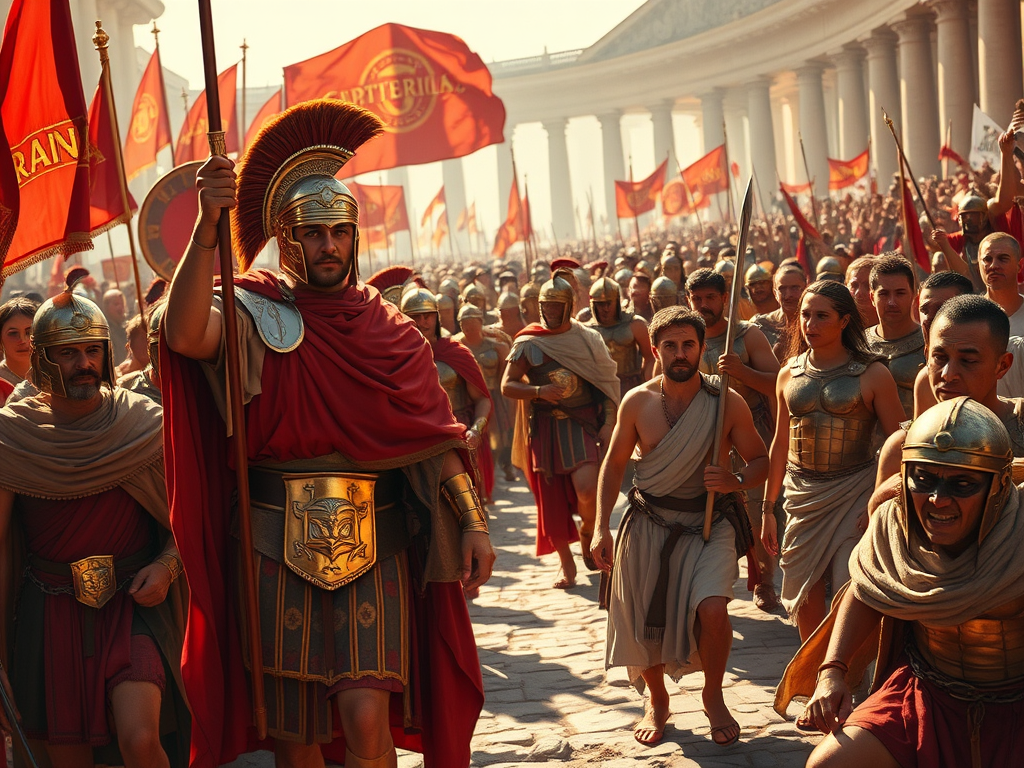
In ancient Rome, successful military conquests and campaigns ended with a triumphant homecoming parade. It was spectacle on a grand scale and the crowds loved it. The victorious general would lead his legion through the streets with their banners flying while the masses lined the streets and cheered.

Of course, every parade has to end, and in this case, at the end of the Roman victory parade were the prisoners of war, chained, beaten, and condemned. What a sharp contrast to the glorious, polished and pompous army who had just inspired and energized the adoring crowd. The prisoners provided the Roman masses with the opportunity to gloat in Roman greatness and bask in schadenfreude at their worthless enemies. The prisoners could be mocked, jeered, and pelted with whatever rocks or refuse was available along the street. In many cases, they’d already suffered abuse at the hands of their captors. They’d been ill-treated and marched for hundreds of miles against their will.

Ultimately, these prisoners would be marched to the Roman arena where, to the delight of the Roman crowds, they would face a horrific death. Among the most popular with the Roman masses was watching people getting ravaged and eaten by packs of wild beasts who had been starved in preparation for the occasion. But that wasn’t enough. The Romans would build contraptions that gave prisoners a false hope of being able to climb and escape from the beasts, but they were rigged to fall apart or fail, giving the crowds a little extra entertainment.

In yesterday’s post, I wrote about our human penchant for turning leaders into celebrities. In today’s chapter, Paul turns that entire notion on its head. He compares himself, and his fellow apostles to one of Roman prisoners being drug through the streets at the end of the parade. And, it wasn’t total hyperbole. When you study the persecution, punishment, and injustice that Paul and his fellow apostles endured, it’s both astounding and gut-wrenching.

Which makes his attitude even more amazing to me. “When we are cursed, we bless; when we are persecuted, we endure it; when we are slandered, we answer kindly.” Which, is not only what Jesus taught, but what Jesus exemplified as He was bound, beaten, mocked, and unjustly executed in a horrific way.

The struggle, of course, is to even connect with these realities here in my 21st century reality. I live in the most affluent country in the world in arguably the greatest time to be alive in human history. So, what am I supposed to take away from Paul’s reality and example?

First, I’m taking perspective with me into this day. I can list every single trouble, worry, or anxiety I might be feeling and then consider a Roman prisoner-of-war’s reality, Paul’s reality, and Jesus’ reality. Talk about a reality check. What am I complaining about?

Second, even in my own rather comfortable realities, I can think of specific instances of people being unkind towards me, unjustly accusing me of things, and using their power or influence against me. What’s my response?

Anger, vengeance, retribution, playing the victim card?

Or, like Paul, do I bless, endure, and answer kindly?

That, is a reminder I need every day.

If you know anyone who might be encouraged by today’s post, please share.

These chapter-a-day blog posts are also available via podcast on all major podcast platforms including Apple, Google, and Spotify! Simply go to your podcast platform and search for “Wayfarer Tom Vander Well.” If it’s not on your platform, please let me know!

Anonymous Cogs

Then the chief priests, the teachers of the law and the elders looked for a way to arrest [Jesus] because they knew he had spoken the parable against them. But they were afraid of the crowd; so they left him and went away. Later they sent some of the Pharisees and Herodians to Jesus to catch him in his words.
Mark 12:12-13 (NIV)

Many years ago I stumbled upon a business blogger who went by the pseudonym Anonymous Cog. “AC” was one of those front-line minions in the institutional labyrinth known as corporate America. His vocation was fodder for the comic strip Dilbert and he blogged about the daily travails of being an “anonymous” cog in the giant corporate machine. AC and I began a back channel correspondence. I almost instantly recognized a kindred spirit in his words. Now, whenever I see people working inside of any human institution, I think to myself: “Anonymous cogs.”

Enneagram Type Fours are often known as the Individualists, and that’s me. Along my life journey, one of the things that I’ve learned about myself is that I’m typically (not always) better off when I am able to operate independently. Whenever I’ve found myself operating inside a large bureaucratic system it brings out a rebellious streak in me because they are typically full of silliness, foolishness, inefficiency, and injustice. They become insularly focused on power, internal politics, and of course money.

The Great Story is, at the heart of it, about an eternal conflict between the Kingdom of God and human empire. I’ve observed that human empire can be embodied in an individual human being, but it’s easiest to see it at work in the large institutions of this world. This includes, but is not limited to, the worldly kingdoms of government, commerce, finance, labor, academia, and even religion.

In today’s chapter, Mark is careful to name all of the institutional cogs that had set themselves up against Jesus. He names chief priests, teachers of the law, elders, Pharisees, Sadducees, and Herodians. Jerusalem was a regional seat of power, not only for religion, but also for government and commerce. The Roman Empire, the regional government of Herod, and the Chief Priests of the temple were all separate institutional powers who fought for wealth, clung to power, and controlled the lives of the anonymous cogs living in the region. These institutions held a constant and uneasy tension in the flow of power and wealth.

Jesus was a wrench in the works for all of them.

The clearing of the money-changers out of the Temple courts was Jesus’ way of shining a holy light on the corruption of the religious institutional human empire that the Hebrew leaders had assembled at the Temple. The crowds Jesus was drawing and Jesus’ sharp criticism was a potential powder keg. If riots broke out it would bring down the wrath of Rome, and that threatened both the power and money that flowed out of the Temple and into the hands of Herod and the Chief Priests.

The Son of God, an upstart outsider from rural Galilean backwaters, stands alone against the human institutional empires of government, commerce, and religion. That’s the picture that Mark is painting for us in today’s chapter. One of the things I’ve observed along my life journey is that human empires will always attempt to crush or eliminate any anonymous cog who threatens their system or the power and wealth of its leaders. I refer you to any daily news outlet for evidence.

In the quiet this morning, my individualist heart is stirred by this David vs. Goliath scenario that emerges from Mark’s stylus and the events he reports. At the same time, I have to return to what I wrote just a few paragraphs back. Human empire can exist in me. My individualism can be transformed into a personal empire with me on the throne of my own life, rigging everything I control to consolidate the flow of power, wealth, status, influence, and appearances so that it benefits me above all else. If I allow this to happen, I become a microcosm of the very institutional worldly empires that stand in opposition to God’s Kingdom. The anonymous cog becomes emperor of his own world.

Jesus calls me to live a Kingdom of God life amidst a world of human empires. He calls me as His disciple to seek after eternal things rather than temporal things. He calls me to serve rather than expect to be served. He tells me to be extravagant in my generosity rather than hoard things and money for myself. He calls me to humbly surrender my personal desires rather than demand my own way.

Kingdom of God or personal human empire? That’s the daily conflict. Every day I choose a side.

If you know anyone who might be encouraged by today’s post, please share.

These chapter-a-day blog posts are also available via podcast on all major podcast platforms including Apple, Google, and Spotify! Simply go to your podcast platform and search for “Wayfarer Tom Vander Well.” If it’s not on your platform, please let me know!

Of Motives and Outcomes

So Herodias [King Herod’s wife] nursed a grudge against John [the Baptist] and wanted to kill him. But she was not able to, because Herod feared John and protected him, knowing him to be a righteous and holy man. When Herod heard John, he was greatly puzzled; yet he liked to listen to him.

The king was greatly distressed, but because of his oaths and his dinner guests, he did not want to refuse her. So he immediately sent an executioner with orders to bring John’s head.

Mark 6:19-20, 26-27 (NIV)

Along my life journey, I’ve been a part of a handful of regular gatherings of Jesus’ followers that drew large crowds, in a large part, because of the gifted teaching and/or charismatic personality of the leader. Looking back, I find each one of the experiences to have been a living parable of one form or another. Man, do I have some stories.

As I revisit every one of these experiences in my memory, I can quickly conjure the names and faces of individuals who were a regular part of the gatherings. These individuals were prominent members of their communities, leaders of commerce, local government officials, affluent, and influential. I observed over time that many of these individuals led lives that were unabashedly incongruent with Jesus’ teachings. I mention this, not in judgement, because I didn’t know them intimately nor did I know their stories. I was always glad they were interested enough to be there. I rarely, however, witnessed much, if any, change in these individual’s lives in response to what they heard.

This came to mind this morning as I read about King Herod Antipas and Jesus’ cousin, John the Baptist. John was a wildly popular preacher. Crowds regularly flocked to hear him preach in the wilderness and to be baptized. King Herod was intrigued and fascinated by the rogue, prophetic, wild man. He liked to hear the preacher. He even carried a deep level of respect for the man.

It’s important to know that Herod, along with his father (Herod the Great) were card-carrying members of the Jewish faith. This was, of course, politically expedient since they ruled over a constituency that was mostly Jewish. Herod, however, did not live like he gave two-bits about the Law of Moses and how God prescribed for His people to live. So, when Herod married his own brother’s wife, John loudly and publicly call him out on it. Herod found it expedient to arrest John to manage PR and control the narrative.

What’s fascinating about the story is that even with John in prison, Herod protected John, and even gave him audience. Mark describes that Herod respected that John was the real deal, a sincere and holy man of God.

Nevertheless, when Herod’s step-daughter performed a dance for him at a party full of the rich and influential brokers you’ll find at the center of any worldly center of power, John makes the mistake of offering her up-to half his kingdom as a reward for her amazing performance. At her mother’s suggestion, she chooses the head of John the Baptist, and he reluctantly delivers.

And this brings me back to those rich and influential local brokers I’ve observed gathering around talented and charismatic teachers along life’s road. One of the things that my observation taught me was to consider both motives and outcomes, first in myself, and then in others. Jesus Himself exemplified this. In John’s biography of Jesus, he records that Jesus refused to “entrust” Himself to the crowds that gathered to listen to Him because He knew their motives. Then when the crowds followed Jesus after He fed 5,000 with a couple of fish and five loaves, John records that Jesus called their motives into question and called them to set their sights on a different outcome:

Jesus answered, “You’ve come looking for me not because you saw God in my actions but because I fed you, filled your stomachs—and for free.

“Don’t waste your energy striving for perishable food like that. Work for the food that sticks with you, food that nourishes your lasting life, food the Son of Man provides. He and what he does are guaranteed by God the Father to last.”
John 6:26-27 (MSG)

Herod may have respected John the Baptist. He may have recognized John as a man of God and protected him. The truth of the situation was, however, that Herod protected John only when it was expedient for him to do so. And when it came to Herod’s daily life, it was obvious that God’s message through John fell on a heart of stone just like Jesus’ parable of the sower and the seed a few chapters ago. And, the evidence is that Herod never changed. Herod viewed John as an amusement, and a couple of years later he would treat Jesus the same way on the morning of His crucifixion, dressing the beaten and bloodied Jesus up in glittery robe and begging for Jesus to entertain him with a miracle.

In the quiet this morning, I come back to the only motives and outcomes I can control, and those are my own. What are my motives for going to church, being a disciple, and reading a chapter-a-day? What outcome does it have in my daily words, actions, and relationships? Along life’s road I’ve observed that crowds are fickle, fame is fleeting, what’s popular isn’t typically true, and people are generally attracted to all three like flies to feces. I’m reminded this morning as I head into another work week that Jesus said, “small is the gate and narrow the road that leads to life, and only a few find it.”

If you know anyone who might be encouraged by today’s post, please share.

Flyover Country

Jesus replied, “Let us go somewhere else—to the nearby villages—so I can preach there also. That is why I have come.” So he traveled throughout Galilee, preaching in their synagogues and driving out demons.
Mark 1:38-39 (NIV)

Other than a four year sojourn to the outskirts of Chicago for college, I have lived my entire life in Iowa. As I network for work with business people on both coasts, I find that most people a) don’t know exactly where Iowa is on the map and b) have never been here. Iowa is known as “flyover” country. Business, politics, and culture in America are driven primarily by people on the either coast. Here in Iowa It’s mostly rural farmland dotted with small towns. We’re an easy target for comedians. The only reason anyone pays attention to Iowa is our first in the nation caucuses every four years that kick of the presidential race, and every four years the important and elite talking heads on the coasts gripe in the media about us having that little sliver of the political pie.

In the 40-plus years that I’ve been studying this Great Story from Genesis to Revelation, one of the things that I find lost on most people is the giant cultural divide between the worldly powers of Jesus’ day and where Jesus chose to begin His earthly ministry. For those living in Judea, the center of everything elite and important was in Jerusalem. The city of Jerusalem was New York, L.A., and Washington D.C. rolled into one. Just as people flock to those centers of business, politics, and entertainment to “make it” in the world today, so would those who wanted to “make it” in Jesus day go directly to Jerusalem. Every one who was anyone of power and prestige was in the big city.

The north shore of Galilee, on the other hand, was the “flyover” country in its day. That’s where Jesus chose to begin his ministry. When I visited the area I was amazed how remote it still feels today. To get to some of the little villages where Jesus taught we had to navigate back-country roads to places it’s obvious few people ever visit. It’s remote, isolated, and about as far away from “worldly power” as one could get.

Today our chapter-a-day journey begins a trek through the gospel of Mark, written by a man named John Mark, who has his own interesting story. Mark was a young man when his mother, Mary, became a follower of Jesus. He was among the throng of followers who are often forgotten in the shadows behind The Twelve who got most of the attention. Mark’s mother was among the women with means who financially supported Jesus’ ministry and in the events after Jesus’ crucifixion and resurrection, Jesus’ disciples and followers met at and lived in Mary’s home. Mark is in the background of most of the events of those early years of the Jesus’ Movement. He was with Paul on the first missionary journey, spent much of his adult life living with and assisting Peter. At the end of Paul’s life, Mark is there by his side.

I felt a spiritual connection between person and place this morning as I meditated on the first chapter of Mark’s biography of Jesus. Jesus chose to center His ministry in a rural area dotted with small villages of simple people just trying to catch fish, grow crops, and survive. Jesus’ followers were, for the most part, blue-collar workers with little education and zero prominence in the world. People like Mark, who was just a kid whose mom decided to follow Jesus, and so he lived his life in the background of events that would change the world. He was a stage-hand in the drama of the Jesus Movement – listening, learning, and then sharing Jesus’ teaching. Just one of those names in the program to which no one really pays attention.

And, I think this is the point. Through the prophet Isaiah, God said that His ways are not our ways. He doesn’t do things the way Wall Street, Washington, Hollywood, or Silicon Valley believe that things should be done. God sent His Son to flyover country to simple people living in rural areas who are just trying to make a living and figure out life.

I find something endearing and profoundly significant in this, especially in a culture where popularity, fame, and influence have become the currency of power in an online world that has become an endless cacophony of voices. Jesus’ message has never broadly resonated in the power centers of this world where the kingdoms of politics, education, commerce, and even religion hold sway. I am reminded that at the very end of the Story in Revelation, those kingdoms will still be lined up against God.

And so, in the quiet this morning, I sit in flyover country. Few people can find me on a map, and most people will avoid visiting. The further I get in my life journey the more I appreciate it. Jesus taught that I should seek first the Kingdom of God. Along life’s road I discovered that the closer and more enticed I become with the Kingdoms of this world, the harder it becomes find the eternal treasures that Jesus said were most important. I think Mark understood this. What a great role model; Living life in the background listening, learning, and sharing Jesus’ teaching among simple people who are just trying make a living and figure out life.

If you know anyone who might be encouraged by today’s post, please share.