Tag Archives: Flaws

Seduced by the Unseen

Now faith is confidence in what we hope for and assurance about what we do not see.
Hebrews 11:1 (NIV)

Unseen.

That’s the word that leapt off the page again and again this morning as I meditated on the well-known chapter. It’s known as faith’s Hall of Fame.

The author starts by saying that faith is assurance of what we do not see. The word faith in Greek (pistis) was a term from relationship and politics: loyalty, trustworthiness, fidelity. In Roman culture, it was the glue of friendships and alliances. When the author of Hebrews repeatedly pens the words “by faith,” he’s whispering: “They aligned their lives with God. They trusted His character enough to follow, to act.”

And with each example, the author points out that they are following and acting upon the “unseen.”

Creation that came into being from unseen nothingness.
Enoch, who walked so intimately with God he was no longer seen.
Noah, who built a boat in the desert in preparation for unseen storms.
Abraham, who followed God to a land promised but not yet seen.

The author is speaking at once on a grand eternal scale and a dusty, earthly one. He points out that this entire temporal life journey is leading to a City, a home, an eternal reality that we do not see. In this we are sharing the same journey with all of these well-known characters in the Great Story who have gone before us.

At the same time, it’s that assurance of the unseen that shapes the way I enter and traverse my 21,759th day walking through this world. Everyone mentioned in today’s chapter had their own mundane days to trek through. These people aren’t flawless, they’re faith-full. A drunk, a murderer, a vain self-centered jock, a liar, an adulterer. They are remembered for their trust, not their perfection. What God was looking for was faith amidst the rough edges of their very human flaws, not a polished religious finish meant to hide them. They each pressed on daily toward promises unseen.

I love that Rahab is chosen for mention. A woman, a Canaanite, and a sex worker. The author could have chosen Miriam, Deborah, or Hannah. He chooses Rahab and breaks every box of religiosity. Faith loves people with a past.

As I sat in the quiet and meditated on this, it struck me that all these ancient lovers of God are not far away. They’re not marble statues in a faith hall of fame. They’re close. A cloud of witnesses pressed up around me like warm bodies in a crowded room, whispering, “Keep going, Tom.
Don’t stop. We’ve walked this way too.”

So, in the quiet this morning, I realize that I am seduced by the unseen. God wired me for wonder. My spirit is tuned to that point-of-tension between what is and what’s still just beyond the veil. When today’s chapter speaks of the unseen — of walking toward a country you’ve never seen, of trusting a God that cannot be measured — it presses all my deepest buttons:

My longing for meaning.
My hunger to taste the divine in every bland task.
My desire to be drawn into something bigger, riskier, holier.

And so, on this Monday of a short work week leading to an annual day of gratitude, I’m lacing up my walking boots. I’m pressing on in the journey towards an earthly future and an eternal City that are both unseen. But I feel it in my spirit. It burns in my bones. It continues to seduce me to press on while an unseen cloud of witnesses whisper their encouragement.

Have a great week friends.

If you know anyone who might be encouraged by today’s post, please share.

Promotional graphic for Tom Vander Well's Wayfarer blog and podcast, featuring icons of various podcast platforms with a photo of Tom Vander Well.
These chapter-a-day blog posts are also available via podcast on all major podcast platforms including Apple, Google, and Spotify! Simply go to your podcast platform and search for “Wayfarer Tom Vander Well.” If it’s not on your platform, please let me know!
An icon representing an open book with a stylized design, symbolizing access to scripture or religious texts.

Solomon: Most Wise Fool

Solomon: Most Wise Fool (CaD 1 Ki 4) Wayfarer

The people of Judah and Israel were as numerous as the sand on the seashore; they ate, they drank and they were happy. And Solomon ruled over all the kingdoms from the Euphrates River to the land of the Philistines, as far as the border of Egypt. These countries brought tribute and were Solomon’s subjects all his life.
1 Kings 4:20-21 (NIV)

In the list of Solomon’s officials are two secretaries and a recorder. I’m not sure if one of them functioned like the press secretaries that Presidents have today, but today’s chapter drips with the positive spin we’ve come to cynically expect from modern press briefings of national leaders. In today’s chapter, everything is rosy. Everyone is happy. Solomon is the perfect ruler whose wisdom is second only to the future Messiah.

Over a lifetime of observing positive spin from both sides of the political aisle, I have, perhaps, grown a little cynical. Many readers may take the information shared in today’s chapter on merit, but between the facts written through rose-colored glasses, I couldn’t help but notice a few things.

Solomon inherited everything from his father. The lands and peoples over which Solomon reigned were conquered by David. Solomon simply took over control. I can’t help but think that history is full of stories of children squandering what their parent(s) had earned. Governing and maintaining control over many tribal groups over a large area for any length of time was tricky business in that period of history. It took an amazing balance of diplomacy and military threat. The facts we are given simply point to a Solomon who lived rich, courted foreign diplomats who showered him with praise, and enjoyed every minute of being the richest and wisest man in his known world. Knowing from history that the entire kingdom implodes immediately after Solomon died, I’m left to wonder if Solomon gave any thought to preserving the kingdom that God had established and blessed for subsequent generations, or if he simply enjoyed the wild and luxurious ride he’d inherited.

Solomon’s administration was full of insiders. Solomon’s officials and advisors were largely sons of his father’s advisors and sons-in-law. David had built the Kingdom on a diverse group of supporters from different backgrounds that he developed from his decades as a mercenary. Solomon does not appear to be building bridges and political alliances with the conquered peoples over whom he’s ruling. He’s keeping his kingly power concentrated with what many in his kingdom might call “the same old cronies.”

Solomon’s great kingdom was built by forced labor. There are only seven or eight jobs listed in Solomon’s cabinet. One of them is the secretary of “forced labor.” Solomon’s lavish building projects are being accomplished on the backs of slaves and “forced labor” from his own people. This was not new. It was the way of the world back in those days. However, Solomon’s never-ending construction projects from palaces to the Temple would indicate that he likely required a level of forced labor that would have bred all sorts of anger and discontent among the masses.

Solomon’s twelve “districts” were a form of ancient gerrymandering that crossed tribal boundaries and redrew the map. There may have been a good reason for this. Perhaps Solomon was trying to ensure that every district had enough agricultural production to provide their annual monthly supply for his lavish lifestyle at court. Redrawing the map, however, meant that districts crossed ancient tribal boundaries, which in turn likely stirred up ancient tribal rivalries and resentments. The key to preserving a kingdom in those days was maintaining peace and stability, not stirring up trouble.

In the quiet this morning, I’m pondering two realities. The first reality is that Solomon was most certainly the intelligent, charismatic, and wise man described in today’s chapter. There is no doubt that he was wealthy and successful during his reign and in his lifetime. The second reality is the sobering fact that Solomon was also a flawed human being just like every other sinful human being. Solomon’s press secretary does a masterful job of diverting our attention away from Solomon’s flaws and focusing on Solomon’s greatness. History, however, reveals that it is Solomon’s flaws and blind spots that lead to his great kingdom dying with him. Those blind spots will plague subsequent generations with political strife, civil war, violence, and bloodshed for hundreds of years.

I’m reminded this morning of the word picture Jesus gives His followers at the end of His famous Sermon on the Mount. I’m reminded because I just gave a message a few Sundays ago about that very word picture. It is a contrasting word picture of two people who each build their own house. One of the houses blows down when the storms of life hit. The other house remains standing through those storms. For all of his wisdom, Solomon’s kingdom will fall with the first political wind that blows after his death.

As I mentioned in my message, Jesus’ word picture begs a number of questions of me:

What am I building with this life I’m given?
What am I building it on?
What am I building it with?
What will blow away with my death? What will last for eternity?

Today’s featured image, Most Wise Fool, was created with Wonder A.I.

If you know anyone who might be encouraged by today’s post, please share.

Lessons in the Layers

Lessons in the Layers (CaD Gen 44) Wayfarer

[Judah said to Joseph ] “Now then, please let your servant remain here as my lord’s slave in place of the boy, and let the boy return with his brothers. How can I go back to my father if the boy is not with me? No! Do not let me see the misery that would come on my father.”
Genesis 44:33-34 (NIV)

During my family roots investigation that I’ve discussed in the last couple of posts, I was blessed to discover and correspond with my cousin, John, in the Netherlands. John and I are third-generation cousins. When my great-grandfather sailed for America he left his younger brother, John’s great-grandfather, behind. When Wendy and I traveled to London back in 2009, John joined us and we spent a very enjoyable day together.

Late that day, the three of us were sharing a pint together in a London Pub. I expressed my curiosity about what would make my great-grandfather leave everything, including his entire family, and make a new life in America by himself. I remember John not being surprised by this. He shared that getting angry and walking away was not uncommon in our family.

Along my journey, I’ve observed that certain themes are recurring in family systems. It could be sin that occurs in repeated generations or behavioral or relational patterns that repeat themselves. I remember one family member observing that when her husband left her she was the exact same age as her mother when her father left. I have found these types of patterns fascinating and meaningful in gaining both understanding and wisdom.

I continued to see these patterns in today’s chapter. Joseph deceives the brothers who wanted to kill him, then chose to sell him into slavery. This is just like his father, Jacob, deceiving his own father, Isaac. It’s just like Jacob’s Uncle Laban deceiving him. It’s just like Isaac and Abraham deceiving their hosts into thinking their wives were their sisters. It’s just like Joseph’s brothers deceiving their father into thinking Joseph had been eaten by a wild animal. It’s a pattern in the family system.

Yesterday I discussed that Judah, the fourth-born son of Jacob/Israel, has now ascended to the role of the leader, the position of the first-born. This is also a recurring theme as both his grandfather (Isaac) and father (Jacob) were second-born sons who ascended to the blessing and position of the first-born. This is a theme that will reoccur throughout the Great Story as an object lesson of God’s message: “My ways are not your ways.”

Faced with the prospect of fulfilling their father’s worst fears, Judah steps up to plead for Benjamin’s life and offers himself as a substitutionary slave in place of his little brother. Fascinating that it was Judah who saved Joseph’s life by pleading with his brothers not to kill Joseph but sell him into slavery back in chapter 37. Judah’s conscience is weighed down by what they did to Joseph and their father. He will do anything not to repeat the robbing of their father of his beloved son. He’s been down this road before. He doesn’t want to repeat the pattern.

Toxic patterns of thought, behavior, and relationship wreak havoc within a family system. These were the kinds of things I wanted to discover, process, and address in my own journey as I dug into the layers of stories, foibles, and flaws in my family’s root system. Did it succeed? One could easily argue not if perfection is the standard. Yet, I’ve observed that the pursuit and/or expectation of perfection is a toxic thought pattern in-and-of-itself. I did, however, discover invaluable lessons in the layers. It has been successful in imparting wisdom, allowing me to recognize certain patterns in other areas of life, and informing both my choices and how I manage relationships. I know that blind spots remain, but I doggedly pursue sight with each layer of blindness that’s revealed in my journey.

Perhaps the most important layer of lessons has been about grace. Abraham, Isaac, Jacob/Israel, Judah, and Joseph all had their faults and blind spots. They, too, were part of a very flawed, very human family system. It still didn’t disqualify them from being used by God in their leading roles within the opening chapters of the Great Story. So, I’ve learned (and am learning) to have grace with those flawed ancestors and family members in my own family system as I pray they and my descendants will have grace with me. It’s also teaching me that God’s amazing grace extends to, and through, very flawed human beings, and that includes me.

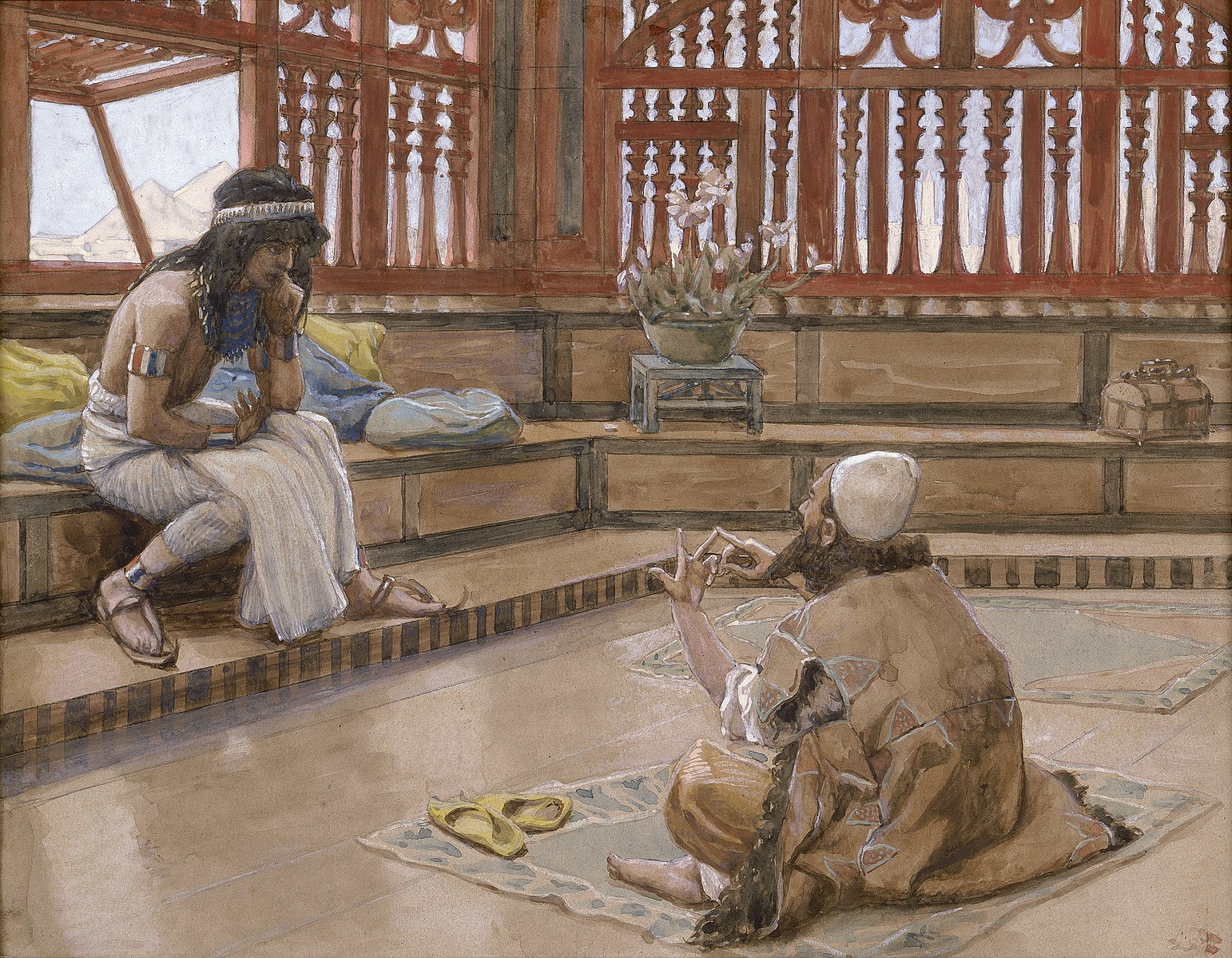
Featured image: Joseph Converses with Judah by Tissot. Public Domain.

If you know anyone who might be encouraged by today’s post, please share.

Sharing the Burden, Carrying the Weight

Carry each other’s burdens, and in this way you will fulfill the law of Christ.
Galatians 6:2

…for each one should carry their own load.
Galatians 6:5

Last week I had a CrossFit workout done with a partner. There were four weight lifting exercises with 25, 35, 45 and 55 reps, respectively. These were shared. My partner and I chose to alternate doing five reps each, back and forth, until they were completed. Between each weightlifting exercise we both had do 12 “over the bar burpees” together, at the same time. Each of us was responsible to do all 12 reps, even though we did them together.

In today’s chapter, I noticed what seemed to be a contradiction in Paul’s instructions to the followers of Jesus in Galatia. First he tells them to “carry each others burdens,” but then a few sentences later he tells them that each person should “carry their own load.” So, which is it? Carry each other’s burdens or carry your own load?

Yes, and.

As I dug into the original Greek words Paul used when he wrote the letter, I found that he used two very different words for “burden” and “load.” When talking about carrying each other’s burden he used a form of the Greek word “baros” which literally means a weight. He’s just finished stating that if a brother or sister is caught in a sin we should “restore them gently.” The picture here is that we all have our own shortcomings. Everyone, even the best of us, will blow it from time to time because we’re human and we all have our faults.

This is a partner workout. When you’re struggling I’m going to be there to help you carry the weight. And you do the same for me when I’m struggling. We alternate and share the reps so that we can mutually encourage one another and allow for mutual “restoration” back and forth.

A few sentences later Paul uses the word “phortion” (for-tee-on) when he says one should carry their own “load.” This specifically means a burden that is not transferrable. It can’t be shared.

Which brings me back to the workout last week. The weightlifting exercises was “baros.” It was a shared burden as we alternated. One of us carried the weight as the other rested and was restored. Back and forth. The Burpees, on the other hand, were “phortion” and each of us was responsible to do all twelve reps. The Burpees were our own load to carry, and we couldn’t transfer the reps to our partner. (Though there was mutual encouragement as we did them together, in unison. We weren’t alone as carried our personal Burpee burden, which is a completely different spiritual lesson.)

Along this life journey I’ve found that I have different kinds of burdens to carry as I make my way along the path. Sometimes burdens are mutual and I share them with my partners and companions. Other times I have a load that is mine alone to carry and no one else can carry it for me. In the quiet this morning I’m pondering some of life’s burdens. Once again, I find myself asking three familiar questions that provide important definition to life:

What’s mine?
What’s yours?
What’s ours?

The Hard Facts

As for the other events of Solomon’s reign, from beginning to end, are they not written in the records of Nathan the prophet, in the prophecy of Ahijah the Shilonite and in the visions of Iddo the seer concerning Jeroboam son of Nebat?
2 Chronicles 9:29 (NIV)

In today’s chapter, the author of Chronicles concludes his account of Solomon’s reign. He chooses, however, to leave out some pertinent facts provided in the eleventh chapter of 1 Kings.

Solomon was a womanizer. He married 700 wives, most of them were daughters or women from foreign royal families seeking to make political alliances with the king. On top of that, Solomon kept 300 concubines. Solomon’s wives worshiped foreign gods, and they convinced Solomon to build altars and temples to their gods. Solomon even worshipped the gods of his wives, including a couple of nasty ones who demanded child sacrifice.

By the end of his reign, Solomon’s years of conscripting slave-labor had created political problems for him. The nation his father worked so hard to unite was falling apart. Rebellions and uprisings began to occur. Prophets began prophesying the end of the united kingdom. Solomon resorted to assassination to maintain power and rid himself of threats.

All of this, the Chronicler fails to mention.

We can only assume why the writer of 2 Chronicles whitewashes Solomon’s story. Scholars believe that the Chronicles were written at the time the Hebrew exiles returned from captivity in Babylon. The temple needed to be rebuilt, and the Chronicler’s account may have been intended to drum up support for the new temple by glorifying Solomon and the old temple. This scholarly assumption concludes that the Chronicler chose to focus on Solomon’s glory and  leave the inconvenient truths buried in the bibliography.

This past Sunday at our local gathering of Jesus’ followers I gave a message about “Story.” Over the centuries the institutional church has turned the concept of “witnessing” into a host of systematic programs for communicating the theological concepts of salvation. However, when Jesus told his followers to be “witnesses” He simply meant for them to share their stories about their experiences with Him. In the opening lines of the letter that became 1 John, Jesus’ disciple literally gives the testimony “I heard him. I saw him. I touched him.” John’s story is how his experiences with Jesus transformed him from being known as a “Son of Thunder” (because of his anger and rage) to “The disciple of love.” Each of us has a story. Each of us has a God story whether that story is how we came to believe or disbelieve.

We also choose how to tell our stories, how to give witness, and what that testimony will be. We may choose to tell our story differently depending on the audience and the circumstances. This is  not only common, but I would argue that sometimes it is even wise. Nevertheless, our stories all contain hard facts. I made huge mistakes in life. I became addicted to porn as a child. My first marriage failed. I was unfaithful. I made a complete mess of things. A big theme of my God story is the grace, forgiveness, and redemption God has shown me despite my being a complete boogerhead. I can’t tell that story without also sharing some hard facts about what a deeply flawed person I am.

This morning I’m thinking about my story. I’m thinking about the hard facts of my life. My life journey is riddled with big mistakes I’ve made. To this day I struggle with being self-ish and self-centered. Wendy can give witness to my melancholy and pessimism, my emotional overreactions, and complete blindness to anyone or anything other than what I’m focused on in the moment.  But there’s also the story of my journey, of God growing me up, freeing me, and giving me second chances. There’s a story of transformation that has come from following Jesus and what God has done in me. It’s a good story.

For whatever reason, the Chronicler chose to leave out the hard facts about Solomon. It makes me sad. Our stories are much more powerful and interesting when we’re honest about the hard facts. Even tragedies make powerful stories from which we can benefit.

Life is Messy

Gideon made an ephod of it and put it in his town, in Ophrah; and all Israel prostituted themselves to it there, and it became a snare to Gideon and to his family.
Judges 8:27 (NRSV)

Life is messy. We generally like things to be black and white and believe that things would be so much easier if they were. We like our movies to provide us with simple delineations between the people who wear white hats and those who wear black hats. We like the ending of our movies to wrap up neatly. The bad guy is dead. The good guy rides off into the sunset.

But life is rarely that way. We would like a simple choice for President. We want the person who is fully qualified, looks the part, has no moral flaws, is void of skeletons in the closet, inspires us, communicates clearly, and unites a diverse citizenship. That person, however, does not exist.

Even the great heroes of the faith, whom God raised up as leaders in ancient days, were sons of Adam and daughters of Eve. They were flawed the same as me and you. God raised up Gideon to defeat the Midianites, but in today’s chapter we find that Gideon was far from perfect. He defeated an idolatrous oppressor only to create a golden ephod (generally, a garment woven with gold) that became an idol itself. Gideon, for all of his leadership qualities, had his flaws. With his power and prestige he amassed for himself many wives and concubines. With 70 sons on record, the total number of his children had to be well over a hundred. Talk about messy.

Today, I am reminded that on this life journey East of Eden we rarely get the storylines of our lives to work out how we like them in our movies. Despite our perceptions, people rarely fit into simple black hats or white hats. Most all of us wear shades of gray. We all make mistakes along the way; Some of them tragic. We have messy lives, messy relationships, and mortal flaws. Riding off into the sunset is often just the view we choose to see through our rose colored glasses.

I do not believe, however, that this is cause for pessimism or cynicism. Rather, it is an opportunity for grace, forgiveness, and understanding. Just as Jesus taught, if I can be honest about the log in my own eye, I can learn to have grace for the speck in the eye of my brother, my sister, my friend, and my neighbor.

chapter a day banner 2015

featured photo by senorhans via Flickr