Those who led the way rebuked him and told him to be quiet, but he shouted all the more, “Son of David, have mercy on me!” Luke 18:39 (NIV)
When I was in college studying acting, my professor sent us on an unusual assignment. He sent us a few miles up the road to a busy shopping mall. We were told to sit in the middle of the mall for at least two hours.
Watch people. Really observe them. How they move. Their unusual tics. The particular way they behave with others.
The goal was to teach me as an actor about creating a realistic and believable character on stage. It’s more than memorizing lines and regurgitating them on stage. It’s about creating a real person.
With a particular gate to his walk. Mannerisms unique to his character. A specific way he reacts and responds physically.
That lesson profited me far beyond my training for the stage. The importance of observation was an entire life-lesson. It had spiritual implications.
In my daily life. On this chapter-a-day journey. I keep the eyes and ears of my heart open. Observing. Watching for patterns, repetition, and surprises.
As I read and meditated on today’s chapter, I noticed something.
The chapter is book-ended with a parable and an episode. There’s a connection.
The parable concerns a judge and an old widow. A widow in the culture of Jesus’ day was a nobody. Marginalized. Poor. Zero social status. Everyday she begged the judge to hear her case. Everyday. She made herself annoying. Until the judge heard the case just to shut her up.
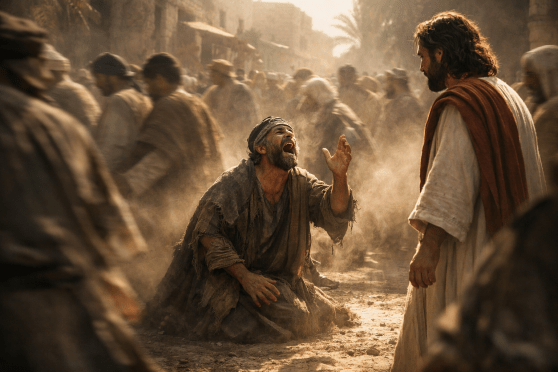
At the end of the chapter, Jesus is walking through a crowd. On the side of the road was a blind man. A beggar. He shouts, “Jesus, son of David, have mercy on me!” Again. And again. And again. Annoyed, those around him tell him to shut up. He yells louder. Jesus stops. Calls the man over, and heals him.
The widow knocked on the judge’s door. The blind man shouted into the crowd. Different scenes. Same audacity.
A week or so ago, I was struck by a similar parable Jesus told. The neighbor who begs for bread at midnight. Shameless audacity. Socially inappropriate.
What struck me as I meditated on these things this morning was that I was observing a pattern in the parables and stories that are lifting off the page for me in the quiet.
Prayer. Pleading. Persistence. A holy refusal to be ignored.
It’s a Holy Spirit whisper.
“Pray Tom. Keep praying. Be bold. Be audacious. Don’t stop. Try to annoy me.”
And so in the quiet this morning and observable pattern informs me of my marching orders.
And with that, I will finish this post.
I have some praying to do.
If you know anyone who might be encouraged by today’s post, please share.
These chapter-a-day blog posts are also available via podcast on all major podcast platforms including Apple, Google, and Spotify! Simply go to your podcast platform and search for “Wayfarer Tom Vander Well.” If it’s not on your platform, please let me know!
So the Israelites did everything the Lord commanded Moses; that is the way they encamped under their standards, and that is the way they set out, each of them with their clan and family. Numbers 2:34 (NIV)
There is always a subtle tension in our household. There is a ying and yang to the way Wendy and I operate, the way we were created, and the way our brains are wired. It can be at once exasperating and beautiful. For the most part, you’ll find our home well-ordered. There is a place for everything and everything in its place. It doesn’t take long to know the patterns, where to find things, and the places they belong. That’s Wendy. I, on the other hand, tend to bring chaos to that order. This isn’t out of antagonism or ill-will but rather from simply not being wired the same way. Our brains work differently. Wendy is Rembrandt and I’m Pollack. She’s Bach and I’m Bird. The truth is that I love order. In fact, I tend to find it in places others can’t see it while being blind to it in plain sight.
Chaos. Order.
That’s how the Great Story begins.
Formless, empty, dark, and deep chaos.
Then God brings order in seven days. Six days of work. One day of rest.
Then there is a serpent, a lie, temptation, desire, disobedience, shame, and blame.
Order gives way to chaos.
For the rest of the Story, there is an ebb and flow between order and chaos. It has been observed that when God delivers the Hebrews from slavery in Egypt, the 10 plagues mirror creation in reverse order. Egypt, the greatest, most ordered and glorious human empire on the earth descends from order to chaos before Pharaoh finally relents and lets the Hebrews depart.
Out of the chaos, God leads the Hebrews into something new. He gives them a detailed and orderly blueprint for doing life together in Leviticus.Now, as they make preparations to set out on their wilderness journey, God provides order to both their camping and their procession. In both walking and resting there is a pattern to be followed. Every member is part of a tribe and every tribe has its place in the camp and in the parade.
God loves order.
In fact, what most casual readers fail to notice is that even today’s chapter is written to reflect the order of the Hebrews camp described in the text. God in His tabernacle are at the center of the camp. This is mentioned smack-dab in the middle of the chapter. It’s called a chiasm. The most important bit is in the center, and everything else is symmetrically structured around it.
God loves order.
In the quiet this morning, I find myself meditating on the fact that there are patterns even in the seemingly randomness of nature. I find it meaningful that the first thing we find God doing at the beginning of the Story is turning chaos to order. Because, along my life journey, I’ve observed that no matter how ordered I try to structure my personal, earthly human empire, the chaos of my own failings, blind spots, and foolishness eventually plagues me. Who will set me free from the chaos of my own making?
Thank God, He’s been doing it from the beginning. He’ll be doing it to the end. He’ll be doing it when He begins everything anew. He is my hope and salvation from the chaos of my own making, and the chaos of this broken world.
Time for my procession through another day of this life journey. I may not see it clearly, but I know God has a plan, just like He gave to the Hebrews in today’s chapter. It’s who He is. As I proceed, I take comfort in that.
If you know anyone who might be encouraged by today’s post, please share.
These chapter-a-day blog posts are also available via podcast on all major podcast platforms including Apple, Google, and Spotify! Simply go to your podcast platform and search for “Wayfarer Tom Vander Well.” If it’s not on your platform, please let me know!
For I will stir up and bring against Babylon an alliance of great nations from the land of the north. They will take up their positions against her, and from the north she will be captured. Their arrows will be like skilled warriors who do not return empty-handed. Jeremiah 50:9 (NIV)
Human history is, at a glance, the story of one conquest after another. Families became tribes. Tribes became nations. Nations became empires. Empires rise and fall. That, in a nutshell, is the Great Story from Genesis through the fall of Jerusalem that Jeremiah predicted. It starts with Abraham having a family. The family grows into the twelve tribes. God delivers them from slavery in Egypt and makes them into a nation. Under King David and Solomon they became a regional empire. As with most empires, a combination of internal implosion and external enemies lead to decline and defeat at the hands of the next emerging empire.
We are nearing the end of the voluminous compilation of Jeremiah’s prophetic messages. For 49 chapters the prophet has been proclaiming the defeat and exile of his own people at the hands of what he referred to early on as a “nation from the north” and later revealed to be the emerging Babylonian empire. Now, at the very end of his prophetic works, Jeremiah turns the tables 180 degrees.
In today’s chapter it is Babylon who receives God’s prophetic word of doom. This time it is the Babylonians who will fall to an alliance of nations from the north (i.e. the Medes and Persians). And, while Jeremiah proclaims this event from afar, the prophet Daniel is present in Babylon for the event as God presents the Babylonian regent with the literal handwriting on the wall (see Daniel 5) as Babylon falls to the invaders and a new empire takes over.
I found myself mulling this over in the quiet this morning.
Amidst the prophecy against Babylon, God reminds His people in exile of the promise He’s been making to them all along. A remnant will return to Jerusalem. Jerusalem will be rebuilt. The temple will be rebuilt. Out of her a messiah will emerge as Jeremiah prophesied back in chapter 23.
What a contrast Jesus was to the human history of empire building. He came, not as earthly monarch, but as the King of Heaven. “My kingdom is not of this world,” He told Pilate. The paradigm He gave His followers was antithetical to human empire building. His paradigm was for a radical love to change the heart of an individual. The individual then spreads that radical love to change the hearts of others in their spheres of influence. The love spreads exponentially and begins to change communities, tribes, and nations from the inside out. The Jesus Movement of the first century rocked the Roman Empire with this paradigm.
Then, in what I consider to have been a brilliant chess move by the evil one, whom Jesus referred to as the Prince of this World, he gave control of the Empire itself to the Jesus Movement. Slowly, absolute power corrupts absolutely, and humans turned the Movement into another human empire, just like we always seem to do throughout history.
I also thought this morning about the prophetic end of the Great Story that was laid out for John in his Revelations. It ends with the Prince of this World and all the nations of the world, the human empires, lined up against the King of Heaven.
And, I think that’s a macrocosm of the spiritual journey as a follower of Jesus. Jesus asks me, as an individual, to turn away from the human way of doing things, the rat-race of wealth and earthly success, the dynamics of power and personal empire building. Jesus wants me to live with radical love, extravagant generosity, and a servant-hearted kindness to others, even my enemies who want to roll over me with their own power-plays and personal empires.
In the end, Jeremiah reminds me that what goes around comes around. Empires rise, they fall, and other empires emerge on this earth.
Or, as U2 put it:
Kingdoms rise, and kingdoms fall, but You go on, and on, and on, and on…
Personally, I want to be part of a Kingdom that’s not of this world.
If you know anyone who might be encouraged by today’s post, please share.
“He did evil in the eyes of the Lord, just as his father had done.” 2 Kings 24:9 (NIV)
One of the things I’ve observed along my life journey is that we live in a universe that is of incredible design. In this amazingly designed world, systems create patterns. Wisdom can be found in discovering patterns of thought, patterns of behavior, patterns of relationship, patterns of generations, and patterns of spirit. Destructive patterns can be addressed and changed. Healthy patterns can be enhanced and replicated.
As I traverse this chapter-a-day journey, one of the things I try to see and recognize is patterns.
For example, one of the themes in the Great Story is the importance of the patterns of the family system and generations. When God first prescribes his “way” through Moses, this family/generational pattern was part of the prescription:
Only be careful, and watch yourselves closely so that you do not forget the things your eyes have seen or let them fade from your heart as long as you live. Teach them to your children and to their children after them. Remember the day you stood before the Lord your God at Horeb, when he said to me, “Assemble the people before me to hear my words so that they may learn to revere me as long as they live in the land and may teach them to their children.” Deuteronomy 4:9-10 (NIV)
Fix these words of mine in your hearts and minds; tie them as symbols on your hands and bind them on your foreheads. Teach them to your children, talking about them when you sit at home and when you walk along the road, when you lie down and when you get up. Write them on the doorframes of your houses and on your gates, so that your days and the days of your children may be many in the land the Lord swore to give your ancestors, as many as the days that the heavens are above the earth. Deuteronomy 11:18-21 (NIV)
But, as I read the history of the Kings of Israel and Judah, something broke down in the system, beginning all the way back with David, who had a blind spot when it came to his children born from his many wives. Over the past two days, the chapters have told the story of good King Josiah, who exemplified single-hearted, life-long devotion to God, unlike any king since David the author tells us. In the telling, we learn that God’s prescriptions to the Hebrews to “remember” and “teach” their legacy and God’s way to subsequent generations had been forgotten and lost for some 800 years.
In today’s chapter, however, we read of the quick succession of two of Josiah’s sons, his grandson, and his brother. All of them, the author reports, “did evil in the sight of the Lord.” The reforms of Josiah were isolated and short-lived. The healthy “pattern” God had prescribed had not been followed and another, destructive pattern emerged that ultimately led to the downfall of the nation and the Babylonian exile.
In the quiet this morning, I’m meditating on the important natural patterns of family and family systems, both healthy and not-so-healthy. Even Jesus’ earthly family initially rejected Him and thought He was crazy. I’m also mindful that Jesus expanded the paradigm of “family” in His teaching:
Then Jesus’ mother and brothers arrived. Standing outside, they sent someone in to call him. A crowd was sitting around him, and they told him, “Your mother and brothers are outside looking for you.”
“Who are my mother and my brothers?” he asked.
Then he looked at those seated in a circle around him and said, “Here are my mother and my brothers! Whoever does God’s will is my brother and sister and mother.” Mark 3:31-35 (NIV)
I have tried, and have honestly, often failed, at following and exemplifying God’s prescribed pattern of teaching my children the way of Jesus and the Great Story. Doing so may have influenced but does not guarantee that my children will follow in my spiritual footsteps. In fact, like David, my failings may have had greater influence than my teaching. And there’s the rub. God prescribed a spiritually ideal pattern to flawed humans who can’t and won’t follow the pattern perfectly. Things break down. Which is why I need the grace and mercy of Jesus, and my children and grandchildren.
If you know anyone who might be encouraged by today’s post, please share.
[Judah said to Joseph ] “Now then, please let your servant remain here as my lord’s slave in place of the boy, and let the boy return with his brothers. How can I go back to my father if the boy is not with me? No! Do not let me see the misery that would come on my father.” Genesis 44:33-34 (NIV)
During my family roots investigation that I’ve discussed in the last couple of posts, I was blessed to discover and correspond with my cousin, John, in the Netherlands. John and I are third-generation cousins. When my great-grandfather sailed for America he left his younger brother, John’s great-grandfather, behind. When Wendy and I traveled to London back in 2009, John joined us and we spent a very enjoyable day together.
Late that day, the three of us were sharing a pint together in a London Pub. I expressed my curiosity about what would make my great-grandfather leave everything, including his entire family, and make a new life in America by himself. I remember John not being surprised by this. He shared that getting angry and walking away was not uncommon in our family.
Along my journey, I’ve observed that certain themes are recurring in family systems. It could be sin that occurs in repeated generations or behavioral or relational patterns that repeat themselves. I remember one family member observing that when her husband left her she was the exact same age as her mother when her father left. I have found these types of patterns fascinating and meaningful in gaining both understanding and wisdom.
I continued to see these patterns in today’s chapter. Joseph deceives the brothers who wanted to kill him, then chose to sell him into slavery. This is just like his father, Jacob, deceiving his own father, Isaac. It’s just like Jacob’s Uncle Laban deceiving him. It’s just like Isaac and Abraham deceiving their hosts into thinking their wives were their sisters. It’s just like Joseph’s brothers deceiving their father into thinking Joseph had been eaten by a wild animal. It’s a pattern in the family system.
Yesterday I discussed that Judah, the fourth-born son of Jacob/Israel, has now ascended to the role of the leader, the position of the first-born. This is also a recurring theme as both his grandfather (Isaac) and father (Jacob) were second-born sons who ascended to the blessing and position of the first-born. This is a theme that will reoccur throughout the Great Story as an object lesson of God’s message: “My ways are not your ways.”
Faced with the prospect of fulfilling their father’s worst fears, Judah steps up to plead for Benjamin’s life and offers himself as a substitutionary slave in place of his little brother. Fascinating that it was Judah who saved Joseph’s life by pleading with his brothers not to kill Joseph but sell him into slavery back in chapter 37. Judah’s conscience is weighed down by what they did to Joseph and their father. He will do anything not to repeat the robbing of their father of his beloved son. He’s been down this road before. He doesn’t want to repeat the pattern.
Toxic patterns of thought, behavior, and relationship wreak havoc within a family system. These were the kinds of things I wanted to discover, process, and address in my own journey as I dug into the layers of stories, foibles, and flaws in my family’s root system. Did it succeed? One could easily argue not if perfection is the standard. Yet, I’ve observed that the pursuit and/or expectation of perfection is a toxic thought pattern in-and-of-itself. I did, however, discover invaluable lessons in the layers. It has been successful in imparting wisdom, allowing me to recognize certain patterns in other areas of life, and informing both my choices and how I manage relationships. I know that blind spots remain, but I doggedly pursue sight with each layer of blindness that’s revealed in my journey.
Perhaps the most important layer of lessons has been about grace. Abraham, Isaac, Jacob/Israel, Judah, and Joseph all had their faults and blind spots. They, too, were part of a very flawed, very human family system. It still didn’t disqualify them from being used by God in their leading roles within the opening chapters of the Great Story. So, I’ve learned (and am learning) to have grace with those flawed ancestors and family members in my own family system as I pray they and my descendants will have grace with me. It’s also teaching me that God’s amazing grace extends to, and through, very flawed human beings, and that includes me.
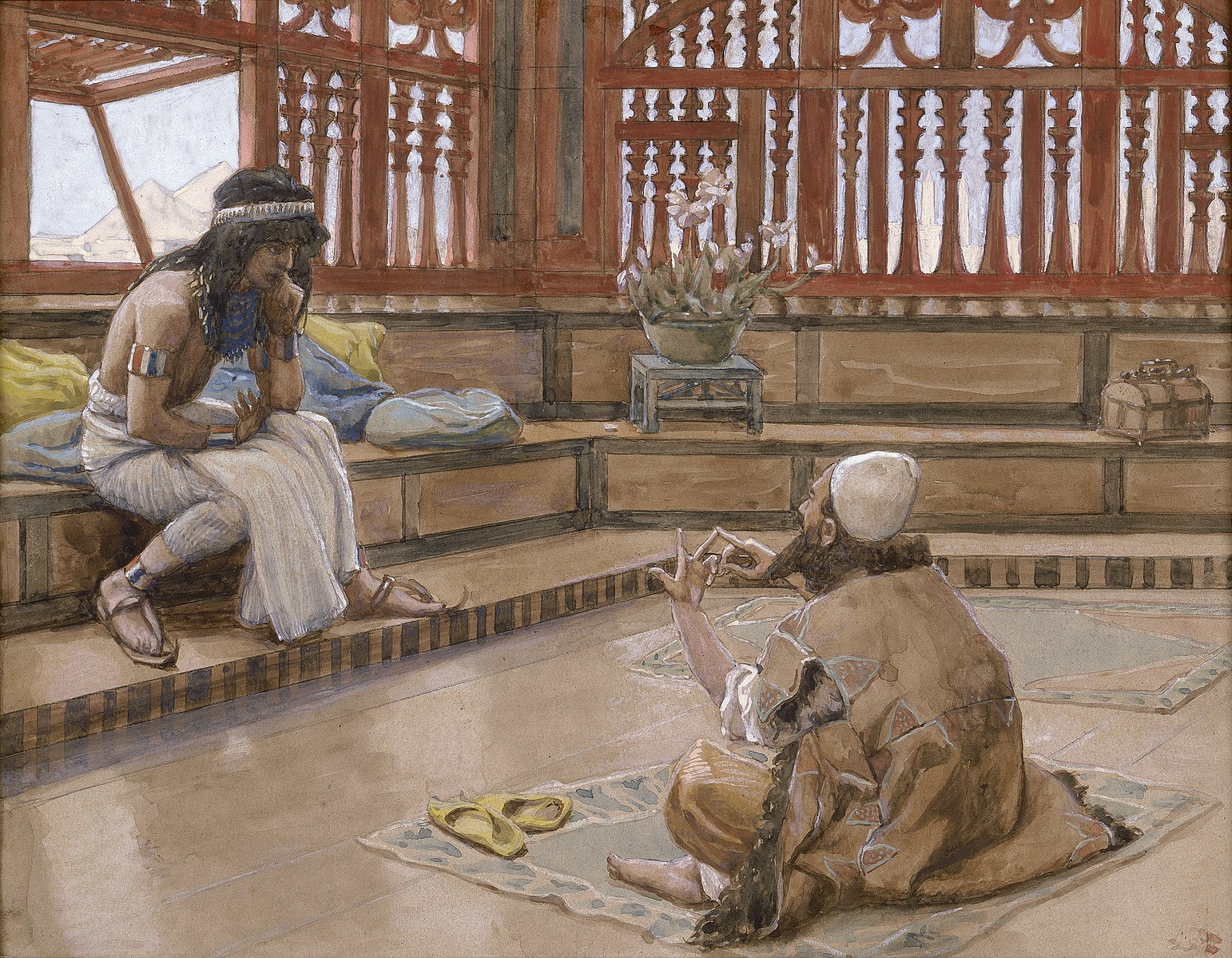
Featured image: Joseph Converses with Judah by Tissot. Public Domain.
If you know anyone who might be encouraged by today’s post, please share.
I’ve always been interested in family history. Over the years I’ve learned a great deal, but there’s a point at which the scant evidence of names and dates leave a lot to be desired from a story perspective. My “van der Wel” surname seems to spring from one particular neighborhood in Rotterdam, while the Bloem genes trace back to Gronigen. I have McCoy genes that likely lead back to the McKay clan in Scotland. My Hamblen genes trace back to Virginia during the American Revolution, and then back to England where there’s a knight entombed in effigy in eastern England. Informational clues that leave a lot to the mystery of history.
In the same way, the first 11 chapters of the Great Story are considered “primeval” history. They provide a broad brush sketch of creation and God’s relationship with all of humanity with scant information and a lot of mystery, but there’s plenty of good stuff to mine in the mystery.
For example, numbers and patterns play a role in the telling. The letters of the Hebrew alphabet do double-duty as numbers, and the authors of ancient Hebrew often hide numerical patterns in the writing. The number 10 is associated with harmony and completeness, especially related to humanity. The book of Genesis is divided into ten sections. Ten times in Genesis the phrase “God said…” is used. The genealogies in today’s chapter and again in chapter 11 both list ten generations. God will later deliver the Hebrews from slavery in Egypt through ten plagues, and subsequently provide humanity with ten commandments.
Yesterday’s chapter told of the sin and curse of Cain and then traced his family line to the 7th generation after Adam. Seven is also a number associated with “completeness” but it is more associated with the divine, as in the seven days of Creation. The seven generations of Cain’s line hint at the completeness of God’s divine judgement on the family which remained rebellious toward God in the 7th generation. The 10 generations listed in today’s chapter hint at the complete human family line of Adam that will perpetuate humanity to, and after, the flood.
Then there are the patterns that emerge in the telling. The seventh generation in the line of Cain was Lamech who continued his ancestor’s murderous and rebellious ways. The seventh generation on Seth’s line is Enoch who “walked faithfully with God.” There’s also the fact that Cain, the first born son, was cursed and it was through a younger son, Seth, that humanity was blessed and perpetuated. In human terms, the blessing, power, and position always go to the first-born son, but God’s blessing through the younger son is a pattern repeated through Genesis as well as the Great Story:
Seth over Cain. Shem over Japheth Isaac over Ishmael Jacob over Esau Judah and Joseph over their brothers Ephraim over Manasseh David over his brothers Solomon over his brothers
The pattern of going against human tradition is a continuous reminder of what God would later say plainly through the prophet Isaiah:
“For my thoughts are not your thoughts, neither are your ways my ways,” declares the Lord.
As I always say, God’s base language is metaphor. Today’s chapter is more than a genealogy. It is layered with numbers and patterns that metaphorically speak to the moral contrast between Cain’s family line and Seth’s family, the contrast of divine judgement and blessing, and the contrast of death and life.
On Sunday, I’m giving a message among my local gathering of Jesus’ followers from Ecclesiastes 3, the passage made familiar to millions by the Byrds: “To everything there is a time and season.” One of the things I plan to discuss is that my own life contains patterns that lead to deeper understanding of self, of family, of life, if I’m willing to search under the surface of simple dates and memories.
If you know anyone who might be encouraged by today’s post, please share.
For the sake of your servant David, do not reject your anointed one. Psalm 132:10 (NIV)
Wendy and I are almost through the first season of Poldark, originally a 2015 Masterpiece Theater production. It’s been thoroughly enjoyable. The series is set in the late 18th century and tells the story of a headstrong and struggling English nobleman who returns from the American Revolution to find his father dead, his family estate in shambles, the love of his life engaged to his cousin, and the family business on the edge of bankruptcy.
The themes of the show include the clash between nobility and peasant, the long-held tradition of the entitlement of the first-born son, and the legacy of both family systems and family names.
Over the past year of Covid-19 with all its tension over masks, mandates, and lockdowns, one of the conversations I found fascinating was the individualistic spirit in Americans. From our break from mother England to today, we don’t like being told what to do. Along my life journey, I’ve come to believe that we don’t have a full realization of, nor appreciation for, just how deep the “rugged individualism” that fueled our country runs in our veins. In the entire history of human civilization, human rights and the freedom of self-determination are relatively new concepts. For thousands of years, an individual’s lot-in-life was pretty much fully established the moment they were born. It was completely dependent on your family, your gender, and your birth order.
Today’s chapter, Psalm 132, is a case-in-point. This ancient Hebrew song was used at the coronation of monarchs ascending to the throne of King David. Some scholars believe it was initially written to honor King David at the dedication ceremony of the Solomon’s Temple in Jerusalem. David’s family line was firmly established as the royal line of Judah, the prophets also pointed to the coming Messiah being from the same lineage, and the lyrics of today’s chapter would have been a clear reminder to the people not to forget it.
In the quiet this morning, I find myself meditating on the concept of determination. Growing up, I and my peers were told that we could be anything we wanted to be in life if we were willing to work hard, study hard, and pursue our dreams. Once again, I’m reminded that this very notion would have been ludicrous for the vast majority of human beings who ever lived. And yet, while I would argue that there are, in general, greater opportunities for self-determination than in any other time in human history, there are still those determining influences of life that I don’t control.
Among the teachings of Jesus that fueled the Jesus Movement of the first century was that everyone was welcome at the dining table where believers sat, listened, prayed, feasted, and “communed.” Men, women, slaves, slave owners, rich, poor, societies’ big shots, and social lepers. As Paul put it in his letter to the followers of Jesus in Galatia:
In Christ’s family there can be no division into Jew and non-Jew, slave and free, male and female. Among us you are all equal. That is, we are all in a common relationship with Jesus Christ. Also, since you are Christ’s family, then you are Abraham’s famous “descendant,” heirs according to the covenant promises.
In the quiet this morning, I find myself thinking about the things in this life that I can control, and the things that I can’t. When Jesus said to those seated around Him, “Here are my mother and my brothers! Whoever does God’s will is my brother and sister and mother” I believe that He was telling his followers that I don’t have to be enslaved to systems that formed me. When Paul said that for the believer “old things pass away” I believe that among the things that pass away are beliefs, patterns of thought, and behaviors that were instilled in me by the systems into which I was born and in which I was raised. I observe that the spiritual transformation I’ve experienced on my spiritual journey as a follower of Jesus has not only changed me, but it has led me to leverage the fruit of God’s Spirit to help transform the human systems I’m a part of for the better.
I will listen to what God the Lord says; he promises peace to his people, his faithful servants— Psalm 85:8a (NIV)
Shame can be toxic. It’s that deep sense of being worth-less, and I while I find most seem to perceive me as having all sorts of self-confidence, the truth is that I have quietly battled that nagging, pessimistic self-perception of shame my entire life. I have acknowledged it, processed it, studied it, and have learned to work through it while learning how to have grace with myself even as I open my heart to receiving the amazing grace that God has given me.
The seeds of shame, I have come to learn, are typically sown in childhood. From some individuals I’ve met in the struggle, it was the repeated words of an adult or an older sibling telling them things like, “You’re stupid,” “You’re good for nothing,” or “You should have never been born.” Born into a loving family, that was never my issue. For me, the seeds of shame were misunderstandings of my place in the world and a negative self-perception that was fueled by my Enneagram Four temperament. I grew up being so self-absorbed as to think that any negative circumstance in life stems from something I did, or else it some divine retribution prompted by my worthlessness. The Minnesota Vikings’ loss in four Superbowls was totally my fault for stealing all of the family’s cash envelopes off of Grandma Golly’s Christmas tree in 1972. My apologies to Vikings nation.
As a person who knows the struggle against shame, I totally identify with today’s chapter. It felt a bit like looking into a spiritual mirror. Psalm 85 was written as a song to be used when the Hebrew people gathered to worship. Fourteen lines long, it is a song of two halves. Things had not been going so well for the Hebrew people. Scholars think it may have been written during this historic drought that occurred during the time of the prophet Hosea.
The first half of the song reads like me when I was a kid.
“God, you’re angry with me. I’ve done something wrong. I thought you were over that Christmas cash thing, but obviously I haven’t served my time. How long is this going to take, Lord? How long until you get over your anger with me?”
The song then pivots 180 degrees in the second-half, which kicks off with the songwriter declaring, “I will listen to what the Lord says.”
As the songwriter gets his eyes off of himself, and gets his ears to turn away from the endless loop of negative self-talk being played in his spiritual, noise-cancelling AirPods, he begins to recognize the very different message that God has been perpetually saying. God promises salvation, affirms his faithfulness, peace, generosity, and goodness.
One of the things that I had to learn along my journey of addressing shame was the very same process. I have a well-worn page that I put together ages ago. Like the songwriter of Psalm 85, I turned my ear to the Great Story and wrote down a list of God’s specific messages, including, but not limited to:
I am… fearfully and wonderfully made… (Ps 139) made in the likeness of God… (James 3:9) worth more than many sparrows… (Matt 10:31) God’s workmanship… (Ephesians 2:10) born again… (1 Peter 1:23) a son of God… (Galatians 3:26) and heir of God… (Galatians 4:6, 1 John 3:2, Rom 8:17) God’s temple… (1 Cor 3:17) the aroma of Christ… (2 Corinthians 2:15)
You get the idea. I still, on occasion, have to pull this well-worn sheet of divine affirmations out and literally read through the list again. Often, I read all two-pages out-loud to myself. It’s like spiritual chiropractic. When my shame has me bent out of shape and tied up in knots, the affirmations from the Great Story get my head and heart back in alignment.
In the quiet this morning, I find my heart ruminating once again on this difficult year. I think about strained relationships created by differences in world-views. I think about our business which took a sizable hit in 2020. I think about the mental and emotional fatigue from the never-ending conflict in every medium of media about a host of hot-button topics. It’s amazing how silently shame’s whispers can creep back into my head and heart without me realizing it. Like the writer of Psalm 85, I find myself having to consciously stop and listen “to what God the Lord, says.”
FYI: Here are the entire set of affirmations I compiled for anyone who might benefit in both image and document forms. The PDF was a handout from a message series on shame several years ago.
Hear the voice of my supplication, as I cry to you for help Psalm 28:2 (NRSVCE)
Back in the days before iPods, iPhones, and digital streaming, the only way one got music in a car was the radio. Since I spent a lot of time in rental cars for my job, I got used to spending the first part of any journey scanning “the dial” for the available stations and programming the stations I wanted to keep into the car’s radio.
One of the things I noticed as a young man scanning the airwaves was that it generally took me less than a second to identify the kind of music any station typically played as I quickly made my way across the dial:
There is a certain sound, pattern, cadence, and frequency to different types and styles of music.
As I read the psalm this morning, the thing that struck me was how similar it is to the previous few psalms. That’s because it is. David had patterns that he repeatedly used as he penned his songs. We do the same thing. Symphonies typically follow a pattern of four movements. Your basic popular song is typically structured verse, chorus, verse chorus, bridge, verse, chorus.
Those who compiled the anthology of song lyrics we call Psalms put the section we are reading through together with similarly structured songs. It is a simple, repeated pattern: They all start with a praise and plea for God to listen followed by a complaint and/or petition, and end with a proclamation of faith and assurance that God has or will hear and answer.
In the quiet this morning, this got me thinking about patterns. Almost everything in life falls into certain patterns. Almost everything in life has patterns. Good patterns can provide a sense of health, security, and surety to life. Bad patterns of thought and behavior result in destructive and unhealthy consequences in my life and relationships. That’s rather obvious. What’s not so obvious is that some patterns that were good and necessary for a time can actually become unhealthy for me without me really recognizing or realizing it.
Along my life journey, I’ve come to observe that spiritual progress always involves the breaking of old patterns and establishing new ones. A faith journey always requires that I leave behind something that is tangibly known and comfortable in order to pursue something that is not clearly evident and is only hoped for.
“You have heard it said,” Jesus would say to his followers before adding, “but I say…” In other words, there was an established pattern that Jesus was calling His followers to change. He called for old, established patterns to pass away so that new patterns could emerge. The word repentance is rooted in the word picture of changing direction. Whenever Jesus told someone “Follow me” it was always a call to leave things behind to pursue things to which He was leading.
What started out as good, even healthy, patterns can lead to stagnation. Stagnation leads to settling. Settling leads to spiritual atrophy. Spiritual atrophy leads to decay. Decay leads to death. That’s what Jesus was getting at when he told the religious people of His day:
“You’re hopeless… Frauds! You’re like manicured grave plots, grass clipped and the flowers bright, but six feet down it’s all rotting bones and worm-eaten flesh. People look at you and think you’re saints, but beneath the skin you’re total frauds.“
-Jesus, Matt 23:27-28 (MSG)
In the quiet this morning, I find myself meditating on my own patterns of thought, behavior, relationship, and spirit. The truth is that almost every pain-point I experience on life’s journey can be traced back to unhealthy patterns. Growth, progress, and maturity necessitate the breaking of unhealthy patterns and the establishment of healthier ones, even those patterns that were once good for me but have actually become unhealthy.
David’s song this morning felt familiar to the point of me being kind of bored with it after reading psalms with the same pattern every morning this week. C’est la vie. It happens. Having journeyed through the Psalms many times, I am mindful that when we get to Psalm 40 David writes that he is singing “a new song.” God called David “a man after my own heart.” Even he could get stuck in certain patterns that he had to break in order to move on where God wanted to lead him.
If you know anyone who might be encouraged by today’s post, please share.
Before "Old Things Pass Away," They Often Lure Me Back (CaD Ex 32) –
Wayfarer
When the people saw that Moses delayed to come down from the mountain, the people gathered around Aaron, and said to him, “Come, make gods for us, who shall go before us; as for this Moses, the man who brought us up out of the land of Egypt, we do not know what has become of him.” Exodus 32:1 (NRSVCE)
Along my life’s journey, I have gone through multiple stretches of time in which my life experienced major change. In each one, it was a period of upheaval, deep introspection, conscious breaking with old patterns of thought and behavior, seeking to reach for new things that were further up and further in than anything I’d experienced before. Each time I have gone through one of these shifts has been a period of discomfort. Comfort, on the other hand, is both simple and easy. All I had to do was stay in the same patterns of thought, relationship, and behavior.
When I was in my mid-to-late twenties I began to seriously address some hard-wired, addictive behaviors, and unhealthy patterns of thought and relationships in my life. I began working with a counselor and going to support-groups with others who were dealing with their own unhealthy patterns. One of the things that quickly came into focus for me was that many of the patterns of thought and behavior I was struggling with were present in me as a child and in my adolescence.
In a moment of God’s synchronicity, I just happened to be traveling on business to the city where my older brother lived. My brother is seven years older than me and we rarely saw one another in those days. We got together for dinner and I discovered that he was walking his own version of trying to figure out his own unhealthy patterns. As dinner turned into several hours of late-night conversation, we found ourselves attempting to unravel and understand a mystery to us both. Why, when we return home as adults, do we seem to fall back into what feels like this defined role we had always played in the system with which our family operated, complete with scripted lines, well-rehearsed relational blocking? My brother and I walked that stretch of the journey together. In fact, we’re still on it! But, together we’ve made significant progress and some really worthwhile personal discoveries that have informed our respective lives and relationships.
For anyone who grew up annually watching The Ten Commandments with their family every Easter/Passover weekend, today’s chapter should be eerily familiar. Several chapters ago, Moses when up the mountain to talk with God. It’s been over a month now, and he still hasn’t come down from the mountain. So, the Hebrews basically give-up on their relatively new leader and his unfamiliar God with His really strange belief system. They approach Aaron and ask him to make for them a god just like one of the 1500 gods they were familiar with back in Egypt. Aaron relents, makes a golden calf god, and Moses finds the camp in religious revelry.
I confess this morning that every time I watched the movie and every time I’ve read this story before, I have been led to the prescribed audience reaction. I shake my head and whisper a “tsk, tsk” in self-righteous judgment for the weak-minded Hebrews.
This morning, however, I’m seeing it in a whole new way. The Hebrews were only doing what I so often do. I try to push forward into being more like Jesus in how I think, act, and related to others only to find myself slipping back into comfortable old’ patterns that are comfortable, simple, and easy. I spiritually go home and just mindlessly play the old role I’ve always played. It’s just easier. The Hebrews are simply doing the same. God is pushing them out of Egypt, out of victim-mentality, out of the chains of slave-mindedness, into the spiritual boot camp of the wilderness, into a new way of understanding and a new level of maturing relationship. It feels hard, uncomfortable, strange, and unfamiliar. So, they default to back to what is familiar, comfortable, and easy.
In the quiet this morning, I’m recognizing a pattern that has emerged in this chapter-a-day journey through the Moses-story. I keep seeing how the Moses story relates to the Jesus story. Jesus, like Moses, led His followers into major shifts in understanding God, how we have a relationship with God, and how that should lead us to relate to one another and our world. However, when the Jesus movement became the institution of the Holy Roman Empire it was the golden calf moment for Jesus’ followers. In short order, the Jesus movement went back to old, entrenched patterns of social hierarchy, patriarchy, and religious institutionalism.
How do I change? How to I grow? How do I allow old things to pass away and lay hold of the new things God has for me? I’m still learning that piece, but I have learned along the way that it takes both willful determination and the faith to jump and trust that the net will appear. It requires the patience and perseverance to endure discomfort and to keep running even when I hit the wall. It’s helpful, almost essential, to have good companions with me and good mentors out ahead of me. It demands that I learn to have grace with myself when I stumble, stall, and fall back; To receive the grace that God endlessly showers on me if I simply open my heart to it.
It requires that I press on.
And so, on this Monday morning I’m lacing ’em up once again. Another wayfaring stranger on his way home over Jordan.
Thanks for being my companion on the journey today, my friend.
Let’s go!
If you know anyone who might be encouraged by today’s post, please share.