Tag Archives: Grace

“If You Can’t Do the Time…”

Absalom behaved in this way toward all the Israelites who came to the king asking for justice, and so he stole the hearts of the people of Israel. 2 Samuel 15:6 (NIV)

Much like David, I made a mess of life and my first marriage when I was a young man. Those sins and mistakes are among the long laundry list of sins I have committed that God has graciously forgiven. There are still friends, however, who’ve never spoken to me since. Some I’ve reached out to, but they never reciprocated or returned my calls.

Being forgiven does not erase the fact that we must face the natural consequences of our actions. After being confronted by the prophet Nathan regarding his adultery with Bathsheba and subsequent conspiracy to commit murder, David showed great remorse and sought God’s forgiveness. The events, however, sewed seeds of scandal, anger, and resentment both inside David’s family and in the public among King David’s subjects. Part of Nathan’s prophetic word to David was that the sword would never depart David’s house as the consequences of David’s blind spots would bear bitter fruit.

David’s children knew their father’s weaknesses both as a father and as a king. David’s son Absalom witnessed first-hand King David’s turning a blind eye to the favored, eldest son Amnon’s rape of Absalom’s sister. The seeds of anger, bitterness, and vengeance have taken root in Absalom’s heart. In today’s chapter, Absalom masterfully exploits his father’s scandal and weakened poll numbers in a brilliantly planned and executed coup d’etat. David is forced to make hasty preparation to escape the city with his closest followers and arrange for spies to gather inside information regarding his renegade son and the rebel plot. David’s very own son had stolen his kingdom and was now reaching out to steal his crown.

David, on the run again just as he was as a young man fleeing from Saul, does what he always does. He cries out to God in song. It was during this episode that David, fleeing from his own son and the rebels seeking to usurp his kingdom that David wrote the lyrics to Psalm 3, a desperate plea for God to protect and deliver David and bless God’s people.

Lord, how many are my foes!
    How many rise up against me!
Many are saying of me,
    “God will not deliver him.”

But you, Lord, are a shield around me,
    my glory, the One who lifts my head high.
I call out to the Lord,
    and he answers me from his holy mountain.

I lie down and sleep;
    I wake again, because the Lord sustains me.
I will not fear though tens of thousands
    assail me on every side.

Arise, Lord!
    Deliver me, my God!
Strike all my enemies on the jaw;
    break the teeth of the wicked.

From the Lord comes deliverance.
    May your blessing be on your people.

In the quiet this morning, I am reminded of many mistakes I’ve made along the journey and their residual effect on relationships, circumstances, and perceptions. Jesus advised people to “count the cost” before agreeing to follow Him. The same advice might also be given when tempted to sin. There is a cost to wrong-doing and we are all wise to give consideration to the tragic consequences that quote arise in the wake of our poor choices. As the saying goes, “If you can’t do the time, don’t do the crime.”

 A Note to Readers
I’m taking a blogging sabbatical and will be re-publishing my chapter-a-day thoughts on David’s continued story in 2 Samuel while I’m taking a little time off in order to focus on a few other priorities. Thanks for reading.
Today’s post was originally published in May 2014
.

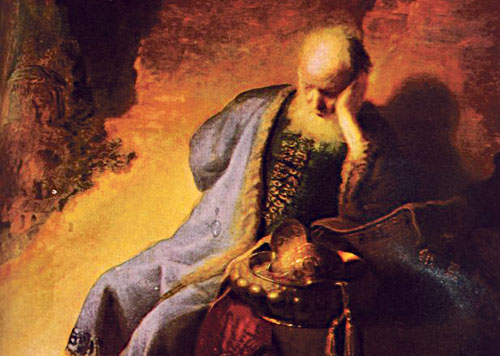
Today’s featured image was created with Wonder A.I.

If you know anyone who might be encouraged by today’s post, please share.

Grace for the Lame

Grace for the Lame (CaD 2 Sam 9) Wayfarer

The king asked, “Is there no one still alive from the house of Saul to whom I can show God’s kindness?”

Ziba answered the king, “There is still a son of Jonathan; he is lame in both feet.”
2 Samuel 9:3 (NIV)

In the small community where we live is a local non-profit organization that serves adults who are physically and mentally challenged. Many of these adults live on their own or in local group homes. They have a tremendous amount of autonomy, work locally, and learn to live as independently as possible. If you spend any amount of time in our town you will eventually meet and interact with a number of them. I have always found it a unique aspect of our community that we collectively embrace and assist them. Just a few weeks ago one of our special neighbors approached Wendy uptown and asked for a ride. Of course, she drove him to the store even though it was out of her way and didn’t fit her schedule.

Back in 2008-2009, our daughter Taylor was serving a mission in Morocco. She and a teammate connected with a local center that served handicapped children and they spent time serving at the center and loving the children. Through her eyes and stories, we learned how different the experience can be for those with disabilities in other cultures. Families are often ashamed of their disabled children and the culture makes an effort to hide them away from public view. Little assistance is provided for the centers that serve the disabled or those who are caretakers. I’m sure Taylor and her team were an amazing blessing to the children and the administrators of the center where they volunteered.

I thought about these contrasting experiences when reading about David’s kindness to Jonathan’s lame son, Mephibosheth. I am quite certain that a lame man in David’s day was far more likely to experience the shaming derision of the community as Taylor experienced in Morocco than the community embrace that our town attempts to give to the adults from the local center. Mephibosheth’s personal shame and self-condemnation are apparent from the moment he opens his mouth: “What is your servant, that you should notice a dead dog like me?”

David’s grace to the lame son of his late friend reminded me this morning of the grace that Jesus has afforded me. I am spiritually lame in so many ways. I am undeserving of the King’s favor, and yet I am invited daily to His table to enjoy provision, relationship, healing, encouragement, strength, and most of all forgiveness.

Today, I am thinking about the grace David showed Mephibosheth, the grace Jesus has shown me, and how I can pay it forward in a tangible way with those in my spheres of influence.

 A Note to Readers
I’m taking a blogging sabbatical and will be re-publishing my chapter-a-day thoughts on David’s continued story in 2 Samuel while I’m take a little time off in order to focus on a few other priorities. Thanks for reading.
Today’s post was originally published in May 2014
.

If you know anyone who might be encouraged by today’s post, please share.

Prepped for Success

King David dedicated these articles to the Lord, as he had done with the silver and gold from all the nations he had subdued…. 2 Samuel 8:11 (NIV)

Yesterday I was in my client’s office and he was sharing with me a little bit about his background. He took me through a brief overview of his professional journey and resume. At the end of it, he had connected the dots to reveal how his entire career had uniquely prepared him for his current role in his company and industry. Laughing, he told me “I guess I learned a thing or two along the way.”

I thought about that conversation this morning as I read today’s chapter. David was on a roll. Bent on expanding and establishing his kingdom, his energies were focused on conquest. Connecting the dots, I recognize how all those painful years on the run from Saul now benefitted him greatly. Those difficult years prepared him uniquely to be a successful leader. He had been forced to live in foreign territories and had gathered around himself an international military team. He knew how to lead a diverse group of men. His understanding of neighboring nations, their politics, their militaries, and all of the geopolitical nuances of the region allowed him to be shrewd in his decisions as a general and a king. Like my client, David had learned a thing or two along the way.

I have to believe that all of those years depending on God for daily strength, courage, provision, and perseverance also prepared David with humility. He knew what it was like to be an outlaw living life in a cave. Now that he was king and the military victories were stacking up David had not lost sight of the fact that it was God who made those victories possible. The trophies of his victories he dedicated to God, refusing to take the glory for himself.

Today I am reminded to place credit where credit is due in my own life and victories. Like my client, like David, I can connect the dots in my journey and see how God has led me to this place. I’ve learned a thing or two as well, and have been prepared for my calling.

Though my victories are relatively small and insignificant in the grand scheme of things, there is no doubt that I have been richly blessed. God has been good to me and I never want to lose sight of that fact, nor take credit for what has been graciously and undeservedly given.

A Note to Readers
I’m taking a blogging sabbatical and will be re-publishing my chapter-a-day thoughts on David’s continued story in 2 Samuel while I’m take a little time off in order to focus on a few other priorities. Thanks for reading.
Today’s post was originally published in May 2014
.

If you know anyone who might be encouraged by today’s post, please share.

Justice Then and Now

Justice Then and Now (CaD Jos 20) Wayfarer

Then the Lord said to Joshua: “Tell the Israelites to designate the cities of refuge, as I instructed you through Moses, so that anyone who kills a person accidentally and unintentionally may flee there and find protection from the avenger of blood.
Joshua 20:1-3 (NIV)

Some of our most epic stories have ridiculously high body counts. I’ve had the joy of seeing many of Shakespeare’s plays produced on stage. His tragedies, in particular (e.g. Hamlet, Macbeth) end with seemingly everyone in the play dead. The same with the feuding Capulets and Montagues in Romeo and Juliet. The same is true in more modern epics like the Godfather trilogy in which warring families endlessly kill one another. Game of Thrones also found creative and nasty ways to rack up the body counts. Even the climactic final chapters of Harry Potter contained the death of some of my most beloved characters.

Throughout history, our epic stories are reflections of our humanity, complete with its deepest flaws and tragic ends. Ever since Abel’s blood cried out, murder, death, and vengeance have been a part of human tragedies.

In today’s chapter, God reminds Joshua of a rudimentary system of justice outlined in the law of Moses. Knowing that tragic deaths could often result in violent, systemic, and generational blood feuds between families, clans, and tribes, Cities of Refuge were designated. If a tragic death occurred unintentionally yet a person was accused of murder, the accused could flee to one of these cities of refuge. The town protected the accused from acts of vengeance until a trial could be held by the tribal assembly and a verdict rendered. It was rudimentary, but it provided a time-out so that hot tempers could cool off and vengeance could be stalled in order for justice to be carried out.

As a student of history, I have often read about the historical implications that the Law of Moses had on humanity. It’s the recognized seminal code of law on which our own system of justice is built. No human system of justice is perfect, just as no human system of government is perfect. But in the story of the Hebrews, I see God prescribing a huge step forward toward a more just society.

So what does this have to do with me here in my 21st-century life journey? First of all, I’m grateful to have very little need for a justice system thus far on my life journey. I am blessed to have lived what amounts to a relatively peaceful life. I take that for granted sometimes, and so I whisper a prayer of gratitude in the quiet this morning.

I also recognize as I meditate on the chapter that justice is more pervasive in the human experience than the weighty matters of manslaughter and capital murder. Justice is a part of every human relationship and interaction. As a follower of Jesus, I can’t ignore that He calls me to be just, generous, loving, and merciful in every relationship. Jesus taught that In God’s kingdom:

  • Cursing another person is as serious as murder.
  • Lust is as serious as adultery.
  • I shouldn’t worship God if I’ve got an interpersonal human conflict that needs to be resolved.
  • I am to forgive, as I have been forgiven, and then keep forgiving, and forgiving, and forgiving, and forgiving, as and when necessary.
  • When cursed by others, I am to return blessings.
  • When asked for a favor, I am to go above and beyond what was asked.
  • As far as I am able, I am to live at peace with every person in my circles of community and influence.

And this is not an exhaustive list. It’s just a top-of-mind list that came to me in the quiet.

And so I enter another day in the journey, endeavoring to be a person of love, mercy, generosity, and justice in a world that has always desperately needed it at every level.

If you know anyone who might be encouraged by today’s post, please share.

A Different Way

A Different Way (CaD Jos 6) Wayfarer

But Joshua spared Rahab the prostitute, with her family and all who belonged to her, because she hid the men Joshua had sent as spies to Jericho—and she lives among the Israelites to this day.
Joshua 6:25 (NIV)

Over the last year, I found myself subscribing to several accounts on social media that regularly publish posts and memes about what it was like growing up in the 70s and 80s. It’s brought back a lot of memories:

As much as these bring back fond memories, they also remind me of just how much life has significantly changed in just one generation. Just as I could never fully fathom what my grandparents’ lives were like living through two World Wars and the Great Depression, my grandchildren will never fully fathom life without access to more information in their hands than was available to me on the entire planet.

As technology, data, processing speed, and computer memory continue to advance at an ever increasing pace, I’ve observed what appears to be an increasing lack of empathy and/or appreciation for the past. What I witness is that Cancel Culture isn’t just about socially ostracizing people who don’t toe an ideological line, but I also see people dismissing the past as being as outdated and worthless as that second-generation iPod gathering dust in a drawer somewhere.

Today’s chapter introduces us to the brutal life that was daily human existence 3500 years ago and in the early chapters of the Great Story. The Hebrew conquest of Canaan is layered with meaning that contains implications and themes that foreshadow the larger themes of grace, judgment, and redemption that are present in the larger story. Yet, it is easy to dismiss for modern readers who are used to simply canceling anything that doesn’t comfortably fit in my 21st century, politically correct worldview.

War and conquest were the dominant way of life. City-States and regions were continually embroiled in surviving those armies, nations, and fledgling empires bent on growing their power. But what happened at Jericho is actually different in many regards. God makes it clear that it is He who is passing judgment on the people of Jericho, it is God who is out front making victory miraculously possible, and it is God who was gracious with Rahab and her family, who by faith, believed that the God was the one true God. The Hebrew people were not allowed to take spoil from the battle. Archaeological evidence at Jericho found entire jars full of grain that had been left which makes little sense in a world in which famine regularly wiped out entire people groups. There’s something different taking place. For forty years God has been doing something different with these Hebrew tribes than the world has ever seen.

And, if I can’t fully fathom what life was like for my grandparents in the Great Depression, then I certainly can’t fully fathom what life was like for those Hebrew tribes at Jericho. Personally, I don’t take that as a license to ignore and judge either the Hebrews or God, but rather as an invitation to be gracious in my ignorance while also wrapping my head and heart around the larger Story being told that I might continue to gain wisdom in my own journey and where this Great Story is leading.

In the quiet this morning, I can’t shake the fact that it is God who is driving the action, God who is leading the charge, God who is just beginning to reveal Himself to humanity by telling His people “I’m going to show you a different way of doing things.” Which is the same thing that Jesus did when He revealed that Messiah was not about earthly power and kingdoms, but about a suffering servant compelled by love to sacrificially lay down His life for others.

Which reminds me that on this day, even with my phone in my hand which has more computing power than the Apollo mission had sending men to the moon, and access to an infinite number of distractions of any kind I could possibly want, I believe that Jesus is still trying to get my attention, to hold my focus long enough to get through to me: “Tom, I’m trying to show you a different way of doing things. A different way than you see all the kingdoms and power structures of this world doing with them amidst all the technology and knowledge they have. Follow me.”

If you know anyone who might be encouraged by today’s post, please share.

Bad Blood

Bad Blood (CaD Ob 1) Wayfarer

Jacob will be a fire
    and Joseph a flame;
Esau will be stubble,
    and they will set him on fire and destroy him.
There will be no survivors
    from Esau.”
The Lord has spoken.

Obadiah 1:18 (NIV)

Some of the more fascinating discoveries in the excavation of my family history have been the bad blood that exists between individuals and family units. In some cases, entire family groups have had little or no relationship with one another for generations and have no idea that the distance is rooted in bad blood from generations before.

I found bad blood in both my paternal and maternal families. I discovered bad blood rising from a host of reasons including, but not limited to, unwanted pregnancies, marriages, re-marriages, inheritance, family business, addiction, and deception. Most commonly, bad blood occurred between siblings, but bad blood between parents and children was also present.

Today’s chapter is the prophecy of Obadiah who wrote a short prophetic poem against the nation of Edom at the time Nebuchadnezzar and the Babylonian Empire were marching on Jerusalem around 600 B.C. The Edomites, who had considered joining the local defense against the Babylonian Empire, ended up siding with Babylon.

The Edomites were descendants of Esau, the elder twin brother of Jacob. If you were on our chapter-a-day journey through Genesis last year, you might recall the bad blood between them. Bad blood arose between brothers because of the favoritism demonstrated by both parents. Dad favored Esau. Mom favored Jacob. This led to Jacob’s deceptive stealing of Esau’s blessing and inheritance then fleeing into exile for years. All of this took place around 2000 B.C.

I did the math this morning. The bad blood Obadiah is writing about in today’s chapter between the people of Israel and the people of Edom began with a conflict between brothers 1400 years before Obadiah picked up his papyrus and stylus.

In the quiet this morning, I circle back to thinking about family. I know that a lot of people could give a rat’s rear-end about the past. I get it. I have always had a bent toward the past and a love of history. It was fascinating to learn that this is part of being an Enneagram Type Four. I have personally found it worthwhile in a couple of different respects.

First, I have gotten to correspond with and to know members of my family I would otherwise have never known. Their stories have added new layers of understanding of the family systems from which I spring. It helps me understand myself, my parents, my grandparents, and my great-grandparents and their stories in a greater context, along with a ton more grace. There’s so much in life we don’t control, including the family systems that produced us.

Second, is the old adage that “those who don’t learn from history are doomed to repeat it.” I have tried very hard along my life journey to avoid the traps that lead to the kind of bad blood which can affect individuals and family groups. I can’t help but recall Paul’s words to Jesus’ followers in Rome:  “If it is possible, as far as it depends on you, live at peace with everyone.”

Along my journey, I’ve discovered that living at peace requires me to care more about what matters than what doesn’t. That has meant valuing people over politics (or religion, or morality codes, etc.), choosing relationships over being right, and letting go of things of temporal value to perpetuate love that is priceless. This sometimes (often?) requires letting go of the past and choosing forgiveness so that future generations don’t systemically perpetuate bad blood they personally had nothing to do with simply because that bad blood was never dealt with and permanently infected the family system.

If you know anyone who might be encouraged by today’s post, please share.

The Context

The Context (CaD Matt 22) Wayfarer

“Then he said to his servants, ‘The wedding banquet is ready, but those I invited did not deserve to come. So go to the street corners and invite to the banquet anyone you find.’
Matthew 22:8-9 (NIV)

Along my spiritual journey, I’ve observed that it’s easy to read with a mental microscope or magnifying glass to inspect every word, every verse, or every parable as if they exist as individual and/or exclusive works of divine wisdom. I’ve come to observe that there’s more to be gained by launching my mental drone to rise above the text and see the word, verse, and parable within the larger tapestry of the Great Story. Today’s chapter is a great example of this.

The entire chapter takes place at a very specific time and place. It’s the last week of Jesus’ earthly life. He is in Jerusalem and spending His day at Herod’s Temple, the seat and center of Hebrew religious power and worship. There is an escalating conflict emerging between Jesus and the religious leaders of His day. Public opinion is on Jesus’ side for the moment, and the religious leaders are working their fundamentalist political playbook. They keep sending different groups with questions in hope that Jesus will make a gaffe, say something stupid on the hot mic, or make a partisan comment which will offend His audience and give them political ammunition to publicly discredit Him. This is the same kind of political theater that plays out in press conferences and the media every single day.

They ask Jesus about paying taxes to Rome because it’s a hot-button issue. Most of Jesus’ audience hated the Romans, and they hated paying taxes. The religious leaders even make sure that Rome’s local political puppets, the Herodians, are there to witness the answer. They hoped Jesus’ answer would be treasonous enough to arrest Him.

A religious faction, the Sadducees, try a trick question on Jesus that was rooted in a hot-button theological debate about whether there was a resurrection or not. The motive was to trip Jesus up and make Him look like a fool. Jesus nailed the answer and discredited the questioners.

They tried another theological question, but Jesus nailed that one, too.

Then Jesus decided it was time for Him to ask the question. He asks about the popular term being used for the coming Messiah, the same one they were indignant about children applying to Jesus in yesterday’s chapter: Son of David. Jesus discredits the term (perhaps in response to their indignation the previous day?) based on David’s own lyrics.

This is a political tennis match with Jesus volleying back and forth with the religious leaders. And it’s in the context of this rising conflict that I must understand Jesus’ parable of the Wedding Banquet. The guests invited to the feast who ignored the invitation are Jesus’ religious enemies. They’ve ignored the heart of God’s commandments to cling to their power, greed, and fundamentalism. The servants who get beat up and killed are the prophets. The King sending His army to destroy the murderers and raze the city is prophetic, as this is exactly what happened in AD 70 when the Romans razed Jerusalem and the Temple. The King’s decision to go to every corner and invite “anyone you can find” is equally prophetic. It is what happens in the book of Acts when the Jesus Movement breaks out of the shackles of Hebrew fundamentalism and embraces anyone, Jewish or not, who chooses to repent, believe, and follow.

In the quiet this morning, I find myself asking what this means for me today. My heart’s desire is to always follow Jesus, but I can look back on my journey and see ways in which I’ve been more like the religious leaders. I’ve been religious, but I confess that there’s hard evidence that my religion has at times been more about being right, condemning others, and holding appropriate political and doctrinal views instead of being about love, grace, and mercy. That makes me more like Jesus’ enemies.

Mea culpa.

Whenever personal faith intertwines with human institutions and systems, it’s hard for it not to get sucked into the same trap that the Hebrews fell into. And that’s as true for me as it is for anyone else.

So, for me, that’s the take-away. I want to be diligent in living out my “religion” in Jesus’ terms:

Religion that God our Father accepts as pure and faultless is this: to look after orphans and widows in their distress and to keep oneself from being polluted by the world. James 1:27 (NIV)

If you know anyone who might be encouraged by today’s post, please share.

The Sticky Wicket

The Sticky Wicket (CaD Matt 19) Wayfarer

Some Pharisees came to him to test him. They asked, “Is it lawful for a man to divorce his wife for any and every reason?”
Matthew 19:3 (NIV)

I married as a young man with every intention of never divorcing. I was blessed growing up that I didn’t experience it in my own family. I’d be lying if I said that I didn’t have feelings of shame and failure when it actually happened seventeen years later.

Divorce is a sticky wicket among many Christian persuasions. Among some more Fundamentalist branches divorce is leveraged as a major litmus test to distinguish the pure and the unpure, who is “in” and who is “out,” who is “holy” and who is not. When my first wife and I were amidst our divorce I received a handwritten letter of some 8-10 pages from a “friend” who felt it important to explain to me why I was going to hell in no uncertain terms and would be forever sealed with the scarlet letter “D” for the rest of my days. According to him, divorce was an unpardonable sin. There was no grace, no redemption, and no going back. What was really interesting about it, however, was that this friend’s wife had left him many years before that, divorced him, and got remarried though he steadfastly refused to acknowledge that they were, in fact, divorced. He continued to wear his wedding ring and live in denial.

Divorce brings out all sorts of emotions in all sorts of people.

In today’s chapter, the fundamentalist religious leaders approach Jesus with the motivation of testing Him. If you want to “test” someone, just ask the person to take a stand on a controversial issue knowing that you’ll make at least half your audience angry. Politicians and journalists do it all the time. It’s a tactic from a well-worn playbook.

The test for Jesus was the sticky wicket of divorce, though modern readers may not comprehend the full context of the matter in Jesus’ day. Among the Hebrew religious lawyers at that time, there were two schools of thought when interpreting the Law of Moses in Deuteronomy 24:1-4 in which a man who “finds something displeasing” about his wife “because he finds something indecent about her” then he can write a certificate of divorce and send her from his house. One legal camp focused on the term “finds something displeasing” and contended that any man could divorce his wife for any displeasure no matter how small or trivial. He might simply divorce her for burning his steak. The other legal camp focused on the phrase “because he finds something indecent about her” and believed that divorce was confined to some kind of indecent sexual immorality.

In Jesus’ day, divorce was a much larger social issue. Women had no rights. Women had no legal standing. Women had virtually no means or opportunity to survive and provide for themselves. Thus, a widow or a divorced woman was placed in the precarious position of having very few options available to them. They could find another husband (good luck finding a husband with that scarlet “D” on your tunic), they could live off the charity of family or friends, or they could become sex workers. A man who dismissed his wife was not only placing her in an impossible position but was also adding to a larger social problem for which there were few good answers.

Jesus, of course, pointed back to the pattern of creation as God’s intent: one man and one woman who become one flesh for life. I find it intriguing that polygamy was not a heated religious issue given this fact and its prevalence throughout history.

In the quiet this morning, I guess you could say that I’m wrestling with my demons. Shame is a constant for me. Jesus certainly pointed to the ideal as God’s desire for us, though my experience is that the ideal is rarely seen or experienced on this life journey in any context. In this fallen world, divorce is a human reality as old as humanity itself. It will never be ideal. At the same time, my personal experience is that God was never absent during the breakdown of my marriage or during the time of my divorce. And, my experience through it all was ultimately that of God’s love, grace, restoration, redemption, and the germination of new life in multiple ways. Old things passed away, and new things began.

There are so many sins and mistakes that wreak havoc on lives, families, and, society. Divorce is one of them, but certainly not the only one. If there’s one thing that I’ve learned in my 40 years of following Jesus, it’s that the very heart of His entire mission was to take broken things and to redeem them, to make them new. Wendy and I have seen this and experienced it in countless ways, despite the pit to hell that my “friend” dug for me in his letter all those years ago. I can’t help but remember the words of Corrie ten Boom: “This is no pit so deep that God’s grace isn’t deeper still.”

Note: I will be taking a break next week while I’m out on a business trip and focusing on my client. Feel free to use the Chapter-a-Day Index to go back and read some old posts. You can also scroll back through old episodes on any of the podcast platforms. Have a great week!

If you know anyone who might be encouraged by today’s post, please share.

The Debt

The Debt (CaD Matt 18) Wayfarer

“This is how my heavenly Father will treat each of you unless you forgive your brother or sister from your heart.”
Matthew 18:35 (NIV)

He was a big man. He was not a person I would want angry with me, and he had a natural bent toward anger. As we chatted, he shared stories of just how hot his anger burned and the difficult situations he’d found himself in because of it. He’d been brought up with religion. In fact, there was a lot of religion. From the cradle, he’d been raised with rules, rituals, and regulations out the wazoo, but by his own admission, religion did nothing to curb his anger or modify the spiteful way he treated anyone who crossed him. And his rage led him to some nasty places. Then, through a series of unfortunate events, he found himself in the darkest, seething rage of his life. It was there he met Jesus.

This man came to mind this morning as I read the parable Jesus told His disciples in today’s chapter. If you didn’t read the chapter yourself, I encourage you to take 60 seconds and read it (Matthew 18:23-35). It’s a simple story of a servant who owes the king 10,000 bags of gold. When the king calls the loan, which will bankrupt the servant and ruin his life, the servant pleads for more time to pay it back. The king has compassion and forgives the entire debt. No sooner had this servant left the king’s presence that he runs into a fellow servant that owes him 100 silver coins from a wager they’d made on the Jerusalem Jackals game. The servant chokes his friend, demands payment, and has him tossed into debtor’s prison until he could pay the small sum.

Along my spiritual journey, I’ve both experienced and observed that there are common circumstances in which individuals struggle to actually “forgive those who sin against us” as Jesus famously told us to pray.

I’m simply a religious person going through the ritual motions. This lesson can be applied to so many circumstances, but in this case, it has everything to do with my ability to forgive and withhold judgment. Being a member of a church, or adhering to the tenets of religious rules and rituals only modifies my public behavior. It does nothing to change my heart. I’ve only seen a heart and life transformed and changed when a person has experienced a relationship with Jesus. My religion will never transform my heart and life, but a heart and life transformed by Jesus will definitely transform my religion.

I have no idea how great a debt I owe. If the servant in Jesus’ parable had been ignorant of just how much he owed the king, his behavior toward the fellow servant would not seem like such huge hypocrisy. As humans, I’ve observed that we have a penchant for keeping score with our mental scales. We know we’ve done this bad thing so I’ll throw that on one side of the scales. But, the person who injured me has done this and that so I’ll throw them both on the other side. See that! They’re worse than me so they deserve my wrath! James 2:10 points out that God’s economy doesn’t work like ours. If I keep all the rules and trip up on just one, I stand condemned and guilty of all of it. From God’s perspective, keeping score is a fool’s errand. We’re kidding ourselves to think or believe that we’re “not that bad.”

I haven’t truly experienced the power of grace myself. In the parable, the servant had experienced grace at an unbelievable level. 10,000 bags of gold was an incalculable sum to Jesus’ listeners. It’s like Elon Musk’s net worth in today’s standard. As I just mentioned, in God’s economy we all spiritually owe 100 billion dollars. It’s the contrast between the sum the servant had been forgiven and the paltry pittance the servant was owed that powers the moral of the story. When I know and have experienced how great a debt I’ve been forgiven by Jesus, it transforms the way I perceive and respond to those who offend and injure me.

In the quiet this morning, this brings me back to my big, angry friend. After meeting Jesus amidst his dark, seething rage had shared with me how his life began to change. It transformed his religion, his relationships, and the entire direction of his life. He’s still prone to anger, and he’s still not someone I’d want to see angry, but I wasn’t really worried about it as I listened to his story. After meeting Jesus and experiencing true grace, the fuse on his anger began to grow increasingly longer. The explosions of anger were more tempered, and he began to take responsibility for cleaning up the mess when it occasionally went off.

The words to an old, old hymn have been resonating in me the past month or two:

How deep the Father’s love for us,
How vast beyond all measure!
That He would send His only Son,
To make this wretch His treasure.

If you know anyone who might be encouraged by today’s post, please share.

The Choice

The Choice (CaD Gen 50) Wayfarer

But Joseph said to [his brothers], “Don’t be afraid. Am I in the place of God? You intended to harm me, but God intended it for good to accomplish what is now being done, the saving of many lives. So then, don’t be afraid. I will provide for you and your children.” And he reassured them and spoke kindly to them.
Genesis 50:19-20 (NIV)

Over the years, Wendy and I have enjoyed hosting Godfather nights. We have a big Italian dinner with friends who have never seen the all-time classic movie, and we watch together over wine and cannoli. It’s so much fun.

[Spoiler Alert] In the final minutes of the film, the patriarch of the family dies, and his son, Michael, decides to make a move against all of the family’s enemies. This includes traitors within the family itself. As Michael stands in a Catholic church and becomes godfather to his sister’s baby at a baptism ceremony, the vengeance is mercilessly carried out. It all takes place as Michael is asked in the baptism ritual: “Do you renounce Satan?” and he responds, “I do renounce him.”

That scene came to mind this morning as I read the final chapter of Genesis. Jacob dies. He and his family are living in Egypt under Joseph’s protection. With the patriarch of the family dead, Joseph’s brothers realize that they are in a precarious position. Joseph has all the power of Pharaoh and Egypt at his beck and call. Should Joseph decide to “settle accounts” with his brothers for beating him with murderous intent and then selling him into slavery he could. All Joseph had to do was give the word and they would all be sleeping with the fishes.

The brothers send word to Joseph begging for his forgiveness. They bow down before him and offer to be his slaves.

Joseph’s response is classic:

“Am I in the place of God?” Joseph is foreshadowing the song of Moses after the defeat of the Egyptians at the Red Sea, along with the instruction in Paul’s letter to Jesus’ followers in Rome:

If it is possible, as far as it depends on you, live at peace with everyone. Do not take revenge, my dear friends, but leave room for God’s wrath, for it is written: “It is mine to avenge; I will repay,” says the Lord. On the contrary:

“If your enemy is hungry, feed him;
    if he is thirsty, give him something to drink.
In doing this, you will heap burning coals on his head.”

“You intended to harm me, but God intended it for good…” Joseph makes a willing decision to allow God’s intentions to overshadow the ill-intent of his brothers. Once again, his thoughts and actions mirror the behavioral instructions given to Jesus’ followers:

“You have heard that it was said, ‘Love your neighbor and hate your enemy.’ But I tell you, love your enemies and pray for those who persecute you.” Matthew 5:43-44

Not only so, but we also glory in our sufferings, because we know that suffering produces perseverance; perseverance, character; and character, hope. Romans 5:3-4

Consider it pure joy, my brothers and sisters, whenever you face trials of many kinds, because you know that the testing of your faith produces perseverance. James 1:2-3

In all this you greatly rejoice, though now for a little while you may have had to suffer grief in all kinds of trials. These have come so that the proven genuineness of your faith… 1 Peter 1:6-7

“…to accomplish what is now being done, the saving of many lives.” Joseph’s response foreshadows two important spiritual realities.

First, he understands that all that has happened to him has resulted in saving the lives of his family. When God leads the tribes out of slavery in Egypt, He will say to them: “This day I call the heavens and the earth as witnesses against you that I have set before you life and death, blessings and curses. Now choose life, so that you and your children may live” (Deut 30:19) God is the God of Life. Joseph chooses not to go the Michael Corleone route down the path of death and vengeance. Joseph chooses life for his brothers.

Second, the promise given to Abraham was that through his descendants “all nations of the earth will be blessed.” Through Joseph’s trials, he was placed in a position to give life, not only to the Egyptians and his family but also to the other nations who came to Egypt to buy food in the famine. Had it not been for Joseph’s many trials, so many people from so many nations and peoples would have perished. Instead, they lived and were blessed through Abraham’s descendant.

In the quiet this morning, I find myself searching my heart to see if the seeds of vengeance are present. Stories like Joseph and The Godfather are so epic, yet the principles involved are intensely personal. Who has caused me harm? Who has made my life miserable? Who has wronged me, slandered me, or thrown me under the bus?

What seeds are taking root in my heart?

The seeds of resentment, hatred, and vengeance?

The seeds of grace, mercy, and forgiveness?

I’m reminded that the fruit of the former leads to death, while the fruit of the latter leads to life.

Spare the gun. Share the cannoli.

If you know anyone who might be encouraged by today’s post, please share.