Tag Archives: Kingdom of God

What They Fear the Most

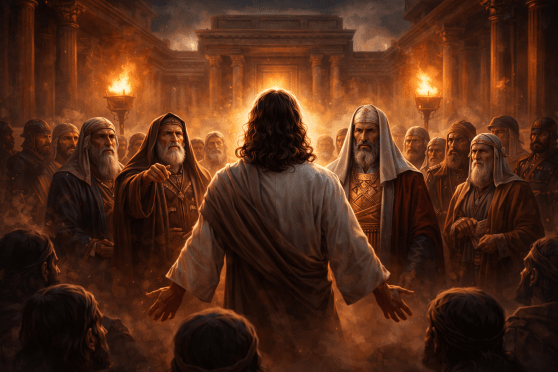
One day as Jesus was teaching the people in the temple courts and proclaiming the good news, the chief priests and the teachers of the law, together with the elders, came up to him.

“Tell us by what authority you are doing these things,” they said. “Who gave you this authority?”
Luke 20:1–2 (NIV)

Over the years, as Wendy and I scan current events in the morning—and as I continue my lifelong study of history—I’ve noticed patterns.

Kingdoms of this world—especially dictatorships, tyrannies, and tightly controlled religious systems—tend to operate the same way:

Power concentrated in the hands of a few
Control over nearly every aspect of life
Rules for the masses
Severe consequences for questioning authority

And beneath it all…

Fear.

The thing these systems fear most is the people.

Rebellion.
Uprising.
Revolution.

Jesus has arrived in Jerusalem. It is the final week of His earthly life.

This is a showdown.

God’s Son steps into the epicenter of power to confront the kingdoms of this world—

Human empire.
Human religion.
Human pride.

If you read this chapter closely, it’s dripping with the tension of a political thriller:

Corrupt system.
A lone truth-teller.
Traps. Spies. Hidden agendas.
The pressure building.

As the chapter opens, the chief priests, elders, and their legal experts approach Jesus.

This is a show of force.

These are the elites who run the Temple… the religion… the system.

And Jesus?

He’s a problem.

He speaks with authority—but not theirs.
He operates outside their control.
And the people love Him… a little too much.

That’s dangerous.

Because the thing these systems fear most… is the people.

So they ask the question that always protects power:

“By whose authority are you doing these things?”

They are the authority.

And in their world, authority is never questioned.

Over time, what began as something established by God has been twisted by sin and pride into just another human system—one clinging tightly to control.

And now Jesus stands in their midst… a threat they cannot control.

Jesus responds with brilliance.

He brings up John the Baptist.

Another maverick.
Another prophet the people loved.
Another voice who challenged their corruption.

So Jesus asks:

Was John’s authority from God… or from man?

If they say “from God”—they condemn themselves for rejecting him.

If they say “from man”—they risk the people’s anger.

They are trapped.

Rock? Meet Hard Place.

So they refuse to answer.
And Jesus, in turn, refuses to answer them directly.

Instead, He tells a story.

A vineyard owner (God).
Tenant farmers (the religious leaders).
Servants sent to collect what is due (the prophets).
Beaten. Rejected. Killed.
Finally, the owner sends his son.
They kill him too.
Because if the son is gone… they believe the vineyard will finally be theirs.

And just like that, Jesus names the reality standing right in front of them.

This isn’t just a disagreement.

It’s a collision between kingdoms.

The rest of the chapter unfolds more of the same:

Spies planted.
Traps laid.
Political factions taking their turn.
Loaded questions meant to entangle.

But beneath it all is an ancient root:

The pride of life.
The human desire to control.
To define truth.
To hold authority.
To be… God.

The same whisper from the Garden still echoes here.

And maybe more uncomfortably…

It still echoes now.
These kingdoms are still clashing if I have the eyes to see it.

In the quiet this morning, I sense the Holy Spirit whispering a simple reminder into my soul.

In a few minutes, Wendy and I will sit down together and scroll through the day’s headlines.

Wars and rumors of war.
Cultural tensions.
Political division.
Religious infighting.
Economic anxiety.
Voices shouting.
People grasping.
Systems straining to hold control.

If I look at the world through a worldly lens…

I will have worldly reactions.
I will think worldly thoughts.
I will feel anger, fear, anxiety.

And that’s perfectly natural—

if this world is all I see.

But if I look through the lens Jesus offers…

Everything changes.

I begin to recognize these systems for what they are.
Temporary. Fragile. Grasping for control.

And I remember who I am.

An ambassador of a different Kingdom.
Living in contested territory.
Trusting eternal promises over temporary fears.

Called—not to react—but to respond.

With love.
With clarity.
With courage.

Now if you’ll excuse me…

I have a breakfast date with Wendy—

to read the news…

through a Kingdom lens.

If you know anyone who might be encouraged by today’s post, please share.

Promotional graphic for Tom Vander Well's Wayfarer blog and podcast, featuring icons of various podcast platforms with a photo of Tom Vander Well.
These chapter-a-day blog posts are also available via podcast on all major podcast platforms including Apple, Google, and Spotify! Simply go to your podcast platform and search for “Wayfarer Tom Vander Well.” If it’s not on your platform, please let me know!
An orange square icon featuring an open book illustration in white.

God’s Kingdom… It’s Already Here

Once, on being asked by the Pharisees when the kingdom of God would come, Jesus replied, “The coming of the kingdom of God is not something that can be observed, nor will people say, ‘Here it is,’ or ‘There it is,’ because the kingdom of God is in your midst.”
Luke 17:20-21 (NIV)

Every Sunday our local gathering of Jesus’ followers, like many around the world, says the Lord’s Prayer together. As we do so, we pray,

“Your kingdom come, your will be done, on earth as it is in heaven.”

For most of my life, I confess that I muttered these words without truly even thinking about what they meant.

I thought I was asking God to do something.
I thought I was waiting for something to happen.
I figured it was all about Revelation and end times.

It’s amazing how many things I’m still learning after 45 years as a disciple.

In today’s chapter, Jesus is asked by a Pharisee about the coming of the kingdom of God that Jesus talked so much about. The Pharisees and the religious leaders were thoroughly convinced that the Messiah and His kingdom would be major and dramatic divine production.

Thunder. Smoke. Earthquakes.
A warrior king leading armies against Rome.
An earthly palace in Jerusalem.
Giant throne.

Think Kings David and Solomon on steroids.

If that Pharisee were uttering Jesus’ prayer, that’s what he would have been praying for as he said, “Your kingdom come.”

Jesus answer hit me like a ton of bricks in the quiet this morning.

“The coming of the kingdom of God is not something that can be observed, nor will people say, ‘Here it is,’ or ‘There it is,’ because the kingdom of God is in your midst.”

It’s already here.

Over the last several years I’ve been learning about how life with God on earth is understood by thinking about life on four levels.

Level Four: Kingdom of God
Level Three: Kingdoms of this World
Level Two: My Community and Circles of Influence
Level One: My Relationship with God

The way the world (Level Three) works is to use power and wealth to control others and make them do your will.

Armies march.
Empires dictate.
Governments rule.
Businesses employ, delegate, and demand.
Religions regulate, condemn, and shame

Power.
Authority.
Threat of pain, loss, and punishment.

Now think back to what the Pharisees were looking for from God’s Messiah.

Just another kingdom of this world.

This is how Paul described Jesus’ game plan…

In your relationships with one another, have the same mindset as Christ Jesus:
Who, being in very nature God,
    did not consider equality with God something to be used to his own advantage;
rather, he made himself nothing
    by taking the very nature of a servant,
    being made in human likeness.
And being found in appearance as a man,
    he humbled himself
    by becoming obedient to death—
        even death on a cross!

Philippians 2:5-8 (NIV)

Jesus was in heaven up on Level Four.

He didn’t come crashing down with power through Levels Three and Two.

He slipped quietly into Level One to establish one-on-one relationships.
He called individuals.
He healed individuals.
He forgave individuals.
He loved individuals.
He got into the heart of individuals.

Then He said, “Go love others on Level Two. In your community and your circles of influence — so my love might penetrate their Level One lives as well.”
Your family.
Your neighbors.
Your coworkers.
Your enemies.

This isn’t the way the world works — power down authority.
This is the way God works — humility loving its way up.

Love others.

One-to-one.

Kindness.
Patience.
Faithfulness.
Goodness.
Forgiveness.

And when Jesus disciples followed that formula in the first century.
They turned the world upside down.

When Jesus told the Pharisee, “The kingdom of God is in your midst” He was talking about Himself.

But He was also talking about…
Peter.
James.
Mary.
Joanna.
Young John Mark.
The woman at the well.
The Samaritan leper.

The Kingdom of God is not in a palace in Jerusalem.
The Kingdom of God is in me.
In every believer.
To be “loved up” into others the way Jesus showed us.

“Your kingdom come, your will be done, on earth as it is in heaven.”

It’s not a prayer for God to do something.

It’s a commitment to God of what I’m going to do.

A conversation.
A moment of patience.
Choosing forgiveness, again, when I really don’t want to.

If you know anyone who might be encouraged by today’s post, please share.

Promotional graphic for Tom Vander Well's Wayfarer blog and podcast, featuring icons of various podcast platforms with a photo of Tom Vander Well.
These chapter-a-day blog posts are also available via podcast on all major podcast platforms including Apple, Google, and Spotify! Simply go to your podcast platform and search for “Wayfarer Tom Vander Well.” If it’s not on your platform, please let me know!
Logo featuring an open book icon on an orange background

The Weight of April

For where your treasure is, there your heart will be also.
Luke 12:34 (NIV)

It’s April.

I shared a few weeks ago that a friend and I spent 24 hours at a monastery in silent retreat. Each of us arrived with something on which we wanted to pray and meditate. For me, it was April.

This month brings a harmonic convergence of three important milestones in my life journey.

This month marks the 20th anniversary of these chapter-a-day blog posts and podcasts. My first post was April 4, 2006. One paragraph on Mark 8. Twenty years later I’m still here scattering my chapter-a-day posts to the winds of the internet.

Around the middle of this month my first book will be published and available on Amazon. This Call May Be Monitored (What Eavesdropping on Corporate America Taught Me About Business and Life) is the fulfillment of a life-long dream.

On the last day of the month I have one of those monumental birthdays with zero at the end. Yet 60 feels more monumental than the others. At this waypoint on the journey the conversation turns to retirement, health, and golden years. It’s the back turn before the home stretch.

Hitting all three milestones in one month has me returning to three important questions:

Where have I been?
Where am I at?
Where am I going?

Which is why they were rattling around my head and heart as I read today’s chapter. Jesus is coming out of his own back turn. In chapter nine He made the “resolute” turn towards Jerusalem. He’s entering the home stretch, and He knows exactly what awaits him.

As I read the text with that in mind, I once again found a common thread running through Jesus’ teaching. How, then, am I going to live? His ways are not our ways. According to Jesus, living for God’s Kingdom looks different than living for this world.

Kingdom people don’t fear death – or suffering (vs 4-12)
The world focuses on ways to cheat death, ignore it, or prefer it to life.

Kingdom people don’t worry about hoarding wealth & stuff (vs 13-21)
The U.S. alone has over 2 billion square feet of self-storage space.

Kingdom people don’t worry (vs 22-34)
Since 2020, levels of anxiety have skyrocketed across the spectrum.

Kingdom people remain fixed on eternal perspective (vs 35-48)
The world loses itself in the temporary—rarely stopping to consider what lasts.

Kingdom people view current events through an eternal lens (vs 54-59)
The world spins with every trending topic and momentary news blast

And so, in the quiet this morning I find myself meditating on how I am doing as I complete my 60th journey around the sun this month. As a disciple of Jesus…

How am I doing at living for God’s Kingdom?

How am I no different than the world?

What changes would Jesus have me make coming out life’s back turn?

Because there are more days behind me than are ahead of me.

And that’s no April foolin’.

If you know anyone who might be encouraged by today’s post, please share.

Promotional graphic for Tom Vander Well's Wayfarer blog and podcast, featuring icons of various podcast platforms with a photo of Tom Vander Well.
These chapter-a-day blog posts are also available via podcast on all major podcast platforms including Apple, Google, and Spotify! Simply go to your podcast platform and search for “Wayfarer Tom Vander Well.” If it’s not on your platform, please let me know!
An orange square icon with a white open book illustration on it.

An Open Invitation

Submit yourselves for the Lord’s sake to every human authority: whether to the emperor, as the supreme authority, or to governors, who are sent by him to punish those who do wrong and to commend those who do right.

 Show proper respect to everyone, love the family of believers, fear God, honor the emperor.
1 Peter 2:13-14, 17 (NIV)

I have for many years had a recurring brainstorm that returns every four years or so like the spring rains on the fields of Iowa. Every four years potential Presidential candidates from all political persuasions pass through Iowa for months in anticipation of the Iowa caucuses.

What if we invited them for dinner? We’d extend an invite to every one of them who passes through town. Just the candidate (and perhaps spouse) breaking bread and sharing a meal with just me and Wendy here in our dining room. Nothing fancy. No press. Just a meal and a private chat.

I think we’d learn a lot, not just about the candidate’s views, but the candidates themselves. Wendy and I have long held the position that we may not agree with a candidate’s politics, but we’d be willing to host any candidate – no matter their party or lack thereof – for a nice meal and respectful conversation. (For the record, I am not affiliated with any political party)

Today’s chapter is a head-on collision of Kingdom of God posture in human empire territory where the kingdoms of this world rule. Jesus’ counter-cultural kingdom ethic is on full display through the very man He once called ‘the rock..

First we have to understand the context of Peter’s letter which was written sometime around 60-64 A.D. Peter also references being in “Babylon” in his personal greetings (5:13). ‘Babylon’ was code for Rome.

Why does Peter use code? It is a time of rising hostility toward Christians. The storm clouds are gathering, and within a few short years Nero will unleash brutal persecution. It’s one of the reasons that the letter is being written in the first place. Referencing Rome as “Babylon” served multiple metaphorical purposes:

  • It protects believers if the letter is intercepted.
  • It frames Rome theologically: not merely a city, but an empire embodying exile and oppression.
  • It reminds Jewish believers of the first exile under literal Babylon.

And who is on the throne? Nero. That Nero. Corrupt. The one who will famously fiddle while Rome burns, then blame who? Christians.

Nero was volatile, self-indulgent, increasingly paranoid—and within a few years would unleash brutal violence against Christians.

Peter is not naïve. He knows who sits on the throne.

Which makes his instruction feel less like polite civic advice and more like defiant kingdom theology. Peter doesn’t tell believers to “burn it down.” He says, “honor (literally choose in your hearts to attach worth to him) the Emperor.”

Peter’s logic runs like this:

  • You are aliens and strangers (2:11).
  • Your loyalty is to Christ.
  • Therefore you are free.
  • Therefore you do not need to grasp for power.
  • Therefore you can show honor—even to flawed rulers.

This isn’t endorsement.
It’s witness.

The early Christians were not passive. They were faithful. And faithfulness sometimes meant suffering rather than seizing power.

Peter is not baptizing Nero.
He’s refusing to let Nero define conduct for followers of Jesus.

For me as a disciple of Jesus, this lands like a dagger in the heart of modern outrage culture: God through Peter commands honor in a world where the emperor will kill him. And Nero will have Peter crucified just a few years after this letter is written, the words of the risen Jesus echoing in his soul…

“Very truly I tell you, when you were younger you dressed yourself and went where you wanted; but when you are old you will stretch out your hands, and someone else will dress you and lead you where you do not want to go.”
John 21:18 (NIV)

As I meditate on these things in the quiet this morning, I find that God’s demand that I honor governing authorities is not a demand that I agree with them, approve of them, sanctify them, or remain silent about injustice. The demand is that I refuse to dehumanize them. In a culture that delights in contempt, Peter commands dignity.

That was radical under Nero.

It may be more radical now.

Which brings me back to my recurrent brewing brainstorm. If any candidates thinking about a run in 2028 find themselves coming through Pella on their Iowa Caucus tour, let Wendy and me know. You have an open invitation for dinner and a chat.

If you know anyone who might be encouraged by today’s post, please share.

Promotional graphic for Tom Vander Well's Wayfarer blog and podcast, featuring icons of various podcast platforms with a photo of Tom Vander Well.
These chapter-a-day blog posts are also available via podcast on all major podcast platforms including Apple, Google, and Spotify! Simply go to your podcast platform and search for “Wayfarer Tom Vander Well.” If it’s not on your platform, please let me know!
Icon featuring an open book on an orange background, symbolizing reading or education.

Not Our Ways

Believers in humble circumstances ought to take pride in their high position. But the rich should take pride in their humiliation—since they will pass away like a wild flower.
James 1:9-10 (NIV)

I’m in the final edit of my forthcoming book, which tells the story of how I, as a young man, had the unshakable belief that I was called to pastoral ministry and had zero interest in business. Then, God let me slog through six long years of personal purgatory in pastoral ministry and made it divinely clear that He was calling me to business.

That business? Analyzing phone calls. Over 100,000 of them from companies of all sizes and industries. Receptionists, customer support, inside sales, reservations, outbound sales, accounting, tech support, collections, emergency services, and just about any other function you can think of. I’ve learned about business from the inside out, in tens of thousands of moments of truth when a company interacts with their customers.

I’ve been blessed. I’ve done well. I was hired in 1994 with zero experience or interest. Now I own the company.

God has a sense of humor.

Now let me let you in on a little secret. I don’t really like to talk about business, or economics, or finance that much. I love my clients. I love serving them. I love applying my experience and knowledge to help my clients and their employees succeed in listening to their customers and improving their serve. What I really care about is the people. I care about the flesh-and-blood of business where clients, customers, and colleagues connect, conflict, and communicate.

Life has informed my business. Lessons from my business have fed the Life within me. That’s what my book is about. The career I never wanted — and the one God knew would save me.

His ways are not our ways.

Today our chapter-a-day trek takes a quick pass through the letter of James. This is not James as in one of Jesus’ twelve disciples, but rather James the Just — Jesus’ younger brother. He once thought Jesus was crazy, then he watched and listened. He saw his big brother risen from the dead. He became one of the strongest and most influential leaders of the Jesus Movement and was killed for it.

There has been a crackdown. Both Jewish leaders and Romans are persecuting believers, so followers of Jesus have scattered abroad to escape the threat of imprisonment, seizure of their assets, torture, and potential execution. James writes this letter to be copied, sent out, and passed around to all of those who have fled and are living life on the lam.

As I read through the chapter in the quiet this morning, I couldn’t help but pick up on a strong undercurrent in James’ encouragement.

His ways are not our ways.

The world tells us that comfort and ease are what we should strive for, that they are signs of success in life.

In God’s economy, trials and difficulties are profitable — necessary means of spiritual growth and maturity.

The world tells us that money and wealth is the most important and desirable thing in life.

In God’s economy, worldly wealth is spiritual poverty. Eternal treasure is found in contentment. Spiritual investments compound when I humbly find satisfaction with less.

The world views religion as the repetitive ritual motions around a set of doctrinal beliefs.

In God’s economy, true religion is faith in action on the street and in every day life. Caring for those in need. Tangibly loving others at home, in my community, and even in my business where I serve my flesh-and-blood clients and their team members.

His ways are not my ways. I’ve spent my entire spiritual journey learning this truth. In fact, the further I get in this life the more I come to understand just how pervasively true it is in every way. The more I understand it, the more it changes how I see and perceive everything in life.

Now, if you’ll excuse me, I’ve got to get to work. I have a big research presentation I’m working on for a client tomorrow. Not because of the paycheck it affords me, but because of the people I am called to serve.

If you know anyone who might be encouraged by today’s post, please share.

Promotional graphic for Tom Vander Well's Wayfarer blog and podcast, featuring icons of various podcast platforms with a photo of Tom Vander Well.
These chapter-a-day blog posts are also available via podcast on all major podcast platforms including Apple, Google, and Spotify! Simply go to your podcast platform and search for “Wayfarer Tom Vander Well.” If it’s not on your platform, please let me know!

A Land That Drinks Rain

The land you are entering to take over is not like the land of Egypt, from which you have come, where you planted your seed and irrigated it by foot as in a vegetable garden. But the land you are crossing the Jordan to take possession of is a land of mountains and valleys that drinks rain from heaven.
Deuteronomy 11:10-11 (NIV)

It’s not even Christmas and our driveway has required shoveling more times already than a few entire winters of recent memory. Last weekend Wendy and I were driving through a snow storm.

“Well, the farmers will be happy,” Wendy said.

That is such an Iowa thing to say. When you live in a state that drives nearly $50 billion dollars in annual revenue from crop production, agriculture is always part of the conversation. But for children of Iowa, it’s more than just money. We know that the fertile fields of Iowa feed the world. Closer to home and hearth, we know that farming is the life-blood and legacy of families.

Growing up in Iowa, you quickly learn that weather isn’t just about comfort or recreation, it’s an essential element of life, provision, and prosperity.

On a macro level, Moses’ words to the Hebrews crossing into the Promised Land in today’s chapter are about the blessings of love, legacy, and loyalty contrasted with the curses of apathy, forgetfulness, and hearts that wander. Right in the middle of the chapter (ancient Hebrew writers loved to put the most important bits in the center of the text), is a fascinating reference. Meteorology as metaphor: rain.

Back in Egypt, Moses reminds his people, water had to be industrially stored and channeled. Irrigation systems required. Humans digging, tunneling, manufacturing ways to make water work for them—that’s human empire. Human ingenuity finding ways to do what God does naturally by divine means. Humans have been doing that since the Tower of Babel.

The Promised Land, Moses tells his children, is God’s country. It is a land God Himself waters with rain from heaven. Rain is God’s blessing on the land and the people. God’s blessing, however, requires…

Faith, not function
Trust, not contraptions
Love, not labor.

This is God through Moses laying another layer of metaphor to lovingly communicate what He’s been saying all along. I’ve chosen and called you to be different than this world and the kingdoms of this world. Not because you deserve it or earned it but because of my love, grace, and mercy. Love me, trust me, follow me and rain will fall from heaven and you will be blessed with abundance and prosperity you can scarcely imagine.

Then comes the hard side of love. It isn’t punishment, it’s consequence.

There is a consequence, a curse, that comes if love, trust, and fidelity fade and fail. The skies close up. Drought conditions set in. At some point things resort back to the function, labor, and contraptions. When that happens, God’s people will be just like all the other kingdoms of this world.

The message I found flowing through the chapter in the quiet this morning was that the danger is not rebellion or disobedience. The danger is forgetting. Moses’ mantra thus far in his deathbed message has been the steady rhythmic beat of Zakhor: remember, remember, remember. Remembering what God has done is the crucial first step and activating ingredient in Life and blessing. Forgetting leads down a very different path.

“Believe me,” Moses urges his children, “you don’t want to go there.”

In a little divine wink, I’ve been hearing waves of heavy rain hitting the window of my office as I’ve been writing these words. I pulled up the radar. It’s a chilly Iowa winter morning, but well above freezing. A heavy rain is melting the snow from last weekend’s storm and soaking the slumbering earth.

In coffee shops all over Iowa, farmers sitting patiently through the death of winter and looking to the promise of Spring are smiling. A soaking winter rain. It’s a good thing. Gotta love it. But, it’s not a guarantee. Gotta have faith, too. Spring is still a long season away.

Rain is a gift.
So is remembering.
And faith, like spring, is something we wait for—but also something for which we prepare.

If you know anyone who might be encouraged by today’s post, please share.

Promotional graphic for Tom Vander Well's Wayfarer blog and podcast, featuring icons of various podcast platforms with a photo of Tom Vander Well.
These chapter-a-day blog posts are also available via podcast on all major podcast platforms including Apple, Google, and Spotify! Simply go to your podcast platform and search for “Wayfarer Tom Vander Well.” If it’s not on your platform, please let me know!
Spotify logo with an orange background and an open book icon, representing the listening platform.

Every Hand Dirty

“Eliashib the high priest and his fellow priests went to work and rebuilt the Sheep Gate. They dedicated it and set its doors in place, building as far as the Tower of the Hundred, which they dedicated, and as far as the Tower of Hananel.
Nehemiah 3:1 (NIV)

I gave a message among my local gathering of Jesus’ followers a few weeks ago about Jesus’ parable of the “mustard seed” and the “leaven.” In both metaphors, one small seed/amount has an exponentially huge effect. A small mustard seed creates a mustard plant/tree that could spread and take over an entire garden. Likewise, a pinch of yeast spreads through a giant batch of dough. The point Jesus is making is His plan for how He expects God’s Kingdom to spread to the world.

It starts with little ol’ me.

I’m the seed. I’m the yeast. Jesus’ love is supposed to spread through me and through my words, actions, and relationships it’s supposed to spread to others like leaven spreading through dough. As it infuses others, it keeps spreading outward.

It begins with every believer, no matter who they are, no matter what they’ve done, no matter how they are gifted, no matter what they do for a living, no matter their present circumstances. The Kingdom of God was always intended to be a grass-roots movement with every believer being a productive and fruitful seed.

In today’s chapter, the actual work of Nehemiah’s project to repair Jerusalem’s walls and gates begins. For the casual reader it reads like a construction ledger. Beneath its mortar and measurements lies a theology of community, cooperation, and consecration.

The first crew mentioned is the High Priest and his fellow priests. Spiritual leadership led the way, and led by example. They repaired the “sheep” gate, which references the sacrificial lamb. The sheep gate is the gate through which the sacrificial animals passed. This is more than just a civic project. This is allowing for the perpetuation of God’s redeeming work of all humanity. They are repairing the entire world.

As the chapter continues, it echoes Jesus parable of the mustard seed and leaven. Every one is involved in the effort. Perfumers, merchants, goldsmiths, individuals from all trades, individuals from all stations of life. In this way, the work of the wall here in Nehemiah is a foreshadowing of the very way Jesus intends the walls of God’s Kingdom on earth to be built in the on-going work of redemption.

Nehemiah even mentions that not everyone was a willing and cheerful participant. Verse 5 states, “The next section was repaired by the men of Tekoa, but their nobles would not put their shoulders to the work under their supervisors.” There is not a project in which I’ve participated, whether it was work, church, or community theatre, in which there isn’t some kind of challenge or obstacle rooted in human opposition, passivity, or negative attitude. I love that Nehemiah’s retelling is not some kind of idyllic memory. It’s a hand’s dirty account of a community project, complete with dishing out the dirt.

I’m reminded in the quiet this morning that in God’s Kingdom work, everyone has a brick to lay. Sacred work is often very ordinary work. Nehemiah has some 40 crews working in small sections, so I don’t need to feel the burden of changing the world – just working on my little section of it. I can be grateful for and supportive of all the other individuals and crews working on their little sections – they don’t need me meddling.

Another day of the journey. Time once again to get my hands dirty doing the ordinary work of building up God’s Kingdom. All the best to you on your little section of the wall. Shout out if you need help.

If you know anyone who might be encouraged by today’s post, please share.

Promotional graphic for Tom Vander Well's Wayfarer blog and podcast, featuring icons of various podcast platforms with a photo of Tom Vander Well.
These chapter-a-day blog posts are also available via podcast on all major podcast platforms including Apple, Google, and Spotify! Simply go to your podcast platform and search for “Wayfarer Tom Vander Well.” If it’s not on your platform, please let me know!
An orange icon featuring an open book, representing a Bible or religious text, with a black outline and the word 'BibleGateway' below it.

A Larger Reality

As for you, you were dead in your transgressions and sins, in which you used to live when you followed the ways of this world and of the ruler of the kingdom of the air, the spirit who is now at work in those who are disobedient.
Ephesians 2:1-2 (NIV)

A few years ago I had the joy of visiting the Marion E. Wade Center at Wheaton College in Illinois which contains C.S. Lewis’ archives. Along with his letters and writings, I had a chance to see and touch both his desk and his wardrobe. For a fan of The Chronicles of Narnia it was a real treat.

Here in our home we have an enduring love of, and appreciation for, classic epic children’s fantasy stories like The Chronicles of Narnia, Harry Potter, and A Wrinkle in Time. As I’ve pondered these classic stories, it has struck me that there is a common theme. Children in this world discover that there is another world, a larger reality that most people know nothing about. As readers we are drawn into these larger worlds through a wardrobe or Platform 9 3/4 and we blissfully lose ourselves within them. They resonate deeply within us.

For C.S. Lewis, at least, the creation of Narnia was simply a reflection of a spiritual reality he discovered when he himself became a believer:

“If I find in myself a desire which no experience in this world can satisfy, the most probable explanation is that I was made for another world.”

To be a disciple of Jesus is to believe that there is a much larger Story being told outside the feedback system of our physical senses and human intellect. Jesus continually taught of God’s Kingdom, told His followers to seek that Kingdom, to store up treasures in that Kingdom, and understand that there is an eternal reality that is greater than we realize or can humanly comprehend. In fact, if we have faith to believe it, that reality is more real than this earthly reality in which we live each day. Those who have had Near Death Experiences (NDEs) and have had a taste of that reality often say that it’s really this physical world that is a mere shadow of the ultimate realities of God’s eternal Kingdom.

In Paul’s letter to the believers in Ephesus, I find that he is attempting to pull back on the lens of their understanding to see the much larger spiritual realities of the Great Story in which they find themselves. The Story begins in Genesis when humanity finds itself stuck in a conflict of good and evil. Jesus ministry begins with a confrontation between himself and evil one. Jesus earthly life ends acknowledging that His death is a part of this larger Kingdom conflict. The Story ends in Revelation in a final confrontation between Jesus and the evil one who gathers all of the kingdoms of this world against Him. The Story begins and ends in a reality that exists outside of our present earthly realities.

Paul tells the believers in Ephesus that they are part of a much larger Story than they ever realized. It’s a Story in which Paul and his ancestors have played a major part through history while the Gentile (e.g. non-Jewish) Ephesian believers have been largely clueless. Through Jesus, Paul explains, they need to understand that they’ve entered into this larger Story that God has been authoring from the beginning. They are part of it now, and they need to understand the larger spiritual realities they’ve entered.

Just like Lucy hiding in an old wardrobe and suddenly finding herself standing by a lamppost in the snow.

In the quiet this morning, I’m reminded that this day, every day, there is more going on in the spiritual realm of God’s Kingdom than I can possibly, humanly know. This doesn’t make the mundane tasks of my to-do list meaningless. It makes them holy. The seemingly banal tasks of my everyday life become a liturgy of the ordinary that are part of a higher purpose. It’s what Paul was saying to the followers of Jesus in Colossae who were enslaved. Every day they were serving an expansively larger Kingdom amidst their limited earthly realities.

And so, I enter another day of this earthly journey doing the mundane tasks on my to-do list. The liturgy of the ordinary in God’s Kingdom work on earth.

If you know anyone who might be encouraged by today’s post, please share.

A collage featuring podcast platform icons alongside a portrait of Tom Vander Well, with the title "Wayfarer" displayed prominently.
These chapter-a-day blog posts are also available via podcast on all major podcast platforms including Apple, Google, and Spotify! Simply go to your podcast platform and search for “Wayfarer Tom Vander Well.” If it’s not on your platform, please let me know!
An orange icon featuring a book symbol, representing a digital learning platform or online resource.

The Choice and the Outcome

Then Jesus came to them and said, “All authority in heaven and on earth has been given to me.
Matthew 28:18 (NIV)

Today’s brief and final chapter marks the end of Jesus’ physical ministry on Earth. Matthew shares that Jesus rose from the dead. He and the disciples then returned to Galilee “to the mountain” where He “told them to go.” There, on top of the mountain, He told them that “all authority in heaven and on earth” had been “given” to Him.

Just this past Sunday I gave the message among my local gathering of Jesus’ followers and talked about when Jesus was tempted by the enemy in the wilderness. It was just before the beginning of Jesus’ physical ministry on earth. Luke writes:

The devil led him up to a high place and showed him in an instant all the kingdoms of the world. And he said to him, “I will give you all their authority and splendor; it has been given to me, and I can give it to anyone I want to. If you worship me, it will all be yours.”

What a fascinating contrast on which to meditate in the quiet this morning. The beginning and end take place on mountains and the issue at hand is kingdom authority. Right before the beginning of His earthly ministry, Jesus was offered all the authority of the kingdoms of the world on earth. All He had to do was bow down to the enemy.

Jesus, however, chose to love His Father and love others rather than bowing and taking a shortcut to worldly power and riches. Jesus’ love for His Father and others led Him to choose to surrender His will to the will of His Father, take up a cross, and sacrifice Himself for sins of others. Having done so, He now stands on a different mountain and proclaims that all authority in heaven and earth has been given to Him.

Satan offered Jesus a shortcut to the limited authority he’s been granted over just the kingdoms of the earth. Jesus chose the path of sacrificial love and was given all authority of both heaven and earth (which includes authority over Satan). Jesus chose the path of eternal authority, and got both. It was the living embodiment of what He taught: “But seek first his kingdom and his righteousness, and all these things will be given to you as well.”

I know the choice Jesus made. I know the outcome.

I can’t help but to consider that Jesus told me that I have the same choice that He was given. I can focus on the earthly or the eternal. I can bow to the temporary authority of the kingdoms of this world and chase after their power, riches, fame, and splendor. Or, I can follow Jesus in choosing an eternal path having faith that in the end I will not only find something much greater, but “all these things” will be included (though I have a sneaking suspicion that they will pale in comparison).

Do I bow to the temporary authority of the kingdoms of the world, or to the eternal authority of heaven and earth?

I believe it is a choice that I make a thousand times every day.

If you know anyone who might be encouraged by today’s post, please share.

These chapter-a-day blog posts are also available via podcast on all major podcast platforms including Apple, Google, and Spotify! Simply go to your podcast platform and search for “Wayfarer Tom Vander Well.” If it’s not on your platform, please let me know!

The Guilt of Innocent Blood

“I have sinned,” [Judas] said, “for I have betrayed innocent blood.”

“What is that to us?” [the chief priests and elders] replied. “That’s your responsibility.”

Matthew 27:4 (NIV)

I made a decision years ago not to be affiliated with any political party. A few years ago I changed my non-affiliated status to vote for an individual whom I believe in during the primaries, but then I switched back to being non-affiliated. I know people on the right who think I’m too far left and people on the left who think I’m too far right. There are individuals on both sides of the aisle who lump me in with “those people” in the opposite party. It is what it is. I know, love, and respect people across the political spectrum who have very diverse views and opinions.

When Jesus sent The Twelve out two-by-two to share His message in towns and villages around the Sea of Galilee, He told them to be “shrewd as serpents and gentle as doves.” I have found that advice sage whenever I am navigating the world, whether that’s reading the news, operating in the business world, or doing my civic duty by participating in elections.

Along my life journey, I’ve observed that both sides of the political spectrum are guilty of looking the other way and justifying it when someone on their team is guilty of corruption, but then scream for blood and justice when one of “those people” on the other side do the same thing. I get it. This is just how the world works.

As a disciple of Jesus, I’ve been tasked with being “in the world, but not of it.” So, along the way I personally chose out of both sides. I know fellow disciples who feel called to serve in one of both major parties. That’s cool, too. The Great Story is filled with examples of God using different people in different political contexts. Jeremiah was a prophet inside the (corrupt) political system of his day. Elijah was a political outsider and voice in the wilderness. Among The Twelve Jesus chose a far-right zealot named Simon and a far-left Roman collaborator named Matthew. I have learned along the way that God leads different people on different paths for different reasons yet does so for His same eternal purposes.

I find that the Great Story is, at its foundation, a conflict between good and evil; A war between the kingdoms of this world and the Kingdom of God. Nowhere is this more abundantly clear than in the events of Jesus arrest, trials, and execution.

In today’s chapter, Judas feels remorse for his betrayal and returns the 30 pieces of silver to the religious leaders at the Temple. He tells them that Jesus is innocent and that “innocent blood” is on his hands.

“What is that to us?” they ask Judas in excusing their actions.

In asking this question, they expose tremendous hypocrisy. It should mean everything to them. They are leaders of the Hebrew people. They are “experts” in God’s Law. They are the authorities over God’s given system of justice. They know that in Deuteronomy God established that entire system of justice and explained the reason saying:

“Do this so that innocent blood will not be shed in your land, which the Lord your God is giving you as your inheritance, and so that you will not be guilty of bloodshed...You must purge from Israel the guilt of shedding innocent blood, so that it may go well with you.”
Deuteronomy 19:10 (NIV) [emphasis added]

Ironically, the same legal section of God’s Law gives specific instructions about false witnesses like Judas and the others they put forth at Jesus’ trial:

“If a malicious witness takes the stand to accuse someone of a crime, the two people involved in the dispute must stand in the presence of the Lord before the priests and the judges who are in office at the time. The judges must make a thorough investigation, and if the witness proves to be a liar, giving false testimony against a fellow Israelite, then do to the false witness as that witness intended to do to the other party. You must purge the evil from among you.”
Deuteronomy 19:16-19 (NIV)

The Chief Priests and Elders knew that they were breaking many laws in their railroading of Jesus. To ask, “What is that to us?” was a mockery of God’s entire purpose for the Law. God was establishing a system of justice that would protect the innocent and poor and hold the rich and powerful accountable. The Chief Priests and Elders used this system to become rich and powerful. They are now using the Law to protect that wealth and power while they ignore the laws that call on them to free Jesus and hold Judas accountable for his false testimony (though they broke that same Law in paying Judas for that false testimony).

Judas throws the silver from his betrayal at their feet and flees.

To make their hypocrisy even more blatant, these men who are supposed to be the keepers of the Law but have flaunted the most basic of God’s Laws regarding justice now look at the blood money and say, It is against the law to put this into the treasury, since it is blood money.”

This is how the world works. Left and Right. Conservative and Liberal. Fox and CNN. Catholics and Evangelicals. Fundamentalist and Frozen Chosen. Choose the rules you want to follow and those you want to ignore depending on how and when it suits your personal benefit and political purposes.

“Rules for thee but not for me.”

The irony continues later in the chapter as the Chief Priest and Elders “persuade” the crowd (I assume there was more silver involved) to call on Pilate to release Barabbas and crucify Jesus. Pilate, the non-Hebrew Roman, knows that Jesus is “innocent blood” and wants nothing to do with this injustice. The Hebrew Chief Priests, Elders, and their good Hebrew mob-for-hire then scream to, Pilate:

“His blood is on us and on our children!”

I couldn’t help but remember Jesus words to these same Chief Priests and Elders just a few days before:

“Woe to you, teachers of the law and Pharisees, you hypocrites! You build tombs for the prophets and decorate the graves of the righteous. And you say, ‘If we had lived in the days of our ancestors, we would not have taken part with them in shedding the blood of the prophets.’ So you testify against yourselves that you are the descendants of those who murdered the prophets. Go ahead, then, and complete what your ancestors started!”
Matthew 23:29-32 (NIV)

In the quiet this morning, I am reminded that as Jesus’ disciple I am both a citizen of the Kingdom of Heaven, and therefore an ambassador of that Kingdom here among the kingdoms of this world. The more I’ve taken this spiritual reality seriously, the more I’ve discovered how it requires me to be shrewd as a serpent and gentle as a dove. Nevertheless, in my thoughts, words, actions, and relationships I don’t want to mindlessly be another example of how the world works. I want to follow in Jesus’ footsteps, even if I’m crucified for it.

If you know anyone who might be encouraged by today’s post, please share.

These chapter-a-day blog posts are also available via podcast on all major podcast platforms including Apple, Google, and Spotify! Simply go to your podcast platform and search for “Wayfarer Tom Vander Well.” If it’s not on your platform, please let me know!