Tag Archives: Adultery

Bad Motorcycle, Better Covenant

“However, if you do not obey the Lord your God and do not carefully follow all his commands and decrees I am giving you today, all these curses will come on you and overtake you…
Deuteronomy 28:15 (NIV)

Yesterday at breakfast, Wendy and I discussed an article she’d read about a string of women who became adulterous lovers of a serial adulterer. When later on life’s road the serial adulterer gained a certain amount of notoriety, the women determined to make their former lothario into their scapegoat. They are determined to ruin his life as they blame him for ruining theirs.

Fascinating.

As I meditated on the situation, what I saw in between the lines of the news article was the chaos and the unraveling of life that comes with journeying down the road of infidelity and adultery. The line I love to quote about the path of adultery is from Bob Dylan. He sings that it’s “like a bad motorcycle with the devil in the seat, going 90 miles-and-hour down a dead end street.”

Believe me, you don’t want that ride.

Today’s chapter is arguably as tough as it gets when it comes to harsh Old Testament language. It’s the kind of chapter that causes modern readers to close the book and walk away. There’s so much going on beneath the surface of this chapter that I could write an entire book unpacking it—but let me try to do it succinctly.

Today’s chapter follows a well-established pattern of what we call an Ancient Near Eastern suzerainty treaty. A suzerainty was a dominant king who, in expanding his empire, would take over foreign cities and people groups. They became his vassals. The suzerainty treaty was one the king would make with vassals he’d conquered and who were now under his sovereignty and protection. These treaties had a distinct pattern they followed, and one of the pieces of that pattern was to briefly explain the blessings the vassals would experience by being faithful to their new king followed by a long host of agonizing consequences they would experience if they were unfaithful.

Today’s chapter follows the exact pattern of these suzerainty treaties, with God as the suzerain and the Hebrews as the people he’s entering into a covenant with. It was intended by the ancients to act like a prenuptial agreement. It briefly highlights the blessings the bride could expect in the relationship (life, abundance, provision, blessing) and then goes to great lengths describing in the harshest terms the unraveling that comes with infidelity and disobedience (death, destitution, poverty, chaos).

The suzerain was saying “You don’t want to hop on the back of that motorcyle.”

Now, hang with me because it gets better. I know that in the Great Story everything is connected, and today’s chapter is no different. The primary difference between typical suzerain treaties and today’s chapter is that the suzerain was typically a distant monarch sitting on his foreign throne. God has drawn up the covenant in the covenant language the Hebrews were used to, but He isn’t distant. He’s right there in the middle of their camp. He showed up and introduced Himself. He delivered them from Egypt then joined them on their wilderness journey. The blessings and curses presented are not from a distant, conquering foreign king but a divine suitor who for 40 years has been wooing them. God wants a good marriage with this people.

By the time you reach Deuteronomy 28, Israel already has a problem baked into the dough.

The covenant assumes:
A faithful people
A loyal vassal
A nation that listens, obeys, trusts

But Scripture immediately begins narrating the truth:
The Hebrews cannot sustain covenant faithfulness.

The blessings are glorious – but the curses become prophetic autobiography.

The Old Testament tension is not:
“Will God be faithful?”
It’s:
“Can Israel be?”
And the answer—generation after generation throughout the Great Story—is a weary, sheepish “no.”

When the Son of God appears on the scene, He doesn’t come as the suzerain King but as an every day carpenter — just another one of the vassals. As a human being, Jesus walks the same path as the Hebrews, but with fidelity.

Hebrews —> 40 years in the wilderness grumbling, testing God
Jesus —> 40 days in the wilderness, tempted but faithful

And when Jesus responds to the devil’s temptation, He quotes — wait for it — Deuteronomy.

He doesn’t invent a new covenant language. He fulfills the old one.

Suzerainty treaties assumed:
Loyalty
Exclusive allegiance
Submission to the greater king

Jesus refuses:
Political shortcuts
Coercive power
Empire without obedience

He won’t reach for an earthly throne.
He won’t grasp.
He won’t rebel.

That restraint?
That’s vassal faithfulness.

In today’s chapter:
Obedience earns blessing
Disobedience triggers curse

Jesus:
Lives perfect obedience
Deserves full blessing
Receives the curse anyway

Exile. Shame. Abandonment. Death outside the city. The faithful vassal takes the consequences of the unfaithful people. That’s not legal trickery.
That’s covenant love with skin on.

Christ redeemed us from the curse of the law by becoming a curse for us, for it is written: “Cursed is everyone who is hung on a pole.”
Galatians 3:13

This means my relationship with God is not sustained by:
Perfect obedience
White-knuckled faithfulness
Fear of slipping into curse

It’s sustained by participation—showing up at the table, taking a seat, and choosing to stay.

It’s not about performance. I don’t earn blessing.
I inhabit it—because Jesus already stood where I couldn’t.
Obedience becomes response, not requirement.
Faithfulness becomes gratitude, not terror.
And Deuteronomy 28 stops sounding like a threat…

…and starts sounding like a story that finally found its hero.

If you know anyone who might be encouraged by today’s post, please share.

Promotional graphic for Tom Vander Well's Wayfarer blog and podcast, featuring icons of various podcast platforms with a photo of Tom Vander Well.
These chapter-a-day blog posts are also available via podcast on all major podcast platforms including Apple, Google, and Spotify! Simply go to your podcast platform and search for “Wayfarer Tom Vander Well.” If it’s not on your platform, please let me know!
Icon of an open book on an orange background.

The Knife, the Cradle, and the Cross

It is the Lord your God you must follow, and him you must revere. Keep his commands and obey him; serve him and hold fast to him.
Deuteronomy 13:4 (NIV)

For twelve chapters Moses’ deathbed message for his people has lovingly poured out of his heart. Remember, remember, remember the God who introduced Himself to you, the God who made a covenant with you and your ancestors, the God who delivered you from your chains, the God who miraculously provided and protected you, and the God who has promised you hope and a future.

Moses reminds his children and grandchildren through these twelve chapters that their relationship with God is a marriage. God has perpetually wooed, courted, delivered, provided, protected, and guided. What He asks of His bride is faithfulness. This is Moses at his most intense.

Moses poses three scenarios.

A prophet arrives with signs and wonders that appear to be the calling card of divine authority. Bedazzlement then gives way to the whisper of seduction. The prophet suggests they worship other gods.

An intimate family member whom you love deeply and trust implicitly suggests that together you worship other gods.

An entire community of people within your tribe chooses to follow and worship other gods and it becomes part of the community’s acceptable culture.

Notice that none of these seductions come from outside. They arise from within—religion, family, and community.

The response prescribed is uncompromising: resist, expose, remove. Loyalty to YHWH is not negotiable, not sentimental, not softened by affection or awe. The chapter ends with a repeated refrain: “So all Israel will hear and be afraid, and no one among you will do such an evil thing again.”

Today’s chapter is jarring, especially at the beginning of the week of Christmas as I hum O Little Town of Bethlehem. Yet one of the things that I’ve discovered about this Great Story is that everything connects.

It is easy sitting in my 21st century context listening to soft Christmas piano music on my computer to think that today’s chapter is the antithesis of Jesus. Only if I’m selective in my hearing of Jesus’ words. The reality is that Jesus embraced and extended the covenant as marriage metaphor. He repeated an uncompromising demand for fidelity, and warned of the consequences of faithlessness. He repeatedly channeled the serious, uncompromising truth of Deuteronomy 13.

Whether it’s prophets:

“For false messiahs and false prophets will appear and perform great signs and wonders to deceive, if possible, even the elect.See, I have told you ahead of time. “So if anyone tells you, ‘There he is, out in the wilderness,’ do not go out; or, ‘Here he is, in the inner rooms,’ do not believe it. For as lightning that comes from the east is visible even in the west, so will be the coming of the Son of Man. Wherever there is a carcass, there the vultures will gather.
Matthew 24:24-28 (NIV)

Or intimate family members:

“Anyone who loves their father or mother more than me is not worthy of me; anyone who loves their son or daughter more than me is not worthy of me.
Matthew 10:36-38 (NIV)

Or community:

Then Jesus began to denounce the towns in which most of his miracles had been performed, because they did not repent. “Woe to you, Chorazin! Woe to you, Bethsaida!For if the miracles that were performed in you had been performed in Tyre and Sidon, they would have repented long ago in sackcloth and ashes. But I tell you, it will be more bearable for Tyre and Sidon on the day of judgment than for you.
Matthew 11:20-22 (NIV)

Or even myself:

 “If your right eye causes you to stumble, gouge it out and throw it away. It is better for you to lose one part of your body than for your whole body to be thrown into hell. And if your right hand causes you to stumble, cut it off and throw it away. It is better for you to lose one part of your body than for your whole body to go into hell.”
Matthew 5:29-30 (NIV)

Jesus does not dilute the command to love God alone; He intensifies it.

But here is the turn that happens at Bethlehem. Jesus, the Bridegroom of heaven, leaves heaven behind and comes to humanity. He arrives, not only to woo and court His bride, but also to pay the bride price.

Where Deuteronomy polices faithfulness from the outside, Jesus transforms it from the inside.

The battle moves from execution to examination. From purging towns to purifying hearts. The idol is no longer a carved figure—it’s whatever claims ultimacy. Whatever replaces affection and fidelity. Whatever becomes that which I care about more than the One who cared so much for me:

Power. Nation. Certainty. Distraction. Entertainment. Even religion itself.

And instead of destroying the seducer, Christ absorbs the cost of human unfaithfulness into His own body.

The knife becomes a cross.
The warning becomes a wound.
Love bleeds instead of legislates.

Deuteronomy 13 is not asking me whom I would stone.
It is asking me what I would refuse—even if it came wrapped in love, success, or certainty.

Deuteronomy demands clarity.
Christmas whispers comfort.

Together they ask a single, piercing question:

What has the power to lead my heart away – even gently?

This week as I stand at the manger, the text invites a holy audit:

What voice do I trust because it dazzles?
What affection do I excuse because it’s familiar?
What belief do I protect because it flatters me?

The babe wrapped in swaddling clothes will not compete for my loyalty.
He will simply lie there—vulnerable, unarmed—waiting to see if my love still knows His name.

And if I listen closely, beneath both Moses’ warnings and a chorus of angels, I hear the same ancient invitation of a Bridegroom:

Choose life.
Choose love.
Choose the One who refuses to seduce—and instead, saves.

And so, I enter this week of Christmas with a heart that is not just floating with sentimentality, but anchored in the sobriety of a Love who’s sacrifice “demands my life, my soul, my all.”

If you know anyone who might be encouraged by today’s post, please share.

Promotional graphic for Tom Vander Well's Wayfarer blog and podcast, featuring icons of various podcast platforms with a photo of Tom Vander Well.
These chapter-a-day blog posts are also available via podcast on all major podcast platforms including Apple, Google, and Spotify! Simply go to your podcast platform and search for “Wayfarer Tom Vander Well.” If it’s not on your platform, please let me know!
A screenshot of the Bible Gateway website logo with an open book icon.

Explicit Sin, Explicit Message

At every street corner you built your lofty shrines and degraded your beauty, spreading your legs with increasing promiscuity to anyone who passed by.
Ezekiel 16:25 (NIV)

Jerusalem is a fascinating city. It is a city filled with tensions. And it is amazing to experience. It’s crazy to think that a tiny little Canaanite town thousands of years old became, and remains to this day, the most political and religious hot spot of the entire world.

Today’s long chapter is a prophetic message God gave to Ezekiel specifically about the city of Jerusalem. To make sense of Ezekiel’s message, it helps to know a little about Jerusalem’s history.

Jerusalem began as a Canaanite village. It was David who made it his Capital city. At the time he did so, it was a Jebusite city. Only after David’s reign was it considered Israelite. Its multi-cultural history made it a city of political and religious tension from the beginning.

Ezekiel’s message is a long metaphorical story about a non-Jewish baby girl thrown into a field and left to die. God wills the girl to live, cares for her as she grows, and when she flowers into a woman He marries her. She, however, is unfaithful to God, her husband. She becomes an adulterer and a temple prostitute for pagan worship. She sacrifices her children in pagan rituals. Eventually, she then runs after her clients and freely gives herself to them seeking their protection.

If you read the chapter, and I encourage you to do so, it gets rather graphic in its descriptives of her “spreading her legs” for her neighbors and even describes one of them, Egypt, as having an – ahem – very large penis. I confess my curiosity this morning and, just for fun, I pulled up that verse in Bible Gateway and compared every English translation to see how translators handled the reference. Fascinating, some ignored it completely. Some disguised it in vague euphemisms such as “great of flesh” and “lustful.” Others went with a little more specific “well-endowed,” “large member,” or “large genitals.”

Of course, Ezekiel was pulling no punches and the people of his day would have known exactly what he was talking about. He was accurately describing actual Egyptian fertility idols, common in that day, depicting an Egyptian man with a protruding giant erect penis.

And this is the point. The prophets like Ezekiel get very graphic in their messages because the extreme nature of the sins that they were addressing, including ritualized sexual immorality and ritual child sacrifice.

I have to remember that Ezekiel is living in Babylon and the Babylonians had their own version of sex and fertility cults and rituals. The Ishtar Festival, in particular was known for its sexual and moral debauchery. This may very well have fueled the metaphorical rawness of his message.

The adulterous wife was an apt description of Jerusalem. While it had become the chosen city of God’s people, the city itself remained the hometown of both Jews and pagan Canaanites. The pagan residents may have politically gone along with prevailing wind of Jewish authority, but it would always struggle to be faithful to the God of David.

God’s judgment on Jerusalem is pronounced as the just consequences of her adultery, prostitution, infanticide, and social injustices. What is fascinating, however, is that this judgment is not final. God promises to remain faithful, to restore, and to redeem His bride. Not only that, but God declares that He will personally make atonement for her sins:

So I will establish my covenant with you, and you will know that I am the Lord. Then, when I make atonement for you for all you have done…

Fast forward about 500 years and this is exactly what Jesus did when He died on the cross outside the very city of Jerusalem, over which He lovingly laments:

“Jerusalem, Jerusalem, you who kill the prophets and stone those sent to you, how often I have longed to gather your children together, as a hen gathers her chicks under her wings, and you were not willing. Look, your house is left to you desolate.”

With Jesus, the metaphor switches from Jerusalem being the bride to Jerusalem being the prodigal child. Jesus moves the bride metaphor and applies it to His followers. Which, for me, means that as the bride I find in Ezekiel’s explicit message to Jerusalem both a warning and a comforting truth. If I stray from Jesus, I can expect to experience the consequences of my thoughts, words, and actions. However, while it’s easy to focus on Jerusalem’s sins, the most amazing and important piece of the message is God’s sacrificial love and faithfulness in spite of those sins. This reminds me that no matter how much I stray or how deeply I may fall into sin, His sacrificial love and infinite grace will always extend further and deeper.

If you know anyone who might be encouraged by today’s post, please share.

Living Lesson

Living Lesson (CaD Hos 3) Wayfarer

So I bought [Gomer] for fifteen shekels of silver and about a homer and a lethek of barley.
Hosea 3:2 (NIV)

I was coaching a client last week on their Enneagram Type. As I was getting to know the person’s story, I learned that they were the youngest in birth order among their siblings. My client talked about a reality that I also experienced as the youngest child. The youngest child gets to watch all the older siblings in relationship and conflict with parents. This becomes a living lesson in child-parent relationships that can inform the younger sibling what to do, or what not to do, to avoid parental conflict, wrath, and punishment.

In the opening chapters of Hosea, God tells Hosea to marry a promiscuous and adulterous woman. The purpose of this was so that Hosea’s own marriage, his daily reality, would become a living, metaphorical, prophetic message for everyone who knew him and his situation. Life as prophetic performance art.

Today’s chapter is very short. It’s a prophetic exclamation point punctuating Hosea’s obedience, and the very real circumstances he found himself living out because of it. His wife Gomer was, as anticipated, adulterous and fell into a relationship with another man. But there was more to it than sleeping with another man. While the exact circumstances are sketchy, the text makes it clear that Gomer found herself deep in some kind of debt. In order for Hosea to bring Gomer back and restore their marital relationship he was required to pay the debt. Once he has her back, Hosea proclaims that there will be a period of sexual abstinence between them.

There is no mystery in the metaphor. Hosea makes it clear that this period of marital exile is a living picture of the exile that the nation of Israel will experience when they are taken captive by the Assyrians. Just as this period of abstinence is intended to restore the spiritual marital commitment between Hosea and Gomer, it is amidst exile that Israel’s hearts will be changed and they will rediscover God as their first love.

In the quiet this morning, I find myself moved by the fact that Hosea not only took his wife Gomer back after her adulteries, but that he had to pay her debts in order to do so. It is a living picture of Jesus’ own sacrifice, to pay the debt of my willful and repeated choices to go my own way. In paying my debts, Jesus opened the possibility that relationship might be restored between me and God.

Growing up, I learned lessons from the living example of my siblings as I watched them in relationship with my parents. As a result, my own adolescent years were relatively peaceful. In the same way, Hosea’s broken marriage, the redeeming of his unfaithful wife, and his sacrificial love for her are intended to be a living example. The poor choices I make with my free will break relationship with God just like when a spouse freely chooses to commit adultery. But Jesus chose to pay my debt in order that the relationship might be eternally restored. The only thing left to decide is how I will respond to His sacrificial love.

As I enter another work week this morning, I find myself grateful for that love, and motivated to be as faithful to Jesus as Jesus proved Himself faithful for me.

May my life be a positive, living lesson for others to see and follow.

If you know anyone who might be encouraged by today’s post, please share.

“If You Can’t Do the Time…”

Absalom behaved in this way toward all the Israelites who came to the king asking for justice, and so he stole the hearts of the people of Israel. 2 Samuel 15:6 (NIV)

Much like David, I made a mess of life and my first marriage when I was a young man. Those sins and mistakes are among the long laundry list of sins I have committed that God has graciously forgiven. There are still friends, however, who’ve never spoken to me since. Some I’ve reached out to, but they never reciprocated or returned my calls.

Being forgiven does not erase the fact that we must face the natural consequences of our actions. After being confronted by the prophet Nathan regarding his adultery with Bathsheba and subsequent conspiracy to commit murder, David showed great remorse and sought God’s forgiveness. The events, however, sewed seeds of scandal, anger, and resentment both inside David’s family and in the public among King David’s subjects. Part of Nathan’s prophetic word to David was that the sword would never depart David’s house as the consequences of David’s blind spots would bear bitter fruit.

David’s children knew their father’s weaknesses both as a father and as a king. David’s son Absalom witnessed first-hand King David’s turning a blind eye to the favored, eldest son Amnon’s rape of Absalom’s sister. The seeds of anger, bitterness, and vengeance have taken root in Absalom’s heart. In today’s chapter, Absalom masterfully exploits his father’s scandal and weakened poll numbers in a brilliantly planned and executed coup d’etat. David is forced to make hasty preparation to escape the city with his closest followers and arrange for spies to gather inside information regarding his renegade son and the rebel plot. David’s very own son had stolen his kingdom and was now reaching out to steal his crown.

David, on the run again just as he was as a young man fleeing from Saul, does what he always does. He cries out to God in song. It was during this episode that David, fleeing from his own son and the rebels seeking to usurp his kingdom that David wrote the lyrics to Psalm 3, a desperate plea for God to protect and deliver David and bless God’s people.

Lord, how many are my foes!
    How many rise up against me!
Many are saying of me,
    “God will not deliver him.”

But you, Lord, are a shield around me,
    my glory, the One who lifts my head high.
I call out to the Lord,
    and he answers me from his holy mountain.

I lie down and sleep;
    I wake again, because the Lord sustains me.
I will not fear though tens of thousands
    assail me on every side.

Arise, Lord!
    Deliver me, my God!
Strike all my enemies on the jaw;
    break the teeth of the wicked.

From the Lord comes deliverance.
    May your blessing be on your people.

In the quiet this morning, I am reminded of many mistakes I’ve made along the journey and their residual effect on relationships, circumstances, and perceptions. Jesus advised people to “count the cost” before agreeing to follow Him. The same advice might also be given when tempted to sin. There is a cost to wrong-doing and we are all wise to give consideration to the tragic consequences that quote arise in the wake of our poor choices. As the saying goes, “If you can’t do the time, don’t do the crime.”

 A Note to Readers
I’m taking a blogging sabbatical and will be re-publishing my chapter-a-day thoughts on David’s continued story in 2 Samuel while I’m taking a little time off in order to focus on a few other priorities. Thanks for reading.
Today’s post was originally published in May 2014
.

Today’s featured image was created with Wonder A.I.

If you know anyone who might be encouraged by today’s post, please share.

Spiritual Pivot-Point

Spiritual Pivot-Point (CaD Ps 32) Wayfarer

Then I acknowledged my sin to you,
    and I did not hide my iniquity;
I said, “I will confess my transgressions to the Lord,”
    and you forgave the guilt of my sin.

Psalm 32:5 (NRSVCE)

It’s good to be back!

While I was on hiatus the past few weeks, Wendy and I were able to enjoy some time with friends. Over dinner one night, I was asked to share some of my life story. Parts that my friends didn’t know much about. I shared. They asked questions. I found myself recounting things I hadn’t thought too much about in a long time.

I generally like to let “old things pass away” as Paul wrote to the followers of Jesus in Corinth, and dwell in the “new things” and new places God has led in my journey. There is, however, no escaping the fact that, like all good stories, my life has its chapters of shortcomings, moral failure, bad choices, and the tragic consequences that result. My story includes tragic flaws, secrets, addiction, adultery, and divorce. These things are not secret, and I’ve been publicly honest in owning my own personal failures and their tragic consequences.

But, that’s not the end of my story. And, that’s the point.

Today’s psalm contains the lyrics of another song penned by King David. It’s a before-and-after song. It is a tale with two halves. It’s the song of David’s own personal journey.

Like most of David’s songs, it begins with a one verse introduction letting us know that he is looking back in time and writing the song from a place of redemption further down the road. He then confesses to have at one time kept secrets and sins locked up inside. The consequences were guilt, shame, weakness, struggle, heaviness, and waste.

Then, David came clean. He confessed. He owned up to his mistakes, weaknesses, and shortcomings. David’s own personal story, by the way, includes top-line shortcomings including, but not limited to, adultery, deceit, murder, and gross parental failure. He, however, confessed this, owned it, stopped hiding it, came clean, and sought God’s forgiveness.

Then I acknowledged my sin to you,
    and I did not hide my iniquity;
I said, “I will confess my transgressions to the Lord,”
    and you forgave the guilt of my sin.

That’s the pivot point of David’s song, just as it is the pivot point of David’s spiritual journey. What comes after, in the second half of the song? Forgiveness, protection, safety, security, deliverance, instruction, guidance, wisdom, steadfast love, and out of these things comes David’s song of joy that we now call Psalm 32.

In the quiet this morning I am reminded that the Great Story is quite clear about the individual spiritual journey having a pivot point. For Paul, it was on the road to Damascus (Acts 9). For Peter, it was along the shore of Galilee (John 21). For David, it was being confronted by God’s prophet in his throne room (2 Samuel 12). For me, it was a series of events over a five-year period.

Without coming clean and owning my failings I don’t truly experience the pivot-point that opens the floodgates of grace and forgiveness. Without experiencing the powerful current of grace and forgiveness I don’t truly experience flow of spiritual transformation truly moving me forward toward maturity. Without that flow of spiritual transformation moving me forward, the spiritual journey remains mired in stagnant and shallow religion which Jesus described as being like a gorgeous, marble tomb sitting in a pristine, manicured cemetery. It may look wonderful on the outside, but the reality is that once you get past the manufactured exterior appearances, all you find is death, rot, and decay.

If you know anyone who might be encouraged by today’s post, please share.

Sex and a Larger Wisdom

Keep to a path far from her,
    do not go near the door of her house

Proverbs 5:8 (NIV)

One of the challenges in the reading of ancient wisdom is embracing the historical, cultural, and social differences I find rather than letting them get in the way. In our current culture of reactivity and the quick dismissal of anything that doesn’t fit neatly in the personal box of my world view, I’m afraid many miss out on the larger wisdom that is still there for anyone willing to see it.

The role and status of women in ancient cultures is a fascinating study. Just a few chapters ago I wrote about the fact that when the ancients personified wisdom she was a woman. Contrasting that honoring celebration of the feminine, today’s chapter is a head-scratching corollary. Solomon warns his son to beware of a caricatured predator: the adulterous woman.

It seems hypocritical for King Solomon to preach such monogamous virtue to his son, given the fact that the “wise” King was recorded to have had 700 wives and 300 concubines. Of course, it could also be argued that he was writing out of the pain of his own folly, as it is also recorded that he was “led astray” by having 1000 women at his disposal (though I doubt he was an unwilling victim).

Along my life journey, I’ve experienced that it takes two to do the tango of adultery. The peddling of forbidden sexual fruit is not discriminatory by gender, nor is the temptation to taste its pleasures. It is also my observation that gender is inconsequential when it comes to matters of seduction, sexual temptation, sexual surrender, promiscuous relationships and the bitter consequences typically experienced at the dead-end of those paths. It would be foolish of me not to look past the cultural differences between the ancient Hebrews and my own time to see the larger wisdom that Sophia has to share for anyone willing to listen to what she has to say about the foolishness of sexual promiscuity.

In the quiet this morning I find folly and wisdom in multiple layers. There is the obvious folly of promiscuity and the wisdom of relational fidelity presented in the text. I also find the folly of what I see on both sides of our current cultural discourse, in which I can easily be dismissive of others who don’t comfortably fit inside the box of my comfortable world-view. I find there is typically larger wisdom present if I’m willing to seek her out.

The Importance of the Backstory

If a man commits adultery with the wife of his neighbor, both the adulterer and the adulteress shall be put to death.
Leviticus 20:10 (NRSV)

Over recent months I have been reading J.R.R. Tolkien’s The Silmarillion. It is not an easy read. Rather than a simple and continuous narrative, The Silmarillion is a collection of stories that, together, create the cosmology of Tolkien’s fictional universe from its creation.  Having a lot of excellent on-line reference material has been extremely helpful.

Slogging my way through The Silmarillion I am constantly inspired as I make connections and gain a broader understanding of the backstory of The Lord of the Rings. Knowing the backstory makes the story I know so well even more colorful and thought provoking. I better understand why the elves are leaving Middle Earth and where they are going. I better understand exactly what the “Three rings of elven kings” really are and represent. I learn the skinny on Shelob the giant spider and the evil Sauron, the scary faces in the Dead Marshes, all the obscure references made by the hobbits and about hoard they find with the barrow wights in the Old Forest, and the song Aragorn sings as he and the hobbits camp on the road to Rivendell.

In many ways The Silmarillion parallels the loose collection of history, poetry, prophecy, and legal text that make up what is commonly known as the Old Testament. For many people these ancient writings are difficult to wade through and understand. Nevertheless, I’ve always found that without them I have an incomplete view of who Jesus is, what His message was about, and why things happened the way they did. The stories of Jesus suddenly gain more color and depth in context with the backstory.

One such example struck me this morning. According to Levitical law in today’s chapter, those who committed adultery were to be put to death – both the man and the woman who committed the deed. I then thought about the story in John’s biography in which the religious leaders, seeking to trap Jesus and discredit him, bring a woman to Him. She had been caught “in the act” of adultery and deserved the death penalty. They wanted Jesus to render the verdict. If He let them kill her then it would be unpopular with the crowds, but if He let her off then they could accuse Him of being a lawbreaker.

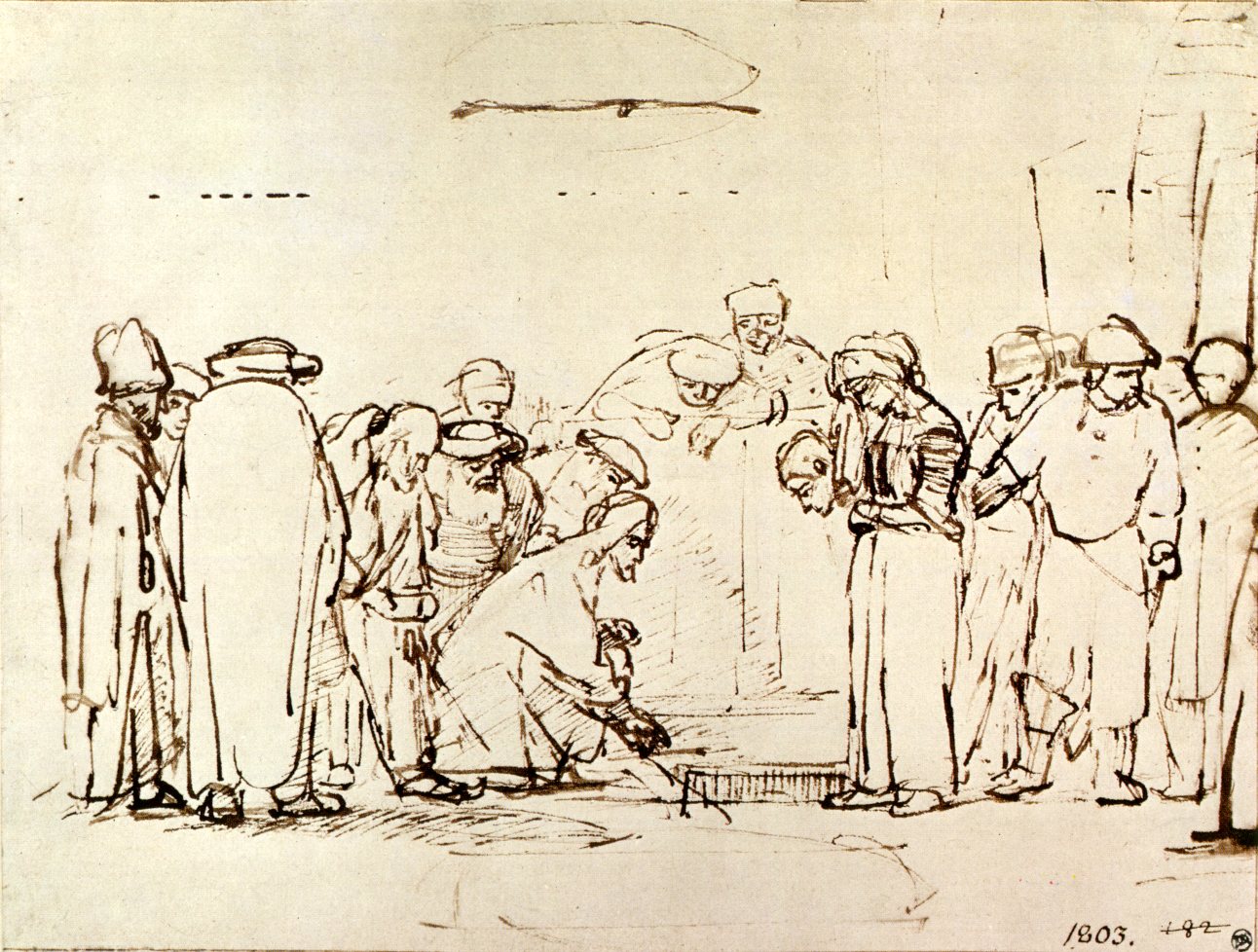
But Jesus knew today’s chapter as well as they did. If she was caught “in the act” then where was the man who was committing adultery with her? He was to be put to death as well. The story said that Jesus sat doodling in the dirt as the religious leaders were making their case. Perhaps Jesus was symbolically writing the name of the woman’s lover into “the record.” Knowing the law, I begin to understand how hypocritical, misogynistic, and crooked these religious leaders proved themselves to be with their accusations. Without even saying a word, Jesus’ brilliant response called the leaders to a legal point-of-order. His gracious forgiveness of the woman means even more to me in light of this context. [Note: you can read the brief story in John 8]

This morning I’m thinking about backstories. Beyond The Silmarillion and the Old Testament, there are also backstories to our lives, our families, our communities, our nation, and our world. I realize, once again, this morning why I love history. Knowing backstories helps me better perceive and understand things in the present. With that, I can made better decisions and judgements in the present just as Jesus did with the woman caught in adultery.

chapter a day banner 2015

Context and Color

If a man is caught lying with the wife of another man, both of them shall die, the man who lay with the woman as well as the woman. So you shall purge the evil from Israel.
Deuteronomy 22:22 (NRSV)

The ancient books of law are not always an easy, inspirational read. I like it, however, when I come across something that provides a layer of context and color to other stories in God’s Message. Today is a good example. The law of the ancient Hebrews was  that when a man and woman committed adultery they were both guilty and were to be punished by being stoned to death.

In John’s biography of Jesus there is the story of a woman caught in adultery. The religious leaders brought the woman before Jesus, stones in hand, asking Jesus to render judgment whether they should stone her to death. But, according to the law we read into today’s chapter, both the man and woman were to be stoned. So, where was the man?

The context helps provide evidence of why Jesus was so angry with the religious leaders of that day who liked to use the letter of the law when it worked to their own advantage, while they conveniently ignored the parts that weren’t. Jesus deftly handles the situation by telling the religious leaders that whichever one of them is without sin could cast the first stone. The religious leaders split and Jesus forgave the woman and sent her on her way.

Today, I’m thinking about my own heart and life. Who do I most resemble in the story? The religious hypocrite using God’s Message for my own advantage? The disgraced sinner doomed to die? Or am I like Jesus, extending grace and mercy to the condemned? As I sit here in the morning quiet I must admit that I am a mixture of all three. Today, I want to be more the latter and less the former.

chapter a day banner 2015

featured image by Rembrandt van Rijn (wikipedia)

Marriage as Metaphor

Michael Buesking illustrates another prophet, Hosea, whose adulterous marriage became a word picture of God's relationship with His people. Buesking's artwork can be found by clicking on the image or at prophetasartist.com
Michael Buesking illustrates another prophet, Hosea, whose adulterous marriage became a word picture of God’s relationship with His people. Buesking’s artwork can be found by clicking on the image or at prophetasartist.com

“Later I passed by, and when I looked at you and saw that you were old enough for love, I spread the corner of my garment over you and covered your naked body. I gave you my solemn oath and entered into a covenant with you, declares the Sovereign Lord, and you became mine.” Ezekiel 16:8 (NIV)

Across all human relationships, the marital relationship is unique in many respects. Two people choose to enter into a covenant relationship with one another, to be exclusively faithful and more completely intimate with that person than with any other. Marriage is the closest thing we have on Earth to embody the relationship God desires to have with each of us, and God uses the marriage relationship over and over again to embody the intimate relationship He desires to have with each of us.

In today’s chapter, God once again instructs Ezekiel to use marriage as a metaphor describing God’s relationship with the people of Israel. He uses imagery around the marital traditions of that day. God chooses Israel as His bride and enters into a marriage covenant, but Israel commits adultery by chasing after other lovers in the form of the many gods and idols that were popular in that culture.

God makes it prophetically clear that He will not ignore the unfaithfulness of His bride. There will be disgrace and consequences in the siege and destruction of Jerusalem. Yet, in the end of the chapter God makes it clear that He will continue to honor His covenant; There will be a remnant who will survive and return to Jerusalem. God says he will make atonement for the adulterous sins committed; He will send His Son to be the atoning sacrifice for sin, once for all.

Today I am struck that God, through Ezekiel, has been speaking the same message in many different metaphors and word pictures. I find that in the human experience not everyone “gets” a message the same way. Some people connect with one medium, some with another. A word picture may be profoundly revelatory to one person while another person remains blind to the message. Across the book of Ezekiel I am impressed at how God is desperately trying to get through to His people, His spouse. He keeps trying to get through.