Tag Archives: Epic

Spiritual Waxing & Waning

I rebuked them and called curses down on them. I beat some of the men and pulled out their hair...
Nehemiah 13:25a (NIV)

Across my life journey, I’ve experienced seasons of revival at different waypoints in life’s road. There were specific moments in time when I witnessed many people putting their faith in Jesus and becoming followers in a short period of time. In some cases, many of those who became followers were the last people I would have expected to do so.

In each of these seasons, I observed individuals who became faithful disciples. I also observed individuals whose spiritual experience appeared to have only short-term effect. At the same time, I’ve lived long enough of this life journey to have experienced that every individual has their own story regarding their relationship (or lack of relationship) with God. Sometimes an individuals journey waxes and wanes. With others, I’ve experienced zero interest of faith until their death bed. And yes, I’ve witnessed very real, very sincere death-bed conversions.

There is a similar observation I’ve had regarding church programs designed to “create” community through small groups, many of which I played a significant role. There’s a recurring pattern I’ve noticed. Initial hype and interest. Large kick-off event and great participation followed by months of slow waning interest. A few small groups continue to do life together long after the “program” fades into oblivion. Most never make it more than a short season.

These things came to mind as I read today’s final chapter of Nehemiah. Nehemiah’s story ends on a downer. After the miraculous rebuilding of the walls in less than two months and the joyful climactic celebration that kick-started Temple operations for the first time in 150 years, things quickly return to spiritual complacency. The “revival” event in yesterday’s chapter is immediately followed by people going back to doing what they’ve always done. They don’t make a habit of going to Temple and giving their tithes and offering. With no tithes and offerings to provide for all the priests and Levites, they leave the Temple and go back to their fields. Nehemiah finds that the Hebrews pretty much ignore every commitment they made to God’s covenant just a few chapters ago.

Nehemiah goes full-prophet postal screaming, beating, and condemning his people for their lack of faithfulness.

Been there. Done that.

In the quiet this morning, I’m reminded that history tells me the rest of the story. Despite Nehemiah experiencing what seems like the failure of his revival event, the Temple system he restored will actually take off. The “second temple” period he’s begun will become one of the most profitable periods of Jewish history with regard to scholarship, scripture, and literature. Of course, that will eventually wane too. When Jesus arrives on the scene some 500 years later, the Temple system will be thriving but completely corrupt. Forty-years after Jesus death and resurrection, it will be completely wiped out by the Romans.

This leads me back to my observations across my life journey. Like Nehemiah, it’s easy to get caught up in moments and seasons on life’s road. Revivals are exciting, and I’m blessed to have experienced them. Events, however, are moments. The spiritual journey is not an event but an epic story complete with mountain-top climaxes and long wilderness wanderings. There is a spiritual waxing and waning that most people experience across their lives. There are tragic moments when everything seems dark and hopeless, and moments of eucatastrophe when the miraculous breaks through and everything is right with the world. It’s all of it.

I love Nehemiah’s passionate, prophetic heart. But as he screams at his people and attempts to beat them into repentance and obedience, my heart whispers: “Dude! Chill out. There’s a Story God is authoring in all of this. Trust the Story.”

If you know anyone who might be encouraged by today’s post, please share.

Promotional graphic for Tom Vander Well's Wayfarer blog and podcast, featuring icons of various podcast platforms with a photo of Tom Vander Well.
These chapter-a-day blog posts are also available via podcast on all major podcast platforms including Apple, Google, and Spotify! Simply go to your podcast platform and search for “Wayfarer Tom Vander Well.” If it’s not on your platform, please let me know!

Best of ’24: #7 The Gospel According to Harry Potter

The Gospel According to Harry Potter (CaD Rom 8) Wayfarer

For I am convinced that neither death nor life, neither angels nor demons, neither the present nor the future, nor any powers, neither height nor depth, nor anything else in all creation, will be able to separate us from the love of God that is in Christ Jesus our Lord.
Romans 8:38-39 (NIV)

Our daughters were the perfect age to get in on the original Harry Potter craze. Taylor turned nine the year that Harry Potter and the Sorcerer’s Stone hit number one on the New York Times Bestsellers List. She was roughly the same age as Harry, Ron, and Hermoine as the subsequent books were annually published. She and Madison literally grew up with these characters.

In yesterday’s post/podcast, I wrote about religious rulekeepers. Religious rule-keepers, by the way, are often reactionaries. They are quick to condemn at a distant whiff of impropriety. When the Harry Potter craze took off, they got themselves into a lather. I have learned along my life journey that when the Christian rule-keepers get into a lather, I should definitely check out what they’re upset about because I’ll probably love whatever it is they hate. This was certainly true with the Harry Potter books.

I have always held that all great stories are a reflection of the Great Story, and I found this to be true with Harry Potter. It is an epic story of good and evil set in an entertaining fantasy world just like The Chronicles of Narnia (which has witches, by the way) and Lord of the Rings (which has wizards, by the way) and A Midsummer’s Night Dream (which, by the way, has a talking donkey just like the Bible).

In today’s chapter, Paul writes of the supremacy of Christ’s love. When a person is baptized into Jesus and joined with Christ’s Spirit, they are filled with and surrounded by Love. Once this happens, Paul writes, “There is no more condemnation.” Not only that, but we can’t be separated from that Love by anything. As Paul described it to Jesus’ followers in Corinth: “It always protects, always trusts, always hopes, always perseveres.”

In Harry Potter, it was the sacrificial love of his mother, who gave her life to protect her baby from evil that made Harry special. The wise sage Dumbledore forever tries to help Harry understand that it is the power of love that will ultimately defeat evil, though Harry simply can’t see it until it proves true in the end. What a beautiful story that illustrates the very Love that Paul is talking about in today’s chapter. A sacrificial Love that indwells, protects, perseveres, and conquers the darkness. A Love from which I can never be separated, even by darkness or demons.

In the quiet this morning, I found myself meditating on the fact that we so often discount the power of Love in a world where power is demonstrated by wealth, status, authority, influence, leverage, and force. Just like Harry, who dismisses Dumbledore’s assurance of love’s conquering power, it’s easy for me to feel that love seems to pale in comparison. Perhaps one could argue that it does pale in terms of this world’s perspective. As C.S. Lewis famously concluded, however, I was not made for this world. I was made for a Kingdom that is not of this world in which Love reigns supreme.

As a follower of Jesus, I am told that while I may not have been made for this world, I am in this world for a purpose. That purpose is to represent that eternal Kingdom in this fallen world, by loving others, even my enemies and those who have been deceived by evil. By the way, this is exactly how Dumbledore loved Draco by sacrificing himself to protect the young man from doing an evil thing that would haunt him for the rest of his life.

If you know anyone who might be encouraged by today’s post, please share.

These chapter-a-day blog posts are also available via podcast on all major podcast platforms including Apple, Google, and Spotify! Simply go to your podcast platform and search for “Wayfarer Tom Vander Well.” If it’s not on your platform, please let me know!

The Gospel According to Harry Potter

The Gospel According to Harry Potter (CaD Rom 8) Wayfarer

For I am convinced that neither death nor life, neither angels nor demons, neither the present nor the future, nor any powers, neither height nor depth, nor anything else in all creation, will be able to separate us from the love of God that is in Christ Jesus our Lord.
Romans 8:38-39 (NIV)

Our daughters were the perfect age to get in on the original Harry Potter craze. Taylor turned nine the year that Harry Potter and the Sorcerer’s Stone hit number one on the New York Times Bestsellers List. She was roughly the same age as Harry, Ron, and Hermoine as the subsequent books were annually published. She and Madison literally grew up with these characters.

In yesterday’s post/podcast, I wrote about religious rulekeepers. Religious rule-keepers, by the way, are often reactionaries. They are quick to condemn at a distant whiff of impropriety. When the Harry Potter craze took off, they got themselves into a lather. I have learned along my life journey that when the Christian rule-keepers get into a lather, I should definitely check out what they’re upset about because I’ll probably love whatever it is they hate. This was certainly true with the Harry Potter books.

I have always held that all great stories are a reflection of the Great Story, and I found this to be true with Harry Potter. It is an epic story of good and evil set in an entertaining fantasy world just like The Chronicles of Narnia (which has witches, by the way) and Lord of the Rings (which has wizards, by the way) and A Midsummer’s Night Dream (which, by the way, has a talking donkey just like the Bible).

In today’s chapter, Paul writes of the supremacy of Christ’s love. When a person is baptized into Jesus and joined with Christ’s Spirit, they are filled with and surrounded by Love. Once this happens, Paul writes, “There is no more condemnation.” Not only that, but we can’t be separated from that Love by anything. As Paul described it to Jesus’ followers in Corinth: “It always protects, always trusts, always hopes, always perseveres.”

In Harry Potter, it was the sacrificial love of his mother, who gave her life to protect her baby from evil that made Harry special. The wise sage Dumbledore forever tries to help Harry understand that it is the power of love that will ultimately defeat evil, though Harry simply can’t see it until it proves true in the end. What a beautiful story that illustrates the very Love that Paul is talking about in today’s chapter. A sacrificial Love that indwells, protects, perseveres, and conquers the darkness. A Love from which I can never be separated, even by darkness or demons.

In the quiet this morning, I found myself meditating on the fact that we so often discount the power of Love in a world where power is demonstrated by wealth, status, authority, influence, leverage, and force. Just like Harry, who dismisses Dumbledore’s assurance of love’s conquering power, it’s easy for me to feel that love seems to pale in comparison. Perhaps one could argue that it does pale in terms of this world’s perspective. As C.S. Lewis famously concluded, however, I was not made for this world. I was made for a Kingdom that is not of this world in which Love reigns supreme.

As a follower of Jesus, I am told that while I may not have been made for this world, I am in this world for a purpose. That purpose is to represent that eternal Kingdom in this fallen world, by loving others, even my enemies and those who have been deceived by evil. By the way, this is exactly how Dumbledore loved Draco by sacrificing himself to protect the young man from doing an evil thing that would haunt him for the rest of his life.

If you know anyone who might be encouraged by today’s post, please share.

Great Stories, My Story

But Absalom said, “Summon also Hushai the Arkite, so we can hear what he has to say as well.” 2 Samuel 17:5 (NIV)

It is said that one of the aspects of great stories is their timelessness. When I studied theatre in college there were entire sections of study devoted to Greek tragedies like Antigone and Oedipus Rex and, of course, the works of William Shakespeare. It was the late 20th century and in many classes, I spent more time studying plays and stories that were hundreds and thousands of years old than contemporary works.

As I read ancient stories like the story of David we’re wading through now, I can’t help but hear echoes of other timeless stories and make connections between them. Power plays for the throne (Game of Thrones), tragic human failure (Anakin Skywalker), and the intrigue of family rivalries (Succession) are the stuff of which classic stories are made. Today as I was reading the chapter, I thought of The Godfather films and the saga of the Corleone family; A timeless classic in its own right. As they led their mafia family, Vito and Michael Corleone always tried to have a guy, loyal to the family, on the inside of a rival family or faction. Luca Brasi dies while trying to convince the Tataglias that he wants to betray Don Corleone. Michael sends his brother Fredo to Las Vegas which not only serves to get Fredo out of his sight but also plants his own brother inside of an operation he doesn’t trust.

A few chapters ago, amidst the chaos of Absalom’s coup, the last thing that King David did before fleeing the palace was to plant his man, Hushai, inside Absalom’s inner circle. It proved to be a cunning move. Absalom took the bait hook, line, and sinker. In today’s chapter, David’s scheme comes to fruition and Hushai sets the hook which will be the undoing of Absalom. Absalom was a cunning young man and had planned his moves against his brothers and father well. In the end, however, he underestimated all the wisdom and experience his father had gathered while running for his life in enemy territory for many years. In addition, Absalom’s self-seeking motivation was about anger, vengeance, hatred, and personal power. The repentant David may have been facing the tragic consequences of his own blind spots and failings, but at the core of his being his heart was still humble before God.

In the third act of Francis Ford Coppola’s Godfather epic, Michael Corleone’s son confronts his father about the “bad memories” he has of his family and childhood. “Every family has bad memories,” Michael replies. And, so they do. Another appeal of great stories is the connections we make to our own lives and experiences. We are all part of the human experience. Even in my own family, there are true tales of tragedy and intrigue. Times change, but people are people, and our common human flaws source similar tales in our own lives and families. We each play our part in the story. We are each a cog in our family’s system. The cool thing is that we get to choose our character and influence the story with our daily choices of words, relationships, and deeds.

How will I choose to influence my story, and my family’s story, today?

 A Note to Readers
I’m taking a blogging sabbatical and will be re-publishing my chapter-a-day thoughts on David’s continued story in 2 Samuel while I’m taking a little time off in order to focus on a few other priorities. Thanks for reading.
Today’s post was originally published in May 2014
.

The featured image on today’s post created with Wonder A.I.

If you know anyone who might be encouraged by today’s post, please share.

The Choice

The Choice (CaD Gen 50) Wayfarer

But Joseph said to [his brothers], “Don’t be afraid. Am I in the place of God? You intended to harm me, but God intended it for good to accomplish what is now being done, the saving of many lives. So then, don’t be afraid. I will provide for you and your children.” And he reassured them and spoke kindly to them.
Genesis 50:19-20 (NIV)

Over the years, Wendy and I have enjoyed hosting Godfather nights. We have a big Italian dinner with friends who have never seen the all-time classic movie, and we watch together over wine and cannoli. It’s so much fun.

[Spoiler Alert] In the final minutes of the film, the patriarch of the family dies, and his son, Michael, decides to make a move against all of the family’s enemies. This includes traitors within the family itself. As Michael stands in a Catholic church and becomes godfather to his sister’s baby at a baptism ceremony, the vengeance is mercilessly carried out. It all takes place as Michael is asked in the baptism ritual: “Do you renounce Satan?” and he responds, “I do renounce him.”

That scene came to mind this morning as I read the final chapter of Genesis. Jacob dies. He and his family are living in Egypt under Joseph’s protection. With the patriarch of the family dead, Joseph’s brothers realize that they are in a precarious position. Joseph has all the power of Pharaoh and Egypt at his beck and call. Should Joseph decide to “settle accounts” with his brothers for beating him with murderous intent and then selling him into slavery he could. All Joseph had to do was give the word and they would all be sleeping with the fishes.

The brothers send word to Joseph begging for his forgiveness. They bow down before him and offer to be his slaves.

Joseph’s response is classic:

“Am I in the place of God?” Joseph is foreshadowing the song of Moses after the defeat of the Egyptians at the Red Sea, along with the instruction in Paul’s letter to Jesus’ followers in Rome:

If it is possible, as far as it depends on you, live at peace with everyone. Do not take revenge, my dear friends, but leave room for God’s wrath, for it is written: “It is mine to avenge; I will repay,” says the Lord. On the contrary:

“If your enemy is hungry, feed him;
    if he is thirsty, give him something to drink.
In doing this, you will heap burning coals on his head.”

“You intended to harm me, but God intended it for good…” Joseph makes a willing decision to allow God’s intentions to overshadow the ill-intent of his brothers. Once again, his thoughts and actions mirror the behavioral instructions given to Jesus’ followers:

“You have heard that it was said, ‘Love your neighbor and hate your enemy.’ But I tell you, love your enemies and pray for those who persecute you.” Matthew 5:43-44

Not only so, but we also glory in our sufferings, because we know that suffering produces perseverance; perseverance, character; and character, hope. Romans 5:3-4

Consider it pure joy, my brothers and sisters, whenever you face trials of many kinds, because you know that the testing of your faith produces perseverance. James 1:2-3

In all this you greatly rejoice, though now for a little while you may have had to suffer grief in all kinds of trials. These have come so that the proven genuineness of your faith… 1 Peter 1:6-7

“…to accomplish what is now being done, the saving of many lives.” Joseph’s response foreshadows two important spiritual realities.

First, he understands that all that has happened to him has resulted in saving the lives of his family. When God leads the tribes out of slavery in Egypt, He will say to them: “This day I call the heavens and the earth as witnesses against you that I have set before you life and death, blessings and curses. Now choose life, so that you and your children may live” (Deut 30:19) God is the God of Life. Joseph chooses not to go the Michael Corleone route down the path of death and vengeance. Joseph chooses life for his brothers.

Second, the promise given to Abraham was that through his descendants “all nations of the earth will be blessed.” Through Joseph’s trials, he was placed in a position to give life, not only to the Egyptians and his family but also to the other nations who came to Egypt to buy food in the famine. Had it not been for Joseph’s many trials, so many people from so many nations and peoples would have perished. Instead, they lived and were blessed through Abraham’s descendant.

In the quiet this morning, I find myself searching my heart to see if the seeds of vengeance are present. Stories like Joseph and The Godfather are so epic, yet the principles involved are intensely personal. Who has caused me harm? Who has made my life miserable? Who has wronged me, slandered me, or thrown me under the bus?

What seeds are taking root in my heart?

The seeds of resentment, hatred, and vengeance?

The seeds of grace, mercy, and forgiveness?

I’m reminded that the fruit of the former leads to death, while the fruit of the latter leads to life.

Spare the gun. Share the cannoli.

If you know anyone who might be encouraged by today’s post, please share.

Flawed Characters

Flawed Characters (CaD Gen 30) Wayfarer

Then God remembered Rachel; he listened to her and enabled her to conceive. She became pregnant and gave birth to a son and said, “God has taken away my disgrace.” She named him Joseph, and said, “May the Lord add to me another son.”
Genesis 30:22-24 (NIV)

One of the things Wendy and I have enjoyed doing the past year or so is to watch some of the epic film series in order. This summer we watched all eleven movies of the Star Wars canon in the chronological order of the story arc. We’ve begun doing this with the Marvel Universe.

One of the things that she and I have discussed about the Harry Potter films, in particular, is that they were written and produced with a fatal flaw. None of the films’ writers and directors knew the entire story until the final installment because they were produced as the story was still being told. There was, therefore, important story elements in the earlier books that were important threads to the larger story, but those telling the particular episode of the epic didn’t know this or couldn’t see it.

Along my journey, I’ve observed a common flaw with those who read and study the Great Story. It’s easy to get lost in the minutiae of the immediate episode I’m reading that I lose sight that this episode is a thread in the larger theme that the Author of Life is telling.

Today’s chapter contains two stories that can be, quite frankly, head-scratchers. Both episodes of Jacob’s story flashback to earlier events and they foreshadow important elements of the story to come.

The first episode is a great birthing contest between sisters Leah and Rachel, both wives of Jacob. The second is Jacob’s deceptive scheme to increase his herds at his uncle’s expense.

In the culture of that day, providing your husband with a male heir was of utmost importance. In fact, a wife who did not produce a son by a prescribed period of time could nullify the marriage. In many cases, a wife lived with her father’s house until she did produce a male heir. The rivalry between sisters fuels their desire to win favor by producing sons for Jacob. Rachel’s barrenness and her demand that Jacob bear sons by her servant are flashbacks to Grandma Sarah who did the same thing. Likewise, Jacob’s shrewd deceit of his Uncle Laban in increasing his flocks hearkens back to the theme of deceit that pervades Rebekah’s family and Jacob’s life.

The story also foreshadows important elements in the story to come. Of all the sons born to Jacob, two are going to figure prominently in the rest of Genesis and in the history of the twelve tribes of Israel. Leah’s son, Judah will lead the tribe from which King David and the future Messiah will come. Rachel’s firstborn, Joseph, will live a life of exile and redemption, ultimately saving the entire family and becoming the conduit through which the next major chapter of the Great Story will be told.

The forest that is often lost in the trees of this story is the covenant God gave Abraham to expand his descendants and bless all the nations of the earth. The blessing that Jacob is part of. The birthing contest, with all of its human flaws, conflict, and intrigue, is going to exponentially increase Abraham’s descendants. The many sons of Jacob will become the twelve tribes of Israel.

In the quiet this morning, I find myself again contemplating the fact that the Great Story is being told through flawed, sinful human beings. I can look at each character from Abraham to Rachel and find character flaws, sins, and mistakes. Yet, with the exception of Jesus, that’s true of every human character in the Great Story.

That’s true of me.

Jacob, Rachel, and Leah are part of the larger story of Abraham’s covenant. Abraham’s covenant is part of the larger story of God redeeming fallen humanity. With no one to use but sinful human beings, God weaves the storyline through human failings, ultimately redeeming them in the larger work of ultimate redemption which is the meta-theme of the Great Story itself.

And, in the quiet this morning, I take comfort in that. In this way, I am Jacob. I am Rachel. I am Rebekah and Laban. Jesus placed His ministry into the hands of twelve flawed human beings which they passed on to other flawed human beings, and it has passed from flawed human being to flawed human being until it ultimately reached me.

I am a flawed human, but that does not disqualify me from playing my role in this penultimate drama. It does not cancel me in God’s eyes. It merely makes me part of the meta-theme of redemption, just like every other human in the Great Story.

I recently heard that the great actor, Alan Rickman, was considering quitting the role of Severus Snape in the series of Harry Potter films because Snape seemed like a one-dimensional, irredeemably bad character. J.K. Rowling pulled him aside to explain the powerful, redemptive role that Snape plays in the epic, which does not become fully clear until the end. Gratefully, he stuck with the role.

Sometimes, the seemingly irredeemable characters are essential to the ultimate story of redemption.

If you know anyone who might be encouraged by today’s post, please share.

Exilic Reflections

Exilic Reflections (CaD Ps 107) Wayfarer

Then they cried out to the Lord in their trouble,
    and he delivered them from their distress.

Psalm 107:6 (NIV)

As I’ve been mulling over the spiritual milestones I’ve shared about recently, I have been looking back at my life journey of 20,000+ days and my spiritual journey of 40 years. There have been some amazing moments, some stretches of prosperity on multiple levels, and then there have been some seasons of soul-stretching adversity. As I recount the peaks and valleys and where they’ve brought me, it occurs to me that the latter has been more critical in my spiritual growth. And, very often the former follows. The valleys of life prune me spiritually, and when I eventually reach the high places they are particularly fruitful.

“Exile” is one of the grand themes of the Great Story. Some scholars have gone so far as to say that it is the primary theme that occurs over and over again, beginning with Adam and Eve being exiled from the Garden and their intimate relationship with the Creator. The Hebrews living in bondage and exile in Egypt, then later being exiled and scattered by the Babylonian and Assyrian empires. The crux of the Great Story is Jesus leaving heaven to be exiled here as one of us to make a way for us to escape our own earthly exile and be at home in eternity. And, that’s just the tip of the iceberg. Exile is a theme in the stories of Noah, Abraham, Jacob, Joseph, Moses, David, Ruth, Esther, Daniel, Nehemiah, Mary, Joseph, John the Baptist, Jesus, John, and Paul.

All good stories are a reflection of the Great Story, and I typically find the theme of exile in every major human epic.

Today’s chapter, Psalm 107, kicks off the fifth and final “Book” of Hebrew Song lyrics we know as the Psalms. Psalm 107 is another liturgical song, most likely written to be sung during one of the Hebrew religious festivals. Most scholars agree that it was penned during the period of time when the Hebrews returned from Babylonian exile, rebuilt Jerusalem and God’s temple there. Having come through years of captivity and exile, they have ascended Mount Zion to worship, reflect on their experiences, and give thanks.

The song lyrics introduce different exilic experiences: wandering in the desert, living in darkness, struggling through captivity and forced labor, bitter consequences of foolish choices, sickness and disease, and being lost and rudderless on the stormy seas. In each of the stanzas the description of exilic struggle leads to the phrase: “Then they cried out to the Lord in their trouble.” This is followed by God’s salvation, deliverance, redemption, and restoration. Each stanza ends calling the listener to gratitude and praise.

In the quiet this morning, I’m seeing the pattern. Out of darkness into the light. Up from the valley to the mountaintop. Return from exilic adversity to the blessing of finding myself safe at home. This is the Great Story. It’s life’s story. It’s my story, too.

As I meditate on the lyrics of Psalm 107 and look back on my journey, I’m reminded that there is purpose in the painful stretches. Perseverance has always paid off. I have always been able to cry out to the Lord in my troubles. There have always been better stretches ahead.

Note: A new message has been posted to my Messages Page.

Epic Wisdom

Epic Wisdom (CaD Ps 78) Wayfarer

I will open my mouth with a parable;
    I will utter hidden things, things from of old—
things we have heard and known,
    things our ancestors have told us.

Psalm 78:2-3 (NIV)

My grandparent’s home in Le Mars, Iowa, was a humble little house with three small bedrooms and one bath. I grew up spending weekends there every few months, and as I got older I had opportunities to spend even more time there. It’s hard to believe it now, but when I was only about ten years old my parents would buy me a bus ticket and put me on the Greyhound bus bound for Le Mars where I would spend my spring break. Mom would tell me to sit right behind the driver so he could keep an eye on me. Wow. How times have changed.

The “west room” at Grandpa and Grandma Vander Well’s house was mostly a storage room that doubled as a guest bed when necessary. The small four-poster double bed, complete with a feather mattress, was from their wedding set and it took most of the room. One entire wall was covered, floor-to-ceiling, with shelves on which my grandparents stored the remnants of their lives. I spent hours in that bedroom exploring all of the strange, old things on those shelves and letting my imagination run free.

I have always had a thing for history. I don’t know why. It presented itself in me when I was very young. I was fascinated by the old stuff that had to be explained to me.

“Hey, Grandpa. What’s this? What does this thing do?”

As I grew, my curiosity led me to explore family history. What was fascinating was what meager little scraps of information were spoken. I have come to believe that there are multiple reasons for this. My grandparents grew up in a time when families tended to bury the family stories that they found shameful. Every family is messy, but my grandparents’ generation was particularly closed when it came to talking about such things. They were also the depression generation. Genealogy and family history are luxuries people could ill-afford when they were desperately trying to survive day-to-day and raise a family. Much of what I eventually learned about both my maternal and paternal families came late in my grandparents’ lives, or after their deaths.

Today’s chapter, Psalm 78, is an epic song in the traditional sense of the word. If you’ve actually been reading the Psalms on this chapter-a-day journey you know that they’re typically quick reads. Much like most of today’s popular music, three verses and a bridge is typically all you get. But then, every once in a while, a song stands out because it is epic. Psalm 78 is a musical epic that was written to teach children and grandchildren the story of their people. Reading was still very rare in the days when Asaph wrote the song, and most of what people learned was through oral history. Stories told by family elders around the fire at night or songs, like today’s chapter, that were sung during seasonal festivals.

Psalm 78 mostly recounts the story of the Hebrew people’s exodus out of slavery in Egypt, the 40 years of wandering in the wilderness, and the covenant relationship between God and the Hebrew people. Asaph, one of David’s temple choir directors, ends the poem alluding to the civil war between the Hebrew tribes, the fall of the northern tribes to the Assyrians, and God’s blessing of David and the southern kingdom of Judah.

In the quiet this morning, I find myself contemplating my love of history on both a large scale as well as the more intimate history of both my paternal and maternal families. I have come to realize that most people don’t care for such things, but it’s through the warts-and-all history of both family and humanity that Wisdom has taught me so much. The shame of my grandparents’ generation led them to keep the past hidden like the little remnants of their lives stuffed on the guest room shelves. I observe the shame of the emerging generation leading to the tearing down of history. I watch history being burned and buried. I imagine both of these extreme approaches to the past have existed throughout the Great Story. They wax and wane with the times.

Nevertheless, my soul aches in both cases. Asaph states quite clearly in Psalm 78 that he wants future generations to learn from the Hebrew past. As I read the chapter, I find that he wrote the epic complete with recollections of the glories and tragedies, the failures and successes, and both victories and defeats. I have met Wisdom in every one of those stories. She is present in every instance. Through each, she helps me see my current stretch of life’s road with more clarity and perspective.

I pray that I pass a little of that Wisdom along, one blog post at a time.

Prophecy & Professor Trelawney

Prophecy & Professor Trelawney Wayfarer

Posterity will serve him;
    future generations will be told about the Lord,
and proclaim his deliverance to a people yet unborn,
    saying that he has done it.

Psalm 22:30-31 (NRSVCE)

I’ve been doing a series of podcasts called the Beginner’s Guide to the Great Story. There are ten episodes in the series and I’m doing the series for those who know little or nothing about how what we call the Bible. Why do I call it the Great Story? Well, I’m not the first to do so, and I find that just saying the word “Bible” can conjure up so many prejudicial thoughts and notions. Besides, I’m more interested in the Story that is being told through the narrative from the beginning in Genesis to the end of Revelation which, again (spoiler alert!), a new beginning.

The next episode in the Beginner’s Guide to the Great Story series is part seven in which I’m going to talk about the section of texts from Isaiah to those written by the Italian prophet Malachi (Sorry, that’s like a dad joke, it never gets old for me). The prophets were some of the strangest characters in the Great Story, and the prophetic texts are mysterious, sometimes poetic and inspiring, sometimes gruesome and violent, sometimes so graphic it would make church ladies blush (therefore those texts are almost universally ignored by everyone).

Think about how the prophetic is almost universally present in all of our great epic stories. One of my favorite prophetic characters is Sybill Trelawney in J.K. Rowling’s Harry Potter epic (and NOT because my sister, Jody, could could easily pull off being the doppleganger of Emma Thompson’s iconic take on the character). I just love how Professor Trelawney does virtually nothing by way of being prophetic or accurate in her daily predictions. She’s a miserable failure at her subject. But on just a couple of occasions she actually is prophetic, though in each case she doesn’t know it and has no memory of what she actually said. That is classic prophetic mystery. I love it.

Today’s psalm, written by David, is a classic because the warrior-king songwriter has his Sybill Trelawney moment. Written in the neighborhood of 1000 years before Jesus, the 22nd psalm is dripping with prophetic imagery of Jesus.

My God, my God, why have you forsaken me?
    Why are you so far from helping me, from the words of my groaning?

Psalm 22:1

And about three o’clock Jesus cried with a loud voice, “Eli, Eli, lema sabachthani?” that is, “My God, my God, why have you forsaken me?”
Matthew 20:46

But I am a worm, and not human;
    scorned by others, and despised by the people.
Psalm 22:6

Pilate asked them, “Why, what evil has [Jesus] done?” But [the crowd] shouted all the more, “Crucify him!”
Mark 15:14

All who see me mock at me;
    they make mouths at me, they shake their heads

Psalm 22:7

The chief priests and the scribes stood by, vehemently accusing him. Even Herod with his soldiers treated him with contempt and mocked him; then he put an elegant robe on him, and sent him back to Pilate.
Luke 23:10-11

Yet it was you who took me from the womb;
    you kept me safe on my mother’s breast.

Psalm 22:9

And having been warned in a dream not to return to Herod, [the Magi] left for their own country by another road.

Now after they had left, an angel of the Lord appeared to Joseph in a dream and said, “Get up, take the child and his mother, and flee to Egypt, and remain there until I tell you; for Herod is about to search for the child, to destroy him.”
Matthew 2:12-13

On you I was cast from my birth,
    and since my mother bore me you have been my God.
Psalm 22:10

The angel said to her, “Do not be afraid, Mary, for you have found favor with God. And now, you will conceive in your womb and bear a son, and you will name him Jesus. He will be great, and will be called the Son of the Most High, and the Lord God will give to him the throne of his ancestor David. He will reign over the house of Jacob forever, and of his kingdom there will be no end.” Mary said to the angel, “How can this be, since I am a virgin?” The angel said to her, “The Holy Spirit will come upon you, and the power of the Most High will overshadow you; therefore the child to be born will be holy; he will be called Son of God.
Luke 1:30-35

Many bulls encircle me,
    strong bulls of Bashan surround me;
they open wide their mouths at me,
    like a ravening and roaring lion.

Psalm 22:12-13

Now the men who were holding Jesus began to mock him and beat him; they also blindfolded him and kept asking him, “Prophesy! Who is it that struck you?”
Luke 22:63-64

I am poured out like water,
    and all my bones are out of joint;
my heart is like wax;
    it is melted within my breast;
my mouth is dried up like a potsherd,
    and my tongue sticks to my jaws;
    you lay me in the dust of death.

Psalm 22:14-15

So they took Jesus; and carrying the cross by himself, he went out to what is called The Place of the Skull, which in Hebrew is called Golgotha. There they crucified him…
John 19:16-18

For dogs are all around me;
    a company of evildoers encircles me.
My hands and feet have shriveled;
I can count all my bones.
They stare and gloat over me;
they divide my clothes among themselves,
    and for my clothing they cast lots.

Psalm 22:16-18

When the soldiers had crucified Jesus, they took his clothes and divided them into four parts, one for each soldier. They also took his tunic; now the tunic was seamless, woven in one piece from the top. So they said to one another, “Let us not tear it, but cast lots for it to see who will get it.” This was to fulfill what the scripture says,
“They divided my clothes among themselves,
    and for my clothing they cast lots.”
And that is what the soldiers did.

John 19:23-25

The poor shall eat and be satisfied;
    those who seek him shall praise the Lord.

Psalm 22:26

Jesus answered them, “Very truly, I tell you, you are looking for me, not because you saw signs, but because you ate your fill of the loaves. Do not work for the food that perishes, but for the food that endures for eternal life, which the Son of Man will give you.
John 6:26-27

To him, indeed, shall all who sleep in the earth bow down;
    before him shall bow all who go down to the dust,
    and I shall live for him.
Posterity will serve him;
    future generations will be told about the Lord,
and proclaim his deliverance to a people yet unborn,
    saying that he has done it.

Psalm 22: 30-31

So when they had come together, they asked him, “Lord, is this the time when you will restore the kingdom to Israel?” He replied, “It is not for you to know the times or periods that the Father has set by his own authority. But you will receive power when the Holy Spirit has come upon you; and you will be my witnesses in Jerusalem, in all Judea and Samaria, and to the ends of the earth.” When he had said this, as they were watching, he was lifted up, and a cloud took him out of their sight.
Acts 1:6-9

In the quiet this morning I find myself asking, “Did David have any idea what he was writing when he penned the lyrics to the song we now call Psalm 22?”

I don’t think he did. I think it was his Sybill Trelawney moment. Along my life journey, I’ve observed that this is the way the prophetic works. It’s mysterious, and strange, and comes from the most unexpected of people in the most random moments of time. Maybe even me. Maybe even you. You can’t will it to happen like Professor Trelawney so aptly proved in every one of her utterly useless classes. Those who try to do so end up charlatans like Gilderoy Lockhard or end up drowning their sorrows in a bottle of Sherry like Professor Trelawney herself. The prophetic happens when it’s supposed to happen via the medium God chooses (and God often chooses the strangest of mediums). Yet, when it happens, like David having his Trelawney moment in Psalm 22, it’s pretty amazing.

Today I’m pressing on, not willing things to happen, but open and expectant of whatever is supposed to happen in this Great Story in which I’m simply trying to play my bit part to the best of my ability.

(Exit Tom, stage left) See you tomorrow!

If you know anyone who might be encouraged by today’s post, please share.

The Dude Abides

[The man of lawlessness] will oppose and will exalt himself over everything that is called God or is worshiped, so that he sets himself up in God’s temple, proclaiming himself to be God.
2 Thessalonians 2:4 (NIV)

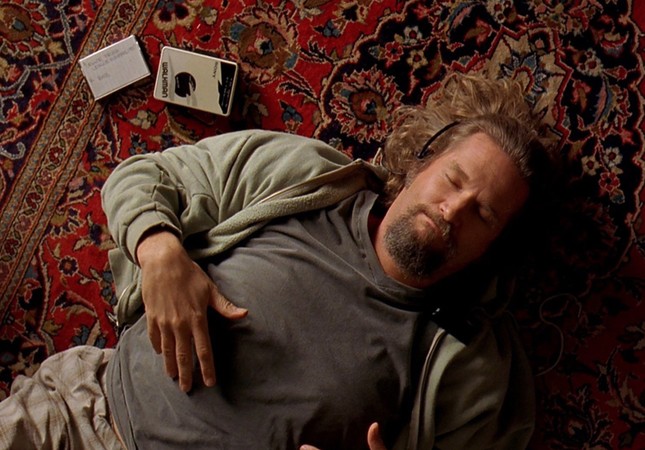
Yesterday, as I was getting ready, I had the Cohen brothers’ classic movie, The Big Lebowski, playing in the background. It’s become one of my all time favorites movies. What most people don’t realize is that The Big Lebowski is basically a classic 1940s film noir detective story set in the early 1980s with an unlikely stoner named The Dude unwittingly placed in the role of the protagonist detective.

I grew up watching a lot classic films and the hard-boiled detective movies (e.g. Philip Marlowe, Sam Spade) of the film noir genre were among my favorites. In The Big Lebowski you have all the classic detective movie motifs: the old millionaire, the millionaire’s daughter with whom the protagonist falls in love, blackmail, rabbit trails, crime lords, a secondary detective, and the protagonist detective getting “slipped a Mickey” (drugged with a drink).

I’ve observed that most people watch films in a vacuum, as though each film sort of stands alone. The reality is that all good stories and films borrow themes and motifs from one another. All of my favorite epics, for examples, have the overarching theme of good versus evil. Usually an epic story is about an ancient struggle coming to a climax. There’s always a prophecy woven into the storyline, as well. In Harry Potter there is the prophecy Harry retrieves from the Ministry of Magic. In The Lion, the Witch, and the Wardrobe there is the prophecy and deep magic of the stone table. In The Lord of the Rings Aragorn is led to take the Paths of the Dead because of the “words of Malbeth the Seer.

I say it fairly regularly: “All good stories are a reflection of the Great Story.” Our stories reflect our own humanity. Deeper still, I believe that human history is a Great Story being told across the ages. I believe that evil exists and there is a very real struggle between good versus evil. I believe in the prophetic.

Along my life journey I’ve experienced the prophetic. I have found it to be both mysterious and messy and therefore quickly dismissed by many. I have come to believe that tragedy lies on either side of the tension between two possible errors: Dismissing the prophetic altogether or drowning too deeply in the mystery. I’ve always tried to hold the tension between the two.

In the early years of the Jesus movement there were many prophecies given concerning where the plot line of the Great Story was going. This led to many arguments and mistaken assumptions.  In today’s chapter, Paul is addressing some mistaken assumptions  in today’s chapter. Without drowning too deeply in the specifics, I find myself being reminded of two things.

First, there is evil, and evil opposes good. Jesus was very aware of the evil opposing Him. He knew that His coming was prophesied (He proclaimed Isaiah’s prophetic word in His first sermon). He cast out demons throughout His ministry. He knew He was being tempted by the evil one to abandon His sacrificial mission. We don’t like to think too much about the reality of evil, but it exists.

Second, evil cannot create but, instead, it always counterfeits. Tolkien clearly picked up this theme in his epic stories. Orcs were counterfeits made in opposition to elves. Trolls were counterfeits made in opposition to ents. Paul says there is prophesied a counterfeit messiah to come whom he calls the Man of Lawlessness. The Greek term he uses is anthropos (man, mankind, humanity; as in anthropology the study of humanity) anamos (opposition, lawless, wicked; from which we get the English word animosity). Paul explains that it has been prophesied that this counterfeit messiah will come before Jesus’ return in a climax to this Great Story.

In the quiet this morning I find myself pondering all of these mysteries. I don’t want to get lost in them, but neither do I want to dismiss them. Again, I find myself trying to hold the tension. I believe my life journey is part of the Great Story. How it fits and weaves into the larger plot lines is a mystery to me. I’m just trying to stick to the path appointed for me, to follow the steps I’m led, to do the good God calls me to do, and to be shrewd as a serpent and gentle as a dove, aware of both the evil and the good around me.

Or, as Jeffrey Lebowski would put it: “The Dude Abides.”

Abide well today, my friend.