Tag Archives: King

Authority with Ink-Stained Fingers

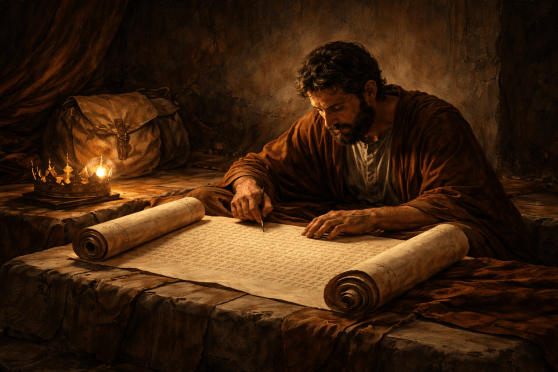
When [the king someday] takes the throne of his kingdom, he is to write for himself on a scroll a copy of this law, taken from that of the Levitical priests. It is to be with him, and he is to read it all the days of his life so that he may learn to revere the Lord his God and follow carefully all the words of this law and these decrees…
Deuteronomy 17:18-19 (NIV)

Just the other morning Wendy and I were stopped by friends who wanted to discuss a role I’d played on stage about ten years ago. It was a show that Wendy directed. It was one of my favorite roles ever, and it was fun to relive the memories with our friends.

One of the questions people repeatedly ask me when speaking of my various turns on stage is, “How do you memorize all those lines?” The truth is that the entire rehearsal process lends itself to the memory work. That said, there is a combination of both discipline and device required.

One of the mnemonic devices I use is to write my lines down. Literally, I will go through the script and transcribe my lines by hand on paper. There is a connection made between hand and brain when you write things by hand. The act of writing the words themselves allow the brain to catch things that the eyes alone don’t see on the page. The process takes time and forces the brain to consider and contemplate words, phrases, and sentences in ways that simple reading and reciting doesn’t.

In today’s chapter, Moses foreshadows a time when Israel asks for a king. Moses lays the foundation describing the person the king should be:

  • A person God chooses (God’s choice, not a human popularity contest)
  • No hoarding of horses (military might)
  • No accumulation of wives (political manipulation)
  • No stockpiling of silver and gold (economic domination)

Then Moses prescribes the most astonishing of tasks for every person appointed to the throne. Handwrite a copy of the Torah onto a single scroll – the entirety of Genesis, Exodus, Leviticus, Numbers, and Deuteronomy. Why? There is a connection between brain and hand. As you write words on paper, they penetrates the brain – they even seep into the heart.

But merely transcribing God’s Word was not the end of the prescription. The scroll is to be portable – able to fit in the king’s backpack. It is to be with him always. Having the scroll allowed the King to perpetually reference, read, meditate, and remember.

The scrolls very presence was a moral compass whispering, “Not so fast, mighty one.”

As I meditated on the chapter, two things struck me:

  • Being king requires being a student. Not delegating. Not outsourcing. Ink on fingers. Scroll on lap. Leadership begins as listening.
  • Limits are mercy. The prohibitions against excess aren’t anti-royalty; they’re anti-corruption. Torah assumes power will tempt—and lovingly cages it before it devours the soul.

The subversive whisper in today’s chapter is this: No one is above the Law—not even the one wearing the crown.

When I was discipled as a young man, the first task I was given was to memorize Joshua 1:8:

This Book of the Law shall not depart from your mouth, but you shall meditate on it day and night, so that you may be careful to do according to all that is written in it; for then you will make your way prosperous, and then you will achieve success. (NASB)

Notice the similarity? Meditate day and night. Let it penetrate. House it in your head and heart. Let it be an ever-present reminder, a reference, a voice of wisdom, a guardrail against foolish choices.

Which is why, my friend, I’m still here in the quiet each morning reading, meditating, writing, and hopefully letting it penetrate ever deeper. Just like an actor memorizing my lines.

After all, Shakespeare so poetically observed,

“All the world’s a stage,
And all the men and women merely players…”

On the stage of life, this Great Story between Genesis and Revelation is my script. If I’m going to play my role well, I had better know my lines—and listen for the Director’s cues.

And that reminder is a good cue with which to start this another day on this earthly journey.

If you know anyone who might be encouraged by today’s post, please share.

Promotional graphic for Tom Vander Well's Wayfarer blog and podcast, featuring icons of various podcast platforms with a photo of Tom Vander Well.
These chapter-a-day blog posts are also available via podcast on all major podcast platforms including Apple, Google, and Spotify! Simply go to your podcast platform and search for “Wayfarer Tom Vander Well.” If it’s not on your platform, please let me know!
Logo of a Bible app featuring an open book icon on an orange background.

Tearing Down Walls

Tearing Down Walls (CaD Ezk 46) Wayfarer

“‘The prince must not take any of the inheritance of the people, driving them off their property. He is to give his sons their inheritance out of his own property, so that not one of my people will be separated from their property.’”
Ezekiel 46:18 (NIV)

There was a fascinating article in the Wall Street Journal this past week about some of the political wrangling in the U.K. They have two “houses” in their government, too. However, their houses began with one being for the “common” people and the other being for those with a royal title. Today, the House of Lords does not look like it did when it was instituted but there is a certain percentage of members who are there because they inherited a royal title from a father or grandfather. There’s a push by the new Prime Minister to force them and push the old aristocracy into extinction.

This article came to mind this morning as I continued to read Ezekiel’s ideal vision of Israel’s restoration. Today’s chapter continues to provide instructions for how things are to function. There were two things that stand out with regard to “the Prince” and all the other people of Israel.

First, the Prince was to enter into the Temple with all of the other people, and he was to exit with all of the other people. No special entrances or VIP gate. The Prince is no different than any other person. In Ezekiel’s day, this was a radical idea.

A bit later in the chapter Zeke explains that the Prince has no power to take away anyone’s land and claim it for himself. This was a common practice in monarchies throughout history. In fact, hundreds of years before Ezekiel, the people of Israel wanted a king like all the other nations around them. The prophet Samuel warned them that a king would take whatever he wanted from them, whenever he wanted, including their land.

[A king] will take the best of your fields and vineyards and olive groves and give them to his attendants.
1 Samuel 8:14 (NIV)

In Zeke’s vision of how things can and should be, the Prince has his land that he can give to his descendants as he chooses, but he cannot take anyone else’s land “so that not one of my people will be separated from their property.’” This was a radical idea in Ezekiel’s day. The Prince is no different from the common every day citizen. Every family has their allotment that cannot be taken away.

In the quiet this morning, I think about this game that humanity has played throughout history. We divide people into distinctions of royal and common, aristocrats and bourgeoisie, Popular and losers, blue bloods and the masses, elites and the lower class. Even today, I can own my own land and have it taken away by eminent domain.

Not only that, but along my journey I’ve observed that even here in the States, where we supposedly have done away with old forms of monarchy and aristocracy, we still essentially turn our Presidents, politicians, and celebrities into royalty. What is it in humanity that perpetually builds these distinctions?

As a disciple of Jesus, I can’t help to think about the fact that Jesus came to build on this seed that Ezekiel’s vision is planting and do something new. Jesus came to tear down distinctions of race, class, and gender:

There is neither Jew nor Gentile, neither slave nor free, nor is there male and female, for you are all one in Christ Jesus.  If you belong to Christ, then you are Abraham’s seed, and heirs according to the promise.
Galatians 3:28-39 (NIV)

This begs two questions of me:

Where have I, or my culture, rebuilt a wall of distinction that Jesus purposefully tore down?

How can I personally tear it back down in my heart, mind, and actions?

If you know anyone who might be encouraged by today’s post, please share.

Silos

Silos (CaD 1 Chr 15) Wayfarer

Now David was clothed in a robe of fine linen, as were all the Levites who were carrying the ark, and as were the musicians, and Kenaniah, who was in charge of the singing of the choirs. David also wore a linen ephod.
1 Chronicles 15:27 (NIV)

I have a bit of a fascination with words and their origins. There is a weekly column in the Wall Street Journal in which the author, an etymologist, chooses one word that was used a lot in the news that week and explores its origins and uses. I know. It’s geeky, but it’s my kind of geeky.

When working in business, one hears a lot of references to silos, which I find fascinating living in Iowa. An agricultural staple used for storing grain on the farm became a universally used metaphor describing strict divisions within a business or corporation. In my career, I’ve had to struggle with our client’s silos regularly. The Sales and Marketing silo usually pays for customer research, but the results have all sorts of important data for the Customer Service team who is in the Operations silo. At best, they don’t communicate well. At worst, they consider each other internal rivals. Silos prevent the data from having a maximum impact on the client and their customers’ experiences.

In the ancient world of the Hebrews, there were also silos that God had established in the Laws of Moses. Only members of the tribe of Levi were priests and caretakers of God’s ark and the temple. Hundreds of years later, the Hebrews established a monarchy. But King David, despite being anointed by God and established as a man after God’s own heart, was from the tribe of Judah. That’s a different silo.

The Chronicler, unlike the earlier account of David’s reign in Samuel, is writing hundreds of years later and with knowledge of all that has happened since, including the writings of all the prophets. He knows from the prophets that the Messiah will come from David’s line and that the Messiah will be both King and High Priest.

In today’s chapter, I noted that the Chronicler was careful to explain that it was King David who ordered that no one but the Levites should carry the Ark of the Covenant and that they should all consecrate themselves before doing so as prescribed in the Law of Moses, a mistake they had made two chapters earlier. So it’s the King who is commanding the priestly tribe of Levi to do their job.

Later in the chapter, the Chronicler provides a little detail about the big event of the Ark of the Covenant’s big arrival celebration in Jerusalem. King David was wearing the same priestly garments as the Levites.

The Chronicler is establishing with David there was a tearing down of the silos between King and Priest. David had authority and told the Levites to do their job. David wore priestly garments as the Ark was brought into Jerusalem. The Chronicler sees David as the precursor of the King-Priest that will eventually be fully realized in the Messiah.

Note: The Priest-King issue as it relates to Jesus was eventually explained by the author of Hebrews, and it’s pretty cool. The answer lies in a mysterious figure who appears briefly in Genesis. I introduce him briefly in this post.

So what does this have to do with my life today? As a disciple of Jesus, I find that He’s all about tearing down the silos. He tore down cultural silos and religious silos. He burned the silo of a priestly class system to the ground and made every follower a member of the royal priesthood. I just talked about that in a message I gave to our local gathering of Jesus’ followers a few weeks ago.

So in the quiet this morning, I find myself asking “Where have I built silos in life that need to be torn down?” Where do I see distinctions between me and others that Jesus would say don’t exist? If I’m a member of the royal priesthood as God tells me I am, then how am I supposed to live that out in my life, my words, and my actions today? Or, have I built a silo around my heart and mind so that I can ignore this spiritual truth and tell myself “It’s not my job!”?

If you know anyone who might be encouraged by today’s post, please share.

Do the Right Thing

Do the Right Thing (CaD Jer 22) Wayfarer

This is what the Lord says: Do what is just and right.
Jeremiah 22:3a (NIV)

Doing the right thing is not always the easiest thing. It sounds so simple, but it is not. Like yesterday’s post, it sometimes requires surrender. I spent some time meditating on my life journey and the times I’ve had to make a willful decision to do the right thing.

I lost friendships because I chose to intervene and try to get my friends the help they needed rather than let them destroy themselves further. I still grieve the loss of those friendships.

I gave up multiple jobs because I refused to be a part of the corrupt or unjust things going on in the workplace. I’ve never regretted it.

As I meditate on those decisive moments, it strikes me that my decision was fairly simple because the circumstances were fairly black and white to me.

What’s less simple are the times when being a follower of Jesus has meant I had to forgive those who wronged me and choose grace instead of anger, judgment, retaliation, and resentment. If I’m honest, the hardest have perhaps been the times when doing the right thing meant surrendering my very strong personal will and self-centric desires in order for a greater good to flourish.

In today’s chapter, God sends Jeremiah to confront the kings of Judah. He begins by laying out what God expects of the King:

Do what is just and right. Rescue from the hand of the oppressor the one who has been robbed. Do no wrong or violence to the foreigner, the fatherless or the widow, and do not shed innocent blood in this place.

Jeremiah then goes on to pick apart those who have inhabited the throne for “building the palace with injustice” and for setting their “eyes and heart on dishonest gain.”

It’s fairly easy for me to gloss over Jeremiah’s prophetic smack-down of kings who lived 2500 years ago, but then in the quiet this morning I thought about a message I gave just a couple of weeks ago. In that message I talked about my “sin” being simply my personal, willful indulgence of my base and self-centric appetites and desires. I used two kings from the works of Shakespeare as examples. I even wore a crown as I did so.

My grandfather used to say, “I’m king of this castle! And, I have my wife’s permission to say so.” All jokes aside, I am very much ruler of my heart, soul, mind, and strength. I can choose to rule my life with self-indulgence, chasing after dishonest gain, and seeking only my own personal desires. Or, I can surrender my crown and my will in order to love God and love others with my heart, soul, mind, and strength.

I enter this day which will be filled with a myriad of choices and decisions. I endeavor, O Lord, to consistently do what you ask of me: do the right thing.

If you know anyone who might be encouraged by today’s post, please share.

Blind Spots

Blind Spots (CaD 2 Sam 13) Wayfarer

When King David heard of all these things, he became very angry, but he would not punish his son Amnon, because he loved him, for he was his firstborn.
2 Samuel 13:21 (NSRV)

I have been doing leadership development with the management team of one department of a client this week. It’s been both fascinating and a lot of fun as I spent time with each team member, learned their Enneagram Type, shadowed them as they went about their job, and observed them coaching their team members. Today, I get to sit with the team and review my observation and recommendations. They are great people and have a lot of potential but they also have a lot of challenges both individually and collectively.

David was a great warrior, a great general, and a great leader of men. Evidence leads me to believe that he was not, however, a great husband or father. As we’ve read David’s story he has slowly been amassing wives like the spoils of war and the result was many children. But, an army of children does not an army make. A family system and the complex relationships between birth order and gender can be difficult enough for a monogamous, nuclear family. I can’t imagine the exponential complexities that emerge when you have eight wives, ten concubines, and children with almost all of them.

As I read through these chapters I’ve noticed that I never read of David telling his children “no” nor do I read of him disciplining them for their behavior. David appears to have even had a reputation among his offspring for not refusing their requests. David’s daughter, Tamar, tells her half-brother Amnon that if he simply asks Dad she’s sure he’ll let them get married. When Amnon rapes Tamar instead and then turns her away we hear of David’s anger, but he doesn’t do anything about disciplining his beloved firstborn son. When Tamar’s full brother Absalom plots to kill their half-brother Amnon in revenge, Absalom goes to David and presses good ol’ dad until David relents and sends all the brothers on Absalom’s little fratricidal sheep-shearing retreat.

David has a blind spot. He can lead an army to endless victories but his record as leader of a family is a tragic string of failures and defeats.

I cannot point at David without three fingers pointing back at me. We all have our blind spots. The managers I’ve been mentoring this week have been learning that their Enneagram Type reveals their tremendous strengths, but also their core fears and weaknesses. If they are going to succeed as a team, they will have to embrace both within themselves and their team members. Our greatest strengths have their corollary weaknesses. We cannot escape this reality, but we can escape being enslaved to it. What we can do is be honest about our blind spots. We can choose to shine a light on them and invest time and attention in addressing them. We can surround ourselves with others who will graciously help us see them, work through them, and who will patiently love us as we do.

 A Note to Readers
I’m taking a blogging sabbatical and will be re-publishing my chapter-a-day thoughts on David’s continued story in 2 Samuel while I’m take a little time off in order to focus on a few other priorities. Thanks for reading.
Today’s post was originally published in May 2014
.

The featured image on today’s post was created with Wonder A.I.

If you know anyone who might be encouraged by today’s post, please share.

A New Org Chart

If you fear the Lord and serve and obey him and do not rebel against his commands, and if both you and the king who reigns over you follow the Lord your God—good!
1 Samuel 12:14 (NIV)

One of the more fascinating parts of my job is getting to observe and experience many different company cultures. I have learned a lot about both leadership and how systems function from being in the trenches with many different companies large and small.

Once we were hired to help a company improve their customer satisfaction and customer service. Our survey of the company’s customers revealed a lot of room for improvement. Customer Satisfaction was low, and there were a few major things customers didn’t like. Our assessment of recorded phone calls between the company’s customers and the Customer Service team revealed that there were huge disparities in service quality between service reps, and some customers were getting such bad service experience as to make them detractors.

As we began working with the leadership team to address some of the issues, I quickly learned that the company was a mess internally. The long-time CEO of the company set an example of management by power, fear, and intimidation. The rest of the company followed suit. The org chart was a mess. Silos in the organization worked against one another. Front line managers directly reported to multiple superiors and simply answered the loudest threats each day.

The sign on the wall said that they were committed to exceptional customer service, but the entire organization was built in such a way as to make exceptional customer service an impossibility.

Today’s chapter is another key episode in the transition of the Hebrew system of government from a tribal theocracy to a national monarchy. The org chart is changing. In the old org chart, God was recognized as King. Then came a Judge (Samuel was the last) who was recognized as the one God had raised to lead and deliver the tribes along with a tribal council of elders. From there, each tribe had its own governance.

Today, Samuel lays out the new org chart. King Saul will now be at the top of the org chart and all the tribes will be ruled by him. Yet Samuel is quick to remind his people that God is still above King Saul on the org chart. The new monarchy will only work well if both the King and the people will serve the Lord with all their hearts and avoid the worship of idols.

As for Samuel? He makes it clear that there’s a new role on the org chart. He is giving up civil governance, but he’s taking up the mantel of spiritual leadership:

As for me, far be it from me that I should sin against the Lord by failing to pray for you. And I will teach you the way that is good and right.

From this point forward, the nation would have prophets in the org chart who would directly report to God, and they will be God’s spiritual mouthpiece to both the King and the people. Future Kings would also assemble “yes men” prophets who would be subordinate to them and tell them what they want to hear, but God would ensure that His prophets would speak His words even if it wasn’t what the King wanted to hear.

One of the things I’ve learned in my career is that companies typically don’t make dramatic changes in corporate culture unless the person at the top of the org chart is driving it. The company I mentioned at the top of this post was a great example of that. The CEO had created a culture that worked against what they claimed to be the company values. If the CEO doesn’t change, the organization isn’t going to change either.

In the quiet this morning, I’m thinking about the org chart of my own life. As a follower of Jesus, I’m called to make Jesus the Lord of my life. Like Samuel reminded Saul, God is at the top of the org chart. And yet, like the old Kings of Israel, I have the autonomy to either obediently submit myself to God’s authority or to pay lip service to God while I willfully do my own thing. I can also do a little of both.

That leads me to ask myself some tough questions here in the quiet. Where am I being obedient? Where am I simply paying lip service? Some days I need a fresh reminder that God is at the top of my life’s org chart.

If you know anyone who might be encouraged by today’s post, please share.

What the Camera Sees

What the Camera Sees (CaD 1 Sam 9) Wayfarer

Kish had a son named Saul, as handsome a young man as could be found anywhere in Israel, and he was a head taller than anyone else.
1 Samuel 9:2 (NIV)

The other day in my post I mentioned how much change I have observed in our world and culture with the advent of the internet and social media. It has been fascinating to observe the dawn of such a powerful, global medium of communication. As with every communication medium, it has both the potential for so much good and the potential for so much evil.

Like most people, I have enjoyed exploring, learning, and using different online tools and social media like this blog I’ve been writing now for sixteen years. With two grandchildren living on the other side of the Atlantic Ocean, I am so grateful for photos, video, and FaceTime. I’ve enjoyed that social media has allowed for closer, more frequent direct connections with family, classmates, and friends. I have been amazed to watch groups of people supporting others in times of need and crisis that never would have been possible before the internet because everyone was scattered around the world and we simply lost track of one another with no good way to effectively and easily communicate with so many people.

Along the way, I have also observed how things are communicated on social media. I have thought long and hard about how I want to use this tool and what I choose to communicate. I’ve observed that it is easy to start living life almost completely online. For those who are physically isolated for one reason or another, that brings incredible freedom. At the same time, I’ve observed that it becomes a dangerous escape for others.

In the early days of the internet, I was part of a group chat with people from all over the world. What I discovered over time was that some individuals in the chat were themselves, while others in the chat had created a persona they wanted others to believe was them. One member messaged me privately to confess that everything they purported to be in the group was a lie. The person was lonely, depressed and life was out of control, so they lived a fantasy online life in a group chat, hidden behind a username.

I have also been fascinated to observe how people present themselves online and how “likes” and “views” have become intertwined in a person’s self-esteem and sense of self-worth. I’ve also learned that young people will sometimes have two social media accounts on the same platform. One is for the general public and parental viewing/oversight while the other “secret account” is for their private group of friends to post the things they don’t want mom and dad to see or read.

In my mass communication classes in college, I was drilled into me that we only see what the person behind the camera wants us to see. My professors in the 1980s were talking about news editors, publishers, and filmmakers. The internet has brought the power of mass communication to every person in the world and put it right in the palm of our hands. With our posts, tweets, and photos we project ourselves to the world. Our followers see and hear only what we choose to show them. So what am I choosing for others to see, and why?

In today’s chapter, the first thing we read about the young man who will become Israel’s first king is that he is tall and handsome and from a prominent family in the tribe of Benjamin. What a perfect description of an ideal political candidate. But what if underneath that handsome face and six-foot frame there lurks a tortured soul, hidden rage, or mental health issues? We only see what the author of 1 Samuel wants us to see. Just like me and my social media feed.

Over time, I have found myself posting far less on social media than I once did. It’s not that I made a specific rule for myself. I simply began asking myself honest questions about my motives and my choices, and I began to embrace that no one really needs to see a photo of my suitcase on a business trip or the cowboy guy on my flight. I want to be present with loved ones and friends in the moment, and less worried about making sure the world knows who I was with and what I was doing.

What do I want others to see? Just another wayfaring stranger with very normal problems, faults, and shortcomings. I’m following Jesus. I’m pressing on this earthly journey one day at a time, reading the Great Story, pondering things in the quiet, and trying to enjoy life and my good companions with whom I share this journey and whom I endeavor to love well.

If you know anyone who might be encouraged by today’s post, please share.

The “Human” Problem

The "Human" Problem (CaD 1 Sam 8) Wayfarer

But the people refused to listen to Samuel. “No!” they said. “We want a king over us. Then we will be like all the other nations, with a king to lead us and to go out before us and fight our battles.”
1 Samuel 8:19-20 (NIV)

As a youth, I was always involved in student government. I served regularly from junior high and into my college years. There was a period of time in those years that I dreamed of running for elected office as an adult. A few years ago I ran into one of my high school classmates at a coffee shop. As we enjoyed a casual conversation and caught up on each other’s lives she asked me if I still thought about running for office. I told her that the desire left me a very long time ago. She graciously teased me about reconsidering. It was kind of her.

Along my life journey, I’ve come to the conclusion that the problem with any human government is the fact that humans are involved. It has been famously observed in history that power corrupts, and it is true. Even with all the checks and balances the founders of the United States placed in the Constitution to diminish the possibility, an objective glance at Washington D.C. reveals all kinds of waste, fraud, and abuse that result from corruption at all levels.

In today’s chapter, the Hebrew people come to Samuel, who was leading the tribes as a Judge, and demand that he appoint a king and establish a monarchy. This didn’t come out of nowhere. It’s been brewing for some time.

What I found fascinating in today’s chapter was the fact that what brought the issue of national governance to a head was the fact that Samuel’s own sons, whom Samuel had appointed as his successors, were corrupt, just as the sons of Eli had been corrupt in the time of Samuel’s childhood and youth. I don’t think it is a coincidence. It’s a pattern and a very human one, just as it is tempting to believe that another form of human government will be better than the one under which you’re living. But I cannot escape the “human problem” on this earth. I can discuss the relative merits and downsides of every form of human government that’s ever been tried in the history of civilization, but there are always downsides to every system of government because human beings are involved and no matter how much I want to believe that humans can be good and altruistic history has proven that at some point the one(s) in power take advantage of their power in the system to personally benefit.

This is what God tells Samuel to remind his fellow Hebrews. Having a king will bring certain benefits, but the monarchy is also going to have negative consequences that the people and their descendants will experience acutely. This is correct. The rest of 1 Samuel and the next five books in the Great Story (2 Samuel, 1 Kings, 2 Kings, 1 Chronicles, and 2 Chronicles) are a testament to the truth of Samuel’s words.

As I ponder these things I am reminded of the Apostle Paul who was, himself, a citizen of Rome and took full advantage of the exclusive rights and benefits that came with it in his day. He also reminded Jesus’ followers in Philippi that they were citizens of God’s heavenly Kingdom. In that same vein, I consciously consider myself as having dual citizenship with the rights and responsibilities that come with both U.S. citizenship and citizenship in God’s eternal kingdom. One of those citizenships will end at some point while the other will not.

If you know anyone who might be encouraged by today’s post, please share.

Herald

Herald (CaD Matt 3) Wayfarer

In those days John the Baptist came, preaching in the wilderness of Judea and saying, “Repent, for the kingdom of heaven has come near.” This is he who was spoken of through the prophet Isaiah:
“A voice of one calling in the wilderness,
‘Prepare the way for the Lord,
    make straight paths for him.’”

Matthew 3:1-3 (NIV)

The “herald” is a long-standing historical figure across many cultures. The role of the herald was to go before a king or queen to announce his/her impending arrival so that the royal subjects could prepare to greet the monarch appropriately. In the story of Daniel, it was a herald who told the Babylonian people how to respond appropriately (bow) before Nebuchadnezzar’s statue (Daniel 3:3-5). God, through the prophet Habakkuk (note: one doesn’t get to quote Habakkuk very often), ordered that His words be written down so that “a herald may run with it” (Hab 2:2).

The Hebrew people of Jesus’ day were abuzz with Messianic experts teaching and lecturing on who the Messiah would be and what it would look like when the Messiah arrived. It is not unlike the abundant number of authors and lecturers today who wax eloquent on when the Second Coming of Christ will take place. For the record, the so-called experts of Jesus day were dead-wrong in their predictions. Since “nothing is new under the sun,” I tend to assume that today’s experts are most likely dead wrong, too. But they certainly do sell some books.

Remember that Matthew’s writing was motivated by sharing with his fellow Hebrews that Jesus was the Messiah they’d been waiting for. One of the Messianic tidbits of which Matthew’s audience would have been well aware was that the last of the prophets predicted that the prophet Elijah would appear before the “Day of the Lord” (Malachi 4:5). They would have connected Matthew’s description of John the Baptist with Elijah.

Description of Elijah in 2 Kings 1:8:

“He had a garment of hair and had a leather belt around his waist.”

Matthew’s description of John the Baptist:

“John’s clothes were made of camel’s hair, and he had a leather belt around his waist.”

Matthew’s audience also believed that the Messiah would be a King, and they knew that every king has a Herald.

John the Baptist was Jesus’ Herald. Later in Matthew’s account, Jesus will acknowledge that John was the embodiment of Elijah that Malachi prophesied, but the “experts” didn’t recognize him for who he was. John’s rather impressive backstory is recorded in the opening chapters of Luke. Jesus and John were cousins. They knew each other. Their brief exchange in today’s chapter seems to reveal that John knew that Jesus was the Messiah, and Jesus knew that John was His herald.

In the quiet this morning, I found myself ruminating on two things.

First, I was reminded that in each of Paul’s letters to Timothy he referred to himself as a “herald” even before claiming to be an apostle and teacher. As a follower of Jesus, I’m charged with being an ambassador of Christ’s kingdom on earth. I guess that makes me a herald, as well. I’ve never really thought about that before.

Second, I’m reminded that later in Matthew’s account John himself sent his followers to ask Jesus, “Are you the one?” (Matt 11:1-3). In today’s chapter John seems to have no doubt. Later, he does doubt. I wonder if even John had preconceived notions about what Jesus would do and how He would present Himself to the world. Jesus certainly didn’t immediately fulfill John’s prophecies of judgment and a baptism of fire.

So, as a self-proclaimed herald of the King of Heaven, I’m reminded that it’s a very human thing to be confused about who Jesus is. I’ve observed many who judge Jesus based on the description they were taught by so-called institutional experts or the description of Jesus they’ve been given by clownish televangelists hawking their own books and building their own personal kingdoms on earth.

Which, is why, time-and-time-again, I bring my chapter-a-day journey back to the primary source material of Matthew’s account. I try to let go of preconceived notions. I try to shut out what others have said about Jesus. I once again read the account with fresh eyes and an open heart. I want to meet the King of Heaven anew, that I might be an effective and honest herald on earth.

If you know anyone who might be encouraged by today’s post, please share.

“King of My Castle”

"King of My Castle" (CaD Ps 145) Wayfarer

I will exalt you, my God the King
Psalm 145:1 (NIV)

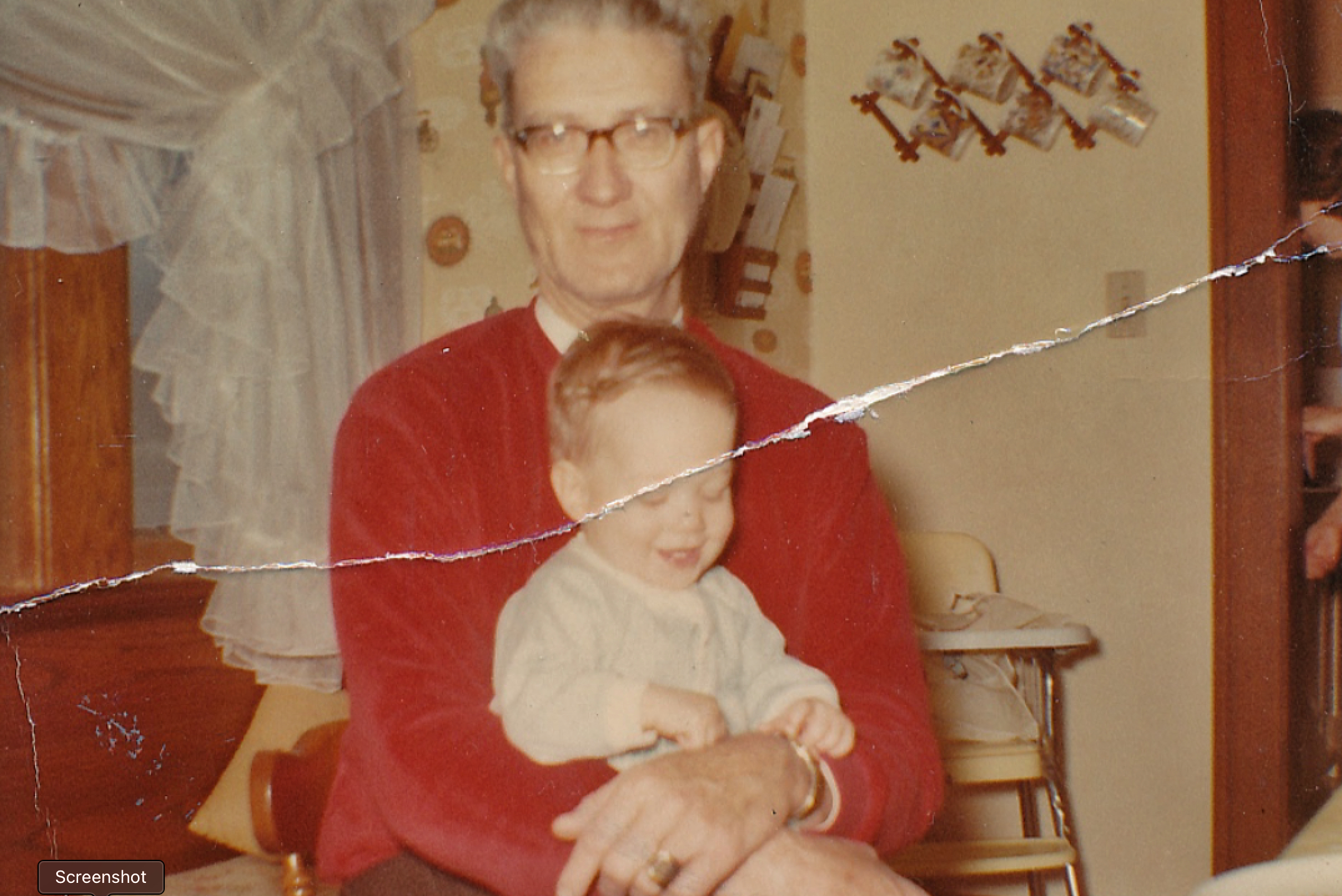
In my mind’s eye, I can vividly see my Grandpa Spec sitting at the head of his dining room table during a family meal, smoking his Dutch Masters cigar. There was a humor with which he approached life that always endeared me to him. I loved being his little shadow. It was only as an adult, as I learned his story, that I fully appreciated his humble and quiet joy.

On Spec’s 10th birthday he came home from school to find the remains of his father’s suicide. His mother sent him to be raised by his grandparents, while she kept his little brother and sister. He came of age during the Great Depression, got married nevertheless, almost lost his wife to childbirth, and scratched out a living in the tire business. He had so much to be bitter about. He had so many reasons to play the victim card, but he didn’t.

From the head of the table, cigar in hand, Grandpa would often smile, pound his fist on the table, and with a gleam in his eye insist, “I’m the king of this castle!” It was part of a never ending dance of teasing between he and Grandma Golly. They needled one another mercilessly whether they were competing at cards or betting on the World Series. In response to Grandpa’s claim to the throne, grandma hung a decorative plaque above the kitchen sink (Grandpa always did the dishes) which read, “I’m the boss of this house, and I have my wife’s permission to say so.”

As I read today’s chapter, Psalm 145, anew this morning, it was the first verse that leapt off the page at me. King David, the greatest King in Hebrew history, sings an exaltation to God whom he refers to as “my king.” The King has a King.

It’s hard for a modern reader to understand how this sentiment ran against the grain of the popular monarchy playbook of his times. Kings wanted the masses under control. Kings wanted an air of undisputed authority. Kings wanted people to fear them. To achieve these ends, Kings claimed to be gods. They might worship other deities for good measure, but they demanded that their people view them as a god themselves.

Not David.

David always saw himself as a servant of the One True King of heaven. Having read all of his lyrics in the Psalms about enemies within his own kingdom seeking to slander and supplant him, I begin to wonder how much easier his reign might have been had he followed the playbook. But that’s what made David different, and God saw it in him when David was a shepherd-boy, the runt of Jesse’s litter of sons. Samuel balked. God assured the prophet. “He’s a man after my own heart.” David is humble. He acknowledges his role in the Great Story. He fully embraces position and place as God’s partner in the Divine Dance.

“I’m king of the Hebrews! And, I have God, my King’s, permission to say so.”

In my mind’s eye, I now distinctly see Grandpa Spec sitting on his glider rocker. He’s shirtless and wearing an old pair of shorts. (He might have central air-conditioning, but one doesn’t want to resort to that unless one has to. The Great Depression taught him many things. Frugality was at the top of the list). He is smoking his pipe now. It’s a summer afternoon and he is listening to the baseball game on the transistor radio. He survived many tragedies and trials on his life journey, but he humbly pressed on with simple faith and determination to do the right. He is king of his castle, and like David, eternally grateful to the King of Heaven for the blessing of his little three-bedroom, quarter-acre kingdom on the east side of Des Moines. He is the servant of his wife, and his family.

In the quiet this morning, I find myself reviewing my own “place and position.” Over the past year, I’ve observed that it’s easy, even fashionable, to feel the heady satisfaction of pious self-rule, then proudly take to the no-man’s-land of social media to stake one’s claim of divine-rightness and lord one’s opinions and world-view upon others, demanding submission upon threat of being sentenced to relational exile.

I don’t want to do that.

I want to try and follow David’s example, and Grandpa Spec’s example. I want the last song in my life’s anthology to be like Psalm 145, ascribing anything I’ve gained and every blessing I’ve been afforded to my King. In fact, when it comes right down to being the person Jesus asks me to be I must accept that I am Lord of no one. I am a servant of all.

God, help me to fully embrace that role today in thought, word, and deed.