Tag Archives: Ambassador

Of Appointees & Crowds

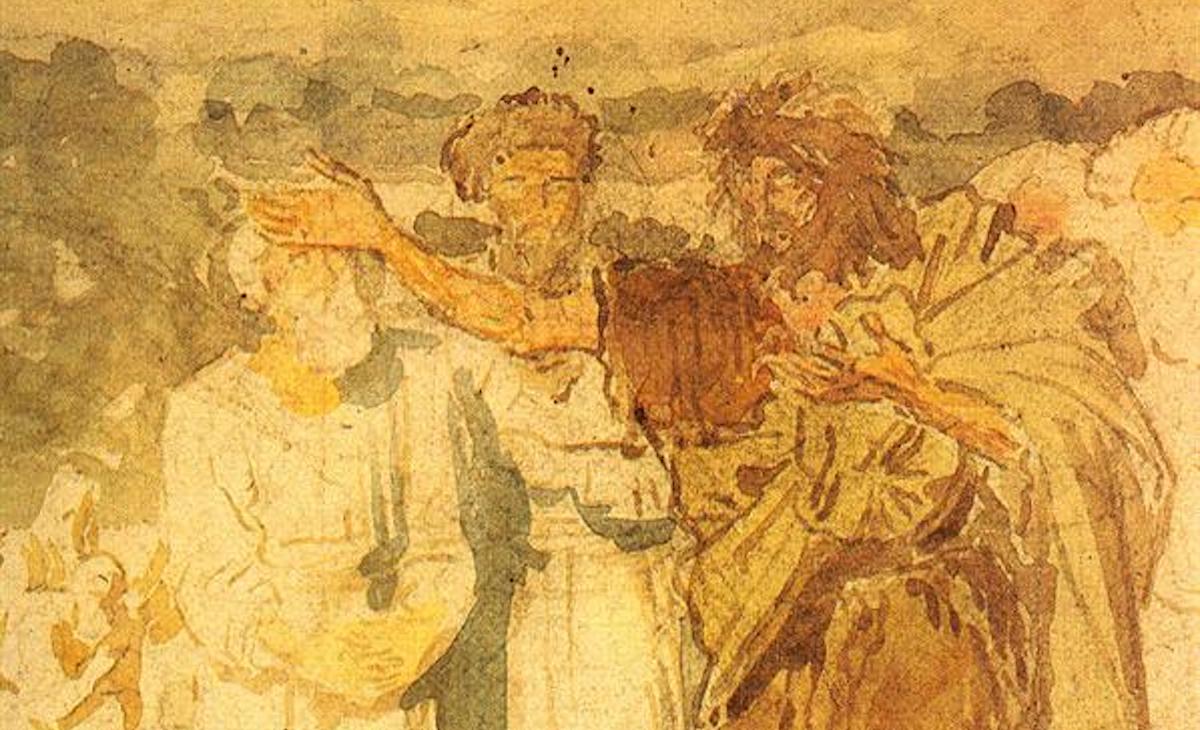
Very early in the morning, the chief priests, with the elders, the teachers of the law, and the whole Sanhedrin, made their plans. So they bound Jesus, led him away and handed him over to Pilate.
Mark 15:1 (NIV)

For sports fans, December is a busy month. Of course, there are all of the college bowl games and the NFL season comes to climactic end as teams scramble for a playoff spot. Yet, even in baseball there are a flurry of off-season trades sparked by the MLB’s winter meetings. Wendy and I have been keeping tabs on several trades our beloved Cubs have made this past week.

As much as fans hate it, trades are part of the business in sports. Every team has legendary trades that fans talk about decades after the fact. Some are positive, but the ones that tend to live on in legend are the trades that produced the deepest scars. For Cubs fans it’s the trading of Hall of Famer Lou Brock to our rival Cardinals. For Vikings fans, its the trade we made with the Dallas Cowboys for Hershel Walker. That trade helped set up the Cowboys for a Super Bowl and relegated the Vikings to continued, perpetual mediocrity.

Hershel Walker made news in recent days. He’s been appointed the U.S. Ambassador to the Bahamas. It’s not surprising. Ambassadors are appointed by Presidents and it’s how Presidents reward followers and loyalists. Lots of banquets, meetings with visiting dignitaries, and for Hershel, I imagine colorful drinks with little umbrellas on the beach.

This came to mind this morning as I pondered one of history’s villains, Roman Governor Pontius Pilate. The truth is that being a Roman Governor was also a political appointment, and Caesar doled them out like a President doling out Ambassadors. It wasn’t what you knew, it was who you knew that got you appointed a Roman Governor. Governors had two basic jobs: Keep the tax money flowing freely and generously to Rome, and maintain order. For Pilate, the latter was his greatest concern. Judea was a powder keg of Hebrew rebels and insurrectionists bent on driving the Romans out. Pilate’s life, financial well-being, and political reputation back in Rome hinged on maintaining order.

The Chief Priests were not stupid. Their ascent to and hold on the power and wealth of the Temple racket required political savvy. They needed Pilate to give the execution order of Jesus, because under Roman occupation he was the only one with the authority to do so. With their trumped up charges they made Jesus out to be a threat to Rome. Their hastily produced protest with a crowd calling for Jesus’ crucifixion, they applied maximum political pressure right where it would have maximum impact with the Roman Governor. Pilate, the tenuous political appointee, knew he was being played, but the cost of making the right decision and releasing an innocent man was outweighed by the personal political cost of making an unpopular decision with the crowd of constituents that were screaming at him.

One of the things that I’ve noticed in this chapter-a-day trek through Mark is his repeated reference to “crowds.” Thirty-four times in 16 chapters, Mark mentions the “crowd.” He is clear to mention that the Chief Priests were afraid of the crowd. He mentions in today’s chapter that Pilate was motivated to satisfy the crowd.

And that has me meditating in the quiet this morning. As human beings, the crowd continues to have a tremendous impact on lives, culture, and personal decisions. Individuals refuse to speak truth, or their objections to prevailing ideologies, to avoid getting cancelled. People follow the crowd trending online like a herd of sheep as fads emerge from influencers. Doing the right thing is sacrificed time and time again on the altar of doing the politically correct thing. I don’t think Pilate was so much a villain as he was like any normal human being who chases after power, authority, status, and influence. You’re always going to do what is best for you in any given situation.

Which is an interesting contrast to Jesus as He stands before this mid-level Roman, political appointee. According to Roman law, if a defendant refuses to make a defense, Pilate had to find him guilty. With His silence, Jesus is actively choosing His fate. Why? Because He is choosing to do the right thing for all of humanity. He is choosing to be obedient to His Father’s will. He is sacrificing Himself pay sins penalty for all, for me. He is choosing to exemplify the attitude and actions He wants me to exemplify in my own daily thoughts, words, actions, and choices.

And so, I endeavor today to once again follow Jesus teaching and example, even if it means going against the current of the crowd.

I hope Hershel Walker avoids having to make critical Pilate-like political decisions as U.S. Ambassador to the Bahamas. Enjoy the beach, Hershel!

If you know anyone who might be encouraged by today’s post, please share.

These chapter-a-day blog posts are also available via podcast on all major podcast platforms including Apple, Google, and Spotify! Simply go to your podcast platform and search for “Wayfarer Tom Vander Well.” If it’s not on your platform, please let me know!

The Scepter and the Sword

The Scepter and the Sword (CaD Ezk 21) Wayfarer

“‘Shall we rejoice in the scepter of my royal son? The sword despises every such stick.’
Ezekiel 21:10b (NIV)

Along my life journey, I have observed that the political divide here in the States can arguably be boiled down to those who don’t trust the government to do anything well and want to diminish its role in our lives versus those who trust the government to do everything for us and therefore want to entrust more and more of our lives to it.

One of the things that history has taught me is that while the world changes, the one thing that does not change is the human condition and, therefore, all the human systems that we humans create. It’s why Shakespeare is still so powerfully relevant today. Arguably, no one has ever captured the human condition for the purposes of both comedy and tragedy as the Bard.

In today’s chapter, I found that the ancient Israelites were dealing with their own sense of safety and trust in their government, a monarchy founded on the royal line of David.

Throughout history, the staff or scepter has been a symbol of authority, royalty, and command. When God called Moses to lead His people out of Egypt, He sent Moses with a staff that became a metaphor for God’s power and authority. Archaeologists have uncovered an ivory pomegranate that was used at the top of a scepter with an inscription indicating it may have very well been used by the priests in Solomon’s Temple. Statues and artwork of both royalty and idols frequently showed them holding a scepter.

The Israelites of Ezekiel’s day, living in Judah and Jerusalem, had been raised to revere the King as a member of David’s royal house. It had been proclaimed that God would establish David’s throne forever, and they put a lot of stock in this promise. Many believed that as long as a member of David’s house was on the throne God would protect them and prosper them. Certainly the King had prophets on his payroll who would proclaim this loudly in an effort to keep the peace. People believed it.

Ezekiel, however, is given a prophetic vision contrasting the scepter of the royal house of David to the sword of God’s judgment in the hands of the King of Babylon. The prophetic word begins with the sword despising and mocking the “stick” in the king’s hand. The prophecy continues to explain that the sword is more powerful than the scepter, and warns the people not to trust their king and his royal prophets.

The prophecy ends on a Messianic note:

“‘A ruin! A ruin! I will make it a ruin! The crown will not be restored until he to whom it rightfully belongs shall come; to him I will give it.’
Ezekiel 21:27 (NIV)

As a follower of Jesus, I couldn’t help but note that the monarchy in Jerusalem did end with Babylon’s siege. There was no king in Jerusalem until Jesus rode in on a donkey and Matthew remembered the words of the prophet Zechariah:

“Say to Daughter Zion,
    ‘See, your king comes to you,
gentle and riding on a donkey,
    and on a colt, the foal of a donkey.’

In the quiet this morning, I am reminded of my dual citizenship. Yes, I am a citizen of the United States, but as a disciple of Jesus I am also a citizen of God’s heavenly kingdom. The former is human and temporal, the latter is divine and eternal. My citizenship in God’s Kingdom does not diminish my earthly citizenship or my responsibility to be an active and participatory citizen on earth as I have heard people argue. On the contrary, as an ambassador of God’s Kingdom on this earth I am required to be a more dutiful and engaged member of society, respecting those in authority and acting on a daily basis to make life on earth a better place for my fellow human beings for Heaven’s sake.

With that in mind, I am also mindful that the one thing that does not change on this earth is the human condition, unless it becomes subject to the power of God’s Holy Spirit. The end of the Great Story as told in Revelation is a parallel to Ezekiel’s prophecy in today’s chapter. God’s sword (pictured as the Words from Jesus’ mouth; see Rev 19:15) standing against the scepters of the Prince of this World and all the kingdoms of this world.

Despite knowing and believing the ending, my role in this Great Story is to be an ambassador of God’s Kingdom here on earth today. And that means being a good citizen, and operating out of love in everything I say and do. Here we go…

If you know anyone who might be encouraged by today’s post, please share.

Herald

Herald (CaD Matt 3) Wayfarer

In those days John the Baptist came, preaching in the wilderness of Judea and saying, “Repent, for the kingdom of heaven has come near.” This is he who was spoken of through the prophet Isaiah:
“A voice of one calling in the wilderness,
‘Prepare the way for the Lord,
    make straight paths for him.’”

Matthew 3:1-3 (NIV)

The “herald” is a long-standing historical figure across many cultures. The role of the herald was to go before a king or queen to announce his/her impending arrival so that the royal subjects could prepare to greet the monarch appropriately. In the story of Daniel, it was a herald who told the Babylonian people how to respond appropriately (bow) before Nebuchadnezzar’s statue (Daniel 3:3-5). God, through the prophet Habakkuk (note: one doesn’t get to quote Habakkuk very often), ordered that His words be written down so that “a herald may run with it” (Hab 2:2).

The Hebrew people of Jesus’ day were abuzz with Messianic experts teaching and lecturing on who the Messiah would be and what it would look like when the Messiah arrived. It is not unlike the abundant number of authors and lecturers today who wax eloquent on when the Second Coming of Christ will take place. For the record, the so-called experts of Jesus day were dead-wrong in their predictions. Since “nothing is new under the sun,” I tend to assume that today’s experts are most likely dead wrong, too. But they certainly do sell some books.

Remember that Matthew’s writing was motivated by sharing with his fellow Hebrews that Jesus was the Messiah they’d been waiting for. One of the Messianic tidbits of which Matthew’s audience would have been well aware was that the last of the prophets predicted that the prophet Elijah would appear before the “Day of the Lord” (Malachi 4:5). They would have connected Matthew’s description of John the Baptist with Elijah.

Description of Elijah in 2 Kings 1:8:

“He had a garment of hair and had a leather belt around his waist.”

Matthew’s description of John the Baptist:

“John’s clothes were made of camel’s hair, and he had a leather belt around his waist.”

Matthew’s audience also believed that the Messiah would be a King, and they knew that every king has a Herald.

John the Baptist was Jesus’ Herald. Later in Matthew’s account, Jesus will acknowledge that John was the embodiment of Elijah that Malachi prophesied, but the “experts” didn’t recognize him for who he was. John’s rather impressive backstory is recorded in the opening chapters of Luke. Jesus and John were cousins. They knew each other. Their brief exchange in today’s chapter seems to reveal that John knew that Jesus was the Messiah, and Jesus knew that John was His herald.

In the quiet this morning, I found myself ruminating on two things.

First, I was reminded that in each of Paul’s letters to Timothy he referred to himself as a “herald” even before claiming to be an apostle and teacher. As a follower of Jesus, I’m charged with being an ambassador of Christ’s kingdom on earth. I guess that makes me a herald, as well. I’ve never really thought about that before.

Second, I’m reminded that later in Matthew’s account John himself sent his followers to ask Jesus, “Are you the one?” (Matt 11:1-3). In today’s chapter John seems to have no doubt. Later, he does doubt. I wonder if even John had preconceived notions about what Jesus would do and how He would present Himself to the world. Jesus certainly didn’t immediately fulfill John’s prophecies of judgment and a baptism of fire.

So, as a self-proclaimed herald of the King of Heaven, I’m reminded that it’s a very human thing to be confused about who Jesus is. I’ve observed many who judge Jesus based on the description they were taught by so-called institutional experts or the description of Jesus they’ve been given by clownish televangelists hawking their own books and building their own personal kingdoms on earth.

Which, is why, time-and-time-again, I bring my chapter-a-day journey back to the primary source material of Matthew’s account. I try to let go of preconceived notions. I try to shut out what others have said about Jesus. I once again read the account with fresh eyes and an open heart. I want to meet the King of Heaven anew, that I might be an effective and honest herald on earth.

If you know anyone who might be encouraged by today’s post, please share.