Tag Archives: Monarch

Authority with Ink-Stained Fingers

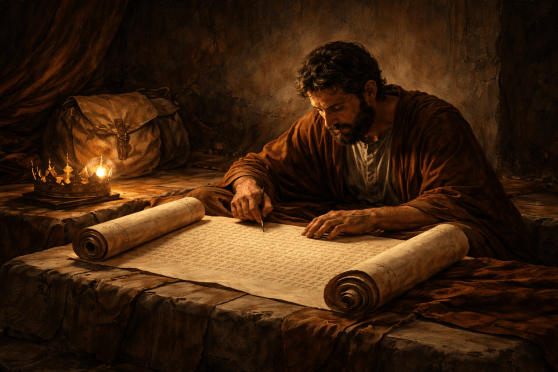
When [the king someday] takes the throne of his kingdom, he is to write for himself on a scroll a copy of this law, taken from that of the Levitical priests. It is to be with him, and he is to read it all the days of his life so that he may learn to revere the Lord his God and follow carefully all the words of this law and these decrees…
Deuteronomy 17:18-19 (NIV)

Just the other morning Wendy and I were stopped by friends who wanted to discuss a role I’d played on stage about ten years ago. It was a show that Wendy directed. It was one of my favorite roles ever, and it was fun to relive the memories with our friends.

One of the questions people repeatedly ask me when speaking of my various turns on stage is, “How do you memorize all those lines?” The truth is that the entire rehearsal process lends itself to the memory work. That said, there is a combination of both discipline and device required.

One of the mnemonic devices I use is to write my lines down. Literally, I will go through the script and transcribe my lines by hand on paper. There is a connection made between hand and brain when you write things by hand. The act of writing the words themselves allow the brain to catch things that the eyes alone don’t see on the page. The process takes time and forces the brain to consider and contemplate words, phrases, and sentences in ways that simple reading and reciting doesn’t.

In today’s chapter, Moses foreshadows a time when Israel asks for a king. Moses lays the foundation describing the person the king should be:

  • A person God chooses (God’s choice, not a human popularity contest)
  • No hoarding of horses (military might)
  • No accumulation of wives (political manipulation)
  • No stockpiling of silver and gold (economic domination)

Then Moses prescribes the most astonishing of tasks for every person appointed to the throne. Handwrite a copy of the Torah onto a single scroll – the entirety of Genesis, Exodus, Leviticus, Numbers, and Deuteronomy. Why? There is a connection between brain and hand. As you write words on paper, they penetrates the brain – they even seep into the heart.

But merely transcribing God’s Word was not the end of the prescription. The scroll is to be portable – able to fit in the king’s backpack. It is to be with him always. Having the scroll allowed the King to perpetually reference, read, meditate, and remember.

The scrolls very presence was a moral compass whispering, “Not so fast, mighty one.”

As I meditated on the chapter, two things struck me:

  • Being king requires being a student. Not delegating. Not outsourcing. Ink on fingers. Scroll on lap. Leadership begins as listening.
  • Limits are mercy. The prohibitions against excess aren’t anti-royalty; they’re anti-corruption. Torah assumes power will tempt—and lovingly cages it before it devours the soul.

The subversive whisper in today’s chapter is this: No one is above the Law—not even the one wearing the crown.

When I was discipled as a young man, the first task I was given was to memorize Joshua 1:8:

This Book of the Law shall not depart from your mouth, but you shall meditate on it day and night, so that you may be careful to do according to all that is written in it; for then you will make your way prosperous, and then you will achieve success. (NASB)

Notice the similarity? Meditate day and night. Let it penetrate. House it in your head and heart. Let it be an ever-present reminder, a reference, a voice of wisdom, a guardrail against foolish choices.

Which is why, my friend, I’m still here in the quiet each morning reading, meditating, writing, and hopefully letting it penetrate ever deeper. Just like an actor memorizing my lines.

After all, Shakespeare so poetically observed,

“All the world’s a stage,
And all the men and women merely players…”

On the stage of life, this Great Story between Genesis and Revelation is my script. If I’m going to play my role well, I had better know my lines—and listen for the Director’s cues.

And that reminder is a good cue with which to start this another day on this earthly journey.

If you know anyone who might be encouraged by today’s post, please share.

Promotional graphic for Tom Vander Well's Wayfarer blog and podcast, featuring icons of various podcast platforms with a photo of Tom Vander Well.
These chapter-a-day blog posts are also available via podcast on all major podcast platforms including Apple, Google, and Spotify! Simply go to your podcast platform and search for “Wayfarer Tom Vander Well.” If it’s not on your platform, please let me know!
Logo of a Bible app featuring an open book icon on an orange background.

“King of My Castle”

"King of My Castle" (CaD Ps 145) Wayfarer

I will exalt you, my God the King
Psalm 145:1 (NIV)

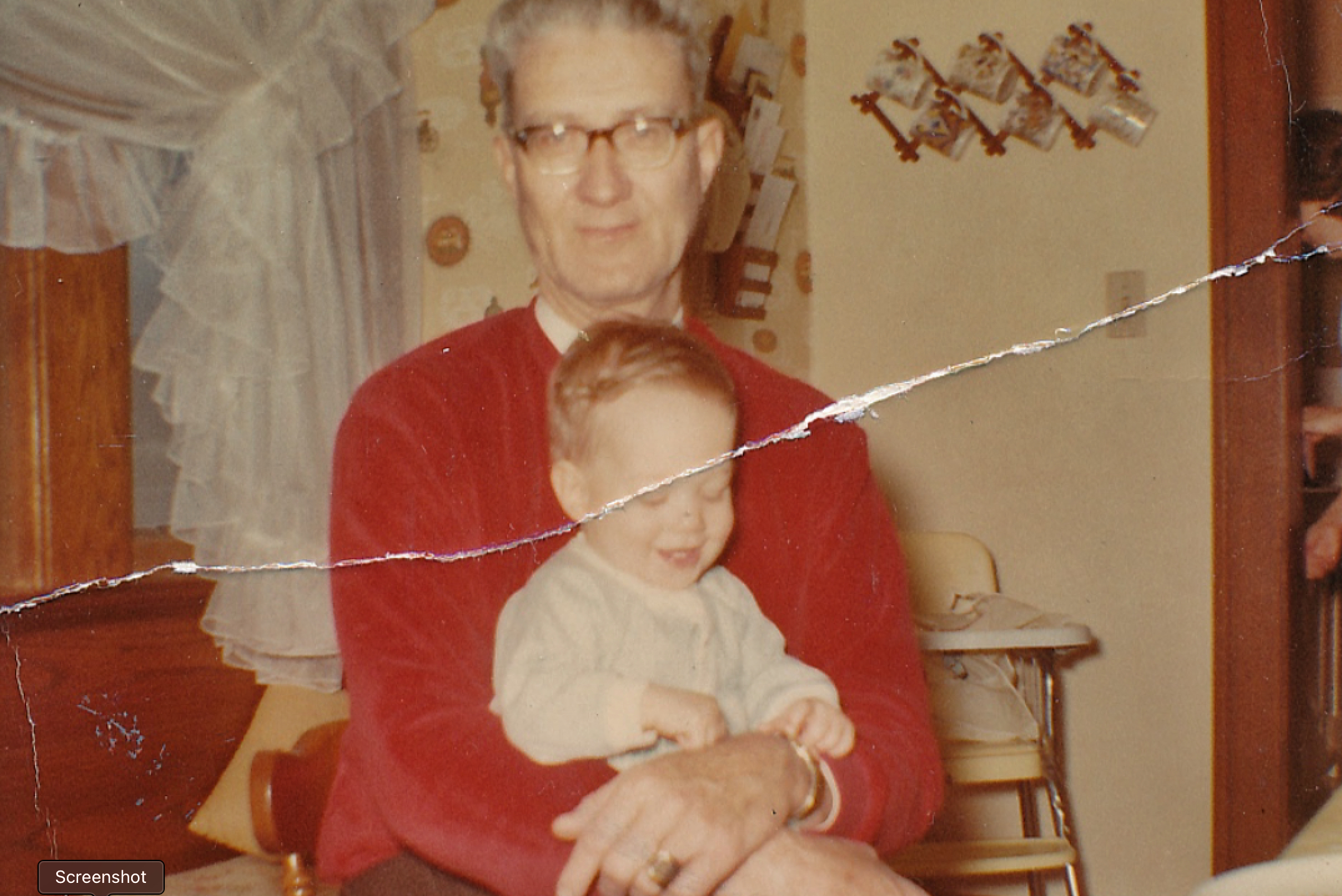
In my mind’s eye, I can vividly see my Grandpa Spec sitting at the head of his dining room table during a family meal, smoking his Dutch Masters cigar. There was a humor with which he approached life that always endeared me to him. I loved being his little shadow. It was only as an adult, as I learned his story, that I fully appreciated his humble and quiet joy.

On Spec’s 10th birthday he came home from school to find the remains of his father’s suicide. His mother sent him to be raised by his grandparents, while she kept his little brother and sister. He came of age during the Great Depression, got married nevertheless, almost lost his wife to childbirth, and scratched out a living in the tire business. He had so much to be bitter about. He had so many reasons to play the victim card, but he didn’t.

From the head of the table, cigar in hand, Grandpa would often smile, pound his fist on the table, and with a gleam in his eye insist, “I’m the king of this castle!” It was part of a never ending dance of teasing between he and Grandma Golly. They needled one another mercilessly whether they were competing at cards or betting on the World Series. In response to Grandpa’s claim to the throne, grandma hung a decorative plaque above the kitchen sink (Grandpa always did the dishes) which read, “I’m the boss of this house, and I have my wife’s permission to say so.”

As I read today’s chapter, Psalm 145, anew this morning, it was the first verse that leapt off the page at me. King David, the greatest King in Hebrew history, sings an exaltation to God whom he refers to as “my king.” The King has a King.

It’s hard for a modern reader to understand how this sentiment ran against the grain of the popular monarchy playbook of his times. Kings wanted the masses under control. Kings wanted an air of undisputed authority. Kings wanted people to fear them. To achieve these ends, Kings claimed to be gods. They might worship other deities for good measure, but they demanded that their people view them as a god themselves.

Not David.

David always saw himself as a servant of the One True King of heaven. Having read all of his lyrics in the Psalms about enemies within his own kingdom seeking to slander and supplant him, I begin to wonder how much easier his reign might have been had he followed the playbook. But that’s what made David different, and God saw it in him when David was a shepherd-boy, the runt of Jesse’s litter of sons. Samuel balked. God assured the prophet. “He’s a man after my own heart.” David is humble. He acknowledges his role in the Great Story. He fully embraces position and place as God’s partner in the Divine Dance.

“I’m king of the Hebrews! And, I have God, my King’s, permission to say so.”

In my mind’s eye, I now distinctly see Grandpa Spec sitting on his glider rocker. He’s shirtless and wearing an old pair of shorts. (He might have central air-conditioning, but one doesn’t want to resort to that unless one has to. The Great Depression taught him many things. Frugality was at the top of the list). He is smoking his pipe now. It’s a summer afternoon and he is listening to the baseball game on the transistor radio. He survived many tragedies and trials on his life journey, but he humbly pressed on with simple faith and determination to do the right. He is king of his castle, and like David, eternally grateful to the King of Heaven for the blessing of his little three-bedroom, quarter-acre kingdom on the east side of Des Moines. He is the servant of his wife, and his family.

In the quiet this morning, I find myself reviewing my own “place and position.” Over the past year, I’ve observed that it’s easy, even fashionable, to feel the heady satisfaction of pious self-rule, then proudly take to the no-man’s-land of social media to stake one’s claim of divine-rightness and lord one’s opinions and world-view upon others, demanding submission upon threat of being sentenced to relational exile.

I don’t want to do that.

I want to try and follow David’s example, and Grandpa Spec’s example. I want the last song in my life’s anthology to be like Psalm 145, ascribing anything I’ve gained and every blessing I’ve been afforded to my King. In fact, when it comes right down to being the person Jesus asks me to be I must accept that I am Lord of no one. I am a servant of all.

God, help me to fully embrace that role today in thought, word, and deed.

An Unorthodox Choice

Michelangelo david solomon
Michelangelo’s David and Solomon (Photo credit: Wikipedia)

Then he called for his son Solomon and charged him to build a house for the Lord, the God of Israel. 1 Chronicles 22:6 (NIV)

When reading the ancient stories in God’s Message, I’ve learned that a big part of the story is often not what is said in the text, but what is left unsaid. I found it interesting last week when we read 1 Chronicles 20 that the scribe left out the naughty bits about David’s sin with Bathsheba and his conspiracy to murder Uriah, her husband. Today, the scribe moves right into the story of David commissioning his son Solomon to build the temple, but why Solomon was chosen as the one to ascend to the throne is never addressed.

Through the millennia, it has been a common practice in monarchies around the world for the throne to be passed to the eldest living son. In the case of King David, there were many children born to him from a handful of wives and several concubines. David’s scandalous dalliance and subsequent marriage to Bathsheba happened relatively late in his life. There were several sons born to David prior to Solomon, but David chooses his young son Solomon, born to him through Bathsheba rather than any of his other children.

Very few families escape the conflicts, machinations, and hard feelings that arise from parental favor and estate. This is true even of simple nuclear families trying to settle  issues of a parent’s last will and testament. Imagine the chaos that ensues when polygamy, the throne, political power, and vast riches are at stake. David’s choice of the young Solomon could not have gone over well with his half-siblings who had been waiting in line for the throne for many years.

I am reminded again this morning what God said to Samuel when David was anointed King as a young boy:

“The Lord does not look at the things people look at. People look at the outward appearance, but the Lord looks at the heart.”

We don’t know why David chose young Solomon over his siblings, but David had a long track record of seeking to do the right thing in God’s eyes. I must wonder if David’s choice was based on what he saw in the hearts of his children rather than sticking with human protocol of simply handing the crown to his eldest.

Life is full of choices and decisions. Handling family dynamics with children of diverse personalities, gifts, and capabilities can be difficult for the even the most dutiful parent. It requires, if you’ll forgive the blatant connection, “the wisdom of Solomon.” And, perhaps, that is what David perceived in making his unorthodox choice of successor.

The Bookend Monarchs

David and Saul
David and Saul (Photo credit: Wikipedia)

Saul answered, “But am I not a Benjamite, from the smallest tribe of Israel, and is not my clan the least of all the clans of the tribe of Benjamin? Why do you say such a thing to me?” 1 Samuel 9:21 (NLT)

For hundreds of years, the nation of Israel had existed as clans and tribes living under a loose system of government. The priesthood of Aaron’s descendants and the priestly tribe of Levi held the tribes together through the law of Moses and the sacrificial system God established during their escape from Egypt. National leaders emerged as God raised them up in times of need (e.g. Gideon, Samson, and Deborah) and the “judges” God raised became national leaders for their lifetime. There was, however, no system in place to elect a new leader once the old leader died. National leadership defaulted back to the priests or to a high priest (like Eli, who was the priest leading when we began reading 1 Samuel). Local leadership appears to have been handled by tribe and clan patriarchs who appealed to judges as the arbitrator of disputes.

At this point in the story, the people of Israel have demanded a new system of government. They want a monarch, a king, like all of the neighboring nations. But, how do you just start a monarchy? I find it fascinating that God told Samuel to anoint Saul ruler of Israel. In a few chapters God will tell Samuel to anoint David. So, while the people are asking for a king, God is still the one raising up the leader, just as He did with the judges.

In raising up first Saul, then David, God provides Israel with a national object lesson. In Saul, God will provide for the nation a self-centered crazy maker who will exemplify all that a nation does NOT want or need in a leader. Then, in David, God will raise up a flawed man whose heart follows after God. Two flawed human beings (what else can you find on the earth?) with stark differences of heart. God will reject Saul and make David’s line the royal line through which Jesus, the Messiah, will be born. The people may have demanded a monarch, but through Samuel God is raising the monarch of His choosing.

I also find it interesting this morning that in the bookend rulers, Saul and David, God raises up men from the smallest of tribes, and from the least of the tribal clans. In David, God goes one step further to choose the youngest of many brothers. Over and over and over again God raises up individuals from the smallest towns, the dregs of society, the youngest, the socially handicapped and the least networked to accomplish His purposes.

If God specializes in using the least of society, then He can and will use both you and me.