Tag Archives: Common

Tearing Down Walls

Tearing Down Walls (CaD Ezk 46) Wayfarer

“‘The prince must not take any of the inheritance of the people, driving them off their property. He is to give his sons their inheritance out of his own property, so that not one of my people will be separated from their property.’”
Ezekiel 46:18 (NIV)

There was a fascinating article in the Wall Street Journal this past week about some of the political wrangling in the U.K. They have two “houses” in their government, too. However, their houses began with one being for the “common” people and the other being for those with a royal title. Today, the House of Lords does not look like it did when it was instituted but there is a certain percentage of members who are there because they inherited a royal title from a father or grandfather. There’s a push by the new Prime Minister to force them and push the old aristocracy into extinction.

This article came to mind this morning as I continued to read Ezekiel’s ideal vision of Israel’s restoration. Today’s chapter continues to provide instructions for how things are to function. There were two things that stand out with regard to “the Prince” and all the other people of Israel.

First, the Prince was to enter into the Temple with all of the other people, and he was to exit with all of the other people. No special entrances or VIP gate. The Prince is no different than any other person. In Ezekiel’s day, this was a radical idea.

A bit later in the chapter Zeke explains that the Prince has no power to take away anyone’s land and claim it for himself. This was a common practice in monarchies throughout history. In fact, hundreds of years before Ezekiel, the people of Israel wanted a king like all the other nations around them. The prophet Samuel warned them that a king would take whatever he wanted from them, whenever he wanted, including their land.

[A king] will take the best of your fields and vineyards and olive groves and give them to his attendants.
1 Samuel 8:14 (NIV)

In Zeke’s vision of how things can and should be, the Prince has his land that he can give to his descendants as he chooses, but he cannot take anyone else’s land “so that not one of my people will be separated from their property.’” This was a radical idea in Ezekiel’s day. The Prince is no different from the common every day citizen. Every family has their allotment that cannot be taken away.

In the quiet this morning, I think about this game that humanity has played throughout history. We divide people into distinctions of royal and common, aristocrats and bourgeoisie, Popular and losers, blue bloods and the masses, elites and the lower class. Even today, I can own my own land and have it taken away by eminent domain.

Not only that, but along my journey I’ve observed that even here in the States, where we supposedly have done away with old forms of monarchy and aristocracy, we still essentially turn our Presidents, politicians, and celebrities into royalty. What is it in humanity that perpetually builds these distinctions?

As a disciple of Jesus, I can’t help to think about the fact that Jesus came to build on this seed that Ezekiel’s vision is planting and do something new. Jesus came to tear down distinctions of race, class, and gender:

There is neither Jew nor Gentile, neither slave nor free, nor is there male and female, for you are all one in Christ Jesus.  If you belong to Christ, then you are Abraham’s seed, and heirs according to the promise.
Galatians 3:28-39 (NIV)

This begs two questions of me:

Where have I, or my culture, rebuilt a wall of distinction that Jesus purposefully tore down?

How can I personally tear it back down in my heart, mind, and actions?

If you know anyone who might be encouraged by today’s post, please share.

Distinctions

Distinctions (CaD Ezk 41) Wayfarer

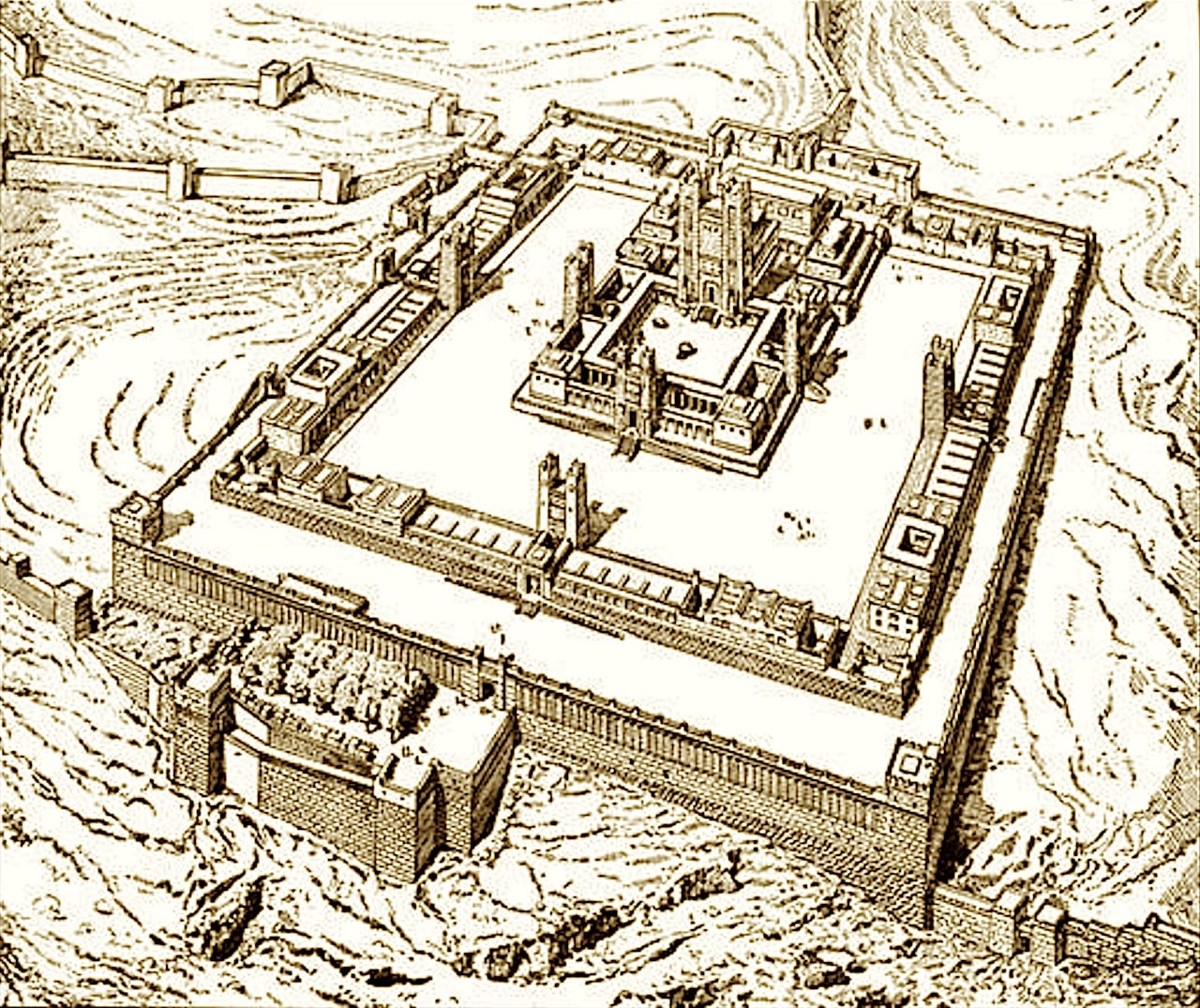
Then he measured the temple; it was a hundred cubits long, and the temple courtyard and the building with its walls were also a hundred cubits long. The width of the temple courtyard on the east, including the front of the temple, was a hundred cubits. Then he measured the length of the building facing the courtyard at the rear of the temple, including its galleries on each side; it was a hundred cubits.
Ezekiel 41:13-15 (NIV)

For the recently freed Hebrew slaves, everything about life had changed. All they knew about the God of their ancestors Abraham, Isaac, and Jacob was what Moses had told them. But they’d witnessed what God could do in the ten plagues that had been inflicted on Pharaoh and Egypt. They’d seen God part the waters of the Red Sea so they could cross and then bring the same waters crashing down on the Egyptian army.

But they still know relatively little about God. But in Exodus 19, they are about to learn a whole lot more. Moses goes up on a mountain by himself. From below they watch as lightning strikes, then smoke starts billowing, and the whole mountain trembles. When Moses descends, he not only has the Ten Commandments, but he has the blueprints and instruction manual for a Temple, a priesthood, rituals, and sacrifices that prescribe an entirely new way of living with God and with one another in community.

One of the things that became quickly clear to the ancient Hebrews when God, through Moses, gave them instructions for a temple and its rituals is that God made distinctions. Again, this parallels the Creation poem in Genesis 1 and 2 where God made a distinction between “this” and “that” parts of creation. There are consistent structural designs from the tent tabernacle, to Solomon’s Temple, and to the Temple Ezekiel sees in his vision. With each, there were distinctions of space. There were spaces between the common and the sacred, the space that was everyday people, and the “most holy” space where God’s presence resided.

The Most Holy Place, sometimes called the “Holy of Holies” was a perfect square. The only person who could enter was the high priest.

Fast forward to Jesus, some 400 years after Ezekiel. In Luke 9, Jesus takes his three inner-circle disciples and goes up a mountain. Suddenly, Jesus is transformed into blinding, bright light. There is lightning and then there’s smoke everywhere and then Moses shows up in his glorified, heavenly body along with Elijah. Does this sound familiar?! Jesus would descend that mountain and consequently usher a completely new blueprint and new distinctions that build on the old.

Jesus subsequently told His disciples that the Temple would soon be reduced to rubble, and 40 years later it was. After His death and resurrection, Jesus sent His Holy Spirit. This is an important new distinction. God’s presence was in Jesus’ people. The human soul became the “Most Holy Place” where God’s Spirit dwells and the body is its Temple.

But wait, we’re not done. The night before Jesus’ was executed, He told His followers, “I’m going to prepare a place for you.” When John is given a vision in Revelation this place is revealed as a new Jerusalem. Just like with Ezekiel, John had to watch as it was measured and wouldn’t you know it, this heavenly city is perfectly square just like the Most Holy Place. The distinctions from beginning to end have been transformed and flipped inside out. What began as a small (about 15 feet square) Sacred Space with the distinction that only God’s Presence is holy enough to be there, becomes at the end of the Great Story a “Most Holy Place” that is 1200 miles square where all of God’s people dwell together with God because, through the sacrificial death and resurrection of Jesus, they have been made holy, as well.

In the quiet this morning, I am reminded that the tremendously precise and ordered details that Ezekiel describes are a part of how God metaphorically reveals Himself to us. He is a God of detail and distinctions who transforms chaos into order, death into life, and the common into that which is holy. Paul wrote to the believers in Corinth that if anyone is joined with Christ, that person is a new creation, old things pass away and new things come. In other words, I am a microcosm of the very thing that God is doing throughout the entire Great Story, transforming that which wasn’t holy into that which is eternally holy.

I am in process, and as my local gathering of Jesus’ followers continues to remind everyone, this journey is about progress, not perfection.

And so, I progress into another day of the journey.

If you know anyone who might be encouraged by today’s post, please share.