Tag Archives: Division

“An Appeal to Heaven”

I urge, then, first of all, that petitions, prayers, intercession and thanksgiving be made for all people— for kings and all those in authority, that we may live peaceful and quiet lives in all godliness and holiness.
1 Timothy 2:1-2 (NIV)

In 1775, the American British Colonies were preparing for open war with Mother England. George Washington commissioned six schooners with the task of harassing British supply ships. They became known as “Washington’s Cruisers.” It was America’s first navy.

Betsy Ross had yet to stitch the stars and stripes as an official flag of the United States, and Washington’s Cruisers wanted a banner to sail under. The sailors turned to English philosopher, John Locke, who argued that when people live under tyranny and no appeal can be made to an earthly judge there is still “an appeal to heaven” that can be made. They stitched the words on a white flag with a pine tree representing the American pines that England tyrannically mandated could only be used for masts on British ships.

In today’s chapter, Paul urges his protégé and all the believers in Ephesus to make an appeal to heaven for “kings and all those in authority.” It must be noted that Paul’s command to pray for “all” in authority included the one man who was the highest human authority in the Roman Empire at the time: Emperor Nero. Paul had already been imprisoned in Rome once waiting for his appeal to Caesar to make its way up the docket. In a few years from the writing of this letter Paul will be imprisoned again. His appeal to Nero will never be realized and Nero will have Paul executed.

Paul, however, remains laser focused on his appeal to heaven. Paul appealed to Caesar back in Acts 25 knowing that, if successful, he would have an opportunity to share his story and Jesus’ message with the most powerful human authority on earth. Paul’s eyes were fixed on Jesus, and bringing God’s Kingdom to earth. His rights as a Roman citizen technically afforded him an opportunity to be ushered into Caesar’s throne room, and since the charges against him were rooted in his faith in Jesus and the riot it caused among his Jewish brethren, Paul would naturally have to testify regarding his faith as part of the trial. Paul is dying for the chance to share Jesus with Nero. In fact, the attempt will ultimately cost him his earthly life.

But that’s still a few years in the future. As he writes Timothy, he urges that everyone pray for all in authority, including the dreaded and debauched Emperor Nero who has murdered some of his own family members and had sex with others. Nero, who will cover Christians in pitch and burn them alive on stakes as entertainment and illumination for the orgy in his garden.

Pray for him.

When there is no other appeal to be made on earth, there is still an appeal to heaven.

In the quiet this morning, I can’t escape the current realities of our political divide, political hatred, political violence, political vengeance, and political retribution. I stand in the tension and have watched it on both sides of the political spectrum as it has progressively escalated in both camps over the past decade.

And so, Paul reminds me this morning along with Timothy. It doesn’t matter how dreaded and debauched, how deceptive and dastardly, I am called to make an appeal to heaven for “all those in authority.” Ultimately, God is the final appeal. So, I might as well make that appeal today.

If you know anyone who might be encouraged by today’s post, please share.

Promotional graphic for Tom Vander Well's Wayfarer blog and podcast, featuring icons of various podcast platforms with a photo of Tom Vander Well.
These chapter-a-day blog posts are also available via podcast on all major podcast platforms including Apple, Google, and Spotify! Simply go to your podcast platform and search for “Wayfarer Tom Vander Well.” If it’s not on your platform, please let me know!

The Goal, the Role, and the Lesson

“With him I speak face to face,
    clearly and not in riddles;
    he sees the form of the Lord.
Why then were you not afraid
    to speak against my servant Moses?”

Numbers 12:8 (NIV)

For a handful of years I had a rare privilege to serve as mentor and coach to individuals among my local gathering of Jesus followers who wanted to give preaching a try. Our gathering is unique in that we have a second worship space on Sundays that gathers concurrently with the main worship area. It was designed to be a space to experiment and try new things. One of those “new things” was to recognized that individuals in our midst might have the gift of preaching or teaching and perhaps we should identify, develop, and allow those who are gifted to use their gifts. This runs directly opposite the popular paradigm of the celebrity pastor and the traditional paradigm of the spiritually-elite priest.

During my time, I think there were somewhere between 30 and 40 individuals who at least gave it a shot. Some were already known teachers who wanted to continue to develop their gifts. Many had never given a message before. Individual results were as varied as people’s own stories. On a macro-level, this period moved our local gathering further away from the celebrity pastor paradigm and further into a team teaching concept.

I’m honestly not sure how well I performed in my role. It was something I’d never done before and there was no template. In the end, I think I learned more than those in my charge. I’d like to touch on a couple of those personal lessons that came to mind as I meditated on today’s chapter in which Aaron and his wife Miriam work themselves into a critical lather about Moses. The source of their critical spirits is prejudice, as they were upset he’d married “a Cushite.” We can’t know for certain what “Cushite” refers to, but suggestions range from her being from Sudan to Arabia to the term simply referring to Zipporah, Moses’ non-Hebrew wife from. Midian.

Father God calls Aaron, Miriam, and Moses to His study at the entrance of the traveling tent temple in order to have a talk with His children. He scolds Aaron and Miriam for being so mean to their brother, affirms his love for and support of Moses, then punishes both Aaron and Miriam, sending Miriam into a seven-day time-out outside the camp.

At the heart of this story is the fact that we human beings can be envious, jealous, catty, and downright mean to one another. When it comes to what God is trying to do in and through His people in community, that is not only not-productive, it can be destructive. It erodes the loving-order God is trying to develop and leads towards the chaos that our spiritual enemy initiates, supports, and celebrates.

In my tenure mentoring prospective preachers, I knew that not everyone I worked with would be truly gifted at it. But here’s a few quick hits of things I observed and learned:

Every message bore fruit. There was never a Sunday that I didn’t have at least one person tell me something to the effect of “I needed to hear that this morning.” Through the prophet Isaiah (55:11), God said that when His Word goes out it does not return empty. God used every person I ever worked with, no matter how much they struggled and sputtered through their message. It may have been one or two little fruit blossoms, but the tree was never void of fruit.

Every messenger was God’s vessel. Every individual I worked with was a wonderful human being and child of God. Every one wanted to do a good job. Every one had a unique voice, their own story, and a sincere desire to do a good job. Results varied, but what never changed was how special each person was in God’s eyes. Jesus loved and died for each of them. Each person was God’s vessel indwelled by God’s Spirit.

There was no failure. Some individuals realized that preaching was not their gift, but that doesn’t mean they or their message was a “failure” (see the previous two observations). In the paradigm and metaphor God gave us through Paul, we are all one body, but there are many different parts, different functions, and entirely different systems with different essential functions within that body. We all have an essential role within the system whether I’m a tooth in the mouth speaking God’s Word or a booger in the nose helping the entire body breathe God’s Spirit well.

The goal, I’ve learned, is to discover and embrace the role I was created and gifted to play in service to the whole, and to respect and honor every other part for the roles they were created and gifted to play. If every part of the body is not willing to embrace this truth, then we’re back to order giving way to chaos.

We live in the most divisive times. Fueled by the anonymity of social media and online commentary, people are downright terrible to one another. I observed that people are more quick to anger, quick to speak, and quick to criticize than at any time in my lifetime. Name calling, insults, threats, and demeaning/dehumanizing messages towards others has become not only normal, but those who do this communicate smug self-justification for doing so.

It’s not creating more order, only more chaos.

In the quiet this morning, the story of Aaron and Miriam, and the lessons of my time as a preaching coach, remind me that God calls me to do things differently than what I see in the world, and differently than how my sinful human nature emotionally prompts me to react. I am to honor my fellow human beings as God’s sacred creation and individuals Jesus loves and for whom Jesus died. I am to honor my fellow believers as indispensable parts of God’s body no matter how different they are and how differently they are gifted. I am to lovingly treat them with deference, kindness, and gentleness. And, I am to embrace my unique gifts, calling, and role within God’s body and the part I’m playing in the Great Story God is authoring.

These lessons have taken a lifetime to learn.

I’ve had to sit in time-out many times in order to learn it.

If you know anyone who might be encouraged by today’s post, please share.

Promotional graphic for Tom Vander Well's Wayfarer blog and podcast, featuring icons of various podcast platforms with a photo of Tom Vander Well.
These chapter-a-day blog posts are also available via podcast on all major podcast platforms including Apple, Google, and Spotify! Simply go to your podcast platform and search for “Wayfarer Tom Vander Well.” If it’s not on your platform, please let me know!
Logo of a religious or educational platform featuring an open book icon with the text below that reads 'The Bible Project'.

Arrogant Luxury

Arrogant Luxury (CaD Matt 3) Wayfarer

“[The one who comes after me], his winnowing fork is in his hand, and he will clear his threshing floor, gathering his wheat into the barn and burning up the chaff with unquenchable fire.”
Matthew 3:12 (NIV)

We live in very unique times. In fact, I believe that we are in one of the most tectonic shifts in the history of Christianity. It is, perhaps, the most significant shift since the Reformation. Mainline denominations who held sway over the lives of millions of believers around the globe for centuries have imploded and fractured into countless factions. Some are still in the process of their implosions. After Covid, millions of regular and semi-regular church goers simply stayed home and never returned to church. Here in rural Iowa where Wendy and I live, small churches have shut their doors in record numbers. The institutions of academia and government around the globe, many of them founded by Christians and/or Christian principles, have become hostile to Christianity, some claiming it to be the worst thing that ever happened to humanity.

I can see the result of these things in our own local gathering of believers. It broke with the mainline denomination it was part of for a century and a half. Suddenly it is a melting pot of sincere and committed Jesus’ followers from widely diverse denominational backgrounds and theological bents. It is forcing our gathering to reexamine all of our beliefs and ritual practices. I personally consider this a great thing.

A while back I ran into someone among our gathering who came from a slightly different theological bent than our gathering’s tradition. One of the differences, which I consider to be minor, is in the interpretation of the prophesies of the end times such as in the book of Revelation. My friend was obviously disturbed, believing their interpretation to be the one true way of belief, and the gathering’s traditional interpretation to be heretical. These are the kinds of hair-splitting that created so many denominational silos over the centuries. In my mind, we can no longer afford such proud luxuries of smug assuredness in our interpretation of theological non-essentials, especially as it relates to the prophetic.

The truth of things is that humans have a long tradition of getting God’s prophecies wrong. The greatest, most educated theological minds of Jesus’ day had interpreted that God’s Messiah would be a warrior King (wrong) who would wipe out Rome (wrong), establish Himself as a human monarch on a throne in Jerusalem (wrong), and rule over all the kingdoms of this world (wrong).

In today’s chapter, we meet John the Baptist. John was the fulfillment of multiple prophesies. He was a herald and forerunner of Jesus as proclaimed by Isaiah. The prophet Malachi, in the final prophetic words of the Great Story before the time of Jesus, said that the prophet Elijah would return. In the story of Elijah, he did not physically die but was taken up to heaven. So, naturally all of the great theological minds in Jesus’ day with the proud luxury of espousing and proclaiming their learned thought were assured that Elijah himself would physically return in bodily form. They were all wrong.

Of John, Jesus said, “Truly I tell you, among those born of women there has not risen anyone greater than John the Baptist.” Yet as I pondered John’s words in the chapter it was obvious that John had his own preconceived notions about who Jesus would be and how things would play out. John expected Jesus to immediately be the superhero Messiah in his cape, wiping out the bad guys and ushering in a new world order. In fact, in just a few chapters John will find himself unjustly languishing in Herod’s prison. The fact that Jesus has not dashed into a phone booth, come out wearing his cape, given Herod his just desserts, and freed John from prison has John at the point of having a crisis of faith.

In the quiet this morning, I find myself asking a simple question. If the prophet whom Jesus said was greater than everyone was completely wrong in his interpretation of the ancient prophesies and what Jesus’ life, ministry, and mission would actually be, then how can I possibly afford to be smug in my own personal theological interpretations? History proves that humans regularly get the prophetic wrong. God through Isaiah made it clear that God’s ways are not our ways and His ways and thoughts are infinitely higher than our own. Why on earth would I conclude that I am one-hundred percent right and other learned, sincere believers are one-hundred percent wrong in their interpretation of how things will play out at the end of the Great Story? Why on earth would I judge them and let our differences of opinion divide us?

The further I get in my journey, the more humbly I find myself simply choosing not to ascend theological hills to die on. I find myself more open than ever to loving and learning from my brothers and sisters in our diversity of thought, experience, and backgrounds. I am more convinced than ever that we are entering a time when believers will find unity in the essentials of our faith and learn to appreciate and learn from our diversity in the non-essentials. The world has shunned the arrogance, division, and pride of our forebears in their denominational kingdoms. Perhaps we can learn to be the Light of the World in our humility and love for one another in the age to come.

If you know anyone who might be encouraged by today’s post, please share.

These chapter-a-day blog posts are also available via podcast on all major podcast platforms including Apple, Google, and Spotify! Simply go to your podcast platform and search for “Wayfarer Tom Vander Well.” If it’s not on your platform, please let me know!

Farms and Feuds

Farms and Feuds (CaD Ezk 48) Wayfarer

“This is the land you are to allot as an inheritance to the tribes of Israel, and these will be their portions,” declares the Sovereign Lord.
Ezekiel 48:29 (NIV)

In recent posts I’ve mentioned that throughout human history land has meant life. Owning land means you have a place to put up permanent shelter, grow crops, and raise livestock. Land has tangible value. Land meant prosperity.

Living my entire life in Iowa, I perhaps understand this better than some. Iowa farmland is among the richest, most productive in the entire world which means that it is of great financial worth. Because of this, living in Iowa gives you a front row seat to what land can do to the human heart.

Land becomes the golden calf for many individuals and families. Many years ago I pastored a small rural church. In the back pew in one corner sat one man every Sunday. Every Sunday, in the opposite corner as far away as possible, sat his neighbor. They had a boundary dispute between their land decades before and so they never spoke and avoided one another like the plague. I did funerals for patriarchs of family farms in which one child and their family refused to be in the same room with another child and their family all because of dispute over how the land was distributed. I have watched bitterness and resentment over the inheritance of land shrivel men’s souls. And yes, it’s even driven individuals to take out their anger the way Cain did with Abel.

The ancient nation of Israel knew this same paradigm. Remember that the nation was originally 12 tribes from the same family. Moses originally allotted the land among the tribes.

Some tribes had more land. Others had far less. As history wore on, disputes arose. Civil War broke out. The nation fractured in two.

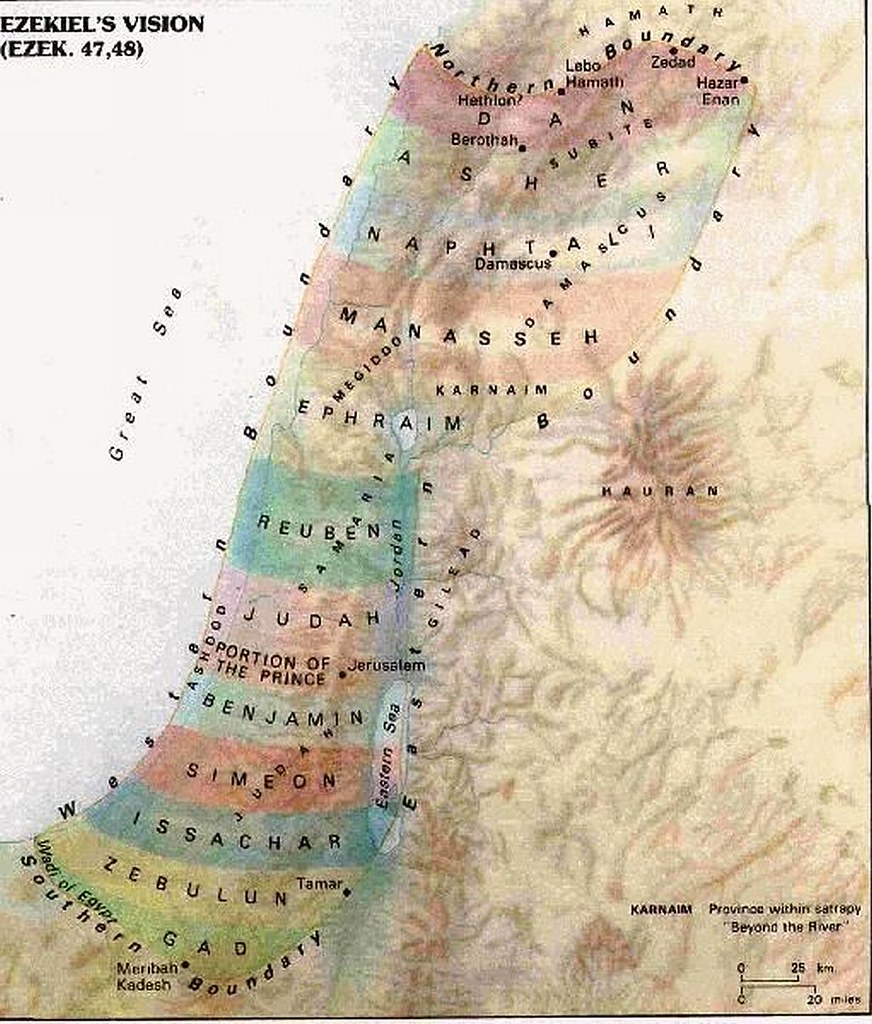
As Ezekiel pens his final chapters, there is no longer a nation of Israel. It was conquered. Its capital city and temple were destroyed. Zeke’s vision is of a restored Israel and a new allotment of a restored nation. No more division between north and south. He envisions one united nation in which each tribe gets an allotment of land that looks like a twelve-layered cake from top to bottom, north to south. Each tribe gets it’s own layer that’s roughly the same size as every other tribe. It is a vision of twelve family tribes living in peace and harmony. No disputes of bigger or smaller, there is equal inheritance. There is shalom.

And that brings me back to the fact that the entire Great Story from Genesis to Revelation is about God restoring shalom between Himself and humanity. It’s the way it was before a snake slithered into the Garden. It’s the way the Great Story ends with God and humanity living in perfect shalom in a new heaven, a new earth, and a new holy city. It is what God wants me to experience each day amidst the trials of living in a fallen world with other fallen individuals. It’s what God wants me to strive for and share with others.

In the quiet this morning, my spirit is reminding me of two men I know who grew up on family farms. Each of them got the shaft when it came time for the family farm to be passed to the next generation. Both men know the journey of grief, anger, and resentment that comes with that particular reality. Each of these men have shared with me their story, and they are both incredibly blessed, filled with joy in their lives and families. Both of them, disciples of Jesus, shared with me how they consciously and deliberately surrendered their will and desire to God. They let go of resentment, put their trust in God, and sought their inheritance from Him. Each of these men have ultimately prospered. Each has found and is experiencing shalom.

What Ezekiel is describing on a macro level as he finishes his prophetic book is what God wants me to experience on the micro level, right here, today.

Shalom, my friend. Have a good weekend.

If you know anyone who might be encouraged by today’s post, please share.

Rules and Rifts

Rules and Rifts (CaD Rom 3) Wayfarer

…and all are justified freely by his grace through the redemption that came by Christ Jesus.
Romans 3:24 (NIV)

Wendy and I get along remarkably well despite the fact that we have very different temperaments. Wendy is an Enneagram Type Eight (the Challenger) and I am an Enneagram Type Four (the Individualist). The Enneagram Institute calls this relational combination the most “inherently volatile.” Nevertheless, Wendy and I somehow manage to be around one another pretty much 24/7/365. Not only have we not killed one another, but we actually enjoy our perpetual proximity. The Enneagram Institute goes on to describe the Eight/Four coupling: “Both types bring passion, intensity, energy, and deep (often unconscious) feelings to all aspects of the relationship.”

Wendy and I have also found ways in which we are very different. This occasionally creates rifts between us. For example, I was raised in a home where the rule was “the door is always open and everyone is welcome at any time.” My dad would be happy to regale you with countless stories of my friends, and the friends of my siblings, stopping by at all hours unannounced.

Wendy, on the other hand, believes firmly in the rule that the kind thing to do is always let people know in advance that you’d like to stop by. Thus, we had a rift that would regularly present itself in conversation while on our way to Des Moines to visit my parents. It started like this:

Wendy: “Did you call your parents and tell them we’re coming?”

Tom: “No.”

I’ll let you imagine the rest of the conversation.

In today’s chapter, Paul continues to address the rift between Jewish and Gentile believers. The rift was rooted in the Jewish preoccupation with being rule-keepers. They had been given God’s rulebook through Moses, and good religious Jews were obsessed with keeping the rules. This presented a problem, however. It was a historic problem that presented itself almost immediately after the Law had been given. It then continued through the period of the Judges and the period of the Kings and perpetuated itself during Jesus’ ministry. Jesus confronted this problem time and time again.

The problem was relatively simple: People chose which rules they wanted to follow, and which rules they wanted to conveniently ignore. The rules that they chose to follow were the rules that others could clearly see with their own eyes.

Did you keep the sabbath?
Did you make your prescribed offerings?
Did you go to the Temple for the feast?
Did you circumcise your male children?

The rules they ignored were easier to hide and corporately convenient to simply sweep under the rug.

Did you love the foreigner in your midst and honorably treat them as you would want to be treated?
Were you generous, refusing to get rich at another’s expense?
Did you treat others lovingly and with equity?
Did you take care of the poor, the needy, and the outcast?

Jesus spent his entire three-year ministry trying to get His good religious Jewish brothers and sisters to see the problem. They cared more about Jesus keeping the rule about not working on the Sabbath (which is easy to see) and failed to see that the rule was never intended to keep them from doing something good for someone (e.g. healing, helping, lending a hand). Having God’s rulebook didn’t make the Jewish people righteous. It didn’t make them better at anything other than learning to keep up appearances with some rules while clandestinely skirting other rules for their selfish gain.

This cultural obsession with rule-keeping was deeply ingrained in them. Jews who became followers of Jesus and had been raised in this culture had a hard time not demanding that everyone be a rulekeeper. They looked down on those non-Jewish believers who never had the Law of Moses (and didn’t really care). Thus the rift.

In the quiet this morning, my mind drifted back to Wendy and me in the car on our way to Des Moines. One of the things we’ve learned about the rifts that appear in our relationship is that it’s rarely, if ever, an “either-or” issue in which one is right and the other is wrong. It’s often a “both-and.” My parents’ hospitality and generosity were wonderful aspects of a home that blessed countless people. It’s nice to know that they were always open to welcoming someone unexpectedly knocking at the door. Also, it is always a kind thing to call ahead and let people know you’re planning to stop by.

Paul is making a similar “both-and” argument for the rift between the Jew and Gentile believers. Yes, the Jews were blessed to have been given God’s rulebook, AND having the rulebook didn’t make them more righteous than the average Gentile. Both Jew and Gentile have sinned and fall short of God’s glory, AND both Jew and Gentile are justified by God’s grace through faith in Jesus alone. The spiritual realities they share are greater than the differences they experience in the rift about rules.

If you know anyone who might be encouraged by today’s post, please share.

History Lesson (or Not)

History Lesson (or Not) [CaD 1 Chr 9] Wayfarer

Now the first to resettle on their own property in their own towns were some Israelites, priests, Levites and temple servants. Those from Judah, from Benjamin, and from Ephraim and Manasseh who lived in Jerusalem were
1 Chronicles 9:2-3 (NIV)

Our place at the lake is in central Missouri on Lake of the Ozarks. I have a lot of family history connections in the region on my mother’s side. Great-great-grandparents are buried in the little town of Atlanta which Wendy and I pass by every time we drive to the lake. Another Great-great-grandfather fought in the Civil War on the Union Side for the Missouri 10th Infantry. Missouri was a border state and was heavily divided during the Civil War. Remnants of that division remain.

As we approach the lake there is a giant Confederate battle flag that flies along the highway. The base of the giant flag is surrounded by a fence with barbed wire. A light is fixed on the base at night to discourage anyone from tampering with the fence or the flag. It wouldn’t surprise me if there weren’t cameras, too.

A few years ago I was traveling through southern Missouri on my way to a client meeting in Memphis. GPS took me on a curious route through some remote areas and I happened upon a property surrounded by a giant wrought-iron fence. The entrance had a locked gate and above the gate were the initials C.S.A. (Confederate States of America). The property and the house at the back were covered with Confederate battle flags. I considered stopping and taking a picture of it, but I was afraid I might get shot at.

In today’s chapter, we finish the Chronicler’s long stretch of genealogical information before he begins the narrative part of ancient Israel’s history. He focuses this last section on all of the priests and Levites who returned from exile in Babylon. Because only descendants of Aaron could be priests and only members of the tribe of Levi could attend to the maintenance, upkeep, and security of the Temple, this final list of families was important to the Chronicler. With the newly rebuilt temple inside the rebuilt Jerusalem, he was establishing for his contemporary readers the individuals and families who were responsible for these duties.

Curiously, he begins this list with the term “All Israel” and then goes on to provide lists of Levite families from not only the tribes of Judah and Benjamin (the two primary tribes of the southern Kingdom of Judah) but also from Ephriam and Manasseh (Ephriam was often used to refer to the entire northern kingdom of Israel). This is fascinating because the nation of Israel was taken into captivity by the Assyrian Empire and the people of Israel were still largely scattered among other nations. With his inclusive words “All Israel” and his inclusion of the Levites from among northern tribes, The Chronicler is establishing a new age for the Hebrews returning from exile. The divided kingdoms are no longer kingdoms, so they are no longer divided. He considers that they are a united family of tribes once again under their historic faith in the God of Abraham, Isaac, Jacob, and Moses.

As I meditated on what would have been a historic shift of thought for the Chronicler’s generation, the Confederate flag on Highway 54 and the Confederate loyalist compound sprang to mind. Along my life journey, I’ve observed the truth of the well-known statement that those who fail to learn from history are doomed to repeat it. I’ve also observed a related truth: Those who get stuck in history will never be able to learn from it.

This is true, not only on a national level but also on a personal level. The spiritual journey is a path laden with trials, temptations, obstacles, and conflicts. God’s desire is that I walk through them so that I might develop the character traits of perseverance, faith, hope, and spiritual maturity. and wholeness. If I, for example, get stuck in hatred, bitterness, and the refusal to forgive a person (or persons) who wronged me, it’s like me continuing to fly a Confederate battle flag 180 years after the conflict ended. I can’t learn and grow spiritually from that conflict until I embrace the forgiveness, grace, and mercy Jesus extended to me and channel it toward the individual(s) who injured me.

In the quiet this morning, I pondered where there might be “sticking points” in my own life, along my own journey. Where am I “stuck” in my own personal history? Holy Spirit brought to mind a prayer that Wendy and I have been including every morning in our prayer time together. It’s a prayer that our entire gathering of Jesus’ followers has been uttering collectively and individually for the past few months. It seems a good prayer on which to end today’s post and to begin today’s journey:

Lord Jesus,
I seek to live as your disciple in all that I do today. My life is your school for teaching me.

I relinquish my agenda for this day and I submit myself to you and your kingdom purposes.

In all situations today, I pray:
“Your will, Your way, Your time.”
Amen

If you know anyone who might be encouraged by today’s post, please share.

Division

Division (CaD Acts 15) Wayfarer

Barnabas wanted to take John, also called Mark, with them, but Paul did not think it wise to take him, because he had deserted them in Pamphylia and had not continued with them in the work. They had such a sharp disagreement that they parted company. Barnabas took Mark and sailed for Cyprus, but Paul chose Silas and left, commended by the believers to the grace of the Lord.
Acts 15:37-40 (NIV)

I have a dear friend I have not spoken with in almost 20 years. This friend told me that I had done something, or said something, that wounded him deeply. He said that he knew that I had no clue what I’d done to wound him, but he also refused to tell me what it was despite attempts to make amends and to make it right. I eventually concluded that I couldn’t continue in a relationship under the constant cloud of guilt/shame of knowing that I had caused an injury but was given no opportunity or recourse to make it right. I love my friend and grieve the loss of our relationship. Nevertheless, I decided that I would wait for my friend to be willing to tell me what I had done.

I’m still waiting.

Along my life journey, I’ve observed and experienced conflict and division between believers, both interpersonal and corporate. The conflicts have ranged from silly, to personal, to matters of faith and/or belief. In some cases, the conflicts were amicably resolved. In other cases, they resulted in amicable division. In yet other cases, they resulted in division and anger that eventually became amicable respect. In some cases, I have observed conflict and division that appear never to have been resolved.

Today’s chapter describes two forms of division. The first one has been brewing for some time within the events Luke describes in Acts. The Jesus Movement began as a Jewish sect. Jesus never hid the fact that He intended His Message and His mission to be for all people “to the ends of the earth.” Nevertheless, there were good Jews who wanted to keep the Jesus Movement to remain a strictly Jewish sect. To be Jewish, men had to be circumcised. So some began teaching that non-Jewish believers had to be circumcised to be part of the Jesus Movement. They were essentially saying, “Become a Jew first, then you can be a believer in Jesus.”

This dispute is handled capably by the leaders of the Jesus Movement. Everyone got together. Both sides were discussed. The leaders made a judgment that non-Jewish Gentiles did not have to become Jewish and males did not have to be circumcised to be believers.

The second division is personal and unexpected. Paul and Barnabas decide they should travel to visit all the local gatherings they’d started on Cyprus and Asia Minor back in chapters 13 and 14. Barnabas, ever the encourager, wants to include John Mark, who began that first journey with them but left them early in the journey. Paul, offended by John Mark bailing on them the last time, refuses to include him. Tempers flare. Voices are raised. The disagreement is sharp. Paul and Barnabas part ways. Barnabas takes John Mark and sets out on his own. Paul recruits Silas and sets out on his own.

We don’t know why John Mark bailed on that first journey. We do know from the letters of Paul and Peter that eventually John Mark became a close associate of Peter and was later reconciled to Paul. Paul wanted John Mark with him in his final days. Paul also would later write with respect and admiration for all Barnabas was doing within the Movement. One commentary I read this morning said that Paul and Barnabas’ conflict resulted in four people on the mission instead of two. God sometimes uses even human conflict and division for divine purposes.

In the quiet this morning, I realized that I have come to embrace the reality that there will be division among human beings and groups of human beings. It’s part of the nature of this fallen world east of Eden. But I have also embraced Paul’s metaphor of the “Body of Christ.” The body not only has many appendages, but it also has many entire systems that function pretty independently within the whole. Some cells and organs function independently of one another, but both are essential for the health and well-being of the body. So it is with individuals and groups. We sometimes learn that we can function independently of one another while both contribute to Jesus’ Movement and its mission.

I said a prayer for my estranged friend this morning. Over the years I have received reports of where God has led him and rejoice that he appears to be well and doing the things he’s been led to do. I love him. Perhaps we will one day see one another again. Perhaps he will finally be able to tell me what I did to wound him so deeply and I will be able to seek forgiveness and make amends. Perhaps whatever that was will have passed away with time. Sometimes that happens, too. In the meantime, I rejoice that we are both well and contributing to the health and well-being of the whole.

If you know anyone who might be encouraged by today’s post, please share.

Division

Division (CaD Jhn7) Wayfarer

Thus the people were divided because of Jesus.
John 7:43 (NIV)

Here in America, the news is filled with talk about the deep political divisions that seem to have only widened in the past decade. Both sides of the political aisle have their version of extremists to which the other side can point and stoke up fear and loathing that politicians have proven motivates crowds to action like nothing else. Both sides ignore the worst and most obvious flaws in their own presumed candidates while believing the worst accusations and exaggerations of the candidate on the opposite side. Meanwhile, the media giants (who are equally divided among political lines) in their insatiable need for clicks, likes, shares, and revenue relentlessly exploit the worst of the opposition while ignoring the glaring newsworthy problems on their own preferred side of the political narrative. It’s not a great situation.

This came to mind in the quiet this morning simply because in today’s chapter John focuses on how incredibly divisive Jesus was at the peak of His public ministry. The scene is an annual seven-day Jewish harvest festival called the Feast of Tabernacles, or Sukkot. Jewish pilgrims from all over flocked to Jerusalem to celebrate the harvest at the Temple.

John begins by simply stating the fact that the Jewish religious leaders in Jerusalem were looking for a way to kill Jesus. Obviously, tensions are high. John spends the rest of the chapter focusing on three distinct groups of people and their opinions about Jesus.

First, there is Jesus’ own younger brothers. The younger sibs are currently of the opinion that their eldest sibling is whacked. They (and presumably the rest of the family) are headed to Jerusalem for the feast. When Jesus begs off, they sarcastically tease him in true sibling fashion that if He wants to stay at the top of the #trending charts He shouldn’t pass up going to the feast where He can have maximum public exposure.

The “crowds” of everyday people on pilgrimage are the second group John mentions. The Jewish religious leaders in Jerusalem are the third. The distinction between these groups falls along eerily familiar socio-political lines. The Jewish religious leaders are the educated, wealthy “elites” who view the crowd of pilgrims as uneducated deplorables from fly-over country.

John reveals that among both of these groups, there was tremendous division over who Jesus was. Some believed that Jesus was the Messiah, a prophet, or at least a good man and teacher. Others saw Jesus as a deceiver or an agent of the devil. Among the elite religious leaders, the die has already been cast and they secretly have put a price on Jesus’ head. They are even spinning the narrative that Jesus can’t be a prophet or the Messiah because He comes from Galilee and “no prophet comes from Galilee.” Their spin was absolutely wrong. Jonah came from Galilee, and God can raise up a prophet from wherever He chooses. But the elite are used to being able to say whatever they want and the system will obediently line up behind them. John is careful to note, however, that Nicodemus (who made a clandestine visit to Jesus back in chapter 3) was willing to call his colleagues on their own self-deception. There was at least some quiet opposition among them.

The entire book of John is about John presenting his primary source account of Jesus to readers. At the time of his writing, the question about who Jesus was was no less divisive, perhaps only more so. John clearly embraces this fact, acknowledging that those reading his account could be anywhere on the spectrum between believer and antagonistic rejector. His job, which he states up front in the prologue, is to share what he saw, heard, and experienced being one of Jesus’ most intimate followers. John is silently begging the question: “Who do you believe Jesus is?”

So in the quiet this morning, I can’t help but ponder this question anew. Jesus famously shared that “the truth will set you free,” but He equally shared that the truth will also sharply divide. Today’s chapter is John’s testimony as to the latter. As a disciple of Jesus, among the exhibits of this divide is the reality that Jesus’ famous quote “the truth will set you free” has a caveat that literally no one includes with the famous quote:

“If you hold to my teaching, you are really my disciples. Then you will know the truth, and the truth will set you free.” (emphasis added)

My observation is that everyone wants “truth” and its promised “freedom” without Jesus, His teaching, or the need to hold to that teaching. As a disciple of Jesus, I can’t expect the latter without submitting to the former.

So, once again I enter another day on the journey endeavoring to hold to Jesus’ teaching, believing that He is who He said He was, and trusting that I will continue to find both truth and freedom as I make the trek.

If you know anyone who might be encouraged by today’s post, please share.

Division

Divison (CaD Ps 114) Wayfarer

Judah became God’s sanctuary,
    Israel his dominion.

Psalm 114:2 (NIV)

Along my journey, I have experienced discord and division among any number of groups to which I belonged. This includes family, churches, community organizations, and most recently, a nation.

When division happens, no matter the size or scope of that division, it creates so much relational mess in its wake. Suddenly, individuals who love one another find themselves on opposite sides of a topic or circumstance. Mental lines get drawn. Emotional trenches are dug. A relational no man’s land grows between, and neither party feels very much like being the one to crawl out of the trench and initiating the crossing of no man’s land.

It’s hard.

Today’s chapter, Psalm 114, is the second in a series of Ancient Hebrew songs known as the Hallel, which is sung each year at the Passover feast which celebrates God’s deliverance of the Hebrews from slavery in Egypt. Like yesterday’s psalm, it is sung before the Passover meal. In eight simple verses, the song overviews the major events of their exodus out of Egypt, through the wilderness, and into the promised land. As yesterday’s chapter was metaphorically the “call to praise” of the Passover feast, today’s chapter is, metaphorically, a prologue that overviews the journey participants will take through the feast.

What struck me the most as I read this morning was the second verse:

Judah became God’s sanctuary,
    Israel his dominion.

Casual readers are likely to miss the weight of this verse for the ancient Hebrews who sang it back in the day. Scholars say that the song was penned during a period in Hebrew history known as “the divided monarchy.” The twelve tribes of Israel were divided into two nations. Two tribes, led by Judah, became the southern nation of Judah with Jerusalem as its’ capital. The other ten tribes joined into the northern nation of Israel. There was perpetual discord, division, and civil war between the two.

As with any event of human discord and division, there was the drawing of mental lines, digging of emotional trenches, and the development of relational no-mans-lands.

The Passover feast, to which all good Hebrews were expected to attend and participate in was held in Jerusalem at Solomon’s temple in the capital city of Judah. This meant that the faithful who lived in the northern nation of Israel had to cross no-mans-land. I can only imagine the relational tension that existed in the city on that week each year. A festival that was meant to unite the people in remembrance of the unifying event of their national identity became a political and religious powder keg. I can’t help but feel an acute identification with that reality in light of my own nation’s recent events.

In the quiet this morning I find myself thinking back to those divisions which I have experienced and which dot the timeline of my life as painful waypoints on my journey. Given time, I’m glad to say that I’ve experienced relational healing and reconciliation in certain relationships. In others, the relational division led to separate paths that I don’t expect to converge on this side of eternity. In yet others, I have made attempts to cross the emotional no-mans-land only to be greeted with an emotional fence of barbed wire. I must also confess that there are yet other circumstances in which I would say that I desire there to be reconciliation, but that desire has not led to my willingness to initiate a crossing of no-mans-land. Those are the ones that lay heavy on my spirit this morning.

I find it ironic that my chapter-a-day journey happens upon the Passover Hallel on this week when followers of Jesus begin the annual spiritual pilgrimage with Jesus to Jerusalem, to crucifixion, and to resurrection. The final, climactic events of Jesus’ earthly life happened during the week of Passover. Followers of Jesus see the two events as spiritually akin. Moses led the Hebrews out of slavery in Egypt to the promised land. Jesus led any who will follow out of bondage to sin, through the wilderness of this earthly journey, to an eternal promised land.

It’s also ironic that today happens to be known as Ash Wednesday, which it the opening event of the season follower call Lent. It’s the day we are called to Spirit mode to embark on a spiritual journey of remembrance with Jesus to the cross. Just like yesterday’s chapter and today’s chapter called the Hebrews to the spiritual journey of remembrance with Moses to the promised land. (By the way, I didn’t plan this!)

I find myself answering the call to that annual journey this morning in the quiet of my office. I find myself thinking about those relationships on the other side of no-mans-land. Holy Spirit whispers the words of Jesus to my spirit:

“This is how I want you to conduct yourself in these matters. If you enter your place of worship and, about to make an offering, you suddenly remember a grudge a friend has against you, abandon your offering, leave immediately, go to this friend and make things right. Then and only then, come back and work things out with God.”

Unseen Choices

Unseen Choices (CaD Ps 71) Wayfarer

As for me, I will always have hope;
    I will praise you more and more.

Psalm 71:14 (NIV)

I have observed on multiple occasions that 2020 has, thus far, been the most challenging year of my life journey. Over the weekend I found myself hitting the wall with it all. COVID, masks, lockdowns, racism, riots, name-calling, finger-pointing, posturing, politics, put-downs, elections, and egos. I came to the realization that I just don’t want to talk about it anymore, nor do I want to hear anybody talk about it. It seems, however, that it’s the only thing people can talk about right now. I get it. We all need to process.

In the quiet this morning, I began peeling away all of the circumstantial elements of our currently stressful times. I separated circumstance and spirit, elections and eternity, coronavirus, and Kingdom. Under the surface of all the Jesus said and did there was a conflict that broiled but remained unseen, a struggle of the spiritual.

Without conflict you don’t have a good story, and at the heart of the Great Story lies the ultimate conflict: The power of Life and that which sets itself up against it.

That which celebrates death instead of life.
That which perverts justice with power.
That which perverts appetite with lust.
That which perverts humility with pride.
That which perverts truth with deception.
That which seeks to tear down rather than build.
That which seeks to turn faith into fear.
That which seeks to turn hope into despair.
That which seeks to turn unity into division.
That which seeks to turn peace into conflict.
That which seeks to turn order into chaos.

In our chapter-a-day journey, we are coming to the end of “Book II” of the anthology of Hebrew song lyrics known as the Psalms. Thus far, almost every song in the 70 we’ve read was penned by David. We’re coming to the end of David’s journey. Today’s psalm was written near the end of his life.

If you’ve been sharing this chapter-a-day journey with me the past few months, it’s obvious that David’s life was not a cake-walk. David saw his share of death. He experienced injustice as well as the consequences of his own lust. He suffered through the pride, hatred, division, conflict, and despair of his own son who tried to steal his Kingdom away. He has faced constant fear from enemies both without and within who worked to tear him down. Now, as he feels his life slipping away there is growing chaos regarding who will ascend to throne after him.

David sang the blues a lot, and with good reason. I imagine David shaking his head at me this morning.

“Dude, you’ve had a rough year. I, like, had 2020 for a lifetime.”

It was with that perspective that I went back and read today’s chapter, Psalm 71, a second time.

Though you have made me see troubles,
    many and bitter,
    you will restore my life again;
from the depths of the earth
    you will again bring me up.

I couldn’t help but notice that David’s faith, hope, trust, and praise are not the result of his circumstances. They don’t spring from a cushy life on Easy Street. What became clear to me is that David is choosing them despite his circumstances, the same way he always has…

When he was on the run from Saul.
When he had a price on his head.
When he found himself alone in his enemy’s fortress.
When he was living in a cave in the wilderness.
When his own son raped his own daughter.
When his other son killed his own brother.
When that same son almost took his kingdom.
When he faced scandal from his adultery.
When his conspiracy to commit murder became public.

David’s lyrics, written across his life journey and making up roughly half of the Psalms, stand as testimony that time-and-time again he chose into praise, faith, hope, and trust when he had every reason to give in to the anger, fear, despair, and hopelessness.

In today’s song, the old man nears his journey’s end. He looks back at all he’s been through and everything he’s experienced. And this is the center verse, the lynch-pin of his song:

As for me, I will always have hope;
    I will praise you more and more.

I am reminded this morning that in the early chapters of the Great Story God said to His people, “Life or death. You choose.”

David teaches me that the choice is still there. Every day. Every year. A choice that, in the eternal perspective, is more consequential than my November vote for any politician.

As I enter this week of Thanksgiving, I choose Life. I choose hope.

Always.

As 2020 keeps punching, I choose to double-down on praise.