Tag Archives: Hopelessness

This is the Way

This is the Way (CaD Ezk 37) Wayfarer

Therefore prophesy and say to them: ‘This is what the Sovereign Lord says: My people, I am going to open your graves and bring you up from them; I will bring you back to the land of Israel.
Ezekiel 37:12 (NIV)

I have mentioned in recent weeks that our local gathering of Jesus’ followers has been journeying through the book of Exodus and the story of God revealing Himself to Moses and leading the Hebrew people out of slavery in Egypt. It is the very beginning of God’s relationship with the Hebrew people as an entire people, a nation. I gave a message about it this past Sunday. FWIW: You can watch/listen here.

It was not a conscious decision to have our chapter-a-day journey trekking through Ezekiel at the same time, but I’ve been amazed at the parallels. Ezekiel is roughly 1,000 years after Exodus. They are two different stages of history, two different chapters of the Story. Yet the same theme weaves through them both and foreshadows what is yet to come.

Today’s chapter is one of the most iconic prophetic messages in the entire Great Story. If you didn’t actually read the chapter today, I encourage you to take two minutes (that’s all it will take) and read the first 14 verses of Ezekiel 37. It’s an apt passage to read the week of Halloween, by the way. Ezekiel is taken in the Spirit to a valley full of dry bones all across the valley floor. God has Zeke prophesy to the bones and the bones begin connecting themselves, tendons grow to hold them together then flesh grows on top and finally skin completes the bodily resurrection of the bones. God has Zeke prophesy once more and Life is breathed into them.

We have to remember that just a couple of chapters ago, Zeke and the Hebrews living in exile in Babylon got word that their nation was destroyed. Jerusalem was turned to rubble and burned. Solomon’s Temple was razed to the ground. What was left of their people were slaughtered or else they fled. Their hopes are dashed. Their souls are crushed. Their nation is dead. I can hear the wails of Zeke and his compatriots crying out to the Lord… just like a thousand years before:

The Israelites groaned in their slavery and cried out, and their cry for help because of their slavery went up to God. God heard their groaning and he remembered his covenant with Abraham, with Isaac and with Jacob. So God looked on the Israelites and was concerned about them.
Exodus 2:23b-25 (NIV)

The Hebrews were hopeless, crushed, and dead in their slavery. God brought ten plagues on Egypt that metaphorically deconstructed the seven days of creation in Genesis. Then, God leads them out of the death of slavery and begins to infuse new life and new ways of living.

Now the same people find themselves crying out a thousand years later. Once again, they are surrounded by death, hopelessness, and despair. The vision God gives Zeke is a repeat of the theme. “Amidst your death, despair, and hopelessness I am going to raise new life.”

Life –> Death –> New Life

God tells Zeke, “Then you, my people, will know that I am the Lord, when I open your graves and bring you up from them. I will put my Spirit in you and you will live…”

As a follower of Jesus, it is impossible not to see God pointing 500 years into the future and foreshadowing the exact thing Paul wrote to Jesus’ followers in Ephesus. Picture Zeke’s valley of dry bones as you read this:

“As for you, you were dead in your transgressions and sins, in which you used to live when you followed the ways of this world and of the ruler of the kingdom of the air, the spirit who is now at work in those who are disobedient. All of us also lived among them at one time, gratifying the cravings of our flesh and following its desires and thoughts. Like the rest, we were by nature deserving of wrath. But because of his great love for us, God, who is rich in mercy, made us alive with Christ even when we were dead in transgressions—it is by grace you have been saved.”
Ephesians 2:1-5 (NIV) emphases added

Life –> Death –> New Life

In the quiet this morning, my heart is encouraged, lightened, and hopeful. In one week, our nation will have a Presidential election. On both sides of the aisle, people and pundits are prophesying the death of our nation, the demise of democracy, and the end of all things should the other side win. I have talked to people who are on the brink of despair because of their fear of the outcome. I personally think it’s all overblown fear-mongering that politics has always used to motivate people to action. Please refer to all of human history. But I am also reminded this morning that no matter what happens next Tuesday there is a theme that God has been revealing to humanity over and over and over again for thousands of years that dispels any of my fears. It is amidst death and despair and hopelessness that new life emerges.

Jesus said to [Martha], “I am the resurrection and the life. The one who believes in me will live, even though they die; and whoever lives by believing in me will never die. Do you believe this?”

Yes. Yes, I do.

Life –> Death –> New Life

This is the way.

If you know anyone who might be encouraged by today’s post, please share.

Unseen Choices

Unseen Choices (CaD Ps 71) Wayfarer

As for me, I will always have hope;
    I will praise you more and more.

Psalm 71:14 (NIV)

I have observed on multiple occasions that 2020 has, thus far, been the most challenging year of my life journey. Over the weekend I found myself hitting the wall with it all. COVID, masks, lockdowns, racism, riots, name-calling, finger-pointing, posturing, politics, put-downs, elections, and egos. I came to the realization that I just don’t want to talk about it anymore, nor do I want to hear anybody talk about it. It seems, however, that it’s the only thing people can talk about right now. I get it. We all need to process.

In the quiet this morning, I began peeling away all of the circumstantial elements of our currently stressful times. I separated circumstance and spirit, elections and eternity, coronavirus, and Kingdom. Under the surface of all the Jesus said and did there was a conflict that broiled but remained unseen, a struggle of the spiritual.

Without conflict you don’t have a good story, and at the heart of the Great Story lies the ultimate conflict: The power of Life and that which sets itself up against it.

That which celebrates death instead of life.
That which perverts justice with power.
That which perverts appetite with lust.
That which perverts humility with pride.
That which perverts truth with deception.
That which seeks to tear down rather than build.
That which seeks to turn faith into fear.
That which seeks to turn hope into despair.
That which seeks to turn unity into division.
That which seeks to turn peace into conflict.
That which seeks to turn order into chaos.

In our chapter-a-day journey, we are coming to the end of “Book II” of the anthology of Hebrew song lyrics known as the Psalms. Thus far, almost every song in the 70 we’ve read was penned by David. We’re coming to the end of David’s journey. Today’s psalm was written near the end of his life.

If you’ve been sharing this chapter-a-day journey with me the past few months, it’s obvious that David’s life was not a cake-walk. David saw his share of death. He experienced injustice as well as the consequences of his own lust. He suffered through the pride, hatred, division, conflict, and despair of his own son who tried to steal his Kingdom away. He has faced constant fear from enemies both without and within who worked to tear him down. Now, as he feels his life slipping away there is growing chaos regarding who will ascend to throne after him.

David sang the blues a lot, and with good reason. I imagine David shaking his head at me this morning.

“Dude, you’ve had a rough year. I, like, had 2020 for a lifetime.”

It was with that perspective that I went back and read today’s chapter, Psalm 71, a second time.

Though you have made me see troubles,
    many and bitter,
    you will restore my life again;
from the depths of the earth
    you will again bring me up.

I couldn’t help but notice that David’s faith, hope, trust, and praise are not the result of his circumstances. They don’t spring from a cushy life on Easy Street. What became clear to me is that David is choosing them despite his circumstances, the same way he always has…

When he was on the run from Saul.
When he had a price on his head.
When he found himself alone in his enemy’s fortress.
When he was living in a cave in the wilderness.
When his own son raped his own daughter.
When his other son killed his own brother.
When that same son almost took his kingdom.
When he faced scandal from his adultery.
When his conspiracy to commit murder became public.

David’s lyrics, written across his life journey and making up roughly half of the Psalms, stand as testimony that time-and-time again he chose into praise, faith, hope, and trust when he had every reason to give in to the anger, fear, despair, and hopelessness.

In today’s song, the old man nears his journey’s end. He looks back at all he’s been through and everything he’s experienced. And this is the center verse, the lynch-pin of his song:

As for me, I will always have hope;
    I will praise you more and more.

I am reminded this morning that in the early chapters of the Great Story God said to His people, “Life or death. You choose.”

David teaches me that the choice is still there. Every day. Every year. A choice that, in the eternal perspective, is more consequential than my November vote for any politician.

As I enter this week of Thanksgiving, I choose Life. I choose hope.

Always.

As 2020 keeps punching, I choose to double-down on praise.

Prayer of Desperation

Prayer of Desperation (CaD Ps 54) Wayfarer

Surely God is my help;
    the Lord is the one who sustains me.

Psalm 54:4 (NIV)

It could be argued that in King David’s young adult years he was a loose archetype of the legendary character we know as Robin Hood. He is living in the wilderness with a rag-tag band of some 600 vagabonds, mercenaries, and outcasts. David’s got a price on his head and mad-king Saul is hell-bent on killing his young rival whom he knows is God’s anointed replacement to his throne.

The thing about having a big price on your head is that you never know who you can trust. David and his merry band of exiles have been on the move, trying to stay one step ahead of Saul and his army. While hiding in a region known as the Desert of Ziph, the people of that area see a prime opportunity to cash-in on the sizable bounty Saul has laid out for David’s capture and strengthen their diplomatic ties with the current ruler.

In short order, David and his men find themselves on the run. Saul and his army are closing in. It’s a dire situation and things look hopeless. In the midst of his desperation, David writes a song. It’s the song we know as Psalm 54.

I love about Psalm 54 is short, sweet, and to the point. It’s like a guttural prayer that surfaces in the heat of the moment. It’s just seven short verses that begin with a plea for God’s vindication and end with David’s proclamation of faith that God will rescue David from his tight spot. As I’ve mentioned in previous posts, Hebrew songs like this were structured to be symmetrical with the center verse being the key to the entire thing. The center verse is the heart of what the songwriter is trying to express:

Surely God is my help;
    the Lord is the one who sustains me.

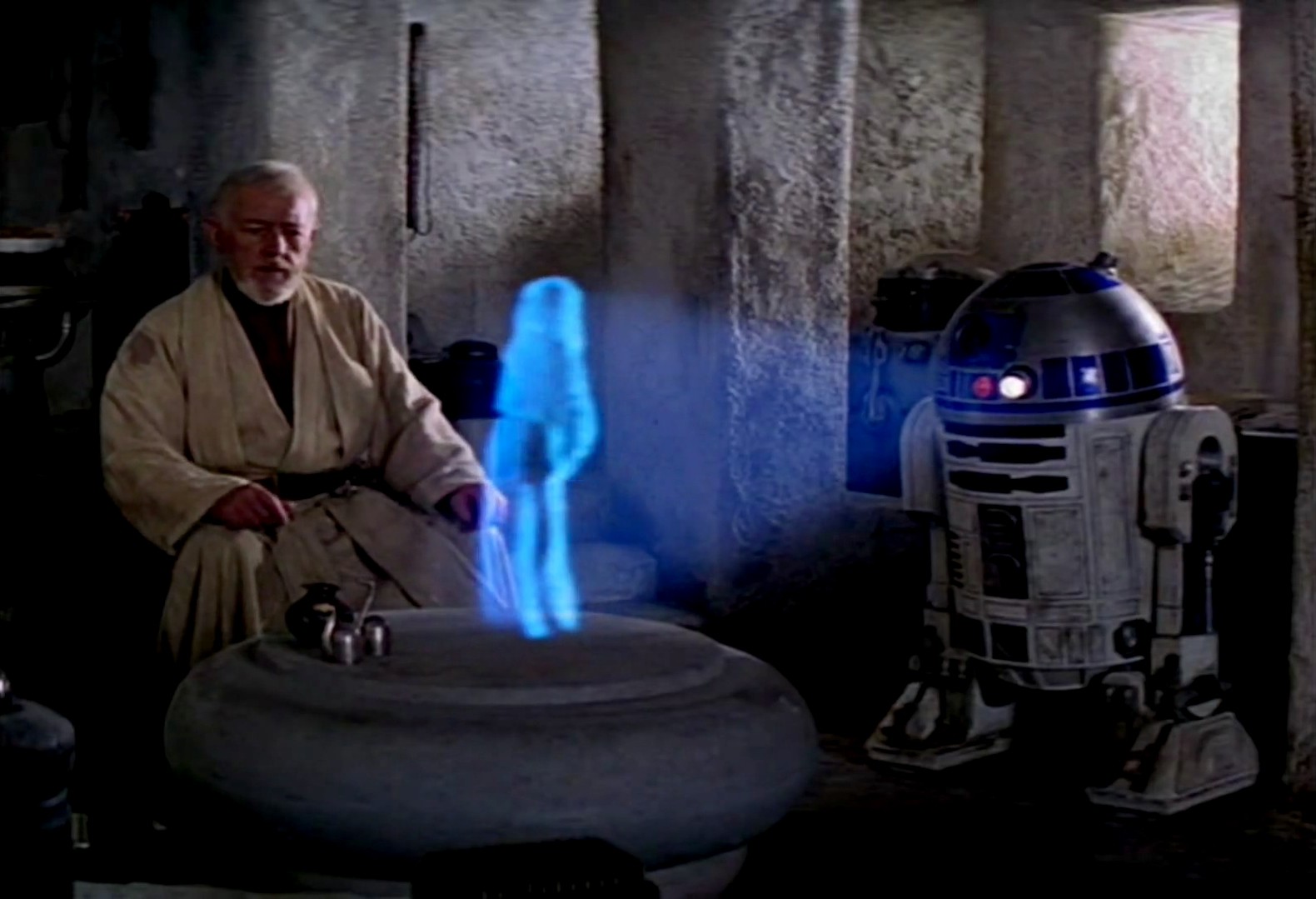
Along this life journey, I also encounter moments when I feel pinned down by circumstances stacked against me. There are times when I feel like I’m stumbling around with the darkness closing in. I have flashes when my prayer feels like Princess Leia’s hologram.

In the quiet this morning I found myself ear-marking Psalm 54 for those times when I, like David, have the enemy bearing down on me and there are others who seem to be against me. David’s song makes a great prayer of faith and assurance in the midst of desperation.

Psalm 54 is also a reminder that God does answer prayer. Just as Saul and his army were about to capture David and his men, a messenger arrives to tell Saul that a foreign army was raiding the land. Saul and his army had to stop their pursuit. David and his men escaped to a hideout in another area. It turns out that David’s musical prayer was prophetic:

You have delivered me from all my troubles,
    and my eyes have looked in triumph on my foes.

May you be blessed to find yourself delivered from your troubles today, my friend!

The Story is NOT Over. The Story WILL Go On.

He remained hidden with them at the temple of God for six years while Athaliah ruled the land.
2 Chronicles 22:12 (NIV)

I am convinced that there are stretches along every person’s life journey in which the road descends into chaos. Things we trusted to remain solid fall apart. Tragedy strikes suddenly and without warning. Just when we thought things couldn’t get any worse, another bomb drops. The compass we’ve always trusted to point true north spins out of control. We lose our personal bearing. Nothing seems safe. It is as if nothing will ever be “okay” again.

Ever.

For the people of ancient Judah, their unshakable faith in God’s promise to King David had provided them with a sense of peace. The Davidic line would remain as a trustworthy sense of stability. The throne would pass from father to son, from generation to generation. You can count on it.

Until things descended into chaos.

Jehoshaphat marries his eldest son, Jehoram, to Athaliah the daughter of Ahab and Jezebel. Jehoram kills all of his brothers in a bloodbath intended to solidify his control. His reign implodes as enemies invade and kill his entire family with the exception of his youngest son, Ahaziah. The only viable heir of David, the young Ahaziah is placed on the throne. His one-year reign is a disastrous chain-reaction of events ending in his assassination. Ahaziah’s power-hungry mother, Athaliah, kills off the rest of the royal family to consolidate her own power over the nation of Judah.

The Davidic line wiped out. That which was trusted is lost.

The people of Judah had to be reeling in the valley of chaos. They trusted the Davidic royal line would be forever. A member of the reviled and evil house of Ahab and Jezebel is on the throne of their nation. The compass they always trusted to point true north is spinning out of control. Nothing seems safe. It’s as if nothing will ever be “okay” again.

Ever.

But, the story isn’t over. While the circumstantial events in the valley of Judah’s chaos seem eternal and inescapable, the perspective of history allows us to see that this is simply a dark chapter in the Great Story.

There is a woman. There is a baby.

(How often can we quote that line in the Great Story?)

The woman is a daughter of the king. She is the wife of the priest.  She has the courage to risk her life for what is right.

The baby is the son of the king.

In the moment, no one knows it. In the chaos they cannot see it.

The story is not over. The story will go on.

In the quiet this morning I’m thinking of the valleys of chaos into which I’ve descended. I’m remembering my own feelings of helplessness and hopelessness. And, I’m looking back from a waypoint further down Life’s road that provides me with a much needed perspective.

The story is not over. The story will go on.

A Faith Investment

Fields will be bought for silver, and deeds will be signed, sealed and witnessedin the territory of Benjamin, in the villages around Jerusalem, in the towns of Judah and in the towns of the hill country, of the western foothills and of the Negev, because I will restore their fortunes, declares the Lord.”
Jeremiah 32:44 (NIV)

A few years ago I read a couple of books about the Monuments Men. During World War II this small group of art experts were tasked with finding the hoard of European artwork that had been stolen, looted, and pillaged by the Nazis. Most all of the artwork had been taken from Jewish collectors, dealers, and artists as the Jews themselves were sent to Nazi ghettos and death camps.

Imagine, for a moment, that you’re a Jewish art collector living in Paris during the Nazi occupation. The round up of Jews has already begun and you’ve personally witnessed the homes of your Jewish neighbors and fellow art collectors being raided. All of their possessions, including their priceless artwork, has been confiscated by the Nazis while your neighbors have been loaded onto trucks and carried off to God knows where. You know that it’s only a matter of time before you hear the dreaded knock on your own door.

Then, an angel of God visits you in a dream and tells you to take all of your life savings and visit a local art dealer to purchase a rare painting by Van Gogh for your personal collection.

It doesn’t seem like a wise investment, does it?

In today’s chapter, it’s just that kind of investment that God tells the ancient prophet Jeremiah to make. The Babylonians have begun the siege of Jerusalem. Jerusalem, the land around it, and every single thing that is within it will become the property of King Nebuchadnezzar. God tells Jeremiah at that very moment to make an investment in the purchase of some land.

We’re back to God’s favorite medium of communication: the world of word pictures and metaphors. Jews in Europe during the holocaust would be foolish to invest in artwork unless they knew for a fact that they and their artwork would survive. It is similarly foolish for Jeremiah to buy a piece of land when the Babylonians are clearly going to take it all for themselves in a short period of time.

But Jeremiah’s financial investment was not the issue in God’s . His people’s faith investment was. Jeremiah’s public purchase was made to be a message of faith and hope to his people in a moment of hopelessness and despair. “My people will come back to this land,” God is saying through Jeremiah’s metaphorical purchase. “All that you think is being pillaged, stolen and lost in this moment will eventually be restored.”

Jeremiah’s investment reminds me this morning of God’s faithfulness. 2 Timothy 2:13 says that “If we are faith-less God remains faith-full because He cannot disown himself” (emphasis added). Being faithful is at the core of who God is even when I have trouble seeing it in the blindness of my short-sighted humanity.

In the quiet this morning I’m grateful that The Monuments Men succeeded in finding and restoring much of the artwork stolen by the Nazis (It’s a good movie, btw). I also take solace in knowing that Jeremiah’s people did return to rebuild their city and their temple (as told in Nehemiah). Even in the darkest moments of the Great Story, when all seems hopeless and lost, I have to remember that it’s not the end of the story. I just have to have to make an investment of faith.

I Get it Now

pregnancy test - negative
pregnancy test – negative (Photo credit: Konstantin Lazorkin)

Chapter-a-Day Genesis 16

So Sarai said to Abram, “The Lord  has prevented me from having children. Go and sleep with my servant. Perhaps I can have children through her.” And Abram agreed with Sarai’s proposal. Genesis 16:2 (NLT)

My sojourn through God’s Message does not end. God’s Book is not a one-and-done proposition. I go back to it again and again and it has something new for me. This is not because the Message has changed, but because I have changed and am at a different place on life’s road.

I have read the story of Abram and Sarai countless times in the past 30 years. I have heard it shared, I’ve listened to any number of sermons and lectures on this chapter. I’m sure I’ve even given a few messages of my own from this text along the way. This time, however, the story is different. After several long years of Wendy and me trying and failing to bring a child into the world,  I’m reading it, seeing it, feeling it as if for the first time. The waiting. The questioning. The endless monthly roller coaster of expectation and despair. The alone-ness and isolation. The desperation. The grief. The depression. The hopelessness. The grasping with futility for something, anything to hasten the realization of some kind of positive resolution.

Sarai shouldn’t have…. Abram should have…. Why on earth didn’t they just…?

They did what they did. It doesn’t make it right, but I get it now.

Why is the answer always “no?”

And still, God is good.