Tag Archives: Trends

Arrogant Luxury

Arrogant Luxury (CaD Matt 3) Wayfarer

“[The one who comes after me], his winnowing fork is in his hand, and he will clear his threshing floor, gathering his wheat into the barn and burning up the chaff with unquenchable fire.”
Matthew 3:12 (NIV)

We live in very unique times. In fact, I believe that we are in one of the most tectonic shifts in the history of Christianity. It is, perhaps, the most significant shift since the Reformation. Mainline denominations who held sway over the lives of millions of believers around the globe for centuries have imploded and fractured into countless factions. Some are still in the process of their implosions. After Covid, millions of regular and semi-regular church goers simply stayed home and never returned to church. Here in rural Iowa where Wendy and I live, small churches have shut their doors in record numbers. The institutions of academia and government around the globe, many of them founded by Christians and/or Christian principles, have become hostile to Christianity, some claiming it to be the worst thing that ever happened to humanity.

I can see the result of these things in our own local gathering of believers. It broke with the mainline denomination it was part of for a century and a half. Suddenly it is a melting pot of sincere and committed Jesus’ followers from widely diverse denominational backgrounds and theological bents. It is forcing our gathering to reexamine all of our beliefs and ritual practices. I personally consider this a great thing.

A while back I ran into someone among our gathering who came from a slightly different theological bent than our gathering’s tradition. One of the differences, which I consider to be minor, is in the interpretation of the prophesies of the end times such as in the book of Revelation. My friend was obviously disturbed, believing their interpretation to be the one true way of belief, and the gathering’s traditional interpretation to be heretical. These are the kinds of hair-splitting that created so many denominational silos over the centuries. In my mind, we can no longer afford such proud luxuries of smug assuredness in our interpretation of theological non-essentials, especially as it relates to the prophetic.

The truth of things is that humans have a long tradition of getting God’s prophecies wrong. The greatest, most educated theological minds of Jesus’ day had interpreted that God’s Messiah would be a warrior King (wrong) who would wipe out Rome (wrong), establish Himself as a human monarch on a throne in Jerusalem (wrong), and rule over all the kingdoms of this world (wrong).

In today’s chapter, we meet John the Baptist. John was the fulfillment of multiple prophesies. He was a herald and forerunner of Jesus as proclaimed by Isaiah. The prophet Malachi, in the final prophetic words of the Great Story before the time of Jesus, said that the prophet Elijah would return. In the story of Elijah, he did not physically die but was taken up to heaven. So, naturally all of the great theological minds in Jesus’ day with the proud luxury of espousing and proclaiming their learned thought were assured that Elijah himself would physically return in bodily form. They were all wrong.

Of John, Jesus said, “Truly I tell you, among those born of women there has not risen anyone greater than John the Baptist.” Yet as I pondered John’s words in the chapter it was obvious that John had his own preconceived notions about who Jesus would be and how things would play out. John expected Jesus to immediately be the superhero Messiah in his cape, wiping out the bad guys and ushering in a new world order. In fact, in just a few chapters John will find himself unjustly languishing in Herod’s prison. The fact that Jesus has not dashed into a phone booth, come out wearing his cape, given Herod his just desserts, and freed John from prison has John at the point of having a crisis of faith.

In the quiet this morning, I find myself asking a simple question. If the prophet whom Jesus said was greater than everyone was completely wrong in his interpretation of the ancient prophesies and what Jesus’ life, ministry, and mission would actually be, then how can I possibly afford to be smug in my own personal theological interpretations? History proves that humans regularly get the prophetic wrong. God through Isaiah made it clear that God’s ways are not our ways and His ways and thoughts are infinitely higher than our own. Why on earth would I conclude that I am one-hundred percent right and other learned, sincere believers are one-hundred percent wrong in their interpretation of how things will play out at the end of the Great Story? Why on earth would I judge them and let our differences of opinion divide us?

The further I get in my journey, the more humbly I find myself simply choosing not to ascend theological hills to die on. I find myself more open than ever to loving and learning from my brothers and sisters in our diversity of thought, experience, and backgrounds. I am more convinced than ever that we are entering a time when believers will find unity in the essentials of our faith and learn to appreciate and learn from our diversity in the non-essentials. The world has shunned the arrogance, division, and pride of our forebears in their denominational kingdoms. Perhaps we can learn to be the Light of the World in our humility and love for one another in the age to come.

If you know anyone who might be encouraged by today’s post, please share.

These chapter-a-day blog posts are also available via podcast on all major podcast platforms including Apple, Google, and Spotify! Simply go to your podcast platform and search for “Wayfarer Tom Vander Well.” If it’s not on your platform, please let me know!

Habakkuk’s Cry

Habakkuk's Cry (CaD Hab 1) Wayfarer

Why do you make me look at injustice?
    Why do you tolerate wrongdoing?
Destruction and violence are before me;
    there is strife, and conflict abounds.
Therefore the law is paralyzed,
    and justice never prevails.
The wicked hem in the righteous,
    so that justice is perverted.

Habakkuk 1:3-4 (NIV)

I have known many fellow followers of Jesus over the years who would confess to never willingly cracking open the Old Testament unless under the social pressure of being asked to do so during a Sunday worship service. Even if they said they “occasionally” read from the Old Testament on their own, I’m sure that reading would be confined to the books of Psalms and Proverbs. Okay, maybe a few chapters of Genesis or one of the short stories like Ruth or Esther. If I were to ask them, “When was the last time you read the prophet Habakkuk?” they would probably just laugh at me. I’d wager that hearing a pastor say, “Let’s all open to the book of Habakkuk!” is maybe a once-in-a-lifetime occurrence.

We live in a world in which things “trend” on social media for minutes before being buried by another “trend.” Current events likewise dominate media and social media for a day or two tops before media and social media is on to the next hot topic in search of clicks and likes.

So what could an ancient Hebrew prophet have to say in 600 B.C. that is in any way relevant to my world today?

Let me walk through the verses I pasted at the top of this post:

Why [God] do you make me look at injustice?
    Why [God] do you tolerate wrongdoing?

Like mules leaving almost 50 dead immigrants rotting in the back of a tractor trailer?

Like drug cartels flooding the streets with opioids killing people in record numbers and never being held accountable?

“Destruction and violence are before me;

Like mass shooters opening fire in schools, churches, and malls?

Like demonstrations that torch entire neighborhoods of minority-owned businesses and end with dead bodies lying in the street?

“there is strife, and conflict abounds

Like individuals breaking off relationships with friends and family because they disagree on issues?

Like name calling, insults, and threats calling for death, murder, and assassination on social media?

Like political division between factions who refuse to compromise?

Therefore the law is paralyzed,

Like 400 law enforcement personnel who stood outside a classroom as children were being shot?

Like the headline I just read in this morning’s Wall Street Journal: “Who Would Want to Be a Police Officer in Seattle?”

and justice never prevails

Like the fact that not one of Jeffery Epstein’s high-profile customers has been named or indicted for raping underage girls?

Like political corruption that gets ignored and swept under the rug for the “greater good” of keeping a political party of choice in power?

The prophet Habakkuk lived in a period of political corruption, crime, violence, war, and social upheaval under a corrupt king and a nefarious ruling class. He pens his poetic dialogue with the Almighty and opens with a line that aptly described the questions of my own soul as I daily read the headlines:

How long, Lord, must I call for help,
    but you do not listen?
Or cry out to you, “Violence!”
    but you do not save?

It felt pretty relevant to me in the quiet as I read the chapter this morning. Habakkuk is giving voice to questions and sentiments that are echoed throughout history and will always resonate in a fallen world that is the domain of the “Prince of this World,” in which evil is present, and worldly kingdoms and institutions hold sway.

It is easy to feel as if God is both silent and absent.

Habakkuk’s short, poetic dialogue with God has a simple outline:

Question one: Why are you silent and will not act against injustice?

God’s answer: Just wait. I’m going to raise up the Babylonians to bring about the justice that I’ve been announcing through you and other prophets like your peer Jeremiah for some time now. I’ve been patiently listening for people to listen and repent. That’s not happening, so get ready.

Question two: Serious?!? Why would you use the evil Babylonians?!?

Tomorrow’s chapter is God’s answer to this second question.

In the quiet this morning, I found myself identifying with Habakkuk’s questions. In the middle of writing this post, I went downstairs to have breakfast with Wendy and we perused the headlines. Habakkuk’s lines kept resonating in my head and heart as I read.

God’s response also echoed. Within the Great Story, faith is defined as “the assurance of what we hope for, the evidence of that which we can’t see.” That includes the reality that God appears to be silent, and it seems like God is not doing anything, but I have limited, finite human senses and knowledge. So, my heart cries out like Habakkuk.

Having just finished the book of Revelations, I know that God has promised to bring divine justice to the earth one day and deal with evil and the fruits of evil once-and-for-all. Until then, my prayerful cries of “How long, oh Lord?” rise as incense in heaven’s Throne Room along with your cries, and everyone else’s cries.

When will God make good on His promised judgment?

I don’t know.

I have faith that He will.

Until then, I’ll keep crying out along with brother Habakkuk.

If you know anyone who might be encouraged by today’s post, please share.

Resurrection of the Organism

[Apollos] began to speak boldly in the synagogue. When Priscilla and Aquila heard [Apollos], they invited him to their home and explained to him the way of God more adequately.

When Apollos wanted to go to Achaia, the brothers and sisters encouraged him and wrote to the disciples there to welcome him.
Acts 18:26-27 (NIV)

My local gathering of Jesus’ followers has been studying the book of Acts. It’s one of the reasons I’m journeying through it again here on my blog. Like all institutional organizations, my local gathering of believers has a traditional hierarchy and well-maintained organization. We even have an official prayer ministry and volunteers who have been trained up and will pray for those who ask for it or need it. That is an absolutely awesome thing for which I’m thankful.

In the past couple of weeks, however, something very interesting has been happening. A few weeks ago the teacher of the morning asked anyone who wanted prayer, for whatever reason, to simply stand where they were during our worship song. Those seated around anyone standing were then encouraged to stand, reach out, place a hand on that person and pray for them. Many stood and many prayed. It was beautiful.

Over the coming weeks one could see that after the morning worship there were several small pockets of believers praying over and for one another. This wasn’t some official part of the service. These weren’t official prayer ministers from the prayer ministry doing what they were trained to do by the organization. These prayers for and over one another were happening organically from among those hanging out after the service, unprompted by any leader or individual.

In today’s chapter, we meet three new individuals. First, there’s Priscilla and Aquila (interesting that even Luke references the wife before the husband). The couple were among all of the Jews expelled from Rome by Emperor Claudius (a well established historical event). The fact that they appear to have already been believers means that the Message of Jesus had already spread to Rome, though we have no evidence of Paul or any of the other apostles having made an official missionary journey there at that point in time.

The other individual we meet in today’s chapter is a man named Apollos, also a Jew who was a believer of Jesus. We don’t know much about his background other than what Luke provides here. From Alexandria, he’d been traveling and sharing the Message of Jesus in synagogues much as Paul had done.

The underlying message of today’s chapter is that the Message of Jesus had been unleashed. The concentric circles of the Jesus movement was spreading out further and further. This was not happening by official means led by authorized envoys of the twelve in Jerusalem. It was happening organically. The Message was being embraced and shared by the growing number of believers. Everyone was in on it, and everyone was compelled and encouraged to share the Message even if they, like Apollos, didn’t have a complete understanding.

Notice that Apollos wasn’t discouraged from what he was doing, even though there were some details he was ignorant about. Priscilla and Aquila took him in, educated him, and sent him back out with their blessing. Paul didn’t do that. Priscilla and Aquila didn’t send him to Jerusalem to be educated by Peter and the boys and receive an institutional stamp of approval. This early church was a living organism in which every individual cell was growing, multiplying, and shaking things up wherever it went.

That’s why I’m both excited and encouraged by what I’ve witnessed in my local gathering of believers in recent weeks. For centuries the Institutions of Christianity have encouraged believers to sit quietly in their pews, go about their business, and let the professional, officially trained and approved ministers do things. Suddenly, I find that everyday believers from all walks of life are rediscovering their spiritual giftedness, their personal calling to use those gifts, and Holy Spirit power that fuels and empowers both.

I hear that we have moved into a “post-Christian” and “post-Evangelical” world. Perhaps we are. Yet, from where I sit I’m witnessing something remarkable. As the old Institutional organizations wane and die, the organism is being resurrected.

Flexibly Staying the Course

And Joshua said to them, “Do not be afraid or dismayed; be strong and courageous; for thus the Lord will do to all the enemies against whom you fight.”
Joshua 10:25 (NRSV)

Just the other night Wendy and I were with some friends and we recounted a period of time when we all worshiped together in the same church service. During this particular period of time the leaders loved having a catch phrase or motto that would be touted as the theme of whatever new initiative happened to spring into the leaders’ heads. There would be banners and bookmarks and an official launch of the great new theme. And, it would last for a mere few weeks until the next great theme came a long. There was a lot of laughter around the table as we recounted a number of themes and catch phrases that had been raised and then abandoned shortly thereafter when the next “it” theme came along.

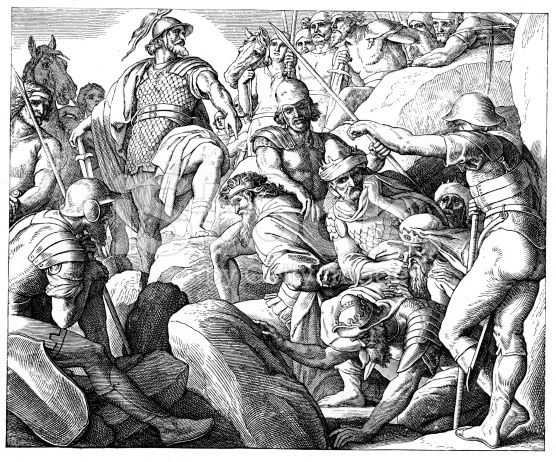
In today’s chapter, I found it fascinating to find Joshua still clinging to the word God had given him back in the first chapter. “Be strong and courageous. Don’t be afraid or discouraged.” We’re ten chapters and several battles (both won and lost) into the story. Joshua’s theme, however, has not changed with the winds of war or shifting sands of the landscape. In fact, Joshua makes a point of ensuring that  the theme is not forgotten. He takes the opportunity of victory to call the nation together and remind them to keep focused on that which God had said to him from the beginning.

Today I’m thinking about the challenge of staying the course amidst a culture of social media, news media, web content and trending topics that reduce our attention spans to mere moments. As a leader in family, business, church and community I’m thinking about my role in helping groups and individuals remain focused on vision, values, goals, and objectives. Like Joshua, I want to hold course to the vision, even while I remain flexible in adapting to ever-changing circumstances around me.

chapter a day banner 2015