Tag Archives: Mentor

The Goal

“The goal of this command is love, which comes from a pure heart and a good conscience and a sincere faith.
1 Timothy 1:5 (NIV)

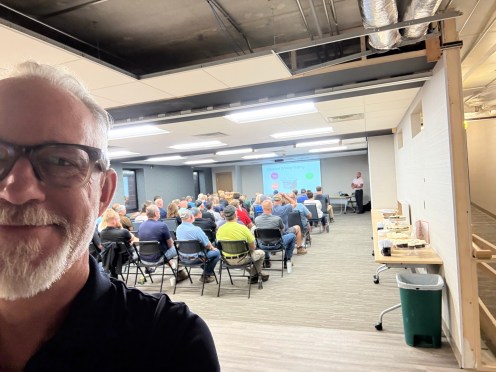
I spent yesterday on-site with a client. It was an unexpected business trip that got added to my schedule. The primary Customer Support team I work with have been focused on a goal this past year. The goal is to help customers understand that leasing a necessary piece of equipment from the company will make their overall experience with the company’s service better in multiple ways. This is not just a sales pitch. It’s a fact. The team I work with has been doing a good job reaching and meeting the goal. However, it was discovered that colleagues on a different customer facing team in the company was undermining these efforts. They were telling customers that it was cheaper to purchase their own equipment. This left customers thinking that maybe the Customer Support team was just selling them a bill of goods to make the company more money.

Ouch.

To be fair, the associates of this other team have limited exposure to the bigger picture, the data we have regarding the customer experience, and the larger strategy that led to the goal. So, I got to do presentations yesterday to this other customer facing team. I explained the goal, the reason for the goal, and how important it was that they understand and support the initiative rather than undermining it. I’m glad to say it was a successful day.

Today our chapter-a-day journey steps into Paul’s letters to his young protégé, Timothy. Their relationship was very much a mentorship. Paul was a spiritual mentor and a surrogate father to young Timothy. In both my spiritual journey and my professional career I have many coaching and mentoring experiences, so it’s fascinating for me to read Paul’s letter from the perspective of Paul coaching Timothy regarding his leadership among the local gathering of believers in Ephesus. Paul left Timothy in Ephesus to help lead the gathering in his absence when Paul went on an extended business trip to visit the other gatherings he’d planted in other cities.

Ironically, the struggle Paul writes to address with his young charge is not that different than the one I had to address with my client yesterday. There was a team in the local gathering of believers in Ephesus who were undermining the faith. They were voicing a contrarian message that was creating division and wasn’t based on the truth of Jesus’ Message.

Paul addresses this right from the start and gives Timothy the goal. Goals are good. We need goals. In this case Paul tells his young charge that the goal is:

Love…
-from a pure heart
-from a good conscience
-from a sincere faith

The further I get in my spiritual journey, the more I’ve come to embrace the preeminence of love as the goal in all things.

This is not just in my personal life or my church life, but also in my professional life. My client yesterday has a goal of creating the best possible and most cost-effective experience for their customers. There’s a love for their customers in that goal. The team I addressed yesterday did not have all of the facts, and I know that the team members who were telling customers to take the cheaper route thought they were doing right by the customers. I believe they were sincerely motivated, and honestly mistaken. As I made my presentations yesterday, my goal was not to chastise, punish, or demean anyone. My goal was to with patience, kindness, and gentleness explain the facts, the strategy, and goal that creates a win-win for both the customer and the company. In other words, my goal was to deliver my message with love so that my client could better love both their colleagues and customers.

I’m back in the office today working on different things, but the goal remains the same in all things.

Love…
-from a pure heart
-from a good conscience
-from a sincere faith

If you know anyone who might be encouraged by today’s post, please share.

Promotional graphic for Tom Vander Well's Wayfarer blog and podcast, featuring icons of various podcast platforms with a photo of Tom Vander Well.
These chapter-a-day blog posts are also available via podcast on all major podcast platforms including Apple, Google, and Spotify! Simply go to your podcast platform and search for “Wayfarer Tom Vander Well.” If it’s not on your platform, please let me know!
Orange icon featuring an open book with a white outline, accompanied by the text 'Bible Gateway' in black font.

The Goal, the Role, and the Lesson

“With him I speak face to face,
    clearly and not in riddles;
    he sees the form of the Lord.
Why then were you not afraid
    to speak against my servant Moses?”

Numbers 12:8 (NIV)

For a handful of years I had a rare privilege to serve as mentor and coach to individuals among my local gathering of Jesus followers who wanted to give preaching a try. Our gathering is unique in that we have a second worship space on Sundays that gathers concurrently with the main worship area. It was designed to be a space to experiment and try new things. One of those “new things” was to recognized that individuals in our midst might have the gift of preaching or teaching and perhaps we should identify, develop, and allow those who are gifted to use their gifts. This runs directly opposite the popular paradigm of the celebrity pastor and the traditional paradigm of the spiritually-elite priest.

During my time, I think there were somewhere between 30 and 40 individuals who at least gave it a shot. Some were already known teachers who wanted to continue to develop their gifts. Many had never given a message before. Individual results were as varied as people’s own stories. On a macro-level, this period moved our local gathering further away from the celebrity pastor paradigm and further into a team teaching concept.

I’m honestly not sure how well I performed in my role. It was something I’d never done before and there was no template. In the end, I think I learned more than those in my charge. I’d like to touch on a couple of those personal lessons that came to mind as I meditated on today’s chapter in which Aaron and his wife Miriam work themselves into a critical lather about Moses. The source of their critical spirits is prejudice, as they were upset he’d married “a Cushite.” We can’t know for certain what “Cushite” refers to, but suggestions range from her being from Sudan to Arabia to the term simply referring to Zipporah, Moses’ non-Hebrew wife from. Midian.

Father God calls Aaron, Miriam, and Moses to His study at the entrance of the traveling tent temple in order to have a talk with His children. He scolds Aaron and Miriam for being so mean to their brother, affirms his love for and support of Moses, then punishes both Aaron and Miriam, sending Miriam into a seven-day time-out outside the camp.

At the heart of this story is the fact that we human beings can be envious, jealous, catty, and downright mean to one another. When it comes to what God is trying to do in and through His people in community, that is not only not-productive, it can be destructive. It erodes the loving-order God is trying to develop and leads towards the chaos that our spiritual enemy initiates, supports, and celebrates.

In my tenure mentoring prospective preachers, I knew that not everyone I worked with would be truly gifted at it. But here’s a few quick hits of things I observed and learned:

Every message bore fruit. There was never a Sunday that I didn’t have at least one person tell me something to the effect of “I needed to hear that this morning.” Through the prophet Isaiah (55:11), God said that when His Word goes out it does not return empty. God used every person I ever worked with, no matter how much they struggled and sputtered through their message. It may have been one or two little fruit blossoms, but the tree was never void of fruit.

Every messenger was God’s vessel. Every individual I worked with was a wonderful human being and child of God. Every one wanted to do a good job. Every one had a unique voice, their own story, and a sincere desire to do a good job. Results varied, but what never changed was how special each person was in God’s eyes. Jesus loved and died for each of them. Each person was God’s vessel indwelled by God’s Spirit.

There was no failure. Some individuals realized that preaching was not their gift, but that doesn’t mean they or their message was a “failure” (see the previous two observations). In the paradigm and metaphor God gave us through Paul, we are all one body, but there are many different parts, different functions, and entirely different systems with different essential functions within that body. We all have an essential role within the system whether I’m a tooth in the mouth speaking God’s Word or a booger in the nose helping the entire body breathe God’s Spirit well.

The goal, I’ve learned, is to discover and embrace the role I was created and gifted to play in service to the whole, and to respect and honor every other part for the roles they were created and gifted to play. If every part of the body is not willing to embrace this truth, then we’re back to order giving way to chaos.

We live in the most divisive times. Fueled by the anonymity of social media and online commentary, people are downright terrible to one another. I observed that people are more quick to anger, quick to speak, and quick to criticize than at any time in my lifetime. Name calling, insults, threats, and demeaning/dehumanizing messages towards others has become not only normal, but those who do this communicate smug self-justification for doing so.

It’s not creating more order, only more chaos.

In the quiet this morning, the story of Aaron and Miriam, and the lessons of my time as a preaching coach, remind me that God calls me to do things differently than what I see in the world, and differently than how my sinful human nature emotionally prompts me to react. I am to honor my fellow human beings as God’s sacred creation and individuals Jesus loves and for whom Jesus died. I am to honor my fellow believers as indispensable parts of God’s body no matter how different they are and how differently they are gifted. I am to lovingly treat them with deference, kindness, and gentleness. And, I am to embrace my unique gifts, calling, and role within God’s body and the part I’m playing in the Great Story God is authoring.

These lessons have taken a lifetime to learn.

I’ve had to sit in time-out many times in order to learn it.

If you know anyone who might be encouraged by today’s post, please share.

Promotional graphic for Tom Vander Well's Wayfarer blog and podcast, featuring icons of various podcast platforms with a photo of Tom Vander Well.
These chapter-a-day blog posts are also available via podcast on all major podcast platforms including Apple, Google, and Spotify! Simply go to your podcast platform and search for “Wayfarer Tom Vander Well.” If it’s not on your platform, please let me know!
Logo of a religious or educational platform featuring an open book icon with the text below that reads 'The Bible Project'.

Unorthodox Message

Unorthodox Message (CaD Ezk 4) Wayfarer

“Now, son of man, take a block of clay, put it in front of you and draw the city of Jerusalem on it. Then lay siege to it: Erect siege works against it, build a ramp up to it, set up camps against it and put battering rams around it. Then take an iron pan, place it as an iron wall between you and the city and turn your face toward it. It will be under siege, and you shall besiege it. This will be a sign to the people of Israel.”
Ezekiel 4:1-3 (NIV)

As I have mentioned before, I spent a handful of years mentoring individuals within my local gathering of Jesus’ followers in the art of preaching. It was a great experience, and I continue to believe that perhaps I learned more over that stretch of time than my protégés.

As I think back to those years and try to remember the messages of the people I coached, there is one thing that makes many of them stand out in my memory: unusual visual lessons. I remember one message using a full-sized rowboat on stage. Another message was delivered while walking on a treadmill. One of my favorites was the individual who came out portraying Mr. Rogers, singing the theme song, switching from suit coat to sweater, and changing from dress shoes to sneakers. Not only were these things attention grabbers, but the metaphors they presented visually with a boat, a treadmill, and Mr. Rogers helped to remember the message they were trying to get across.

In today’s chapter, God assigns the young prophet Ezekiel his first prophetic message to the people of Israel already living in Babylon. In modern terms, it was like God saying, “Grab some Legos from the kids’ room, a skillet from your kitchen, some bungee chords you have in your garage, and the ingredients for making bread from your pantry. Oh, and grab a bottle of water, too.”

God had Zeke create a model of the City of Jerusalem as if it was under siege, then put the skillet between the City and himself as he tied himself up with ropes, lay on his side, and made bread for lunch using a dried cow pie as fuel along with rationed sips of water at regular intervals. Oh, and he was to repeat this little performance art piece every day for 430 days.

The scene, of course, was a message in and of itself. I always say that God’s base language is metaphor. Zeke’s daily performance art symbolized what God was about to do, allowing His people in Jerusalem to suffer a long and bitter siege by the Babylonians because they refused to listen, repent, and turn their hearts back to God even after years of His prophets like Jeremiah warning them of the bitter consequences if they refuse. Zeke’s Lego and bungee chord performance art not only gave his people a memorable visual, but it drew attention, created conversation, and the daily repetition for over a year ensured that it would stick in people’s heads, even if they refused to let it penetrate their hearts.

As I sit in the quiet and meditate on Ezekiel’s first prophetic message, I have to believe he was more than a little taken aback by the assignment. I have found human beings to be stringent in our herd mentalities. We want to be normal, socially acceptable, and not make waves. We don’t want to stand out or be labeled as strange. If Zeke was like the average human being, he would have initially balked at what God was asking Him to do, and indeed he does push back at God when the original instructions were for him to use human excrement as his fuel for baking bread every day, which is exactly the type of extreme measures that human beings stuck in a city under siege had to resort to to stay alive. God wasn’t pulling any punches with Zeke’s metaphorical message.

Of course, Zeke did obey, and I can only imagine the negative reactions he had to endure. How courageous he was in his obedience.

And, what lengths God was willing to go to get His message across to His people. He broke convention, grabbed attention, and gave memorable visuals that were hard to ignore. Zeke’s audience in Babylon had already experienced phase one of what God had been proclaiming through the prophets for decades. Having endured a 900-mile exile march and now living in a strange land, I would tend to think they might be more open to Zeke’s unorthodox warning.

I’m reminded this morning that sometimes I need to be more unorthodox when delivering a message, and more open-hearted when receiving one.

If you know anyone who might be encouraged by today’s post, please share.

No Worries

No Worries (CaD Lk 12) Wayfarer

“Who of you by worrying can add a single hour to your life?”
Luke 12:25 (NIV)

Wendy and I are blessed to share our earthly journey with good friends. By “good friends,” I mean people with whom we not only socialize but also dig in and have life-giving conversations. We have spent entire days with our friends doing nothing but sitting and having one long conversation about life that goes into some deep personal places. Some of our friends have even been teased and ridiculed by other friends who are unashamed in their desire to keep their conversations in the wading pool.

Socrates famously said, “The unexamined life is not worth living.” I have found that to be true as I’ve trekked along on this earthly journey. My life journey has been one of constant examination. I have friends who are entrenched in the shallow end of life’s pool and are intimidated by the very thought of sitting down with a counselor or therapist. They laugh when I tell them how many different ones I’ve seen along the way. Add to that a handful of mentors I’ve spent time with during the early and middle stretches of the journey. On top of that is a layer of inner-circle friends going all the way back to early childhood who are always willing to dive into the deep end with me, even if we haven’t spoken to one another for years.

It is through all of these various conversations of examination that I’ve learned my own patterns of thought and behavior, both healthy and unhealthy. It’s through these relationships that I’ve found a safe place to address my blind spots with others who are gracious, loving, and forgiving. It is through these conversations and relationships that I’ve grown to be a better person.

One of the things I have learned about myself is how anxiety and worry manifest themselves in my life. When I worry, the object of my worry sits on the frontal lobe of my brain like a giant landslide over the road. I’m an internal processor, and so my thoughts fixate on what I’m anxious about even though I continue to project to the world that all systems are normal. I wake up out of a deep sleep at 3:00 in the morning as my brain mulls and spins and chews on this thing I’m worried about. My productivity drops and my ability to be fully present with others wanes.

In today’s chapter, Luke records core pieces of Jesus’ teaching. One of the major themes is Jesus telling His followers to not worry or be anxious about anything. The antidote He prescribes is two-fold. First, He tells me to expand my vision. Rather than myopically focusing on this earthly life and its worries, He wants me to have faith to see that God’s eternal kingdom which lies at the end of this earthly journey is more real than what I experience on this earth with my five senses. Then, He desires for me to know and experience God’s abundant love, generosity, and provision.

“Do not be afraid, little flock,” Jesus says, “for your Father has been pleased to give you the kingdom. Sell your possessions and give to the poor. Provide purses for yourselves that will not wear out, a treasure in heaven that will never fail, where no thief comes near and no moth destroys. For where your treasure is, there your heart will be also.”

Through self-examination, and through trial-and-error, I have learned to recognize when my mind is fixated and spinning in worry and anxiety. I’ve learned that I have to acknowledge it, say it out loud, or write it out on a page. This allows me to process it with someone else who I know and trust to be objective, loving, and non-judgmental. Finally, I have learned that I must consciously remind myself of God’s love, promises, generosity, and provision. Often, I do this by looking back and recounting all of the ways God has faithfully provided and guided me in the past. If I work these steps, I find that my worry loses its hold on me as my faith kicks in.

I would never have learned these steps, however, if I hadn’t first learned how worthwhile it is to live an “examined” life.

If you know anyone who might be encouraged by today’s post, please share.

Transitions

Transitions (CaD 2 Ki 2) Wayfarer

When they had crossed, Elijah said to Elisha, “Tell me, what can I do for you before I am taken from you?”

“Let me inherit a double portion of your spirit,” Elisha replied.

2 Kings 2:9 (NIV)

Transitions are typically difficult.

Along my life journey, I’ve been part of many different transitions and have walked alongside others in their own seasons of transition. I’ve noticed that there are many different elements that make a transition easier or more difficult for those involved. It can be a matter of temperaments, as some individuals handle change differently than others. It also has to do with how long the transition has been anticipated and how well the transition has been planned. It has to do with how well those in the system experiencing the transition have been prepared. It also has to do with whether or not the transition flows in the natural progression of time or whether the transition is unforeseen and forced by sudden tragedy or change in circumstances.

Over the past few years, Wendy and I have been in a season in which we are experiencing a number of transitions in our families and in business.

Today’s chapter is about a major transition in the spiritual landscape of the ancient kingdoms of Israel and Judah. The prophet Elijah appeared on the scene like Clint Eastwood wandering into town in High Plains Drifter. God uses Elijah to take on corrupt King Ahab, his wife Jezebel, and the prophets of Baal. God worked miraculously through Elijah throughout his ministry, and now it’s time for him to ride off into the sunset (or in this case, riding off in a chariot and a whirlwind). Today’s chapter is all about the transition of Spirit and prophetic authority from Elijah to his protégé Elisha.

First God leads the two of them on Elijah’s farewell tour of the three towns where companies of prophets reside: Gilgal, Bethel, and Jericho. In each place, it is known or made known that Elijah is going to be taken away. Elijah and Elisha then cross over the Jordan river, with Elijah striking the water with his cloak and parting the waters to cross on dry ground. This is a direct parallel to Moses striking the water with his staff so that the people of Israel could cross into the Promised Land in Exodus 14.

This is also the root of so many metaphors that we continue to use today. Elijah is “crossing over Jordan” to be taken to heaven. “Crossing Jordan” is still used in life and lyrics when referencing death and the passing of a person from earthly life to eternal life.

Elijah then asks Elisha what he wants, and Elisha asks for a “double portion” of Elijah’s spirit. In modern western culture, this sounds like a consumerist request as if Elisha is asking for a spiritual BOGO coupon. What Elisha is asking is in reference to the Mosaic laws of inheritance. The first-born son gets a “double portion” of the father’s inheritance and takes on the role of patriarch in the family. Elisha is asking to receive the mantel of spiritual leadership among the prophets and the people, to be the spiritual firstborn son among the prophets of God’s people.

When Elijah is taken, he leaves his cloak behind, which Elisha picks up and strikes the water of the Jordan. The waters part and he returns to the other shore on dry land, symbolizing that he indeed received what he had asked for. And, by the way, we still use this event metaphorically in talking about transitions of power and authority. Another word for cloak is “mantel.” The “mantel of leadership” had been passed from Elijah to Elisha.

The last two stories in the chapter confirm the miraculous powers of blessing (healing the water) and curses (the curse on the jeering boys) that Elisha now possessed just as Elijah had possessed before him.

In the quiet this morning, I find myself thinking through all of the areas of transition that Wendy and I are still navigating. How does the transition from Elijah to Elisha speak into all of these other transitions?

First, there was a process. So often in transitions, I experience the desire to jump to the end of the process. I want to skip the more difficult parts, especially the ones that are about dealing with messy relationships. But the process is necessary, and it can make a huge difference in the success of the transition.

Second, there was a nod to both the past (Moses crossing Jordan) and to the future (Elijah being taken to heaven in order to set up the “return” in the person of John the Baptist). The good transitions I’ve experienced in life and organizations both honor the past and open up new paths and future opportunities. In the transitions I’m experiencing, how can I embrace both?

Finally, there was an element of the divine mystery in the transition. Elijah didn’t grant Elisha’s request. He deferred that to God. That’s why Elisha’s three miracles (dividing Jordan, healing the water, cursing the jeering boys) confirmed that God had granted Elisha’s request. In this, I am mindful that there is, I believe, an element of the divine mystery in every earthly transition. I believe that God is at work in my story and in each person’s story. I have been a part of transitions that didn’t end the way I wanted them to, but in retrospect, I can see how it was instrumental in the directing of my steps.

So, I’m reminded of my one word this year: Trust.

Trust the Story.
Trust the plan.
Transitions are waypoints in the direction of our path.

FWIW: Several of my messages from the past five months were uploaded to the Messages page. Messages are listed in chronological order with the newest messages on top.

Featured image on today’s post is by Jan Saenrendam, from the collection of the City of Amsterdam, and is in the Public Domain.

If you know anyone who might be encouraged by today’s post, please share.

Wayfarer Weekend Podcast: Dr. Bob Laurent

(WW) Interview with Dr. Bob Laurent Wayfarer

The night I made the life-changing decision to become a follower of Jesus, Dr. Bob Laurent was preaching. A bit further down the road, Dr. Bob was my professor. Bob is my friend, and one of my most cherished mentors. At the age of 75, Dr. Bob has more passion than ever for being a follower of Jesus, a student of the Great Story, and he continues to passionately preach Jesus’ truth and love.

This week, my Wayfarer Weekend podcast is a phone conversation Dr. Bob in which we discuss topics from preaching to life and to the meta-lessons Bob has observed and learned in over 50 years of preaching and teaching. He’s still going strong, preaching regularly as part of the teaching team at Granger Community Church in northern Indiana. Here’s a brief clip…

Dr. Bob Laurent

(WW) My 20,000th Birthday

(WW) My 20000 Birthday! Wayfarer


I’m publishing this podcast on my 20,000th birthday. I’m 20,000 days old today. When I was a young man my mentor encouraged me to “number my days.” Years later he asked me if I’d be willing to speak at his funeral and share about the things I learned in doing so. I’m sorry to say I didn’t have the opportunity to do that, but I’m sharing it with you in this podcast.

My First Lesson in Time Management

My First Lesson in Time Management (CaD Ps 90) Wayfarer

Teach us to number our days,
    that we may gain a heart of wisdom.

Psalm 90:12 (NIV)

When I was growing up, there still existed a tradition of the grand department store chains having nice restaurants inside the store. In Des Moines, Younkers Department Store was the place to go for both shopping and a nice meal. It was there in the Meadowlark Room that I, at the age of about sixteen, met a mentor for lunch.

I had been fascinated by observing how my mentor seemed to manage his time. He had this really cool little three-ring leather binder to which he constantly referred, making notes with his mechanical pencil and double-checking things written there. I was curious and intrigued about the system he used and how he managed it. So, I asked him to teach me about time management.

What I was looking for was an explanation of the system, the brand of that cool binder with all the daily calendar pages, and the method he used to manage each day. Instead, he told me that the first lesson was to memorize and meditate on Psalm 90:12:

Teach us to number our days,
    that we may gain a heart of wisdom.

He told me that this was the first lesson. It was the foundation. If I didn’t have a spiritual perspective of time, he told me, then the system I used to manage it really wouldn’t matter that much. He then pointed me to a number he’d written at the top of the daily calendar page of his cool binder. I shrugged as I read it. The number had no meaning for me. He then told me it was the number of days he’d spent on his earthly journey. He began each day writing that number at the top of his daily calendar.

I memorized Psalm 90:12 that day. I got my calculator out. I began keeping track of my days and have been doing so ever since. The simple process has caused me to constantly meditate on time and my life journey. There are a number of spiritual lessons it’s taught me:

This day is not promised to me. There are no guarantees that I will live through this day or that I will survive to see tomorrow. There are averages and odds, but no assurances. I have several specific examples of individuals I’ve known whose journeys unexpectedly ended far sooner than the average or the odds would have dictated. This gives me the day set before me some perspective.

Yesterday is gone. I can’t go back. There are no mulligans on this earthly journey. How I may have wasted and squandered my yesterdays will remain as will the consequences of my actions. Wallowing in shame and sorrow won’t change it, nor will my perpetual attempts to pretend it didn’t happen or somehow keep my mistakes, failures, and foolishness hidden.

This day is a clean slate that sits before me. My thoughts, choices, decisions, and actions will reveal the fruit of my spirit.

Wisdom is required each day to discern the right choices in the constant conflict between that which is desired, that which is necessary, that which is urgent, and that which is important.

Time flies. Today is 19,969. I have a milestone coming up next month. Where have the days gone? Have they counted for anything? If so, how many of them did I spend wisely and how many did I spend foolishly?

Which leads me to the pertinent question:
What am I going to do with day 19,969?

I might share with you tomorrow, but I can’t guarantee it! 😉

By the way, if you’re curious about your days, this website saves a lot of time: https://www.timeanddate.com/

Conversations with Life (Part 2)

On this Wayfarer Weekend podcast, the second-half of my chat with Matthew Burch. As a therapist, consultant, and advisor, Matthew believes that everyone is having a conversation with life. We continue to unpack what that means.

(WW) Conversations with Life (Part 2) Wayfarer

Matthew Burch is the founder of Life Leadership in Pella, IA.

Conversations with Life (Part 1)

On this Wayfarer Weekend podcast, we welcome Matthew Burch. As a therapist, consultant, and advisor, Matthew believes that everyone is having a conversation with life. We’re going to unpack that notion over the next two Wayfarer Weekend podcasts.

(WW) Conversations With Life and Matthew Burch (Part 1) Wayfarer

Matthew Burch is the founder of Life Leadership in Pella, IA.