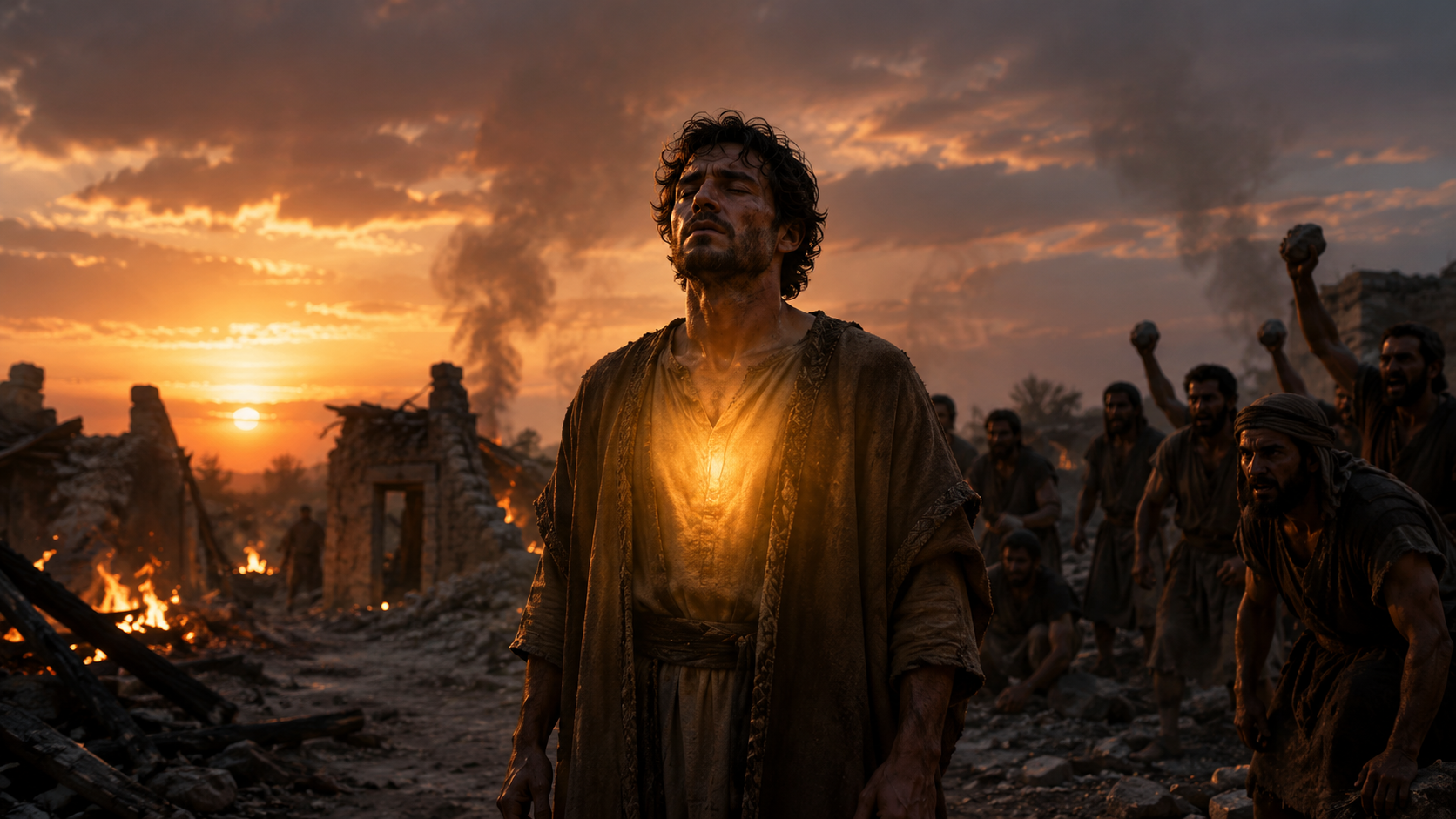
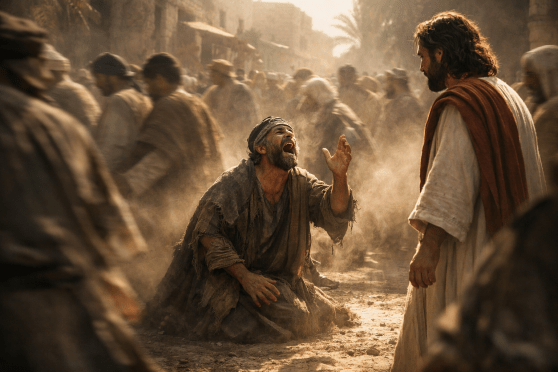
Those who led the way rebuked him and told him to be quiet, but he shouted all the more, “Son of David, have mercy on me!” Luke 18:39 (NIV)
When I was in college studying acting, my professor sent us on an unusual assignment. He sent us a few miles up the road to a busy shopping mall. We were told to sit in the middle of the mall for at least two hours.
Watch people. Really observe them. How they move. Their unusual tics. The particular way they behave with others.
The goal was to teach me as an actor about creating a realistic and believable character on stage. It’s more than memorizing lines and regurgitating them on stage. It’s about creating a real person.
With a particular gate to his walk. Mannerisms unique to his character. A specific way he reacts and responds physically.
That lesson profited me far beyond my training for the stage. The importance of observation was an entire life-lesson. It had spiritual implications.
In my daily life. On this chapter-a-day journey. I keep the eyes and ears of my heart open. Observing. Watching for patterns, repetition, and surprises.
As I read and meditated on today’s chapter, I noticed something.
The chapter is book-ended with a parable and an episode. There’s a connection.
The parable concerns a judge and an old widow. A widow in the culture of Jesus’ day was a nobody. Marginalized. Poor. Zero social status. Everyday she begged the judge to hear her case. Everyday. She made herself annoying. Until the judge heard the case just to shut her up.
At the end of the chapter, Jesus is walking through a crowd. On the side of the road was a blind man. A beggar. He shouts, “Jesus, son of David, have mercy on me!” Again. And again. And again. Annoyed, those around him tell him to shut up. He yells louder. Jesus stops. Calls the man over, and heals him.
The widow knocked on the judge’s door. The blind man shouted into the crowd. Different scenes. Same audacity.
A week or so ago, I was struck by a similar parable Jesus told. The neighbor who begs for bread at midnight. Shameless audacity. Socially inappropriate.
What struck me as I meditated on these things this morning was that I was observing a pattern in the parables and stories that are lifting off the page for me in the quiet.
Prayer. Pleading. Persistence. A holy refusal to be ignored.
It’s a Holy Spirit whisper.
“Pray Tom. Keep praying. Be bold. Be audacious. Don’t stop. Try to annoy me.”
And so in the quiet this morning and observable pattern informs me of my marching orders.
And with that, I will finish this post.
I have some praying to do.
If you know anyone who might be encouraged by today’s post, please share.
These chapter-a-day blog posts are also available via podcast on all major podcast platforms including Apple, Google, and Spotify! Simply go to your podcast platform and search for “Wayfarer Tom Vander Well.” If it’s not on your platform, please let me know!
“This will be a sign to you: You will find a baby wrapped in cloths and lying in a manger.” Luke 2:12 (NIV)
In a couple of weeks I will celebrate my 20th anniversary of this chapter-a-day blogging and podcasting journey. I’ve been mulling that over a lot over the past year. The truth is that this was in many ways an overflow of a daily practice I carved out for many years before that. Each morning I crawl out of bed, I grab a cup of coffee and I show up at the table. There, I spend some time with God, meditating, praying, and thinking about where I find myself on life’s road.
Along this journey, I’ve observed that many people hope for a connection with God at their weekly church service. The hope is that being in a building they believe is God’s House, somewhere amidst the music, the spectacle, the communal worship, and the spoken word they will experience something special.
As a follower of Jesus I am called to gather with fellow believers regularly, and God does inhabit and work in-and-through the praise and worship of His people. I have observed, however, that this lends itself to wanting or expecting something amazing, emotional, and spectacular. Sometimes churches even try to create those moments intentionally — crafting services designed to stir powerful emotions.
My own experience is that this misses the point.
It wasn’t a conscious choice on my part to move from the story of Esther to Luke’s version of Jesus’ story. Yet, in the first two chapters I’m finding connections I’ve never seen before. In yesterday’s chapter, it was the fact that God raises simple, faithful, unassuming people into key players within the Great Story. In today’s chapter, it’s reversals. The story of Esther is known for all of its reversals of fortune. Wouldn’t you know it, today’s chapter is full of them, as well.
The best and the brightest of religious minds and thinkers expected God’s Messiah to arrive in pomp. The Messiah, it was believed, would establish an earthly throne, wipe out the Roman Empires and subdue the nations, reign in earthly glory in Jerusalem where the entire earth would come to worship him.
But through the prophet Isaiah God had already said:
“For my thoughts are not your thoughts, neither are your ways my ways,” declares the Lord.”
Building on yesterday’s chapter, we find that the Messiah enters human history quietly through unassuming people of simple faith. In today’s chapter, Luke methodically present this reversal:
What People Expected
What God Actually Did
The Messiah would arrive in royal splendor
A baby is born quietly to a young couple of simple faith
The King would be announced to rulers and priests
Angels announce Him to shepherds in a field
The Messiah would enter the world through power
He enters through vulnerability, lying in a manger
The religious elite would recognize Him first
Two elderly saints quietly recognize Him in the Temple
God’s presence would remain centered in the Temple
Jesus begins forming relationships around everyday tables
The kingdom would overthrow Rome by force
The kingdom begins by transforming hearts
Jesus did show up at the Temple. In fact, He does so twice in today’s chapter. Once as a baby and then as a twelve-year-old. But God’s Son is already establishing that His ways are not the ways of religious institutions. His focus will never be the Temple, because He knows that the Temple will be rubble in 40 years. He even tells His disciples this. His focus is on the table…
The table he learns to craft with his earthly father’s training
The table he shares daily with family and community for thirty years
The table where he eats with His disciples
The table where he dines with tax collectors and sinners
The table where he has a midnight conversation with Nicodemus
The table where Pharisees host Him as a guest
The table where Lazarus throws a dinner party in His honor
The table where He celebrates one final Passover and blesses bread and wine
In the quiet this morning, Luke reminds me that a major paradigm shift has already begun. Jesus would go to the Temple for festivals, but His focus was never on the spectacle and bustle of the Temple. His focus was daily spent quietly at the table with others.
It’s no accident that Luke’s version of Jesus’ story begins with a baby laid in a feeding trough and ends with bread broken at a table. From the beginning, God was inviting us not to a spectacle, but to a meal.
My relationship with Jesus began in a church. Worship with my local gathering of Jesus’ followers is an essential part of the spiritual rhythm of my life. But it’s not the most transformative part. The most transformative part of my relationship with Jesus is here in the quiet of my office, every morning, at the table.
If you know anyone who might be encouraged by today’s post, please share.
These chapter-a-day blog posts are also available via podcast on all major podcast platforms including Apple, Google, and Spotify! Simply go to your podcast platform and search for “Wayfarer Tom Vander Well.” If it’s not on your platform, please let me know!
The angel answered, “The Holy Spirit will come on you, and the power of the Most High will overshadow you. So the holy one to be born will be called the Son of God.” Luke 1:35 (NIV)
Yesterday we finished our trek through the story of Esther in which God providentially works through two unassuming individuals to save the Jewish people from genocide. Mordecai and his niece Esther were exiles and foreigners in Persia. Mordecai was a bureaucratic paper pusher. Esther was just a young girl.
God loves to work through unassuming people of faith.
As we begin our Lenten trek through Luke’s biography of Jesus, we see this same paradigm again.
An old priest and his wife who live in the back-country hills of Judah. A young girl in the backwater town of Nazareth.
These are nobodies. Simple people living faithfully where life has planted them. But through them, God is going to begin a new creation.
When Mary asks the angel Gabriel how she could be pregnant, since she was a virgin, he said that God’s Spirit would “overshadow” her. That’s a fascinating word to use. The Greek word means “to overshadow,” the language used when God’s presence fills the tabernacle. It also echoes the opening chapter of the Great Story in which God’s Spirit “hovers” over the chaos and creation begins. Gabriel is announcing that through Mary a new creation is about to begin, and Mary will become like an Ark of the New Covenant.
The Ark of the Covenant was the most sacred object in Israel.
Inside it were three things:
The stone tablets of the Law
A jar of manna
Aaron’s priestly staff
Above it rested what was known as the mercy seat, and God’s glory—the Shekinah—was said to dwell there. In other words, the Ark represented the place where God’s presence touched the earth. And when the Ark was placed in the tabernacle, Scripture says the cloud of God’s glory “overshadowed” it — and there’s that word again.
Now watch what Luke does.
Luke structures Mary’s visit to Elizabeth so that it mirrors an earlier story in Israel’s history.
The story appears in 2 Samuel, when King David brings the Ark to Jerusalem.
Let’s compare the passages.
Ark Story
Mary Story
David travels to the hill country of Judah
Mary travels to the hill country of Judah
David asks: “How can the ark of the Lord come to me?”
Elizabeth asks: “Why am I so favored that the mother of my Lord should come to me?”
The Ark stays in the house of Obed-Edom three months
Mary stays with Elizabeth about three months
David leaps/dances before the Ark
John leaps in Elizabeth’s womb
Now, let’s compare what was in the Ark of the Covenant and what is inside of Mary…
Ark Contents
Fulfillment in Mary
Stone tablets of the Law
Jesus — the living Word
Jar of manna
Jesus — the bread of life
Aaron’s priestly staff
Jesus — the ultimate High Priest
Luke begins his version of Jesus’ story by telling us that God’s glory no longer lives in a golden box inside a temple.
Instead, it lives:
in the womb of a teenage girl
in a stable outside Bethlehem
in the life of a wandering rabbi with the calloused hands of a carpenter
God has moved out of the temple and into the neighborhood.
And what neighborhood?
Not the Temple Mount in Jerusalem, nor in glorious Rome— but to a back water town in Galilee. A rural nowhere where you’ll find simple people of faith living quiet, every day lives.
The kind of unassuming people God loves to use.
The same Spirit who overshadowed:
the waters of creation
the tabernacle in the wilderness
Mary in Nazareth
now chooses to dwell in ordinary lives that say yes to Him.
In the quiet this morning, my heart is mulling over the reality that God tends to create the most world-changing things in hidden places. The very theme I saw all over the place in Esther’s story.
Before creation, there was dark water. Before redemption, there was a quiet womb.
The Spirit doesn’t only move in thunder.
Sometimes He hovers.
Over a life. Over a calling. Over a slow, unseen work of grace.
And when He does, creation happens all over again.
“Therefore, if anyone is in Christ, the new creation has come: The old has gone, the new is here!” 2 Corinthians 5:17 (NIV)
If you know anyone who might be encouraged by today’s post, please share.
These chapter-a-day blog posts are also available via podcast on all major podcast platforms including Apple, Google, and Spotify! Simply go to your podcast platform and search for “Wayfarer Tom Vander Well.” If it’s not on your platform, please let me know!
Mordecai the Jew was second in rank to King Xerxes, preeminent among the Jews, and held in high esteem by his many fellow Jews, because he worked for the good of his people and spoke up for the welfare of all the Jews. Esther 10:3 (NIV)
I have often mentioned in these blog posts that the Great Story from Genesis to Revelation is primarily a story of conflict between God’s Kingdom and human empire. The story of Esther is fascinating because it is about God’s people living in exile within a foreign empire. Mordecai and Esther begin the story as anonymous cogs within the Persian Empire, but they are placed in positions where they can make a positive difference for their people within an antagonistic system.
This theme is echoed in the teachings of Jesus, whose followers were marginalized minions operating under occupation by the Roman Empire and corrupt authority of the ruling religious system. The letters of the New Testament are equally addressed to followers of Jesus living through persecution from those same two kingdoms of this world.
Along my life journey, I’ve observed that the theme of “human empire” has far reaching implications. Empire exists at a number of levels. In my career I have worked with numerous clients—from giant global corporations to small family businesses. Each one is a type of human empire with a certain degree of control and impact on the lives of human beings. Likewise, the nuclear family is a type of human empire. I’ve observed what happens to children who grow up in a tyrannical home or a home in which leadership is passive or absent.
Of course, my life itself is a micro-level human empire. I have free will. I control my thoughts, words, actions, and choices.
Today’s chapter is a three-verse epilogue to the story of Esther. After all the intrigue, the fear, the courage, and the great turning of the tables, the story ends quietly. Mordecai simply goes to work—seeking the good of his people and speaking for their welfare. No miracles split the sky. No prophets thunder from the hills. Life resumes under the vast reign of Xerxes I.
Yet God placed them in positions of influence within that system.
In those positions they could serve themselves, or they could use their influence for the good of others. Esther ends with Mordecai choosing the latter.
In the quiet this morning I find myself reflecting on the reality that I face the same choice every day in every little empire where the paperwork, bureaucracy, and machinations of my life unfold.
My personal life My marriage and family My business My community My church
Each day I choose who I am going to serve.
And perhaps that is the final lesson of Esther: God’s hand is often most present not in spectacle but in faithful people who quietly use whatever influence they have for the good of others. And who knows? Perhaps that quiet faithfulness is exactly how God continues to turn the tables in our world today — one small empire at a time.
Tomorrow, we begin a trek through the book of Luke.
If you know anyone who might be encouraged by today’s post, please share.
These chapter-a-day blog posts are also available via podcast on all major podcast platforms including Apple, Google, and Spotify! Simply go to your podcast platform and search for “Wayfarer Tom Vander Well.” If it’s not on your platform, please let me know!
Humble yourselves, therefore, under God’s mighty hand, that he may lift you up in due time. 1 Peter 5:6 (NIV)
I sat at the local pub one afternoon journaling. Without warning a thunderstorm of ideas rolled in. I began thinking about all of the life lessons I have gained as a result of my career.
“Customer complaints are rarely about the complaint.” “Systems shape souls.” “Everyone wants to make rules out of exceptions.”
If you had told me when I was a teenager that I would spend over three decades of my life analyzing tens of thousands of business interactions between clients and their customers I would have invited you to go take a long walk off a short pier. That would have been among the last things on this earth I would want to spend my life doing. Besides, I had my entire life dream planned out.
Over 100,000 business phone calls, emails, and chats analyzed. Customer research. Front-line coaching and training. Executive strategy sessions.
I was good at it. My gifts and abilities dove-tailed perfectly with the job.
There I sat at the bar writing down all of the lessons I’d learned on this, long, strange trip I called a career. Not just business lessons. Life lessons. Spiritual lessons. Lessons about relationships and human interaction. Lessons about systems that apply universally across humanity. They poured right out of me onto the pages of my journal.
When the storm receded I looked at the list. This was the foundational content of a book. I just knew it.
That was well over a decade ago. The idea sat quietly in my journal for years. It wasn’t forgotten. I thought about it all the time. I even had one occasion in which I spoke seriously with a publisher about it, but the opportunity wasn’t right.
I waited. And, I waited.
My soul aches when I have to sit on a great idea.
Last May I was invited to a Zoom networking meeting with a man named Michael through another networking contact I know in Puerto Rico. I have these kinds of networking meetings all the time. You never know who you’re going to meet. I scheduled the meeting with Michael. I had no idea what he did.
As Michael began sharing his story, something funny happened. I discovered right up front that Michael was a believer. He and his wife had spent years working for a ministry I knew very well. I had a former employer who worked for the same ministry. Our stories were eerily similar.
We both chased ministry. We both tasted disappointment. God had rerouted both of us into business.
In today’s final chapter of Peter’s first letter, Peter tells his readers to humble themselves before God. I often think of humility as an attitude, but Peter speaks of it as being an action to be taken. Humility isn’t thinking lowly of myself, it’s placing myself willingly under God’s hand.
I’ve learned along my journey that humbling myself before God is really all about surrender.
“Whatever you want from me God.” “I surrender my will as I embrace and pursue the passions you gave me.” “I will continually ask, seek, and knock as I press on one day at a time.”
Approaching life with this posture, Peter writes that God “may lift you up in due time.”
Which means that humbling myself before God also requires that I trust God’s timing.
In a brainstorm at the pub God gave me the seeds of a book. Then He buried it in the soil of time for over a decade
But that didn’t mean it was dead. I thought about it. The lessons marinated in my mind and soul. I added lessons to the list. I continued to make mental and spiritual connections.
The seeds germinated.
They grew roots.
Then one day I had a random Zoom meeting with a man name Michael.
The fruit will be available for you to taste in just a few weeks when the book is published.
I have learned along life’s road that there is a timing to the Story that God is authoring in me.
If I’m going to trust the Story. I have to trust His timing.
If you know anyone who might be encouraged by today’s post, please share.
These chapter-a-day blog posts are also available via podcast on all major podcast platforms including Apple, Google, and Spotify! Simply go to your podcast platform and search for “Wayfarer Tom Vander Well.” If it’s not on your platform, please let me know!
Wives, in the same way submit yourselves to your own husbands so that, if any of them do not believe the word, they may be won over without words by the behavior of their wives…
Always be prepared to give an answer to everyone who asks you to give the reason for the hope that you have…. 1 Peter 3:1, 15 (NIV)
In my upcoming book I share the story of how as a young man I believed with certainty that I was supposed to become a pastor, and how God made clear that He had purposed for me a quirky career analyzing business phone calls (a la “This Call May Be Monitored”).
My mother was greatly disappointed by the abrupt change in my vocational trajectory. My mother was a sweet lady. She was never given to overt confrontation. She was, however, an expert at letting her concerns made known through what she thought were subtle messages that we as her children could see coming a mile away.
As least once a year, sometimes more often, my mother would wait for us to be having an enjoyable casual conversation.
“Are you ever going to go back to ministry?” she would ask quietly.
Only, it really wasn’t that quiet. She asked the question repeatedly. It was always the same question. She never heard my answers above the din of her own internal fear.
I know my mother loved me. I know she was proud of me. I also know she had her heart set on me spending my career in vocational ministry. I don’t think she ever shook her angst that perhaps I was outside of God’s will. I think she loved having a son who was a preacher.
And boy, did she remind me. Again. And again.
My mother was not alone. Along my life journey, I have observed many well-intentioned parents perpetually express their spiritual concern for their adult children to their adult children. It comes in many different forms.
The annual Christmas gift of a Bible or the latest, bestselling devotional, testimonial biography, or that popular Christian movie.
[cue: Children’s eye roll]
The letter (or email) of concern because “you just have to know how I feel” or, “What we believe.”
Children: “Seriously, do you actually think I don’t know how you feel?”
The passive aggressive comments, questions, and not-so-casual asides that get slipped into almost every conversation.
Followed by hurt and wonder when the adult children, inexplicably, don’t seem to want to hang out all the time.
Today’s chapter begins with a statement that creates such surface angst and outrage in modern culture that the principle of what Peter is getting at is easily lost. He starts by telling wives who are followers of Jesus to submit to their husbands “so that they may be won over without words.”
“Without words…” Behaviors that speak louder than words. Life example that shows the way like metaphorical bread crumbs. Trusting God with the soul of my loved one — and recognizing that my fear may say more about my faith than about their future.
What’s often lost in the cultural outcry of Peter’s encouragement is that Peter isn’t singling out women or wives. He is calling on everyone who is a follower of Jesus to be an example of Jesus to those in their circle of influence “without words.”
Slaves (2:18) Husbands (3:7) All of you (3:8)
Peter then goes on to write what is a well-known and well-worn instruction:
“Always be prepared to give an answer to everyone who asks you to give the reason for the hope that you have…”
But the context that Peter has established is that a person is asking me the reason for the hope that I have ibecause my life, my behavior, my relationships, and my example have made them curious…
…without using words.
The wise teacher of Ecclesiastes said, “there is a time to speak, and a time to be silent.” (Ecclesiastes 3:7)
When our daughters were young, it was time for me to speak. I taught. I answered. I guided.
When they became adults, it was time for me to learn silence.
They know what I believe. They grew up in my home. They know desire for them to believe. I made my heart known long ago. They know they can always talk to me. They bring it up when they’re ready.
In the meantime, I continue to walk my own journey. I pray for them. To Peter’s instruction, I remain ready and available to assist and provide as needed. To answer when asked. To speak when spoken to. Otherwise, I do my best to continue to model the spiritual life and relationship with Jesus that I would love for them to experience…without words.
And then, in the quiet, I surrender to Jesus any notion I have that their relationship with Him has to look exactly like the relationship I have with Him. I surrender my desire for their relationship with Him to be exactly what I desire for it to be. I let go of my desire to think that their stories should look like my story, or the story I would write for them if I was God…if I was in control.
And, that’s the point Peter is getting at.
I’m not in control of others whether it’s a boss, spouse, parent, friend, or child. I don’t write their stories. I don’t know the story God is authoring in their stories, nor has God ever asked me to be a co-author.
He asks me to love. He asks me to pray. He asks me to live as such an example that he can leverage that as a theme as He writes their own personal, individual stories. He asks me to be ready with words — but to live so faithfully that the question comes before the speech.
If you know anyone who might be encouraged by today’s post, please share.
These chapter-a-day blog posts are also available via podcast on all major podcast platforms including Apple, Google, and Spotify! Simply go to your podcast platform and search for “Wayfarer Tom Vander Well.” If it’s not on your platform, please let me know!
Since you call on a Father who judges each person’s work impartially, live out your time as foreigners here in reverent fear. 1 Peter 1:17 (NIV)
I’m always amazed how much you learn about someone simply by listening.
The old man at the retirement center had a lot on his mind. His brain worked at a feverish pace despite being advanced in years. I was impressed. I could almost see it spinning inside his silver pated cranium as the stream of his consciousness flowed from his lips.
Money. Finance. Business. Debts. Investments. Real Estate. Savings.
The future.
When my new acquaintance learned that I was once a pastor there a definite shift in the course of his stream of consciousness. The questions started flowing directly at me.
Along the journey, I’ve had a number of people want to pick my brain about prophecy and the end times. Some chase theories. Others chase reassurance.
What’s going to happen to me? How afraid should I be? How can I insulate myself from what’s coming?
For the sharp old man, I sensed there was a hope of leveraging insider knowledge for personal gain. In every market crash there are always a few who make a fortune. I could see his brain calculating the possibilities.
It was a fascinating conversation, even though I think I may have disappointed him. The greatest religious scholars of Jesus’ day were completely wrong in their theories regarding who the Messiah would be. They didn’t even recognize Him when He was standing among them. The only ones who correctly interpreted His arrival were Zoroastrian priests from Persia who arrived with gifts of gold, frankincense, and myrrh.
If all of those religious scholars got it wrong with Jesus first coming, I suspect we’ll all get it wrong with Jesus’ second coming. Even Jesus shrugged and said He didn’t know when it would be. I think trying to predict anything is a fool’s errand. I was sorry to disappoint my new friend looking for an edge.
I dusted off one of my favorite old jokes for him and told him I when it came to Revelation I consider myself a “pan-tribulationist.” It’s all going to pan-out in the end.
[cue: rimshot]
As I left the retirement center that day I thought about my new friend. What struck me most about our conversation was how invested he was in this earthly life. He had been retired for who knows how many years. Who knows how many days he has left on this earthly journey but it doesn’t take a prophet to know there’s a precariously small amount of sand left in his hourglass. Even if he reads the tea leaves and escapes the coming Tribulation as the one who made the right financial play, what will it profit him?
I felt a pang of sadness as Jesus’ words echoed in my soul.
“Don’t hoard treasure down here where it gets eaten by moths and corroded by rust or—worse!—stolen by burglars. Stockpile treasure in heaven, where it’s safe from moth and rust and burglars. It’s obvious, isn’t it? The place where your treasure is, is the place you will most want to be, and end up being.” Matthew 6:19-21 (MSG)
Peter’s letter was written to a largely non-Jewish audience of Jesus followers. Like the recipients of James’ letter, these believers had been scattered by persecution. Interestingly, Peter begins his letter to non-Jewish believers by referencing a deeply Jewish paradigm: exile.
Exile is one of the overarching themes of the entire Great Story. Some scholars consider it the primary theme. As these believers live scattered abroad living in strange places far from the homes they knew Peter is saying to his Gentile brothers and sisters, “Welcome to the club!”
Later in the chapter, Peter takes the paradigm a step further. He tells his audience to consider themselves permanent “foreigners.” As the old song says, “This earth is not our home, we’re just passing through,” or the other old song I personally favor, “I’m just a poor wayfaring stranger travelin’ through this world of woe.”
Peter was urging his fellow believers to embrace the very words Jesus spoke to him. Consider your investment strategy.
Eighty-years or so on this earth – I leave everything behind. Eternity waits beyond, and I can begin investing today.
I don’t know. If I really believe what I say I believe, then the portfolio I really want to invest in seems pretty clear.
I never saw my friend again. By now, I suspect his earthly journey is finished.
I hope he made some deposits in his eternal accounts.
If you know anyone who might be encouraged by today’s post, please share.
These chapter-a-day blog posts are also available via podcast on all major podcast platforms including Apple, Google, and Spotify! Simply go to your podcast platform and search for “Wayfarer Tom Vander Well.” If it’s not on your platform, please let me know!
Now listen, you rich people, weep and wail because of the misery that is coming on you. James 5:1 (NIV)
What do you remember from 25 years ago?
I remember a great deal. It doesn’t seem so long ago. The turn of the century. The Y2K hoopla. Life and air travel before 9/11. I remember the townhouse we lived in. Taylor and Madison in their preteen years crazy about boy bands and Spice Girls.
As James writes his letter, it has been roughly 20-30 years since Jesus’ crucifixion and resurrection. James is the specified leader of the followers of Jesus in the city of Jerusalem, which remains the center of the Jesus Movement. It is the same Jerusalem and Temple system in which Jesus taught and performed miracles just a few decades before. Those who saw Him, heard him teach, saw Him hanging on the cross, and witnessed Him risen from the dead were still alive to bear witness.
In Jerusalem, the same corrupt kingdoms of government, economics, commerce, and religion that illegally arrested Jesus, forced Him through a kangaroo court set of trials, and then had him executed remain staunchly in place. The power brokers remain the same even if a few faces have changed: the Roman Governor, the Herods, and the family of Annas the high-priest.
This menagerie of wealth and human power not only killed Jesus, but the corrupt Jewish leaders under Annas’ influence had stoned Stephen to death. The Herods had seen to it that James, the Son of Zebedee, was killed by the sword. They’ve arrested countless followers of Jesus, stolen believers’ property through corrupt legal means, imprisoned many, and executed others. It’s so bad that many believers have fled to live in other towns, cities, and regions. That is why James is even writing this letter “to the twelve tribes scattered among the nations.”
Meanwhile, James is trying to hold things together in Jerusalem. The followers of Jesus are doing their best to maintain Jesus’ teaching. They are caring for the poor, the sick, the leprous, widows, and orphans. They are sharing what they have with one another to survive. As the undisputed leader of the believers in Jerusalem, James is the one who must stand before the Romans, the Herods, and the corrupt Temple leaders—absorbing the pressure, the threats, and the consequences on behalf of Jesus’ followers.
If you’ve not read the chapter, I encourage you to do so with this context in mind as you read. Suddenly, the words take on a new layer of meaning.
The “rich” oppressors he describes at the beginning of the chapter have names and faces. They are part of a social-economic system in which the rich and powerful get even more rich and powerful at the expense of the poor and weak. James has to stand before these rich authority figures to defend Jesus’ followers, and he’s experienced the futility of standing against their corrupt power.
Those whom James urges to be “patient in suffering” also have names and faces. They are James’ friends. They were part of his local gathering of Jesus’ followers. He’s writing this letter to precious friends and loved ones who’ve lost everything because of their faith and are now surviving life in exile one day at a time.
James final pleas also feel far more poignant when I place my feet in the sandals of one of the letters’ original recipients.
Pray. Don’t stop praising God, even in your present circumstances. Pray for one another in sickness and sin. Live life with other believers. Stick together in such intimacy that you confess to one another. Have faith. Assist one another in keeping that faith.
Two things surfaced in my heart as I meditated on James’ words in context to the circumstances in which they were written.
The first is that I can’t imagine the daily reality that both James and the recipients of his letter were experiencing. Yes, it’s Monday morning at the beginning of a new work week, but I can honestly count my many blessings and praise God for the relatively wonderful life I’ve been gifted.
The second is that there are those in this world who painfully know these realities today. Nigerian believers are in fear for their lives, some live in hiding. Tens of thousands have been persecuted and slaughtered in recent years. In China believers are imprisoned, persecuted, and live under constant threat from the State. Throughout the Muslim world are communities of believers who trace their faith back to the earliest days of the Jesus Movement, but live under constant threat of the very types of persecution James and the early believers.
They are brothers and sisters in Christ.
As I enter my day, Wendy and I will pray — and trust James words that our prayers might be “powerful and effective” for those who need it far more that we do given the realities they stare down this day.
Our chapter-a-day journey moves to the letters of Peter tomorrow, beginning with 1 Peter 1.
If you know anyone who might be encouraged by today’s post, please share.
These chapter-a-day blog posts are also available via podcast on all major podcast platforms including Apple, Google, and Spotify! Simply go to your podcast platform and search for “Wayfarer Tom Vander Well.” If it’s not on your platform, please let me know!
Jeshurun grew fat and kicked; filled with food, they became heavy and sleek. They abandoned the God who made them and rejected the Rock their Savior. Deuteronomy 32:15 (NIV)
If you hang out with Wendy and me for any length of time, you’ll soon notice that Wendy is not “Wendy” to me. She is “Luv,” or I more commonly prefer, “M’Luv.”
When I train clients on the art of customer service, I always talk about names. Names are important because names imply relationship, and customers typically desire more than a transaction when they find themselves in a tough spot – they want a personal service relationship.
One of the funny things about names is that the more intimate the relationship the more intimate the moniker we use for the “other” in relationship. An acquaintance might begin being referenced by a simple pronoun. (e.g. “him,” “her”). Relationship is established and names are learned and used (e.g. “John,” “Mary”). When relationship becomes intimate, we create pet names for one another (e.g. “Darling,” “Sweetheart”). Or, in the case of me and Wendy, “M’Luv.”
Here’s what is fascinating. When relationships break down, the cycle works in reverse. Amidst divorce, the woman I once referred to “Sweetheart” is easily reduced to “my children’s mother” or even back to the impersonal pronoun “her.”
In yesterday’s post/podcast I reference about this crazy idea God gives Moses, to give His people a song. In today’s chapter, Moses teaches the people the song. It’s a doozy. It’s less Love Me Do and more Symphonie Fantastique. Epic in length, it has five distinct movements:
God is introduced as The Rock—steady, faithful, just.
Israel is remembered as the one God carried, fed, and taught to walk.
Then comes the heartbreak: prosperity leads to forgetfulness; forgetfulness leads to idolatry.
Judgment follows—not as cruelty, but as consequence.
Yet the song does not end in wrath. It ends in vindication, mercy, and restoration.
The ancient Hebrews were all about structure in math, literature, poetry, and music. When it comes to song lyrics, the center of the lyrics is almost always the thematic hub and everything expands outward on either side of it. So, notice the center bullet of the summary above. The center of Moses’ Song is:
Jeshurun grew fat and kicked…
As I went down the rabbit hole of meditation and study on Moses’ Song in the quiet this morning, two important things emerged for me.
First, the prophesied rebellion of God’s people does not happen out of suffering, trial, or condemnation. It happens when things go well.
Blessing increases wealth. Wealth brings abundance. Abundance breeds comfort… and comfort makes us fat.
It is not in adversity we forget God, but in prosperity.
Yet notice how God addresses them at this central moment He calls them out: Jeshurun.
This is a name that is rarely used in the Great Story, and names are important.
Jeshurun can be translated “My beloved, upright people.” It’s not the common and neutral every day name “Israel.” This is a pet name — a covenantal endearment. It is an intimate moniker whispered between lovers, not shouted in public.
And, that is what makes its use here so devastating.
Despite His beloved’s forgetfulness, rebellion, and infidelity that is at the center of this love story, God does not address her with watered down formality or impersonal pronouns. He doesn’t shift to courtroom language foreshadowing divorce court. He doubles down and addresses her with a pet name reserved for the most intimate of moments.
Jeshurun.
It does three things…
Recalls Identity This is who you were named to be. Highlights Irony The Upright One has developed scoliosis. The straight one has grown crooked through comfort. Deepens the Betrayal This isn’t rebellion by strangers. This is infidelity by the beloved.
At the heart of it, Moses is saying: “You did not forget God because you were oppressed. You forgot Him because you were satisfied.”
That is the ache of the song.
It is also, for me, a sobering spiritual reminder. Here in the quiet of my office I sit in prosperity and abundance smack dab in the middle of the wealthiest most affluent empire that has ever risen on the face of the earth in all of human history.
If there’s anyone at high-risk for forgetting God, it’s me.
A good reminder for me to carry into my day. A good conversation to unpack over coffee and breakfast with M’Luv.
If you know anyone who might be encouraged by today’s post, please share.
These chapter-a-day blog posts are also available via podcast on all major podcast platforms including Apple, Google, and Spotify! Simply go to your podcast platform and search for “Wayfarer Tom Vander Well.” If it’s not on your platform, please let me know!
“Now write down this song and teach it to the Israelites and have them sing it, so that it may be a witness for me against them.” Deuteronomy 31:19 (NIV)
I was scrolling through all the playlists in my Spotify music library the other day. I have a lot of them. I came across the playlist I’d made for my mom towards the bottom. This coming St. Patrick’s Day will be three years since we gathered to celebrate her heavenly homecoming. In a funny way, music became the last language my mother and I shared.
I made a short playlist of favorite songs from her youth. I and my siblings were taking turns caring for her while our dad was in the hospital, and I would play the list while we were in the car driving. Her Alzheimer’s was so advanced that by the time we got to the songs at the end of the playlist she had forgotten that we’d even played the songs at the beginning.
I drove and she sang repeatedly through the short playlist. She remembered every word of the lyrics even as she announced with every repeated song. “Oh! I haven’t heard this song in a long time. This is a ‘goldy oldy!'”
In her final days at the care center she would be visited in her room by music therapists.
“Do you know the the song…,” the therapist would ask.
Mom always shook her head.
Then she proceeded to sing right along with them.
In all of creation, God infused music with a secret super power. It embeds itself in our minds. It sinks into our souls. It attaches itself to memories. As soon as I hear the opening guitar riff of Long Cool Woman by the Hollies I am immediately transported to the summer of 1975. I’m in Cabin #3 at Camp Idlewood on a rainy afternoon listening to music on the 8-track with my sister and the other kids from the camp. I can see it. I can hear the laughter.
There’s just something about a song.
We’re in the homestretch of Deuteronomy. Moses has finished reminding the next generation of God’s Law. He’s written it all down so there’s a permanent record that can be read and remembered. He begins to pass the torch of leadership to Joshua.
“Wait a minute,” God says to Moses. It enters the moment almost like an interruption. “I want to give you a song, and I want you to teach it to all the people.”
Then God says, “It will be a witness for me against them.”
It’s easy to forget laws and regulations written on a scroll that only gets read every seven years.
A song embeds itself in the mind. It sinks into the soul. It attaches itself to memory in a way that even Alzheimer’s disease finds itself powerless to erase the tape.
“Give them a song,” God says.
He knows that in forty years when they’ve settled into the land their hearts and lives are going to wander. They will forget God. They will forget what He taught them through Moses. The song, however, will transport them immediately back to this moment on this day by the River Jordan. They’ll see the people assembled. They’ll be able to smell the river. They’ll feel the sun on their face.
God, Moses, Joshua, Torah, and covenant.
When my mother had forgotten my name, she still knew all the lyrics to Sh Boom (Life Could Be a Dream) by the Crew Cuts.
If you want someone to remember. Give them a song. God did.
If you know anyone who might be encouraged by today’s post, please share.
These chapter-a-day blog posts are also available via podcast on all major podcast platforms including Apple, Google, and Spotify! Simply go to your podcast platform and search for “Wayfarer Tom Vander Well.” If it’s not on your platform, please let me know!