Tag Archives: Divisive

Division

Division (CaD Jhn7) Wayfarer

Thus the people were divided because of Jesus.
John 7:43 (NIV)

Here in America, the news is filled with talk about the deep political divisions that seem to have only widened in the past decade. Both sides of the political aisle have their version of extremists to which the other side can point and stoke up fear and loathing that politicians have proven motivates crowds to action like nothing else. Both sides ignore the worst and most obvious flaws in their own presumed candidates while believing the worst accusations and exaggerations of the candidate on the opposite side. Meanwhile, the media giants (who are equally divided among political lines) in their insatiable need for clicks, likes, shares, and revenue relentlessly exploit the worst of the opposition while ignoring the glaring newsworthy problems on their own preferred side of the political narrative. It’s not a great situation.

This came to mind in the quiet this morning simply because in today’s chapter John focuses on how incredibly divisive Jesus was at the peak of His public ministry. The scene is an annual seven-day Jewish harvest festival called the Feast of Tabernacles, or Sukkot. Jewish pilgrims from all over flocked to Jerusalem to celebrate the harvest at the Temple.

John begins by simply stating the fact that the Jewish religious leaders in Jerusalem were looking for a way to kill Jesus. Obviously, tensions are high. John spends the rest of the chapter focusing on three distinct groups of people and their opinions about Jesus.

First, there is Jesus’ own younger brothers. The younger sibs are currently of the opinion that their eldest sibling is whacked. They (and presumably the rest of the family) are headed to Jerusalem for the feast. When Jesus begs off, they sarcastically tease him in true sibling fashion that if He wants to stay at the top of the #trending charts He shouldn’t pass up going to the feast where He can have maximum public exposure.

The “crowds” of everyday people on pilgrimage are the second group John mentions. The Jewish religious leaders in Jerusalem are the third. The distinction between these groups falls along eerily familiar socio-political lines. The Jewish religious leaders are the educated, wealthy “elites” who view the crowd of pilgrims as uneducated deplorables from fly-over country.

John reveals that among both of these groups, there was tremendous division over who Jesus was. Some believed that Jesus was the Messiah, a prophet, or at least a good man and teacher. Others saw Jesus as a deceiver or an agent of the devil. Among the elite religious leaders, the die has already been cast and they secretly have put a price on Jesus’ head. They are even spinning the narrative that Jesus can’t be a prophet or the Messiah because He comes from Galilee and “no prophet comes from Galilee.” Their spin was absolutely wrong. Jonah came from Galilee, and God can raise up a prophet from wherever He chooses. But the elite are used to being able to say whatever they want and the system will obediently line up behind them. John is careful to note, however, that Nicodemus (who made a clandestine visit to Jesus back in chapter 3) was willing to call his colleagues on their own self-deception. There was at least some quiet opposition among them.

The entire book of John is about John presenting his primary source account of Jesus to readers. At the time of his writing, the question about who Jesus was was no less divisive, perhaps only more so. John clearly embraces this fact, acknowledging that those reading his account could be anywhere on the spectrum between believer and antagonistic rejector. His job, which he states up front in the prologue, is to share what he saw, heard, and experienced being one of Jesus’ most intimate followers. John is silently begging the question: “Who do you believe Jesus is?”

So in the quiet this morning, I can’t help but ponder this question anew. Jesus famously shared that “the truth will set you free,” but He equally shared that the truth will also sharply divide. Today’s chapter is John’s testimony as to the latter. As a disciple of Jesus, among the exhibits of this divide is the reality that Jesus’ famous quote “the truth will set you free” has a caveat that literally no one includes with the famous quote:

“If you hold to my teaching, you are really my disciples. Then you will know the truth, and the truth will set you free.” (emphasis added)

My observation is that everyone wants “truth” and its promised “freedom” without Jesus, His teaching, or the need to hold to that teaching. As a disciple of Jesus, I can’t expect the latter without submitting to the former.

So, once again I enter another day on the journey endeavoring to hold to Jesus’ teaching, believing that He is who He said He was, and trusting that I will continue to find both truth and freedom as I make the trek.

If you know anyone who might be encouraged by today’s post, please share.

The Difference a Dinner Makes

So [the king of Israel] prepared a great feast for the [Aramean soldiers], and after they had finished eating and drinking, he sent them away, and they returned to their master. So the bands from Aram stopped raiding Israel’s territory.
2 Kings 6:23 (NIV)

As Wendy and I sit each morning over breakfast and peruse the news of the day, we will often discuss different politicians or other individuals making headlines. Of course, there are always certain individuals for whom we have a certain affinity but we don’t always have the most glowing impressions of other individuals.

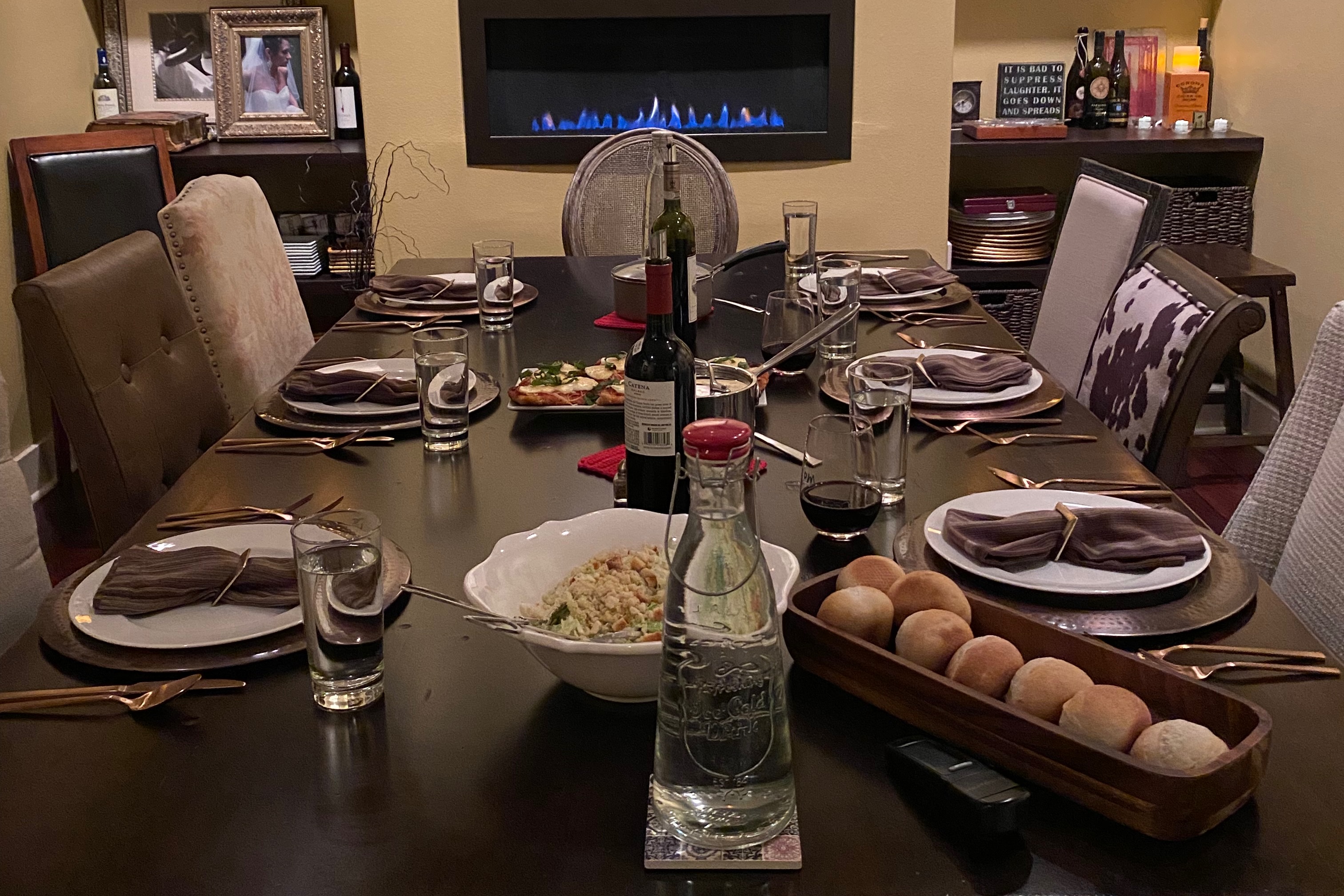
I’m not sure how and when this happened, but Wendy and I will commonly discuss the notion of having said individuals over for a meal. I think this idea began during a Presidential campaign years ago. A few months ahead of the Iowa Caucuses you can’t spit without hitting a visiting presidential candidate. One year when the number of candidates was off the charts, Wendy and I discussed the idea of how nice it would be to actually have each of the candidates (from any/all parties) over for dinner one at a time. It’s easier to really get to know a person over a good meal and good table conversation. Somehow, the idea stuck and now it comes up quite regularly in our conversations, what it would be like to have so-and-so over for dinner.

Today’s chapter is filled with extreme events from the miraculous to a horrific human tragedy. I have no recollection of this quiet little episode stuck in the middle. The kingdom of Aram shared a border with the kingdom of Israel, and bands of Aramean soldiers were constantly raiding the towns of Israel. Elisha miraculously blinds one of these raiding parties and leads them straight into Samaria, the capital city of Israel. When the king of Israel suggests killing them, Elisha instructs him to treat them to a feast instead.

So, the king of Israel treats the enemy soldiers as honored guests. They sat around the table and enjoyed a feast together. I imagine they swapped stories, laughed together, and got to know one another to a certain degree. The Arameans, knowing they could have been killed, were treated the way Jesus would later instruct His followers to treat our enemies, by blessing those who intend to persecute us. The result? The border raids stopped.

In the quiet this morning, I am reminded of the conference Wendy and I attended this past week that addressed some of the most controversial and divisive topics of our day. One of the most powerful things that the conference accomplished was to share the complex and intimate stories of individuals struggling at the heart of the issue. When issues are translated into human stories, it changes both my perceptions and understanding of the issues themselves. It’s the same principle that the king of Israel and the Aramean soldiers discovered. They came to bust heads and instead broke bread. It changed their attitudes and behavior toward their enemies.

(BTW: Another Presidential election cycle begins later this year. For any candidate who happens to read this, there’s an open dinner invitation here at Vander Well manor! 😉)

If you know anyone who might be encouraged by today’s post, please share.

Simply Walk Away

Warn a divisive person once, and then warn them a second time. After that, have nothing to do with them.
Titus 3:10 (NIV)

Wendy and I enjoyed dinner with friends the other night. Casual conversation and catching up led to the subject of a particular individual. Ironically, everyone at the table had worked with this individual in an authoritative capacity, and everyone of us had similar, negative experiences. Duplicitous, malicious, narcissistic and untrustworthy, this individual had repeatedly been a crazymaker with each one of us before burning bridges in spiteful ways. Tragically, every one of us had a similar story to tell.

I couldn’t help but think of that dinner conversation as I read Paul’s instructions to Titus in today’s chapter: “Warn a divisive person once, and then warn them a second time. After that, have nothing to do with them.” As I thought back to the various stories of the crazymaker we had in common, I recounted many second and third chances this person had been given. In retrospect, every one of us at the table wished we had simply cut ties much earlier.

Along my life journey I’ve come to accept that there are broken people in this world who, for various reasons, become crazymakers who sow division, discord, and deceit wherever they go. I’ve also observed that, in most cases, it does no good to try and rebuke or reform a true crazymaker.

I confess to you that, as the conversation went on around the table, my imagination conjured up scenes of things I would love to say and do were I to run into this person again, but every dream sequence I came up with ran afoul of Paul’s earlier advice to Titus in the chapter: “slander no one, to be peaceable and considerate, and always to be gentle toward everyone.” That’s the other thing I’ve found to be consistently true about crazymakers. They bring out the worst in us.

This morning I’m thankful that I have had very few crazymakers in my life. I’m also reminded that in order to keep Paul’s admonition to “live at peace with everyone” I sometimes have to simply walk away.