Tag Archives: Remember

A Land That Drinks Rain

The land you are entering to take over is not like the land of Egypt, from which you have come, where you planted your seed and irrigated it by foot as in a vegetable garden. But the land you are crossing the Jordan to take possession of is a land of mountains and valleys that drinks rain from heaven.
Deuteronomy 11:10-11 (NIV)

It’s not even Christmas and our driveway has required shoveling more times already than a few entire winters of recent memory. Last weekend Wendy and I were driving through a snow storm.

“Well, the farmers will be happy,” Wendy said.

That is such an Iowa thing to say. When you live in a state that drives nearly $50 billion dollars in annual revenue from crop production, agriculture is always part of the conversation. But for children of Iowa, it’s more than just money. We know that the fertile fields of Iowa feed the world. Closer to home and hearth, we know that farming is the life-blood and legacy of families.

Growing up in Iowa, you quickly learn that weather isn’t just about comfort or recreation, it’s an essential element of life, provision, and prosperity.

On a macro level, Moses’ words to the Hebrews crossing into the Promised Land in today’s chapter are about the blessings of love, legacy, and loyalty contrasted with the curses of apathy, forgetfulness, and hearts that wander. Right in the middle of the chapter (ancient Hebrew writers loved to put the most important bits in the center of the text), is a fascinating reference. Meteorology as metaphor: rain.

Back in Egypt, Moses reminds his people, water had to be industrially stored and channeled. Irrigation systems required. Humans digging, tunneling, manufacturing ways to make water work for them—that’s human empire. Human ingenuity finding ways to do what God does naturally by divine means. Humans have been doing that since the Tower of Babel.

The Promised Land, Moses tells his children, is God’s country. It is a land God Himself waters with rain from heaven. Rain is God’s blessing on the land and the people. God’s blessing, however, requires…

Faith, not function
Trust, not contraptions
Love, not labor.

This is God through Moses laying another layer of metaphor to lovingly communicate what He’s been saying all along. I’ve chosen and called you to be different than this world and the kingdoms of this world. Not because you deserve it or earned it but because of my love, grace, and mercy. Love me, trust me, follow me and rain will fall from heaven and you will be blessed with abundance and prosperity you can scarcely imagine.

Then comes the hard side of love. It isn’t punishment, it’s consequence.

There is a consequence, a curse, that comes if love, trust, and fidelity fade and fail. The skies close up. Drought conditions set in. At some point things resort back to the function, labor, and contraptions. When that happens, God’s people will be just like all the other kingdoms of this world.

The message I found flowing through the chapter in the quiet this morning was that the danger is not rebellion or disobedience. The danger is forgetting. Moses’ mantra thus far in his deathbed message has been the steady rhythmic beat of Zakhor: remember, remember, remember. Remembering what God has done is the crucial first step and activating ingredient in Life and blessing. Forgetting leads down a very different path.

“Believe me,” Moses urges his children, “you don’t want to go there.”

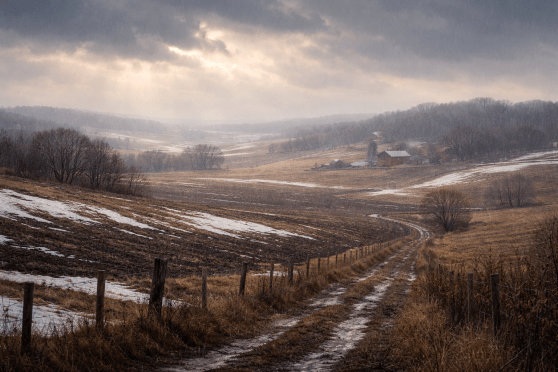
In a little divine wink, I’ve been hearing waves of heavy rain hitting the window of my office as I’ve been writing these words. I pulled up the radar. It’s a chilly Iowa winter morning, but well above freezing. A heavy rain is melting the snow from last weekend’s storm and soaking the slumbering earth.

In coffee shops all over Iowa, farmers sitting patiently through the death of winter and looking to the promise of Spring are smiling. A soaking winter rain. It’s a good thing. Gotta love it. But, it’s not a guarantee. Gotta have faith, too. Spring is still a long season away.

Rain is a gift.
So is remembering.
And faith, like spring, is something we wait for—but also something for which we prepare.

If you know anyone who might be encouraged by today’s post, please share.

Promotional graphic for Tom Vander Well's Wayfarer blog and podcast, featuring icons of various podcast platforms with a photo of Tom Vander Well.
These chapter-a-day blog posts are also available via podcast on all major podcast platforms including Apple, Google, and Spotify! Simply go to your podcast platform and search for “Wayfarer Tom Vander Well.” If it’s not on your platform, please let me know!
Spotify logo with an orange background and an open book icon, representing the listening platform.

The After-Meal Blessing

When you have eaten and are satisfied, praise the Lord your God for the good land he has given you.
Deuteronomy 8:10 (NIV)

The first apartment I lived in during college was the upper level of an ancient house. There were roaches. A lot of roaches. Turn on a light at night and they would all scurry. Complaints fell on deaf ears. It was obvious that the landlord had given up trying to get rid of the pests. The deposit and first month’s rent took all the money on hand. The first week there was a loaf of bread and jar of peanut butter to get us through to pay day.

Every morning as Wendy and I gather for coffee, breakfast, and some quiet time we pray together. Quite often, those prayers include an extended time of gratitude. We don’t offer a simple, blanket “thank you.” We name our blessings. A wonderful home that is beyond anything I could have imagined when I was living in that Roach Motel. A pantry that is full. An unlooked for career that has blessed me on multiple levels. Loving family, children, grandchildren, intimate relationships, faithful friendships, and amazing community. Naming them and saying thank you for each and every one is a kind of spiritual chiropractic—small adjustments that realign the soul.

This regular exercise of gratitude brings our hearts into alignment. God has blessed us. I don’t ever want to get seduced into thinking that it’s all about what I’ve done, or what we’ve done. I don’t want to get spiritually lazy and forget the source of every breath, every day, and every blessing.

Many years ago I memorized Deuteronomy 8:10. It resonated deep within me. Here in Iowa, you grow up learning to appreciate the land. Iowa means “beautiful land,” and it is beautiful. It is also abundant with a perpetual harvest of life and blessing. But, there was something else that stirred as I meditated on the verse. Wendy and I love a good meal with good wine, good company, and good conversation that keeps you at the table for hours. There is a satisfaction of soul that I feel sitting at the table and experience the satisfaction of having both stomach and heart satiated. I began quietly quoting Deuteronomy 8:10 to myself as a post meal blessing.

I didn’t know it, but I had stumbled upon what Jewish tradition calls Birkat HaMazon. It means literally “blessing of the food,” but it’s the blessing after the meal, not before. Most prayers are uttered in emptiness and need, this prayer flows out of satisfaction. It’s not a prayer for when I’m empty, but when I’m full. And goodness, is my life full.

The Birkat HaMazon is a blessing like a loaf of bread broken into four pieces.

For Sustenance.
I have eaten because God is generous, not because I’m deserving.

For Land.
Not just food, but place. History. Inheritance. Story. In this Jewish prayer I see a reflection of Jesus. He is the Alpha-point from which everything in creation flows in Genesis. He is the Omega-point to which everything in creation will return in Revelation. Everything I seemingly have and possess, is gift not entitlement. Prosperity is entrusted, not earned outright. To bless the land is my confession: “I didn’t build the ground beneath my feet.”

For Jerusalem.
This is the part of the blessing that aches. It remembers loss even in abundance. Even at a full table, Jewish prayer makes space for longing—for justice unfinished, peace incomplete, restoration still coming. It refuses to give in to the illusion that comfort equals completion. Along my life journey, I’ve learned that holy ache keeps the heart supple.

For God’s Goodness.
The blessing’s final movement gathers everything and says, in essence: “God, you are good. You always have been. You always will be.”

Not because the meal was perfect. Not because life is tidy. But because God’s character is rock steady. Even when we are faithless, God remains faithful. It’s who He is, and He can’t be anything but who He is.

Once again, I find myself in the quiet this morning wishing I could bathe in the text. There is so much wisdom in Moses’ reflection. He remembered the manna. His people didn’t complain the loudest when they were starving. Their complaints hit the highest decibel level when God’s provision of manna became predictable.

Today’s chapter is a reminder of a roach filled apartment and week-long diet of peanut butter toast and peanut butter sandwiches. Looking back, that season wasn’t punishment, it was spiritual formation. In a few moments I will head downstairs for breakfast with Wendy. I will take her hand and we will name our blessings. We will enjoy breakfast. We will solve the problems of the world in about a half-hour. Then we will get up to start our day.

But before I do, I will thank the Lord our God for the good land He has given us.

If you know anyone who might be encouraged by today’s post, please share.

Promotional graphic for Tom Vander Well's Wayfarer blog and podcast, featuring icons of various podcast platforms with a photo of Tom Vander Well.
These chapter-a-day blog posts are also available via podcast on all major podcast platforms including Apple, Google, and Spotify! Simply go to your podcast platform and search for “Wayfarer Tom Vander Well.” If it’s not on your platform, please let me know!
Logo representation of a Bible with an orange background and a white outline of an open book, indicating a religious or scripture-related theme.

Final Message

Now, Israel, hear the decrees and laws I am about to teach you.
Deuteronomy 4:1 (NIV)

There is a seriousness about Life that takes stage whenever Death is standing in the wings. I’ve experienced in hospitals and the rooms of hospice. I’ve observed it in homes where families tend to their loved one’s final days. The seriousness can take many different forms, but I find that they are always holy moments.

I find it important as I meditate on the chapters of Deuteronomy to remember that this entire book is one of those holy moments. Death is standing on the banks of the Jordan River in wait for Moses. Moses is ancient. His body is decimated with age. His face is lined with the stress of decades of leadership. Deuteronomy is Moses taking the face of his people lovingly in his withered hands and looking them in the eye one last time. These are the words of his deathbed.

“Listen,” he is whispering with final breath earnestness. “No. Really listen to me.”

When Moses uses the word “hear” it is the Hebrew word shema. It is more than auditory reception. Shema is listening with your heart as well as your ears. It’s hearing channeled into action. It is listening that love transforms into obedience. It’s the same Jesus asked whenever He said, “Those who have ears to really hear, hear this….”

Suddenly, the words of today’s chapter have another layer of meaning. They are the love-filled plea of the man who has given everything to lead his people. I don’t just want to read the words. I want to shema what Moses is communicating in this holy moment as I see Death standing in the background along Jordan’s shore.

Guard the appetites of your heart. Moses begins with a plea to his people to guard their hearts. They serve a living God. They’ve seen what He can do. They’ve heard His voice though they saw no form. There is no form that can adequately represent His being. So don’t fashion idols for yourselves and bow down to animals, or people, or the sun. Don’t give your love and devotion to things that can never love you back.

Be ever aware of God’s nearness. God is with them. He’s pitched His tent in the center of their camp. He goes before them. He goes with them. He is not god up above somewhere. God is always right here, right now.

Remember. Remember. Remember. Moses repeats the word over and over again.

Remember the fire on the mountain.
Remember the voice with no form.
Remember the covenant.
Remember who rescued you.
Remember who claimed you.

Memory is a mentor. The moment you begin to forget you are one step closer towards being lost. Then Moses prophetically foresees that his children, whom he knows all too well, will indeed lose their way.

Home awaits every prodigal. He wraps up his message by reminding them that no matter how far they wander, no matter how badly they lose their way, God is waiting. He’s not waiting with crossed arms but arms that are open. It doesn’t matter what distant pig stye they find themselves mired in. If they, like the prodigal, will seek Him with all their heart they will find Father God there on the porch at home with his eyes glued to the driveway. He just waiting to welcome the prodigal home and celebrate His lost child’s return.

I feel a weight in my meditations in the quiet of my home office this morning. Placing my feet in the sandals of a child of Israel standing along the Jordan River listening to Moses’ heartfelt final plea gives the words added potency. Suddenly the message is more meaningful. Life suddenly gets more serious whenever Death is near.

The neighbor’s diesel pick-up truck has begun to idle across the street. It’s my daily reminder that it’s time to move out of the quiet and into all that awaits me on the calendar and task list of the day. Thankfully, I’m unaware of Death being anywhere nearby today. Nevertheless, I head out with the heart of Moses’ message informing how I want to go about whatever awaits me.

Have a great day, my friend.

If you know anyone who might be encouraged by today’s post, please share.

Promotional graphic for Tom Vander Well's Wayfarer blog and podcast, featuring icons of various podcast platforms with a photo of Tom Vander Well.
These chapter-a-day blog posts are also available via podcast on all major podcast platforms including Apple, Google, and Spotify! Simply go to your podcast platform and search for “Wayfarer Tom Vander Well.” If it’s not on your platform, please let me know!
Icon representing a Bible with an open book illustration, emphasizing scripture study and accessibility.

Run

Therefore, since we are surrounded by such a great cloud of witnesses, let us throw off everything that hinders and the sin that so easily entangles. And let us run with perseverance the race marked out for us.
Hebrews 12:1 (NIV)

I was never much of a runner. I tried cross-country in high school but only made it half a season. Later, friends talked me into giving running another chance. I did… but the passion never ignited. I like variety when it comes to exercise—different movements, different forms of exertion that trip my trigger.

Still, those handful of forays into running, and the many friends who’ve kept at it with lifelong devotion, taught me a few things.

I was in high school when my hardcore cross-country friends trained for their first marathon. I don’t recall any of them making it to the finish line. What I do remember is how they compared notes afterward—each one describing the exact point on the course where they ‘hit the wall.’

It was the first time I’d heard the phrase. It’s that moment when physical exhaustion breaks the mind. The brain can’t will the body to push through the pain. The finish line—the very thing that motivated their months of training—suddenly seems meaningless. The wall isn’t only physical. It’s mental. Even spiritual.

The author of Hebrews is writing to an audience of believers in the middle of a grueling real-life marathon. Thus far they have been socially ostracized by friends, family, and community. They have been publicly insulted and persecuted. Their homes and possessions have been confiscated. They have watched fellow believers imprisoned, beaten, stoned, and executed. Then came exile. They fled everything familiar to find refuge.

They are at risk of hitting the wall. The author knows it. It is the primary purpose of his entire letter, and it crescendos in today’s chapter. As I meditated on the text in the quiet this morning, I found four key movements in this climactic passage.

Remember

Yesterday’s post/podcast was all about those individuals in the Great Story who already ran their earthly race—men and women who stumbled, suffered, persevered. Today the author tells us to remember them. To let their lives whisper courage into our weariness. They ran with faith and perseverance. Today’s chapter begins with the author telling us to remember this cloud of witnesses. The Greek word is martyrōn from which we get the word martyr.

They suffered as you are.
They kept the faith.
They finished their earthly race.
They are right here. Living examples. Cheering you on.

Race

The author then lays down the metaphor for this entire capstone chapter. The race set before us. This life is not a sprint. It’s a marathon, just like the ones our cloud of witnesses endured. They weren’t perfect—they were beautifully, stubbornly human. They had their weaknesses and flaws. What they did have, was faith.

Fix your eyes on Jesus. It isn’t merely gazing at Jesus—it’s deliberately refusing every distraction, like a transfixed lover choosing to gaze on one face in a crowded room.

Consider all Jesus endured for us. The garden, the sweating of blood, the tears, the trials, the scourging, the mocking, the crown of thorns, the bloodied walk to Calvary, the nails, the cross.

Don’t think for a second that you can’t do this.

Run.

Rigor

The author then moves into discussing the rigor required of anyone in this race. Suffering produced endurance and perseverance. There is progress in the pain. The discipline a parent instills in a child is not easy in the moment, but it’s good and necessary. In the same way, the discipline called upon to gut-it-out in life’s most difficult seasons is never easy. But it is also good and necessary.

It pushes me to shake off the weight of bitterness and hatred.
It forces me to dig deeper to tap into the spiritual resources I need.
It tests my faith and develops my endurance.
It develops levels of maturity within that I can’t get any other way.
It teaches me how to lean into hope.
It leads to depths of joy found only on the other side of suffering.

Reception

The author then describes the finish line with an interesting contrast. He begins by looking back at Mount Sinai in the book of Exodus when Moses climbed the mountain and God met him there to deliver the Law. Fire, thunder, smoke, fear, and trembling.

That was the beginning of the Law that the author has stated has been completed and is obsolete. Old things pass away. New things come.

He then points us to a new mountain. It’s an eternal and heavenly Mount Zion and the New Jerusalem John describes in Revelation 21. This mountain is an unimaginable finish-line reception. Angels and celebration—movement, music, and unspeakable joy.

There will be shaking and there will be fire, because “Our God is a consuming fire,” but it’s not like the former. Not a fire meant to burn me up, but to burn away everything that keeps me from being who I truly am.

Tom—pure gold, refined through the flame.
Tom—unshakable, when the shaking ends.
Tom—welcomed on Zion’s festival-drenched mountain.

And so, once again I set out into another day of the race. This race doesn’t belong to the swift, but to those who keep running.

Press on, my friend.
Press on.

If you know anyone who might be encouraged by today’s post, please share.

Promotional graphic for Tom Vander Well's Wayfarer blog and podcast, featuring icons of various podcast platforms with a photo of Tom Vander Well.
These chapter-a-day blog posts are also available via podcast on all major podcast platforms including Apple, Google, and Spotify! Simply go to your podcast platform and search for “Wayfarer Tom Vander Well.” If it’s not on your platform, please let me know!

Remember: Getting My Head and Heart Aligned

Do not boast about tomorrow,
    for you do not know what a day may bring.

Proverbs 27:1 (NIV)

It’s been a couple of weeks now that Wendy and I have joined the rest of the world in keeping to ourselves. My home office is the most organized that it’s ever been. Our house is clean. Honey-dos have that have been on the task list for a long time have gotten done. We’re almost caught up on This is Us after binging on it this week. We had a FaceTime marathon with family yesterday afternoon. And, I’ve dusted off the never-ending work on my family tree and the giant tub of old family photos and ephemera.

Who saw this COVID-19 global quarantine coming? Who knows where this is all going to lead?

On this earthly journey, I’ve observed that most of us cognitively know that we can’t predict what tomorrow may bring, but we still set our hearts on some personal vision of how we expect life to play out. What I have set my heart on always seems to take precedence over what my brain knows. So, when life eventually throws me a wicked curveball I instinctively flail at it and fall all over myself like a clown (for a laugh, watch the video below), rather than having the spiritual discipline to hold my stance and wait for another pitch. Along the journey, I’ve found that I have to repeatedly and consciously go through an actual process of getting my heart in sync with my brain.

Like everyone else, I’ve been medicating with the clever humor everyone is posting on social media. One of my favorite memes from the past week said: “Your grandparents were called to war. You’re being called to sit on your couch. You can do this.”

That’s was a great dose of much-needed perspective for me. That statement also reminded me of the process I’ve had to learn to get my heart and soul aligned with what I both know and believe. It’s the same process that God, from the very beginning, taught His people: Remember.

  • Remember that you were slaves in Egypt and that the Lord your God brought you out of there with a mighty hand and an outstretched arm.
  • But do not be afraid of them; remember well what the Lord your God did to Pharaoh and to all Egypt.
  • Remember how the Lord your God led you all the way in the wilderness these forty years.
  • …so that all the days of your life you may remember the time of your departure from Egypt.
  • Remember the days of old; consider the generations long past. Ask your father and he will tell you, your elders, and they will explain to you.

I know a lot of my family’s stories. Coming to America alone and starting a new life, the hardship of the Great Depression, the rationing and struggle of the Great War, dad’s lost jobs and the time we almost lost our home, tragic deaths, financial setbacks, relational struggles, and times of uncertainty. And, through all of these tragedies and difficult circumstances, three things remained: faith, hope, and love. Sure, things changed and didn’t always turn out exactly as the storyline on which hearts were set. But, looking back and remembering, I can see God’s goodness through each story. Time and time again I can see God’s faithfulness.

It reminds me of Paul’s words to the followers of Jesus in Corinth:

You know for yourselves that we’re not much to look at. We’ve been surrounded and battered by troubles, but we’re not demoralized; we’re not sure what to do, but we know that God knows what to do; we’ve been spiritually terrorized, but God hasn’t left our side; we’ve been thrown down, but we haven’t broken.

2 Corinthians 4:8 (MSG)

In the quiet this morning, I continue to wonder (along with everyone else) where this whole Coronavirus crisis will take us, and what it will mean. And, if I spend too much time focused on it, I can find myself out-of-sorts. So, once again I shift-focus, look back, and remember God’s faithfulness through the generations. No matter what changes in circumstance are in my future, God’s goodness and faithfulness are what my past has taught me will never change.

if we are faithless,

    he remains faithful,

    for he cannot disown himself.

2 Timothy 2:13 (NIV)

Walking Backwards Into the Future

Remember those earlier days…
…So do not throw away your confidence.
Hebrews 10:32,35a (NIV)

Just yesterday, in a Facebook post, I was reminded of my college days and my dear group of friends from Judson Theatre. It’s funny how one thought leads to another. I went to bed thinking about my friends and my college days. Perhaps that’s why this morning I was reminded in my  quiet time of a word picture one of my profs shared in a chapel service. It’s a word picture I’ve never truly forgotten, though I have to dust it off once in a while on a day like today.

Picture a person walking across the platform facing backward, but with his/her hand stretched out behind their back as if being led. This, my prof argued, was what God continually asks us to do. Hold out our hand to be led by Him, but perpetually face backward. Look back across the journey and remember all of the ways God proved faithful: providing needs, guiding, leading, fulfilling promises, healing, restoring, and filling.

This is what the Hebrews did. This is why their exodus from slavery in Egypt is referenced time and time again. It’s referenced by the prophets Haggai, Micah, Amos, Hosea, Daniel, Ezekiel, Jeremiah, and Isaiah. It’s referenced again and again throughout the Psalms. As they progressed on their journey through history they have continually looked backwards and remembered all that God has done to faithfully guide, lead, and preserve.

Why? Because remembering all that God has done before reminds me that I can have faith and be confident that God will see me through whatever I might be going through today.

This all came to mind while reading today’s chapter. The author of Hebrews perpetuates the walking backwards word picture by urging his/her readers “Remember those earlier days…” and references a particular period in which the early Christians were persecuted severely. God had brought them faithfully through the persecution. The author then ends the paragraph with “So do not throw away your confidence.” There it is. Turn backwards. Remember. Then have faith. Press on confidently with your hand outstretched to be led.

This morning I’m thinking about the road lying before me on this life journey. I have many questions about where the path is leading. I also confess to more than occasional bouts with fear, doubt and anxiety.  I’ve been reminded this morning by a memory and a word picture from college. I’m taking a little time in the quiet to glance backward instead of ahead. I’ve been following Jesus on this life journey for over 36 years. I’ve experienced many things from God’s miraculous power to God’s presence and peace amidst tough times to God’s quiet faithfulness in the everyday mundane. In the remembering I’m reminded that I can trust God’s power, presence, peace and faithfulness for the road ahead, as well.

Hand outstretched, I’m going to keep walking backwards…confidently.

Featured photo courtesy of Mandee Johnson via Flickr

Recounting

“The following are the kings of the land whom Joshua and the Israelites defeated….”
Joshua 12:7a (NRSV)

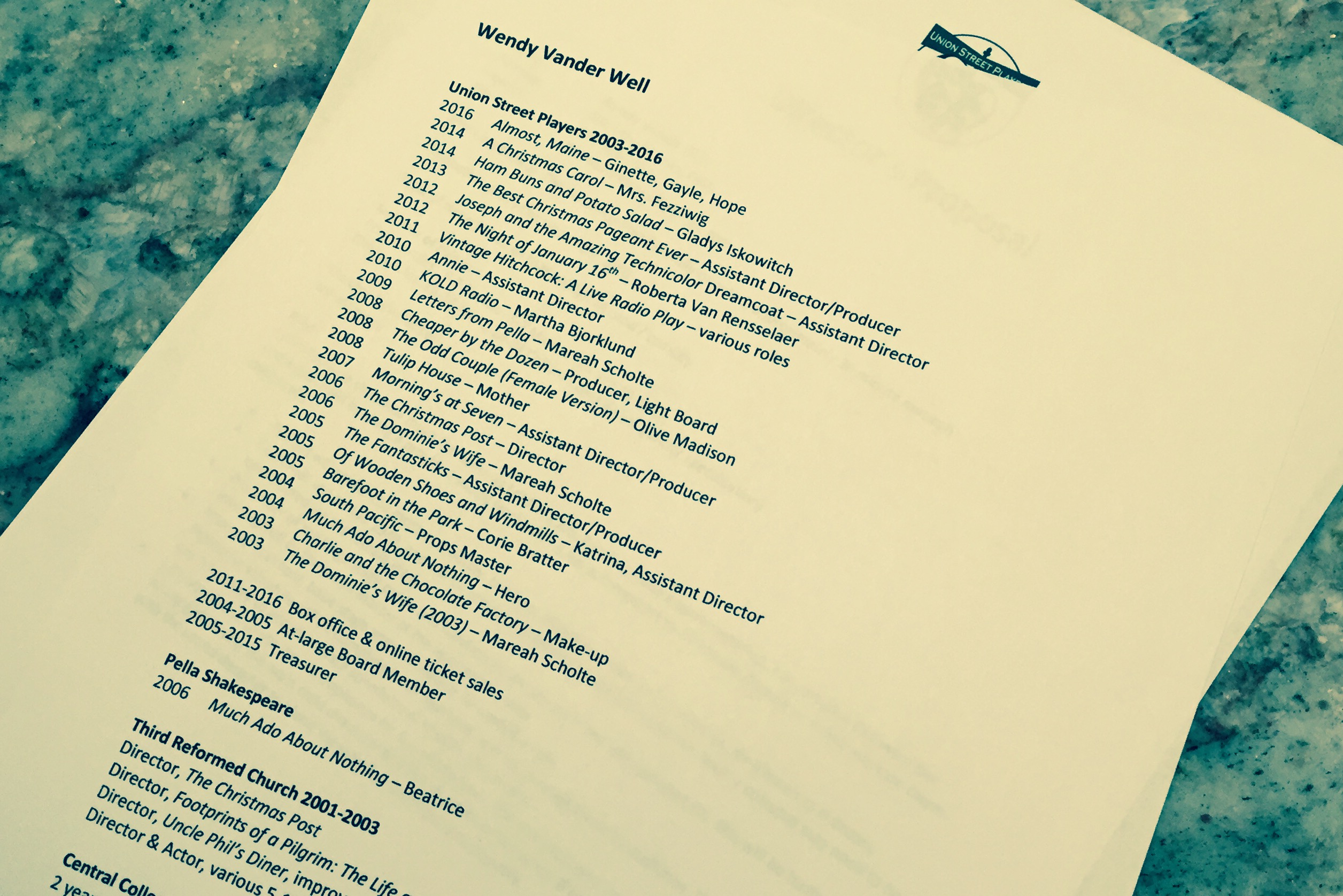
In the fall of this year, Wendy is scheduled to direct a musical for our local community theatre called The Christmas Post. She’s directed it twice before. It’s been ten years since the last time. Yesterday Wendy was putting together some of the required paperwork and she handed me a list of all the shows she’s been involved in over the past 11 years. It filled the better part of a page, single-spaced.

Oh my gosh,” she exclaimed as she held up the list for me to look at. “This is a lot of shows! You don’t think about it until you really write it all down and see the whole list!”

She is right, of course. Along life’s journey I’ve discovered that it’s good to recount things. Just think about the word: re-count. Count it again. Make a list. Go over the list. Think about it. I have always had a bent towards history and nostalgia, so perhaps it comes a bit more naturally to me. Nevertheless, I’ve found it worthwhile. Recounting things reminds you of where you’ve been, which gives you perspective of where you are, which then helps you make informed decisions about where you’re going, which helps you choose the next step.

Recounting can also remind you of what God has done in the past, which strengthens the faith you need in the moment, so that you can press on in the journey to which He has called you. It is a repetitive theme throughout God’s Message: Remember these things. Teach them to your children. Don’t forget this story. Feast each year and recount what happened. Count your blessings and name them one-by-one.  “As often as you do this, remember me.”

Today’s chapter is not exactly full of inspiration. It’s simply a recounting of the kings who Josh and the 12 Tribes defeated. But it serves as a reminder that sometimes it’s good to re-count. Recount the good times. Recount the times God answered a prayer. Recount what got me to this place. Recount the lessons I’ve learned.

Happy recounting.

chapter a day banner 2015

The Power of the One Ring (Not THAT One)

Those twelve stones, which they had taken out of the Jordan, Joshua set up in Gilgal, saying to the Israelites, “When your children ask their parents in time to come, ‘What do these stones mean?’ then you shall let your children know, ‘Israel crossed over the Jordan here on dry ground.’
Joshua 4:20-23 (NRSV)

I have a ring that is worn on a chain around my neck. Those who know my life-long love of Tolkien are likely to think it some homage to the ring of power in Lord of the Rings. The ring around my neck may be a ring of power, but its power is not in magic, elves, wizards, or the stuff of imaginative fantasy. The ring around my neck was a gift to me from Wendy. She gave it to me before we were married, and its power is in the meaning it holds for her, and for me.

The ring was and is, for Wendy, a special reminder of a waypoint in her own spiritual journey, and the things God had done in her heart and life. These things are a part of her story, thus they are hers to tell and I will leave it at that. When she knew that I was to be her husband and that God was bringing me into her story, the ring became a gift to me. It always hangs around my neck. It is a ring of power, even if its power is limited in significance to Wendy, me and God.

Memorial [muh-mawr-ee-uh l] noun. Something designed to preserve the memory of a person, event, thing, etc.

In today’s chapter, the people of Israel were called to create a memorial. Twelve stones, one stone for each tribe, were piled as a reminder of what God had done in drying up the River Jordan so that they could cross. They would preserve the memory of that event. When future generations asked about the pile of stones, they could learn the story.

We generally think of memorials as a reminder of people after they die, but memorials can be a powerful tool in other ways. When God does something special or remarkable in the life of a person, a couple, or a family, it is an opportunity to create a tangible memorial of His faithfulness, provision, deliverance, miracle, answered prayer, or etc. The memorial can be a powerful reminder, even if its power or significance is limited to the person, couple, or family involved.

Today, I’m thinking about the ring that has hung around my neck for nearly 11 years, and the fact that 99.9 percent of the time I forget that it’s even there. But, I catch sight of it in the mirror as I shave, or I feel it pop out of my t-shirt when I bend over, and it reminds me of Wendy, her journey, and her gift. It reminds me in the moment of what God has done in her story, in my story, in our story. I am reminded once again of grace, provision, and redemption.

Therein lies the power of the ring.


chapter a day banner 2015

Moving Forward Facing Backward

from Halans via Flickr

But then I recall all you have done, O Lord;
I remember your wonderful deeds of long ago.
Psalm 77:11 (NLT)

One of the recurring themes I’ve found on my sojourns through the Old Testament is exactly what Asaph does in his lyric of this psalm by “recalling all you have done, O Lord.” Time and time again the writers recount the many things God did as chronicled in the writings. One of my teachers once told me that the people of ancient Israel “walked backwards into the future” as their constant looking back and remembrance of all God had done before gave them faith to continue moving forward.

I was reminded this morning of an old hymn we would sing in church growing up which admonished us to “count your blessings, name them one by one.” It’s the same principle. Often, when the road ahead is dark and scary, the best prescription for moving forward is a long glance back to remember God’s faithfulness in bringing me this far. As I recall specific instances of grace, deliverance, forgiveness, and provision I find strength to take the next step.

Making a Memory

Here I Go Again (EP)
(Photo credit: Wikipedia)

I went past the field of a sluggard,
    past the vineyard of someone who has no sense;
thorns had come up everywhere,
    the ground was covered with weeds,
    and the stone wall was in ruins.
I applied my heart to what I observed
    and learned a lesson from what I saw:
A little sleep, a little slumber,
    a little folding of the hands to rest—
and poverty will come on you like a thief
    and scarcity like an armed man.
Proverbs 24:30-34 (NIV)

I’m amazed at how our minds and memories work. If I’m listening to the radio and hear the Hollies‘  Long, Cool Woman in a Black Dress I am suddenly transported to Camp Idlewood, Rainy Lake, Minnesota where my family vacationed the first two weeks of August every year. I’m in Cabin #3 with my sister along with our friends Matt, Piper John, and Mark. The song is playing from an 8-track tape. Mark is being a clown and making everyone laugh as we try to sing the lead singer’s “Whoo!” at the right place in the instrumental bridge. It’s raining outside. I can picture it like it’s happening right now.

You find yourself in a funk and don’t know why. Then you remember something sad and depressing that long ago happened at this same time of the year. Your conscious mind had forgotten but your senses remember.

When I read the verses above I was suddenly talking to my friend Spike. It was the year between my freshman and sophomore year in college. Spike and I hung out a lot that summer, and one day he talked about these verses which he’d recently read. They made an impression on him and he quoted the last part of it from memory. That, in turn, made an impression on me. Thirty years later I read the verses and think of Spike. I think of the example of hard work he’s been to me in his academic pursuits and his successful career as a university professor.

We are making memories for ourselves, but more importantly for others. They can be positive memories or negative ones. The memories we create for others can be either healing or destructive. We choose through our thoughts, words, actions and relationships. How cool to imagine that someone might read a verse from God’s message and have a fond memory of me. Those are the kinds of memorable impressions I want to make for others.

Today, I want to live in such a way that it will be a pleasant memory for myself and others.


[An index of all Tom’s chapter-a-day posts covering every book and chapter]