Tag Archives: Courage

Facing the Giants

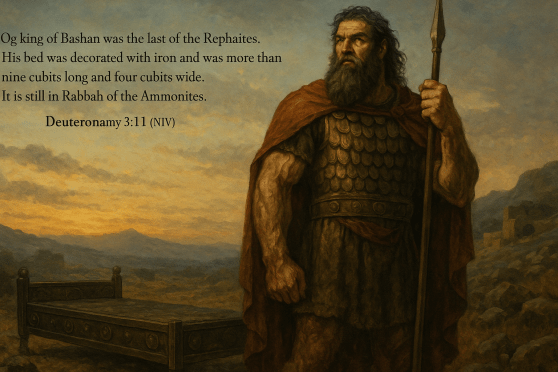
(Og king of Bashan was the last of the Rephaites. His bed was decorated with iron and was more than nine cubits long and four cubits wide. It is still in Rabbah of the Ammonites.)
Deuteronomy 3:11 (NIV)

In the 20 years of this chapter-a-day blogging journey, my choice of which book we trek through has been typically haphazard. I don’t give it much thought, to be honest. As a right-brained creative, I tend to eschew straight lines and blueprints and embrace adventure of the unexpected. That said, I don’t think our current trek through Deuteronomy is coincidental. As we finished the book of Hebrews last week I heard the Spirit’s whisper in my soul. I need this.

This past year has been a season of transition for me. It’s still in process. We’ve come a long way, but we’re certainly not settled in the Promised Land. There are tasks and obstacles to be faced. Just yesterday I shared with Wendy how overwhelming it sometimes feels. Scary even. Like facing a giant.

This is a feeling with which Moses is very familiar.

Before there was Goliath there was Og, King of Bashan.

As Moses leads the next generation of Hebrew tribes to the Promised Land there are two major enemies standing in the way. The first one was Sihon, king of Heshbon who was rather easily defeated in yesterday’s chapter. The second enemy is a different story. For Moses and the Hebrews, Og, King of Bashan was their Goliath.

The text calls Og the last of the Rephaim. The Rephaim are a mysterious ancient people known for their unusual size. Archaeology has unearthed remains of ancient tribes with warriors who ranged from 6’8” to 7’2”. Today’s chapter records a parenthetical mention of Og’s iron bed which was 13 feet long. Og and the Rephaim were giants. and if I’m an ancient Hebrew whose average height ranged between 5’3” to 5’5” I imagine my knees would be knocking a bit at the prospect of that battle.

Beyond Og’s sheer size, he ruled over numerous fortified cities. He had a formidable army and a super-sized reputation. This was not an easy task that lay before Moses and the Hebrews. They had every reason to feel overwhelmed. Jewish commentators note that the first thing God says to Moses as the armies line up for battle is, “Do not be afraid.” This hints that even Moses who has miraculously and successfully led the Hebrews out of slavery and through the wilderness was even feeling overwhelmed by fear in that moment. Even great leaders quake.

Courage is not fearlessness but moving forward in spite of trembling knees.

The previous generation of Hebrews refused to enter the Promised Land out of fear of the “giants” who inhabited the land. Isn’t it interesting that God leads Moses and this next generation up against a giant before they even reach the Promised Land. It’s almost as if God is ensuring that there won’t be a repeat of last time. If His people experience victory over the giants outside the Promised Land, they won’t fear rumors of giants inside of it.

The Hebrews are successful. Og is defeated along with all his cities. His 13-foot iron bed becomes a museum piece for travelers passing through Rabbah of the Ammonites. The next generation of Hebrews experience a huge boost of faith in God’s promises.

In the quiet this morning, I find a much needed reminder for the waypoint on life’s road where I find myself. There are moments for all of us when we’re facing our own giants. Sometimes they are just rumors. Sometimes they are very, very real. In either case, God’s message never changes. It’s the same as He said to Moses.

“Don’t be afraid. I’ve got this. Trust me. Take courage. Move forward.”

And so, even with knees knocking in my spirit and despite the nagging feelings of being overwhelmed, I move forward into this another day.

If you know anyone who might be encouraged by today’s post, please share.

Promotional graphic for Tom Vander Well's Wayfarer blog and podcast, featuring icons of various podcast platforms with a photo of Tom Vander Well.
These chapter-a-day blog posts are also available via podcast on all major podcast platforms including Apple, Google, and Spotify! Simply go to your podcast platform and search for “Wayfarer Tom Vander Well.” If it’s not on your platform, please let me know!
Logo of a digital Bible app featuring an open book icon and the text 'Bible' beneath it.

Last Day of Camp

Keep your lives free from the love of money and be content with what you have, because God has said,
“Never will I leave you;
    never will I forsake you.”
Hebrews 13:5 (NIV)

Summer camp is always a special place to be. Both as a camper, and later as a leader, and guest speaker, I have such fond memories of the laughter, adventure, friendships, and fun. For some, that fun never ends. There are entire summer camp communities where adults and families spend summers “at camp” where worship, studies, activities, and relationships become part of the rhythm of summer their entire lives.

Nevertheless, summer always ends. There is always that final day of camp. The camp fires become the embers of memory. The guitars are in their cases. The cabins have been emptied. The beds stripped. The close friendships forged in the intense togetherness (and maybe even a sparked romance) must come to an abrupt end. Cars arrive to take campers back to their disparate hometowns. Campers return to their daily routines. It is the death throes of summer, when in one moment the fun seems to end with gut punch. As you hug these people who have come to mean so much to you in such a short period of time, you know autumn’s descent is imminent. All of the real life activities and responsibilities that come with it await.

I have a very vivid memory of lying in the backseat of our family’s Mercury Marquis station wagon (yes, complete with wood paneling on the side) driving home from camp. Tears streamed down my cheeks. They dripped down on the car’s brown carpet littered with gum wrappers and spilled McDonald’s french fries. I didn’t want to go back. I wanted to live at camp forever.

Today’s final chapter of Hebrews reads like the last day of camp. No lofty theology now—no soaring angels, no mysterious Melchizedek, no blazing heavenly tabernacle. Here at the end, the gospel comes home, rolls its sleeves up, and gets practical. Earthy. Intimate.

The car is running. Your duffel bag of dirty clothes and life-long memories is already in “the way back” of the station wagon. Mom and Dad are waiting as you say your good-byes. The camp counselor who has become like a big brother or sister leans down to face you intimately. Lovingly taking your face gently in both hands, looking directly into your eyes, your counselor whispers, “Everything we’ve journeyed through together? Everything we learned? Everything we talked about in our cabin’s middle-of-the-night heart-to-hearts? Now live it.”

Today’s chapter is a heart-felt list of loving marching orders from a camp counselor to a tearful camper who doesn’t want to return to “real life.”

Love as everyday liturgy

“Keep on loving one another as brothers and sisters.”

The Greek implies continually, habitually—love not as an emotion but as a practice. Prisoners become kin. Marriage is honored, not as a cage, but as a covenant shelter. The chapter opens like it believes the mundane moments are sacred ground.

Life free from fear

“Be content… for God has said, ‘Never will I leave you; never will I forsake you.’”

It’s God whispering,
“Even if the world shakes, I’m not going anywhere.”

Remember your leaders

The writer encourages the church to imitate the faith of leaders whose lives embody Jesus.

Not heroes on pedestals—humble guides whose walk matches their talk. Like the camp counselor who was just a college kid making less money than he could have behind a fast-food counter.

Jesus: yesterday, today, and forever

It’s the spine-tingling line. The center of gravity for the whole letter.

Everything changes—priesthoods, covenants, temple curtains, seasons in the heart. And summer, too. There’s always a last day of camp.

But Jesus?
Steady as the sun.
Always the same warm presence, the same mercy, the same fierce love.

The strange altar of grace

The author points to Christ as our once-for-all offering outside the camp.
Outside the religious system. Outside the institutions and walls of the church. Outside the boundaries of status and purity.

There’s an invitation and encouragement for unkempt daily life:
“Meet Him where it’s messy. Worship Him with your life, not rituals.”

The Benediction

“May the God of peace… equip you with everything good for doing His will.”

There is no demand from a tyrannical God. It’s not a shaming you into obedience. Equip you. Like handing you warm gloves for the road home and the inevitability of autumn’s cold winds and the impending winter you know follows right behind it.

Finally: “May He work in us what is pleasing to Him.”

Not me working for God.
God working inside me.

It’s divine intimacy—God and me, heart-to-heart, breath-to-breath.

In the quiet, as I meditate on these things, Holy Spirit takes my face lovingly into both hands and looks me in the eye. Returning to the words:

“Never will I leave you;
    never will I forsake you.”

The original Greek in which this was written has no English equivalent for the structure. It’s a triple negative. It’s like repeating the word “never” three times. One source I found paraphrased it like Jesus saying this:

“I will never ever ever let you go—nope, not happening, not now, not ever.”

And so, with that encouragement from Holy Spirit, my camp counselor, I slip into the back seat of life’s Mercury Marquis station wagon and head into the real life of this new day. Some days, I just don’t want to do it.

But I have my marching orders, and I’m never alone.

If you know anyone who might be encouraged by today’s post, please share.

Soil and Spirit, Weather and Weeds

Soil and Spirit, Weather and Weeds (CaD Matt 13) Wayfarer

Still other seed fell on good soil, where it produced a crop—a hundred, sixty or thirty times what was sown.
Matthew 13:8 (NIV)

Happy Easter! It is spring and here in Iowa the landscape is quickly changing from the dull neutral tones of gray, beige, and deep brown that dominate the death of winter into vibrant and lush green of new life and a rainbow of blossoms that it brings. Here in Pella, the tulip beds are in full bloom and our annual Tulip Time festival is just ten days away.

In today’s chapter, Jesus famously teaches the crowds in parables, and the subject of His parables are all about soil, seeds, and weeds. This got me thinking a bit about the spiritual parable of my own experiences this season…

I’ve already mowed my lawn a couple of times. It was 10 years ago that Wendy and I moved into our newly constructed house. The company we hired to do our lawn was one of the more difficult contractors we worked with in the process. The soil on our property wasn’t the greatest and we had loads of black dirt brought in to supplement it. Even so, the yard was not grated well, and the soil was not spread well. The result has been a decade of trouble and hard work. Every spring as I break out the lawn mower and begin working the lawn I confess feeling a bit embittered regarding how much better and easier it would be if the soil had been done well, and done right, from the beginning.

Meanwhile, inside the house I’ve been experimenting with one of those countertop herb gardens advertised online. I have confessed many times in these posts/podcasts to my brown thumbs and lack of ability to successfully garden, even while living my entire life on the richest, most productive farmland on the face of the earth. I’m happy to say that my tiny little herb garden has been highly productive despite the multiple mistakes I’ve made getting started. I’ve been supplementing my dinner salads with Romain lettuce from countertop. Our supply of fresh Basil is slowly growing, and I’ve got plenty of fresh mint growing to mix some Mojitos to enjoy on the back patio this summer.

One of the things I’ve noticed about my little countertop herb garden has been both the soil, which I’ve never seen anything like it in my life, and the watering system which is genius in allowing the soil to soak up what the plants need without drowning them and takes my human incompetence and lack of disciplined attention out of the equation.

Which has me thinking about Jesus’ parable in the quiet this morning. The difference between the 25% of seeds that became productive and fruitful plants in Jesus’ parable and the 75% of seeds who didn’t make it was the quality of the soil. Which has me thinking about my contrasting experiences with my lawn and my countertop herb garden. The profoundly simple question Jesus’ parable, and my experience, leads to is: “What is the quality of the spiritual soil of my heart, mind, and life?”

As I meditated on Jesus’ parable, I realized that there are both things that I control and things that are out of my control with regard to the spiritual cultivation of my heart and mind. I don’t completely control the weather of life, the circumstances around me, or even the weeds that might have been sown to my right or left and are flourishing to my perpetual aggravation. I do, however, control the inflows of what I draw into my eyes, my ears, my heart, my mind, and my body. I control my time and my energy expenditure. I can push my spiritual roots deeper where springs of Living Water can nourish me, or I can simply choose to soak up the shallow and toxic run-off this world ceaselessly sheds from its surface.

The words of the Serenity Prayer came to me as I pushed my roots deeper this morning:

Lord, grant me the serenity to accept the things I cannot change,
the courage to change the things I can,
and the wisdom to know the difference.

Or, in other words:

Lord, help me to be the best spiritual soil I can be for Your Word to take root that my life might be as fruitful and productive as possible today. Grant me patience, grace, and peace amidst the weeds and weather of this world that I do not control. And give me wisdom to know the difference.

If you know anyone who might be encouraged by today’s post, please share.

These chapter-a-day blog posts are also available via podcast on all major podcast platforms including Apple, Google, and Spotify! Simply go to your podcast platform and search for “Wayfarer Tom Vander Well.” If it’s not on your platform, please let me know!

Serving the Lie

Serving the Lie (CaD 1 Thess 2) Wayfarer

The coming of the lawless one will be in accordance with how Satan works. He will use all sorts of displays of power through signs and wonders that serve the lie.
2 Thessalonians 2:9 (NIV)

On the way home from the lake on Saturday, Wendy and I listened to a podcast interview with a Palestinian man from a small village in the West Bank who is living in fear for his life. He has been largely disowned by his own people, and many want him dead because he dared to send six tweets on October 7th questioning the unspeakable violence and terror that had been unleashed by Hamas. His first tweet simply stated, “What sad and horrible news to wake up to and out of words and unable to digest what’s going on right now. I’m Palestinian and firmly stand against this terror. I pray for the safety of my friends, colleagues, their loved ones, and everyone else affected.”

I found his entire story amazing, and it’s worth a listen no matter where you stand politically on the spectrum. As I listened, I thought to myself that he represents the kind of courage displayed in the iconic photo of the man in Tiananmen Square standing alone in front of a tank. The courage to risk everything to stand against what is evil.

When asked about October 7, he said, “Hamas’s ultimate goal was to incite hatred, create division, and make peace seem impossible.” I couldn’t help but think that this is an apt description of the Evil One’s playbook since he slithered his way through the Garden of Eden.

Today’s chapter is fascinating as Paul tells his Thessalonian disciples that Jesus will not return until “The Man of Lawlessness” is revealed. The fascinating part is that this is the only place in the Great Story where this “Man of Lawlessness” is mentioned, at least by that name. Those who go down the rabbit hole of end times prophesy have all sorts of theories. Have at it.

I don’t have a stake in identifying who this prophetic character is, but I think it’s important to think about what he represents. Like the Evil One, the Man of Lawlessness stands in opposition to God and anything God promotes:

God is love, he sows hatred.
God is life, he sows death.
God is peace, he sows chaos.
God is truth, he “serves the lie.”

As I listened to this humble man’s story, it became clear to me that he is on an incredible spiritual journey. What he knows for sure is that he can no longer stay silent about the hatred, violence, death, and chaos that he’s being told he should embrace and celebrate. Despite a life of incredible struggle in which he has repeatedly experienced discrimination, hatred, and rejection, he chooses to remain hopeful and pursue a personal path of love and peace with others.

In the quiet this morning, I find myself thinking about the current state of our world. There are so many people calling for violence, protests, riots, and chaos. Hatred is not only justified but celebrated and encouraged. Discrimination is deemed acceptable and even encouraged. I personally can’t help but believe that it is the same spirit as the Man of Lawlessness. It all serves the lie.

At the time of Jesus’ ministry, the popular belief among His people was that the Messiah would come and lead an army in a war against Rome. Even after three years following Jesus, His own inner circle of disciples was having trouble letting go of this popular belief that had been drilled into them since they were born. They still couldn’t see that Jesus was establishing a very different kind of Kingdom on earth. His Kingdom is not about using power, violence, and conquest to subject others to His will. Rather it’s about individuals surrendering themselves and using love, kindness, and gracious generosity to make a difference in another life, one person at a time.

If you know anyone who might be encouraged by today’s post, please share.

Two Sides of Jesus

Two Sides of Jesus (CaD John 2) Wayfarer

“Nearby stood six stone water jars, the kind used by the Jews for ceremonial washing…”
John 2:6 (NIV)

In yesterday’s opening chapter of John’s biography of Jesus, I shared that identity is a core theme of John’s narrative.

  • John identifies Jesus as the embodied, eternal Word through which all things were created, whom John himself saw glorified.
  • John identifies Jesus as a spiritual bookend to Moses; The law came through Moses, while grace and truth came through Jesus.
  • John the Baptist identifies himself as not the Messiah, but one who “comes before” and “a voice in the wilderness” preparing the way.
  • John the Baptist identifies Jesus as “the lamb of God who takes away the sins of the world.
  • Jesus identifies his first disciples and gives Simon a new identity, as “Peter.”

In today’s chapter, John chooses two episodes to begin introducing the reader to Jesus. I couldn’t help but recall John’s words at the end of his narrative:

Jesus did many other things as well. If every one of them were written down, I suppose that even the whole world would not have room for the books that would be written.

John 21:25 (NIV)

So why did John choose these two episodes? First, Jesus acts out of His divinity. He gives in to His mother’s request to salvage a wedding feast for the host by miraculously turning water into wine. In the second, Jesus acts out of His humanity at the Temple in Jerusalem. He overturns the tables of the moneychangers in the Temple courts and creates a small riot.

I spent some time meditating on these two stories, and I found them to be a fascinating contrast which identifies two important aspects of Jesus’ person. Jesus channels divine power to extend compassionate generosity to a common, everyday person stuck in a very human social dilemma. John doesn’t even identify the bride, the groom, or the family who found themselves on the cusp of social humiliation by running out of wine for their guests. What a very ordinary human dilemma for Jesus to solve by miraculously producing 180 gallons of wine (and not just your average table wine, He produced the “good stuff”).

In the second episode, Jesus sets Himself against human corruption that polluted the religious institution and Temple system. The leaders of the Temple had a racket going. They extorted money and lined their pockets from poor religious pilgrims who came from all over the world to offer ritual offerings and sacrifices, forcing them to exchange Roman or other currency into Temple currency (plus taxes and fees, of course). No miracle here. Jesus very humanly channels His inner challenger to fire a shot across the bow of the powerful, religious racketeers. It is the opening shot of a three-year conflict that will end with the racketeers’ conspiracy to commit the legally sanctioned murder of Jesus.

Miraculously divine compassion for a common, everyday nobody.

Courageous human action against a corrupt “kingdom of this world.”

And even in the water-to-wine miracle, there exists a powerful metaphor that connects these two episodes. The “six stone jars” Jesus had the wedding attendants use were intended to be used by the religious leaders for their “ceremonial washing” water. The religious leaders will later accuse Jesus of refusing to follow their prescribed ritual “washing.” They will also accuse Jesus of being a drunkard. Jesus uses the water jars used for the religious leaders’ hypocritical cleansing to produce 180 gallons of “new wine.” And, I also can’t forget that there were six jars, and the number six is identified in the Great Story as “man’s number.” Man’s institutional religious hypocrisy is transformed into divine kindness and compassion for a nameless, poor commoner.

  • Fruitful acts of divine love and compassion towards others
  • Bold defiance of institutional corruption and hypocrisy

In the quiet this morning I find myself desiring to embody these two characteristics that John identifies in Jesus.

If you know anyone who might be encouraged by today’s post, please share.

The “Bitter Defeat Blues”

The "Bitter Defeat Blues" (CaD Ps 60) Wayfarer

Give us aid against the enemy,
    for human help is worthless.

Psalm 60:11 (NIV)

Anyone who knows me and Wendy or who has followed this blog for any length of time knows that we love baseball. In particular, we’re Cubs fans, but the truth is that we really enjoy the game. In fact, when we’re at the lake during the summer I love going out on the deck, turning on the audio of the game, and then filling out my scorecard while I have a pint and a stogie. I’m such a geek.

What is ironic is that I was terrible at baseball as a kid. I was always relegated to the outfield, which we all know is purgatory in pee-wee little league, or else I was on the bench. I once considered writing a Cubs blog entitled Sliver Butt with the tag line “from benchwarmer to bleacher bum.” Another irony is that it was while I rode the bench while I played for the Pirates in Beaverdale Little League that I sat next to one of the coach’s wives who had the scorebook and she was keeping score. I was mesmerized by all the marks, symbols, and secret code she used to keep track of the game. I only got one hit that I can remember in two years of little league, but hey, I learned how to keep score!

The other major memory I have from my two-year career in Little League was the devastating loss my pee-wee team suffered. I played for the pee-wee Cardinals, which was a bad omen in and of itself, but we were terrible. There was this one game when we were playing one of the best teams and we were ahead by a ton of runs going into the final inning. I remember being so excited that we were finally going to win a game against a really good team, and then they rallied in the bottom of the final inning and beat us. I remember breaking down in tears in the backseat of our Volkswagen on the way home. I was convinced God hated me.

You’re probably wondering where on earth I’m going with this.

Today’s chapter, Psalm 60, is a song of lament that David wrote after suffering a bitter defeat. The song was intended for the entire nation to sing the blues.

If you listen to my podcast Time (Part 1) I made the case that I think the entire Great Story, the whole of human history, is like one giant, spiritual life-cycle. On this macro-spiritual level, humanity went through its own version of infancy, terrible twos, childhood, pre-adolescence, and etc. As I read David’s “Bitter Defeat Blues” this morning it read a bit like a kid in pee-wees crying in the back of mom’s Volkswagen, convinced that losing was a sign that God hates me, God has abandoned me, and God is punishing me. In retrospect, I know that’s not true, but I had to work through that. I had to grow. I had to mature in my understanding.

One of the other things David’s “Bitter Defeat Blues” had me thinking about this morning is Wendy and our daughters. Being the only male in the household for many years, I have come to appreciate that there are certain sections of the Great Story that just don’t resonate with women. While most guys can easily read passages about battles, banners, and the blood of enemies and it resonates in our wild-at-heart spirits, I’ve learned that most women simply go, “ew” and then skip over to be captivated by the story of Ruth or Esther. I get it.

Nevertheless, from this waypoint on Life’s journey, I find David’s song today is less about an actual battle than it is about feelings of loss, defeat, and despair. Those can be found in infertility, the disintegration of a relationship, a divorce, the death of a loved one, being unemployed, an appliance breaking down, or the cheesecake you made for a special guest falling. Everyone has “Why me God?” moments and they come in sizes from individual travel pack small to mongo Costco-sized huge.

At the end of David’s song today, even in the midst of defeat, he is already beginning the process of moving on. He is moving past the loss. He’s already proclaiming confidence that this defeat is not the end and God will help him and nation process the pain, press on, fight another day, and put this one in the review mirror.

That’s a lesson for me crying in my pee-wee little league uniform, but it’s still a lesson for me today in my company’s logo-wear. As I journey through life the defeats grow in proportion with me. I still have to process the pain. I still have to find the faith to press on to the higher, deeper, and more mature things God is calling me to seek and to find.

“Buck up, Tommy. Mom’s got lemon cake waiting for you at home.”

Have a great weekend, my friend.

“…Don’t Scare Worth a Damn.”

 Then the peoples around them set out to discourage the people of Judah and make them afraid to go on building.
Ezra 4:4 (NIV)

I’m on the road this week for business. I rarely sleep well when I’m on the road. My brain is buzzing from long days of meetings with our client and it is often hard for me to shut down my brain long enough to sleep. I have found that one of the things that help me sleep is to have something familiar playing quietly near me like a favorite audiobook or documentary. Last night, it was Ken Burns’ documentary, The Civil War, that accompanied me to my dreams.

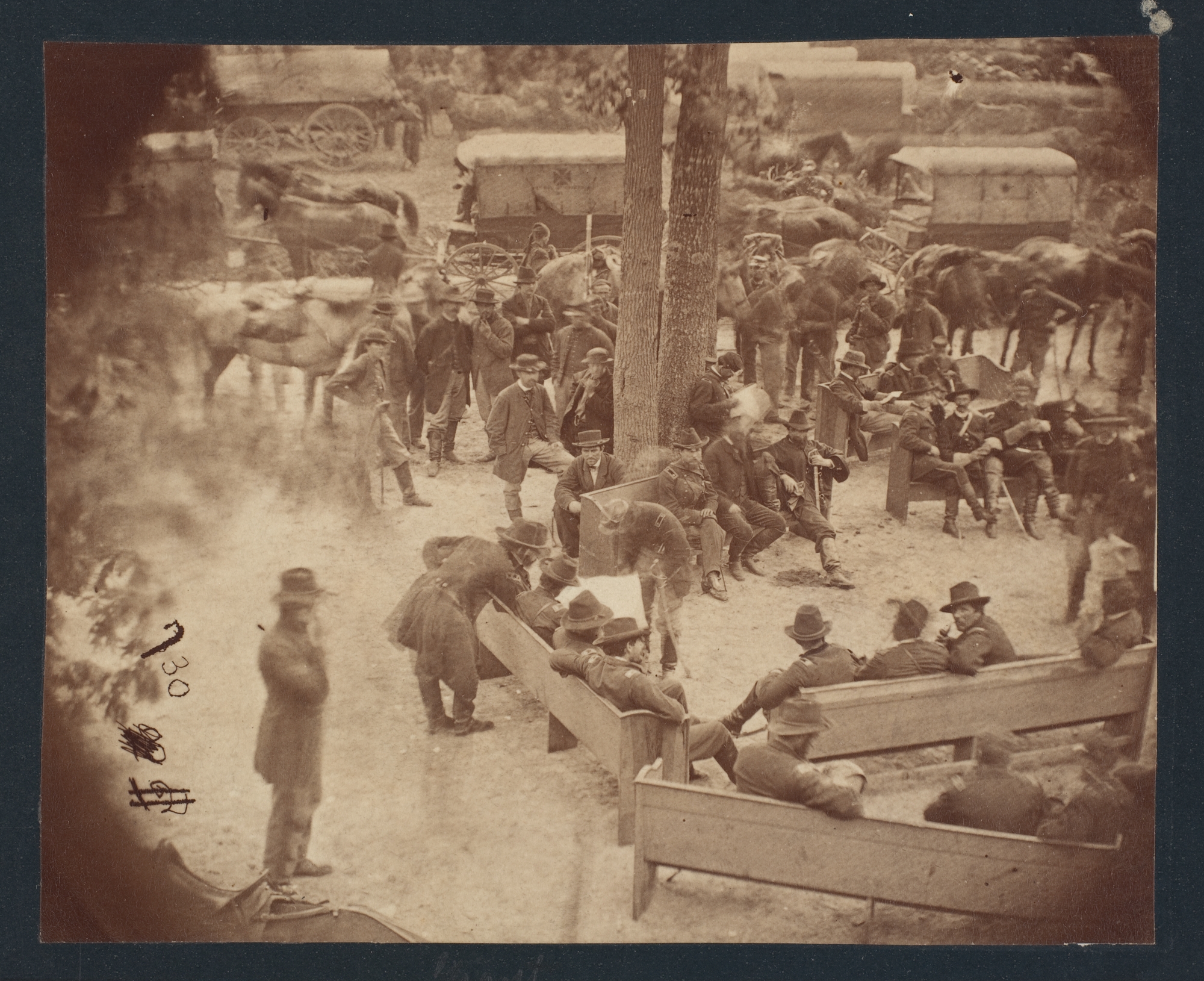
As I woke this morning the nine-part documentary was still playing as it told of how Ulysses S. Grant was able to finally defeat the Confederate General, Robert E. Lee. Lee had successfully defeated a long list of Union generals before Grant. Lee’s army was severely outnumbered and his resolute strategy was to discourage the Union’s resolve to wage war. It was working. When Lee won a battle, the Union’s response had always been to retreat. When Grant lost a battle, however, he refused to retreat. Grant continued to march his army forward no matter the cost or casualties. As one of his soldiers said, “Ulysses don’t scare worth a damn.”

I then read today’s chapter. The Hebrew exiles have begun construction of the Temple in Jerusalem and the repair of the walls. Their regional enemies, however, fear a rebuilt and powerful Jerusalem. So, they set out to thwart the rebuilding. Their strategy? Much like Robert E. Lee, they set out to discourage the Hebrews and break their resolve to rebuild.

In the quiet this morning I’m reminded that God’s Message tells me, as a follower of Jesus, I am engaged in a Level Four spiritual struggle. With the resurrection of Jesus, my enemy’s defeat is made certain, but it did not break my enemy’s resolve. Along my life journey, I have found that the enemy’s strategy is basically the same as Lee’s and the same as the Hebrews’ neighbors in today’s chapter. The enemy wants to discourage me, to diminish my faith and break my resolve to trust and obey the One I follow.

Will I retreat like a long list of Union Generals who always backed down despite overwhelming odds in their favor? Or, will I continue to march forward in the face of an enemy who continually works to discourage me from that resolve?

As I ponder this morning, I can’t help but desire that it would be said of me in the spiritual realm: “That Tom Vander Well. He don’t scare worth a damn.”

Weathering the Storm

 But now I urge you to keep up your courage, because not one of you will be lost; only the ship will be destroyed.
Acts 27:22 (NIV)

Living in the midwest you soon learn that some rather nasty storms can pop up at a moment’s notice. This past summer Wendy and I were witness to a small handful of storms that did considerable damage. It’s always disconcerting to survey the aftermath and find one house almost completely obliterated while the house next door appears to have no damage at all.

I thought of those storm and the damage we witnessed as I read today’s chapter. Paul is in the custody of a Roman centurion making his way to Rome where he is to be tried in Caesar’s court. A terrible storm comes up threatening the lives of everyone on board the ship. Throughout the ordeal, Paul continues to assure the passengers that they will be okay. He urges them to keep up their courage and their physical health. Paul had received an angelic message assuring him that God’s purpose was that Paul stand before the Emperor, not die at sea.

I couldn’t help but contrast the experiences of Paul with another famous sea-faring voyager, Jonah. In Jonah’s case, he was on the run and trying to escape his destiny. His reactions and responses amidst the storm are a stark contrast to Paul.

This morning in the quiet I’m reminded of Jesus’ words: “[Your Heavenly Father] sends rain on the righteous and the unrighteous.” In other words, I can’t escape the storms of life. They will crop up when I least expect them and everyone has to weather them from time to time. The difference between Paul and Jonah, was in their purposes. Paul was sailing with purpose. He was on a mission, and he was confident that the storm was not going to alter his date with destiny. Jonah, on the other hand, was running away from God’s expressed purpose for him.

I can’t stop the storms of life from raging, but the purpose with which I’m walking this Life Journey can make all the difference in how I weather them.

The Work

David also said to Solomon his son, “Be strong and courageous, and do the work. Do not be afraid or discouraged, for the Lord God, my God, is with you. He will not fail you or forsake you until all the work for the service of the temple of the Lord is finished.
1 Chronicles 28:20 (NIV)

When all the work Solomon had done for the temple of the Lord was finished
Then the temple of the Lord was filled with the cloud, and the priests could not perform their service because of the cloud, for the glory of the Lord filled the temple of God.
2 Chronicles 5:3-4, 13-14 (NIV)

King David had been anointed king of Israel by the prophet Samuel while he was still as a boy. Yet, for many years he lived on the run from the reigning King Saul as an outlaw and mercenary. Before becoming King of Israel, first David would be crowned King of his own tribe, Judah. Then began the hard work of reuniting the other tribes into a united kingdom and establishing Jerusalem as its capitol.

From his anointing as King to the fulfillment of the anointing was some 40 years of work to survive, waiting for God to fulfill what had been promised and prophesied many years before.

Once King, David had a passionate vision. He wanted to build a great temple for God in Jerusalem, a permanent version of the tent temple prescribed by God through Moses for the Hebrews as they left Egypt. It would not happen in his lifetime. David made plans, put certain pieces in place, and made provisions. The work, however, would pass to his son, Solomon. “Be strong and courageous,” David admonished his son, “and do the work.”

For over eleven years Solomon diligently carried out his father’s wishes and the construction was completed. It was another year before the dedication would take place.

In today’s chapter, the temple is dedicated. At the inaugural worship service a manifestation of God’s presence, a cloud, fills the temple just as it had filled the tent back in Moses day.

When reading through God’s Message, it’s easy to lose sense of just how long it took for things to happen. David is anointed King, but it took 40 years before it was fulfilled. Solomon promised to build the temple, but it took 12 years of diligent work before it was completed.

Along my spiritual journey I’ve experienced promises, visions, and the prophetic. I’ve also been prone to expect fulfillment in the speed and ease with which I can read David and Solomon’s story from one chapter to the next. When things don’t happen as quickly or as simply as I desired and expected, I fight impatience. Doubts creep in. Faith becomes a struggle. The day-to-day work of pressing on towards the goal often feels like a slog.

This morning as I read about the completion of Solomon’s Temple and as I pictured the cloud of God’s presence being so thick that the priests couldn’t perform their sacrificial work, it struck me that this exciting moment of fulfillment was itself the end of a very long journey. The moment was preceded by a lifetime and two generations of diligent work through faith, struggle, doubt, victory, tragedy, promise, failure, setbacks and hope.

I hear a whisper in my spirit this morning. “Be strong and courageousand do the work.”

And so begins another day.

featured photo courtesy of tjblackwell via Flickr

Speaking the Truth; Hearing the Truth

Then Jeremiah said to King Zedekiah, “What crime have I committed against you or your attendants or this people, that you have put me in prison? Where are your prophets who prophesied to you, ‘The king of Babylon will not attack you or this land’?
Jeremiah 37:18-19 (NIV)

A member of my company’s team recently delivered some research results to a client. The client had not been happy about their recent performance in the market and wanted to know why. So, they approached us and asked our team to conduct a focused survey of their customers.

The story revealed in the data of the survey results was definitely not what our client wanted to hear.

I told them not to shoot the messenger!” my teammate reported to me after meeting with the client’s executive team. “But, it is what it is, ” he continued. “The data doesn’t lie and we had to give them the truth.”

Ugh. I felt for my colleague. I’ve made countless presentations across my career and it’s never fun when the story the data has to tell is going to make you unpopular. You never know how the client is going to react. It’s always possible the client will question the data and blame our company for not knowing what we’re doing. I can recall multiple clients who, after I presented some hard truths our data revealed, quickly deep-sixed the report and never called us again. I’m grateful to say that we have many examples of clients who faced the truth, utilized the data to strategize a turn-around plan, and were eventually grateful for the wake-up call.

I’m also reminded this morning of an experience years ago when I sat on an organization’s board. The organization was not doing well and many of us were convinced that a change in leadership was going to be necessary to move the organization forward. At a regular board meeting the question was asked, “Do we have a leadership problem?”

[cue: crickets chirping]

I confess that I remained silent as did everyone else on the board. The organization’s leader was beloved and no one wanted to confront this person and experience the painful conversation that would transpire if we honestly answered the question. The organization continued to struggle and I’ve always regretted not speaking the truth when I had an opportunity to do so.

Hearing the truth and speaking the truth are both hard. Jeremiah knew this only too well.

Today’s chapter is set in the critical years while the city of Jerusalem was besieged by the Babylonian army. Jeremiah had been predicting this with his prophesies for years even though no one wanted to hear it. During the siege, Jeremiah is arrested for being a traitor and languishes in a dungeon for a long time. Meanwhile, King Zedekiah surrounded himself with prophets who continued telling him what he wanted to hear.

As the situation grows more and more dire, King Zed realizes he needs to hear the truth. He calls Jeremiah from prison and Jeremiah tells him the truth, just as he had always done: “You’re going to be handed over to the King of Babylon.” Jeremiah then takes the opportunity to ask King Zed, “Why am I, the one prophet who tells you the truth, languishing in prison? Where are all the false prophets who tickled your ears with deception and told you only what you wanted to hear? Why aren’t they in the dungeon instead of me?

This morning I’m thinking about all of the layers of life in which I have opportunity to be truth-teller or ear-tickler. I’m thinking of all the places I can embrace truth or choose to ignore it. It happens in relationships, families, organizations, communities, companies, churches, and teams. It even happens with my own internal conversations with self. I can be a truth teller or an ear-tickler. I can be open to hearing the truth or shut my mind and spirit to things I don’t want accept.

In the quiet this morning I find myself choosing, once again, to commit myself to the hard realities of both telling and hearing the truth. I’ve learned along the journey that it may not be pleasant in the moment, but it makes for a more level path down the road.