Tag Archives: Prodigal

Teshuvah

Even if you have been banished to the most distant land under the heavens, from there the Lord your God will gather you and bring you back.
Deuteronomy 30:4 (NIV)

As a parent, I always expected that somehow, in some way, my daughters would rebel. I hoped that I was wrong, but I’ve observed the human condition for too long to harbor any pipe dreams. As I contemplated the eventuality of their wandering — whatever that might look like — I came to a realization.

When it comes to what my young adult children do, the only thing I really control is my response.

I figured that I’d better give that some thought ahead of time. I’m glad I did. Yes, both girls had their season of wandering each in their own way, but those are their stories to tell. What I learned along the way was that my best example for parenting was Father God.

Deuteronomy has had some really tough chapters to slog through. It contains some of the most difficult and challenging of the ancient texts. But today’s chapter stands like a breath of fresh air because it gets at the heart of who God is and what God is all about. In short, God tells His Hebrew children that He knows they’re going wander. It’s not a matter of “if” but “when.” In light of this, He wants them to know teshuvah.

Teshuvah is a Hebrew word we translate into English as “return,” but like many Hebrew words one simple English word cannot contain its meaning.

Teshuvah is “return” as in go back where you belong.

It assumes something breathtaking:

You had a place.
You wandered.
That place still exists.
You are still wanted there.

Teshuvah has a rhythm.

First, there is an awakening. Something stirs. There’s discomfort. “Wait a minute. This isn’t who I want to be.” Clarity – not condemnation.

Next comes the turning. It’s not just a change in thought, it’s physical. You’ve reached second base and are as far from home as possible. You’re facing the centerfield fence. You physically make the turn toward third and the path home is right there waiting.

Then there’s naming. This isn’t a wallow in shame, but the moment of truth telling. It’s the first step of the Twelve Steps. “My life has gotten out of control. This isn’t manageable.”

The way is now open to repairing. Own it. Apologize. Make things right. You carry responsibility without drowning in it.

With that, you return home.

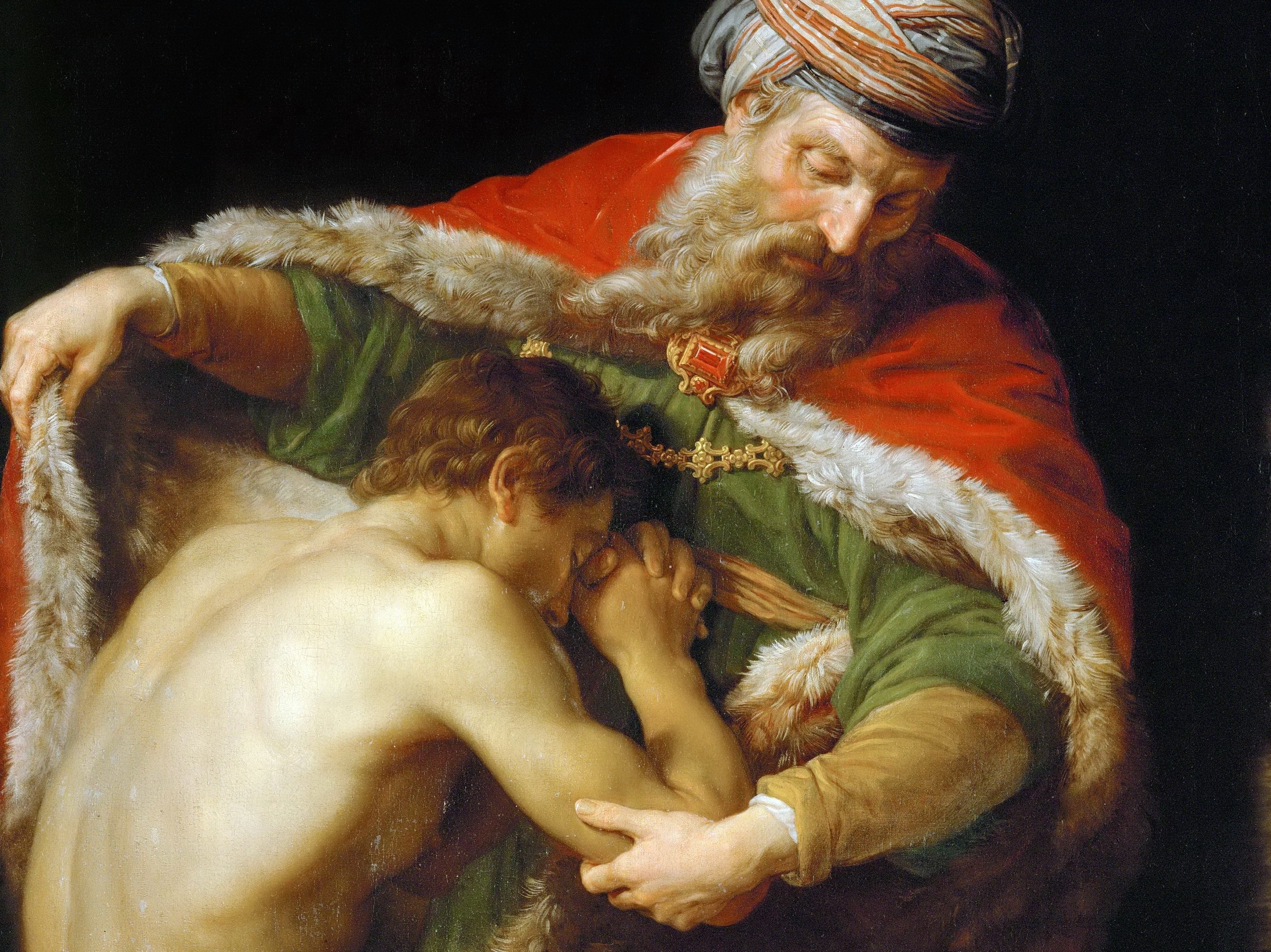
Today’s chapter lays out the theology of teshuvah. Jesus turned it into a love story we know as the Prodigal Son. As a young parent reflecting on how I should respond when my daughters wander, I took note of three things about the Prodigal’s father (aka Father God).

  1. He didn’t go to the distant land to condemn his son and drag him home.
  2. He was sitting on the front porch, eyes on the road, waiting for his son.
  3. He ran down the road to greet his son, and escort him home.

Not a bad example to follow, I thought to myself. Trust teshuvah. Love knows the way home. If I’m wise, I’ll even keep my mouth shut. Directions aren’t necessary.

One of our daughters lived in a commune for a season with a very diverse community of individuals from all over the globe. One day she shared with me that as her comrades shared their stories most of them had no home, no support system, and they lived perpetually on the brink of hopelessness.

They had no where else to go.

“I realized,” my daughter said, “that I will never know that reality. I always have a home I can return to where I am loved and will be cared for.”

Bingo. That’s what Father God wants His children to know with all their heart and soul.

Teshuvah.

Shalom.

If you know anyone who might be encouraged by today’s post, please share.

Promotional graphic for Tom Vander Well's Wayfarer blog and podcast, featuring icons of various podcast platforms with a photo of Tom Vander Well.
These chapter-a-day blog posts are also available via podcast on all major podcast platforms including Apple, Google, and Spotify! Simply go to your podcast platform and search for “Wayfarer Tom Vander Well.” If it’s not on your platform, please let me know!
An orange square icon featuring a simple white outline of an open book.

Final Message

Now, Israel, hear the decrees and laws I am about to teach you.
Deuteronomy 4:1 (NIV)

There is a seriousness about Life that takes stage whenever Death is standing in the wings. I’ve experienced in hospitals and the rooms of hospice. I’ve observed it in homes where families tend to their loved one’s final days. The seriousness can take many different forms, but I find that they are always holy moments.

I find it important as I meditate on the chapters of Deuteronomy to remember that this entire book is one of those holy moments. Death is standing on the banks of the Jordan River in wait for Moses. Moses is ancient. His body is decimated with age. His face is lined with the stress of decades of leadership. Deuteronomy is Moses taking the face of his people lovingly in his withered hands and looking them in the eye one last time. These are the words of his deathbed.

“Listen,” he is whispering with final breath earnestness. “No. Really listen to me.”

When Moses uses the word “hear” it is the Hebrew word shema. It is more than auditory reception. Shema is listening with your heart as well as your ears. It’s hearing channeled into action. It is listening that love transforms into obedience. It’s the same Jesus asked whenever He said, “Those who have ears to really hear, hear this….”

Suddenly, the words of today’s chapter have another layer of meaning. They are the love-filled plea of the man who has given everything to lead his people. I don’t just want to read the words. I want to shema what Moses is communicating in this holy moment as I see Death standing in the background along Jordan’s shore.

Guard the appetites of your heart. Moses begins with a plea to his people to guard their hearts. They serve a living God. They’ve seen what He can do. They’ve heard His voice though they saw no form. There is no form that can adequately represent His being. So don’t fashion idols for yourselves and bow down to animals, or people, or the sun. Don’t give your love and devotion to things that can never love you back.

Be ever aware of God’s nearness. God is with them. He’s pitched His tent in the center of their camp. He goes before them. He goes with them. He is not god up above somewhere. God is always right here, right now.

Remember. Remember. Remember. Moses repeats the word over and over again.

Remember the fire on the mountain.
Remember the voice with no form.
Remember the covenant.
Remember who rescued you.
Remember who claimed you.

Memory is a mentor. The moment you begin to forget you are one step closer towards being lost. Then Moses prophetically foresees that his children, whom he knows all too well, will indeed lose their way.

Home awaits every prodigal. He wraps up his message by reminding them that no matter how far they wander, no matter how badly they lose their way, God is waiting. He’s not waiting with crossed arms but arms that are open. It doesn’t matter what distant pig stye they find themselves mired in. If they, like the prodigal, will seek Him with all their heart they will find Father God there on the porch at home with his eyes glued to the driveway. He just waiting to welcome the prodigal home and celebrate His lost child’s return.

I feel a weight in my meditations in the quiet of my home office this morning. Placing my feet in the sandals of a child of Israel standing along the Jordan River listening to Moses’ heartfelt final plea gives the words added potency. Suddenly the message is more meaningful. Life suddenly gets more serious whenever Death is near.

The neighbor’s diesel pick-up truck has begun to idle across the street. It’s my daily reminder that it’s time to move out of the quiet and into all that awaits me on the calendar and task list of the day. Thankfully, I’m unaware of Death being anywhere nearby today. Nevertheless, I head out with the heart of Moses’ message informing how I want to go about whatever awaits me.

Have a great day, my friend.

If you know anyone who might be encouraged by today’s post, please share.

Promotional graphic for Tom Vander Well's Wayfarer blog and podcast, featuring icons of various podcast platforms with a photo of Tom Vander Well.
These chapter-a-day blog posts are also available via podcast on all major podcast platforms including Apple, Google, and Spotify! Simply go to your podcast platform and search for “Wayfarer Tom Vander Well.” If it’s not on your platform, please let me know!
Icon representing a Bible with an open book illustration, emphasizing scripture study and accessibility.

Who Changed? The Parent or Child?

Who Changed? The Parent or Child? (CaD Lev 20) Wayfarer

“You must not live according to the customs of the nations I am going to drive out before you. Because they did all these things, I abhorred them.”
Leviticus 20:23 (NIV)

Our granddaughter, Sylvie, is an absolute delight. She is also a willful child in excess measure. Once Sylvie sets her will to what she wants or doesn’t want, you are in for the challenge of your life..

Sylvie is currently potty training. She’s taken her own sweet time getting here. When she came to stay at Papa and Yaya’s house last week we quickly discovered this little game she was playing. When her body told her it was time to do the numero dos, she would tell us she had to go potty. We put her on the pot and she would quickly ask for a wipe, use it and then say she was all done without accomplishing the deed. She loves putting the toilet paper in the adult potty and flushing it. Back she went to playing until a few minutes later she said she has to go potty again. Repeat. Repeat. Repeat.

I went along with it the first two or three times, but I was not playing that game all day. What Sylvie doesn’t know is that I successfully raised her Aunt Madison, who was a Grand Master when it came to being a willful child. Sylvie experienced a side of Papa last weekend that she’d never really experienced before. It didn’t change my love for her one iota. She just learned that there’s a serious side of Papa that will meet her toddler willfulness head-on.

When Sylvie is a teenager, and when she becomes a young adult out on her own, my relationship with her will be very different. It’s a natural life progression. Right now, she is a willful toddler who needs loving but very firm and sometimes serious authority from her parents and grandparents to guide her in doing the right and healthy thing.

In this chapter-a-day journey through the book of Leviticus, I have repeatedly used the metaphor of humanity being in its’ toddler stages back in 1500 B.C. One of the hardest things for modern readers of the Great Story to grapple with is that the God of Leviticus seems so different and hardcore than the teachings of Jesus. I think it’s easy to lose sight of who really changed between the two. If our adult daughters, who now have children of their own, behaved in a way I found improper today I wouldn’t shout “NO!” at them with my authoritarian voice, command them to cease, and threaten them with a time-out, being grounded, or inflicting some kind of uncomfortable punishment (not that some parents don’t foolishly still use variations of these tactics with their adult children). That would be silly. They are adults and my relationship with them has changed, though I’m still the same father I was when Grand Master Madison was Sylvie’s age exhibiting her willful shenanigans.

In today’s chapter, God goes back to the sex thing that He addressed with His toddler children two chapters ago. He repeats (you have to repeat things a lot to toddlers) the authoritarian prohibitions of practicing child sacrifice (like the people groups around them were doing) and committing various sexual acts, most all of it referring to incest, which the people groups around them were doing without restraint. The threat of punishment was blunt and severe, just like one threatens a willful toddler.

In the quiet this morning, I thought back to a conversation Wendy and I had with friends over brunch yesterday. The conversation was about children in young adulthood. Children at that stage of human development make some really, really foolish mistakes (the same way we did when we were their age) but a parent must use a far more subtle and nuanced approach in attempting to guide, instruct, and support them towards wise and healthy decisions. The authoritarian toddler stage is pretty easy by comparison. Parenting a young adult requires the surrender, faith, and patience of the Prodigal’s father.

This begs the question, of course, in what ways is God still having to have surrender, faith, and patience with me in my “adult” stages of life? In what aspects of my life am I still being the Prodigal?

If you know anyone who might be encouraged by today’s post, please share.

These chapter-a-day blog posts are also available via podcast on all major podcast platforms including Apple, Google, and Spotify! Simply go to your podcast platform and search for “Wayfarer Tom Vander Well.” If it’s not on your platform, please let me know!

Unexpected

Unexpected (CaD Ezk 1) Wayfarer

In my thirtieth year, in the fourth month on the fifth day, while I was among the exiles by the Kebar River, the heavens were opened and I saw visions of God.
Ezekiel 1:1 (NIV)

Life wasn’t going as planned for Ezekiel. Born into a priestly family, his road in life was as straight and flat as an Interstate 80 in western Nebraska. He would spend his life studying in preparation for his 30th birthday when he would enter the priesthood and begin his priestly duties in the Temple in Jerusalem.

So much for that.

At the age of 26, the Babylonians laid siege to Jerusalem and young Ezekiel was among those forced to make the long 900-mile march to Babylon where he lives in exile with thousands of his people. His momentous 30th birthday arrives, but everything he’s planned for his entire life is gone. There will be no priestly duties in the Temple, which is almost a thousand miles away. Ezekiel finds himself sitting aimlessly by the Kebar River in Babylon. What’s a priest to do living in a foreign land with no Temple in which to perform his duties?

Then, unexpectedly, God shows up.

Today’s inaugural chapter of Ezekiel records the young priest’s first God-given vision, and boy is it a doozy. As I read it in the quiet this morning, I was reminded of a friend in college who described to me what it was like to drop acid. Ezekiel sees some pretty funky-looking creatures. But when you start thinking about the metaphorical meaning and looking at it in the context of the Great Story, it begins to make a lot of sense.

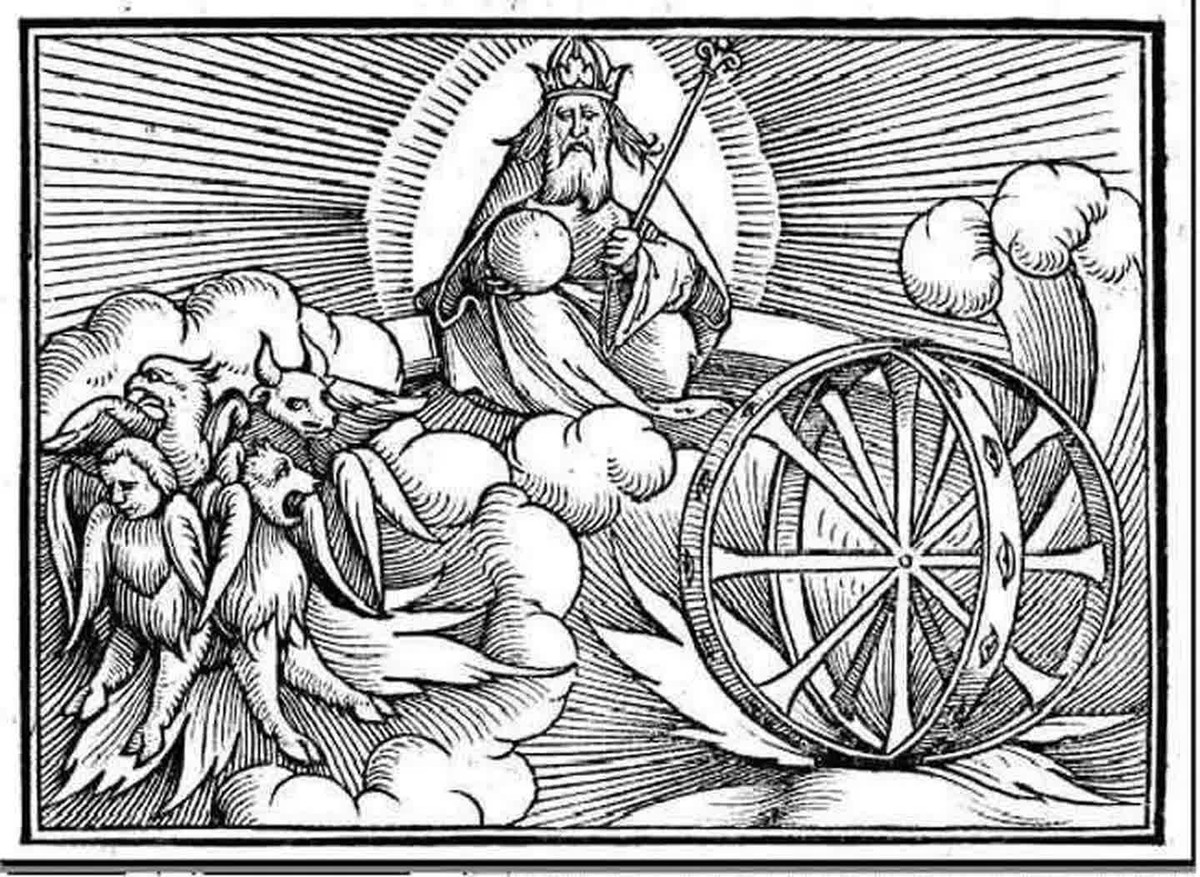
Ezekiel is not alone in receiving visions of God’s throne room. Isaiah had one. The entirety of John’s Revelation is one long vision in God’s throne room. There are many similarities. The number four represents completeness, so four angelic beings (aka Cherubim) with four sides/faces represent the ability to attend to things from all sides. The animals represented are about God’s glory and strength. The intersecting wheels allow for movement in all four directions and the eyes around the rims allow for seeing everything, from every direction. Together, they represent complete attendance to and service of God. Then there’s the Light, the incomparable power and brightness of the light. The “vault” between the cherubim and the throne is the same Hebrew word used in Genesis to describe God separating the waters above from the waters below. In other words, the throne is elevated above and beyond the creatures. It is holy.

Ezekiel may be a thousand miles from the Temple, but he is given a front-row seat in God’s Throne Room. Like Ezekiel, I have discovered along my own life journey that my plans are not always God’s plan.

Ezekiel’s life and prophecies are built upon the foundational theme of exile. It has been argued that exile is the predominant theme of the Great Story. Humanity is exiled from the Garden at the beginning of Genesis and restored into fellowship with God at the end of Revelation. Jesus left heaven to live, teach, suffer, and die in exile on Earth. Joseph was exiled to Egypt, then the Hebrews were exiled to Egypt, and even Jesus was exiled to Egypt. The Jesus movement spread throughout the Roman world in part because persecution drove the early believers into exile. Exile is everywhere in the Great Story.

And, I find that to be a great theme for my own earthly journey. There are seasons of my life that felt like exile because I, like the Prodigal Son, made choices that put me there. In other cases, there were seasons of life when I found myself in places I never expected to be because of circumstances that were largely out of my control. Just like Ezekiel.

The message of Ezekiel is, however, a hopeful one. Ezekiel may be in exile, but God is right there with him. He may not be a priest in the Temple, but God’s got a job for Zeke as His prophet in exile. I also noted as I meditated on this in the quiet this morning that Zeke is not alone. Right up the Babylonian road is a guy named Daniel along with his friends Shadrach, Meshac, and Abednego. They’re living in the same exile, and God has some big plans for using them, too. Despite his feelings of displacement, confusion, and isolation, Zeke is not alone, and he’s right where God has purposed for him to be to accomplish His will.

When I find myself in unexpected places, God shows up in unexpected ways.

If you know anyone who might be encouraged by today’s post, please share.

Faith-less or Un-faithful?

The Lord said to me, “Faithless Israel is more righteous than unfaithful Judah.”
Jeremiah 3:11 (NIV)

There is a stretch of my life journey that I look back on and call “the dark years.” I was angry for a number of reasons, and underneath the anger was an internal struggle with God, with myself, and with my circumstances. In this struggle, I acted out in unhealthy ways.

A therapist friend of mine says that “everyone is having a conversation with Life,” and I have found this to be true in my own experience. During my dark years, I wasn’t ignoring God or pretending He didn’t exist. I was in constant conversation with God. Like a rebellious teenager, I screamed at God. I threw tantrums. I argued with God, I swore at God, and I defiantly did things I was forbidden to do out of spite. And, when my attitude and actions led to really painful places, I found myself walking in the shoes of the Prodigal. I was humbled. I was broken. I was ashamed of the pain I had caused my loved ones, and I returned to the arms of my Heavenly Father and learned what “amazing grace” really means.

The dark years came to mind as I read today’s chapter. It begins with God addressing the southern kingdom of Judah. Judah couldn’t make up their mind regarding their relationship with God. Of their 20 monarchs, nine of them were somewhat faithful to God, while 11 of them followed after the local pagan gods. I can’t help but think of the words of the prophet Elijah from a couple hundred years before Jeremiah: “How long will you waver between two opinions? If the Lord is God, follow him; but if Baal is God, follow him.”

I have to remember that Jeremiah is addressing the people of Judah amidst the religious reforms enforced by King Josiah. The people of Judah are pining for their idols despite the fact that the king has destroyed and outlawed them. They feel no shame about this. Theirs is a life of duplicity and wavering. They want it both ways. They contend to have an open marriage with God. “I should be able to make love to my pagan idols, and God should love and bless me anyway.”

God then tells Jeremiah to consider the northern kingdom of Israel. At the time of Jeremiah’s prophetic sermon, Israel had been destroyed by the Assyrians and led into captivity a hundred years before. Unlike Judah, Israel didn’t waver. They wholeheartedly went after idolatry. Not one of their 19 kings was faithful to God. Like me in my dark years, they flipped off their Heavenly Father in oppositional defiance. And, then they hit rock bottom thanks to the Assyrian Empire.

Now God speaks to Jeremiah as a frustrated yet loving Father. He sees Israel’s outright rebellion as more honest than the duplicitous wavering of her sister, Judah. God uses two different Hebrew adjectives. Israel was “faith-less” (there was no attempt to even pretend they cared) while Judah was “un-faithful” (they toyed and pretended they would be faithful, only to betray God over and over again). Father God then has Jeremiah face the leftover remnants of His people in the north and pleads for the Prodigal to return.

In the quiet this morning, I find myself mulling over my dark years. Ugh! I honestly see the shadow of both Judah and Israel in my own oppositional defiance, neither of them good. But today’s chapter has me contemplating the fact that there is something that God respects in those sinners who don’t even pretend to care about Him in contrast to those who say they love Him and then live as if they love the world and the things of the world. I see this in the way Jesus hung out with the outright “sinners” like Israel while directing His sharpest criticism and condemnation on the “religious” leaders who, like Judah, pretended they were faithful, but whom Jesus described as “whitewashed tombs, which look beautiful on the outside but on the inside are full of the bones of the dead and everything unclean.”

I head into the day with this episode from Matthew 9:11-13 resonating in my spirit:

Later when Jesus was eating supper at Matthew’s house with his close followers, a lot of disreputable characters came and joined them. When the Pharisees saw him keeping this kind of company, they had a fit, and lit into Jesus’ followers. “What kind of example is this from your Teacher, acting cozy with crooks and misfits?”

Jesus, overhearing, shot back, “Who needs a doctor: the healthy or the sick? Go figure out what this Scripture means: ‘I’m after mercy, not religion.’ I’m here to invite outsiders, not coddle insiders.”

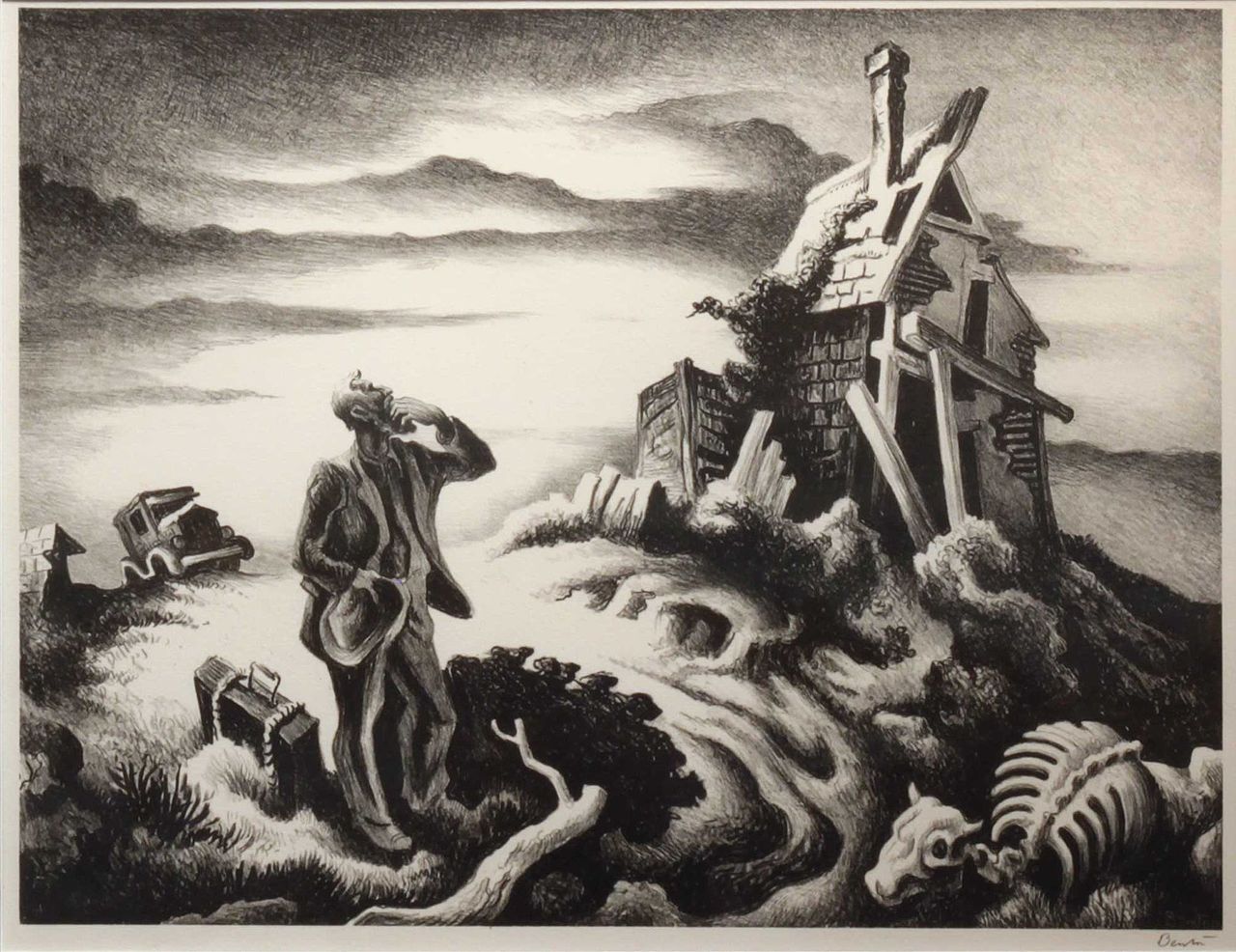
Featured Image: Prodigal Son by Thomas Hart Benton

If you know anyone who might be encouraged by today’s post, please share.

Lost and Found

[King Josiah] stood by the pillar and renewed the covenant in the presence of the Lord—to follow the Lord and keep his commands, statutes and decrees with all his heart and all his soul, thus confirming the words of the covenant written in this book. Then all the people pledged themselves to the covenant.
2 Kings 23:3 (NIV)

One of the common themes of all great stories is when the hero loses his or her way. We see it in Luke Skywalker in Star Wars Episode VIII as he has chosen self-exile. Ron Weasley similarly chooses out in the Deathly Hallows. Edmund loses his way and follows the White Witch in The Lion, the Witch, and the Wardrobe. In The Hobbit, it is Bilbo who loses his way in the Misty Mountains where he happens to find a plain-looking golden ring in the darkness. Despite his insistence that he would never fall away, Peter denies that he knows Jesus three times.

Along my spiritual journey, I have come to embrace that losing one’s way is a common theme for a lot of us. As I look back on my own life journey, I can humbly point back to a period of time I call “the dark years,” in which I lost my way and made many regrettable choices.

In the Great Story told between Genesis and Revelation the theme of losing one’s way is recurring. From the Hebrew tribes “wandering in the wilderness” for 40 years to the exile of Israel and Judah in Assyria and Babylon to Jesus’ parable of the Prodigal Son, the tale of losing one’s way is a familiar one.

In today’s chapter, King Josiah reads the recently discovered Books of Moses to his people. We have no idea how long it had been since the story of Moses delivering the Hebrews from slavery in Egypt and God establishing a covenant with them had been read. It says in today’s chapter that the annual Passover Feast prescribed by God had not been celebrated “neither in the days of the judges who led Israel nor in the days of the kings of Israel and the kings of Judah.” That’s somewhere in the neighborhood of 800 years.

Today’s chapter is essentially about coming home, the Prodigal’s return, and the hero finding his or her way back to the path. Luke shows up to deliver the rebel forces in stunning form. Ron returns just in time to save Harry. Edmund is redeemed and restored by Aslan. Bilbo finds his way back to Thorin and Company with the ring that will help him facilitate the overthrow of Smaug. Jesus restores Peter on the shore of Galilee with three affirmations of his calling. Josiah leads the nation in renewing their covenant with the God who delivered and established them.

In the quiet this morning, I’m reminded that losing one’s way is a very common story. Jesus told stories about lost coins and lost sheep as well as a lost child. The stories are ultimately not about being lost, but about being found. The Shepherd risks the entire flock to search for the lost sheep until it’s found. The Prodigal’s father waits patiently and expectantly on the porch to catch sight of his child’s return. The found book helps Josiah and God’s people to find their way back to God.

I once was lost, but now I’m found.

For the spiritual pilgrim, there’s both encouragement and hope in the revelation that God expectantly desires that I find my way back to Him.

If you know anyone who might be encouraged by today’s post, please share.

The Message in the Moment

The Message in the Moment (CaD 2 Ki 7) Wayfarer

Elisha replied, “Hear the word of the Lord. This is what the Lord says: About this time tomorrow, a seah of the finest flour will sell for a shekel and two seahs of barley for a shekel at the gate of Samaria.”

The officer on whose arm the king was leaning said to the man of God, “Look, even if the Lord should open the floodgates of the heavens, could this happen?”

“You will see it with your own eyes,” answered Elisha, “but you will not eat any of it!”

2 Kings 7:1-2 (NIV)

The stories of the prophet Elisha are so filled with the mysterious and the miraculous that it’s easy for me to get focused on the stories and lose sight of the larger story that’s being told.

After the tribes of Israel were divided into northern and southern kingdoms, the two southern tribes that constituted the Kingdom of Judah clung to the house of David and to the worship of God in Jerusalem. The ten northern tribes making up the Kingdom of Israel denied the house of David and they freely embraced the regional and local pagan gods. Spiritually speaking, the northern tribes were prodigal children, and Father God wanted them to leave the spiritual pig slop of their wayward faith and come home.

The prophetic lives of Elijah and Elisha were exclusively centered among the prodigal children of Israel. They were God’s agents and the sheer number and concentration of miracles that God performed through them during this period of history are rivaled only by the time of Moses and the Exodus and by the ministry of Jesus and His apostles.

As I meditate on this in the quiet, I can’t help but think about what God is saying through each of these three chapters of the Great Story.

In the time of Moses, God’s people are enslaved by Egypt and God desires to free them from their slavery and lead them to a Promised Land.

In the time of Elisha, God’s people have abandoned God, and run away from their spiritual home. God desperately desires to convince them to come home.

In the time of Jesus and the apostles, the world is enslaved to sin and God desires to free me from this slavery so that I might be led to an eternal Promised Land.

I believe the miraculous in each of these chapters of the story are indicative of just how passionate God is in his desire for His creation and His people.

In this context, the story of the siege of Samaria in yesterday’s and today’s chapters take on a deeper and larger meaning than the events they describe. The horrific consequences of the siege should have shaken the leaders of Israel to turn back to God and cry out to God, but they refuse. Even when Elisha (who, along with Elijah, has already performed plenty of miracles that the king and his team know about) announces that God will miraculously lift the siege overnight, the immediate response is doubt. The subsequent miraculous fulfillment shows God’s people how much He wants them to turn their hearts back to Him. The fulfilled prophecy of doom for the King’s doubting official is a stark metaphorical contrast pointing to His people the consequences of their continued spiritual rebellion.

In the quiet this morning, I’m thinking about God’s heart desire as revealed, not only in the events of today’s chapter, but in the sending of Jesus to be the atoning sacrifice for my sin, that I might be in relationship with Him. It’s basically the same message:

“For God so loved the world that he gave his one and only Son, that whoever believes in him shall not perish but have eternal life. For God did not send his Son into the world to condemn the world, but to save the world through him.”

Like God’s people wasting away behind the besieged walls of Samaria, I can choose to believe, or not.

If you know anyone who might be encouraged by today’s post, please share.

“Damned Spots”

"Damned Spots" (CaD James 4) Wayfarer

Come near to God and he will come near to you. Wash your hands, you sinners, and purify your hearts, you double-minded.
James 4:8 (NIV)

There is a classic scene in Shakespeare’s Macbeth. Lady Macbeth and her husband murder the King of Scotland who is spending the night in their home. Macbeth had received a prophetic word that he would be King. The King unexpectedly shows up for a visit on his travels through the region. The couple decide that it’s their place to make the prophecy come true. They murder the King.

In classic Shakespearean story-telling, the murder successfully launches a chain of events to put Macbeth on the throne. It also launches a chain of events that destroy the couple.

In the final act, Lady Macbeth is descending into madness. Her servant notes that Lady Macbeth often walks in her sleep and acts strangely. She and a physician watch together as Lady Macbeth, sleepwalking in the middle of the night, struggles to wash the blood of her victim off her hands…

Out, damned spot! out, I say!-
…who would have thought the old man
to have had so much blood in him.

What, will these hands ne’er be clean?

Here’s the smell of the blood still: all the
perfumes of Arabia will not sweeten this little
hand. Oh, oh, oh!

Wash your hands, put on your nightgown; look not so
pale.–I tell you yet again, Banquo’s buried; he
cannot come out on’s grave.

To bed, to bed! there’s knocking at the gate:
come, come, come, come, give me your hand. What’s
done cannot be undone.–To bed, to bed, to bed!


Macbeth Act 5 Scene 1

Almost anyone who has committed awful acts can attest to the fact that a guilty conscience can really do a number on you. I know this because I write from personal experience. Along my life journey, my hands have been stained with the consequences of my own willful transgressions. I remember the pit of despair, the sleepless nights, the heaviness of soul that reverberates with Lady Macbeth’s question: “What? Will these hands ne’er be clean?”

In today’s chapter, James begins by calling out those who have allowed unchecked passions, appetites, greed, and selfishness to lead to transgressions and the dark consequences of the soul that accompany them. James urges:

Come near to God, and he will come near to you.

Like the Prodigal Son, like Lady Macbeth, when I wallowed in the slop of my own making and wrung my hands in hopes of washing away the stains, it was a futile exercise. It was only when the Prodigal returned home and “came near” to his Father that things began to change.

Wash your hands…

Notice that the washing of hands comes after the “coming near.” This is not a coincidence because it’s not me doing the washing. It was Jesus who washed my feet of the dirt of where I’ve been. It is the Living Water that springs up to wipe the stubbornly stained conscience clean.

In his letter to the followers of Jesus in Corinth, Paul addressed those among the local gathering who had once been immoral, adulterers, drunkards, and slanderers. “But you were washed, you were sanctified, you were justified in the name of the Lord Jesus Christ and by the Spirit of our God.

Purify your hearts

Purification from my sins is not something I did. It was something Jesus did for me. Once again, like the Prodigal, all I did was to come near and confess.

And, as John wrote to the followers of Jesus: “If we confess our sins, he is faithful and just and will forgive us our sins and purify us from all unrighteousness.”

I found myself, like the woman caught in adultery. One moment I was lying in the naked shame of what I had done. The next moment I find that Jesus had not condemned me, but had washed me, purified me, and given me a clean start.

“Go,” He said, “and don’t go back to those dark, dirty places.”

This is what I found crucial to understanding the way of Jesus. The repentance, or turning away from sin, was not the result of being shamed, condemned, and/or threatened. It was the result of experiencing Jesus’ kindness as He washed my stains clean and purified my spotted soul when I didn’t deserve it.

Macbeth and his Lady, I’m afraid, did not experience this grace and forgiveness. Lady Macbeth dies, leaving her husband to cynically reflect on their lives, the futile mess they’d made of things, and the meaninglessness he finds of it all:

It is a tale
Told by an idiot, full of sound and fury,
Signifying nothing.

In the quiet this morning, I find myself grateful that in the deepest and darkest stretches of my journey, I was afforded the grace to “come near” to Christ and experience my “damned spots” washed clean.

If you know anyone who might be encouraged by today’s post, please share.

The Song and the Story

The Song and the Story (CaD Ps 136) Wayfarer

to him who led his people through the wilderness;
His love endures forever.
Psalm 136:16 (NIV)

Psalm 136 is one of the most fascinating of all the songs in the anthology of ancient Hebrew song lyrics we all the book of Psalms. The ancient Hebrew songwriter crafted it in such a way that the the meaning and metaphor of the lyrics are as much in the structure as they are in the words. First, there’s the organization of the the theme:

  • Six verses about creation
  • Six verses about the Hebrews deliverance from slavery
  • One verse about the Hebrews being led through the wilderness
  • Six verses about the Hebrews conquest of Canaan
  • Four verses that echo/summarize the previous themes
  • A final call to praise God

There is no other psalm in the anthology of ancient Hebrew song lyrics that utilizes the call and response device as this song does. Twenty-six times the refrain “His love endures forever” is used. That number is important because for the ancient Hebrews, the letters of their alphabet also did double-duty as numerals. Every letter was used as a number. When you add up the numerical values of the letters of the Hebrew name for God: YHWH (Note: the Hebrew alphabet doesn’t have vowels) the total is, you guessed it, 26.

As I thought about the structure of the song, I couldn’t help but think that it parallels every life story, my life story.

I have a creation story. There’s the time in which I was born, the family in which I was raised, the community of my childhood, and the events that set me on my path in life.

Like the Hebrew exodus from slavery, I have climactic events that shape and define my life journey. My decision to follow Christ and subsequent call to proclaim His message, my being cast in a film and meeting the mentor who would play an instrumental part in my life, my early marriage, the births of Taylor and Madison, the divorce that would end my first marriage after seventeen years, and the unexpected arrival of Wendy in my life.

Like the Hebrew wilderness experience, I have my own stretch of life’s road in which I wandered in the wilderness of my own choosing. I chose the path of the prodigal. I ran. I squandered. I was unfaithful to those I loved most. I had my own pig-slop “Aha!” moment. I had to find my way back.

Like the Hebrew conquest, I have my own slate of victories in life. I have accomplishments, awards, and successes.

And, through it all, God’s faithful, enduring love is woven through every major success and every tragic failure. His love is woven through my best moments and my worst. In his letter to the followers of Jesus in Corinth, Paul wrote that at the end of the Great Story that contains all stories, including mine, there are three things that remain: faith, hope, and love. he adds, “The greatest of these is love.”

In the quiet this morning, as I look back at my own story, I am realizing just how much God’s love shows up like the repeated refrain of Psalm 136. I am also reminded that like the 26 love refrains the song writer metaphorically employed to point me to God, Yahweh, I am pointed to a God who is love incarnate, which is the destination and goal of my entire story and life journey through this world. If I’m not growing into love in increasing measure as Jesus defined it, then I am (perhaps even with the best of intentions) headed in the wrong direction.

An Ancient Ritual; A Fresh Perspective

When all the people were being baptized, Jesus was baptized too.
Luke 3:21 (NIV)

Last week when our family was in South Carolina to celebrate the marriage of our daughter Madison to our new son-in-law, Garrett, we attended their local gathering of Jesus’ followers on Sunday morning. It was a celebration Sunday and several believers were baptized by immersion in a large baptismal pool that had been set up in the middle of the auditorium. It was fun to hear their stories about faith, following, and how Jesus had transformed their lives. The baptisms took place right in the middle of a loud, raucous, worshipping crowd singing and praising at dangerous decibel levels. There were so many people it was standing room only. Inspiring to say the least. Madison said it’s her favorite Sunday of the year, and I’m glad we experienced it.

My visit to the Holy Land many years ago changed the way I understood and experienced the Great Story. One of the things that changed drastically on that trip was my understanding of baptism. In Jesus’ day, ritual baptism was widely practiced by the Jewish people. In the wilderness around the Dead Sea there lived a colony of the monk-like ascetic priests, a Jewish sect called the Essenes. They believed in poverty, simplicity, benevolence, and daily ritual baptism. In the caves where they lived, you can still see the intricate system of baptismal pools in which their daily baptism was practiced.

Scholars believe that the Essene priests were celibate, and it is believed that they took orphans into their community to be raised in their ways and to grow their community. In yesterday’s chapter, Dr. Luke shares the story of John the Baptist’s miraculous conception to the elderly priest, Zechariah, and his wife, Elizabeth. In today’s chapter, the good Doctor fast-forwards to an adult John the Baptist living simply like a hermit in his camel-hair robe in the wilderness around the Dead Sea, preaching repentance, contentment, and baptism. He sounds exactly like an Essene. Born to elderly parents, it doesn’t take a huge mental leap to envision John being orphaned at a young age and his priestly family sending him to be raised by the Essenes, or perhaps a young John choosing to join the sect.

Being raised in the institutional protestant tradition of the Western church, baptism is considered one of the significant sacraments. Babies are sprinkled or adults are immersed. Most Christian theological traditions hold to baptism being a once-in-a-lifetime event. There are very strong feelings about the theology of baptism. Along my life journey, I’ve come to a very different conclusion than the tradition in which I was raised, especially after my visit to Israel and my exposure to the ancient tradition of ritual baptism that preceded and informed the Christian sacrament.

Baptism is a ritual of metaphor just like the sacrament of communion. It’s a sign and a visible word picture. Jesus said, “I am the water of life.” When a believer is plunged into the water it signifies dying to self and being buried in the likeness of Jesus’ death. When the believer rises up out of the water it signifies being raised to a new life in the likeness of Jesus’ resurrection, their sins washed away. It’s a ritualistic way-point on one’s spiritual journey, a fresh start, a new beginning, and an external, public proclamation of an inner-spiritual transformation.

Along my own spiritual journey, I can tell you that my spiritual path has wound itself through some pretty dark places. I’ve experienced my own periods of wilderness wandering. I have found myself the prodigal in far-away lands. I’ve discovered that my own spiritual journey is not a linear, straight-and-narrow interstate but a cyclical, meandering footpath. There are spiritual fits and starts. There are periods of stagnation, moments of repentance, and periodic commitment renewals. I think a ritual cleansing is a perfectly appropriate metaphor for important way-points along the journey. Just as the bread and cup can be a regular reminder of Jesus’ sacrifice, baptism can be a personal statement amidst a supportive community that marks an important shift in one’s spiritual trek.

In my spirit this morning I am still hearing the shouts of celebration, the screams of joy, and the ear-splitting worship that I witnessed with Madison and Garrett’s faith community in South Carolina. I had the opportunity to watch as some of those who were baptized walking out of the auditorium, dripping wet, wrapped in towels as they went to change into dry clothes. Every one of them was smiling, laughing, and visibly ecstatic. I couldn’t help but think to myself, “that’s the metaphor of baptism!” Washed clean, made new, old things passing away, and a fresh start on the right path in a good direction.

Who couldn’t occasionally benefit from that along a long spiritual journey?

Take me to the river.