Tag Archives: Zakhor

Stories and Choices

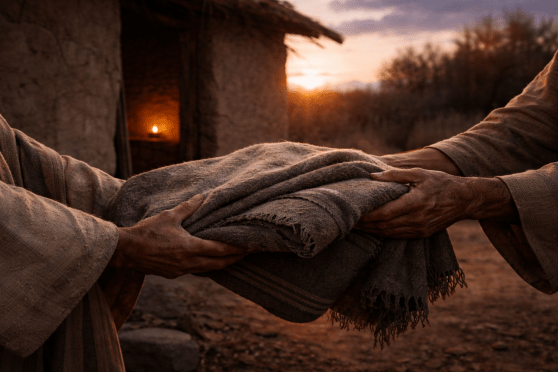
If the neighbor is poor, do not go to sleep with their pledge in your possession. Return their cloak by sunset so that your neighbor may sleep in it. Then they will thank you, and it will be regarded as a righteous act in the sight of the Lord your God.
Deuteronomy 24:12-13 (NIV)

Along this chapter-a-day journey, I have often referenced being a historian of my family. I was a young man when I began really digging into the past and peeking into the dusty corners of the proverbial family attic. At that point in my life journey I was on a quest of self-discovery.

My quest has revealed many things over the years. I discovered plenty of the things families don’t talk about. Most all of the flaws of everyday humanity were lurking there. I learned stories of addiction, adultery, divorce, suicides, illegitimate children, and individuals leading secret second lives.

There was also plenty of dark tragedy that was brought to light. One of my great-great grandmothers was farmed out to be a live-in housekeeper for a distant family. When one of the sons of the family got her pregnant and refused responsibility, she was left with few options. Her own sister took her in, but forced her to live in Cinderella-like seclusion not wanting anyone to know she was there.

I learned that one of my great-grandmothers was a gold digger whose many failed marriages reaped tragic results for her and two of her children.

What I also witnessed in learning my family stories, however, is a lot of human decency. My grandparents for years took care of an elderly widow who lived down the block and had no one else to care for her. I had a grandfather who gave his deadbeat alcoholic brother a second chance. He quietly did the right thing by his family even after his family unjustly gave him the shaft. There are stories of financial generosity, giving friends a place to live, helping friends and neighbors with goodness and loving kindness.

“Remember” is a word Moses uses three times in today’s chapter. He returns to what Jewish teachers called zakhor, memories that help build moral muscle.

Today’s chapter is a collection of rules Moses gives his children and grandchildren as he prepares to send them off into life while he himself lies on his deathbed. The thread that I found running through Moses’ directives is basic human decency.

Divorce with decency for the woman who has zero power or standing in the culture of that day.

Don’t take a millstone—someone’s livelihood—as collateral, and leave them with no means to earn a wage.

Don’t treat your own people with contempt.

A person may owe you money and give you their cloak as collateral, but you return that cloak before nightfall. Don’t leave the poor soul cold at night.

You don’t kill children as justice for their parent’s wrongdoing, nor kill a parent for their child’s wrongdoing. Justice is for the offender, not their family.

Pay your employees promptly. Do right by those who work for you.

Do right by the poor and needy, as well. Leave harvest leftovers in the field and on the limbs and vines for the stranger, orphan, and widow to pick and eat.

As I meditated on all these things, I realized that today’s chapter was the foundation on which Jesus’ built His teaching. It’s doing right by others. It’s treating others the way I’d want to be treated. It’s using whatever authority, power, and means God’s blessed me with to love, serve, and provide – not just to those I know and love, but to those in need, even strangers, foreigners, and enemies.

In the quiet, my own zakhor memory rummaged through all of my family stories. Those stories include examples of individuals who, by faith, embodied the loving-kindness and generosity Moses (and Jesus) prescribe in today’s chapter – and those who didn’t.

This leaves me with the realization that I have a choice.

I can join one group or the other in the collective legacy of zakhor memories my great-great grandchildren will inherit. My choice is determined in a million daily thoughts, words, and actions.

If you know anyone who might be encouraged by today’s post, please share.

Promotional graphic for Tom Vander Well's Wayfarer blog and podcast, featuring icons of various podcast platforms with a photo of Tom Vander Well.
These chapter-a-day blog posts are also available via podcast on all major podcast platforms including Apple, Google, and Spotify! Simply go to your podcast platform and search for “Wayfarer Tom Vander Well.” If it’s not on your platform, please let me know!
An orange icon featuring an open book with a white outline, representing reading or educational content.

A Land That Drinks Rain

The land you are entering to take over is not like the land of Egypt, from which you have come, where you planted your seed and irrigated it by foot as in a vegetable garden. But the land you are crossing the Jordan to take possession of is a land of mountains and valleys that drinks rain from heaven.
Deuteronomy 11:10-11 (NIV)

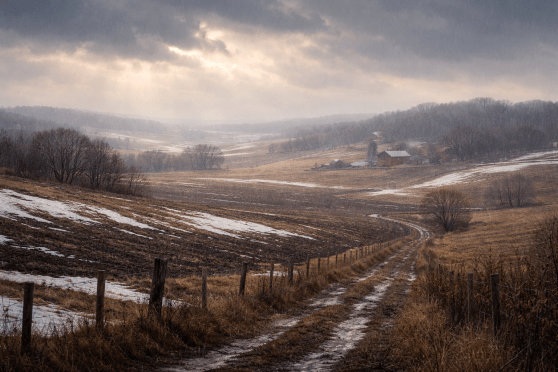
It’s not even Christmas and our driveway has required shoveling more times already than a few entire winters of recent memory. Last weekend Wendy and I were driving through a snow storm.

“Well, the farmers will be happy,” Wendy said.

That is such an Iowa thing to say. When you live in a state that drives nearly $50 billion dollars in annual revenue from crop production, agriculture is always part of the conversation. But for children of Iowa, it’s more than just money. We know that the fertile fields of Iowa feed the world. Closer to home and hearth, we know that farming is the life-blood and legacy of families.

Growing up in Iowa, you quickly learn that weather isn’t just about comfort or recreation, it’s an essential element of life, provision, and prosperity.

On a macro level, Moses’ words to the Hebrews crossing into the Promised Land in today’s chapter are about the blessings of love, legacy, and loyalty contrasted with the curses of apathy, forgetfulness, and hearts that wander. Right in the middle of the chapter (ancient Hebrew writers loved to put the most important bits in the center of the text), is a fascinating reference. Meteorology as metaphor: rain.

Back in Egypt, Moses reminds his people, water had to be industrially stored and channeled. Irrigation systems required. Humans digging, tunneling, manufacturing ways to make water work for them—that’s human empire. Human ingenuity finding ways to do what God does naturally by divine means. Humans have been doing that since the Tower of Babel.

The Promised Land, Moses tells his children, is God’s country. It is a land God Himself waters with rain from heaven. Rain is God’s blessing on the land and the people. God’s blessing, however, requires…

Faith, not function
Trust, not contraptions
Love, not labor.

This is God through Moses laying another layer of metaphor to lovingly communicate what He’s been saying all along. I’ve chosen and called you to be different than this world and the kingdoms of this world. Not because you deserve it or earned it but because of my love, grace, and mercy. Love me, trust me, follow me and rain will fall from heaven and you will be blessed with abundance and prosperity you can scarcely imagine.

Then comes the hard side of love. It isn’t punishment, it’s consequence.

There is a consequence, a curse, that comes if love, trust, and fidelity fade and fail. The skies close up. Drought conditions set in. At some point things resort back to the function, labor, and contraptions. When that happens, God’s people will be just like all the other kingdoms of this world.

The message I found flowing through the chapter in the quiet this morning was that the danger is not rebellion or disobedience. The danger is forgetting. Moses’ mantra thus far in his deathbed message has been the steady rhythmic beat of Zakhor: remember, remember, remember. Remembering what God has done is the crucial first step and activating ingredient in Life and blessing. Forgetting leads down a very different path.

“Believe me,” Moses urges his children, “you don’t want to go there.”

In a little divine wink, I’ve been hearing waves of heavy rain hitting the window of my office as I’ve been writing these words. I pulled up the radar. It’s a chilly Iowa winter morning, but well above freezing. A heavy rain is melting the snow from last weekend’s storm and soaking the slumbering earth.

In coffee shops all over Iowa, farmers sitting patiently through the death of winter and looking to the promise of Spring are smiling. A soaking winter rain. It’s a good thing. Gotta love it. But, it’s not a guarantee. Gotta have faith, too. Spring is still a long season away.

Rain is a gift.
So is remembering.
And faith, like spring, is something we wait for—but also something for which we prepare.

If you know anyone who might be encouraged by today’s post, please share.

Promotional graphic for Tom Vander Well's Wayfarer blog and podcast, featuring icons of various podcast platforms with a photo of Tom Vander Well.
These chapter-a-day blog posts are also available via podcast on all major podcast platforms including Apple, Google, and Spotify! Simply go to your podcast platform and search for “Wayfarer Tom Vander Well.” If it’s not on your platform, please let me know!
Spotify logo with an orange background and an open book icon, representing the listening platform.

Stiff-Necked, Still Chosen

Understand, then, that it is not because of your righteousness that the Lord your God is giving you this good land to possess, for you are a stiff-necked people.
Deuteronomy 9:6 (NIV)

Yesterday’s post faded to black with me and Wendy sitting at the breakfast table naming our blessings and whispering after-meal blessing of gratitude. If I’m not careful, this chapter-a-day journey too easily compartmentalizes each chapter. While I love the rhythm of letting one chapter speak in to my day, I try not to forget that there is a flow to the text. Yesterday’s chapter and today’s chapter are connected.

Yesterday’s chapter and my meditations fit hand-in-glove with the Christmas season. My soft heart loves Christmas. Every day brings cards and photos of family and friends we don’t see often enough. With each one are fond memories and good feelings. Wendy and I have been watching beloved Christmas movies (yes, Die Hard is a Christmas movie) and feeling all the feels. Family gatherings are planned. I can feel the desire to be together, to name our blessings, and to feel the gratitude.

This is sentimental remembering. Warm feelings, meaningful memories, and full hearts that feed the positive emotional endorphins. That’s where I exited yesterday’s post.

Today’s chapter, however, channels a very different kind of remembering.

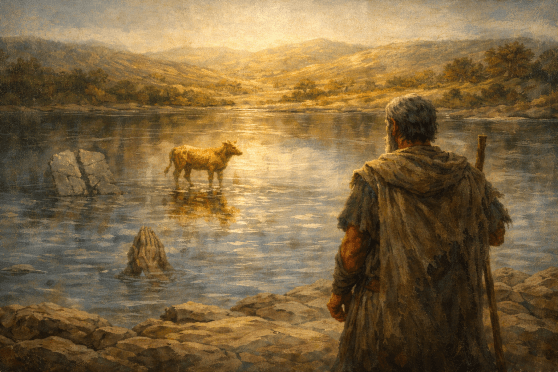
Moses stands at the Jordan River with this next generation of Hebrews gazing across at the Promised Land. They are about to cross over and take possession of it while Moses stays behind and takes his final earthly breath. They will take the land. They will be blessed. They will prosper. But, Moses tells them, there is a truth that needs to sink deep into their hearts before they set out. It is a truth so spiritually vital that Moses repeats it three times like Jesus asking Peter three times: “Do you love me?”

…do not say to yourself, “The Lord has brought me here to take possession of this land because of my righteousness.” (vs. 4)

 It is not because of your righteousness or your integrity that you are going in to take possession of their land… (vs. 5)

Understand, then, that it is not because of your righteousness that the Lord your God is giving you this good land to possess, for you are a stiff-necked people. (vs. 6)

Moses then painfully and deliberately hits the rewind button:

Golden calf.
Stiff necks.
Tablets shattered like dropped china.
Tear-stained intercession that kept the nation from annihilation.

The message lands bare and unflattering:

You didn’t earn this.
You didn’t deserve this.
And you still don’t.

Which—oddly enough—is very good news.

This is what is known in Hebrew as zakhor—not memory as the emotional fog of sentimentality, but memory as moral restraint.

It is Cain remembering the stain of his own brother’s blood on his hands.

It is Abraham remembering the painful casting away of Hagar and his son Ishmael.

It is Israel remembering that he was a deceiver who stole his brother’s blessing.

It is Moses remembering his murder of an Egyptian overseer, fleeing for his life, and his years of living on the lam in Midian exile.

It is David remembering his adultery with Bathsheba, his murder of her husband, and the death of their first-born child.

It is Paul seeing the face of Stephen and all of the other believers he persecuted and had executed before he met Jesus on the road to Damascus.

It is me remembering my long list of moral failings. Failings that trace all the way back to being a five-year-old stealing all the envelopes of Christmas cash off of Grandma Golly’s Christmas tree and hiding them in my suitcase.

In the quiet this morning, sentimental twinkle-light memories get balanced with the sobriety of zakhor memories. Moral memory isn’t shame, it’s schooling. It’s not reproach, it’s reinforcement of reality.

All of this abundance of blessing that surrounds me each day? The blessing that is so abundant that I sometimes forget that’s it’s a blessing?

I didn’t earn this.
I didn’t deserve this.
And I still don’t.

“For it is by grace you have been saved, through faith—and this is not from yourselves, it is the gift of God— not by works, so that no one can boast.”

Moses is channeling the Gospel of Jesus 1500 years before Bethlehem.

As I soak in a little moral remembering this morning, I find my heart humbled. Like the Hebrews standing on the border of the Promised Land, I find myself chosen, called, and blessed – not because of who I am and what I’ve done but despite it.

Sometimes the fog of sentimental remembering lulls me into thinking that blessing is an entitlement. Moral remembering cuts through the fog and grounds me in the reality of His grace.

As Bob Dylan sings,
“like every sparrow fallen,
like every grain of sand.”

If you know anyone who might be encouraged by today’s post, please share.

Promotional graphic for Tom Vander Well's Wayfarer blog and podcast, featuring icons of various podcast platforms with a photo of Tom Vander Well.
These chapter-a-day blog posts are also available via podcast on all major podcast platforms including Apple, Google, and Spotify! Simply go to your podcast platform and search for “Wayfarer Tom Vander Well.” If it’s not on your platform, please let me know!
An inviting breakfast table set with plates and cups, capturing a moment of gratitude and conversation between two individuals.