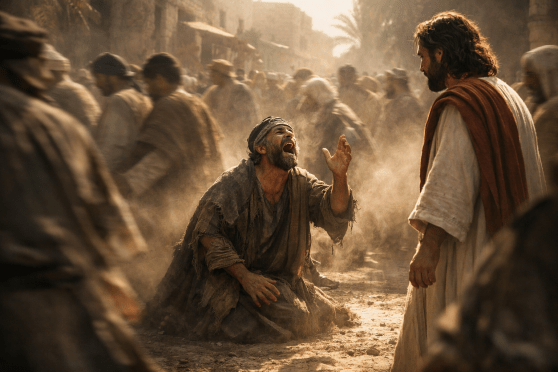
Those who led the way rebuked him and told him to be quiet, but he shouted all the more, “Son of David, have mercy on me!” Luke 18:39 (NIV)
When I was in college studying acting, my professor sent us on an unusual assignment. He sent us a few miles up the road to a busy shopping mall. We were told to sit in the middle of the mall for at least two hours.
Watch people. Really observe them. How they move. Their unusual tics. The particular way they behave with others.
The goal was to teach me as an actor about creating a realistic and believable character on stage. It’s more than memorizing lines and regurgitating them on stage. It’s about creating a real person.
With a particular gate to his walk. Mannerisms unique to his character. A specific way he reacts and responds physically.
That lesson profited me far beyond my training for the stage. The importance of observation was an entire life-lesson. It had spiritual implications.
In my daily life. On this chapter-a-day journey. I keep the eyes and ears of my heart open. Observing. Watching for patterns, repetition, and surprises.
As I read and meditated on today’s chapter, I noticed something.
The chapter is book-ended with a parable and an episode. There’s a connection.
The parable concerns a judge and an old widow. A widow in the culture of Jesus’ day was a nobody. Marginalized. Poor. Zero social status. Everyday she begged the judge to hear her case. Everyday. She made herself annoying. Until the judge heard the case just to shut her up.
At the end of the chapter, Jesus is walking through a crowd. On the side of the road was a blind man. A beggar. He shouts, “Jesus, son of David, have mercy on me!” Again. And again. And again. Annoyed, those around him tell him to shut up. He yells louder. Jesus stops. Calls the man over, and heals him.
The widow knocked on the judge’s door. The blind man shouted into the crowd. Different scenes. Same audacity.
A week or so ago, I was struck by a similar parable Jesus told. The neighbor who begs for bread at midnight. Shameless audacity. Socially inappropriate.
What struck me as I meditated on these things this morning was that I was observing a pattern in the parables and stories that are lifting off the page for me in the quiet.
Prayer. Pleading. Persistence. A holy refusal to be ignored.
It’s a Holy Spirit whisper.
“Pray Tom. Keep praying. Be bold. Be audacious. Don’t stop. Try to annoy me.”
And so in the quiet this morning and observable pattern informs me of my marching orders.
And with that, I will finish this post.
I have some praying to do.
If you know anyone who might be encouraged by today’s post, please share.
These chapter-a-day blog posts are also available via podcast on all major podcast platforms including Apple, Google, and Spotify! Simply go to your podcast platform and search for “Wayfarer Tom Vander Well.” If it’s not on your platform, please let me know!
The Lord said to Moses, “Give this command to the Israelites and say to them: ‘Make sure that you present to me at the appointed time my food offerings, as an aroma pleasing to me.’” Numbers 28:1-2 (NIV)
Here in Iowa I continue to feel the natural change in seasons. Yesterday morning as I set out on a walk it was almost chilly. Later in the day when I went out to check the mail, my body was still expecting the blast furnace heat of the summer sun. Instead, I almost shuddered with the crisp coolness of the air.
This change is part of the natural rhythm of creation and every year this change brings back a flood of memories. The return to school and coming home to mom’s chocolate chip cookies and afternoons playing football in the back yard with the neighborhood kids. The excitement of Friday nights at the high school football game. The smell of burning leaves and countless pillars of smoke rising into the sky for blocks and blocks.
Just this past week as Wendy and I took some vacation we took time to talk about and review our rhythms. Labor Day weekend itself has become a ritual for us and four of our friends who have spent the weekend together for every year for years. It’s become part of the annual rhythm of our lives. But we have daily rhythms and weekly rhythms, as well, whether or not we are even conscious of it.
As Wendy and I examined our daily rhythms we came to the conclusion that things needed some tweaking. Rhythms can be healthy and productive, but sometimes what started as a good thing slowly leads towards the shadow side. Less productive, less healthy, and less life-giving. Sometimes it happens so slowly and subtly that you hardly notice.
In today’s chapter, as the Hebrews sit encamped across from the Promised Land and prepare to enter in, God tells Moses to remind the people of the sacrifices, offerings, and festivals that He had prescribed 40 years before at Mount Sinai. Daily rituals. Weekly rituals. Monthly rituals. Annual rituals.
Spiritual rhythms.
For modern readers, this can easily feel repetitive and silly. Don’t they have a PDF of all this on the hard drive? Why all the repetition?
But that’s just it. They didn’t have a PDF or a hard drive. The written word was rare and the ability to even read or write was just as rare. People needed to be told things, and important things needed to be repeated. Repetition is the key to memory, like crisp fall mornings conjuring dreams that I have to return to high school because there was a class I failed to take.
God is drawing His people near at this momentous inflection point in their journey. Remember who I am. Remember who you are. Things are about to change. I was with you on the road out of Egypt. I’ve been with you on the road through the wilderness. I will be with you on the road in to the Promised Land. These rhythms of offering, sacrifice, ritual, and communion will provide you with the daily, weekly, monthly, and annual connection points you’ll need.
Spiritually, I need my rhythms, too. I need to be mindful of my rhythms. I need rhythms that help connect me with God and others. I need rhythms that foster Life and shalom in increasing measure. This means that sometimes I have to stop. I have to examine my rhythms. I might even have to make some changes. Which is exactly what Wendy and I have implemented this week.
But one rhythm that won’t change is early mornings in the quiet with God, reading a chapter-a-day, meditating on what the Great Story has for me, and sharing it here.
Thanks for being a part of my rhythm, friend.
If you know anyone who might be encouraged by today’s post, please share.
These chapter-a-day blog posts are also available via podcast on all major podcast platforms including Apple, Google, and Spotify! Simply go to your podcast platform and search for “Wayfarer Tom Vander Well.” If it’s not on your platform, please let me know!
On the eighth day Moses summoned Aaron and his sons and the elders of Israel. Leviticus 9:1 (NIV)
I have learned over almost 45 years as a disciple of Jesus that this spiritual journey as His follower is all about my transformation. It’s the gradual migration from my earthly and worldly mindset into having my mind fixed on the things of God. Treasures on earth lose their perceived value for me as spiritual treasures are considered increasingly more priceless in my mind. What I desire becomes less significant (in fact I desire things less) and what God desires of me becomes more of a priority. This is literally what Paul was writing about when he told the Corinthian believers: “Therefore if anyone is in Christ, they are a new creation; the old things passed away; behold, new things have come.”
In today’s chapter, Aaron and his sons are facing an abrupt transformation. The chapter begins by describing the events as taking place on the eighth day. In yesterday’s chapter, God told Aaron and the boys to camp out at the entrance of His tent for seven days. Granted, this seems like a strange request to our logical sensibilities. Today’s events take place on the eighth day. God is using His base language of metaphor again. What does everyone know, from the very beginning of the Great Story in Genesis took place in seven days? Yep, creation. How long were the dudes camping with God? Yep, seven. It is now the eighth day. Something is new. A spiritual transformation has taken place. Something new has been created in Aaron and His sons. The dudes are now priests of the Most High God.
In today’s chapter, Aaron performs the priestly duties and sacrifices for the first time. This is new. Another thing that is abundantly clear is that Aaron performs the offerings exactly as prescribed by God through Moses. The text is painfully repetitive as it recounts Aaron’s exact actions detail for detail. In fact, it’s one of the strange things about Leviticus that drives modern readers bonkers. As I meditated on this in the quiet this morning, two things came to mind.
First, I returned to the reality that these are events are taking place in the toddler stage of humanity thousands of years ago. Writing is a relatively new technology that few know and reading isn’t even a thing for the masses. Things were passed down orally and as an actor currently working on my lines for a role in a play I am reminded that repetition is the key to memorization. When toddlers watch Sesame Street they are introduced to a letter and a number and those are repeated over and over and over again in that episode. The repetition was likely helpful and necessary to the ancient Hebrews learning these detailed instructions.
Second, there is a spiritual lesson taking place even in Aaron’s exacting conformity to God’s instructions. Five hundred years or so later, the Hebrews will decide they want a king and they will choose a guy named Saul. Saul will subsequently decide that he can perform these offerings even though he’s not a son of Aaron as prescribed. Samuel tells him:
“Does the Lord delight in burnt offerings and sacrifices as much as in obeying the Lord? To obey is better than sacrifice, and to heed is better than the fat of rams.”
One of the spiritual lessons God is attempting to teach His fledgling people through this sacrificial system is the importance of obedience. The obedience is more important than the sacrifices themselves. In fact, God makes this abundantly clear in Psalm 50:
“Listen, my people, and I will speak; I will testify against you, Israel: I am God, your God. I bring no charges against you concerning your sacrifices or concerning your burnt offerings, which are ever before me. I have no need of a bull from your stall or of goats from your pens, for every animal of the forest is mine, and the cattle on a thousand hills. I know every bird in the mountains, and the insects in the fields are mine. If I were hungry I would not tell you, for the world is mine, and all that is in it. Do I eat the flesh of bulls or drink the blood of goats?“
At the end of the chapter, as a result of Aaron’s obedience in presenting the offerings according to the instructions, the “glory of the LORD” shows up in the form of fire. So this spiritually transformed dude who is now a priest obeys God, does as instructed, and God responds. It’s the eighth day. It is a new beginning for Aaron and the boys. Old things have passed away. New things have come.
Which is exactly what God has spiritually done in me through being joined with Christ thousands of years later. In fact, spiritually speaking that transformation includes making me a priest of the Most High God, as well (see 1 Peter 2:9).
In the quiet this morning, I find myself marveling once again at how God’s message is consistent even as He communicates it differently at different points of the Great Story, even as I communicate about these same things differently to my toddler granddaughter than I do to her adult parents.
If you know anyone who might be encouraged by today’s post, please share.
These chapter-a-day blog posts are also available via podcast on all major podcast platforms including Apple, Google, and Spotify! Simply go to your podcast platform and search for “Wayfarer Tom Vander Well.” If it’s not on your platform, please let me know!
Bezalel made the ark of acacia wood—two and a half cubits long, a cubit and a half wide, and a cubit and a half high. Exodus 37:1 (NRSVCE)
On Saturday, Wendy and I were driving to our friends’ house for a dinner party. We passed by a church that had a large LED sign out front that had a simple Bible reference in giant letters: “Isaiah 41:10.”
Immediately upon seeing the sign and without thinking, I said out loud, “Do not fear, for I am with you; Do not anxiously look about you, for I am your God. I will strengthen you, surely I will help you. Surely I will uphold you with My righteous right hand.”
Isaiah 41:10 is a verse that I memorized when I was in high school. It became a favorite one for me to quote whenever I was anxious, afraid, or stressed. Sometimes, I had it written on a piece of paper in my pocket. Whenever I reached into my pocket for something and felt the paper, I would say the verse in my head or whisper it to myself. I used it as an affirmation, a reminder, and an antidote to negative blurts that sometimes run rampant in my brain.
Let’s be honest: Today’s chapter of Exodus is boring. Not only is nothing more than a description of the design of the furnishings for God’s ancient tent temple, but it’s almost an exact repeat recitation of verses from about ten chapters back except with the verb tenses changed from future tense (“make a…”) to past tense (“made the…”).
In my perpetual journey through the Great Story I’ve come to learn that sometimes spiritual lessons are not within the text, but outside of it. It’s not what is being communicated that holds value for me as much as how it’s being communicated.
Ancient cultures like the Hebrews often used repetition to help fix something in the reader’s (or hearer’s) brain. Our brains learn from repetition, and by giving the same description twice it both told the audience that it was important and made it more likely that it would be remembered.
In the quiet this morning I couldn’t help but think about that verse from Isaiah. I can’t remember the last time I’d quoted it, but all it took was seeing the reference and it came pouring out of me. As I pondered that this morning I realized that it wasn’t something that I simply memorized to pass a test or check it off a to-do list like your notes for a history exam. It wasn’t like memorizing lines for a role on stage in which I memorized it for a period of time for a specific reason only to dismiss it when I no longer needed it. I memorized the verse, but then with repetition tied to countless moments of anxiety, stress, or fear it got ingested into my soul. It became a part of me.
I had a mentor once tell me, “the Word isn’t for reading, it’s for eating.” Just as food is digested to feed the body with critical, life-giving nutrients, so verses like Isaiah 41:10 become nourishment for soul that devours it. And that process of spiritual digestion begins with same principle used in today’s chapter: simple repetition.
If you know anyone who might be encouraged by today’s post, please share.
The whole company that had returned from exile built temporary shelters and lived in them. From the days of Joshua son of Nun until that day, the Israelites had not celebrated it like this. And their joy was very great. Nehemiah 8:17 (NIV)
As a child growing up, I attended a protestant church that practiced what I would call a very “high church” worship. I was part of a children’s choir. We wore robes with embellishments that corresponded to the season of the church calendar, as did the minister. There was a lot of pomp and grand tradition complete with a pipe organ and stained-glass windows. The service contained many prescribed liturgical practices, responsive readings, and the like. As a child, it was at first all I knew and I found meaning in it all. As I got older, however, it all seemed a bit boring and empty. There grew within me a huge disconnect between my spirit and all the rote repetition of those high-church liturgical practices.
I became a follower of Jesus in my teens and quickly left the church of my childhood. I connected with a different church that had what I would characterize as a freer and more laid-back worship style. It felt more personal to me.
The ironic thing is, as I have continued on in my spiritual journey I have found myself reconnecting with some of the types of liturgical tradition I abandoned in my childhood. When I was a child they were empty of meaning for me, but as I have returned to them I have found them to have all sorts of rich meaning for me at this particular waypoint of life.
In today’s chapter, Ezra reads the law of Moses (the first five books of the Bible: Genesis, Exodus, Leviticus, Number, and Deuteronomy) out loud to all of the assembled exiles who had returned to Jerusalem and repaired the walls of the city. This is some 400-500 years before Jesus. The vast majority of the people were illiterate and had lived all or most of their lives in Babylon. Many had likely never heard the law of Moses read before.
In the Hebrew tradition, the law of Moses prescribed various feasts and festivals throughout the seasons of the year. The “Feast of Tabernacles” (a Tabernacle is like a tent or temporary shelter) happened in the fall and commemorated the Hebrew people camping out as they left slavery in Egypt and returned to the land of Canaan. When the Ezra and the people read about this festival, they realized that they should be celebrating it right then. So, they did.
Ezra and the people of Jerusalem reconnected to a tradition that had been lost and forgotten for centuries, and it was filled with all sorts of meaning for them.
Along my life journey, I have observed that this happens to us a lot as human beings. Traditions and rituals get abandoned and fade away as they lose meaning and connection for those of us repeating them. At some point down life’s road, we rediscover them at a point in our spiritual journey when they meaningfully connect and become spiritually filling. What was old becomes new, what was lost to us as meaningless and boring we find to have all sorts of meaning.
In the quiet this morning I am revisiting the many spiritual traditions that I have experienced in my journey. I’ve experienced a plethora of traditions from the liturgical high-church of my childhood to the Evangelical show. I have sat in the silence of a Quaker meeting house, been in the frenzy of a Charismatic revival meeting, and the energetic worship of a black Baptist church. I long ago abandoned any notion of any tradition being “right” or “wrong.” They are all simply different traditions that have something to teach me. Some connect with my spirit in ways others do not, but each tradition and ritual has something to teach me at different waypoints of my spiritual journey if I’m open and willing to learn them.
Then the Lord said to Isaiah, Go out to meet Ahaz…and say to him, Take heed, be quiet, do not fear, and do not let your heart be faint…
There are certain messages that need repeating. We humans tend to be forgetful. We need to be reminded of things. As a parent (and/or spouse), you get used to repeating yourself…
“Turn out the lights when you leave the room.” “Don’t forget [fill in the blank]” “Take off your shoes.” “Tie your shoes.” “Wipe your nose.”
“Eat something.” “Zip your fly.”
“Go to bed.” “I love you.”
I’ve noticed in my journey through God’s Message that God also repeats the same messages over and over and over again to us children. One of them came up again in today’s chapter:
“do not fear”
A quick search tells me “Do not be afraid” or similar phrasing is repeated nearly 100 times across God’s Message. That has me thinking this morning about the things I’m a afraid of each day. Maybe not knee-knocking, debilitating fear, but certainly nagging pessimistic fear: the future of our country, financial stability, the business climate, old age, declining health, the well-being of my wife and children, and the Cubs’ postseason.
Fear is rooted in doubt that things will be okay.
Doubt is the opposite of faith.
“Without faith it’s impossible to please God.” (Heb 11:6)
God says it over and over and over again.
“Do not fear.” “Don’t be afraid.” “Do not fear.” “Fear not.” “Don’t be afraid.”
My heart, O God, is steadfast; I will sing and make music with all my soul. Awake, harp and lyre! I will awaken the dawn. I will praise you, Lord, among the nations; I will sing of you among the peoples. For great is your love, higher than the heavens; your faithfulness reaches to the skies. Be exalted, O God, above the heavens; let your glory be over all the earth. Psalm 108:1-5 (NIV)
[and Psalm 57:7-11 (NIV)]
Wise King Solomon said, “There is nothing new under the sun.” We are always taking what has been and repurposing it, recycling it, or building on it anew. It’s part of the creative process God bred into us when He, the master Creator, molded us in His own image. For example, consider Shakespeare’s famous romance Romeo and Juliet. One does not have to search far to find countless adaptations of the Bard’s timeless story:
Adaptations and regurgitations aren’t inherently wrong or bad (though some of them are certainly poor reflection of the original). The truth is that some things bear repeating. As children we hear our parents repeat the same things over, and over, and over. As parents we repeat the same things to our children over, and over, and over. It often takes us hearing the same message repeated ad nauseam before it finally sinks in and gets applied. As an actor, I repeat the same lines over and over and over again as part of the memorization and rehearsal process. It never ceases to amaze me how often I will say a particular line countless times, but find new depth of understanding and meaning after hundreds of repetitions.
When reading through the collective lyrics of the Psalms, it’s easy to feel like we’re reading the same thing over and over. That’s because, in some cases, we are. The opening verse of Psalm 108 is an almost word-for-word repeat of the last verse of Psalm 57. Likewise, the third verse of Psalm 108 is a repeat of last verse of Psalm 60.
Some things bear repeating, and some do not. Wisdom is knowing the difference.
It’s the most common question I get as an actor from those who have never been on stage: “How do you memorize/remember all of those lines?”
There are two important things that are true about memorizing lines:
You’ve simply got to do the work of memorization.
There are tricks that make the work easier than you might think.
Make no mistake. Memorization does takes time and effort. You sit with your script and go over the lines again, and again, and again. I will sometimes say the line until I can repeat it perfectly, then repeat it 10 – 20 – or 30 times in a row. There is no substitute for repetition.
What those who have never been on stage do not realize is that the entire acting process does make it easier. It’s not as if you’re memorizing totally random words or thoughts. The lines you’re memorizing are generally part of a conversation. As you internalize the context of the situation/conversation the lines tend to flow naturally. If another character on stage asks your character a question, your line is the logical answer to that question. Your brain follows the order of the conversation and the line becomes like a piece of a puzzle. “This line,” the brain reasons, “fits perfectly at this point in the conversation.”
In addition, when you “block” the scene (determining when and were you move on stage) certain movements or actions become linked to a line or lines by your brain. “When walking over to the table, you’re supposed to say this,” the brain remembers.
Typically, the memorization process requires help. For our production of Ah, Wilderness! there are four stage managers who make themselves available to “run lines” with the actors. Having a wonderful wife who is a capable actor in her own right, I have the luxury of a partner who understands the need to run lines and is typically happy to do so.
Technology also affords actors simple and inexpensive tools. Using a cell phone or computer, you can easily record a “cue track.” You or another person read the line immediately preceding your line and then your line. I have an iTunes playlist of the cue track for all of my lines in Ah, Wilderness! When I’m driving or doing mindless chores around the house I play the cue track on my iPhone and listen to my lines over and over and over again. My car and iPhone also provide me with a “pause” button so I can listen to the cue line, hit pause, then try to say my line from memory.
In the rehearsal process, you’re usually allowed to have the script (a.k.a “book”) in your hand through the blocking and working process of a scene. The rehearsal schedule will tell you when you have to be “off book” for particular scenes. One you’re supposed to be “off book” you can’t have your script with you, but for a period of time you can “call for lines.” If you forget your line you simply say “line” and a stage manager or production assistant is following along and will feed you the line. As you near performance, you are no longer allowed to call for lines and if you forget the line you and your fellow actors are required to figure it out in the moment.
Of course, the process of going “off book” is a natural stressor for actors in any production – but I think that those who’ve never been on stage imagine it to be harder and more stressful than it actually is. The repetition of rehearsals the the natural flow of the process make line recall easier than many believe it to be.
When the Altar was anointed, the leaders brought their offerings for its dedication and presented them before the Altar because God had instructed Moses, “Each day one leader is to present his offering for the dedication of the Altar.”Numbers 7:10-11 (MSG)
Sometimes when reading God’s Message, I don’t find the lesson within the text but within the pattern of the text. For twelve straight days a leader brought the same offering for the dedication of the altar. The text dutifully and exhaustively chronicles the exact same thing twelve times in a row. For the reader this is kind of boring repetition. For me, the lesson is not within all of the offerings, but in asking myself why it was chronicled this way.
Each of the leaders was required to complete the same offering. There was no pass for family standing or the number of shekels they’d donated to the building of the tabernacle. The same thing was required of each person. In the same way, Jesus did not offer a free pass to anyone. If any one wants to follow, Jesus said, they must deny themselves, take up their own cross, and follow. No exceptions.
There is also something powerful in repetition. Read the story of any athletic champion. We see them excel in a few moments on television and hoist the trophy above their heads. It looks so easy and effortless for them. What we don’t see is the disciplined, boring, repetition of training and practice. The amazing ten second highlight on SportCenter is the result of countless hours of lonely practice in the gym and the weight room.
The end of today’s chapter is the powerful presence of God as Moses enters the holy place. But, the power and presence was preceded by twelve days of dutiful, repetitious, obedient, and disciplined offerings by each of the leaders.
Do you not know that in a race all the runners run, but only one gets the prize? Run in such a way as to get the prize. Everyone who competes in the games goes into strict training. They do it to get a crown that will not last, but we do it to get a crown that will last forever. Therefore I do not run like someone running aimlessly; I do not fight like a boxer beating the air. No, I strike a blow to my body and make it my slave so that after I have preached to others, I myself will not be disqualified for the prize. I Corinthians 9:24-27 (NIV)