Tag Archives: Genealogy

Matthew the Quirk

Matthew the Quirk (CaD Matt 1) Wayfarer

Thus there were fourteen generations in all from Abraham to David, fourteen from David to the exile to Babylon, and fourteen from the exile to the Messiah.
Matthew 1:17 (NIV)

Like millions of others around the world, Wendy and I have become enamored with The Chosen, a crowdfunded, independent production that is a modern retelling of Jesus’ story. If you haven’t watched it, I highly recommend it. I also recommend that you push through the first three or four episodes which provide a lot of backstory for that may not seem to be going anywhere when you first watch it. Trust me. If you watch the first three seasons and then go back and watch the first three episodes you’ll see a million things that the writers were telling you before you could actually see them.

One of the more creative choices that the writers of The Chosen have made is to make the character of Matthew a young man on the spectrum. Matthew is brilliant. He is gifted with numbers, which is why the Romans love him as a tax collector. However, the writers have chosen to portray the young disciple as socially awkward. Wendy and I even wondered if they chose to portray him with a mild form of Asberger’s. At any rate, it was an interesting choice.

What we know is definitely true from Matthew’s biography of Jesus is that Matthew loved numbers. The ancient Hebrews loved numbers. The letters of the Hebrew alphabet performed double duty, representing numbers as well as letters. Because of this, there are all sorts of patterns in the Hebrew text of the Great Story that are completely lost when you translate the text into English. And yet, some of them still remain.

In his introductory chapter, Matthew displays his love of numbers. Three times (three is the number of God, the Trinity: Father, Son, and Holy Spirit) Matthew uses the word Messiah (the Greek word Christos) in introducing Jesus.

He also provides a genealogy of Jesus, tracing Jesus’ lineage all the way back to Abraham. There are some fascinating and curious aspects to the genealogy he provides. Before I get to that, I’d like to share one more clip from The Chosen in which Matthew shares with Philip what it fees like to be an outcast. In context, Matthew is both an outcast as a Roman collaborator and because of the fact that he is on the spectrum (Note: You might have to click the link and watch it on YouTube. It doesn’t seem to want to play as an embedded object).

Matthew chooses to list women in the lineage of Jesus. That was certainly not customary in the patriarchal culture of the day. Of course, Jesus had an entire entourage of women who followed Him along with The Twelve, provided financially for His ministry, and served in caring for their daily needs. Of the women Matthew mentions:

Rahab: A non-Hebrew prostitute who sheltered Joshua and Caleb in the spying out of Canaan and Jericho. She was spared from the conquest of Jericho and accepted into the community of Hebrews.

Ruth: A non-Hebrew woman who, after being widowed, followed her mother-in-law (Ruth) back to Israel and was redeemed by, and married to, a Hebrew man named Boaz.

Bathsheba: The adulterous mistress of King David whose husband David had murdered in order to have her as his own.

Women, non-Hebrew Gentiles, a prostitute, and an adulterous mistress. Not quite the glowing personages one might choose to include in the ancestry of the Son of God.

Matthew goes on to list three (the number of God) sets of fourteen (two sets of seven, the number of completion) generations (a total of six sets of seven or twice the number three for a total of three meaningful subsets) that cover the span of Hebrew history from Abraham to Jesus.

Matthew also introduced the reader to a systemic pattern of “Fulfillment” that he will use over, and over, and over again in his biography of Jesus:

“All this took place to fulfill what the Lord said through the prophet…”
Matthew 1:27

Matthew is a numbers guy, a systems guy, and in the Jesus Story he sees patterns that tie the entire Great Story together.

Next March I will celebrate the 20th anniversary of this chapter-a-day blogging journey which I started with a bit of a shrug and an attitude of “Hey, why not?” in March of 2006. In recent years, I’ve tended to trek through one of the four Jesus biographies (a.k.a. Gospels, or “good news”) in the Great Story each Lent season (40 days leading to Easter) and Advent season (40 days leading to Christmas). I noticed yesterday that we trekked through Mark, Luke, and John last year but it’s been three years since our last sojourn through Matthew.

So, in the quiet this morning, I’m excited to metaphorically lace ‘em up and revisit our systemic, numbers guy Matthew’s recollections and first-person account of being among Jesus’ core followers. I’m excited to take a fresh look at the Jesus Story from his unique perspective. My mind and heart are open to what new things I might discover this time through.

I love that God uses the uniqueness of every individual’s experience, personality, giftedness, and temperament for the good of the whole. It reminds me that even I, with my own individual and unique bents and quirks, have a role to play in this Great Story if only I will embrace it and choose in like Matthew did that fateful day when Jesus happened to pass by his Tax Collection booth and said, “Follow me.”

If you know anyone who might be encouraged by today’s post, please share.

These chapter-a-day blog posts are also available via podcast on all major podcast platforms including Apple, Google, and Spotify! Simply go to your podcast platform and search for “Wayfarer Tom Vander Well.” If it’s not on your platform, please let me know!

A Life in One Phrase

A Life in One Phrase (CaD 1 Chr 26) Wayfarer

The lot for the East Gate fell to Shelemiah. Then lots were cast for his son Zechariah, a wise counselor, and the lot for the North Gate fell to him.
1 Chronicles 26:14 (NIV)

Over the years, I have dug into my family’s history. Working on a family tree, you deal with a lot of names that have little or no meaning. They are just names without context, kind of like reading through the list of Hebrew names compiled by the Chronicler in today’s chapter.

I have found it interesting, however, that certain individuals in my family have a reputation that has always been passed down with the name. Typically, I’ve noticed that what gets remembered is not the good things.

“He was a drunk.”
“No one had a good word to say about him.”
She was always mean.”

One of my great-grandfathers, William, was one of multiple ancestors whose name was rarely mentioned without being followed by the fact that he was a drunk. When I inherited my mother’s collection of family photos and ephemera, I found a book that my great-aunt had written about his life. It would seem that she personally took it upon herself to learn her father’s story to try and understand the man with whom she never had much of a relationship.

The story was heartbreaking. His mother had been hired out to a family on a farm miles away from her home when she was just a young girl. She was treated like a slave. One of the sons seduced her and promised her the moon to have his way with her, but broke every promise. When she wound up pregnant she was dismissed and destitute. Her sister, married off to a well-to-do businessman, finally took her in with the condition she was to stay out of sight and no one would ever know they were sisters. An unwanted pregnancy of an illicit affair to a man who wanted nothing to do with the destitute young mother and her offspring. Welcome to the world, little man.

William’s life was tragic from the beginning. Despite his best efforts, tragedy seemed to follow him like a stray dog. He certainly made a number of mistakes in life that compounded his troubles, but I certainly began to understand why he learned to drown his sorrows. Perhaps the crowning tragedy of his life was that a rather complex and compelling life story was reduced to a simple “He was a drunk” to all of his descendants.

In today’s chapter, the Chronicler lists all of the families in the ancient Hebrew tribe of Levi who were assigned to be gatekeepers and treasurers in Solomon’s Temple. As I read through the long string of rather meaningless names, I was struck when the Chronicler mentioned a gatekeeper named Zechariah and then followed the name with “a wise counselor.” He didn’t mention any positive or negative character qualities about any of the other names. What made Zechariah such a “wise counselor” that the Chronicler was compelled to mention it? How cool to think that Zac, an otherwise forgettable ancient gatekeeper, had a reputation for giving wise advice that would be remembered for over 3000 years.

In the quiet this morning, I find myself asking a simple question: When my great-grandchildren see a photo of me and ask, “Who’s that dad?” What words will follow “Oh, that’s your great-grandfather Tom. He….” What will my descendants remember about me? Into what short phrase will my life be reduced by those who knew me?

Every day I contribute to the reputation by which I will be remembered.

If you know anyone who might be encouraged by today’s post, please share.

Connections

Connections (CaD 1 Chr 24) Wayfarer

These were the divisions of the descendants of Aaron: The sons of Aaron were Nadab, Abihu, Eleazar and Ithamar.
1 Chronicles 24:1 (NIV)

One of the most common criticisms I hear made regarding the Bible is that it doesn’t fit together. And, to a casual 21st-century reader who is expecting a simple, chronological story by a single author, I can totally understand how it’s easy to come to this conclusion. After over 40 years of reading and studying this Great Story, which does begin in the beginning and ends with the end (and a new beginning), I actually find the opposite. More and more, I’m blown away by the connections that tie the Great Story together. Like the one I found today.

Today’s chapter is a list of the descendants of Aaron who were appointed priests to offer sacrifices and offerings in the Temple according to the Law of Moses. Aaron was Moses’ brother, and the entire Hebrew worship system was instituted roughly 1400 years before Jesus. The Chronicler is writing his account roughly 400 years before Jesus. Among the lists of the “houses” or families of priests assigned regular sacrificial duties was the house of Abijah (vs. 10). If I put my finger in our 1 Chronicles chapter and flip forward to the first chapter of Luke, I find that Zechariah, the father of John the Baptist, was from the house of Abijah as he received an angelic visit regarding his son’s miraculous birth.

From Aaron in the book of Exodus to the Chronicler’s list of priests in 1 Chronicles to Jesus’ story in Luke, the descendants of Aaron and their role in the Hebrew worship system connect the history and the Great Story across eighteen hundred years. That’s like me being able to connect my family tree back to 500 A.D. I find that amazing.

As I meditate on these new connections I made in what is arguably one of the most boring and seemingly irrelevant chapters in the entirety of Scripture, I am reminded why I continue this chapter-a-day journey and why I continue to study it from beginning to end. It never ceases to reveal more and deeper lessons of Life and Spirit. It also continues to meet me where I find myself on life’s road, to reveal the lessons I need for the moment I am in.

If you know anyone who might be encouraged by today’s post, please share.

Focus

Focus (CaD 1 Chr 8) Wayfarer

Ner was the father of Kish, Kish the father of Saul, and Saul the father of Jonathan, Malki-Shua, Abinadab and Esh-Baal.
1 Chronicles 8:33 (NIV)

I often get asked if I play golf. Our house sits nestled in a neighborhood on a golf course with the clubhouse just a couple of blocks away, so it’s a natural question for people to ask. My answer is that I’m a once-a-year charity best-ball tournament golfer. My goal in this once-a-year charity best ball tournament is to have ONE of my shots over 18 holes be the “best ball” of our foursome. If I do that. I consider it a win.

I do know a lot of people who are avid golfers, and I know it can be addicting for some people. Along my life journey, I’ve met a person or two who were obsessed. It was all they talked about and it was where all of their time and money went. I remember one person whose marriage was on the rocks because his wife considered herself a “golf widow.” Yikes!

I’ve observed along life’s road that you can tell a lot about a person by observing where they invest their time and energy, and what they like to talk about.

In today’s chapter, the Chronicler turns his genealogical focus on the Hebrew tribe of Benjamin. What’s odd about this is that he already listed the tribe of Benjamin in yesterday’s chapter seven (7:6-12) squeezed between the tribes of Issachar and Naphtali. Now he circles back to give a much more extensive look at Benjamin. Why?

The Chronicler is sitting in the rebuilt Jerusalem where the rebuilt Temple stands. He is among many former citizens of the southern kingdom of Judah who have returned from exile in Babylon. As he writes this retrospective history of his people, he is trying to make sense of where he and his people stand at this moment of their Great Story and their relationship with God. We learn a lot about where his mind is focused based on where he spends his genealogical time and energy.

For example, the Chronicler chose to begin his vast genealogical research focused on the tribe of Judah, even though Judah was the fourth oldest of Jacob’s sons. Judah was the largest tribe, made up the majority of the southern kingdom of Judah, and was the tribe from which King David came. He now focuses on Benjamin because when the kingdom split into the northern kingdom of Israel and the southern kingdom of Judah, the tribe of Benjamin stuck with Judah. It was from the tribe of Benjamin that Israel’s first king, Saul, emerged as well as Saul’s son Jonathan who played a large role in David’s story as David’s best friend. Many of the exiles returning from Babylon were from the tribe of Benjamin, perhaps even the Chronicler himself.

In the quiet this morning, I find myself meditating on focus. I’m not an obsessed golfer, but that’s not to say I don’t have other obsessions. I still make daily choices about where I spend my time, attention, and resources. What are they? What do they reflect about me and my life priorities?

If you know anyone who might be encouraged by today’s post, please share.

Black Sheep Family

Black Sheep Family (CaD 1 Chr 5) Wayfarer

…and though Judah was the strongest of his brothers and a ruler came from him, the rights of the firstborn belonged to Joseph.
1 Chronicles 5:2 (NIV)

Along my life journey, I had a friend enter my story unexpectedly. This person may take the prize for being the most tragic individual I’ve personally met on my earthly journey. What are you supposed to do as a teenager when you borrow your dad’s car for a date but have to clean up the blood your father left in the back seat and the trunk before picking up your date? Talk about being haunted by your past. This was a heartbreaking story of a child who dealt with more than any child should have to deal with in life. It was a life that ended just as tragically.

In today’s chapter, the Chronicler shares the genealogy of the three tribes who settled east of the Jordan River. These tribes would be part of the northern kingdom of Israel that broke away from Judah and refused to recognize the lineage of King David as monarch. They were all swept away into exile by the Assyrian Empire where they remained at the time of the Chronicler’s writing.

Two prevailing thoughts come to me as I meditate on today’s chapter. First, the Chronicler once again makes it clear that he is primarily interested in the tribe of Judah, from which the Dynastic line of David hails. He makes this evident. Having established this, I find it interesting that he doesn’t shy away from presenting the genealogy of the tribes he would likely consider “black sheep.”

The tribes the Chronicler lists in today’s chapter were the rebels who shunned the tribe of Judah and David’s line. Reuben, in particular, was the dishonored firstborn who lost his paternal blessing. Unlike the Chronicler and his ancestors from Judah, who returned from exile, these tribes remained scattered across the old Assyrian empire.

But they are still family. They are still part of the story.

As I’ve explored my family’s stories on both paternal and maternal sides, I’ve discovered rifts and feuds. Mind you, I discovered nothing outside of the normal conflicts and scandals that are part of the mess that comes with being part of any family. One of the hardest things about family is that it’s not something we get to choose. My mind wanders to my friend cleaning up the blood their father left in the backseat. I can’t imagine.

As a disciple of Jesus, I cannot help but consider Jesus’ thoughts on family which are somewhat conflicting. His own flesh-and-blood mother and siblings once attempted to take control believing Jesus to have lost His mind (Mark 3:21), and Jesus responds by providing an expanded view of family. “Who are my mother and brothers?” Jesus asked before gesturing to all of His followers and declaring them family. Jesus would go on to acknowledge that many who choose to follow Him would be required to leave flesh-and-blood family behind, though he promised they would find far more family ahead than they left behind.

In the quiet this morning, I find my head and my heart holding the tension between honoring, loving, and serving my flesh-and-blood family while acknowledging that I have friends whom I consider family. It’s easy to fall into an either-or, binary mentality on either side of the issue. I find Jesus’ example to be “both-and.” Yes, He seemed to diminish His family when they thought He was out of His mind, but He also used his dying breath to ensure that a spiritual “brother” (John) would care for His physical mother, Mary. This, despite the fact that Jesus had multiple flesh-and-blood younger brothers who were socially responsible for caring for her.

Then, of course, there is the larger reality of genetics which proves that we all came from the same woman. In many ways, Jesus’ teaching is simply pointing to a much larger truth that may only be seen with perfect clarity in eternity. We humans are all one family, whether we are willing to acknowledge it or not. I’m glad that the Chronicler acknowledged his black sheep family members. I find a spiritual lesson in his honesty.

If you know anyone who might be encouraged by today’s post, please share.

“Everyone Has Their Shit”

"Everyone Has Their Shit" (CaD 1 Chr 3) Wayfarer

All these were the sons of David, besides his sons by his concubines. And Tamar was their sister.
1 Chronicles 3:9 (NIV)

Wendy and I created the lower level of our home with a British theme including a small bar that’s our homage to a British Pub. Add in all of the memorabilia from our years in theatre, and I’d like to imagine it would be at home in London’s West End. Next to the bar is a portrait of Scotland’s Robert the Bruce. In the adjoining guest room, you’ll find portraits of some of the more famous kings and queens of Britain. It’s something we’ve had a lot of fun with.

Royalty is a funny thing. Most of the European nations still acknowledge their royal families and lines of succession though they have no real political power. It’s amazing how the Royal family of Great Britain continues to attract such worldwide fascination. The travails of Harry and Megan over the past few years are a glaring case in point.

For our ancient Chronicler and all of the Hebrew people who returned from exile, it is no different. For over half a millennium their history and heritage were intertwined with the royal family and line of succession, the line of King David.

We’re in our third chapter of the Chronicler’s laying out of the historical genealogies of the Hebrew people. Get ready. There are six more chapters of it coming before we switch to the narrative. In today’s chapter, the focus is on the ever-important line of David. David was God’s appointed King and it was through David’s line that the prophets proclaimed a Messiah would be born. For the Chronicler and his people, the lineage of David was at the core of their history and identity.

Of course, anyone who’s watched Netflix’s wonderful series The Crown (which I highly recommend), knows that the story of Queen Elizabeth isn’t complete without the story of her wild sister, Margaret. Then there’s the tragedy of Diana, the whispers-turned-marriage to Camilla, and the bratty “spare” Prince Harry.

I mentioned in yesterday’s post that one of the things I look for when reading through genealogies in the Great Story is something that is out of place. One of the things I mentioned is the mention of a woman amid all of the men. We find that in today’s chapter. The Chronicler lists all of the sons of David from his various wives and concubines. At the very end of the list, he adds “And Tamar was their sister.”

David certainly had plenty of daughters to go with the sons, but only one is mentioned. Without saying another word, the Chronicler has acknowledged to all of his contemporary readers what he knows they all talk about. He’s telling us “There is a story here.” Tamar was that daughter.

For those who may not know, or may have forgotten, Tamar fell in love with her half-brother Amnon who was also the first-born and heir to David’s throne. The heir to the throne ends up raping his younger half-sister and then completely shuns her and tosses her aside. David shoves the entire event under the proverbial rug, which only serves to plant a seed of rage within the heart of Absalom, his third-born son, and Tamar’s full-blood older brother. Absalom would eventually take out his other brothers like Michael Corleone taking out the heads of the five families at the end of The Godfather, and launch a coup to steal the throne from his father. All of this gets reduced to:

“And Tamar was their sister.”

In the quiet this morning, my mind wandered to a couple of conversations I’ve had in the past few weeks. In each case, I was speaking with individuals I have known for over 30 years. I first met each of these people when they were in high school, though there’s no relationship between the two. They are of different ages and from completely different places in life. The connection is that each of them is in the midst of unbelievably difficult circumstances concerning one of their children. The circumstances are completely different but each case is beyond anything I have personally encountered. I can hardly even imagine what these people are going through.

But you’d never know.

In one of these conversations, as I dug into the difficulties they were living with daily, my friend said, “You know, everyone has their shit. It just looks different. Yet, with each person, it’s their shit in their life and they are having to work through it and deal with it and learn from it.” And, this observation stuck with me. I’ve been chewing on it and meditating on the truth of it.

What my friend was getting at is that each person has their own messy, struggling, difficult, tragic, and even shameful story. We are fallen people living in a fallen world. Yet we project to strangers, acquaintances, friends, and even family that things are “normal” and “good.” Nothing to see here. “And Tamar was their sister.”

Over the past few weeks, I’ve found myself considering those with whom I interact. What is this person’s story? What are they dealing with in life about which I have no clue? The lady behind the counter has a company name tag that says, “Karen. I’m here to help.” It could just as easily say, “Tamar. I’m just the sister.”

I’m reminded of Jesus’ scandalous conversation with the Samaritan woman, a stranger who happened to come to draw water while He was sitting there. He ends up telling the woman, “You’ve been married five times, and you’ve not bothered to get married to the man you’re living with.” It’s easy to read that as subtle condemnation, but there’s no hint or evidence of Jesus condemning her in any way. I think it was really about Jesus saying “I see you. I see the story behind the ‘Hello, my name is Mara’ way in which you’re going about the daily chore of drawing water for you and your husband.”

I confess to you that God’s Spirit has long been working on me to be more considerate. Today’s chapter compels me to consider that every individual I interact with has more going on in life than I can possibly know, and respond accordingly.

If you know anyone who might be encouraged by today’s post, please share.

Genealogical Lessons

Genealogical Lessons (CaD 1 Chr 2) Wayfarer

These were the sons of Israel:
Reuben, Simeon, Levi, Judah, Issachar, Zebulun, Dan, Joseph, Benjamin, Naphtali, Gad and Asher.

The sons of Judah:

1 Chronicles 2:1-3a (NIV)

I have been the closest thing my family has to a genealogist. I’m not great at it because I don’t have the time and energy it takes to do it well, but I’ve learned a lot digging into my family history on both my mother’s and father’s sides of the family.

Our daughter Taylor works for a software company that does really cool things recording family stories for subsequent generations so she recently found herself repping their service at a giant conference on genealogy. Upon her return, we had a lot of fun digging into the tools she discovered and swapping tidbits we gleaned on family history. It had always been rumored that we were related to George Washington in some way, and I was excited to be able to firmly establish that I am George Washinton’s first cousin, ten generations removed. Taylor said she was more stoked by learning she was an 11th cousin of Grace Kelly. I guess we get excited about different things. I acknowledged to her that Cousin Grace is much easier on the eyes than Cousin George.

Genealogy has also provided me with some interesting situations. A while back I received a random message from a stranger online. The person was looking for information on an individual and based on their online search they thought I might possibly be related. It turns out they were correct. This individual was a child of the family member. It was one of those family secrets that no one knew about. Now, decades later, this individual was in the precarious position of wanting to know more about this biological parent they never knew, but not being sure if they wanted the truth to be known and open the proverbial can of worms. The situation led to me learning a lot more about some of my family than I ever knew before.

Family is messy. It always has been. It always will be. Genealogy taught me to embrace this truth along with graciously embracing my messy family and its members with love.

Today’s chapter continues the Chronicler’s genealogy. I realize most people skip over these lists, but there are little tidbits in any genealogy that have lessons for me if I’m willing to observe. When reading these genealogies I always look for things that interrupt the order and flow. Why did the author choose to suddenly provide details about this one person when every other person in the family was simply named? Why is a woman named when this is clearly a patriarchal genealogy with 99.9% male family members listed? Why did things switch to a person I can’t connect to anyone just previously mentioned?

There’s actually a handful of these anomalies in the Chronicler’s genealogy in today’s chapter. He had hundreds of years more history to draw from and far more sources at his disposal. He had to make choices about what to include, what to leave out, and how to present it.

What struck me immediately in today’s chapter was the listing of the 12 sons of Jacob (aka Israel). As a patriarchal society that always favored the firstborn son, the natural thing to do would be to start with the firstborn (Reuben) and his descendants and then proceed in order.

The Chronicler cuts directly to the fourth-born, Judah. Judah was the forefather of David. The Chronicler is writing as a Jewish subject of the Persian empire. His generation has returned from exile. They have rebuilt their city and their temple from rubble. He is looking back at his people, his history, and his faith. He is trying to make sense of it all. And who is the most pivotal and celebrated historical figure in the minds of the Chronicler and his contemporaries?

King David. The giant-slayer. The man after God’s own heart. The general. The conqueror who established a great, united kingdom. The psalmist. The priestly king who envisioned the Temple. The man through whom the prophets declared a Messiah would someday come.

The Chronicler is establishing his priorities. The history he is going to revisit to try and make sense of where he and his people now fit into God’s Great Story is going to center on David, the key historical figure in that Story.

In the quiet this morning, this has me thinking about key figures in my family and my family’s story. I can quickly name key figures for good, and key figures for ill. What lasting consequences did these figures have on the family? How do those consequences connect to my story? I also can’t help but think about my life and my story as I consider Milo, Sylvie, and MJ. I sit in the quiet and envision their children and their children’s children. How can I channel God’s love in such a way that it positively impacts their stories?

If you know anyone who might be encouraged by today’s post, please share.

Both/And Family

Both/And Family (CaD Gen 42) Wayfarer

Now Joseph was the governor of the land, the person who sold grain to all its people. So when Joseph’s brothers arrived, they bowed down to him with their faces to the ground.
Genesis 42:6 (NIV)

There was a period of time in my twenties and early thirties when I did a deep dive into my family history. I investigated both my father’s and mother’s family lines. I talked to my parents, grandparents, great aunts, and great uncles. I asked many questions about relatives I knew nothing about. I heard many fascinating stories, and I learned a great deal. I was led to the conclusion that family is messy. My family, like almost every family, always put our good foot forward for public perception. In both my paternal and maternal families going back several generations, I found plenty of skeletons hidden in the closets.

Divorce
Broken relationships and members refusing to speak to one another
Deceit
Suicide (more than one)
Depression
Alcoholics (more than one)
Illegitimate children
Children sold into servitude
Secret marriages
Sexual harassment
Attempted sexual assault
Public scandal
Lawsuits
Court hearings
Prison sentences…

I also found multiple examples of…

Deep love
Intense devotion
Genuine faith
Sacrificial generosity
Honorable character
Faithfulness to duty
Unquenchable hope
Inner strength

One of the lessons my family history adventure taught me is that family is not either/or “good” or “bad,” but rather it is both/and good things and bad things. Yes, I am a product of a loving family. Yes, my family has failings and dysfunctions like every other family system. I endeavor to do my best to be a healthy cog in my family system. I’d like to think I’ve succeeded in some ways. I must confess I’ve tragically failed in others.

I thought about these things as I read today’s chapter. The dramatic story of Joseph is drawing to its climax. Everything begins to “work together” for Joseph. Israel and his sons are starving in Caanan because of the severe famine that was predicted by Joseph in interpreting Pharaoh’s dream. The same brothers who almost killed Joseph and sold him into slavery because Joseph told them of a dream in which they bowed down to him, now arrive in Egypt to buy food and they bow down to him. The dream is fulfilled just as Joseph described thirteen years earlier.

I thought it fascinating that Israel would not allow Benjamin to travel with the brothers. With Joseph presumed dead, Benjamin was the only son that Israel had left who was born of Rachel, his first love. It would seem that when Israel thought Joseph was dead, he replaced his “favorite” with the only other son of Rachel in the tribe. Joseph, longing to see Benjamin, uses his brother’s ignorance of his true identity to force them to bring Benjamin back to Egypt. Israel balks. Having lost Joseph, he fears that the same will happen to Benjamin.

In the quiet this morning, I found myself thinking about the very human family drama of Israel and his many sons, including the lost son Joseph. Yes, it’s a tragic story fraught with flawed characters, tragic choices, and dreadful circumstances. And, it’s also a beautiful story of redemption, salvation, and God weaving these flawed human beings into a larger story, the Great Story, of God’s redemption of all things.

This gives me hope for my own family story which, when I really dug in to look at it objectively, I found to have its own flawed characters, tragic choices, and dreadful circumstances. Along my journey, I’ve discovered that God has redemptive purposes for me/us as well. On this eve of Thanksgiving, I am grateful for that.

If you know anyone who might be encouraged by today’s post, please share.

Connected

Connected (CaD Gen 36) Wayfarer

This is the account of the family line of Esau (that is, Edom).
Genesis 36:1 (NIV)

A few years ago, Wendy and I participated in a cemetery walk for our local historical society. We have, for many years, portrayed our community’s founding couple (Hendrick Peter and Maria Scholte) at the town’s annual Tulip Festival, and so we were asked to participate in the cemetery walk. Basically, we stood by the gravestones of the couple we were portraying and when people walked by we would share a brief, scripted story about individuals we were portraying. There were other actors in different costumes stationed by gravestones around the cemetery.

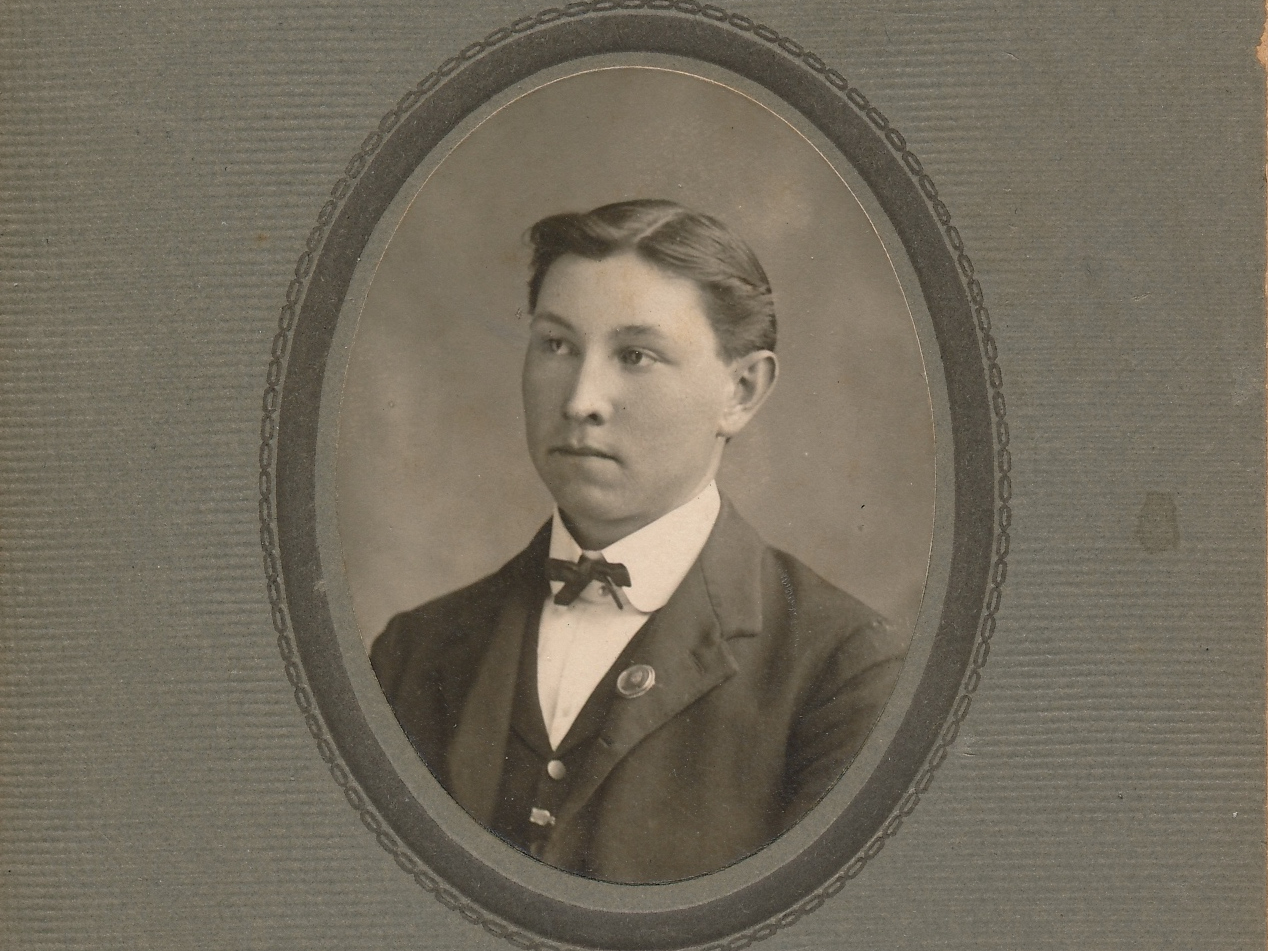
While we were waiting between visitors, I began investigating the gravestones within the Scholte family plot. I was shocked to see a name I thought I recognized. When we got home that afternoon I looked it up. Sure enough, a woman buried in the Scholte family plot, Harriett Yeater Vander Linden (see featured photo on this post), was a relative of mine. Why she was buried with the Scholte family is a bit of a mystery. Especially since she wasn’t Dutch, but came from my mother’s side of the family whose ancestors all came from the British Isles. Never in a million years would I have thought I would end up living in this town portraying its founder. Never in a billion years would I have expected to find my own relative buried with his family.

It’s a small world.

Let’s face it, today’s chapter is one of those that is easily skipped over. It’s one of the genealogical records that everyone hates. All the descendants of Esau are seemingly irrelevant to my life. As an amateur historian and genealogist, however, I spent some time this morning thinking about the bigger picture of Esau’s descendants, who became a small nation called Edom.

It begins with twin brothers, Esau and Jacob. Despite Jacob’s deceit, Esau appears to have prospered on his own. In today’s chapter, they seem to have amicably separated. Esau went to an area east and south of the Dead Sea to settle. The descendants of each brother would grow to become their own tribes which, in turn, would eventually become their own nations, Edom and Israel. Later in the Great Story, the two nations will become enemies. They will war with one another. The prophet Obadiah, for example, wrote his prophetic poem specifically against Edom, predicting its destruction as he recalls that the two nations were rooted in a fraternal relationship.

As time went by and the descendants expanded, the connection was lost. Families became enemies.

One thing that has always appealed to me about history and genealogy is that it is about making connections. It’s kind of the opposite of the Israel/Edom effect I just described. As I make connections to people and the past, I learn things and grow in appreciation for others.

Genetic science has proven that we all descended from one woman referred to as “genetic Eve.” The truth is that we are all connected. Feuds, wars, prejudice, and hatred are the fruit of disconnection. When Jesus calls me to bless my enemies and to pray for those who persecute me, I believe He is calling me to make a reconnection. My enemy is my family. Jesus loves and died for my enemy just as He did for me. While the Kingdoms of this world continue to divide, disconnect, separate, and antagonize, Jesus calls me to be an Ambassador of God’s Kingdom where the goal is to be one Body, connected, unified, and loving.

I may not be able to make a difference on a national level, but I can make a difference in my circles of influence each day. The grave of my great-great-aunt Harriett Yeater Vander Linden reminds me: The connections are closer than I imagine.

If you know anyone who might be encouraged by today’s post, please share.

Beneath the Text

Beneath the Text (CaD Gen 5) Wayfarer

Enoch walked faithfully with God.
Genesis 5:24

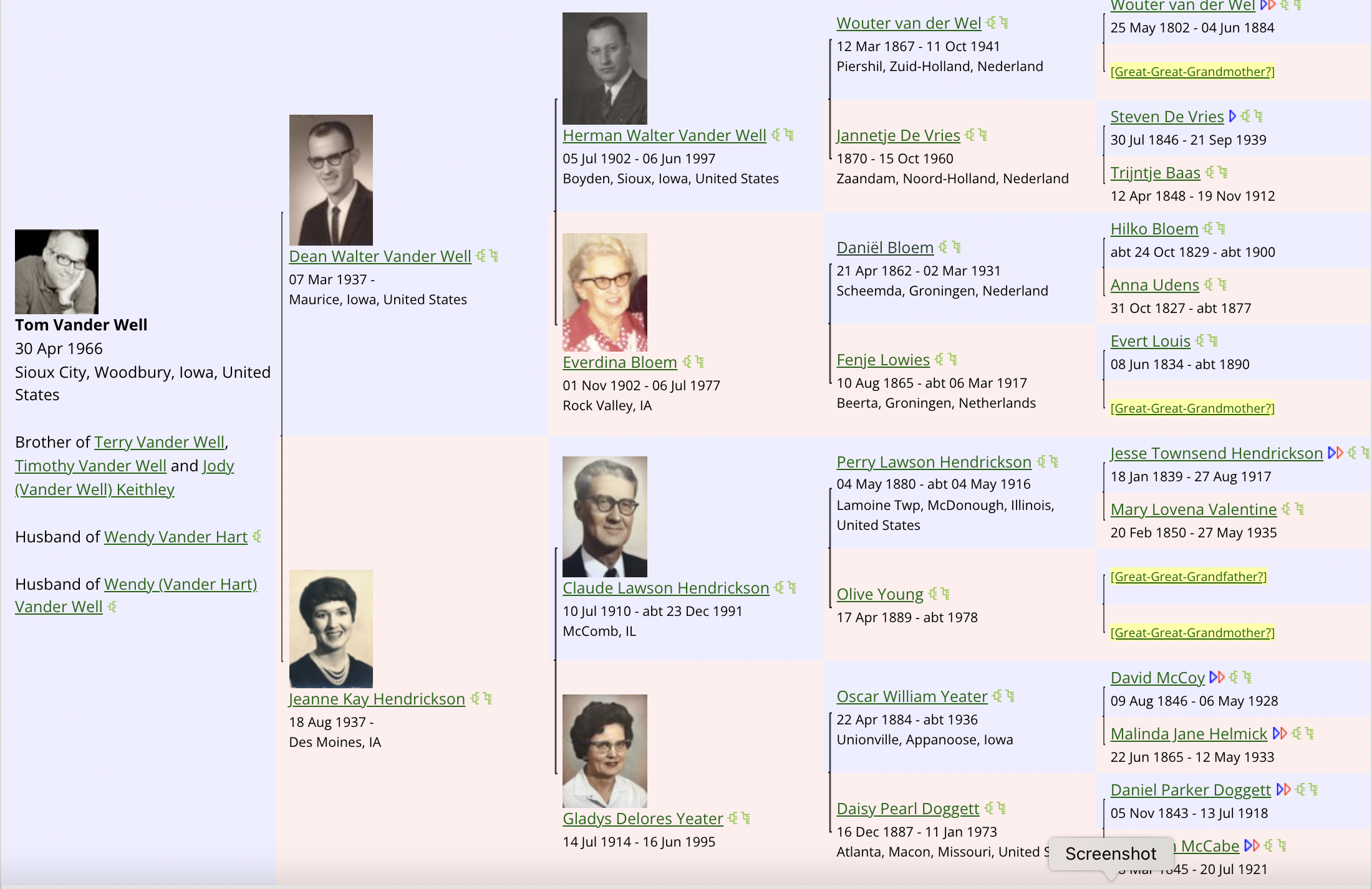
I’ve always been interested in family history. Over the years I’ve learned a great deal, but there’s a point at which the scant evidence of names and dates leave a lot to be desired from a story perspective. My “van der Wel” surname seems to spring from one particular neighborhood in Rotterdam, while the Bloem genes trace back to Gronigen. I have McCoy genes that likely lead back to the McKay clan in Scotland. My Hamblen genes trace back to Virginia during the American Revolution, and then back to England where there’s a knight entombed in effigy in eastern England. Informational clues that leave a lot to the mystery of history.

In the same way, the first 11 chapters of the Great Story are considered “primeval” history. They provide a broad brush sketch of creation and God’s relationship with all of humanity with scant information and a lot of mystery, but there’s plenty of good stuff to mine in the mystery.

For example, numbers and patterns play a role in the telling. The letters of the Hebrew alphabet do double-duty as numbers, and the authors of ancient Hebrew often hide numerical patterns in the writing. The number 10 is associated with harmony and completeness, especially related to humanity. The book of Genesis is divided into ten sections. Ten times in Genesis the phrase “God said…” is used. The genealogies in today’s chapter and again in chapter 11 both list ten generations. God will later deliver the Hebrews from slavery in Egypt through ten plagues, and subsequently provide humanity with ten commandments.

Yesterday’s chapter told of the sin and curse of Cain and then traced his family line to the 7th generation after Adam. Seven is also a number associated with “completeness” but it is more associated with the divine, as in the seven days of Creation. The seven generations of Cain’s line hint at the completeness of God’s divine judgement on the family which remained rebellious toward God in the 7th generation. The 10 generations listed in today’s chapter hint at the complete human family line of Adam that will perpetuate humanity to, and after, the flood.

Then there are the patterns that emerge in the telling. The seventh generation in the line of Cain was Lamech who continued his ancestor’s murderous and rebellious ways. The seventh generation on Seth’s line is Enoch who “walked faithfully with God.” There’s also the fact that Cain, the first born son, was cursed and it was through a younger son, Seth, that humanity was blessed and perpetuated. In human terms, the blessing, power, and position always go to the first-born son, but God’s blessing through the younger son is a pattern repeated through Genesis as well as the Great Story:

Seth over Cain.
Shem over Japheth
Isaac over Ishmael
Jacob over Esau
Judah and Joseph over their brothers
Ephraim over Manasseh
David over his brothers
Solomon over his brothers

The pattern of going against human tradition is a continuous reminder of what God would later say plainly through the prophet Isaiah:

“For my thoughts are not your thoughts,
    neither are your ways my ways,”
declares the Lord.

As I always say, God’s base language is metaphor. Today’s chapter is more than a genealogy. It is layered with numbers and patterns that metaphorically speak to the moral contrast between Cain’s family line and Seth’s family, the contrast of divine judgement and blessing, and the contrast of death and life.

On Sunday, I’m giving a message among my local gathering of Jesus’ followers from Ecclesiastes 3, the passage made familiar to millions by the Byrds: “To everything there is a time and season.” One of the things I plan to discuss is that my own life contains patterns that lead to deeper understanding of self, of family, of life, if I’m willing to search under the surface of simple dates and memories.

If you know anyone who might be encouraged by today’s post, please share.