Tag Archives: Observation

Learning to Observe

Those who led the way rebuked him and told him to be quiet, but he shouted all the more, “Son of David, have mercy on me!”
Luke 18:39 (NIV)

When I was in college studying acting, my professor sent us on an unusual assignment. He sent us a few miles up the road to a busy shopping mall. We were told to sit in the middle of the mall for at least two hours.

Watch people.
Really observe them.
How they move.
Their unusual tics.
The particular way they behave with others.

The goal was to teach me as an actor about creating a realistic and believable character on stage. It’s more than memorizing lines and regurgitating them on stage. It’s about creating a real person.

With a particular gate to his walk.
Mannerisms unique to his character.
A specific way he reacts and responds physically.

That lesson profited me far beyond my training for the stage.
The importance of observation was an entire life-lesson.
It had spiritual implications.

In my daily life. On this chapter-a-day journey.
I keep the eyes and ears of my heart open.
Observing.
Watching for patterns, repetition, and surprises.

As I read and meditated on today’s chapter, I noticed something.

The chapter is book-ended with a parable and an episode.
There’s a connection.

The parable concerns a judge and an old widow.
A widow in the culture of Jesus’ day was a nobody.
Marginalized.
Poor.
Zero social status.
Everyday she begged the judge to hear her case.
Everyday.
She made herself annoying.
Until the judge heard the case just to shut her up.

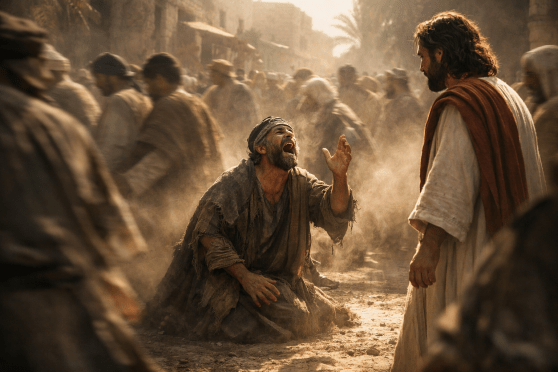
At the end of the chapter, Jesus is walking through a crowd.
On the side of the road was a blind man.
A beggar.
He shouts, “Jesus, son of David, have mercy on me!”
Again. And again. And again.
Annoyed, those around him tell him to shut up.
He yells louder.
Jesus stops. Calls the man over, and heals him.

The widow knocked on the judge’s door.
The blind man shouted into the crowd.
Different scenes. Same audacity.

A week or so ago, I was struck by a similar parable Jesus told.
The neighbor who begs for bread at midnight.
Shameless audacity.
Socially inappropriate.

What struck me as I meditated on these things this morning was that I was observing a pattern in the parables and stories that are lifting off the page for me in the quiet.

Prayer.
Pleading.
Persistence.
A holy refusal to be ignored.

It’s a Holy Spirit whisper.

“Pray Tom.
Keep praying.
Be bold.
Be audacious.
Don’t stop.
Try to annoy me.”

And so in the quiet this morning and observable pattern informs me of my marching orders.

And with that, I will finish this post.

I have some praying to do.

If you know anyone who might be encouraged by today’s post, please share.

Promotional graphic for Tom Vander Well's Wayfarer blog and podcast, featuring icons of various podcast platforms with a photo of Tom Vander Well.
These chapter-a-day blog posts are also available via podcast on all major podcast platforms including Apple, Google, and Spotify! Simply go to your podcast platform and search for “Wayfarer Tom Vander Well.” If it’s not on your platform, please let me know!
Icon with an open book on an orange background

Spiritual Waxing & Waning

I rebuked them and called curses down on them. I beat some of the men and pulled out their hair...
Nehemiah 13:25a (NIV)

Across my life journey, I’ve experienced seasons of revival at different waypoints in life’s road. There were specific moments in time when I witnessed many people putting their faith in Jesus and becoming followers in a short period of time. In some cases, many of those who became followers were the last people I would have expected to do so.

In each of these seasons, I observed individuals who became faithful disciples. I also observed individuals whose spiritual experience appeared to have only short-term effect. At the same time, I’ve lived long enough of this life journey to have experienced that every individual has their own story regarding their relationship (or lack of relationship) with God. Sometimes an individuals journey waxes and wanes. With others, I’ve experienced zero interest of faith until their death bed. And yes, I’ve witnessed very real, very sincere death-bed conversions.

There is a similar observation I’ve had regarding church programs designed to “create” community through small groups, many of which I played a significant role. There’s a recurring pattern I’ve noticed. Initial hype and interest. Large kick-off event and great participation followed by months of slow waning interest. A few small groups continue to do life together long after the “program” fades into oblivion. Most never make it more than a short season.

These things came to mind as I read today’s final chapter of Nehemiah. Nehemiah’s story ends on a downer. After the miraculous rebuilding of the walls in less than two months and the joyful climactic celebration that kick-started Temple operations for the first time in 150 years, things quickly return to spiritual complacency. The “revival” event in yesterday’s chapter is immediately followed by people going back to doing what they’ve always done. They don’t make a habit of going to Temple and giving their tithes and offering. With no tithes and offerings to provide for all the priests and Levites, they leave the Temple and go back to their fields. Nehemiah finds that the Hebrews pretty much ignore every commitment they made to God’s covenant just a few chapters ago.

Nehemiah goes full-prophet postal screaming, beating, and condemning his people for their lack of faithfulness.

Been there. Done that.

In the quiet this morning, I’m reminded that history tells me the rest of the story. Despite Nehemiah experiencing what seems like the failure of his revival event, the Temple system he restored will actually take off. The “second temple” period he’s begun will become one of the most profitable periods of Jewish history with regard to scholarship, scripture, and literature. Of course, that will eventually wane too. When Jesus arrives on the scene some 500 years later, the Temple system will be thriving but completely corrupt. Forty-years after Jesus death and resurrection, it will be completely wiped out by the Romans.

This leads me back to my observations across my life journey. Like Nehemiah, it’s easy to get caught up in moments and seasons on life’s road. Revivals are exciting, and I’m blessed to have experienced them. Events, however, are moments. The spiritual journey is not an event but an epic story complete with mountain-top climaxes and long wilderness wanderings. There is a spiritual waxing and waning that most people experience across their lives. There are tragic moments when everything seems dark and hopeless, and moments of eucatastrophe when the miraculous breaks through and everything is right with the world. It’s all of it.

I love Nehemiah’s passionate, prophetic heart. But as he screams at his people and attempts to beat them into repentance and obedience, my heart whispers: “Dude! Chill out. There’s a Story God is authoring in all of this. Trust the Story.”

If you know anyone who might be encouraged by today’s post, please share.

Promotional graphic for Tom Vander Well's Wayfarer blog and podcast, featuring icons of various podcast platforms with a photo of Tom Vander Well.
These chapter-a-day blog posts are also available via podcast on all major podcast platforms including Apple, Google, and Spotify! Simply go to your podcast platform and search for “Wayfarer Tom Vander Well.” If it’s not on your platform, please let me know!

Missing the Point

“What do you think? There was a man who had two sons. He went to the first and said, ‘Son, go and work today in the vineyard.’

“‘I will not,’ he answered, but later he changed his mind and went.

“Then the father went to the other son and said the same thing. He answered, ‘I will, sir,’ but he did not go.

“Which of the two did what his father wanted?”
Matthew 21:28-31 (NIV)

Yesterday began the celebration of what’s known as “Holy Week” for those who follow Jesus. It’s the annual celebration of the last week of Jesus’ earthly life. The events themselves are dramatic. The week begins with he crowds welcoming Jesus to Jerusalem and shouting His praises. It will end with the same crowds screaming for His execution.

Upon arriving in Jerusalem, Jesus goes to the temple. The temple was the center of Jewish worship. It was where all Jews made pilgrimages to make sacrifices to atone for their sins as prescribed in the ancient laws of Moses. The temple was where the institutional religious leaders held sway in a racket that made them powerful and wealthy.

The temple had its own currency and it had an official line of sacrificial animals. Pilgrims who came to make their sacrifice first had to exchange their Roman currency for Temple currency, and the money changers made exorbitant profits in the exchange that lined the pockets of the powerful religious leaders. Poor pilgrims who brought their own animals for sacrifice would learn that their animals were unacceptable to the priests, and the priests would demand that they buy the temple’s own brand of official sacrifices. The priests and leaders had turned religion into a money-making machine that bilked the poor and the weak.

So, Jesus begins His climactic week by overturning the money changer’s tables and setting the official sacrificial doves free in a provocative act of challenge to the powerful racketeering priests. It makes Jesus even more popular in the eyes of the marginalized and directly threatens the powers-that-be. The rest of today’s chapter is an account of the showdown between Jesus and the religious leaders who sent envoys with trick questions. Their plan is to trip Jesus up and give them reason to discredit or arrest Him.

In this showdown, Jesus gives another simple but powerful parable. Two sons are given a task. One initially refuses but eventually obeys. The other agrees but ends up not doing the task.

The message of the parable is clear. The priests were given the task of shepherding God’s people, but they ignored the task of love, mercy, grace, and forgiveness. Instead, they pursued judgment, greed, power, and self-aggrandizement. Jesus’ followers, on the other hand, were marginalized outsiders in the context of the religious hierarchy, yet they were actively pursuing Jesus’ teaching.

I am reminded this morning of our daughter emailing me from a missions trip in Africa some years ago. She was in a challenging situation with a highly dysfunctional team. Her team “leader” seemed interested only in sitting around the foreign resort area doing nothing all day. Taylor said the person on the team who acted the most like Jesus was the one member saying they didn’t even believe in God. It was Jesus’ parable come to life. Given the parallel to today’s chapter, I believe it quite possible that the atheist on Taylor’s team was closer to God than those who were the most religious.

Holy Week is chalk full of opportunity for religious services, religious acts, and religious observations. This morning I’m reminded that we easily turn our churches into a 21st century example of the temple in Jesus’ day.  We can dutifully attend services, take communion on Maundy Thursday, weep on Good Friday, and shout “Hallelujah!” on Easter morning in our best Easter dress. And, the whole time we can be ignoring the most important things Jesus’ asked of us.

A Spiritual Lesson from Acting 101

But someone will say, “You have faith and I have works.” Show me your faith apart from your works, and I by my works will show you my faith.
James 2:18 (NRSV)

I’ve always believed that acting is the creation of an authentically believable character from the inside out. It is not just the manipulation of body and voice but the understanding of internal need, intention, motivation and thought which then translates into words, movement, and action.

My theatre professor in college taught us that one of the most important tools for the actor is observation. Watch people. We were sent to the local mall to watch people. Really watch them. It’s the Sherlock method of beginning to understanding character. What do you deduce from what you can readily observe in people? What can you tell about that couples’ relationship by the way they walk four feet apart? What does it say about them as a couple when she’s carrying on a conversation but her eyes are always looking over his shoulder at the people walking by? What is that teenager trying to say when he walks with that pronounced strut? Look at that old man, shoulders hunched over as if he’s protecting his soul, shuffling slowly with his eyes glued to the floor as though he’s afraid to look anyone in the eye. What in life led him to walk like that?

James’ discussion of faith and works in today’s chapter has created firestorms of controversy among theologians throughout the centuries. Some have even suggested pitching James’ letter from the canon of scripture altogether. Paul teaches that we are saved by grace through faith, and that it’s not of works. But James writes in today’s chapter that faith without works is worthless faith. So, which is it?

I’ve never been that stressed out about seeming contradiction. Following Jesus is a journey fraught with paradoxes. You have to die to live. You must lose in order to gain. You must give away to acquire. Faith and works is just another spiritual paradox in God’s economy. Theatre learned long ago the spiritual principle required for holding the tension. It’s called “Yes, and.” Yes, we are saved by grace through faith, and yes, faith without works is worthless faith.

James was simply tapping in to Acting 101 class. Watch yourself. Really watch yourself. I should observe myself as others do. What do my words say about me? What can someone deduce from the way I treat my employees, my family, or as James suggests, the poor and needy? My inner spiritual realities are evidenced in my outside behaviors. If I really believe what I say I believe, the internal faith will continually work itself out in my words, actions, and relationships.

This morning I am feeling convicted. The process of honest self observation is never comfortable. Though I’m quite sure I have blind spots, I know most of my major shortcomings acutely. A self-inventory leads me to uncomfortable conclusions. And, I think that’s also ultimately James’ point. Discomfort prompts change, which creates movement, which propels me further in the journey towards Life. Comfort prompts apathy, which creates stagnation, which eventually becomes death.

Faith or works?

Yes.

Being Watchful

people in a mall

Devote yourselves to prayer, being watchful and thankful.
Colossians 4:2 (NIV)

Back in college I had an assignment for my Acting I class that took me to the local mall. The assignment was simply to watch people. Not just to merely look at them, but to really watch them. Acting is about creating believable characters on stage, so our assignment was to watch how real people walk. We were to observe how different people move and carry themselves. What are their quirks? How do they relate to other people.

I thought about that assignment as I read the admonition to be watchful in today’s chapter. I have found that people largely make their way through life’s journey unaware. People are neither observant nor considerate of others. I find people giving little thought to what is happening around them nor how they are engaged in what is happening.

Jesus was fond of saying, “They who have ears, let them hear.” The lesson is clear that there is a difference between merely hearing and really listening and understanding what is going on around you. We just finished going through the Book of Acts and it ended with Paul quoting the prophet Isaiah on this same subject:

“You will be ever hearing but never understanding;
    you will be ever seeing but never perceiving.”
For this people’s heart has become calloused;
    they hardly hear with their ears,
    and they have closed their eyes.

Today, I’m thankful for my education in theatre and the life lessons it provided, such learning to be watchful, observant, and considerate of what is happening around me. I am thinking about my progressive hearing loss, how each year the whole world sounds a little bit more like Charlie Brown’s teacher, and how important it is for me to consciously listen. I’m thinking about my need to be more watchful and aware of others, their circumstances, and their needs.

Governing Observations

The dome of the US Capitol building. Français ...
(Photo credit: Wikipedia)

So Samuel passed on the Lord’s warning to the people who were asking him for a king. “This is how a king will reign over you….” 1 Samuel 8:10 (NLT)

This morning’s chapter was about ancient Israel’s desire for a new system of government. They were frustrated with the way things were having lived for generations under a theocracy in which God raised up a “judge” to lead the people at different times. The book of Judges is a chronicle of Israel’s history during this time. It was a messy form of government, to be sure. The grass looked so much greener on the other side of the border. Their neighbors with their centralized authority (a.k.a. a king) seemed so much cleaner and easier than the theocracy they’d been attempting to live out for hundreds of years. Despite Saul’s warnings of the flaws inherent in a monarchy, the people continued to demand it until they got their way.

As I read this morning I found myself pondering our continual frustration with government, which seems to be universal wherever you go. As I have sojourned in this life, I have observed and have come to some personal conclusions about human government. Looking at things on a macro level, here are my observations:

  • Governments rarely, if ever, shrink (unless by force or implosion), they only expand.
  • Most who reach places of governmental power and authority will do all that they can to retain and expand that power and authority (so that they can do “more good,” of course).
  • Those in government who make rules for others quite regularly exempt themselves from those rules our make loopholes for themselves, friends, and or loved ones.
  • Politics is a performance played out in sound bytes, tweets, posts, press conferences, and public addresses. Public words cloak personal motives.
  • There is no system of government on the face of this earth which is not given to corruption, waste, fraud, and abuse.
  • Every one of us live under a corrupt system of government because we are all governed by human beings marred by the human condition.

What then shall we do? I continue to ponder that as well. I have no great revelation nor answers to share. Personally, I find myself continually returning to what Jesus asks of me as a follower.

Seek God. Love others. Press on.