Tag Archives: Good Friday

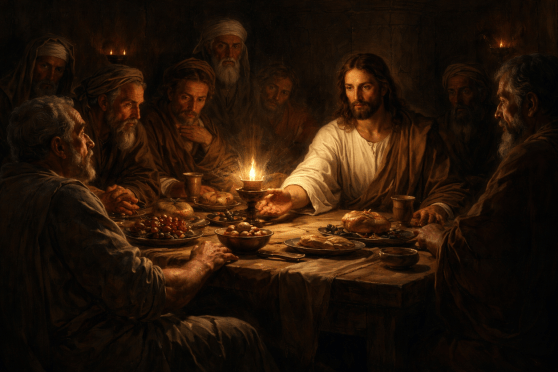
A Dinner Dripping with Intrigue

One Sabbath, when Jesus went to eat in the house of a prominent Pharisee, he was being carefully watched.
Luke 14:1 (NIV)

Context is essential.

The episodes of today’s chapter lie with concentric circles of context that Luke has carefully laid.

Way at the beginning he introduces us to baby Jesus, the Son of God, come to earth. At his dedication, Simeon prophesies:

“This child is destined to cause the falling and rising of many in Israel, and to be a sign that will be spoken against, so that the thoughts of many hearts will be revealed.” (2:34-35)

In chapter 9, Jesus “resolutely” sets out for Jerusalem, having predicted that:

“The Son of Man must suffer many things and be rejected by the elders, the chief priests and the teachers of the law, and he must be killed and on the third day be raised to life.” (9:22)

Today’s chapter begins with a simple statement.

Easily overlooked.

Jesus went to eat in the house of a prominent Pharisee, he was being carefully watched.

Most people read that and forget it. But wait…

Everything in today’s chapter happens in this context.

The baby Messiah who will cause “the rise and fall of many in Israel,” and who will reveal the thoughts of their hearts.

The Messiah on a mission — heading to Jerusalem to be rejected by the religious power brokers – to be killed by them.

And, He is dining with one of those very men…
….at his house.
…under his critical gaze.

This isn’t a casual dinner.
This is a set-up.
The table is dripping with intrigue and tension.

They think they’re watching Him.
But He’s the one setting the table…

He prods His enemies. He pokes at them at every turn.

“Is it lawful to heal on the Sabbath?” (He knows His host thinks it is.)
He heals a man with abnormal swelling sitting in the room.

[Poke]

Watching the prominent religious leaders vying for the seats of honor at the table. He calls them out. Directly.

“But when you are invited, take the lowest place, so that when your host comes, he will say to you, ‘Friend, move up to a better place.’ Then you will be honored in the presence of all the other guests. For all those who exalt themselves will be humbled, and those who humble themselves will be exalted.” (vs 10-11)

[Poke]

Jesus then tells a parable. A great banquet feast is given. All the high-and-mighty guests on the list beg off. The host sends servants to bring in the lowly, the poor, the marginalized, the foreigners, the outcasts.

Translation: You are leaders of God’s people. He sent me to invite you to His great banquet. You’ve rejected me, so I’m inviting others.

[Poke]

Jesus then surveys the room. Some of the powerful religious leaders have been following Jesus. They’ve been listening. Some have even tried to befriend Him. In yesterday’s chapter, it was they who warned Jesus that Herod wanted to kill him — begging Him not to proceed to Jerusalem.

I believe Jesus’ final words at the party are for them.

It’s decision time, gentlemen.

Time to fish, or cut bait.

They are riding the fence. They enjoy the pomp and prominence of their position. They live lives of relative ease. Their names are etched in the boxes at the top of the Temple org chart.

If you’re truly going to follow me, you have to give it all up.

Count the cost, gentlemen.
You can’t sip the Kingdom wine I offer and keep your seat at Herod’s table.

“Those of you who do not give up everything you have cannot be my disciples.”

[Poke]

If you follow the tension in the room. It leads somewhere.

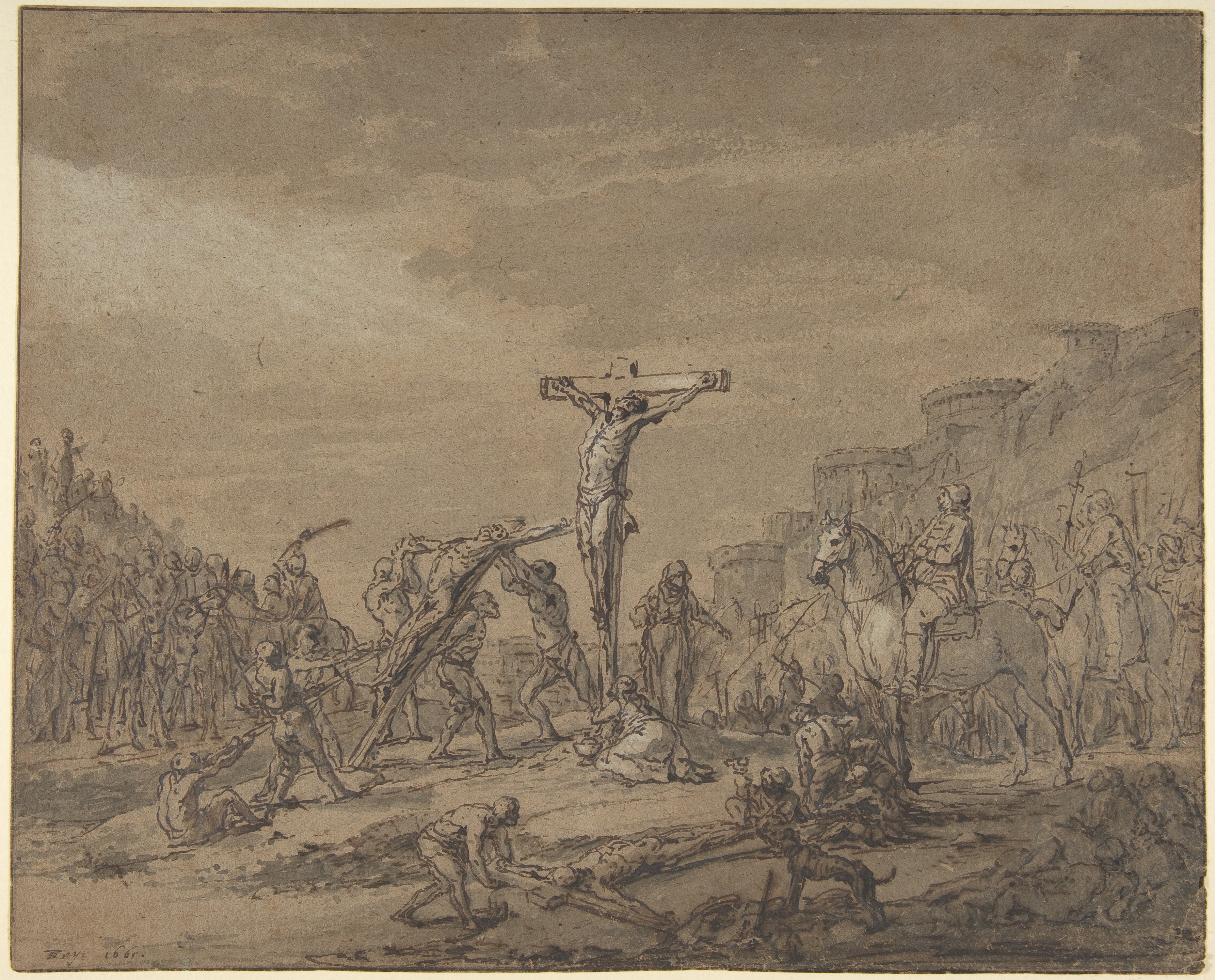
It is Good Friday as I write this post. On this annual day to remember Jesus’ execution on a Roman cross, I’m reminded…

Jesus was resolute in walking toward suffering and death.

Jesus prodded His enemies, and provoked their actions against Him.

Still, He didn’t run.

He went to their houses for dinner. He sat in their midst.
He gave His enemies another chance…
to hear
to see
to choose
to follow

As Jesus hung on three nails between heaven and earth.

He was not a victim.

He was the Son of Man on a mission.

A suffering servant.
A sacrifice, once – for all.

For me.

If you know anyone who might be encouraged by today’s post, please share.

Promotional graphic for Tom Vander Well's Wayfarer blog and podcast, featuring icons of various podcast platforms with a photo of Tom Vander Well.
These chapter-a-day blog posts are also available via podcast on all major podcast platforms including Apple, Google, and Spotify! Simply go to your podcast platform and search for “Wayfarer Tom Vander Well.” If it’s not on your platform, please let me know!
Logo featuring an open book icon on an orange background.

“The Man Who Saw It”

"The Man Who Saw It" (CaD Jhn 19) Wayfarer

The man who saw it has given testimony, and his testimony is true. He knows that he tells the truth, and he testifies so that you also may believe.
John 19:35 (NIV)

I have observed along my journey that certain historical events become so ubiquitous, that the actual events are lost or muddled in the pervasive contemporary and cultural understanding. The symbol of the cross, and the related crucifix, are great examples. We think nothing of the symbol of a cross on a piece of jewelry, a headstone, or a business logo. Most people associate it with the Christian religion, but I would venture to guess that if Jay Leno went “Jaywalking” on the street and asked the average person about the event that gave us the symbol, few would know much about it. They wouldn’t know that the cross was arguably among the most heinous and tortuous devices for executing a human being in history. I remember one commentator musing that if Jesus had been beheaded, women would be wearing little guillotines around their necks (granted, the guillotine wasn’t invented until centuries later, but you get the point).

Likewise, having read and studied the story of Jesus’ crucifixion for over 40 years, I confess that it is easy for me to gloss over the details that I know so well.

At the very beginning of John’s account, he tells us that “The Word became flesh and made his dwelling among us. We have seen his glory, the glory of the one and only Son, who came from the Father, full of grace and truth.” The reason for John writing this account is to present to his first-century readers his primary source memories. He subtly, but importantly, reminds us of this in these final chapters.

One of the stylistic conventions that John uses multiple times is to humbly refuse to identify himself in the narrative. He refers to himself as simply “a disciple” or “the disciple Jesus loved.” I consider John telling me “I’m not the important one. This is not about me. This is all about Jesus.”

In yesterday’s chapter, the unnamed John assists Peter in getting into the courtyard of the High Priest’s house where Jesus was being illegally tried. Peter denies Jesus, but John at that point chooses not to reveal what happens to either him or Peter. In today’s chapter, John reveals that he was at the cross with Jesus’ mother, aunt, and two other female disciples.

At the time John was writing his account, the Jesus Movement was exploding, and the astonishing claim that Jesus died and rose again was driving both faith and doubt. For the doubters, the two most plausible explanations were that 1) Jesus never died in the first place or 2) Jesus’ body was stolen by His followers and made up the resurrection story.

In today’s chapter, John is addressing the first argument of the doubters.

First, John lets me know that he was standing at the cross with Jesus’ mother and Jesus addressed him from the cross. In other words, “I was there. I saw this.”

Second, John explains that the Jews appealed to Pilate to break the legs of the three crucified men to speed up their deaths so that they could be taken down and buried before nightfall. In Jewish tradition, the new day begins at sundown, and with it being Friday afternoon, the Sabbath day of rest would begin in a few hours and no one was allowed to work, even taking a body off a cross and burying it. Crucified victims could languish for hours or days. The cause of death was typically asphyxiation from hanging on the nails in the wrists which made it hard to breathe. The only way to do so was to push up on the nails through the feet to take a breath. By breaking the legs, this was impossible, and the crucified asphyxiated much faster. John records that the Romans found Jesus dead and didn’t break his legs and they speared the dead body to ensure Jesus was dead.

Third, John reiterates that he witnessed this: “The man who saw it has given testimony, and his testimony is true. He knows that he tells the truth, and he testifies so that you also may believe.

In the quiet this morning, I tried to approach John’s account of Jesus’ trials and execution with fresh eyes, even as I allowed my knowledge of history to help me visualize the horrific details lost on most contemporary readers. I also thought about John as the eyewitness, trying to place myself in his sandals as he described the events.

In two weeks, Jesus’ followers around the world will observe Good Friday, the commemoration of Jesus’ trials and execution. I find myself grateful that our chapter-a-day journey is allowing me to contemplate and meditate on the events as that commemoration draws near. I find that heart preparation makes the difference between an observance like Good Friday being a rote religious ritual and the Spirit event it’s intended to be.

If you know anyone who might be encouraged by today’s post, please share.

Judicial Realizations

Judicial Realizations (CaD Ps 139) Wayfarer

Search me, God, and know my heart;
    test me and know my anxious thoughts.
See if there is any offensive way in me,
    and lead me in the way everlasting.

Psalm 139:23-24 (NIV)

Yesterday, I spent some time with a friend who is a bit further down life’s road than I am. He sees the finish line of his vocational journey fast approaching. The fact that his days are numbered and there are fewer days ahead than behind is not lost on him. We talked honestly.

“I just want to finish well,” he said to me.

We then quickly recounted the names of those we know who did not finished life well. It was a sobering thought.

If you ask me to share my individual, unvarnished story with you, I’m going to share things that are pretty unseemly. Along my life journey I have been guilty of both pretty sins and ugly sins. For about the first 15-20 years of my 40 years as a Jesus follower, I did my best to hide these things under a well-polished veneer of goodness. Eventually, things caught up with me. As I hit bottom and could no longer keep up appearances, I had a fellow believer and therapist tell me, “I’ve been watching the slow deconstruction of the image of Tom.”

I’ve learned along this journey that sometimes old things must be razed before new, fruitful things can begin growing.

The 23rd Psalm undoubtedly tops the Billboard Chart for all-time favorite ancient Hebrew songs. Today’s chapter, Psalm 139, is definitely makes the Top Ten. It might even be number two. If you’ve never read it, I encourage you to do so. The liner notes ascribe it to David, which adds an intriguing layer of meaning to the lyrics.

It’s easy to read Psalm 139 in the mind frame of the devotional and theological. But in the context of David’s day, the lyrics are judicial. Christian theology holds that God is omnipresent, meaning that God is present in all places at all times. While the lyrics of David’s song support this idea, the ancients of David’s world had no such notion. Rather, they considered that both gods and kings had access to all places and all knowledge. Therefore, no one could run and hide from justice. No matter how high, low, near, or far I try to hide, the Divine Judge has full access, even to see and know the person I am beneath the well-polished veneer of goodness.

Much like the 51st Psalm, David’s song is an honest and intimate confession. David is laying open his life, his heart, and his soul before God, who is the Divine Judge. In doing so, David is exposing and owning his own sins, both pretty and ugly. A man of violence and bloodshed, an adulterer, a murderer, a failed father, a failed husband, and a less-than-perfect king, David stands before God knowing that God doesn’t need the Freedom of Information Act to see it all. David asks God to search his very heart, which ironically is the thing that led God to choose David in the first place.

Which leads me back to my story, and my life, which is every bit as polluted with sins both pretty and ugly. There came a point in my journey that I had my own Psalm 139 moment. I could continue running, hiding, and polishing, but that never got me anywhere healthy. So, I owned my own shit. I processed my feelings, my failings, and my indulgent human appetites. Ironically, it was at that point in my journey that a number of really good things began to spiritually sprout within me.

In the quiet this morning, I can’t help but think about the fact that I’m writing these words on Good Friday. As I remember that “God made him who had no sin to be sin for me, so that in him I might become the righteousness of God,” I am reminded that it’s not about the things that I have done, but the thing that Christ did for me. The more honest I am about the things I have done, the more potent the thing that Christ did for me becomes. As Paul wrote to the believers in Rome, it is that kindness of Christ that leads me to genuine repentance, not judgement, condemnation, nor religious rigor.

This morning, I find myself thinking that if I want to finish well then I have to keep this spiritual truth before me this day, each day, until I reach the journey’s end.

A Good Day

Then James and John, the sons of Zebedee, came to him. “Teacher,” they said, “we want you to do for us whatever we ask.”
Mark 10:35 (NIV)

Every parent knows a set-up question when they hear it.

“Dad? I’m going to ask you something and you have to answer ‘yes.'”

“Mom? Haven’t I been really, really good this week?”

The set-up question is intended to get the desired answer from the real question. I remember being a young boy playing this game in my prayers with God. If I wanted the Vikings to win the game or my older brothers girlfriends to simply “stop by” our house (they always doted on me, and I loved it), then I would barter with the Almighty to get my wish. I might make the case for my good behavior to have been good enough to “earn” what it is I wanted. I might have promised all sorts of obedient services I could render on the back-end of my fulfilled wish should my Genie-God grant my self-centered request.

Obviously, as a young boy, I had a lot to learn about God, prayer, the Great Story, and my role in it. I’m grateful that God is eternally patient and faithful.

In today’s chapter, I found my lesson wrapped in the layout of events that Mark includes as Jesus prepares to enter Jerusalem for the climactic week of His earthly sojourn.

First, Jesus sends a rich, young man away sad because the man was unwilling to do the one thing that stood between him and God: sell everything he owned and give it to the poor. In the post-event discussion with His followers, Jesus reminds them that in the economy of God’s Kingdom (the real one, not the false one that the institutional church created for 1700 years) “the first will be last and the last will be first.”

The very next thing, Jesus tells #TheTwelve for the third time exactly what’s going to happen:

“We are going up to Jerusalem and the Son of Man will be delivered over to the chief priests and the teachers of the law. They will condemn him to death and will hand him over to the Gentiles, who will mock him and spit on him, flog him and kill him. Three days later he will rise.”

Sometimes I’ve noticed that the chapter breaks and headings that modern scholars have introduced into the text keep me from seeing the flow and connections between pieces of the story. Today was a great example. Jesus reminds the disciples that the first will be last, and then He gives them the ultimate example: I, the miracle-working Son of God who heals, frees, feeds, and raises people from the dead, am going to submit myself to suffer and die in order to redeem all things.

What happens next?

James and John come to Jesus with a “set-up question!”

“Um, Jesus? We want you to promise to do whatever it is we’re about to ask you.”

What was the question? They were looking out for numero uno. If Jesus was going to die, then the brothers Zebedee just wanted to tie up some loose ends. They wanted to make sure that their eternal future was secure. They wanted to ink the deal with Jesus, once and for all, to make sure they ended up “Top Dog” on the heavenly food chain.

I can hear the echo of Jesus’ words from what seems like every single chapter I’ve read the past two weeks: “Do you still not understand?”

For the record, James and John got about as far as I did with the Vikings winning the Super Bowl.

In the quiet, on this Good Friday morning, I am reminded of all the ways I have cast myself in the role of James and John. It might have been cloaked in religious set-up questions, bartered goodness, and the economics of a worldly institutional kingdom dressed in religious robes. The truth is what I’ve been quietly contemplating this week. In so many ways, I know that I still don’t completely get it.

Good Friday. The secret trials. The kangaroo court. The beatings. The mocking. The jeering. The crowd screaming for blood. The scourging. The nails driven into wrists and feet. The hanging naked on a cross as public spectacle; Naked, bleeding and losing control of his bodily functions in front of His own mother. And, as He hangs there between heaven and earth on the cusp of death…

Making sure his mother will be cared for.

Forgiving His executioners.

Extending grace to a confessed and convicted thief.

“The first shall be last. If you want to be the greatest, you must become the servant of all.”

A good day to open my head and heart to continue understanding, to continue getting it, and continuing to let it change me.

Getting It

[Jesus] then began to teach [the disciples] that the Son of Man must suffer many things and be rejected by the elders, the chief priests and the teachers of the law, and that he must be killed and after three days rise again.
Mark 8:31 (NIV)

I spoke to a friend on the phone yesterday. We, of course, discussed the current world situation with the COVID-19 pandemic and how different our lives have been the past few weeks with everyone stay home and keeping to themselves.

“And it’s Holy Week!” my friend exclaimed. “It doesn’t feel very Holy. It feels more like a week with holes.”

I thought about Holy Week as I read this morning’s chapter. I’m half-way through Mark’s version of Jesus’ story. If I’d been thinking ahead I should have scheduled to start a week earlier so that I’d be finishing the story on Easter weekend. Oh well. One more thing to add to the list of things that feels a little “off” right now.

I find it interesting that while Jesus has been speaking in parables and metaphors for several chapters, He is quite direct and plain-spoken about how His story is going to end. It isn’t even a veiled foreshadow. He just puts it right out there.

Peter rebukes Jesus at this point. Ironically, Jesus has been complaining for two chapters about the disciples not understanding His parables. Now He speaks more directly to them than perhaps He’s ever done. They still didn’t understand.

Here’s the thing. The people who walked with Jesus, talked with Jesus, witnessed the miracles, and spent three years in His constant presence didn’t get it when He said it to them plainly.

Who am I to think that I totally get it? How much don’t I get? What am I missing? How frustrated is Jesus with me? Is He shaking His head from heaven? “Tom! Dude! Forty years you’ve been following me, and you still don’t understand?”

I’m kind of glad that things are different this year. I’m asking myself this morning how much the traditions, the trappings, the religious services, the Easter dresses and bonnets and brunches and egg hunts distract me from getting it as I should.

The Son of Man must suffer many things and be rejected by the elders, the chief priests and the teachers of the law. He must be killed and after three days rise again.

I think maybe it’s good for me to be alone during Holy Week for a change. This plain-spoken statement of Jesus is probably something I should sit with in the quiet for a while. It’s something on which I need to ponder and let penetrate.

Lord, have mercy on this blind and deaf follower.

I want to better understand.

A Generous Confession

A generous person will prosper;
    whoever refreshes others will be refreshed
.
Proverbs 11:25 (NIV)

Earlier this week I was with friends in our family room, and we were discussing the spiritual season of Lent that we entered into this past Wednesday. For those not familiar with the practice, Lent (from the Anglo-Saxon word for “length” which is also associated with “Spring”) is a period of roughly 40 days (there are multiple traditions who figure the days differently) leading up to the celebration of Jesus’ death and resurrection at Easter.

The 40 days traditionally relate back to the 40 days Jesus spent alone in the desert (Matthew 4) before he was tempted by the enemy. That 40 days of solitude, introspection, prayer, fasting, and temptation effectively launched Jesus’ three years of ministry. It was the spiritual boot camp that prepared Him for the determined purpose of fulfilling His earthly mission on the cross, through death, and out of the tomb. In the same way, Lent is intended to be a period of personal introspection, confession, denial, repentance, and preparation leading up to Good Friday (observance of Jesus’ death) and Easter (celebration of Jesus’ resurrection).

As my friends and I discussed our diverse religious backgrounds and personal experiences with Lent, we discussed the practice of self-denial and fasting that commonly occurs during the season. One member of our group alluded to a conversation he and his wife had about self-denial within generosity: You know a person who needs a special outfit for an event and they can’t afford it. It’s easy to say, “Here is an outfit from my spare closet that I haven’t worn for years. Take it. It’s yours.” It’s harder to say, “Here is my favorite outfit. It’s the best thing I own, and it cost me a pretty penny. Take it. It’s yours.” Which is true generosity and self-denial?

I thought of that discussion as I read today’s chapter and came across a verse that I, long ago, memorized. It’s today’s verse, pasted at the top of this post.

In the introspection spirit of Lent, I have a confession to make. Generosity has been a life-long struggle of mine. The struggle is two-sided. The obvious side is simply learning to be generous. Things were economically tight in my family growing up. As the youngest of four, I enjoyed a lot of hand-me-downs. The idea of being generous and giving things away was an honest struggle for me because when I had something new that was “just mine” I wanted to cling to it for dear life. It took me a long time to develop a heart of generosity, and even as I write these words I have specific, shameful memories of not being generous and being called out for it.

The other side of my generosity struggle comes from my core pain, which I long ago identified and labeled: not enough. So, even though I have come to embrace, en-joy, and practice generosity in greater measure than any time in my entire life, my Censor (that ugly whisperer inside my head and heart) ceaselessly tells me that it’s not enough.

Welcome to my Lenten introspection.

In the quiet this morning I find myself meditating on, and thinking about, my generosity. Jesus was constantly urging His followers towards the virtues of love, kindness, forgiveness, gentleness, humility, and generosity. Is it even possible to reach a point in my earthly life where I can say that I have arrived at having “enough” of these virtues in my life?

No.

Does that mean I’m an irredeemable failure?

No.

It means that I am on a spiritual journey and a Life journey. I am not where I once was (thank you God) and I can be encouraged by that fact. At the same time, I have not arrived (Lord, have mercy) and I can be humbled by that fact.

So where, does that leave me?

Time to lace ’em up for another day. I’m pressing on. Hope you are, too.

Oh, and if you wear men’s size 9 and you need a pair of shoes for the trek, I have a brand new pair. I think I’ve worn them only once. If you need them, they’re yours.

Heaven, Quantum Theory, and the Wonder of it All

source: Bill Shupp via Flickr

Praise be to the God and Father of our Lord Jesus Christ, who has blessed us in the heavenly realms with every spiritual blessing in Christ. Ephesians 1:3 (NIV)

Earlier this week I was reading about new discoveries in the scientific community relating to physics. Wendy and I have enjoyed long conversations through the years about our faith and science. I credit Wendy with introducing me to the writings and works of Madeleine L’Engle, whose fiction and non-fiction writings both explore the intersection of these two disciplines which have famously warred with one another through the centuries. Wendy and I don’t feel tremendous conflict between the two. Faith that denies science is foolish, as is science that denies its inherent faith. For Wendy and me, our creative imaginations find all sorts of fascinating correlations that complement both.

What I read earlier this week dealt with the theory of relativity and time. It explored the idea of parallel realities and time existing in different dimensions. The possibilities are mind blowing, and it makes me shake my head in gleeful wonder. Despite all that we’ve learned throughout history, I sense that we have only scratched the surface of the depth and complexity that our Creator wove into all creation. As for things existing at once in different dimensions, that’s already hinted at in God’s story.

The verse above from Paul’s letter to the Jesus followers in Ephesus is one of my favorites to chew on in the same vein with which I chew on my rudimentary understanding of relativity and quantum theory. We live on this earth in the moment, our lives bound by the realities of flawed humanity, sickness, conflict, tragedy, and monotony. At the same moment, according to this verse, we have been (past tense) blessed in heavenly realms (is this what science would call another dimension in another or outside of our present time?) with every spiritual blessing in Christ. We exist simultaneously in different realities, bound in earthly time and blessed in spiritual eternity. Talk about mind blowing.

Today, as I write this, we are celebrating Good Friday when Jesus was beaten and crucified. For those of faith, we believe that on the cross and in the empty tomb that was to follow on Sunday morning, there was a fundamental shift in both the earthly and spiritual dimensions which forever altered our present earthly reality and the reality of our standing in the spiritual dimension/realm that exists beyond time. While I do not claim to understand it all, I have faith in the glimpse of it I have been given, and once again I shake my head in the wonder of it all.

Enhanced by Zemanta

Bad News; Good News


The Book of Life 2
(Photo credit: Waiting For The Word)

And I saw the dead, great and small, standing before the throne, and books were opened. Another book was opened, which is the book of life. The dead were judged according to what they had done as recorded in the books. Revelation 20:12 (NIV)

This morning as I read through this verse I had a bit of a panic attack. It’s the end. I’m standing before God. The books are opened, and everything I’ve done is recorded in those books. I’m going to be judged according to what’s in the books. Yikes. This is bad news.

All of a sudden the memories of all the shameful things I’ve done come flooding into my mind. Every heinous thought. Every secretive deed. Every self-centered act. Every errant and angry word. I’ve thought, said, and done so many shameful things. There’s no way I’ll make the cut. I’m doomed.

Then I remember all that we’ve read and learned in this story that’s unfolded as we’ve gone through God’s Message a chapter a day. This is the good news and the core theme of the story:

  • Everyone is doomed. Everyone falls short. Once the books are opened and the truth is revealed there isn’t a person living or dead (Billy Graham, Mother Theresa, and the Pope included) who is “good enough” to earn salvation.
  • There is another book. If you read the chapter then you know that, along with the book that reveals all we’ve said and done, there is a second book mentioned: The Book of Life. This is the book of those who have “received Jesus, who have believed in His name.”
  •  Grace. Jesus promised that any who seek after him and seek forgiveness for all the crap they’ve every done will be forgiven. This is the crux of the story: Jesus suffering and dying on the cross was, in essence, Him choosing to pay the just penalty for all the shameful thoughts, words, and actions recorded under my name (and yours too) in those books John was describing. Jesus paid the penalty for all I’ve done, so that I don’t have to. I don’t deserve what He did for me. That’s called grace: unmerited favor.
  • Covered. In the ancient sacrificial system we’ve read about, the people would bring their sins and sacrifice to the priest. The word picture of the sacrifice was that their sins were place beneath the altar. As the lamb was slain and the blood ran across the altar and fell to the ground it was covering the sin underneath the altar. That is why in John’s vision of heaven Jesus is referred to as the “Lamb of God who takes away the sins of the world.” He was the sacrificial Lamb who made atonement to cover all our sins.
  • Gratitude. So I need not be worried about what is written in those first books John described. My sins are covered by His blood. I have received Him. I have believed in His name and my name is written in the Book of Life. This fact does not give me a sense of pride or arrogance. I am better than no one. I am simply forgiven. I have been given a priceless gift which I do not deserve. I am both eternally humbled and forever grateful.

I find it ironic that we reach this waypoint in our journey the week leading to Easter. This Friday is Good Friday, commemorating the good that Jesus did on the cross for anyone who would seek His grace and forgiveness. It is a good week to think on these things.

Enhanced by Zemanta

Chapter-a-Day John 15

detail from Isenheim Altarpiece by Grunewald

“This is my commandment: Love each other in the same way I have loved you.”
John 15:12 (NLT)

On this day, Good Friday, I believe the verse alone is sufficient. Blessings to you.