Tag Archives: God’s Kingdom

Serving in Small Empires

Mordecai the Jew was second in rank to King Xerxes, preeminent among the Jews, and held in high esteem by his many fellow Jews, because he worked for the good of his people and spoke up for the welfare of all the Jews.
Esther 10:3 (NIV)

I have often mentioned in these blog posts that the Great Story from Genesis to Revelation is primarily a story of conflict between God’s Kingdom and human empire. The story of Esther is fascinating because it is about God’s people living in exile within a foreign empire. Mordecai and Esther begin the story as anonymous cogs within the Persian Empire, but they are placed in positions where they can make a positive difference for their people within an antagonistic system.

This theme is echoed in the teachings of Jesus, whose followers were marginalized minions operating under occupation by the Roman Empire and corrupt authority of the ruling religious system. The letters of the New Testament are equally addressed to followers of Jesus living through persecution from those same two kingdoms of this world.

Along my life journey, I’ve observed that the theme of “human empire” has far reaching implications. Empire exists at a number of levels. In my career I have worked with numerous clients—from giant global corporations to small family businesses. Each one is a type of human empire with a certain degree of control and impact on the lives of human beings. Likewise, the nuclear family is a type of human empire. I’ve observed what happens to children who grow up in a tyrannical home or a home in which leadership is passive or absent.

Of course, my life itself is a micro-level human empire. I have free will. I control my thoughts, words, actions, and choices.

Today’s chapter is a three-verse epilogue to the story of Esther. After all the intrigue, the fear, the courage, and the great turning of the tables, the story ends quietly. Mordecai simply goes to work—seeking the good of his people and speaking for their welfare. No miracles split the sky. No prophets thunder from the hills. Life resumes under the vast reign of Xerxes I.

Yet God placed them in positions of influence within that system.

In those positions they could serve themselves, or they could use their influence for the good of others. Esther ends with Mordecai choosing the latter.

In the quiet this morning I find myself reflecting on the reality that I face the same choice every day in every little empire where the paperwork, bureaucracy, and machinations of my life unfold.

My personal life
My marriage and family
My business
My community
My church

Each day I choose who I am going to serve.

And perhaps that is the final lesson of Esther: God’s hand is often most present not in spectacle but in faithful people who quietly use whatever influence they have for the good of others. And who knows? Perhaps that quiet faithfulness is exactly how God continues to turn the tables in our world today — one small empire at a time.

If you know anyone who might be encouraged by today’s post, please share.

Promotional graphic for Tom Vander Well's Wayfarer blog and podcast, featuring icons of various podcast platforms with a photo of Tom Vander Well.
These chapter-a-day blog posts are also available via podcast on all major podcast platforms including Apple, Google, and Spotify! Simply go to your podcast platform and search for “Wayfarer Tom Vander Well.” If it’s not on your platform, please let me know!
Logo featuring an open book icon on an orange background.

Kingdom & Empire

“Now the men and their wives raised a great outcry against their fellow Jews.
Nehemiah 5:1 (NIV)

One of the overarching themes of the Great Story is God trying to establish His Kingdom on earth amidst humanity’s endless and insatiable desire for empire.

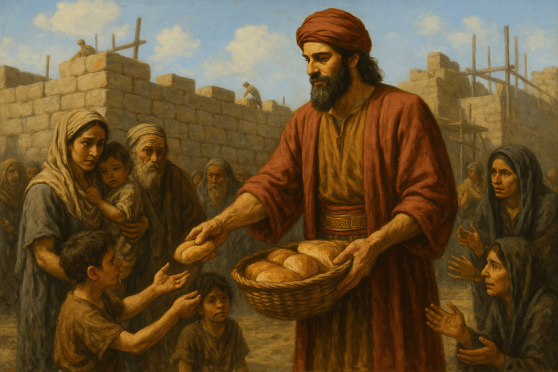
As Nehemiah and the Hebrews in Judah attempt to rebuild the walls of Jerusalem it is the Persian empire that holds sway. As the story opened, we learn that Nehemiah is a right-hand man of the Persian Emperor Artaxerxes. Nehemiah has a front-row seat in that empire and its palace back in Susa. He has the power and wealth that comes with that position.

In today’s chapter, he gets a front-row seat at what the policies of the Persian empire are doing to the lives of average people in flyover country far from the Emperor’s gilded throne room.

Persia had steep taxes along with grain restrictions and regulations. People around Jerusalem had to mortgage their fields in order to make their tax payments. It was Hebrew nobles and merchants with wealth who loaned them the money and mortgaged their fields. When famine hit, and the poor farmers couldn’t make payments, their Hebrew lenders foreclosed or else they took their debtors children into slavery as collateral.

These were common financial practices in the culture of that day. This is how human empires operate. There is nothing new under the sun when it comes to human empire. The rich and powerful rig the system to get richer and more powerful, while the poor and the outcasts find it harder and harder to survive.

What’s crucial for me to consider as I read about the circumstances with which Nehemiah is faced in today’s chapter, is that God had instructed the Hebrews from the beginning of their covenant in Exodus that He wanted them to do things differently. God wanted them to operate by the principles of His Kingdom rather than human empire.

In Exodus 22:15, Leviticus 25, and Deuteronomy 15 God prohibits Hebrews from charging interest from their fellow Hebrews. God established a system by which every seventh year there was a jubilee. All debts were forgiven. Any mortgaged land was given back to the ancestral family who inherited it from God. Slaves were set free. The Hebrews were to be generous and acknowledge that everything belonged to God, not to them. This is how God’s Kingdom works.

This is not what was happening in and around Jerusalem. Here is Nehemiah, an agent of the human Persian empire who created the circumstances in which God’s people have been corrupted. Yet, Nehemiah knows God’s law. He sees the injustice.

Why rebuild the wall to protect God’s Temple and God’s system of redemption if within those walls there is nothing but corruption? Why waste the time, energy, and resources if the Hebrews become nothing more than another human empire?

Jewish rabbis call Nehemiah’s response in today’s chapter mussar. It’s an ethical rebuke that is intended to restore community, not merely punish. Nehemiah not only rebukes the nobles and wealthy money lenders, calling them to repent and follow God’s law, but he once again leads by example. As the Emperor’s right-hand man, Nehemiah had wealth and resources at his disposal. Nehemiah acts out of the generosity that is at the heart of God’s laws. He channels his stipend and food allowance into generously feeding others. He refuses to place more of a tax burden on the people.

As I meditated on today’s chapter in the quiet this morning, it struck me that yesterday’s chapter was about external opposition from neighboring enemies. Today’s chapter is about the enemy within. Yes, it was corruption within the Hebrew people, but it was even deeper than that. It was selfish ambition, greed, and lust for power that had penetrated the hearts and minds of the Hebrew nobles, merchants, and ruling class. It is that same selfish ambition, greed, and lust for power that fuels all human empires, while God’s Kingdom cries out for love, justice, hospitality, and generosity.

Human empire is typically thought of on a global and national scale, but I’m reminded this morning that it also exists on a personal scale. When selfish ambition, greed, and the desire for power are in the driver’s seat of my heart and mind, then my own life, home, family, and business become Tom’s little personal empire. In contrast, Jesus sent His Spirit to dwell within me and He made me and my body His temple. I am God’s Kingdom on earth. I am to live out God’s principles of love, justice, hospitality, and generosity. I can’t do that if I’m more concerned about Tom’s little personal empire.

Lord, help me be a Nehemiah.

If you know anyone who might be encouraged by today’s post, please share.

Promotional graphic for Tom Vander Well's Wayfarer blog and podcast, featuring icons of various podcast platforms with a photo of Tom Vander Well.
These chapter-a-day blog posts are also available via podcast on all major podcast platforms including Apple, Google, and Spotify! Simply go to your podcast platform and search for “Wayfarer Tom Vander Well.” If it’s not on your platform, please let me know!
Logo of Bible Gateway with an open book icon and the text 'Bible Gateway'

“Yeah, but…”

They said, “When the Lord commanded my lord to give the land as an inheritance to the Israelites by lot, he ordered you to give the inheritance of our brother Zelophehad to his daughters. Now suppose they marry men from other Israelite tribes; then their inheritance will be taken from our ancestral inheritance and added to that of the tribe they marry into. And so part of the inheritance allotted to us will be taken away.”
Numbers 36:2-3 (NIV)

When I present customer service training I’ve learned that every customer service skill is likely going to be challenged. A hand will go up in the air. When I call on my class member I typically year, “Yeah, but Tom…”

Now I simply call them, “Yeah, buts.” They are the typical excuses or exceptions to the general customer rule that cause people not to want to follow the rule.

The book of Numbers ends with a “Yeah, but….”

Just a few chapters ago God instructed Moses to allow Zelophahad’s daughters to inherit their father’s allotment of the Promised Land. It was a radical and revolutionary moment in history when women were suddenly given a level of equality no one could have expected.

In today’s final chapter, the men of the tribe approach Moses and say, “Yeah, but Mo, what if Zelo’s daughters marry into another tribe? By law their land would then get absorbed into the ownership of their husband’s family and now our tribe’s land becomes part of another tribe’s allotment. Doesn’t seem fair.”

Moses went before God and God provided a compromise. God did not want land being exchanged between tribes. Every tribe was to get their equitable and divinely appointed allotment of land to divide between the families of that tribe, and the land must stay with the tribe. So, Zelo’s daughters were required to marry a man from a family within their tribe if they wanted to retain ownership.

In the quiet this morning, my heart is split in two directions of thought and emotion.

I love that God has radically broken normal human protocol to divinely advance the female cause. The “Yeah, but…” that is raised is a legitimate legal question. Jewish rabbinical thought through history views God’s response as a balance of the individual rights of the daughters and the community rights of their tribe. The marriage requirement for the daughters was not seen as punishment but as a balance of justice for the daughters and order in the integrity of the tribe and its allotment. God’s divine decree is dynamic as it engages human concerns and balances the competing “good” of individuals and groups.

At the same time, as a student of history, I’m well aware that today’s chapter reflects a well-worn pattern in which men fight female rights and equality. Today’s chapter was just the first “Yeah, but…” to God’s divine decree of female land ownership. Through history, patriarchal male lawyers continued to chip away at it with their legal judgments. They increased the primacy of male heirs. They created marriage and dowry systems that channeled legal ownership to the control of male family members and circumvented the Zelophahad’s Daughter’s rule. They narrowed the circumstances in which the rule was applied and created legal loopholes by which the rule could be effectively bypassed.

The further I get in my journey the more appreciation I have for the women in my life. I love the radical move God made in naming and giving rights to Zelophahad’s daughters. I love that Jesus repeatedly broke patriarchal cultural convention to have relationship with women, even unacceptable women. Mary Magdalene, the Samaritan woman at the well, the woman who’d been bleeding for 12 years, and the woman caught in adultery to name a few. I love that Jesus made way for women to have a seat at the table and that in Christ there is no male and female.

In the long arc of the Great Story I see the Kingdom of God perpetually pushing against the curse of sin and the patriarchal nature of humanity that flows from that curse. Over my journey, my desire had continued to grow to do all I can to push into the equality of God’s Kingdom and impede the flow of sin’s curse and the inequality that it has shackled humanity with since the Garden.

If you know anyone who might be encouraged by today’s post, please share.

Promotional graphic for Tom Vander Well's Wayfarer blog and podcast, featuring icons of various podcast platforms with a photo of Tom Vander Well.
These chapter-a-day blog posts are also available via podcast on all major podcast platforms including Apple, Google, and Spotify! Simply go to your podcast platform and search for “Wayfarer Tom Vander Well.” If it’s not on your platform, please let me know!
Image of a Bible with an open page in an orange icon format, representing a digital Bible or a Bible app.

“I Want to See”

“I Want to See!” (CaD Matt 20) Wayfarer

“So the last will be first, and the first will be last.”
Matthew 20:16 (NIV)

Jesus is making His way to Jerusalem. Just a few weeks ago, followers of Jesus around the world just finished our annual memorial of the events that are about to transpire in Matthew’s version of The Jesus Story. Jesus well knows what is about to happen.

What struck me as I meditated on today’s chapter is the connection between the events. Jesus has just finished talking to the eagle scout, who walked away sad and chose not to follow Jesus because he was unwilling to do the one thing Jesus’ said was keeping him from entering Life. Peter points out that he and the boys had left everything to follow Jesus, which Jesus commends sharing that there will eventually be a special place in heaven for them in the end, at the “renewal of all things.”

I have to keep this in mind as we enter into today’s chapter and remember that the chapters and verses of Matthew’s version of the story were added hundreds of years after it was written. When Matthew penned these episodes, they all flowed together. Jesus is talking about who enters Life, who gets it, and who doesn’t. He utters His famous line “many who are first will be last, and many who are last will be first.” He’s talking about the economy and spiritual principles of God’s Kingdom, which operate differently than the kingdoms of this world.

To illustrate this, Jesus tells the parable at the beginning of today’s chapter. A vineyard owner hires workers to work in his vineyard throughout the course of the day. At the end of the day, they each receive the same pay. This has those who’d been working before sunset furious and crying out for union representation. But the landowner points out that they had agreed to the terms, it was his money to do with what he wanted, and the truth of the matter was that they were envious of those to whom he’d been generous. Jesus then repeats “many who are first will be last, and many who are last will be first.” The parable is an illustration of this spiritual principle, which relates back to what has just transpired.

The eagle scout chose out of God’s Kingdom economics. The disciples had chosen in.

But, they still don’t get it.

To double down on the lesson, Jesus now predicts His suffering, persecution, and death for the third time (and once again, Matthew the Quirk finds and shares the conspicuous number three). Jesus came not to set up an earthly kingdom, but to bring an eternally spiritual kingdom to earth. In the economics of God’s Kingdom, the one who gives receives, the one who is last will be first, the one who sacrifices His life will find it, and the one who dies will be born again to new life.

Just then, James and John’s mother sees an opportunity. Jesus has just mentioned that in the end, at the renewal of all things, in God’s Kingdom The Twelve will have special places of honor and a special role. She wants to make sure her boys have a special position within the special places of honor and the special roles Jesus is talking about. She pulls her boys up with her to speak to Jesus.

Jesus asks what she wants. She tells Him she wants her boys to have the positions of honor on Jesus’ left and right. She wants her boys to be first among the first. She is their union representation trying to make sure they get what she thinks they have earned, and in so doing she will have the honor of knowing her boys have positions of prominence that afford her to brag about them to all the other Jewish mothers.

She still doesn’t get it. She is spiritually blind to the very thing Jesus has been trying to say. The Father will do as He pleases with His rewards just like the vineyard owner in the parable. The economy of God’s kingdom is based on the way of the cross. You have to lay down your life in order to find it. For the record, James will be executed by Herod Agrippa. John will escape martyrdom, but not suffering. He will suffer the fate of the nations of Judah and Israel, living out his earthly journey in exile.

Matthew ends this string of episodes with Jesus healing two blind men. Ironically, Jesus asks them the same question He asked the mother of James and John: “What do you want me to do for you?”

“We want to see!” they answered.

Jesus gives them their physical sight which starkly contrasts the stubborn spiritual blindness of the disciples (and, in the case of James and John, their mother).

Today, I complete my 59th lap around the sun. In the quiet I hear God’s Spirit whisper to my spirit the same question He asked of the wife of Zebedee. The same question He asked the two blind men.

“Happy birthday, Tom. What do you want me to do for you?”

The answer is obvious. I want to see, Lord! I want spiritual sight.

If you know anyone who might be encouraged by today’s post, please share.

These chapter-a-day blog posts are also available via podcast on all major podcast platforms including Apple, Google, and Spotify! Simply go to your podcast platform and search for “Wayfarer Tom Vander Well.” If it’s not on your platform, please let me know!

The Revival I Missed

The Revival I Missed (CaD Matt 8) Wayfarer

I say to you that many will come from the east and the west, and will take their places at the feast with Abraham, Isaac and Jacob in the kingdom of heaven. But the subjects of the kingdom will be thrown outside, into the darkness, where there will be weeping and gnashing of teeth.”
Matthew 8:11-12 (NIV)

At the time I was in high school ours was the most racially diverse school in the state of Iowa. This was not only true because of desegregation, but also because of the large number of Asian refugees who entered the state in the 1970s after the war in Vietnam. Add to these the large racial population differences the other social breakdowns of jocks, geeks, burnouts, band nerds, and the like that were common in the day. It was diverse community, though I remember there being relatively little conflict.

I spent most of my high school years in student leadership so I connected with and communicated with kids from all the various constituencies in our school. From an activity perspective I was at the heart of things a Fine Arts Loser largely involved in theatre, show choir, and choir. Socially, most of my high school years were spent as part of a tight-knit group of Jesus Freaks. We had a holy huddle that stuck together socially both inside and outside of school.

During those years a revival broke out within our student body. It happened through the Fellowship of Christian Athletes (FCA) and a number of jocks in our school became followers of Jesus. It’s hard to communicate how this reverberated throughout the school. There were some radical conversions of individuals I never would have expected to become believers.

What was fascinating about this event is that I and my friends in our holy huddle had nothing to do with it. Zero, zip, zilch, nada. Here we were staying in our lane, sticking together like a herd of scared deer trying to protect ourselves from prowling lions, and assuming that certain individuals would never, ever, in a million years consider believing in Jesus. Think Peter and the boys learning that their greatest enemy, Saul/Paul, had become a believer. It felt a little like that. So, I and my posse were really not a part of the spiritual revival, at all.

This was not lost on me.

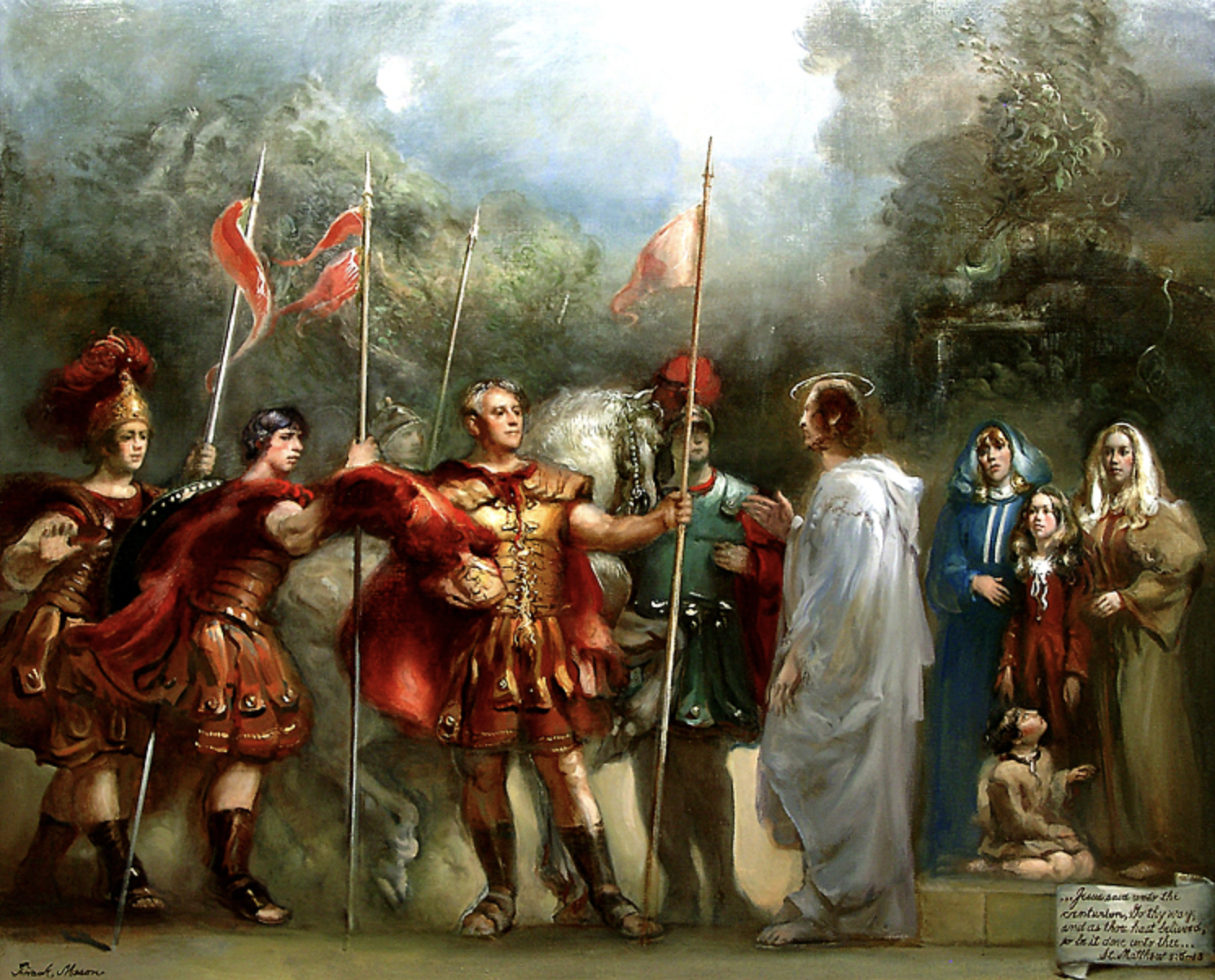
In today’s chapter, we are still at the very beginning of Jesus’ ministry. He spent 40 days fasting and being tempted. He was baptized by John. He delivered His message on the mountain. Things are still in the launch period of Jesus’ Miraculous Mystery Ministry Tour. Along comes a Roman Centurion whose servant is sick.

STOP.

It’s easy to gloss over the 80,000 pound elephant in the room. Romans were hated. Romans were the oppressors. Romans were the enemy of Jesus’ tribe and occupiers of their land. Romans were despised, godless, violent, and merciless usurpers. Jesus’ tribe was waiting for the Messiah to arrive and wipe the Romans out in a holy bloodbath. It’s hard for a casual, modern reader to understand the social and cultural context of this Roman Centurion approaching Jesus.

Think a Russian military general approaching a Ukranian in occupied territory.

Think a German SS officer coming to a Frenchman in occupied Paris during World War II.

Think a Grand Wizard of the Ku Klux Klan walking into a civil rights meeting to talk to Martin Luther King Jr.

Think Donald Trump walking into a local DNC resistance meeting.

What’s fascinating about this episode is that Jesus not only graciously accepts the Centurion and heals His “enemy’s” servant, but that Jesus then makes clear that this is just the first tremor of a massive, tectonic spiritual shift that Jesus is bringing. This is the tremor. The events of the entire book of Acts is the earthquake.

Jesus explains that individuals like this Roman Centurion (vile, hated, despised, enemy) will be seated at “the feast with Abraham, Isaac and Jacob in the kingdom of heaven.” Jesus’ tribe considered this feast to be an exclusive, members only event for holy huddle members only. Jesus goes on to make clear that in the coming spiritual earthquake, those who are considered enemies will take a seat at God’s feast while those in the holy huddle won’t get past the doorman.

I’ve never forgotten that revival in my high school, nor have I forgotten that the only joy I experienced with it was to watch it happen from the cheap seats. I was too busy being a faithful member of the tribe. I was sequestered in my holy huddle assuming everyone outside of our huddle was an enemy to be avoided, if not feared and/or despised. How badly I missed Jesus’ entire Message.

In the quiet this morning, I find myself committed to learning from that lesson even though it is over 40 years later. Jesus’ core message was about the last being first, His love for the “least,” and God’s Kingdom operating opposite the hierarchical socio-economic caste system of this world. In God’s Kingdom,

I am to generously give if I want to receive.
I am to bless those who curse me.
I am to love my enemy, and pray for those who persecute me.
I am to rejoice in my suffering, especially being the object of hatred.
I am to die to myself if I want to experience real life.

And, I need to be willing to step out of my holy huddle like Peter stepping out of the boat to walk to Jesus on the water, if I want to be part of what God’s Spirit is doing.

If you know anyone who might be encouraged by today’s post, please share.

These chapter-a-day blog posts are also available via podcast on all major podcast platforms including Apple, Google, and Spotify! Simply go to your podcast platform and search for “Wayfarer Tom Vander Well.” If it’s not on your platform, please let me know!

Dedication

Dedication (CaD Lev 27) Wayfarer

“‘A tithe of everything from the land, whether grain from the soil or fruit from the trees, belongs to the Lord; it is holy to the Lord.’
Leviticus 27:30 (NIV)

Dedication is one of those words that I know its meaning but when you ask me to simply and clearly define it, it sort of escapes me. So, I looked it up this morning. It’s actually a Swiss army knife of a word. The American Heritage Dictionary actually had eight different definitions. For our purposes today, I’d like to focus on just two of them:

  1. Selfless devotion.
  2. The act of setting apart or consecrating to a divine Being, or to a sacred use, often with religious solemnities; solemn appropriation.

Today’s chapter is the final chapter of God’s instruction manual for the newly appointed Hebrew priests and the Hebrew people back in about 1500 B.C. God finishes the manual with a chapter about dedications and tithes. God has already talked about the offerings, sacrifices, and festivals that He wanted His people to weave into the fabric of their lives. He ends with instructions around acts of dedication that go above and beyond what has already been prescribed.

God tells His people that they have a choice to dedicate servants, houses, and land to God. What’s more, God tells them to consider a tithe (10 percent) of everything they have and everything their land produces belongs to Him. God has already told them that everything that they have been and will be blessed with are God’s divine and generous gift (Lev 26:3-5). In reality, all of creation, including all we are, have, and are blessed to acquire are God’s. God asks His people to gratefully embrace this truth and show it by consciously and willfully setting aside ten percent of everything as a tangible “thank you” back to God.

Why?

As I meditated on this question in the quiet this morning, my mind and heart found themselves wandering back to this pesky human problem of sin that began in the Garden of Eden. God gave everything in the Garden to them for their consumption, save one thing. They were given 99.9% of everything the Garden had to offer, but they couldn’t abide surrendering their appetite and desire to have it all.

I appears to me that God is, in effect, asking His people to turn their hearts back to Him in a way that reverses the Eden Problem. He has generously shown up, miraculously delivered them from slavery, and now promises to abide with them and bless them with life, provision, and land. As with Eden, He’s blessing them with everything. What He asks is that they recognize this and reserve just ten percent to offer back as an on-going “Thank you” card.

First, this requires a spirit of “selfless devotion.” It’s so easy to think that my paycheck is mine. It’s my job. It was my hard work that earned it. It’s my money. But, wait a second…

Who blessed me to be born in the wealthiest and most materially blessed nation in the history of the entire world?

Who blessed me to live in a place with a great educational system that taught me everything I know?

Who saw to it I was born into a family who provided for me, cared for me, and taught me everything I needed to succeed in life?

How blessed have I been to enjoy almost sixty-years of health, opportunity, and affluence?

Did I do one thing to make any of these things happen? Did I do anything to deserve the amazing lot in life that I’ve been afforded?

No.

And that’s the point that God is asking me to tangibly and metaphorically remember every day, every month, and every year of my life. Take ten percent and “set it apart” in a willful act that says:

“Everything I have is from you anyway, God. I wouldn’t have any of it if it wasn’t for you. And, it’s all yours anyway. Someday, any day now really, I’m going to die and my body will return to dust and ashes just like you said. Not a single thing I think I own or consider to be mine is going to mean anything at that point. Adam and Eve weren’t content with 99.9% of the Garden. They had to have that last one-tenth of a percent. I don’t want to live like that. I don’t want to be like that. Here’s ten percent, God. I dedicate it to you. I gratefully give it back to you.”

In the quiet this morning I am reminded of the ten lepers whom Jesus healed. One came back to say, “Thank you.” One of ten was grateful. Ten percent made a willful choice to turn around, trek back to Jesus, and offer his thanks. Jesus response?

“Where are the other nine?”

Wendy and I are consciously willful about being generous with the money and things with which we’ve been blessed. We talk about it. We practice it. We weave it into the fabric of our everyday lives. I don’t want to be like Adam and Eve, discontent with God’s gracious and generous blessing and deluded into thinking that anything (let alone everything) I think I own is really mine. I want to be a ten-percent person like the leper who came back to say “thanks.”

The further I get in my spiritual journey, the more I come to understand that the extent of my generosity is a leading indicator of the depth of both my spiritual understanding of the economics of God’s Kingdom, and my gratitude for God’s insane generosity towards me.

If you know anyone who might be encouraged by today’s post, please share.

These chapter-a-day blog posts are also available via podcast on all major podcast platforms including Apple, Google, and Spotify! Simply go to your podcast platform and search for “Wayfarer Tom Vander Well.” If it’s not on your platform, please let me know!

Kingdoms Fall

Kingdoms Fall (CaD Ezk 26) Wayfarer

 therefore this is what the Sovereign Lord says: I am against you, Tyre, and I will bring many nations against you, like the sea casting up its waves.
Ezekiel 26:3 (NIV)

This past Sunday I delivered a message among my local gathering of Jesus’ followers and I voiced the fact that the entire Great Story from Genesis to Revelation is really about the conflict between God’s Kingdom and human empire.

Human history is a study in the rise and fall of human empires. Some are long-lasting like that of the Byzantine Empire which lasted of 1100 years. The rise and fall of the Third Reich in the 20th century was, by grateful comparison, a blip on the radar at 25 years.

When it comes to the ancient Hebrew prophets, it’s really about human empires, and there was a slew of them rising and falling during the period of the prophets from 875-430 B.C. When reading the prophets like Ezekiel, it helps to have some historical context to inform the reading of the text.

The Kingdom of Tyre (modern day Lebanon) was a prominent and wealthy trading port north of Israel. There were actually two cities. One was a fortified island just off the main land. The other was on the mainland itself. The Kingdom was known for their cedar forest and those cedars were exported by kings in the region for their pet building projects. Solomon used the cedars of Tyre for building his temple.

The relationship between ancient Israel and Tyre was testy. Evil Queen Jezebel was a princess of Tyre who was married to Ahab as a political alliance. She famously tried to rid Israel of the worship of Yahweh and import her native Baal worship. God raised up the prophet Elijah to oppose Jezebel and things didn’t end well for her.

Today’s chapter is the first of three prophetic messages against Tyre. In Ezekiel’s day, prophesying the fall of Tyre would probably have made his listeners laugh. Tyre seemed indestructible. First, it was a major trade port, the source of tremendous wealth, and strategic trade partner with it’s ships bringing in goods from all over the Mediterranean and northern Africa. Then, of course, was the fact that it was two cities. If you destroyed the mainland city, you still had to figure out how to lay siege to the island city.

Ezekiel prophesies that “many nations” would come against Tyre and lay siege to it. Verses 8-9 are a very succinctly detailed description of the stages of siege warfare in that day (Ezekiel and his fellow exiles were living witnesses of how it worked):

He will ravage your settlements on the mainland with the sword

A big part of the success of siege warfare on a walled city was to starve the people inside. The army would start by getting control of the settlements around the city that helped provide crops and food inside the city. This broke off supply lines and starvation would ultimately occur within the walled city.

he will set up siege works against you, build a ramp up to your walls and raise his shields against you.

The next phase of the siege was to get to the top of the walls to take out the city’s defenses. Defenders would stand on the wall and shoot down at the sieging army or pour boiling oil on top of them. A ramp was typically constructed leading up a section of the city wall and “siege towers” would be constructed and rolled up the ramp to get to the top of the wall and eliminate the defenders there.

He will direct the blows of his battering rams against your walls and demolish your towers with his weapons.

Once in control of the top of the wall, the siege army could concentrate on breaking down a section of wall so that the army could flood in. There were multiple ways they could accomplish this. The gates were so fortified that sometimes it was easier to ram through a weaker section or to dig a tunnel under the wall to weaken the wall and cause it to collapse.

Ezekiel’s prophecy was actually fulfilled. Nebuchadnezzar laid siege to Tyre for thirteen years. He destroyed the city on the mainland and was particularly ruthless given how long it took. Babylon didn’t have a lot of experience with naval warfare and he failed to take the island city. A hundred or so years later Alexander the Great would come through and finish the job. He was even more ruthless than Nebuchadnezzar, and historians were aghast at the slaughter. He killed 10,000 men, women, and children, sold 30,000 into slavery, and had all the young men of fighting age crucified.

In the quiet this morning, it leaves me pondering the rise and fall of empires. My friend, Chuck, was head of marketing for Billy Graham films when they made The Hiding Place. It’s the story of Corrie Ten Boom whose family helped hide Jews from the Nazis. Her whole family were sent to concentration camps. She was the only one who survived, released from the camp because of a clerical error. When Chuck asked her why she wanted to make a movie of her story she answered, “To prepare American Christians for what they are going to have to go through someday.”

Chuck told me this when I was in high school. It’s seemed crazy back then. After the last eight years or so, I’m not so sure. I am pretty sure that it’s much like the people of Ezekiel’s day thinking he was crazy to predict the fall of Tyre. History teaches me that kingdoms rise and kingdoms fall. Sometimes the fall is sudden and unexpected. Who knows what the future holds. I prefer to know and trust Who holds the future.

If you know anyone who might be encouraged by today’s post, please share.

The Scepter and the Sword

The Scepter and the Sword (CaD Ezk 21) Wayfarer

“‘Shall we rejoice in the scepter of my royal son? The sword despises every such stick.’
Ezekiel 21:10b (NIV)

Along my life journey, I have observed that the political divide here in the States can arguably be boiled down to those who don’t trust the government to do anything well and want to diminish its role in our lives versus those who trust the government to do everything for us and therefore want to entrust more and more of our lives to it.

One of the things that history has taught me is that while the world changes, the one thing that does not change is the human condition and, therefore, all the human systems that we humans create. It’s why Shakespeare is still so powerfully relevant today. Arguably, no one has ever captured the human condition for the purposes of both comedy and tragedy as the Bard.

In today’s chapter, I found that the ancient Israelites were dealing with their own sense of safety and trust in their government, a monarchy founded on the royal line of David.

Throughout history, the staff or scepter has been a symbol of authority, royalty, and command. When God called Moses to lead His people out of Egypt, He sent Moses with a staff that became a metaphor for God’s power and authority. Archaeologists have uncovered an ivory pomegranate that was used at the top of a scepter with an inscription indicating it may have very well been used by the priests in Solomon’s Temple. Statues and artwork of both royalty and idols frequently showed them holding a scepter.

The Israelites of Ezekiel’s day, living in Judah and Jerusalem, had been raised to revere the King as a member of David’s royal house. It had been proclaimed that God would establish David’s throne forever, and they put a lot of stock in this promise. Many believed that as long as a member of David’s house was on the throne God would protect them and prosper them. Certainly the King had prophets on his payroll who would proclaim this loudly in an effort to keep the peace. People believed it.

Ezekiel, however, is given a prophetic vision contrasting the scepter of the royal house of David to the sword of God’s judgment in the hands of the King of Babylon. The prophetic word begins with the sword despising and mocking the “stick” in the king’s hand. The prophecy continues to explain that the sword is more powerful than the scepter, and warns the people not to trust their king and his royal prophets.

The prophecy ends on a Messianic note:

“‘A ruin! A ruin! I will make it a ruin! The crown will not be restored until he to whom it rightfully belongs shall come; to him I will give it.’
Ezekiel 21:27 (NIV)

As a follower of Jesus, I couldn’t help but note that the monarchy in Jerusalem did end with Babylon’s siege. There was no king in Jerusalem until Jesus rode in on a donkey and Matthew remembered the words of the prophet Zechariah:

“Say to Daughter Zion,
    ‘See, your king comes to you,
gentle and riding on a donkey,
    and on a colt, the foal of a donkey.’

In the quiet this morning, I am reminded of my dual citizenship. Yes, I am a citizen of the United States, but as a disciple of Jesus I am also a citizen of God’s heavenly kingdom. The former is human and temporal, the latter is divine and eternal. My citizenship in God’s Kingdom does not diminish my earthly citizenship or my responsibility to be an active and participatory citizen on earth as I have heard people argue. On the contrary, as an ambassador of God’s Kingdom on this earth I am required to be a more dutiful and engaged member of society, respecting those in authority and acting on a daily basis to make life on earth a better place for my fellow human beings for Heaven’s sake.

With that in mind, I am also mindful that the one thing that does not change on this earth is the human condition, unless it becomes subject to the power of God’s Holy Spirit. The end of the Great Story as told in Revelation is a parallel to Ezekiel’s prophecy in today’s chapter. God’s sword (pictured as the Words from Jesus’ mouth; see Rev 19:15) standing against the scepters of the Prince of this World and all the kingdoms of this world.

Despite knowing and believing the ending, my role in this Great Story is to be an ambassador of God’s Kingdom here on earth today. And that means being a good citizen, and operating out of love in everything I say and do. Here we go…

If you know anyone who might be encouraged by today’s post, please share.