Tag Archives: 1 Peter 3

Without Words

Wives, in the same way submit yourselves to your own husbands so that, if any of them do not believe the word, they may be won over without words by the behavior of their wives…

Always be prepared to give an answer to everyone who asks you to give the reason for the hope that you have….
1 Peter 3:1, 15 (NIV)

In my upcoming book I share the story of how as a young man I believed with certainty that I was supposed to become a pastor, and how God made clear that He had purposed for me a quirky career analyzing business phone calls (a la “This Call May Be Monitored”).

My mother was greatly disappointed by the abrupt change in my vocational trajectory. My mother was a sweet lady. She was never given to overt confrontation. She was, however, an expert at letting her concerns made known through what she thought were subtle messages that we as her children could see coming a mile away.

As least once a year, sometimes more often, my mother would wait for us to be having an enjoyable casual conversation.

“Are you ever going to go back to ministry?” she would ask quietly.

Only, it really wasn’t that quiet. She asked the question repeatedly. It was always the same question. She never heard my answers above the din of her own internal fear.

I know my mother loved me. I know she was proud of me. I also know she had her heart set on me spending my career in vocational ministry. I don’t think she ever shook her angst that perhaps I was outside of God’s will. I think she loved having a son who was a preacher.

And boy, did she remind me. Again. And again.

My mother was not alone. Along my life journey, I have observed many well-intentioned parents perpetually express their spiritual concern for their adult children to their adult children. It comes in many different forms.

The annual Christmas gift of a Bible or the latest, bestselling devotional, testimonial biography, or that popular Christian movie.

[cue: Children’s eye roll]

The letter (or email) of concern because “you just have to know how I feel” or, “What we believe.”

Children: “Seriously, do you actually think I don’t know how you feel?”

The passive aggressive comments, questions, and not-so-casual asides that get slipped into almost every conversation.

Followed by hurt and wonder when the adult children, inexplicably, don’t seem to want to hang out all the time.

Today’s chapter begins with a statement that creates such surface angst and outrage in modern culture that the principle of what Peter is getting at is easily lost. He starts by telling wives who are followers of Jesus to submit to their husbands “so that they may be won over without words.”

“Without words…”
Behaviors that speak louder than words.
Life example that shows the way like metaphorical bread crumbs.
Trusting God with the soul of my loved one — and recognizing that my fear may say more about my faith than about their future.

What’s often lost in the cultural outcry of Peter’s encouragement is that Peter isn’t singling out women or wives. He is calling on everyone who is a follower of Jesus to be an example of Jesus to those in their circle of influence “without words.”

Slaves (2:18)
Husbands (3:7)
All of you (3:8)

Peter then goes on to write what is a well-known and well-worn instruction:

“Always be prepared to give an answer to everyone who asks you to give the reason for the hope that you have…”

But the context that Peter has established is that a person is asking me the reason for the hope that I have ibecause my life, my behavior, my relationships, and my example have made them curious…

…without using words.

The wise teacher of Ecclesiastes said, “there is a time to speak, and a time to be silent.” (Ecclesiastes 3:7)

When our daughters were young, it was time for me to speak. I taught. I answered. I guided.

When they became adults, it was time for me to learn silence.

They know what I believe. They grew up in my home.
They know desire for them to believe. I made my heart known long ago.
They know they can always talk to me. They bring it up when they’re ready.

In the meantime, I continue to walk my own journey. I pray for them. To Peter’s instruction, I remain ready and available to assist and provide as needed. To answer when asked. To speak when spoken to. Otherwise, I do my best to continue to model the spiritual life and relationship with Jesus that I would love for them to experience…without words.

And then, in the quiet, I surrender to Jesus any notion I have that their relationship with Him has to look exactly like the relationship I have with Him. I surrender my desire for their relationship with Him to be exactly what I desire for it to be. I let go of my desire to think that their stories should look like my story, or the story I would write for them if I was God…if I was in control.

And, that’s the point Peter is getting at.

I’m not in control of others whether it’s a boss, spouse, parent, friend, or child. I don’t write their stories. I don’t know the story God is authoring in their stories, nor has God ever asked me to be a co-author.

He asks me to love.
He asks me to pray.
He asks me to live as such an example that he can leverage that as a theme as He writes their own personal, individual stories.
He asks me to be ready with words —
but to live so faithfully that the question comes before the speech.

If you know anyone who might be encouraged by today’s post, please share.

Promotional graphic for Tom Vander Well's Wayfarer blog and podcast, featuring icons of various podcast platforms with a photo of Tom Vander Well.
These chapter-a-day blog posts are also available via podcast on all major podcast platforms including Apple, Google, and Spotify! Simply go to your podcast platform and search for “Wayfarer Tom Vander Well.” If it’s not on your platform, please let me know!
Icon of an open book on an orange background

“Bless You”

Never retaliate when someone treats you wrongly, nor insult those who insult you, but instead, respond by speaking a blessing over them—because a blessing is what God promised to give you.
1 Peter 3:9 (TPT)

In over 50 years of this life journey, I have enjoyed relationships with many friends. Especially among my male friends, I have regularly encountered those individuals with what I will describe as a particular soul wound. They never received a blessing from their father.

In ancient days, a father’s blessing was a cultural ritual. The blessing was the spoken favor of the father given, typically, to his son. The first recorded blessing in the Great Story is God’s blessing to Abram:

The Lord had said to Abram, “Go from your country, your people and your father’s household to the land I will show you.

“I will make you into a great nation,
    and I will bless you;
I will make your name great,
    and you will be a blessing.
I will bless those who bless you,
    and whoever curses you I will curse;
and all peoples on earth
    will be blessed through you.”

Genesis 12:1-3 (NIV)

In Genesis 49, Jacob calls all of his sons and speaks to each one of them “the blessing appropriate for him.” It was a rite of passage, often spoken before death in those days.

Along my journey, I’ve come to realize that our culture has largely forgotten the importance of children receiving a blessing from their parents. I have come to believe that it’s important for a child to hear a blessing from both parents. I have observed, however, that a son receiving a blessing from his father has a major spiritual and emotional impact on a man’s life. I have known men who received nothing but curses from their fathers, and I have known men who received nothing but silence from their fathers. The soul wound is often hidden behind a male ego and masculine bravado, but I’ve seen how it can cut deep and create all sorts of spiritual, emotional, and relational handicaps.

Speaking a blessing doesn’t have to be a formal ritual, though it certainly can be a very meaningful rite of passage when it’s done that way. The most simple blessings are simply words of love and affirmation:

  • “I love you.”
  • “You’ve got this. I believe in you.”
  • “You’re going to be okay. I know it.”
  • “I’m proud of you.”
  • “That was great. Well done.”
  • “You are loveable, valuable, and capable.”
  • “I have no doubt that you will succeed at whatever you’re led to do in this life.”

In today’s chapter, it struck me that Peter instructed believers to specifically speak a blessing over those who wrong you. I find myself wondering if we even know how to do that anymore, even with those we love, let alone doing it with our enemies. Given what I see on social media, cursing appears to be de rigueur.

In the quiet this morning, I’m discovering my renewed desire to bring blessings back. There’s a reason why I speak a blessing at the end of my podcast. I would love for blessings to become fashionable again, but I suppose that means I’ve got to start being more intentional about it. So, here you go, my friend. Receive an old Celtic blessing from this wayfaring stranger (I spoke it as I posted it):

May the blessings of the Light be upon you,
Light without and Light within,
And in all your comings and goings,
May you ever have a kindly greeting
From those you meet along the road.

Have a great day. Press on. You’ve got this.

Character and Life Contributions

Finally, all of you, be like-minded, be sympathetic, love one another, be compassionate and humble.
1 Peter 3:8 (NIV)

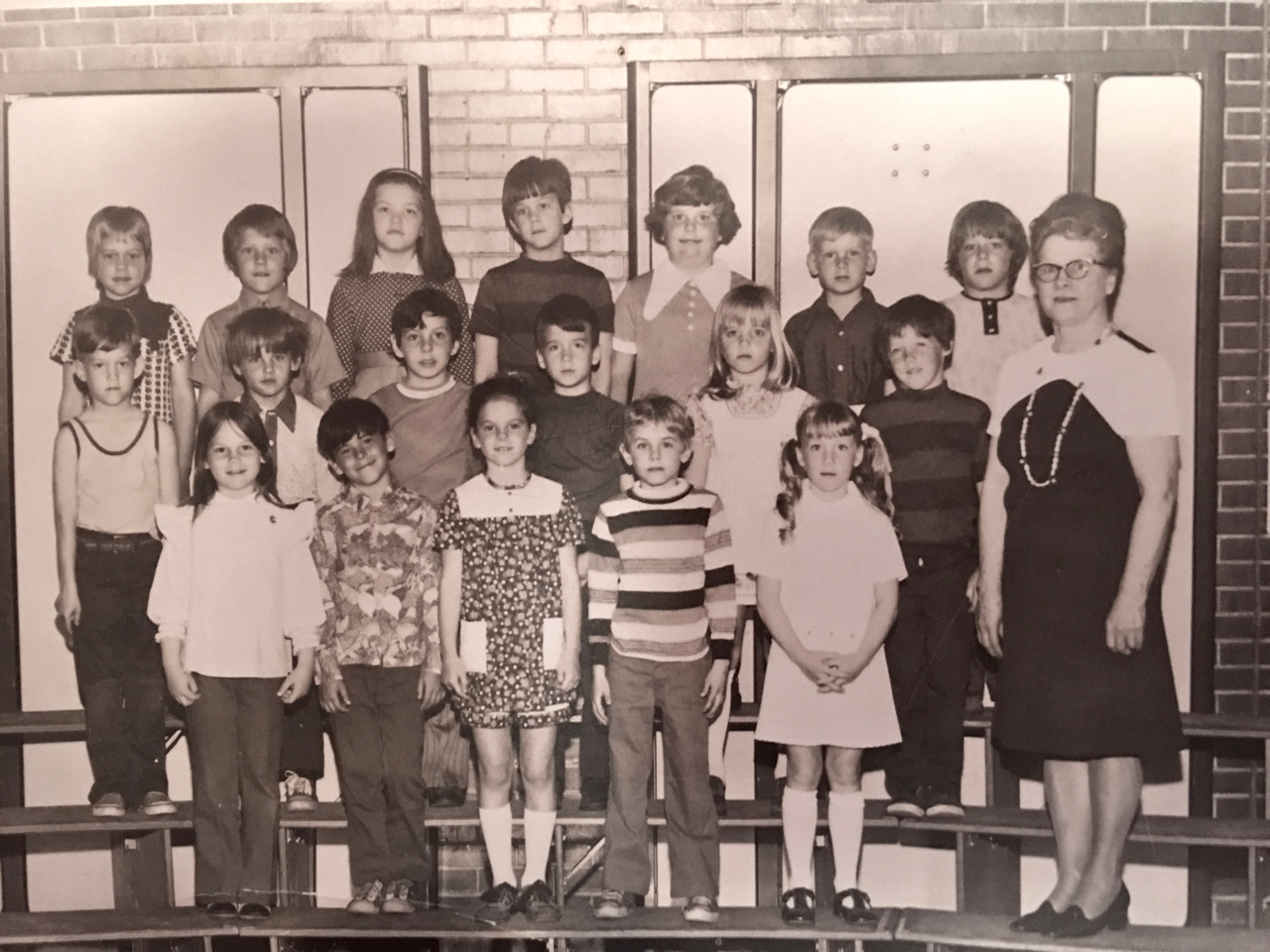
The other day I was going through some old photographs and came upon my class photo from first grade. There was Mrs. Avery in her cat-eye glasses and all of us lined up on the risers in the gymnasium of Woodlawn Elementary school. I tried to remember the names of all my classmates. Believe it or not I can still recall all but two or three.

Just a week or so ago I shared with a group of friends my gratitude for Mrs. Avery. Back in those days our kindergarten classes were half-days and I absolutely hated my kindergarten experience. More than once my mother had to drag me kicking and screaming to school. So it was that I was nervous about attending first grade and having to spend all day at the dreaded school. Then I met Mrs. Avery.

For whatever reason I still remember the first moment walking into that classroom and meeting Mrs. Avery. I was immediately at peace. She was kind and gentle. There was a spirit about her than put me at ease. I spent that year developing an enjoyment of learning.

It was much later in life that I went to Mrs. Avery’s home to thank her for the subtle but significant impact she had on my life. She was still just as kind and gentle and loving. She told me that day, looking over that same class photograph, how she used to pray for each of us students every day.

I happen to be at a place in life at which I can look back and contemplate many, many relationships I’ve had along my journey. My mind is contrasting my experience with Mrs. Avery with that of the acquaintance I mentioned in yesterday’s post. It brings to mind the characteristics of individuals who made a positive contribution to my life journey contrasted with the characteristics of individuals I would just as soon forget.

In this morning’s chapter, Peter behavioral instructions for life and relationships. Here are some of the characteristics he commands followers of Jesus:

Purity
Reverence
Gentle and quiet spirit
Considerate
Respectful
Like-minded
Sympathetic
Loving
Compassionate
Humble
Repaying evil with blessing
Reverent
Gentleness

Not a bad list. Come to think of it, these words describe Mrs. Avery pretty well. They also describe a host of other family, friends, associates, and individuals who’ve made positive contributions in my life. Then I think about those individuals in my life who’ve characterized the antonyms of these words. Rather than making a contribution of Life, it seems to me they’ve had the opposite effect: drain, deplete, tempt, and trouble.

This morning I’m once again taking stock of my own heart, life, words, and actions. I’d like to think that the character qualities Peter commands are how others would describe me. I hope to make Life contributions to others. Basically, I’d like to take a little bit of Mrs. Avery’s contribution to my life and pay it forward. Today, even.


Chapter-a-Day 1 Peter 3

Christ suffered for our sins once for all time. He never sinned, but he died for sinners to bring you safely home to God. 1 Peter 3:18a (NLT)

Wendy and I are sports fans. We follow our teams and enjoy watching them through the seasons. This means it’s been busy the past few weeks as baseball season is winding down, but football season is in full swing. The result is that we’re watching a lot of sports on television and the DVR is working overtime recording shows and movies that we likely won’t get to until after the fall classic.

Though we love watching many different sports, my love of baseball has grown over the years while my love of other sports has waned. There are a number of reasons for this. Baseball, more than any other sport, is a metaphor for life. It is a day-by-day journey that starts with the promise of life each spring and ends (especially for Cubs fans) with the harsh realities of death and disappointment each fall leaving hope of resurrection “next year.” Within the long journey there are highs and lows. Even the worst of teams pull together a few winning streaks and the best of teams are going to experience a host of disappointing losses. The best of the best hitters fail seven out of ten times at the plate. The greatest of pitchers give up a home run now and then.

While I love all these things about baseball, the one thing that I’ve come to appreciate most is the simple object of the game: making it home safely. It is the same objective that this wayfaring stranger has as I day-by-day walk my journey through this world of woe. You’ll even find it in the banner of my blog. It is the same way Peter summarizes the message of Jesus in today’s chapter: Jesus died on a cross and suffered as a sacrifice for ours sins once for all and did so in order to bring we sinners safely home.

Those who’ve walked with me for a long time have watched me hit a few home runs but have more often seen me strike out swinging. I’ve been hit by pitches and have stolen a few bases. I’ve also dropped some easy pop flies. Nevertheless, I get up early each morning with the promise that it’s a new day. I can’t do anything about yesterday’s bitter loss. I can only do my best in today’s game as I make my way toward the inevitable winter that slowly approaches.