Tag Archives: Moniker

A Love Song that Aches

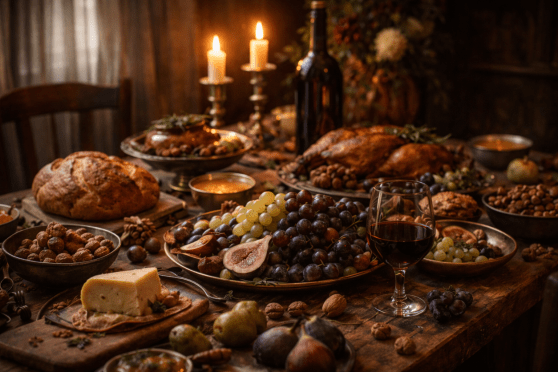
Jeshurun grew fat and kicked;
    filled with food, they became heavy and sleek.
They abandoned the God who made them
    and rejected the Rock their Savior.

Deuteronomy 32:15 (NIV)

If you hang out with Wendy and me for any length of time, you’ll soon notice that Wendy is not “Wendy” to me. She is “Luv,” or I more commonly prefer, “M’Luv.”

When I train clients on the art of customer service, I always talk about names. Names are important because names imply relationship, and customers typically desire more than a transaction when they find themselves in a tough spot – they want a personal service relationship.

One of the funny things about names is that the more intimate the relationship the more intimate the moniker we use for the “other” in relationship. An acquaintance might begin being referenced by a simple pronoun. (e.g. “him,” “her”). Relationship is established and names are learned and used (e.g. “John,” “Mary”). When relationship becomes intimate, we create pet names for one another (e.g. “Darling,” “Sweetheart”). Or, in the case of me and Wendy, “M’Luv.”

Here’s what is fascinating. When relationships break down, the cycle works in reverse. Amidst divorce, the woman I once referred to “Sweetheart” is easily reduced to “my children’s mother” or even back to the impersonal pronoun “her.”

In yesterday’s post/podcast I reference about this crazy idea God gives Moses, to give His people a song. In today’s chapter, Moses teaches the people the song. It’s a doozy. It’s less Love Me Do and more Symphonie Fantastique. Epic in length, it has five distinct movements:

  • God is introduced as The Rock—steady, faithful, just.
  • Israel is remembered as the one God carried, fed, and taught to walk.
  • Then comes the heartbreak: prosperity leads to forgetfulness; forgetfulness leads to idolatry.
  • Judgment follows—not as cruelty, but as consequence.
  • Yet the song does not end in wrath. It ends in vindication, mercy, and restoration.

The ancient Hebrews were all about structure in math, literature, poetry, and music. When it comes to song lyrics, the center of the lyrics is almost always the thematic hub and everything expands outward on either side of it. So, notice the center bullet of the summary above. The center of Moses’ Song is:

Jeshurun grew fat and kicked

As I went down the rabbit hole of meditation and study on Moses’ Song in the quiet this morning, two important things emerged for me.

First, the prophesied rebellion of God’s people does not happen out of suffering, trial, or condemnation. It happens when things go well.

Blessing increases wealth.
Wealth brings abundance.
Abundance breeds comfort…
and comfort makes us fat.

It is not in adversity we forget God, but in prosperity.

Yet notice how God addresses them at this central moment He calls them out: Jeshurun.

This is a name that is rarely used in the Great Story, and names are important.

Jeshurun can be translated “My beloved, upright people.” It’s not the common and neutral every day name “Israel.” This is a pet name — a covenantal endearment. It is an intimate moniker whispered between lovers, not shouted in public.

And, that is what makes its use here so devastating.

Despite His beloved’s forgetfulness, rebellion, and infidelity that is at the center of this love story, God does not address her with watered down formality or impersonal pronouns. He doesn’t shift to courtroom language foreshadowing divorce court. He doubles down and addresses her with a pet name reserved for the most intimate of moments.

Jeshurun.

It does three things…

Recalls Identity
This is who you were named to be.
Highlights Irony
The Upright One has developed scoliosis.
The straight one has grown crooked through comfort.
Deepens the Betrayal
This isn’t rebellion by strangers.
This is infidelity by the beloved.

At the heart of it, Moses is saying: “You did not forget God because you were oppressed. You forgot Him because you were satisfied.”

That is the ache of the song.

It is also, for me, a sobering spiritual reminder. Here in the quiet of my office I sit in prosperity and abundance smack dab in the middle of the wealthiest most affluent empire that has ever risen on the face of the earth in all of human history.

If there’s anyone at high-risk for forgetting God, it’s me.

A good reminder for me to carry into my day. A good conversation to unpack over coffee and breakfast with M’Luv.

If you know anyone who might be encouraged by today’s post, please share.

Promotional graphic for Tom Vander Well's Wayfarer blog and podcast, featuring icons of various podcast platforms with a photo of Tom Vander Well.
These chapter-a-day blog posts are also available via podcast on all major podcast platforms including Apple, Google, and Spotify! Simply go to your podcast platform and search for “Wayfarer Tom Vander Well.” If it’s not on your platform, please let me know!
Logo featuring an open book icon on an orange background.

The “Portion of Jacob”

The "Portion of Jacob" (CaD Jer 10) Wayfarer

He who is the Portion of Jacob is not like these,
    for he is the Maker of all things,
including Israel, the people of his inheritance—
    the Lord Almighty is his name
.
Jeremiah 10:16 (NIV)

Wendy and I have really enjoyed the first three seasons of The Chosen. We have found this cinematic retelling of the Jesus story as amazing as the story of its crowd-funded making. We both honestly felt like it took about three episodes of Season 1 for the writing and story to catch its stride, but from that point on we’ve been enthralled.

One of the things that we both love about this production is the way that it is telling the story. Many of the well-known cinematic retellings of the past have confined themselves to only those episodes and words which are recorded in the books of Matthew, Mark, Luke, and John. The Chosen, on the other hand, has remained true to these episodes while imagining the storylines of the characters around Jesus. In doing so, it places the episodes into the context of real, ordinary, daily lives of those involved – lives that are just like mine or yours. In the most recent third season, Peter and his wife are having marriage problems and a personal crisis that Jesus seems to completely ignore, James (who walks with a permanent limp) struggles with Jesus sending him out on a mission to heal others when Jesus has never once addressed James’ obvious handicap, and Matthew returns to Capernaum to face his estranged parents whose lives have been ruined because of his collaboration with the Romans as the local tax collector.

One of the other subtle things that I have loved about The Chosen is that the writers observe that Jesus loved nicknames. In the show, within The Twelve, He refers to “Big James” and “Little James.” Then there’s Simon the Zealot who is given the moniker “Zee” while the other Simon has yet to be given his nickname “Rocky” (the literal translation of “Peter”). I can’t wait to see how and when they work that one into the story.

I have observed many times along this chapter-a-day journey that God has always loved names and nicknames. As I’ve always said, God’s base language is metaphor. The nicknames that Jesus gave to His followers and that God gave to characters throughout the Great Story usually had a metaphorical meaning pointing to their character or transformation. The myriad of names of God used throughout the Great Story are a testimony to the power of metaphor to give us an increased understanding and appreciation for God, who cannot be truly understood within the limits of my finite mind.

In today’s chapter, I was intrigued by a moniker of God that I never remember noticing before. Jeremiah refers to God as “the Portion of Jacob.” There is only one other time in the entire Great Story in which this name of God is used when Jeremiah uses it again in chapter 51.

And so, in the quiet this morning I sat with and meditated on this nickname, “Portion of Jacob.” Of all the great ancestral heroes of Jeremiah and the Hebrews, Jacob is among the most intriguing. Jacob (which means “deceiver”) was a liar and a deceiver. His is a story of lowly person struggling against his place in life and one who wrestled with God. And yet, God shows Jacob unmerited favor and grace. God uses Jacob despite his flaws. God does not abandon Jacob, but continually humbles and hones Jacob throughout his story.

What a great metaphor for the very people, Jacob’s people, whom Jeremiah describes in today’s chapter. Jeremiah has six times (FYI: in numerology, six is the number of sinful man) described his people as deceitful to this point in the anthology of his messages. Jerry could have chosen to identify God as the God of Abraham, Isaac, Moses, or David. He chooses instead a moniker for God that he alone uses in all of the Great Story. God is the “Portion of Jacob,” the God of the deceitful, rebellious, hard-hearted people who descended from Jacob the deceiver who wrestled with God.

As I pondered this, I was reminded of many of the characters in the Great Story whose earthly lives and paths wound through rebellion, sin, and scandal. I thought of people in my own circles of influence who could be tagged as the spiritual descendants of Jacob the deceiver based on their own scandalous and tragic actions. I couldn’t help but think about my own stretches on this life journey, like those I’ve recently referenced, in which my own actions warranted being identified as a spiritual child of Jacob.

But, that’s the subtle beauty and the meaning of Jeremiah’s nickname for God, which is likely lost on most readers as it’s been lost on me until this morning. God graciously loved and used Jacob despite his very obvious human flaws. Jeremiah is pleading with his flawed and rebellious people to spiritually return to the God who will graciously welcome a repentant prodigal. God graciously loved me despite my own years of wrestling. God calls me to be gracious with those who are in their own stretch of life walking in the shoes as spiritual children of Jacob.

Lord, have mercy on me, a sinner.

If you know anyone who might be encouraged by today’s post, please share.

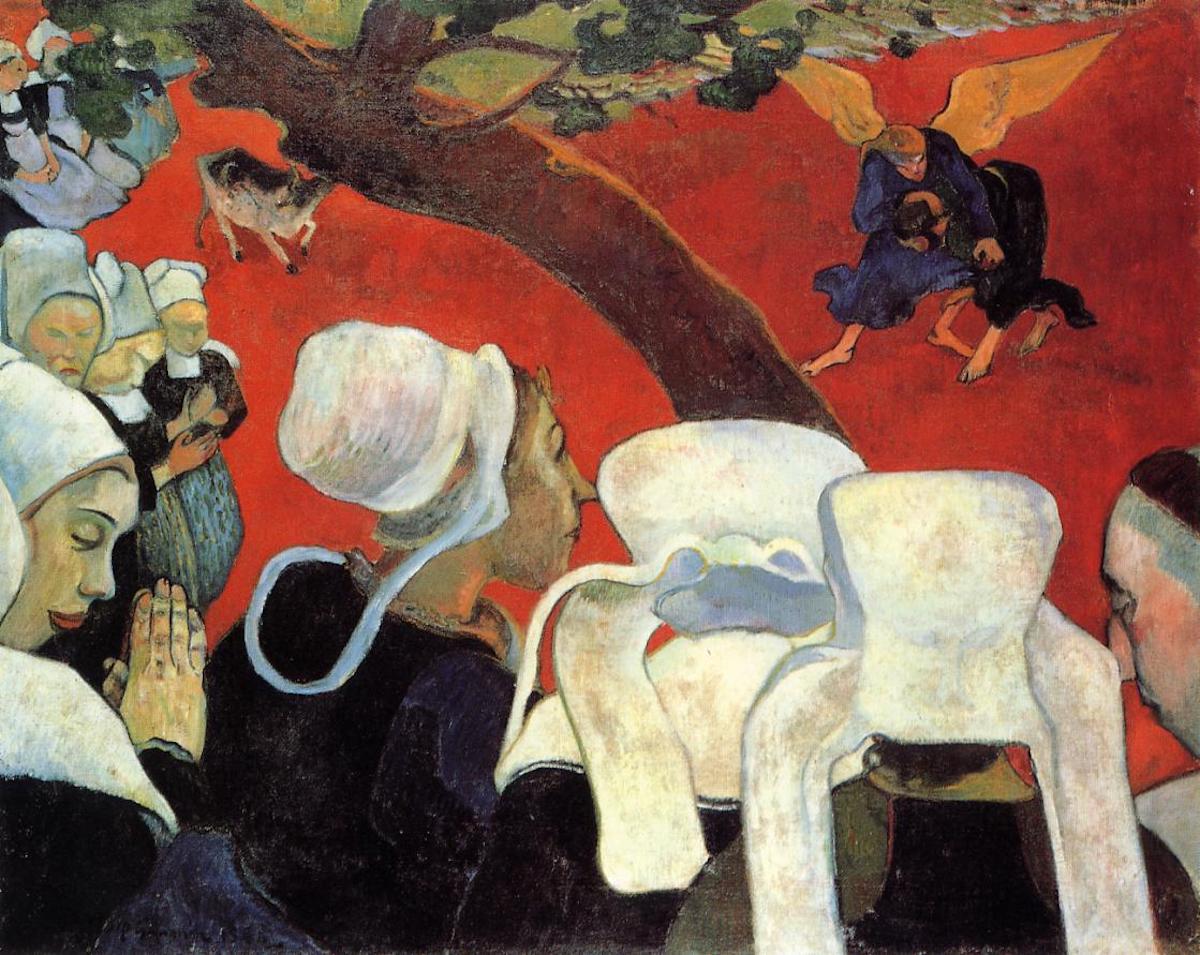
Today’s featured image is The Vision after the Sermon (Jacob wrestling with the Angel) by Paul Gaugin. Public domain. Scottish National Gallery, Edinburgh, UK.