Tag Archives: Reversal

At the Table

“This will be a sign to you: You will find a baby wrapped in cloths and lying in a manger.”
Luke 2:12 (NIV)

In a couple of weeks I will celebrate my 20th anniversary of this chapter-a-day blogging and podcasting journey. I’ve been mulling that over a lot over the past year. The truth is that this was in many ways an overflow of a daily practice I carved out for many years before that. Each morning I crawl out of bed, I grab a cup of coffee and I show up at the table. There, I spend some time with God, meditating, praying, and thinking about where I find myself on life’s road.

Along this journey, I’ve observed that many people hope for a connection with God at their weekly church service. The hope is that being in a building they believe is God’s House, somewhere amidst the music, the spectacle, the communal worship, and the spoken word they will experience something special.

As a follower of Jesus I am called to gather with fellow believers regularly, and God does inhabit and work in-and-through the praise and worship of His people. I have observed, however, that this lends itself to wanting or expecting something amazing, emotional, and spectacular. Sometimes churches even try to create those moments intentionally — crafting services designed to stir powerful emotions.

My own experience is that this misses the point.

It wasn’t a conscious choice on my part to move from the story of Esther to Luke’s version of Jesus’ story. Yet, in the first two chapters I’m finding connections I’ve never seen before. In yesterday’s chapter, it was the fact that God raises simple, faithful, unassuming people into key players within the Great Story. In today’s chapter, it’s reversals. The story of Esther is known for all of its reversals of fortune. Wouldn’t you know it, today’s chapter is full of them, as well.

The best and the brightest of religious minds and thinkers expected God’s Messiah to arrive in pomp. The Messiah, it was believed, would establish an earthly throne, wipe out the Roman Empires and subdue the nations, reign in earthly glory in Jerusalem where the entire earth would come to worship him.

But through the prophet Isaiah God had already said:

“For my thoughts are not your thoughts,
    neither are your ways my ways,”
declares the Lord.”

Building on yesterday’s chapter, we find that the Messiah enters human history quietly through unassuming people of simple faith. In today’s chapter, Luke methodically present this reversal:

What People ExpectedWhat God Actually Did
The Messiah would arrive in royal splendorA baby is born quietly to a young couple of simple faith
The King would be announced to rulers and priestsAngels announce Him to shepherds in a field
The Messiah would enter the world through powerHe enters through vulnerability, lying in a manger
The religious elite would recognize Him firstTwo elderly saints quietly recognize Him in the Temple
God’s presence would remain centered in the TempleJesus begins forming relationships around everyday tables
The kingdom would overthrow Rome by forceThe kingdom begins by transforming hearts

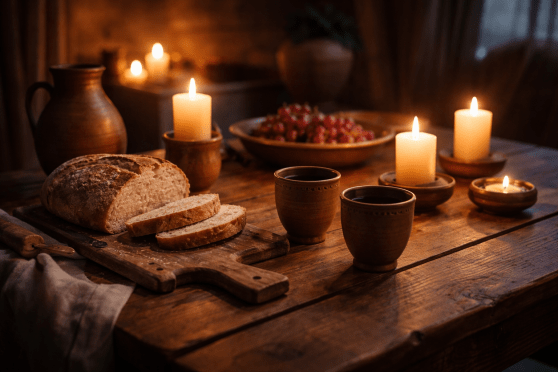
Jesus did show up at the Temple. In fact, He does so twice in today’s chapter. Once as a baby and then as a twelve-year-old. But God’s Son is already establishing that His ways are not the ways of religious institutions. His focus will never be the Temple, because He knows that the Temple will be rubble in 40 years. He even tells His disciples this. His focus is on the table

  • The table he learns to craft with his earthly father’s training
  • The table he shares daily with family and community for thirty years
  • The table where he eats with His disciples
  • The table where he dines with tax collectors and sinners
  • The table where he has a midnight conversation with Nicodemus
  • The table where Pharisees host Him as a guest
  • The table where Lazarus throws a dinner party in His honor
  • The table where He celebrates one final Passover and blesses bread and wine

In the quiet this morning, Luke reminds me that a major paradigm shift has already begun. Jesus would go to the Temple for festivals, but His focus was never on the spectacle and bustle of the Temple. His focus was daily spent quietly at the table with others.

It’s no accident that Luke’s version of Jesus’ story begins with a baby laid in a feeding trough and ends with bread broken at a table. From the beginning, God was inviting us not to a spectacle, but to a meal.

My relationship with Jesus began in a church. Worship with my local gathering of Jesus’ followers is an essential part of the spiritual rhythm of my life. But it’s not the most transformative part. The most transformative part of my relationship with Jesus is here in the quiet of my office, every morning, at the table.

If you know anyone who might be encouraged by today’s post, please share.

Promotional graphic for Tom Vander Well's Wayfarer blog and podcast, featuring icons of various podcast platforms with a photo of Tom Vander Well.
These chapter-a-day blog posts are also available via podcast on all major podcast platforms including Apple, Google, and Spotify! Simply go to your podcast platform and search for “Wayfarer Tom Vander Well.” If it’s not on your platform, please let me know!
Icon of an open book on an orange background.

Miraculous Turnarounds

On the thirteenth day of the twelfth month, the month of Adar, the edict commanded by the king was to be carried out. On this day the enemies of the Jews had hoped to overpower them, but now the tables were turned and the Jews got the upper hand over those who hated them. 
Esther 9:1 (NIV)

It’s time for March Madness. Here in Iowa the state tournaments are in full swing. Just last week a girls team that was down by six points with just 46 seconds ended up winning by five. An 11-point swing in less than one minute.

You gotta love a miraculous last minute turnaround.

And that, in many ways, is the heartbeat of Esther.

What looked like certain doom becomes eucatastrophic deliverance.

#Original SituationThe ReversalWhere It Happens
1Queen Vashti refuses the king and is removedEsther, a Jewish orphan, becomes queenEsther 1–2
2Esther hides her Jewish identityHer identity becomes the very thing that saves her peopleEsther 2 → Esther 7
3Mordecai saves the king’s life but receives no recognitionHis forgotten act becomes the turning point of the storyEsther 2:21–23 → Esther 6
4Haman rises to power as the king’s chief officialMordecai is elevated to that same positionEsther 3 → Esther 10
5Haman demands Mordecai bow before himHaman must lead Mordecai through the city honoring himEsther 3 → Esther 6:11
6Haman plans genocide against the JewsThe Jews gain the legal right to defend themselvesEsther 3 → Esther 8
7A royal decree orders the destruction of the JewsA second decree authorizes their protection and victoryEsther 3:13 → Esther 8:11
8Haman builds gallows to execute MordecaiHaman is executed on the very gallows he builtEsther 5:14 → Esther 7:10
9Haman expects honor from the kingMordecai receives the honor insteadEsther 6
10The Jews prepare for slaughter on the chosen dayTheir enemies are defeated on that very dayEsther 9:1
11Fear of the empire hangs over the JewsFear of the Jews falls upon the empireEsther 9:2
12The day chosen by lot (Pur) for Jewish destructionThe day becomes a festival celebrating Jewish deliverance (Purim)Esther 9:26
13Haman’s house rises in powerHis sons and lineage are destroyedEsther 9:7–10
14Mordecai sits outside the gate in sackclothMordecai leaves the palace in royal robes and authorityEsther 4:1 → Esther 8:15

Esther isn’t just a story of survival. It’s a story of reversal.

As I meditated on this in the quiet this morning I was reminded that this story does not exist isolated among the ancient stories in the Great Story. They are connected as they progressively lead toward the larger climax of the Great Story.

God has promised in Eden that One would come to deliver humanity from the consequences of sin and death. Later, God reveals that this Anointed One, Deliverer, and Messiah would be born through the Hebrew people. While God is never mentioned in the story of Esther, His fingerprints are everywhere. Without this miraculous turnaround—if the Hebrew people had been wiped out—God’s promise could not be fulfilled.

Doom looked certain for Moses and the Hebrews when the Egyptian army was closing in on them. In a miraculous turnaround, God parts the waters for the Hebrews then closes the waters in on the Egyptian army.

Doom looked certain for David as King Saul, the man with all of the power, put a price on his head. David refused to take matters into his own hands, trusting that if God wanted him on the throne as promised, God would see it done. It didn’t happen immediately. But the events that followed were no less than a miraculous turnaround of fortunes. The house of Saul fell (a bit like Haman), and the house of David was established.

Throughout the Great Story…

Schemes unfold.
Enemies seem powerful.
God appears silent.

But Scripture insists something else is happening.

Behind the curtain of history…God is writing reversals.

The cross itself was the ultimate reversal in history.

  • The day meant to destroy Jesus became the day that destroyed death.
  • The Prince of this World and his kingdoms thought they had won.
  • But it was only Friday…Sunday was coming.

The Kingdom of God loves a last-minute plot twist.

So here’s the invitation today’s chapter whispers to me:

The day marked for my defeat may already be scheduled for my deliverance.

The lot has been cast.

But heaven still controls the calendar.

And if I listen closely … I can almost hear the music swelling as the curtain prepares to fall.

If you know anyone who might be encouraged by today’s post, please share.

Promotional graphic for Tom Vander Well's Wayfarer blog and podcast, featuring icons of various podcast platforms with a photo of Tom Vander Well.
These chapter-a-day blog posts are also available via podcast on all major podcast platforms including Apple, Google, and Spotify! Simply go to your podcast platform and search for “Wayfarer Tom Vander Well.” If it’s not on your platform, please let me know!
An orange square icon featuring a simplistic white open book illustration.

Structure and Flow

In every province and in every city to which the edict of the king came, there was joy and gladness among the Jews, with feasting and celebrating.
Esther 8:17 (NIV)

Over the past few years, I have served as a mentor to a group of teachers. I will typically review outlines and provide encouragement and advice prior to their message, and then give feedback after the delivery of their messages. It’s been rewarding to watch individuals improve their preparation and presentation skills, and it’s challenged me in a number of unexpected ways. I honestly think I’ve been a better learner than I have a  teacher in the process.

One of the biggest observations I’ve made over my tenure in this role is the importance of structure. If you have a well-ordered structure then your words and ideas have flow. The hearer, almost sub-consciously, follows the flow and ends up right where you want them at the end. Without structure, there is no flow. Transitions are clunky and the hearer gets lost not being able to follow how what you’re saying now related to what you just said before. When an audience is lost they check out. Casual observers rarely appreciate how a great story, song, play, painting, building, sculpture, movie, or presentation is almost always well-structured.

Which brings us to today’s chapter of Esther in which the villain, Haman, has been dispatched. Mordecai, his nemesis, is elevated to Haman’s position and given his possessions. It’s such a good story, but the casual reader does not realize that the story-teller has carefully structured the narrative in what’s known as a “chiastic” style. The author uses the same phrasing in both introducing Haman and then describing Mordecai’s redemption to highlight the reversal of fortune. Commentators Karen Jobes and Janet Nygren help us see the structure:

In the quiet of my office this morning I find myself thinking about structure and flow. The further I get in my life journey the more aware I’ve become that everything is connected. It’s the design of creation. Even a seemingly random sight of trees in a forest has what scientists call a fractal structure. Whether it’s my work, a message I’m giving, a story I’m telling, our weekly schedule, the vacation plan, our meal plan for the week, or how our living room is arranged there is both structure and flow. If I structure things well then things flow better and the results are generally good. If things are disjointed, disconnected, and there’s no real flow, then everything feels unstable and out of whack.

And with that, I enter the structure of my day.

Flow well, my friend.