Tag Archives: Investment

Wise Investments

Since you call on a Father who judges each person’s work impartially, live out your time as foreigners here in reverent fear.
1 Peter 1:17 (NIV)

I’m always amazed how much you learn about someone simply by listening.

The old man at the retirement center had a lot on his mind. His brain worked at a feverish pace despite being advanced in years. I was impressed. I could almost see it spinning inside his silver pated cranium as the stream of his consciousness flowed from his lips.

Money.
Finance.
Business.
Debts.
Investments.
Real Estate.
Savings.

The future.

When my new acquaintance learned that I was once a pastor there a definite shift in the course of his stream of consciousness. The questions started flowing directly at me.

Along the journey, I’ve had a number of people want to pick my brain about prophecy and the end times. Some chase theories. Others chase reassurance.

What’s going to happen to me?
How afraid should I be?
How can I insulate myself from what’s coming?

For the sharp old man, I sensed there was a hope of leveraging insider knowledge for personal gain. In every market crash there are always a few who make a fortune. I could see his brain calculating the possibilities.

It was a fascinating conversation, even though I think I may have disappointed him. The greatest religious scholars of Jesus’ day were completely wrong in their theories regarding who the Messiah would be. They didn’t even recognize Him when He was standing among them. The only ones who correctly interpreted His arrival were Zoroastrian priests from Persia who arrived with gifts of gold, frankincense, and myrrh.

If all of those religious scholars got it wrong with Jesus first coming, I suspect we’ll all get it wrong with Jesus’ second coming. Even Jesus shrugged and said He didn’t know when it would be. I think trying to predict anything is a fool’s errand. I was sorry to disappoint my new friend looking for an edge.

I dusted off one of my favorite old jokes for him and told him I when it came to Revelation I consider myself a “pan-tribulationist.” It’s all going to pan-out in the end.

[cue: rimshot]

As I left the retirement center that day I thought about my new friend. What struck me most about our conversation was how invested he was in this earthly life. He had been retired for who knows how many years. Who knows how many days he has left on this earthly journey but it doesn’t take a prophet to know there’s a precariously small amount of sand left in his hourglass. Even if he reads the tea leaves and escapes the coming Tribulation as the one who made the right financial play, what will it profit him?

I felt a pang of sadness as Jesus’ words echoed in my soul.

“Don’t hoard treasure down here where it gets eaten by moths and corroded by rust or—worse!—stolen by burglars. Stockpile treasure in heaven, where it’s safe from moth and rust and burglars. It’s obvious, isn’t it? The place where your treasure is, is the place you will most want to be, and end up being.
Matthew 6:19-21 (MSG)

Peter’s letter was written to a largely non-Jewish audience of Jesus followers. Like the recipients of James’ letter, these believers had been scattered by persecution. Interestingly, Peter begins his letter to non-Jewish believers by referencing a deeply Jewish paradigm: exile.

Exile is one of the overarching themes of the entire Great Story. Some scholars consider it the primary theme. As these believers live scattered abroad living in strange places far from the homes they knew Peter is saying to his Gentile brothers and sisters, “Welcome to the club!”

Later in the chapter, Peter takes the paradigm a step further. He tells his audience to consider themselves permanent “foreigners.” As the old song says, “This earth is not our home, we’re just passing through,” or the other old song I personally favor, “I’m just a poor wayfaring stranger travelin’ through this world of woe.”

Peter was urging his fellow believers to embrace the very words Jesus spoke to him. Consider your investment strategy.

Eighty-years or so on this earth – I leave everything behind.
Eternity waits beyond, and I can begin investing today.

I don’t know. If I really believe what I say I believe, then the portfolio I really want to invest in seems pretty clear.

I never saw my friend again. By now, I suspect his earthly journey is finished.

I hope he made some deposits in his eternal accounts.

If you know anyone who might be encouraged by today’s post, please share.

Promotional graphic for Tom Vander Well's Wayfarer blog and podcast, featuring icons of various podcast platforms with a photo of Tom Vander Well.
These chapter-a-day blog posts are also available via podcast on all major podcast platforms including Apple, Google, and Spotify! Simply go to your podcast platform and search for “Wayfarer Tom Vander Well.” If it’s not on your platform, please let me know!
Icon featuring an open book on an orange background, symbolizing reading or education.

Word Budget

Word Budget (CaD Eph 4) Wayfarer

Do not let any unwholesome talk come out of your mouths, but only what is helpful for building others up according to their needs, that it may benefit those who listen.
Ephesians 4:29 (NIV)

Yesterday, like most Sundays, Wendy and I were the last ones out of the Auditorium after worship. We were talking to people. It was more than just casual conversation. One friend is having surgery tomorrow, and it’s a rather complicated procedure to remove a cancerous mass. Another friend is having tests this week to identify what could be a different form of cancer. Another friend is struggling with a stubborn, aging parent. These are good conversations. We’re sharing the things of life with one another, encouraging one another, and bearing one another’s burdens.

Eventually the crowd thinned out and it was just Wendy and me with another couple. Our conversation continued as we walked out of the Auditorium. It continued on the steps outside the building.

I remember thinking to myself, “One of us needs to call an end to this conversation, or we’ll be standing here all afternoon!”

Talk about a good problem to have!

It is said that the average person speaks 16,000 words a day. I am going to say something today, but do I actually have something to say that’s worthwhile? The further I get in the journey, the more I find myself mindful of how I invest my words. I have a daily budget of words that I’m going to spend. How am I going to spend them? Will they be a worthy investment or will I waste them? Am I going to say things that are worthwhile and contribute to relationships and goodness to others? Are my conversations about the things of Life and Spirit or are they wasted on trivial nothingness? Are my words positive and encouraging or negative and critical?

In today’s chapter, Paul urges Jesus’ disciples in Ephesus to give consideration to the words that are coming out of their mouths. He wants them to invest their words so there is a return on investment. He wants them to speak the words others need to hear. He expects a beneficial outcome for the receiver of the words.

I’m reminded in the quiet this morning that Jesus said, “Everyone will have to give account on the day of judgment for every empty word they have spoken.” (Matthew 12:36) Funny, I’ve never seen that one plastered on trinkets at the Christian bookstore. Come to think of it, I’ve never heard a message preached on it either. I might have to do that when I’m given the opportunity to give a message someday. It seems to me that it would be a worthwhile investment of my words.

If you know anyone who might be encouraged by today’s post, please share.

Focus

Focus (CaD 1 Chr 8) Wayfarer

Ner was the father of Kish, Kish the father of Saul, and Saul the father of Jonathan, Malki-Shua, Abinadab and Esh-Baal.
1 Chronicles 8:33 (NIV)

I often get asked if I play golf. Our house sits nestled in a neighborhood on a golf course with the clubhouse just a couple of blocks away, so it’s a natural question for people to ask. My answer is that I’m a once-a-year charity best-ball tournament golfer. My goal in this once-a-year charity best ball tournament is to have ONE of my shots over 18 holes be the “best ball” of our foursome. If I do that. I consider it a win.

I do know a lot of people who are avid golfers, and I know it can be addicting for some people. Along my life journey, I’ve met a person or two who were obsessed. It was all they talked about and it was where all of their time and money went. I remember one person whose marriage was on the rocks because his wife considered herself a “golf widow.” Yikes!

I’ve observed along life’s road that you can tell a lot about a person by observing where they invest their time and energy, and what they like to talk about.

In today’s chapter, the Chronicler turns his genealogical focus on the Hebrew tribe of Benjamin. What’s odd about this is that he already listed the tribe of Benjamin in yesterday’s chapter seven (7:6-12) squeezed between the tribes of Issachar and Naphtali. Now he circles back to give a much more extensive look at Benjamin. Why?

The Chronicler is sitting in the rebuilt Jerusalem where the rebuilt Temple stands. He is among many former citizens of the southern kingdom of Judah who have returned from exile in Babylon. As he writes this retrospective history of his people, he is trying to make sense of where he and his people stand at this moment of their Great Story and their relationship with God. We learn a lot about where his mind is focused based on where he spends his genealogical time and energy.

For example, the Chronicler chose to begin his vast genealogical research focused on the tribe of Judah, even though Judah was the fourth oldest of Jacob’s sons. Judah was the largest tribe, made up the majority of the southern kingdom of Judah, and was the tribe from which King David came. He now focuses on Benjamin because when the kingdom split into the northern kingdom of Israel and the southern kingdom of Judah, the tribe of Benjamin stuck with Judah. It was from the tribe of Benjamin that Israel’s first king, Saul, emerged as well as Saul’s son Jonathan who played a large role in David’s story as David’s best friend. Many of the exiles returning from Babylon were from the tribe of Benjamin, perhaps even the Chronicler himself.

In the quiet this morning, I find myself meditating on focus. I’m not an obsessed golfer, but that’s not to say I don’t have other obsessions. I still make daily choices about where I spend my time, attention, and resources. What are they? What do they reflect about me and my life priorities?

If you know anyone who might be encouraged by today’s post, please share.

Imelda’s Shoes

Imelda's Shoes (CaD Am 3) Wayfarer

“On the day I punish Israel for her sins,
    I will destroy the altars of Bethel;
the horns of the altar will be cut off
    and fall to the ground.
I will tear down the winter house
    along with the summer house;
the houses adorned with ivory will be destroyed
    and the mansions will be demolished,”
declares the Lord.”

Amos 3:14-15 (NIV)

Many years ago I was in Manila and had the opportunity to tour Malacanang Palace that had been the residence of infamous Philippine despots, Ferdinand and Imelda Marcos. The Marcos’ were known for living outlandishly opulent lives while their people struggled to survive. Imelda Marcos was famous for her shoe collection, and I can attest to the thousands and thousands of pairs of shoes she had hoarded away in her palace. I saw them with my own eyes. It was something. After losing power, their palace was made into a museum so that the people of the Philippines could see it for themselves.

Ferdinand and Imelda, of course, are not alone. A person with great wealth often invests in properties. It’s typically a safe investment and it affords space in multiple locations to hoard more stuff.

As Amos delivers his prophecy to the people of Israel, it is a time of great economic prosperity. But like the Philippines under the Marcos regime, the powerful and wealthy are hoarding their ill-gotten gains in their various mansions while the poor and needy struggle to survive. There was no social welfare program in the ancient world.

Beyond this glaring social justice issue, the root of Israel’s corrupt prosperity was idolatry. When the northern kingdom broke away from Judah, the first thing King Jeroboam did was create a pagan altar in the town of Bethel and set up a system of idol worship. Centers of pagan worship generated a lot of business and it made those who controlled it very rich.

In today’s chapter, Amos declares that an unnamed power will punish Israel for her sins of idolatry, greed, and injustice. Amos’ description is striking. The summer villa will offer no refuge. The winter palace will be no place to hide. Even “the horns of the altar” which a condemned person could cling to as a last resort appeal in the justice system of that day would offer no recourse because the altar itself would be utterly destroyed.

In the quiet this morning, I find myself pondering some of the despots who have risen and fallen during my life journey. As it has been, so it is, and will continue to be. Kingdoms rise and kingdoms fall. The teacher of Ecclesiastes observed the futility of building up wealth only to die and leave it to someone who never worked for it. I was watching Antiques Roadshow the other day and a very strange looking dude had a $50,000 cold air return grate that a sugar baron once commissioned Tiffany & Co. to make for his mansion in Manhattan. A generation later the mansion is no more and some rough looking dude in California has the $50,000 cold air grate in his garage.

I suppose that there are those who would say “you only live once” (Yolo) so you might as well get as much as you can while you’re here. Jesus told His followers to have enough faith and wisdom to not just look from here to the grave, but to look from here to beyond the grave, to the eternity that lies beyond it. The sound investment strategy, Jesus said, was to not worry about treasure in this earthly life which is nothing but a shadow of the life to come. He advised His followers to store up treasure in heaven. How? By loving God, and loving the people around me. By living a life of contentment marked by kindness, forgiveness, consideration, gentleness, goodness, and generosity.

An eternal investment portfolio is focused on giving rather than getting while I’m on this earthly journey.

If you know anyone who might be encouraged by today’s post, please share.

“However…”

"However…" (CaD 1 Ki 7) Wayfarer

It took Solomon thirteen years, however, to complete the construction of his palace.
1 Kings 6:38-7:1 (NIV)

By its very nature, this chapter-a-day journey focuses on one chapter each weekday. It’s typically a quick read and allows for efficiently focusing on a limited amount of content. Those chapter numbers and verse numbers were not originally part of the text. Manuscripts as early as the fourth century reveal forms of chapter designations. The chapters we have today date back to the 12th century, introduced by a man named Stephen Langton. Verses came along in 1551, added by a translator named Robert Estienne.

The upside of chapters and verses is that they make referencing and cross-referencing simple. They also help break the text up into easily digestible chunks for purposes of planned reading like this chapter-a-day journey. The downside to chapters and verses, of course, is that it’s easy to think about each chapter in a vacuum, and sometimes the lesson is the context of the larger story being told or the larger lesson being conveyed. When the teaching team among our local gathering of Jesus’ followers was preparing a series of messages on 1 Corinthians, I made a copy of Paul’s letter to the believers in Corinth on plain paper without any chapter, verse, or headings. I printed it in a handwritten font. Many of them spoke of it being a transformational experience to read the letter as it was originally written, as a personal letter. I have found it important for me to occasionally get rid of chapters and verses in order for some lessons to become clear.

Today’s chapter is a great example of this. It begins with the statement, “It took Solomon thirteen years, however, to complete the construction of his palace.” The word “however” is referring back to the end of the previous chapter, but I read that chapter yesterday. That blog post was written and posted; The podcast was recorded and published. It’s a different day, and we’re on to the next chapter. It’s easy to simply ignore it.

The previous sentence at the end of chapter six says:

In the eleventh year in the month of Bul, the eighth month, the temple was finished in all its details according to its specifications. He had spent seven years building it.

Solomon spent seven years building God’s Temple.

He spent thirteen years building his palace.

There’s a lot of context missing, of course. It’s quite possible that Solomon invested a lot more manpower in order to make the Temple a priority and get it built in a shorter period of time. It’s easy to jump to conclusions. I couldn’t help but notice the numbers involved.

The Temple was built in seven years. Seven is associated with “completion” throughout the Great Story (e.g. seven days of creation). So, it would make sense that God’s Temple would be completed in seven years. In addition, it was completed in the eighth month. Eight is associated with “a new thing” as in “seven plus one.” Seven is completion, but add to it and we’re doing something new. This permanent Temple was a new version of the old traveling tent Tabernacle. Old things pass away and new things come.

Solomon’s palace was built in thirteen years. Now we have the number of completion (seven) and add to it six years. John’s Revelations speak very clearly that six is “man’s number” and the human anti-Christ’s number is 666 (three being the number of the Trinity, three sixes form an unholy trinity of man as God). I couldn’t help but think that Solomon’s palace stands as a lesson. As wise as Solomon was, this little “however” statement by the author, and the numbers involved, subtly point to the fact that Solomon’s human hubris was more important to him than a humble and obedient life in which he sought to make God the priority.

In the quiet this morning, I end this work week with a rather simple lesson resonating in my heart and mind. Do I give God a portion and save a larger portion for myself. Do I invest a part of my life in spiritual “treasure” while spending more time and energy chasing after earthly “treasure?” Will family and friends say at my funeral, “Tom was dedicated to the things of God, however...”

If you know anyone who might be encouraged by today’s post, please share.

The featured image on today’s post was created with Wonder A.I.

Two Retirement Funds

Two Retirement Funds (CaD Matt 6) Wayfarer

“Do not store up for yourselves treasures on earth, where moths and vermin destroy, and where thieves break in and steal. But store up for yourselves treasures in heaven, where moths and vermin do not destroy, and where thieves do not break in and steal. For where your treasure is, there your heart will be also.”
Matthew 6:19-21 (NIV)

Last autumn, I spent a lot of time meditating on the ancient sage wisdom of Ecclesiastes. The Teacher spent a lot of time expounding on the grim reality that one spends a lifetime saving, acquiring, and hoarding wealth and possessions only to die and have it all passed on to someone else. In fact, it goes to others who didn’t do the working, saving, and acquiring. The Teacher called this hevel in Hebrew. It’s futile, empty, and meaningless. It’s all smoke and mirrors.

I’m getting to the stage in life when retirement starts to become an increasingly important topic of discussion. It’s always been out there in the distant future, but now I can see it there on the horizon. I have friends who have already retired. I have friends and colleagues who are almost there. The eyes start looking more seriously at what all the working, planning and saving have accumulated.

The lessons of the Teacher echoed in my spirit as I read today’s chapter. We’re still in Jesus’ famous message on the hill. Jesus spends most of the chapter addressing common religious practices: giving, praying, and fasting. He tells His followers to carry out the disciplines of faith quietly and privately as though only God need witness it.

Jesus then seems to address the Teacher of Ecclesiastes. Indeed, the building up of earthly treasure is hevel, Jesus agrees. It rusts, rots, and is given away when you die. So, don’t do it. Instead, Jesus recommends investing in heavenly treasure that has eternal value.

The further I get in my spiritual journey, and especially in the past two years of Covid, I’ve observed how myopically focused one can be on this earthly life. If this earthly life is all there is and my years here are some cosmic coincidence which comes to an abrupt and final end when I die, then I might as well moan and wail along with the Teacher and the bitter pill of life’s meaninglessness. If, however, Jesus is who He said He was and there is an eternity of life waiting on the other side of the grave as He said there is, then His investment advice is profound.

In the quiet this morning, I find myself pondering those I know in my circle of influence who appear focused on earthly treasure is if it is the most important thing in life. I’m ponder yet others who appear to live as if death is an utterly final, bad thing to be feared, avoided, and delayed at all costs for as long as possible. Fear is rampant everywhere I look, which makes perfect sense to me if I’m living in the hevel of a hopeless, meaningless, material world.

I contrast this, of course, with being a follower of Jesus. Death, Jesus taught, is the prerequisite for Life. Death was the mission to make resurrection possible. Death is not a bitter and final end but rather the gateway to a resurrected Life more real than the one on this earth. If I truly believe what I say I believe, then it changes how I view this life, what I consider of real value, how I invest my personal resources, and how I approach my impending death.

As a follower of Jesus, I’m mindful of the fact that I have two retirement funds. One is for this life, and whatever is left will end up with our children and grandchildren. The other is for the next life, where it can be enjoyed for eternity. If I’m wise, Jesus taught in the message on the hill, I will invest in both accordingly.

If you know anyone who might be encouraged by today’s post, please share.

Brewing Interpretation

Brewing Interpretation (CaD Ecc 11) Wayfarer

Ship your grain across the sea;
    after many days you may receive a return.
Invest in seven ventures, yes, in eight;
    you do not know what disaster may come upon the land.

Ecclesiastes 11:1-2 (NIV)

A couple of chapters ago, I discussed the challenges and mysteries that accompany the translation of ancient Hebrew text into modern English. As I spent some time in today’s chapter, I encountered another mysterious challenge that has spawned a very interesting interpretation.

The translators of the NIV have given the interpretation of the first two verses of today’s chapter a decidedly commerce-driven slant. The Hebrew does not so much allude to shipping grain across the sea, but more simply says to throw/cast ones bread/grain on water. The interpretation of invest is also a choice for a Hebrew word that is more simply translated as give. Here are a couple of other ways other translations or paraphrases say these same verses:

Cast thy bread upon the waters: for thou shalt find it after many days.
Give a portion to seven, and also to eight; for thou knowest not what evil shall be upon the earth.
(KJV)

Don’t be afraid to release your bread upon the waters,
        for in due time you will find it.
    Divide your portion—put seven here, maybe eight there—
        for you can never be sure when or where disaster will strike.
(Voice)

Cast your bread upon the waters,
    for you will find it after many days.
Give a portion to seven, or even eight,
    for you do not know what calamity may happen on the earth.
(CEV)

Over the past couple of decades, the craft of brewing beer has exploded into a 22 billion dollar industry with about 9,000 different breweries. I know several individuals who enjoy making their own home brews to share, and I always enjoy sampling when I’m invited to do so. Along with this heightened interest, some craft brewers have delved into investigating the ancient brewing practices of different cultures. For example, there’s an ancient Akkadian text that describes the process of brewing beer in which dates and bread are “thrown into water” as part of the mix of ingredients.

This has led a few scholars (whom I suspect might be craft beer lovers themselves) to consider that the interpretation of these verses of Ecclesiastes may mean that when you throw your bread into the water and it comes back to you in a barrel of beer, be sure to share it with seven or eight others, so that when tough times come they will share their beer with you.

As I consider these translations and interpretations in the quiet this morning, I humbly conclude that I can’t be certain either way. Both the NIV’s decidedly pointed interpretation in favor of commerce and the beer-lovers decidedly pointed interpretation in favor of sharing your beer could be what the Sage of Ecclesiastes intended.

What is clear to me is the general spiritual principle the Sage was getting at, to which all the various translations and paraphrases point: invest, produce, and generously share the profitable returns with many. In doing so, I’m insuring myself for lean times which may certainly come.

I never know where this chapter-a-day journey is going to lead me each morning, and sometimes I’m genuinely surprised at where I end up. Today, I not only have a good spiritual principle on which to meditate and apply to my life, but I also have a pleasant bit of trivia about Akkadian brewing and Hebrew wisdom to share with some unsuspecting new friend over a pint. Cheers!

If you know anyone who might be encouraged by today’s post, please share.

Of Riches and Rubble

Of Riches and Rubble (CaD Mk 13) Wayfarer

As Jesus was leaving the temple, one of his disciples said to him, “Look, Teacher! What massive stones! What magnificent buildings!”

“Do you see all these great buildings?” replied Jesus. “Not one stone here will be left on another; every one will be thrown down.”

Mark 13:1-2 (NIV)

I still remember my first trip to Chicago. I had never been to a major city. My hometown of Des Moines was my only frame of reference, and even at a young age I knew Des Moines like the back of my hand. A person could get from one end of the Des Moines to the other in about 20 minutes. It just wasn’t that big. Chicago was a revelation. I and my friends went to the observation deck of the John Hancock building, and I stared out at city as far as my eye could see. It was impressive.

For Jesus’ followers, the pilgrimage to Jerusalem, and to the Temple, was a similar experience. As far as we know, the Twelve were from small rural villages in the Galilee, and the Temple complex in Jerusalem was the equivalent of the John Hancock building, the Sears Tower, or the Empire State Building.

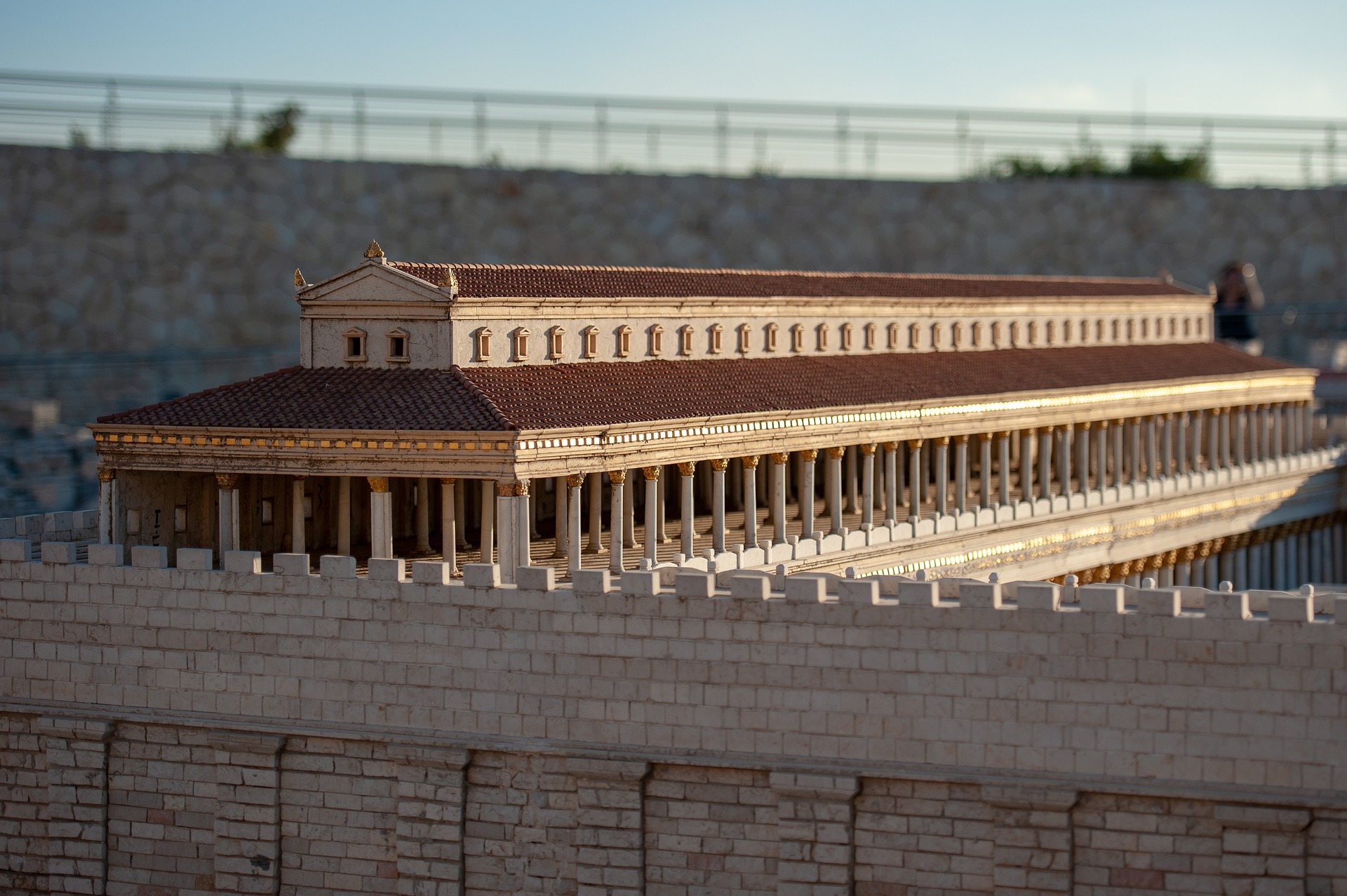
Casual readers may not realize that the temple in Jesus’ day was not the same Temple that Solomon built. That temple was razed to the ground by the Babylonians in 586 B.C. A generation later, it was rebuilt by Hebrews who returned from exile. Then, Herod the Great came to power around 37 B.C.

Like many egomaniacal tyrants, Herod had an edifice complex. He wasn’t Jewish, but he understood that his constituency was, and the temple in Jerusalem was the center of that constituency’s worldly power. Herod was shrewd. He knew it was in his political best interest not only to keep peace with the power brokers of the Jewish community, but he knew it would be even better if this potential threat to his power felt indebted to him. So, Herod decided to invest his vast riches to fix-up the five-hundred year old Temple.

Of course, egomaniacal tyrants with edifice complexes aren’t just going to do a little sprucing up. They have to spend their vast riches to build something that will bear their name (whether officially or unofficially) so the size of the project must be in relative proportion to the size to their egos. The original size of the Temple was relatively small compared to the impressive temples built by the Greeks and Romans. Herod made sure to not just rebuild the Temple itself, but he built an entire Temple complex around it. Sure enough, it’s still known today as “Herod’s Temple.”

That’s why, in today’s chapter, Jesus’ disciples are still exclaiming what a magnificent complex it is even after they’ve spent two entire days listening to Jesus teach in the Temple courts. They can’t get over the sheer size and architectural beauty of it.

And then, Jesus ruins the moment: “It will all be rubble 40 years from now.”

And, it was. The political tension between the Jewish people and their Roman occupiers will continue to grow. There will be wars and rumors of war. It will eventually boil over. The Romans will raze Jerusalem and Herod’s Temple in the year 70 A.D.

Enjoy the view while you can.

In the quiet this morning I couldn’t help but think of the spiritual lesson in this brief exchange. The rest of today’s chapter is Jesus’ prophetic foreshadowing of where the Great Story is headed in the climactic final chapters. It’s not idyllic.

Wars
Earthquakes
Famine
Deception
Tyranny
Families divided
Betrayal
Hatred
Exile
Darkness

I’m reminded as I contemplate it that every good story ends up there. The death eaters descend on Hogwarts. Gandalf and Aragorn stand surrounded and outnumbered at the Black Gate of Mordor. Aslan is bound and lying on the White Witch’s stone table. Jesus lies dead and buried in a borrowed tomb.

There’s always darkness before the dawn.

Without catastrophe there’s no eucatastrophe.

“Be careful what your heart treasures,” Jesus said. “Cars rust and end up at the dump. Today’s fashions will end up at the thrift store where nobody wants them. That expensive gadget will be obsolete in a year. Herod’s Temple will be nothing but rubble in a generation.”

“Invest in the only things that remain,” Holy Spirit whispers to me in the quiet. “Faith, hope, and love.”

I’m off into another day reminded to enjoy the view while I can.

If you know anyone who might be encouraged by today’s post, please share.

Life Investment, and Reinvestment

And the things you have heard me say in the presence of many witnesses entrust to reliable people who will also be qualified to teach others.
2 Timothy 2:2 (NIV)

Along my life journey, I have been blessed with a number of people who have invested in me. This morning as I sip my first cup of coffee and mentally travel all the way back to childhood I am recalling them with a smile on my face, and a heart of gratitude. There were family members, teachers, directors, employers, mentors, and pastors. Some were just doing their job, yet in doing so made a significant impact by simply spending some one-on-one time of instruction, encouragement, and wisdom. A few were intentional in going above and beyond to pour themselves into my life.

I was reminded this past week of the most significant spiritual mentor in my life. It wasn’t just me. I was one of many young men whom he poured himself spiritually for decades. At his funeral, the gentleman leading the service (who was, himself, another protégé) asked everyone who had been discipled by our mentor to stand. A small army of men, from their late teens to their early sixties, stood with me.

What reminded me of my mentor this past week was a pint I shared with a young man from our local gathering of Jesus followers. He just returned from a two-week spiritual intensive. He shared with me how the program had been life-changing for him. That program is the legacy of my old mentor, led and run by others who had, like me, been impacted through his mentoring.

In today’s chapter, Paul continues his letter to the young protégé in whom he had poured more of himself than perhaps any other. He starts the chapter by calling Timothy “son,” then tells Timothy to take all that Paul has poured into him and invest himself in passing it on to others who can, in turn, teach it to others.

Individuals taking the Life that’s been invested in them, and investing it in individuals who, in turn, reinvest what they’ve been given into other individuals.

In the quiet of my office, I am once again seeing the faces and names of those who loved me by investing themselves in me and giving me knowledge, wisdom, time, companionship, encouragement, and occasional admonishment. This begs a few questions:

How am I doing at reinvesting what others have invested in me?

In whom am I intentionally investing anything of real value?

“Enough” With Which to be Faithful

“The man with two bags of gold also came. ‘Master,’ he said, ‘you entrusted me with two bags of gold; see, I have gained two more.’

“His master replied, ‘Well done, good and faithful servant! You have been faithful with a few things; I will put you in charge of many things. Come and share your master’s happiness!’”
Matthew 25:22-23 (NIV)

A wise counselor once asked me to name my pain. “At the depth of your soul,” he asked me, “what would you label the core ache that feeds your strongest feelings of sadness and inadequacy?”

I pondered the question, but it didn’t take me long to come up with an answer: “Not enough.”

I came to realize that most of my life I have had to actively work to overcome an inherent sense of never being enough, giving enough, doing enough, loving enough, caring enough, sharing enough, serving enough, or achieving enough. Addressing “not enough” is a  large part of my spiritual journey.

In today’s chapter Jesus tells a parable that has grown increasingly powerful to me as the years have gone on. As with most of Jesus’ parables, it is quite simple. A master gives each of three servants different amounts of his money and goes away for a long time. The master returns to find that two of the three have invested his money and earned a return on the investment. The third buried his master’s money out of fear and returned just what he’d been given.

Two lessons from this parable have become quite important to me.

First, the master does not evenly distribute his money among the servants. One was given five bags, another two, and the other one. This is another reminder to me that a seemingly fair and equitable distribution of anything in this temporal world has never been part of the economy of God’s eternal Kingdom. I have been given more than some and less than others. The question has never been what I’ve been given, but what I do with what I’m given.

Herein lies the ying and the yang of my core pain. I must learn to be content with what I’ve been given, but also accept that I am responsible for it. I must learn to accept that I have been given “enough” and that God knows I am capably adequate to faithfully invest it wisely.

The second lesson I take from this parable is in the master’s compliment to his servants. “You have been faithful with a few things” he says. The servants were not burdened with the entirety of their master’s affairs. They were given a relatively small amount and were rewarded simply for being faithful with what they’d been given.

Sometimes my feelings of “not enough” grow to epic disproportion in my heart and mind, fueling all sorts of unproductive thoughts and paralyzing fears (much like the third servant in the parable). I quite literally blow everything up in my mind until its completely out of proportion to the truth of the situation. In these moments the master’s compliment helpfully reminds me to boil things down to the simplicity of being faithful to the tasks right  in front of me.

This morning, that means serving my client well in a day full of meetings. If you’ll please excuse me, I have a few things to which I must faithfully attend. And, that will be enough for today.

Have a good day.

Featured image courtesy of AZQuotes