Tag Archives: High School

The Revival I Missed

The Revival I Missed (CaD Matt 8) Wayfarer

I say to you that many will come from the east and the west, and will take their places at the feast with Abraham, Isaac and Jacob in the kingdom of heaven. But the subjects of the kingdom will be thrown outside, into the darkness, where there will be weeping and gnashing of teeth.”
Matthew 8:11-12 (NIV)

At the time I was in high school ours was the most racially diverse school in the state of Iowa. This was not only true because of desegregation, but also because of the large number of Asian refugees who entered the state in the 1970s after the war in Vietnam. Add to these the large racial population differences the other social breakdowns of jocks, geeks, burnouts, band nerds, and the like that were common in the day. It was diverse community, though I remember there being relatively little conflict.

I spent most of my high school years in student leadership so I connected with and communicated with kids from all the various constituencies in our school. From an activity perspective I was at the heart of things a Fine Arts Loser largely involved in theatre, show choir, and choir. Socially, most of my high school years were spent as part of a tight-knit group of Jesus Freaks. We had a holy huddle that stuck together socially both inside and outside of school.

During those years a revival broke out within our student body. It happened through the Fellowship of Christian Athletes (FCA) and a number of jocks in our school became followers of Jesus. It’s hard to communicate how this reverberated throughout the school. There were some radical conversions of individuals I never would have expected to become believers.

What was fascinating about this event is that I and my friends in our holy huddle had nothing to do with it. Zero, zip, zilch, nada. Here we were staying in our lane, sticking together like a herd of scared deer trying to protect ourselves from prowling lions, and assuming that certain individuals would never, ever, in a million years consider believing in Jesus. Think Peter and the boys learning that their greatest enemy, Saul/Paul, had become a believer. It felt a little like that. So, I and my posse were really not a part of the spiritual revival, at all.

This was not lost on me.

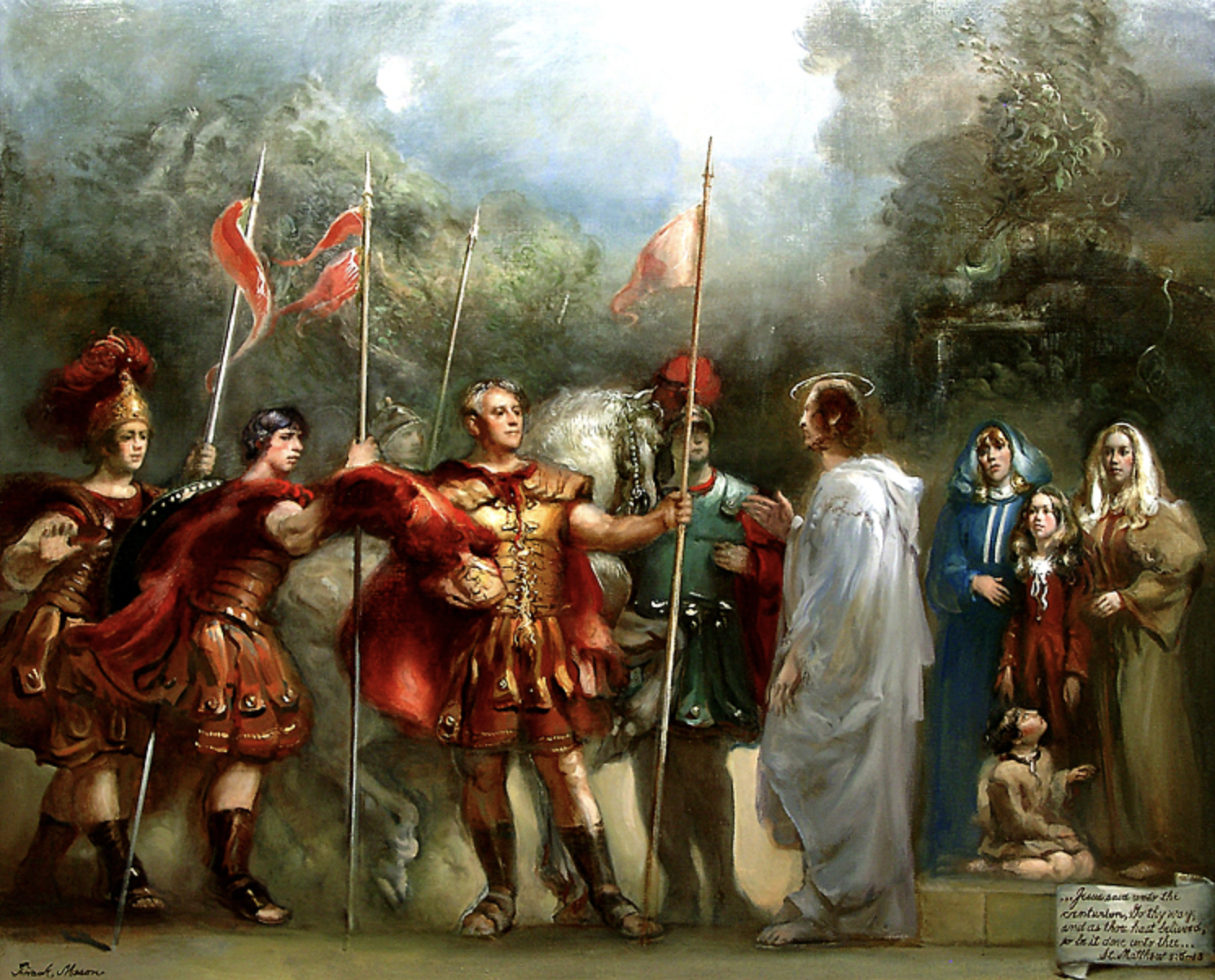
In today’s chapter, we are still at the very beginning of Jesus’ ministry. He spent 40 days fasting and being tempted. He was baptized by John. He delivered His message on the mountain. Things are still in the launch period of Jesus’ Miraculous Mystery Ministry Tour. Along comes a Roman Centurion whose servant is sick.

STOP.

It’s easy to gloss over the 80,000 pound elephant in the room. Romans were hated. Romans were the oppressors. Romans were the enemy of Jesus’ tribe and occupiers of their land. Romans were despised, godless, violent, and merciless usurpers. Jesus’ tribe was waiting for the Messiah to arrive and wipe the Romans out in a holy bloodbath. It’s hard for a casual, modern reader to understand the social and cultural context of this Roman Centurion approaching Jesus.

Think a Russian military general approaching a Ukranian in occupied territory.

Think a German SS officer coming to a Frenchman in occupied Paris during World War II.

Think a Grand Wizard of the Ku Klux Klan walking into a civil rights meeting to talk to Martin Luther King Jr.

Think Donald Trump walking into a local DNC resistance meeting.

What’s fascinating about this episode is that Jesus not only graciously accepts the Centurion and heals His “enemy’s” servant, but that Jesus then makes clear that this is just the first tremor of a massive, tectonic spiritual shift that Jesus is bringing. This is the tremor. The events of the entire book of Acts is the earthquake.

Jesus explains that individuals like this Roman Centurion (vile, hated, despised, enemy) will be seated at “the feast with Abraham, Isaac and Jacob in the kingdom of heaven.” Jesus’ tribe considered this feast to be an exclusive, members only event for holy huddle members only. Jesus goes on to make clear that in the coming spiritual earthquake, those who are considered enemies will take a seat at God’s feast while those in the holy huddle won’t get past the doorman.

I’ve never forgotten that revival in my high school, nor have I forgotten that the only joy I experienced with it was to watch it happen from the cheap seats. I was too busy being a faithful member of the tribe. I was sequestered in my holy huddle assuming everyone outside of our huddle was an enemy to be avoided, if not feared and/or despised. How badly I missed Jesus’ entire Message.

In the quiet this morning, I find myself committed to learning from that lesson even though it is over 40 years later. Jesus’ core message was about the last being first, His love for the “least,” and God’s Kingdom operating opposite the hierarchical socio-economic caste system of this world. In God’s Kingdom,

I am to generously give if I want to receive.
I am to bless those who curse me.
I am to love my enemy, and pray for those who persecute me.
I am to rejoice in my suffering, especially being the object of hatred.
I am to die to myself if I want to experience real life.

And, I need to be willing to step out of my holy huddle like Peter stepping out of the boat to walk to Jesus on the water, if I want to be part of what God’s Spirit is doing.

If you know anyone who might be encouraged by today’s post, please share.

These chapter-a-day blog posts are also available via podcast on all major podcast platforms including Apple, Google, and Spotify! Simply go to your podcast platform and search for “Wayfarer Tom Vander Well.” If it’s not on your platform, please let me know!

Glory Days

Glory Days (CaD 1 Chr 11) Wayfarer

When all the elders of Israel had come to King David at Hebron, he made a covenant with them at Hebron before the Lord, and they anointed David king over Israel, as the Lord had promised through Samuel.
1 Chronicles 11:3 (NIV)

In a few weeks, I will attend my 40th high school class reunion. I graduated in 1984. I came of age in the Reagan years. I entered high school the year Reagan took office and finished college the same year Reagan completed his second term.

It’s common for people to look back at their high school and college years as the “Glory Days” of life. Bruce Springsteen even wrote a song about it. I do find it humorous to think back about what life was like in those days. I get a lot of memes in my social media feed about growing up in the 1970s and 1980s and they always make me laugh. Life has certainly changed a lot in 40 years.

In today’s chapter, the Chronicler begins his description of the reign of King David. With both his words and his choice of details, he paints a “Glory Days” picture of Israel’s great King.

Twice in the first three verses of the chapter, the Chronicler chooses to say that “all” of the people and elders asked David to be their king. He then chronicles the capture of Jerusalem and David making it his capital city. The Chronicler then highlights David’s “mighty warriors” including the trio of nearly comic book-worthy heroes known as “The Three.”

Unity, power, and strength are the themes the Chronicler establishes immediately in his Cliff Notes condensed version of events. While it is true that his contemporary readers knew the more detailed accounts of Samuel version of history it is worth noting that the Chronicler chooses not to deal with the fact that David was named King of Judah years before the rest of the tribes asked him to be king over them. David united the tribes into one Kingdom, but history has taught me that no leader has 100 percent support. Even Walter Mondale took two states in 1984.

It’s also fascinating that the Chronicler puts David’s “Mighty Men” right up front in the narrative, while the author of Samuel placed it near the end almost as an appendix to David’s story. Again, there is a bit of glorification being presented in the Chronicler’s retelling.

Yet in the quiet this morning I can’t help but once again think about the Chronicler’s place in history. His generation was born and raised in exile. He’s known nothing but subservience to foreign empires. Now, he’s returned to Jerusalem which lay in rubble to rebuild a Temple that was also burned and turned into rubble. Our of the realities of defeat, destruction, exile, and subservience he is trying to find a way to rally his people to put their faith in God and have some pride in their national identity. So, he’s focusing on the unity, power, and strength that their great King David had back in the glory days.

And, I get it. It’s human nature to glorify our past. I certainly wouldn’t mind if Ronald Reagan was on the ballot this November.

If you know anyone who might be encouraged by today’s post, please share.

Oh! The Places You’ll Go!

Oh! The Places You'll Go! (CaD Jer 29) Wayfarer

This is what the Lord says: “When seventy years are completed for Babylon, I will come to you and fulfill my good promise to bring you back to this place.”
Jeremiah 29:10 (NIV)

It is mid-May. Yesterday was Mother’s Day. I believe that Mother’s Day weekend is the most popular weekend for colleges and universities to hold their graduation commencements. Social media was wall-to-wall young people in their caps and gowns this weekend. And, we’re not even close to being done. The coming weekends will be chock full of high school commencements, and there are exponentially more school graduates than college graduates. Punch bowls are getting pulled out of storage. White sheet cakes are being made en masse. Millions of greeting cards are being sold.

On Saturday morning, Wendy and I made a trip to her family’s gathering. She played for me a commencement address by writer and humorist, David Sedaris, who was receiving an honorary degree from a university. We laughed all the way to her parent’s house. It was a humorous take on the genre of speeches that millions of graduates will hear this month. Young people full of hope and optimism preparing to launch on their respective life paths with a fresh copy of Dr. Seuss’ Oh the Places You’ll Go tucked under their arm. That’s another thing you can plan on every May: the return of Dr. Seuss to the summit of the New York Times’ bestseller list.

I can guarantee you that a good percentage of graduates will receive at least one card of congratulations with a verse from today’s chapter. It’s the verse after the verse I quoted at the top of the post/podcast:

“For I know the plans I have for you,” declares the Lord, “plans to prosper you and not to harm you, plans to give you hope and a future.”

This is a verse that is tailor made for a graduation card, a calendar, a daily planner, a personal journal, a wall plaque, or any number of gifts and trinkets. Somewhere, I’m sure there’s a well-worn frisbee with that verse inspiring the dog who’s retrieving it for millionth time.

But here’s the thing…

Jeremiah’s words were not intended for young people crossing an educational finish line with a lifetime of hope and opportunity ahead of them. His words were addressed to a people who’d been ripped from their homes, bound (some were likely even been led with a ring through their nose), and drug hundreds of miles to a foreign land. Among them was a young man named Daniel, who certainly would have read Jeremiah’s words from today’s chapter. He was among those for whom they were intended. Daniel may have been the age of many people graduating this month when Jeremiah’s letter arrived, but “Oh! The places you’ll go!” in his young aspirations did not include the city of Babylon in the service of a mad-king. Yet, that’s where he found himself looking at enrollment in the school of hard-knocks and a lifetime of servitude. Jeremiah’s letter promised Daniel and his fellow exiles redemption and return in seventy years. Imagine how that promise sank in. Daniel knew the odds were against him being among those returning. Subsequent generations would enjoy that promise. He was looking at a life-sentence of exile.

And, in the quiet this morning, I can’t help but think that this contrasting reality is perhaps a more honest and truthful message for any graduate who is a follower of Jesus to hear in preparation for the rest of their life journey. It’s certainly more sobering, and not as entertaining as the words of David Sedaris that Wendy and I listened to this weekend. My life journey as a disciple of Jesus has confirmed for me the truth of Jeremiah’s promise. God does have a plan and purpose for me. But, the plans and purpose God has for me are ultimately not about my earthly success or my prosperity, security, safety, or comfort, though all of those things may certainly be experienced along the way. Rather, God’s purpose and plans are about my life of exile and captivity in a temporal, fallen world. They are about my spiritual maturity, my obedience to the One whom I follow, and my increasing measure of sacrificial love and generosity to others all the days of my exile. The purpose, I’ve discovered, is really about my bit part in a story that is ultimately not about me.

I doubt many graduates will hear this. Oh, the places we want to go don’t include the failures, difficulties, setbacks, losses, mistakes, broken dreams, divorce decrees, terminal illnesses, tragic deaths, or the painful consequences of our own poor choices. Nevertheless, those are the requisite pathways to the plans and purposes God has for His children like Daniel, like me.

Of course, like the false prophets that Jeremiah addresses in today’s chapter, there are far more popular messages to echo that are far more enjoyable to hear by mass audiences.

“Wear sunscreen,” for example.

If you know anyone who might be encouraged by today’s post, please share.

Popcorn Prayers

The king said to me, “What is it you want?” Then I prayed to the God of heaven, and I answered the king, “If it pleases the king…..”
Nehemiah 2:4-5a (NIV)

I was honored a few weeks ago when I was asked to pray for our meal at my high school reunion. In part, I was honored because it has become increasingly common for prayers at public events to be ignored or outright forbidden. I also realize that I and my classmates grew up in a time when public prayer was hotly debated along with questions regarding whether it was appropriate for public school choirs to sing sacred music at events such as commencement.

I can remember during some of these debates about “school prayer” that it was humorously acknowledged that the school building will always be the center of a million prayers during finals week. Of course, there is a difference between a public prayer at a school event and the silent prayer students staring at the test that has just been placed before them.

For those who are not regular readers, I have been blogging through what’s known as the exilic books of God’s Message in recent months. These are the writings of the ancient Hebrews who experienced being taken into captivity by the Assyrian, Babylonian, and Medo-Persian empires. They eventually returned to Jerusalem to rebuild and restore their homeland. Being an exile, in its very essence, means living away from home, and being in exile often means a loss of power, control, and public standing. My local gathering of Jesus’ followers is currently exploring the notion that the people of God are, by nature, exilic and what that means for us in the 21st century.

Nehemiah was a cupbearer for the Persian king, Artaxerxes. In today’s chapter, Nehemiah could not hide his grief while serving in the king and queen’s presence. It was, in those days, deemed inappropriate to show any kind of negative emotion in the presence of the king. On a whim, the king could have his servant executed for such an infraction. So when Artaxerxes notices the depressed look on his cupbearer’s face, Nehemiah’s immediate fear was warranted.

What I found interesting is that the phrase “Then I prayed to the God of heaven” is sandwiched in between the king’s question and Nehemiah’s response. There is no way that Nehemiah said, “Can you hang on a few minutes while I get on my knees and pray for a while?” Nehemiah’s prayer to the God of heaven had to have been what I call a “popcorn prayer.” A popcorn prayer is the silent, sudden, internal exclamation of my spirit to God’s Spirit in an instant. It’s exactly what I did as a student before every Biology test (science was not my thing).

According to a 2017 survey by the Barna, 79 percent of Americans said they had prayed in the previous three months. Barna found prayer to be the most common faith practice among American adults, but it was also the most multi-faceted. In fact, the researcher concluded that “the most common thing about people’s prayers is that they are different.”

Along my spiritual journey, I’ve discovered that my own prayer life is much like Barna’s research. It’s multi-faceted. I do, at times, spend set periods of time in prayer. Sometimes, I audibly talk to God while I’m alone in my car driving. Wendy and I pray together before meals, and often we will pray together when it is just the two of us traveling in the car. I’ve sometimes described my life journey itself as one long, uninterrupted conversation with God. I’m constantly aware of God’s presence, and my “popcorn prayers” are popping constantly in the heat of Life’s microwave oven.

Our culture has shifted in the 35 years since I graduated from high school. I know some who see this as a source of grief, anxiety, fear, and even anger. Sociologists and scholars are calling our current culture the “post-Christain” world. Frankly, I’m not that worried about it. In fact, I think it might just be a good thing. Throughout the Great Story, it’s clear that God’s people flourish, not when they are in power, but when they live in exile. It’s a paradox that Jesus said He came to model and that He told his followers to embrace:

“You’ve observed how godless rulers throw their weight around, how quickly a little power goes to their heads. It’s not going to be that way with you. Whoever wants to be great must become a servant. Whoever wants to be first among you must be your slave. That is what the Son of Man has done: He came to serve, not be served—and then to give away his life in exchange for the many who are held hostage.”

Jesus (Matthew 20:25-28 [MSG])

Paul, one of Jesus’ early followers, put it this way:

That is why, for Christ’s sake, I delight in weaknesses, in insults, in hardships, in persecutions, in difficulties. For when I am weak, then I am strong.

Paul of Tarsus (2nd Letter to the Corinthians 12:10 [NIV])

In the quiet this morning I find my head swimming in thoughts of culture, and power, and exile, and prayer. Nehemiah found himself a servant to the King of a foreign empire. Artaxerxes had the power to execute Nehemiah for having a frown on his face, and yet his precarious position of impotence led him to depend on his faith in the power and purposes of God. Isn’t that the very spiritual reality that Jesus wanted us to embrace?

As I finish this post I’m saying a popcorn prayer for any and all who read it. Hope you have a great day, my friend.

“If You Only Knew What it was Like….”

Meanwhile, the remainder of the Jews who were in the king’s provinces also assembled to protect themselves and get relief from their enemies. They killed seventy-five thousand of them but did not lay their hands on the plunder.
Esther 9:16 (NIV)

This past weekend I attended my 35th high school reunion. It’s only the second reunion that I’ve attended and it was a lot of fun to catch up with old classmates and where their life journeys have taken them. I walked to Kindergarten with some of these people. We played Kick-the-Can, Freeze Tag, and Ding-Dong Ditchem’ as children and experienced all the awkwardness of adolescence together. It was especially sobering for me to see the table of memorials to all classmates who have already passed, and to recall moments and life events I experienced with each of them. It was strange to have such vivid memories with these amazing individuals from my childhood and to realize that so much time has passed. One of the common conversations that evening was how our children (and now grandchildren) have no concept of what everyday life was like for us.

I found myself expanding that thought to a macro-level this morning as I read the chapter. It’s been a while since this chapter-a-day journey took me into such a bloody text. It is difficult for this twenty-first century, enlightened Western mind to get my head wrapped around such bloodshed and carnage. I’ve observed along the way that we have a penchant in our modern culture to whitewash, rewrite, or simply ignore certain aspects of history, including the brutal violence which was an everyday part of the culture in ancient days. “Kill or be killed” was the way of life and survival for most tribes and people groups.

In today’s chapter, I found it fascinating that Xerxes did not seem to bat an eye at the destruction of Esther’s enemies. But, I have to remember that his father, Cyrus, established the Persian Empire and became the world’s first “superpower” by destroying a lot of people. Xerxes had a reputation for holding onto that power and his Empire by brutally suppressing any kind of rebellion against him and his kingdom. Again, it was simply the way of life during that period of history.

There are two things happening in today’s chapter that are often lost on the casual reader. The first connects to something I pointed out the other day. The face-off between Mordecai (descendant of King Saul’s tribe of Benjamin) and Haman (descendant of King Agag of the Amalekites) is a historical rematch. In the first round (see 1 Samuel 15), Saul did not complete the task of wiping out Agag and his followers. In today’s chapter, the destruction of Haman and his followers was historically perceived by the Hebrews as righting an old wrong that Saul should have completed.

Second, while Xerxes’ proclamation gave the Hebrews permission to plunder their enemies, you’ll notice the text clearly points out that they chose not to do so. Again, this is further evidence that the events of today’s chapter were perceived as righting the wrongs of Saul, who was forbidden from plundering King Agag and the Amalekites but did so anyway. The story of Esther is layered with the theme of reversals: the reversal of fortunes, the reversal of specific events, and the reversal of past wrongs.

In the quiet this morning, I find myself thinking about the march of time. Based on conversations this past weekend, I and my classmates clearly wish that our children could understand what life was like for us:

  • “If you only knew what it was like without smartphones.”
  • “If you only knew what it was like to write a research paper on a daisy-wheel typewriter without the internet, Google, or Wikipedia.”
  • “If you only knew what it was like to walk a mile to school every day in the winter.”
  • “If you only knew what it was like to be at college and communicate with your parents once a week (at most) because they didn’t want to pay for the collect call.”
  • “If you only knew what it was like to be expected to get a paper route and start working as soon as you were 11 or 12 years old.”

In the same way, I imagine Mordecai and Esther inviting me to take off my modern, rose-colored glasses and to attempt to see beyond my politically correct horror at the violence of their time in history.  I imagine them beckoning me to try and imagine what it was like to live in the “kill or be killed” realities they experienced every day when there was no other choice. “If you only knew what it was like,” I hear them say, “to walk in our sandals as exiles and captives in a foreign land surrounded by enemies bent on killing us.”

I don’t think it’s fully possible, but I’ve found it worth the effort to try. The stories of history have secrets to teach me; Secrets that provide wisdom for my own life journey, and for the journeys of my children and grandchildren.

As Jesus said, “Seek, and you’ll find.

And so my “seeking” begins for another day, in another week.

I hope your own search is going well, my friend.

Standing in the Gap

To Timothy, my dear son: Grace, mercy and peace from God the Father and Christ Jesus our Lord.
2 Timothy 1:2 (NIV)

Last night I had the privilege to speak to a packed room of high school students. They’ve been working their way through a book called God Distorted by John Bishop, and the premise of the book is that we often take the heartache and shortcomings we’ve experienced with our own fathers and project them onto God the Father. The book explores different father types (e.g. absent, passive, controlling, and etc.) and last night I got to unpack the ways in which demanding fathers affect their children and the reality that God is not a demanding Father.

Along life’s road I’ve come to accept the reality that all earthly fathers, myself included without question, fall short of perfection. As my friend Chadwicke shared a week or so ago, “you can’t give away what you haven’t received.” Some fathers certainly do a better job than others, and all who are given the mantel of fatherhood have a responsibility to our children to diligently work at being a good dad. Nevertheless, we all fall short in some areas. It just is what it is. At some point every father must depend on the grace of his children to forgive his shortcomings.

Timothy’s father is absent from mention in God’s message. History does not share with us the reason why, but whether through death or circumstance Timothy seemed to have a gaping hole in his life when it came to the father department. Timothy was raised by his mother and grandmother. Enter Paul, who becomes a mentor and father figure to the young man. In today’s chapter, Paul begins his letter by addressing Timothy as his “dear son.” Sometimes fathers (and/or mothers) have nothing to do with DNA.

This morning I am thinking about the room full of high school students last night. I’m thinking about Paul’s mentoring of Timothy. I’m thinking about my ever-present dad and the ways my life was launched by his love and provision. I’m thinking about the men and mentors who were, nevertheless, like a father to me in so many ways. I’m thinking about my responsibility to mentor others, to stand in the gap, and to provide a father-like presence for those with a gaping chasm in the dad department.

Changes in Life

On “Remember When Wednesdays” I look back at a post from yesteryear and re-blog one for newer readers. In almost 10 years of blogging I’ve had two blog posts that have gone viral. This was the first and it happened back in August of 2011 when WordPress reblogged this post on their “Freshly Pressed” page.

Speaking of life changes. There is, perhaps, no bigger change in life than the ones you make during adolesence. I recently found my Jr. High and High School I.D.s in an old album. Check out the righteous mullet I had going my Junior year! The only problem was that my hair was so curly when it grew out that I couldn’t get it to hang straight down the way it was supposed to. True story: When my mullet was at its longest I went to the bank one day. I opened the door for an elderly gentleman who was shuffling slowly into the bank at the same time. “Why thank you young lady,” he said to me. I got my hair cut that afternoon and never looked back. C’est la vie.

My School I.D.s from 7th through 12th Grade

The Latest: 08-09-2015


It was a crazy, mixed-up sort of week this week. Life felt like it was all over the map.

Suzanna's Birthday

Monday was Suzanna’s birthday, so Wendy, Taylor and I gathered for  a birthday dinner in the evening. Hard to believe the girl is 19 and will be headed to Cedar Falls in a week or so. So much water under the bridge since this teenager came to live with us two years ago. I’m so proud of her and she is so ready to launch. Salmon and rice was the birthday girl’s dinner request with Wendy’s Ghiradelli lava cakes for dessert. Scrumptious.

Tuesday Wendy and I headed to the lake to work remotely and get a little R&R. Huge storms Tuesday evening cut power off for several hours. It’s amazing how dark the Playhouse gets when there’s no electricity.

Wednesday I spent a day in travel hell with a drive to Kansas City International from the lake in the wee hours of the morning trying to get to San Antonio, but getting stuck making my connection in Minneapolis. I was trying to be penny-wise and fly stand-by using the travel perks afforded us with Madison being a flight attendant. I ended up being pound-foolish as I got bumped off one flight after another and couldn’t get where I was going. I was fortunate to get back to Kansas City that evening and drive back to the lake. Business trip scuttled. Frazzled. Tired. Not a great day.

Thursday and Friday Wendy and I worked a lot from the lake, which is always a good place to be even if you’re working. We took a boat ride to Bear Bottom on Friday afternoon for a few hours at the swim up bar soaking in the sun. Enjoyed a nice dinner on the grill. Was surprised on Thursday evening when an old classmate and fellow swimmer from Hoover High School, Jeff Davidson, pulled up to the dock with his daughter. They were at Captain Ron’s for dinner and thought they’d swing by to say “hello.” Nice to see him.

More blasts from the past came on Saturday when Wendy and I drove to Ankeny to attend the baby shower for our friends Dave and Maria Fidalgo-Eick and their new arrival, Jimmy. It was great to see Dave’s sister, Jen, and her husband Jose. I officiated their wedding many moons ago. Also got to hang out with old high school buddies Matt Hill and Doug Reeves. Small world moments were experienced with the Crumleys, and Nancy McClimen who was my Sunday School teacher in 3rd grade and we discovered was a fellow Central Alum with several friends back in Pella. Even Grandpa Dean and Grandma Jeanne were there. It was great to welcome little Jimmy into the world.


Breaking Social Boundaries

source: krayker via Flickr

…and [Peter] said to them, “You yourselves know that it is unlawful for a Jew to associate with or to visit a Gentile; but God has shown me that I should not call anyone profane or unclean.” Acts 10:28 (NSRV)

In high school, people were separated by social sub-cultures: jocks, nerds, burnouts, toughs, bookworms, and etc. There was also separation by ethnicity in my high school which, at the time, was the most racially and ethnically diverse school in the district with whites, blacks, asians, and hispanics. Then there were separation by world-views. Christian kids hung tight, as did partiers, smokers, drugees, and so on. You get the picture.

I’ve observed along my life journey that adults are typically children who learn to mask, obfuscate, deny, normalize, and justify our childishness.

The cultural realities faced by the early followers of Jesus was like an extremely bad case of high school. Romans, Greeks, Africans, and Judeans all had their separate and unequal cultures. Pagans and Jews had their separate groups. Within sub-cultures like the Jews you had sub-groups dedicated to religious, political, and ethnic bents. The region around Jerusalem was a melting pot turned powder keg. You belonged to your sub-culture, you hung with your homeys, and you kept to yourselves.

And, Jesus was about to radically change all of that. The seeds had been sown. Jesus had led the way. In a misogynistic, self-righteous, ethnic Jewish culture Jesus broke social norms by speaking with a Samaritan woman at a well and extended gracious kindness and forgiveness to prostitutes. In a culture of political silos, Jesus was publicly seen with both Jews and Romans, the religious and the secular, the rich and the poor. Jesus called twelve men from a diverse panacea of political views including liberal Roman sympathizers, Jewish zealots, Jewish conservatives. They came from diverse socio-economic strata of the day.

Jesus is now gone, and His followers are falling back into their high school sub-cultures. In today’s chapter, God intervenes by making an introduction between the conservative, religiously self-righteous Peter and the “unclean” Roman foreigner, Cornelius. God makes a radical, paradigm shifting demand of Peter, the appointed leader of Jesus’ followers: stop considering any person unclean (e.g. less than, lower than, other) or profane (e.g. meaningless, not worth my time).

This morning I’m having a serious heart-to-heart with God. Who is my Cornelius? Have I slipped back into high school mode hanging with my homeys and steering clear of those who look differently, were raised different, believe differently, have different political views, come from different social strata? Lord, have mercy on me. Forgive me for my mindless, thoughtless, unintentional way I treat others as unclean and/or profane.

Yesterday is gone, but I have today before me. Help me cross and erase social boundaries in my thoughts, words, and actions.

Weekend Marks Beginnings and Endings

The VL Boys took me to Court Ave Brewing Co for dinner, then to an I-Cubs game for my birthday.

It was a full weekend for Wendy and me. The end of Suzanna’s high school career came on Friday with her last day of school and subsequent choir concert Friday night. Mom and Dad Hall came down from Boone for a visit and attended the concert with us on Friday night along with Grandma VH.

Wendy and I celebrated Suzanna’s accomplishment on Saturday morning with a breakfast at the Windmill Cafe and some special gifts to mark the occasion. We spent some time over breakfast talking about all that Suzanna has experienced and learned this past year. It was ironic that she finished her last high school class on Friday and then went to work at her first job on Saturday night. She’s going to be working at Kaledera restaurant. One chapter ends and another one begins.

The VL boys wanted to take me to an I-Cubs game for my birthday and we did that on Saturday night. It was a gorgeous evening and we dined at Court Ave Brewing Co. on their sidewalk before scooting over to Principal Park to watch our beloved I-Cubbies drop a back and forth affair to Round Rock.

Sunday morning was senior brunch for Suzanna at church as the church celebrated all of the seniors wrapping up their time in the youth group. Upstairs in the church auditorium, where Wendy and I worship, there is new thing happening and I was asked to share a short message and help start the launch.

Wendy and I then headed to our first I-Cubs game on Sunday afternoon. The season is about six weeks old, but it’s the first time we’ve been able to get to a game and we’re looking forward to several more afternoons and evenings watching our boys of summer.

Dinner with mom and dad VW last night at Bravo! We were celebrating Mother’s Day a week late and enjoyed a wonderful meal and time with the folks. We then finished the weekend at Kev and Beck’s along with Taylor who is living with them as she prepares for grad school in Scotland in the fall. A few glasses of wine and a long evening of wonderful conversation.