Tag Archives: Hate

A Step Toward Refuge

If the Lord your God enlarges your territory, as he promised on oath to your ancestors, and gives you the whole land he promised them, because you carefully follow all these laws I command you today—to love the Lord your God and to walk always in obedience to him—then you are to set aside three more cities.
Deuteronomy 19:8-9 (NIV)

As Wendy and I sit in the morning and peruse the news of the day I’ve observed a distinct difference between us. Wendy regularly wades into the comments that readers make to the article or editorial she’s just read. She finds it interesting to gauge response to the topic or opinion. Wendy is an Enneagram Type Eight. For Eights, conflict is a form of intimacy.

I, on the other hand, rarely look at the comments. As an Enneagram Type Four, contention can quickly lead me to despair. When I read comments I find so many thoughtless words, hasty judgments, and seeds of anonymous hate spewed on the digital page. It leaves me desiring my morning shower.

I had the honor of delivering the message yesterday among our local gathering of Jesus’ followers. We’re launching a year-long theme that, looking back at my spiritual journey, I find doesn’t get much play these days.

Refuge. Specifically, Refuge Over Rejection.

Where do I run when I need mercy, grace, and a shelter from the storm?

I find it fascinating that thousands of years ago God made refuge a cornerstone of the community He designed and called for to be implemented among His people. In a moment of synchronicity, “refuge” appears once again in this morning’s chapter.

God through Moses reminds His children, just preparing to cross into the Promised Land, that they are to quickly establish three cities of refuge—spread equidistant across the geography. These cities must be accessible to everyone. They must be clearly marked. The roads leading to them must be clear and easily trodden.

God paves the way to grace.

Mercy has an address.

The chapter goes on to mention that accusations must be corroborated by two or three witnesses. These are not exclusionary sections of the chapter. There is a thread of thought God is weaving through His refuge design. As I meditated on the chapter I came to realize that this divine justice system allows for time.

Rage does not get the final word.
Truth must be corroborated.
Witnesses must agree.
The community must slow down before rendering judgment.

As I pondered this, my mind quickly returned to our digital age and all those comments. Instant news, trending topics, and billions of people with laptops, tablets, and smart phones. We can broadcast our momentary rage, venomous thought, hasty judgment, vengeance, and condemnation to the entire world 24/7/365. And it can all be done behind the anonymity of a username.

As I meditated on the stark contrast between God’s ancient design and our modern Twitter-esque technology, I found both wisdom and solace in the former. The latter strikes me as a modern day Tower of Babel constructed of server farms and cell towers – ending in confusion, chaos, division, and babbling voices that offer no peace, no mercy, no grace, no refuge.

Finally, my thoughts landed on the fact that God calls for three cities of refuge to be established, though the total number in God’s ultimate Promised Land blueprint was six. In other words, God is calling for phased mercy. He doesn’t want His people to wait until the land is completely settled. He wants them to quickly take the first step toward refuge.

Yesterday, as our worship concluded there was an unexpected outpouring among our local gathering. It appeared that everyone in the room was ready to take a step toward refuge. Perhaps I’m not the only one weary of our modern world and culture of Babel.

As our local gathering sets off on our year-long road to refuge. As I set off on this another work week at the beginning of a new year, my soul is mulling over the answers to a few questions surfaced in the quiet:

Is the road to mercy in my life clear—or cluttered?
Do people know how to reach grace through me, or do they hit barricades of judgment and suspicion?

Do my words shelter truth—or endanger it?
False witness isn’t just perjury. It’s gossip. Spin. Tweets. Convenient silence.

Do people find refuge in my presence?
Am I a safe place where people know they will be seen, heard, and loved?

I serve a God of refuge. This morning’s chapter reminds me that from ancient days, God has made being a refuge a priority for His people. I endeavor today, this week, this year, to take steps towards that calling.

If you know anyone who might be encouraged by today’s post, please share.

Promotional graphic for Tom Vander Well's Wayfarer blog and podcast, featuring icons of various podcast platforms with a photo of Tom Vander Well.
These chapter-a-day blog posts are also available via podcast on all major podcast platforms including Apple, Google, and Spotify! Simply go to your podcast platform and search for “Wayfarer Tom Vander Well.” If it’s not on your platform, please let me know!
Icon of an open book with an orange background, representing a digital Bible.

The Revival I Missed

The Revival I Missed (CaD Matt 8) Wayfarer

I say to you that many will come from the east and the west, and will take their places at the feast with Abraham, Isaac and Jacob in the kingdom of heaven. But the subjects of the kingdom will be thrown outside, into the darkness, where there will be weeping and gnashing of teeth.”
Matthew 8:11-12 (NIV)

At the time I was in high school ours was the most racially diverse school in the state of Iowa. This was not only true because of desegregation, but also because of the large number of Asian refugees who entered the state in the 1970s after the war in Vietnam. Add to these the large racial population differences the other social breakdowns of jocks, geeks, burnouts, band nerds, and the like that were common in the day. It was diverse community, though I remember there being relatively little conflict.

I spent most of my high school years in student leadership so I connected with and communicated with kids from all the various constituencies in our school. From an activity perspective I was at the heart of things a Fine Arts Loser largely involved in theatre, show choir, and choir. Socially, most of my high school years were spent as part of a tight-knit group of Jesus Freaks. We had a holy huddle that stuck together socially both inside and outside of school.

During those years a revival broke out within our student body. It happened through the Fellowship of Christian Athletes (FCA) and a number of jocks in our school became followers of Jesus. It’s hard to communicate how this reverberated throughout the school. There were some radical conversions of individuals I never would have expected to become believers.

What was fascinating about this event is that I and my friends in our holy huddle had nothing to do with it. Zero, zip, zilch, nada. Here we were staying in our lane, sticking together like a herd of scared deer trying to protect ourselves from prowling lions, and assuming that certain individuals would never, ever, in a million years consider believing in Jesus. Think Peter and the boys learning that their greatest enemy, Saul/Paul, had become a believer. It felt a little like that. So, I and my posse were really not a part of the spiritual revival, at all.

This was not lost on me.

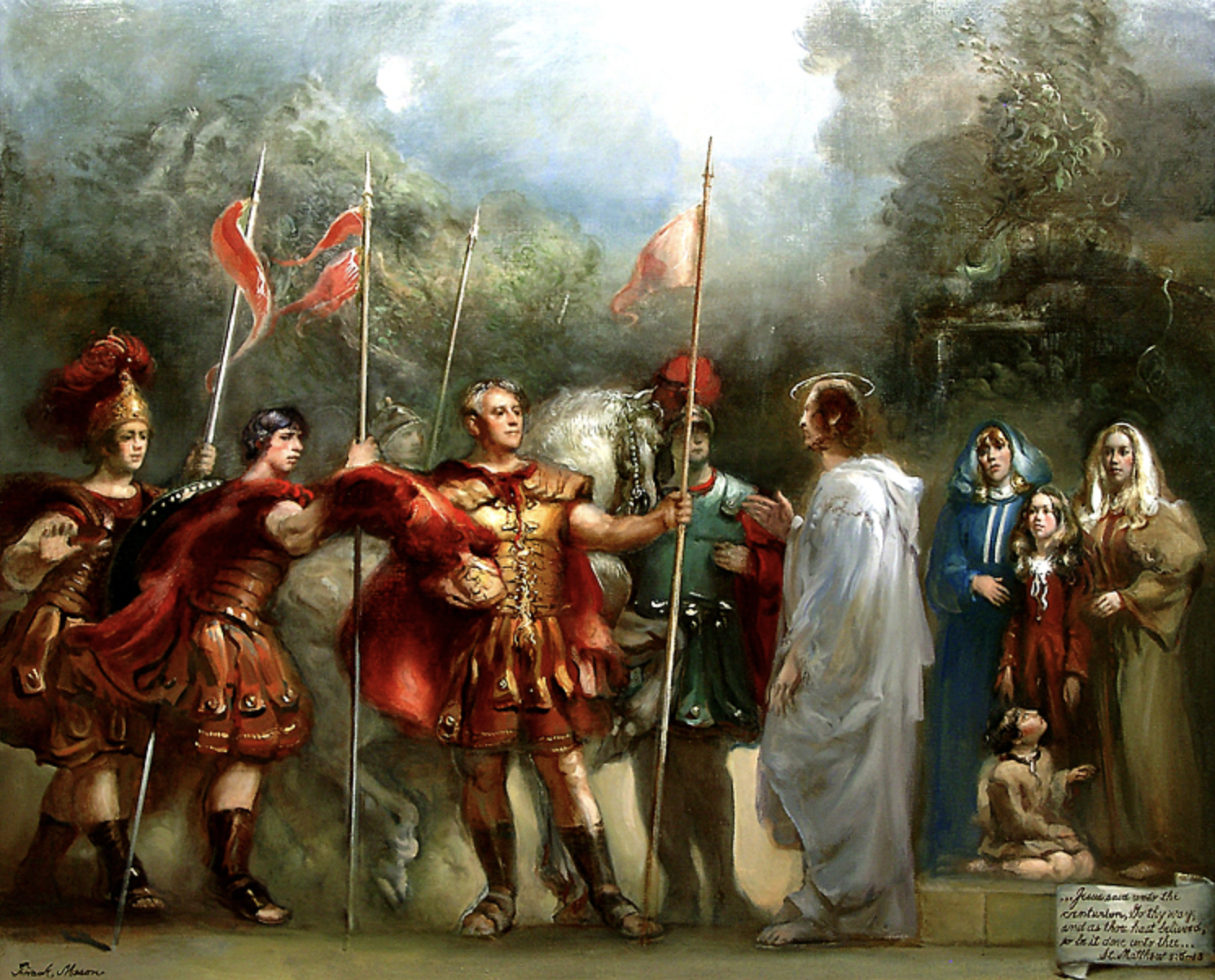
In today’s chapter, we are still at the very beginning of Jesus’ ministry. He spent 40 days fasting and being tempted. He was baptized by John. He delivered His message on the mountain. Things are still in the launch period of Jesus’ Miraculous Mystery Ministry Tour. Along comes a Roman Centurion whose servant is sick.

STOP.

It’s easy to gloss over the 80,000 pound elephant in the room. Romans were hated. Romans were the oppressors. Romans were the enemy of Jesus’ tribe and occupiers of their land. Romans were despised, godless, violent, and merciless usurpers. Jesus’ tribe was waiting for the Messiah to arrive and wipe the Romans out in a holy bloodbath. It’s hard for a casual, modern reader to understand the social and cultural context of this Roman Centurion approaching Jesus.

Think a Russian military general approaching a Ukranian in occupied territory.

Think a German SS officer coming to a Frenchman in occupied Paris during World War II.

Think a Grand Wizard of the Ku Klux Klan walking into a civil rights meeting to talk to Martin Luther King Jr.

Think Donald Trump walking into a local DNC resistance meeting.

What’s fascinating about this episode is that Jesus not only graciously accepts the Centurion and heals His “enemy’s” servant, but that Jesus then makes clear that this is just the first tremor of a massive, tectonic spiritual shift that Jesus is bringing. This is the tremor. The events of the entire book of Acts is the earthquake.

Jesus explains that individuals like this Roman Centurion (vile, hated, despised, enemy) will be seated at “the feast with Abraham, Isaac and Jacob in the kingdom of heaven.” Jesus’ tribe considered this feast to be an exclusive, members only event for holy huddle members only. Jesus goes on to make clear that in the coming spiritual earthquake, those who are considered enemies will take a seat at God’s feast while those in the holy huddle won’t get past the doorman.

I’ve never forgotten that revival in my high school, nor have I forgotten that the only joy I experienced with it was to watch it happen from the cheap seats. I was too busy being a faithful member of the tribe. I was sequestered in my holy huddle assuming everyone outside of our huddle was an enemy to be avoided, if not feared and/or despised. How badly I missed Jesus’ entire Message.

In the quiet this morning, I find myself committed to learning from that lesson even though it is over 40 years later. Jesus’ core message was about the last being first, His love for the “least,” and God’s Kingdom operating opposite the hierarchical socio-economic caste system of this world. In God’s Kingdom,

I am to generously give if I want to receive.
I am to bless those who curse me.
I am to love my enemy, and pray for those who persecute me.
I am to rejoice in my suffering, especially being the object of hatred.
I am to die to myself if I want to experience real life.

And, I need to be willing to step out of my holy huddle like Peter stepping out of the boat to walk to Jesus on the water, if I want to be part of what God’s Spirit is doing.

If you know anyone who might be encouraged by today’s post, please share.

These chapter-a-day blog posts are also available via podcast on all major podcast platforms including Apple, Google, and Spotify! Simply go to your podcast platform and search for “Wayfarer Tom Vander Well.” If it’s not on your platform, please let me know!

Best of ’24: #7 The Gospel According to Harry Potter

The Gospel According to Harry Potter (CaD Rom 8) Wayfarer

For I am convinced that neither death nor life, neither angels nor demons, neither the present nor the future, nor any powers, neither height nor depth, nor anything else in all creation, will be able to separate us from the love of God that is in Christ Jesus our Lord.
Romans 8:38-39 (NIV)

Our daughters were the perfect age to get in on the original Harry Potter craze. Taylor turned nine the year that Harry Potter and the Sorcerer’s Stone hit number one on the New York Times Bestsellers List. She was roughly the same age as Harry, Ron, and Hermoine as the subsequent books were annually published. She and Madison literally grew up with these characters.

In yesterday’s post/podcast, I wrote about religious rulekeepers. Religious rule-keepers, by the way, are often reactionaries. They are quick to condemn at a distant whiff of impropriety. When the Harry Potter craze took off, they got themselves into a lather. I have learned along my life journey that when the Christian rule-keepers get into a lather, I should definitely check out what they’re upset about because I’ll probably love whatever it is they hate. This was certainly true with the Harry Potter books.

I have always held that all great stories are a reflection of the Great Story, and I found this to be true with Harry Potter. It is an epic story of good and evil set in an entertaining fantasy world just like The Chronicles of Narnia (which has witches, by the way) and Lord of the Rings (which has wizards, by the way) and A Midsummer’s Night Dream (which, by the way, has a talking donkey just like the Bible).

In today’s chapter, Paul writes of the supremacy of Christ’s love. When a person is baptized into Jesus and joined with Christ’s Spirit, they are filled with and surrounded by Love. Once this happens, Paul writes, “There is no more condemnation.” Not only that, but we can’t be separated from that Love by anything. As Paul described it to Jesus’ followers in Corinth: “It always protects, always trusts, always hopes, always perseveres.”

In Harry Potter, it was the sacrificial love of his mother, who gave her life to protect her baby from evil that made Harry special. The wise sage Dumbledore forever tries to help Harry understand that it is the power of love that will ultimately defeat evil, though Harry simply can’t see it until it proves true in the end. What a beautiful story that illustrates the very Love that Paul is talking about in today’s chapter. A sacrificial Love that indwells, protects, perseveres, and conquers the darkness. A Love from which I can never be separated, even by darkness or demons.

In the quiet this morning, I found myself meditating on the fact that we so often discount the power of Love in a world where power is demonstrated by wealth, status, authority, influence, leverage, and force. Just like Harry, who dismisses Dumbledore’s assurance of love’s conquering power, it’s easy for me to feel that love seems to pale in comparison. Perhaps one could argue that it does pale in terms of this world’s perspective. As C.S. Lewis famously concluded, however, I was not made for this world. I was made for a Kingdom that is not of this world in which Love reigns supreme.

As a follower of Jesus, I am told that while I may not have been made for this world, I am in this world for a purpose. That purpose is to represent that eternal Kingdom in this fallen world, by loving others, even my enemies and those who have been deceived by evil. By the way, this is exactly how Dumbledore loved Draco by sacrificing himself to protect the young man from doing an evil thing that would haunt him for the rest of his life.

If you know anyone who might be encouraged by today’s post, please share.

These chapter-a-day blog posts are also available via podcast on all major podcast platforms including Apple, Google, and Spotify! Simply go to your podcast platform and search for “Wayfarer Tom Vander Well.” If it’s not on your platform, please let me know!

The Gospel According to Harry Potter

The Gospel According to Harry Potter (CaD Rom 8) Wayfarer

For I am convinced that neither death nor life, neither angels nor demons, neither the present nor the future, nor any powers, neither height nor depth, nor anything else in all creation, will be able to separate us from the love of God that is in Christ Jesus our Lord.
Romans 8:38-39 (NIV)

Our daughters were the perfect age to get in on the original Harry Potter craze. Taylor turned nine the year that Harry Potter and the Sorcerer’s Stone hit number one on the New York Times Bestsellers List. She was roughly the same age as Harry, Ron, and Hermoine as the subsequent books were annually published. She and Madison literally grew up with these characters.

In yesterday’s post/podcast, I wrote about religious rulekeepers. Religious rule-keepers, by the way, are often reactionaries. They are quick to condemn at a distant whiff of impropriety. When the Harry Potter craze took off, they got themselves into a lather. I have learned along my life journey that when the Christian rule-keepers get into a lather, I should definitely check out what they’re upset about because I’ll probably love whatever it is they hate. This was certainly true with the Harry Potter books.

I have always held that all great stories are a reflection of the Great Story, and I found this to be true with Harry Potter. It is an epic story of good and evil set in an entertaining fantasy world just like The Chronicles of Narnia (which has witches, by the way) and Lord of the Rings (which has wizards, by the way) and A Midsummer’s Night Dream (which, by the way, has a talking donkey just like the Bible).

In today’s chapter, Paul writes of the supremacy of Christ’s love. When a person is baptized into Jesus and joined with Christ’s Spirit, they are filled with and surrounded by Love. Once this happens, Paul writes, “There is no more condemnation.” Not only that, but we can’t be separated from that Love by anything. As Paul described it to Jesus’ followers in Corinth: “It always protects, always trusts, always hopes, always perseveres.”

In Harry Potter, it was the sacrificial love of his mother, who gave her life to protect her baby from evil that made Harry special. The wise sage Dumbledore forever tries to help Harry understand that it is the power of love that will ultimately defeat evil, though Harry simply can’t see it until it proves true in the end. What a beautiful story that illustrates the very Love that Paul is talking about in today’s chapter. A sacrificial Love that indwells, protects, perseveres, and conquers the darkness. A Love from which I can never be separated, even by darkness or demons.

In the quiet this morning, I found myself meditating on the fact that we so often discount the power of Love in a world where power is demonstrated by wealth, status, authority, influence, leverage, and force. Just like Harry, who dismisses Dumbledore’s assurance of love’s conquering power, it’s easy for me to feel that love seems to pale in comparison. Perhaps one could argue that it does pale in terms of this world’s perspective. As C.S. Lewis famously concluded, however, I was not made for this world. I was made for a Kingdom that is not of this world in which Love reigns supreme.

As a follower of Jesus, I am told that while I may not have been made for this world, I am in this world for a purpose. That purpose is to represent that eternal Kingdom in this fallen world, by loving others, even my enemies and those who have been deceived by evil. By the way, this is exactly how Dumbledore loved Draco by sacrificing himself to protect the young man from doing an evil thing that would haunt him for the rest of his life.

If you know anyone who might be encouraged by today’s post, please share.

“Ins” and “outs”

“Teacher,” said John, “we saw someone driving out demons in your name and we told him to stop, because he was not one of us.”
Mark 9:38 (NIV)

Over the past five years, I’ve quietly watched as divergent lines of political, social, and religious thought have become more and more entrenched behind walls of prejudice and across what appears to be a “no man’s land” dictated by either and/or both sides of the great divide. It grieves me to observe, and to experience, the lack of grace, tolerance, love, and simple human kindness for other human beings.

Like every other human being, my life journey has been dotted with observing and experiencing the “ins” and “outs” of social groups. Favorites emerge in family systems. Sides are chosen on the playground. The new kid on the block must navigate how to earn acceptance from the neighborhood gang who’ve known each other their whole lives. Social groups with unspoken rules of “in” and “out” emerge out of the shared identities of being jocks, nerds, band geeks, and stoners. Sororities and Fraternities create shared loyalty through their pledging, hazing, and strict hierarchies. Corporations have well insulated “C-Suites” where executives are sequestered in corner offices with private bathrooms. Churches manage who’s in and out with membership cards, doctrinal litmus tests, and unspoken religious rules about dress, speech, morality, and acceptable political stances.

In today’s chapter, there’s an interesting exchange that, in my experience, doesn’t get much air time. In my forty years of following Jesus and regularly attending the gatherings of various groups of fellow followers, I have never heard one sermon, lecture, or lesson on this exchange.

It comes from the mouth of John who bears the moniker, “the one whom Jesus loved,” and one of the three who comprised what’s known as “Jesus’ inner-circle.” It was that “inner circle” (James, John, and Peter) whom Jesus took to witness His transfiguration in today’s chapter. I have to wonder how that went over with the other nine. I think I can guess.

Jesus and His “twelve” are together in someone’s home, away from the crowds. Jesus is holding a little child in His arms, telling his disciples that in the economy of God’s Kingdom the “greatest” are those who are humble and willing to welcome and serve “the least” of society with open and embracing arms.

John then looks at Jesus (who is still holding the child as a living word picture of this lesson about humility, love, openness, and inclusion), and says, “Teacher, we saw some guy we didn’t know today performing an exorcism in your name and we told him to stop, because he’s not one of us!”

He doesn’t belong “in” our group.

You didn’t choose him, like you chose us.

He hasn’t left everything and followed you like we have.

We don’t know where he is from or what he truly believes.

Be proud of us, Jesus, we’re keeping “out” those who don’t belong “in” your entourage!

Jesus, still holding the child in His arms, rebukes John for what he’s said and done. John can’t see the disconnect. Jesus then tears down the wall of John’s “in” group distinctions: “Whoever is not against us, is for us.”

In the quiet this morning, I find myself contemplating all of the walls of distinction that have been erected by various social groups on every side of every issue. And this is where my heart lands as I consider Jesus’ words in today’s chapter, and picture Him holding a little child in His arms:

First:

When I go downstairs this morning to have coffee with Wendy and peruse the news of the day…
I am only going to see what their cameras want me to see.
I am only going to hear what their editors want me to hear.
I am only going to read, watch, and listen to the sources I choose
who, let’s face it, I choose because it makes me comfortable in.my.own.groups.

Second:

What I will see, hear, and read is an infinitesimal and skewed vision of the daily lives, experiences, conversations, and interactions that I and billions of other human beings will have on this planet on this day.

Third:

I can’t control what others may think of me or what they perceive me to be. People may very well choose to hate me and be against me in any way one chooses. Nevertheless, no one is going to get me to hate them any more than they could get Jesus to hate them.

As a follower of Jesus, that’s my calling, my mission, and my heart’s desire.

Forgive? Yes. Hate? No.

If you know anyone who might be encouraged by today’s post, please share.

Top Five Things I Hate About Weddings

Wendy and I are attending three weddings this month. I hate to be a curmudgeon, but I must confess that I really don’t like most weddings I attend. (If I attended your wedding, please don’t take this personally. I’m sure I truly enjoyed myself at your wedding!) I have officiated a lot of weddings and, like most of us, have attended a ton. Typically, I don’t look forward to the experience.

Here are the top five things I typically lament about weddings:

  1. The real meaning of the occasion is typically minimized. Most of the weddings I attend are all about window dressing and very little about the heart of the occasion. I have officiated and attended way too many ceremonies with hungover couples and wedding parties for whom the real significance of the moment is completely lost.
  2. The ceremony is usually too long. I tell people that the perfect wedding was about 23 minutes long. That’s long enough to simply and clearly communicate the meaning of the occasion and make your vows, but it doesn’t belabor the moment for your guests. I’ve been to way too many weddings that drone on for over an hour.
  3. No one knows what’s going on. While there is usually a plan with regard to getting from wedding to reception and how things are going to transpire, guests are often left in the dark as to what that plan actually is. Because the couple, their family, and the wedding party are all busy after the ceremony congratulating each other, wedding guests are often left wondering what they are supposed to do and where they are supposed to go. This creates anxiety, impatience, and frustration among the throng, which is not conducive to kicking off a good reception.
  4. The guests are kept waiting (at worst, without provision). The worst weddings are those in which the bride and groom take photos after the ceremony and before the reception, and have no plan for taking care of their guests. The worst we ever experienced was a reception held at a venue about 20 minutes from the church. After making the commute to the reception venue, we were left waiting in the reception hall almost two hours with no food or drink served while the wedding party took pictures and went for a limousine joy ride. Then, when the wedding party did arrive, we were made to endure long speeches and powerpoint slideshows of the bride and groom before being allowed to eat. And, the food wasn’t worth waiting for.
  5. The dance is lame. Great weddings are generally made great by having a great dance at the reception complete with a mix of music (from all eras) that allows for romantic slow dancing, communal line dancing, and shake-your-booty improvisational dancing. Too many weddings do not give enough thought to the DJ, the mix of music, and providing a fun space and atmosphere that will make people want to get on the floor and trip the light fandango.

Top-Five Friday: Songs I Can’t Stand

change the channelA couple of weeks ago Wendy and I were driving home from Des Moines and the song Knights in White Satin came on the radio. Within a split second I’d changed the channel.

Okay,” Wendy exclaimed in a bit of a shock at the speed with which I’d freed myself from that horrible noise, “I guess we’re not listening to that song.”

No. No we were not. And, it prompted a conversation about the songs that are like fingernails on a chalkboard to you; the songs that come on the radio and you can’t get to the Tune button fast enough to change the channel.

So, for “Top Five Friday” here are my Top Five songs I can’t stand:

  1. Tears of a Clown. John Wayne Gacy. I’m just sayin’.
  2. Whiter Shade of Pale. Haunting, drug induced weirdness. [gag]
  3. Knights in White Satin. Again.
  4. Wildfire. My sister, and every radio station, played this insipid horse song non-stop back in 1975. Thank God it’s founds its way to the musical scrap heap.
  5. Philadelphia Freedom. Does SiriusXM have a contractual obligation to play an Elton John song continuously across their channel line-up? I swear I can’t surf the channels without running into multiple Elton John songs playing at all times. Ironically, this song is also from 1975. I guess I was going through a nine-year-old phase.

There you go. Now, it’s your turn. What songs make you want to hurl?