Tag Archives: Matthew 8

The Revival I Missed

The Revival I Missed (CaD Matt 8) Wayfarer

I say to you that many will come from the east and the west, and will take their places at the feast with Abraham, Isaac and Jacob in the kingdom of heaven. But the subjects of the kingdom will be thrown outside, into the darkness, where there will be weeping and gnashing of teeth.”
Matthew 8:11-12 (NIV)

At the time I was in high school ours was the most racially diverse school in the state of Iowa. This was not only true because of desegregation, but also because of the large number of Asian refugees who entered the state in the 1970s after the war in Vietnam. Add to these the large racial population differences the other social breakdowns of jocks, geeks, burnouts, band nerds, and the like that were common in the day. It was diverse community, though I remember there being relatively little conflict.

I spent most of my high school years in student leadership so I connected with and communicated with kids from all the various constituencies in our school. From an activity perspective I was at the heart of things a Fine Arts Loser largely involved in theatre, show choir, and choir. Socially, most of my high school years were spent as part of a tight-knit group of Jesus Freaks. We had a holy huddle that stuck together socially both inside and outside of school.

During those years a revival broke out within our student body. It happened through the Fellowship of Christian Athletes (FCA) and a number of jocks in our school became followers of Jesus. It’s hard to communicate how this reverberated throughout the school. There were some radical conversions of individuals I never would have expected to become believers.

What was fascinating about this event is that I and my friends in our holy huddle had nothing to do with it. Zero, zip, zilch, nada. Here we were staying in our lane, sticking together like a herd of scared deer trying to protect ourselves from prowling lions, and assuming that certain individuals would never, ever, in a million years consider believing in Jesus. Think Peter and the boys learning that their greatest enemy, Saul/Paul, had become a believer. It felt a little like that. So, I and my posse were really not a part of the spiritual revival, at all.

This was not lost on me.

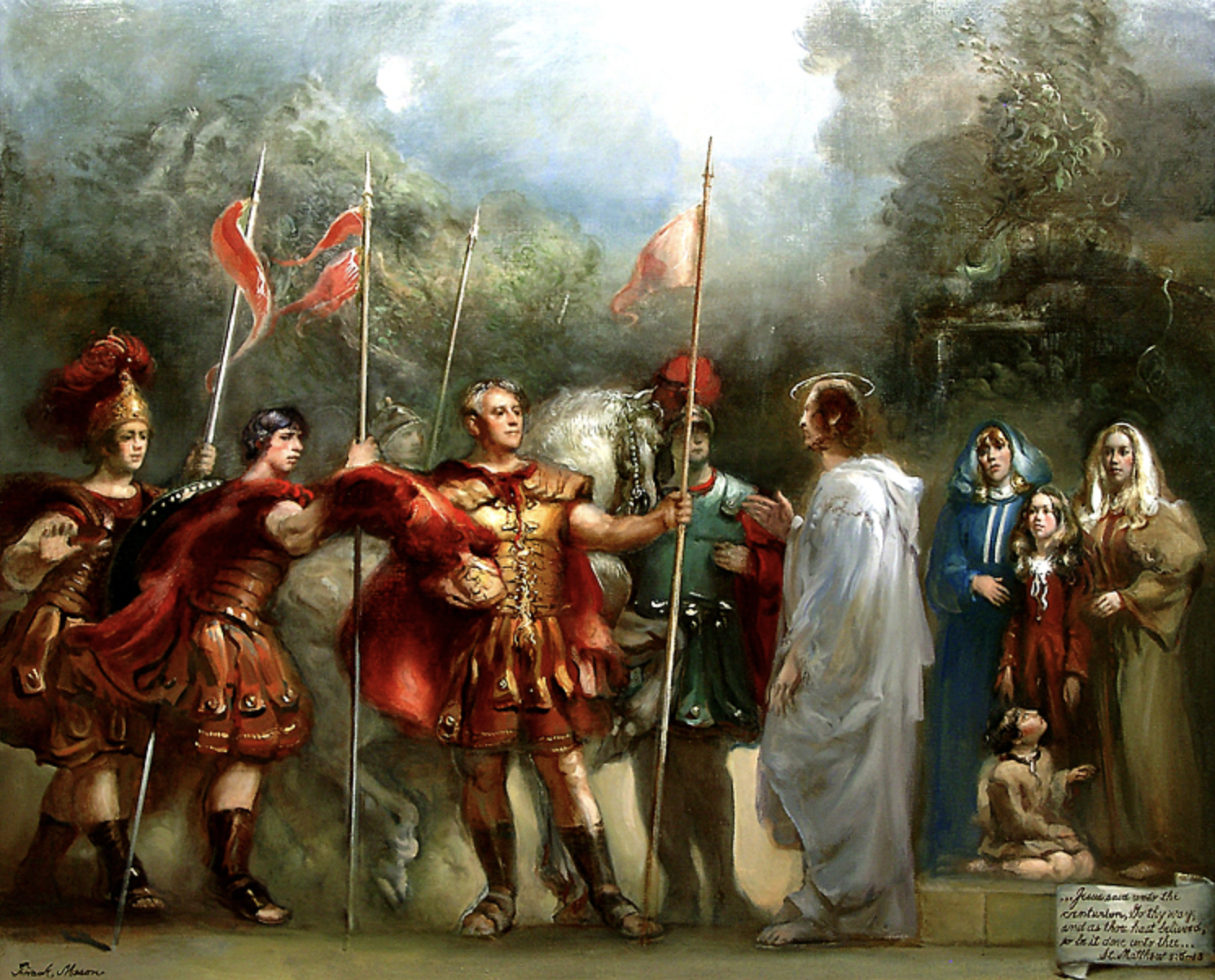
In today’s chapter, we are still at the very beginning of Jesus’ ministry. He spent 40 days fasting and being tempted. He was baptized by John. He delivered His message on the mountain. Things are still in the launch period of Jesus’ Miraculous Mystery Ministry Tour. Along comes a Roman Centurion whose servant is sick.

STOP.

It’s easy to gloss over the 80,000 pound elephant in the room. Romans were hated. Romans were the oppressors. Romans were the enemy of Jesus’ tribe and occupiers of their land. Romans were despised, godless, violent, and merciless usurpers. Jesus’ tribe was waiting for the Messiah to arrive and wipe the Romans out in a holy bloodbath. It’s hard for a casual, modern reader to understand the social and cultural context of this Roman Centurion approaching Jesus.

Think a Russian military general approaching a Ukranian in occupied territory.

Think a German SS officer coming to a Frenchman in occupied Paris during World War II.

Think a Grand Wizard of the Ku Klux Klan walking into a civil rights meeting to talk to Martin Luther King Jr.

Think Donald Trump walking into a local DNC resistance meeting.

What’s fascinating about this episode is that Jesus not only graciously accepts the Centurion and heals His “enemy’s” servant, but that Jesus then makes clear that this is just the first tremor of a massive, tectonic spiritual shift that Jesus is bringing. This is the tremor. The events of the entire book of Acts is the earthquake.

Jesus explains that individuals like this Roman Centurion (vile, hated, despised, enemy) will be seated at “the feast with Abraham, Isaac and Jacob in the kingdom of heaven.” Jesus’ tribe considered this feast to be an exclusive, members only event for holy huddle members only. Jesus goes on to make clear that in the coming spiritual earthquake, those who are considered enemies will take a seat at God’s feast while those in the holy huddle won’t get past the doorman.

I’ve never forgotten that revival in my high school, nor have I forgotten that the only joy I experienced with it was to watch it happen from the cheap seats. I was too busy being a faithful member of the tribe. I was sequestered in my holy huddle assuming everyone outside of our huddle was an enemy to be avoided, if not feared and/or despised. How badly I missed Jesus’ entire Message.

In the quiet this morning, I find myself committed to learning from that lesson even though it is over 40 years later. Jesus’ core message was about the last being first, His love for the “least,” and God’s Kingdom operating opposite the hierarchical socio-economic caste system of this world. In God’s Kingdom,

I am to generously give if I want to receive.
I am to bless those who curse me.
I am to love my enemy, and pray for those who persecute me.
I am to rejoice in my suffering, especially being the object of hatred.
I am to die to myself if I want to experience real life.

And, I need to be willing to step out of my holy huddle like Peter stepping out of the boat to walk to Jesus on the water, if I want to be part of what God’s Spirit is doing.

If you know anyone who might be encouraged by today’s post, please share.

These chapter-a-day blog posts are also available via podcast on all major podcast platforms including Apple, Google, and Spotify! Simply go to your podcast platform and search for “Wayfarer Tom Vander Well.” If it’s not on your platform, please let me know!

“Ins” and “Outs”

"Ins" and "Outs" (CaD Matt 8) Wayfarer

When Jesus had entered Capernaum, a centurion came to him, asking for help. “Lord,” he said, “my servant lies at home paralyzed, suffering terribly.”
Jesus said to him, “Shall I come and heal him?”

Matthew 8:5-7 (NIV)

I’ve been preparing a message I’m going to be giving among my local gathering of Jesus’ followers this Sunday. A year or two ago I happened to do a little personal study on the subject of fundamentalism. I was prompted to do some research because I noticed certain parallels of thought and behavior among a particular civic group that reminded me of things I saw in some of the Christian fundamentalist groups I experienced earlier in my spiritual journey.

My research came up with six elements that mark fundamentalist groups, elements that I would argue create a toxic cocktail no matter where they are found. All major religions have fundamentalist sects that bear these elements. As I studied and meditated on them, I came to realize that the elements of toxic fundamentalism can really be found in almost any human system including political, institutional, corporate, or even in families. As I was studying the assigned text for this Sunday’s message, I realized that Jesus’ religious critics displayed all six elements within the stories.

One of the elements of fundamentalist systems is that they maintain strict “in-group” and “out-group” distinctions. You must toe the line in thought, words, and behavior to be considered “in” with us, but the slightest misstep or evidence that you’ve run afoul of the rules or belief system and you are “out.”

The Hebrew religious system from which Jesus came was a fundamentalist form of Judaism. They had strict “in-group” and “out-group” distinctions. The religious power brokers wouldn’t associate with fellow Hebrews who were on the “outs” because they didn’t toe the line. And the Roman occupying force in Judea was really on the outs with the good religious authorities as well as almost all Hebrews who considered them the enemy.

In today’s chapter, Jesus has just finished his message on the hill, in which He told His listeners to love the enemy. He returns toward their base of operation and he is met by a Roman Centurion (enemy, occupier, a persecutor of His people, religiously dirty “gentile,” and pagan!). The Centurion asks Jesus to heal his servant. Jesus immediately asks if He should come to the Centurion’s house.

Entering the house of a Roman was strictly against fundamentalist rules. The Romans were the “outs” of all “outs.” Years later, in Acts 10, Peter will face the same fundamentalist religious dilemma of being invited to a Centurion’s home. Jesus doesn’t even hesitate: “Would you like me to come with you?”

In the quiet this morning, I was struck by Jesus’ words to His followers after healing the servant remotely and sending the Centurion on his way:

“I say to you that many will come from the east and the west, and will take their places at the feast with Abraham, Isaac and Jacob in the kingdom of heaven. But the subjects of the kingdom will be thrown outside, into the darkness, where there will be weeping and gnashing of teeth.”

Jesus points out that people will be surprised who they see at heaven’s feast. Some of those who were on the “outs” on earth will be present while some of the “ins” on earth will not.

So who do I consider on the “outs” with me and my belief system? Who would I refrain from accepting an invitation to their home? Who is so worthless in my eyes and I don’t even want to be near them? I think the roots of fundamentalisms are found in my own sinful nature. Jesus not only came to forgive me of my sin but also to call me to live contrary to it. Which means tearing down my own personal “in-group” and “out-group” distinctions.

If you know anyone who might be encouraged by today’s post, please share.

Willingness

Jesus reached out his hand and touched the man. “I am willing,” he said.
Matthew 8:3a (NIV)

When my daughter Madison was about four years old I called out to her from my home office in the basement of our home. She came scampering in my office from the next room where she had been playing. I needed something (I can’t remember what it was) retrieved from upstairs. “Will you go upstairs and get it?” I asked.

“Sure Dad!” she said with a big smile and child-like excitement. “I’ll be happy to!” And with that she ran off, immediately did as I asked, and cheerfully returned with the item.

I sat there for a moment thoroughly dumbstruck by her willing attitude. I can vividly remember sitting there and enjoying that little moment. She didn’t do what I asked grudgingly. She didn’t do what I asked dutifully. She didn’t do what I asked because I paid her allowance. She didn’t do what I asked out of obligation or familial obedience. She did what I asked out of a cheerful, willing attitude. I’ve never forgotten that moment.

One of the rarely demonstrated service skills I teach my clients is the simple act of expressing your willingness to do what a customer asks.

“Can you…?”
“I’ll be more than happy to do that for you.”

“Will you…?”
“You bet I will. I’m on it.”

“Is it possible…?”
“It sure is. And I’ll be glad to take care of it.”

In this morning’s chapter, Jesus begins by using this simple service skill when asked by leper if He’d be “willing” to heal him.

“I am willing,” Jesus said, and I imagine the warm smile on his face as he reaches out to touch the contagious, infected, deformed leper.

The rest of the chapter reveals so much about Jesus willingness:

  • Willingness to heal the son of a member of the despised Roman occupational force. (I’m guessing that Jesus’ disciple, Simon the Zealot, would have preferred Jesus kill both the Roman Centurion and his son).
  • Willingness to cast out evil spirits and heal anyone and everyone who came to him.
  • Willingness to heal the mother of his friend, Peter.
  • Willingness to use His power and authority to calm both the sea, and his followers fears.
  • Willingness to show mercy, even to His spiritual enemies, and grant the demons’ request.’

This morning I’m enjoying the memory of Madison’s cheerful attitude. I’m thinking about Jesus willing attitude, and I’m recalling what He said in yesterday’s chapter as He concluded His “Sermon on the Mount”:

“Ask and it will be given to you; seek and you will find; knock and the door will be opened to you. For everyone who asks receives; the one who seeks finds; and to the one who knocks, the door will be opened.

“Which of you, if your son asks for bread, will give him a stone? Or if he asks for a fish, will give him a snake? If you, then, though you are evil, know how to give good gifts to your children, how much more will your Father in heaven give good gifts to those who ask him!

I must confess that I, too often, approach God and Life with the attitude of scarcity. I expect that God wants to punish more than bless, and even if He does bless me He will be miserly doling out those blessings. “After all,” I think to myself, “I’m such a wretch that I should be grateful for anything I receive.” I sometimes attach to God my own warped image of the begrudging parent. Ugh. I see God out of the lens of my own personal shortcomings.

“If you’re willing,” I hear Jesus whispering to my heart this morning in the quiet of my home office, “you can choose to see me differently. To see me as I am: Willing.”

Yes, Lord. I’d be happy to do so. By the way, thank you for your willingness to be patient, and to help open my eyes.