Tag Archives: Research

A Season to Wait, A Moment to Move

Then the Lord said to me, “You have made your way around this hill country long enough; now turn north.
Deuteronomy 2:2-3 (NIV)

My company does a lot of customer research. It’s the core of what Intelligentics does. Just this week I’m working on four different customer research projects for clients. Over 30-plus years, it’s been fascinating to have observed how customer expectations have changed. Because of technology and stark generational differences the consumer landscape is changing at a brisk clip. Businesses are wise to invest in listening to their customers.

What has been growing as a key driver of customer expectation and satisfaction are time-related dimensions of service. We have become used to having a world of information at our fingertips. From a consumer perspective, we can do almost anything instantly on the phone in our hand at any time wherever we happen to be. The result? We are an increasingly impatient people. I see it every day in the data our customer research produces.

The impact of these changes is not just on business. It’s impacting life and relationships. It’s having a spiritual impact, as well.

Ever since I surrendered and committed my life to Jesus as a teenager, I have trekked this earthly journey as a faith journey. I am ever seeking the purpose God has for me and the Story He is authoring in it. In doing so, I have learned three important spiritual truths:

Timing is everything.
Waiting is hard.
God’s timing is perfect.

In today’s chapter, Moses continues sharing memories as mentorship to a new generation of Hebrew tribes preparing to enter the Promised Land. On the surface, the text feels a bit stale and boring. When I step back, however, and look at the Story that is being unpacked, it’s rich with these spiritual truths.

He tells of their 38 years of wandering.
Then God says, “It’s time. Turn north. Move.”
There command to move comes with instructions:
Don’t provoke Edom, Moab, or Ammon (they are family, even if estranged). God’s promise comes with boundaries.

Then comes the pivotal pivot:
It’s time to cross the Arnon Gorge—and now, now, God says, “Rise up. I have given Sihon king of Heshbon into your hands.” The battle begins, the land opens, and Israel steps into a season of forward motion after almost four decades of waiting.

Today’s chapter is about restraint, timing, and finally stepping into what God has purposed, planned, and prepared.

Which brings me back to our current world. I tap a screen and groceries appear. Click early enough in the day and the package will be on my porch before dinner. It’s no wonder we expect instant gratification. Technology has so successfully met this desire in so many areas of our lives that its increasingly driving expectation in every aspect of our lives.

How is this going to affect my faith journey? Spiritual formation and spiritual maturity take time. There are no short-cuts. There’s no pharmaceutical for instant wisdom. There is a discipline of Spirit that one learns as you ask, seek, and knock through seasons of waiting and wilderness wanderings. There is a form of obedience that requires restraint rather than action. There is an attentiveness required to be able to respond when the moment finally arrives.

“Turn north. Time to move.”

In the quiet this morning, I find myself reflecting on the many different seasons of waiting I have endured along this faith journey. Memory is a mentor. I’m also meditating on God’s call on me to move into a new season of life right now and all the feelings that stirs in my spirit after so many years of waiting. Finally, I find myself praying for my children and grandchildren, these next generations. I pray God’s grace to embrace the waiting in a world that is increasingly unwilling to do so.

And so, as the new day dawns, I ask for grace to wait well…
and courage to turn north when He whispers, “Now.”

If you know anyone who might be encouraged by today’s post, please share.

Promotional graphic for Tom Vander Well's Wayfarer blog and podcast, featuring icons of various podcast platforms with a photo of Tom Vander Well.
These chapter-a-day blog posts are also available via podcast on all major podcast platforms including Apple, Google, and Spotify! Simply go to your podcast platform and search for “Wayfarer Tom Vander Well.” If it’s not on your platform, please let me know!
An illustration of a book icon with an orange background, representing a digital platform for biblical study and reflections.

Words for “The Anxious Generation”

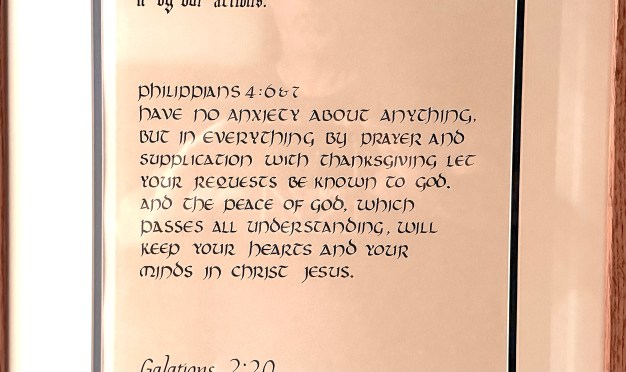
Do not be anxious about anything, but in every situation, by prayer and petition, with thanksgiving, present your requests to God. And the peace of God, which transcends all understanding, will guard your hearts and your minds in Christ Jesus.
Philippians 4:6-7 (NIV)

The paper is so old that it’s faded. I noticed just the other day how it’s showing the wear of time. There’s a large square section that is discolored because of the years it hung where a small ray of sunlight hit it in the same place every day.

When you open the door to my office there hangs a framed piece of paper with three verses written out in three different types of calligraphy. The three verses are among the first I memorized as a young man, and they have spiritually served me more than I can capably communicate along my earthly journey. They were a gift from my brother who was taking a calligraphy class when I was graduating from college almost forty years ago.

One of the verses is from today’s chapter, the verses I pulled and placed/mentioned at the top of today’s post/podcast.

One of the most popular and influential books in the past year or two has been The Anxious Generation by Jonathan Haidt. It tells of the research showing that today’s emerging generation is experiencing unprecedented levels of anxiety and mental illness. I’ve been doing a lot of thinking and meditating on this for multiple reasons. First, the customer and market research my company, Intelligentics, is doing on a regular basis reveals the same things on which Haidt is focused in his scholarly research. Also, I have so many young people in my life, my family, and my circles of influence whom I love deeply. My desire for them is not to be mired in anxiety, but to experience the “peace of God, which transcends all understanding.”

In the quiet this morning, I found myself wondering what I would say to this anxious generation. I think Paul has some sage wisdom for those whose minds and hearts are open to receive it.

First, Jesus is alive, very real, and He offers true hope. Paul experienced a transforming relationship with Christ. I have experienced and am experiencing it, too. If you pay attention, you’ll notice that the world very much wants to dismiss, diminish, and deny this. If you’ll give Jesus a chance, I believe you’ll experience a transformation, as well.

Next, there is power in the words I pasted above. I memorized them. Countless times, in the midst of anxiety, I have recounted them, whispered them, prayed them, thought them, and stated them over and over and over again. I beg you to give it a shot. Can’t hurt, might change your life.

Paul goes on to tell the believers in Philippi “I have learned to be content whatever the circumstances. I know what it is to be in need, and I know what it is to have plenty. I have learned the secret of being content in any and every situation…I can do all things through Christ who strengthens me.” Our world and our economy are based on a system designed to keep us perpetually discontent with ourselves, our lives, our bodies, our circumstances, and our status. It does this because it wants to sell us things and keep us always reaching for the never-ending “more” it claims to offer that will make us happy. There are forces at work that want you to be anxious. Anxious and fearful people are much easier to manipulate and control. Paul, however, discovered a secret that Jesus taught:

“If you decide for God, living a life of God-worship, it follows that you don’t fuss about what’s on the table at mealtimes or whether the clothes in your closet are in fashion. There is far more to your life than the food you put in your stomach, more to your outer appearance than the clothes you hang on your body. Look at the birds, free and unfettered, not tied down to a job description, careless in the care of God. And you count far more to him than birds.

“Has anyone by fussing in front of the mirror ever gotten taller by so much as an inch? All this time and money wasted on fashion—do you think it makes that much difference? Instead of looking at the fashions, walk out into the fields and look at the wildflowers. They never primp or shop, but have you ever seen color and design quite like it? The ten best-dressed men and women in the country look shabby alongside them.

“If God gives such attention to the appearance of wildflowers—most of which are never even seen—don’t you think he’ll attend to you, take pride in you, do his best for you? What I’m trying to do here is to get you to relax, to not be so preoccupied with getting, so you can respond to God’s giving. People who don’t know God and the way he works fuss over these things, but you know both God and how he works. Steep your life in God-reality, God-initiative, God-provisions. Don’t worry about missing out. You’ll find all your everyday human concerns will be met.

“Give your entire attention to what God is doing right now, and don’t get worked up about what may or may not happen tomorrow. God will help you deal with whatever hard things come up when the time comes.”
Matthew 6:25-34 (MSG)

Finally, Paul told the believers to confine our thoughts to things that are:

True
Noble
Right
Pure
Lovely
Admirable
Excellent
Praiseworthy

The next time you find yourself scrolling, I encourage you to ask how much of what you see, hear, and read as you scroll fits these adjectives. May I humbly and respectfully suggest that perhaps there is cause-and-effect at work creating “the anxious generation.”

I was a young man when the personal computer came to be. When I was in high school we had a “computer club” for the very first time in history. The very first thing that I learned in computer club, the first lesson everyone was taught about this emerging technology was this: “Garbage in, garbage out.”

Underlying all of Paul’s sage instructions is a simple truth:

I have free will. I choose.

As a young man I chose to believe words written on what is now faded and discolored paper that reminded me daily not to be anxious but that instead I could pray, be thankful, and seek after things of eternal worth. They served me well. They will serve you well, too.

I’m praying for you.

If you know anyone who might be encouraged by today’s post, please share.

Promotional graphic for Tom Vander Well's Wayfarer blog and podcast, featuring icons of various podcast platforms with a photo of Tom Vander Well.
These chapter-a-day blog posts are also available via podcast on all major podcast platforms including Apple, Google, and Spotify! Simply go to your podcast platform and search for “Wayfarer Tom Vander Well.” If it’s not on your platform, please let me know!
An old and faded piece of paper framed on a wall, featuring three verses written in different styles of calligraphy.

Big Dogs and Bad Dogs

“The Pharisees and some of the teachers of the law who had come from Jerusalem gathered around Jesus…
Mark 7:1 (NIV)

When I began my career over 30 years ago, I had zero experience in the fields of market research or quality assessment, which are the two primary services our company provides. This was intimidating, to be honest. I was a young man entering a world I knew virtually nothing about. Our company’s founder and CEO explained to me that he was not hiring me for my acumen in research and assessment, which I would learn, but rather for my gifts in communication.

What I learned in those early years is that the research and quality assessment our company provides are complimentary. Our customer research tells a client’s executive team what drives their customers’ expectations and what the company needs to do operationally to improve their customers’ satisfaction, retention, and loyalty. Quality Assessment (e.g. “Your call may be recorded for quality and training purposes…”) helps uncover how the front-line Customer Support and Sales representatives can actually improve and deliver on those customer expectations in their daily conversations and interactions with the client’s customers.

These are two very different audiences.

The executive team members handling operations, sales, and marketing are educated, experienced, and influential individuals. They think about data in strategic and tactical ways on an organizational and operational scale. There’s a certain language they speak and a way that they think.

The front-line representatives who are actually interacting with customers and handling the countless daily “moments of truth” in which customer satisfaction is built or broken, are a very different group. They tend to be among the least paid and least powerful individuals in the company. They have a very different lingo and way they think. They also have the monumental, typically overlooked, task of communicating directly with the customer while applying the policies and procedures that have been dictated down the chain of command from the C-Suite.

And, as Shakespeare famously wrote, “There’s the rub.”

My real job, my boss told me, was the ability to take objective data and effectively communicate the same results to these two very different audiences. These audiences, by the way, typically have little appreciation or understanding of one another. I had to help the executive team understand what the data said and what they needed to do operationally to deliver on those expectations through the company’s policies and procedures. To the front-line sales and support representatives, I had the responsibility to communicate the same data in a way that would help them craft their conversations and communication with customers. Often, that means managing the broken policies and procedures that we had yet to convince the executive team to change.

This came to mind today as I read the chapter, in which Jesus is likewise communicating with two very different audiences who have very different perspectives about everything.

The chapter begins by telling us that an entourage of “teachers of the Law” had come from Jerusalem to hear and inspect Jesus. These are the “big dogs” of Jesus’ religion and culture. These are the execs making a visit to the plant in rural nowhere from the Jewish C-Suite at corporate headquarters. “Everyone be on your best behavior. Look sharp, and busy!”

The big dogs call out Jesus for not following their corporate religious HR policies and procedures. Everyone was expected to wash their hands a certain way, as well as the cups, plates, and utensils they use per corporate policy 4A, sub-section B, paragraph three in the employee handbook. Jesus told his team they could ignore these silly rules. The Big Dogs have come to put Jesus on a corporate Performance Improvement Plan and press Him to get in line with corporate policy.

Instead, Jesus gives the Big Dogs an ear-full about how hypocritical and out-of-touch they are with the day-to-day realities of life for the front-line workers in the sweat shops far from the C-Suite. The policies and procedures are not only silly, but they’re rigged to benefit the corporation and its executives, not the customers or the front-line team members.

This does not go over well.

Not surprisingly, Jesus decides to take some PTO from His base of operations in Galilee. He hits the road and gets out of Dodge for a while. Mark tells us that Jesus first goes to the region of Tyre and Sidon then makes His way to an area known as the Decapolis. These are not places where the Big Dogs hold sway. In fact, these are primarily non-Jewish regions where non-Jewish “Gentiles” live and operate. The Jewish Big Dogs considered non-Jewish Gentiles and their lives to be dirty, base, and unacceptable. They literally called Gentiles “dogs” as an insult. The “Big Dogs” looked down with derision and condescension on the Gentiles. Gentiles were the “Bad Dogs.”

So Jesus, having infuriated the Big Dogs, goes to hang out with the Bad Dogs. While He’s there, a Gentile woman comes to Him begging for Jesus to heal her demon possessed daughter. Jesus trots out the corporate employee HR handbook stating that policy 8C, sub-section A, paragraph two forbids him from talking to or healing a Gentile, especially a female Gentile and deal only with the good Jewish children of Abraham (preferably the men). Why? Because Gentiles, especially women are “dogs.” So says corporate policy.

“But Jesus,” the woman replies. “Even dogs get scraps dropped from the children’s table.”

I can picture the smile on Jesus’ face. This lowly “bad dog” gets what all the corporate “big dogs” can’t see or understand from their corner offices at corporate headquarters. What was intended by the Founder to provide an exceptional customer experience of Life and Love had been lost in a culture of profit and power seeking, bureaucracy, and top-down authoritarianism. Jesus makes the demons leave her daughter.

In the quiet this morning, I’m so thankful for the “real world” experience my career has given me to observe how systems operate and to interact with individuals on every different level of those systems. It’s been fascinating to try and use data and truth to change the thinking and behaviors of individuals at different levels of an organization in order to facilitate change that will benefit the client’s customers and culture. I’ve learned a lot, not only about business, but also about life and human beings. Jesus was dealing with a very similar system because they are human systems. As a disciple of Jesus I’ve learned that systems typically don’t successfully change without human beings changing. If you change the motives and outcomes of enough human beings, there’s a chance to change the systems they’re in.

If you know anyone who might be encouraged by today’s post, please share.

These chapter-a-day blog posts are also available via podcast on all major podcast platforms including Apple, Google, and Spotify! Simply go to your podcast platform and search for “Wayfarer Tom Vander Well.” If it’s not on your platform, please let me know!

Jesus & Customer Research

Jesus & Customer Research (CaD Lk 17) Wayfarer

“So you also, when you have done everything you were told to do, should say, ‘We are unworthy servants; we have only done our duty.’”
Luke 17:10 (NIV)

In my daily vocation, I have spent my career in the research and assessment of customer service and satisfaction. It’s been a fascinating journey in many ways. In particular, I love that there are so many spiritual parallels.

For example, our research team often tests different dimensions of customer service to discover their impact on customers’ overall satisfaction. Some dimensions of service are revealed to be penalty variables while other dimensions of service are reward variables.

A penalty variable is something that won’t increase customer satisfaction if it’s demonstrated, but it will definitely diminish customer satisfaction if it’s not. For example, if a customer has a problem and calls Customer Service, the simple act of resolving the problem is typically a penalty variable. It’s very much like when our daughters were young and had household chores they were expected to do, such as cleaning their rooms. If I saw that the room was clean, I didn’t seek them out to embrace them, celebrate the completed task, and shower them with praise. Why? Because it’s a routine household task I simply expected to be accomplished. If, however, they didn’t clean their room I definitely sought them out to complain and threaten them with penalties or punishment if they didn’t meet the expectation.

A reward variable, on the other hand, is a dimension of service that increases satisfaction the more often and more consistently it is demonstrated. Soft skills such as empathy, courtesy, and friendliness are typically reward variables. Let’s go back to the example of our daughters doing their chores. As our daughter is cleaning her room and doing her chores, she steps into my home office to empty the trash. She sees my phone on the desk and stops to write “I Love Dad” on a sticky note and takes a selfie with it for me to find when I open my phone later that day. It’s unexpected. It’s considerate. It makes my day and fills my love tank and she is rewarded with my appreciation for her.

In today’s chapter, both penalty variables and reward variables are pointed out by Jesus.

The chapter begins with Jesus teaching His followers. He speaks of the attitude He expects His followers to have as they dutifully obey His teaching. Jesus uses the metaphor of a household employee who prepares his employer’s meal and waits until after the employer has eaten and things are picked up to take his own dinner break. In short, Jesus expects me to approach my acts of service as penalty variables. I don’t do them for praise or reward. I do them out of gratitude and a servant’s heart.

The chapter continues with Jesus telling ten lepers to go to show themselves to the priests. Because skin diseases were a cause for quarantine, a person healed of the disease had to show themselves to the priest to be declared “clean” so they could return to society. As the lepers are making their way to the priests, they realize that they have all been healed of their disease. Only one of the ten turned and returned to Jesus to thank Him. Jesus was impressed with the gratitude that he alone showed.

In the quiet this morning, I’m reminded of another of Jesus’ core teachings: “Whoever wants to be first must be last and the servant of all.” Along the journey, I’ve learned that this requirement is not only of my deeds but most importantly in the attitude of my heart.

If you know anyone who might be encouraged by today’s post, please share.

Popcorn Prayers

The king said to me, “What is it you want?” Then I prayed to the God of heaven, and I answered the king, “If it pleases the king…..”
Nehemiah 2:4-5a (NIV)

I was honored a few weeks ago when I was asked to pray for our meal at my high school reunion. In part, I was honored because it has become increasingly common for prayers at public events to be ignored or outright forbidden. I also realize that I and my classmates grew up in a time when public prayer was hotly debated along with questions regarding whether it was appropriate for public school choirs to sing sacred music at events such as commencement.

I can remember during some of these debates about “school prayer” that it was humorously acknowledged that the school building will always be the center of a million prayers during finals week. Of course, there is a difference between a public prayer at a school event and the silent prayer students staring at the test that has just been placed before them.

For those who are not regular readers, I have been blogging through what’s known as the exilic books of God’s Message in recent months. These are the writings of the ancient Hebrews who experienced being taken into captivity by the Assyrian, Babylonian, and Medo-Persian empires. They eventually returned to Jerusalem to rebuild and restore their homeland. Being an exile, in its very essence, means living away from home, and being in exile often means a loss of power, control, and public standing. My local gathering of Jesus’ followers is currently exploring the notion that the people of God are, by nature, exilic and what that means for us in the 21st century.

Nehemiah was a cupbearer for the Persian king, Artaxerxes. In today’s chapter, Nehemiah could not hide his grief while serving in the king and queen’s presence. It was, in those days, deemed inappropriate to show any kind of negative emotion in the presence of the king. On a whim, the king could have his servant executed for such an infraction. So when Artaxerxes notices the depressed look on his cupbearer’s face, Nehemiah’s immediate fear was warranted.

What I found interesting is that the phrase “Then I prayed to the God of heaven” is sandwiched in between the king’s question and Nehemiah’s response. There is no way that Nehemiah said, “Can you hang on a few minutes while I get on my knees and pray for a while?” Nehemiah’s prayer to the God of heaven had to have been what I call a “popcorn prayer.” A popcorn prayer is the silent, sudden, internal exclamation of my spirit to God’s Spirit in an instant. It’s exactly what I did as a student before every Biology test (science was not my thing).

According to a 2017 survey by the Barna, 79 percent of Americans said they had prayed in the previous three months. Barna found prayer to be the most common faith practice among American adults, but it was also the most multi-faceted. In fact, the researcher concluded that “the most common thing about people’s prayers is that they are different.”

Along my spiritual journey, I’ve discovered that my own prayer life is much like Barna’s research. It’s multi-faceted. I do, at times, spend set periods of time in prayer. Sometimes, I audibly talk to God while I’m alone in my car driving. Wendy and I pray together before meals, and often we will pray together when it is just the two of us traveling in the car. I’ve sometimes described my life journey itself as one long, uninterrupted conversation with God. I’m constantly aware of God’s presence, and my “popcorn prayers” are popping constantly in the heat of Life’s microwave oven.

Our culture has shifted in the 35 years since I graduated from high school. I know some who see this as a source of grief, anxiety, fear, and even anger. Sociologists and scholars are calling our current culture the “post-Christain” world. Frankly, I’m not that worried about it. In fact, I think it might just be a good thing. Throughout the Great Story, it’s clear that God’s people flourish, not when they are in power, but when they live in exile. It’s a paradox that Jesus said He came to model and that He told his followers to embrace:

“You’ve observed how godless rulers throw their weight around, how quickly a little power goes to their heads. It’s not going to be that way with you. Whoever wants to be great must become a servant. Whoever wants to be first among you must be your slave. That is what the Son of Man has done: He came to serve, not be served—and then to give away his life in exchange for the many who are held hostage.”

Jesus (Matthew 20:25-28 [MSG])

Paul, one of Jesus’ early followers, put it this way:

That is why, for Christ’s sake, I delight in weaknesses, in insults, in hardships, in persecutions, in difficulties. For when I am weak, then I am strong.

Paul of Tarsus (2nd Letter to the Corinthians 12:10 [NIV])

In the quiet this morning I find my head swimming in thoughts of culture, and power, and exile, and prayer. Nehemiah found himself a servant to the King of a foreign empire. Artaxerxes had the power to execute Nehemiah for having a frown on his face, and yet his precarious position of impotence led him to depend on his faith in the power and purposes of God. Isn’t that the very spiritual reality that Jesus wanted us to embrace?

As I finish this post I’m saying a popcorn prayer for any and all who read it. Hope you have a great day, my friend.

Good Doctor Luke

Mattias Stom's depiction of Mark (distracted and looking at us - he probably already finished his 16 chapter cliff notes version on Jesus' life) and Luke (still hard at work with his research).
Mattihas Stom’s depiction of Mark (distracted and looking at us – he probably already finished his 16 chapter cliff notes version on Jesus’ life) and Luke (still hard at work with his research).

With this in mind, since I myself have carefully investigated everything from the beginning, I too decided to write an orderly account for you, most excellent Theophilus….
Luke 1:3 (NIV)

This morning I was up early and spent some time hyperlinking all of the chapters of 1 Chronicles, which we just finished yesterday, into the Chapter-a-Day Index. As I was doing this mundane task I began to think about all of these posts I’ve written day-by-day for over eight years. My brain, still fogged by sleep, had a silly thought: “If I was running for President [talk about a nightmare for all of us], and both the press and public started pouring over my blog to find out more about me, what would they conclude about me based on what I’ve written?”

I then opened to the Luke’s biography of Jesus to start on this morning’s chapter and read Luke’s introduction to Theophilus, the person to whom Luke addressed his account of Jesus’ life. Having just been thinking about what your writing reveals about the person, I realized how much Dr. Luke [traditional holds that he was a physician] revealed about himself in his introduction.

  • He is methodical, making sure that his “orderly” account was properly introduced. There’s a formality to Luke’s style and structure.
  • He notes that his account is the result of “careful investigation,” and I could imagine the brain of a scientist at work.
  • He had researched everything “from the beginning.” The good doctor was thorough as well as methodical.

As I’ve poured over the “big four” biographies of Jesus countless times, I’ve come to appreciate particular things that are unique to each. The thing that I quickly observed in reading Dr. Luke’s investigative report, and which I have come to greatly appreciate over the years, is that it contains small details and entire episodes in the story of the life of Jesus that aren’t found in the accounts of Matthew, Mark, and John. A physician diagnosing the events he’d witnessed, you can feel Luke’s brain systematically questioning, researching, cataloging, and filing all of the facts so as to lay them out to Theophilus in the most clear and logical manner. These details and episodes provide incredible color and context to the story.

This morning, I am thankful for context and color. I’m thankful for diverse peoples and personalities whom God created to bring that color and context to both His-story and to each of our own stories. I’m thankful for Dr. Luke, whose physician’s brain does not work like mine (I think I’m more like John), and his meticulous investigation which I have enjoyed and from which I have greatly benefitted.

Preparing for a Role: Digging Into the Character

scriptworkAs an actor, I want an audience to willingly suspend their disbelief for a couple of hours and really believe that I am the character I’m portraying. When I step on stage in Ah, Wilderness! I want those who know me to forget that they’re watching Tom Vander Well and get sucked into the life and times of Nat Miller. The better I understand the character of Nat Miller, the more likely I am to succeed, and understanding the character takes work. It means being researcher, detective, historian, psychologist, artist, and writer.

Character work is one of the most enjoyable parts of the acting process for me. Here is a brief description of some of the steps I go through as I’m digging into a character:

  • What does the playwright say about the character? Eugene O’Neill does a nice job of describing his characters. Nat Miller is described: “in his late fifties, a tall, dark, spare man, a little stoop-shouldered, more than a little bald. Nat’s face has large, irregular, undistinguished features, but he has fine, shrewd, humorous gray eyes.” I may not look exactly like O’Neill describes, but I get a sense of Nat from words like “spare,” “stoop shouldered,” “humorous,” and “shrewd.”
  • What do other characters in the play say about my character? In one scene my character is off stage, my wife and the other adults talk about the fact that Nat always talks about being allergic to a certain kind of fish even thought my wife has served it to me for years without me knowing it. So, I like to repeat myself and have certain strong beliefs that might not always be accurate. It hints at a playfulness between Nat and his wife. In another scene, a salesman and bartender speak about my characters ability to make life difficult for them, hinting at Nat’s prominence and clout in the community.
  • What do I learn about my character from his own words and actions? Nat uses “hm” a lot, which is very interesting. We all have vocal idiosyncrasies, and that’s one of his along with repeating phrases: “Couldn’t help it. Just couldn’t help it!” Nat puts on a strong, authoritative role when his children are around, but when it comes to actually having an intimate discussion with his son he’s reduced to babbling.
  • In what time and culture does my character live? How would that make him different than me? What was life like then in that place? 1906 was a more proper time. Proper in the way people dress, talk, and the manners they use around the house. The Millers have a servant and an automobile, hinting at the fact that they are well off in that time. How would that change the way I act and relate to others compared to being lower class at that time? How does that effect my expectations of the children in their lives, words, actions, and how they are viewed by the community?
  • What is my characters age and occupation? What was that like? Nat owns a newspaper. Some internet research about what the newspaper business was like in 1906, specifically in Connecticut yielded some interesting results. Yellow journalism was rampant in that day. Newspapers not only reported the news but helped rise and destroy people and their careers. Most newspapers were backed by political parties and were the vehicle of how a political party got their views out. What party was Nat Miller affiliated with? What were his political connections? How did he use his paper to get ahead or influence his community?
  • What is my characters life story? One of the exciting things about acting is the fact that you get some creative control. I will often take my character journal and spend some time doing free writing in a stream-of-consciousness style. I’ll invent an entire back story. What were Nat’s parents like? When did his family come to America? What was his childhood like? Where did he go to school? How did he meet his wife? What dreams did he have as a child? How did he come to own the newspaper? It can be challenging to take hints and clues you find in the script and fill in gaps. The more completely you flesh out the character, the easier it becomes to step into character when you’re on stage. Your lines and the relationships with other characters on stage take on new depth and layers of meaning.
  • What is my relationship with the other characters on stage? Nat has four children in the show and two who do not appear in the play. What does he think of each of his children? Does he have a favorite? His sister is visiting. What was their relationship like growing up? Again, a character journal and some free writing can yield interesting thoughts and discoveries that may turn into interesting choices for how to play a line or react to another character.

Of course, this is all work that takes place outside of rehearsal. It is the homework of an actor’s preparation. Just like school, the more work you do outside of class the more prepared you are when it comes to the discussion in class and the eventual test. It is no different when it comes to the stage. A little work outside of rehearsal can make a big difference in both the rehearsal and in the eventual performance.

[Ah, Wilderness! is being produced by the Theatre Department of Central College under the direction of Ann Wilkinson. It will be performed on the campus of Central College in Pella, Iowa Feb 27 through March 3, 2013.]