Tag Archives: Hospitality

Kingdom & Empire

“Now the men and their wives raised a great outcry against their fellow Jews.
Nehemiah 5:1 (NIV)

One of the overarching themes of the Great Story is God trying to establish His Kingdom on earth amidst humanity’s endless and insatiable desire for empire.

As Nehemiah and the Hebrews in Judah attempt to rebuild the walls of Jerusalem it is the Persian empire that holds sway. As the story opened, we learn that Nehemiah is a right-hand man of the Persian Emperor Artaxerxes. Nehemiah has a front-row seat in that empire and its palace back in Susa. He has the power and wealth that comes with that position.

In today’s chapter, he gets a front-row seat at what the policies of the Persian empire are doing to the lives of average people in flyover country far from the Emperor’s gilded throne room.

Persia had steep taxes along with grain restrictions and regulations. People around Jerusalem had to mortgage their fields in order to make their tax payments. It was Hebrew nobles and merchants with wealth who loaned them the money and mortgaged their fields. When famine hit, and the poor farmers couldn’t make payments, their Hebrew lenders foreclosed or else they took their debtors children into slavery as collateral.

These were common financial practices in the culture of that day. This is how human empires operate. There is nothing new under the sun when it comes to human empire. The rich and powerful rig the system to get richer and more powerful, while the poor and the outcasts find it harder and harder to survive.

What’s crucial for me to consider as I read about the circumstances with which Nehemiah is faced in today’s chapter, is that God had instructed the Hebrews from the beginning of their covenant in Exodus that He wanted them to do things differently. God wanted them to operate by the principles of His Kingdom rather than human empire.

In Exodus 22:15, Leviticus 25, and Deuteronomy 15 God prohibits Hebrews from charging interest from their fellow Hebrews. God established a system by which every seventh year there was a jubilee. All debts were forgiven. Any mortgaged land was given back to the ancestral family who inherited it from God. Slaves were set free. The Hebrews were to be generous and acknowledge that everything belonged to God, not to them. This is how God’s Kingdom works.

This is not what was happening in and around Jerusalem. Here is Nehemiah, an agent of the human Persian empire who created the circumstances in which God’s people have been corrupted. Yet, Nehemiah knows God’s law. He sees the injustice.

Why rebuild the wall to protect God’s Temple and God’s system of redemption if within those walls there is nothing but corruption? Why waste the time, energy, and resources if the Hebrews become nothing more than another human empire?

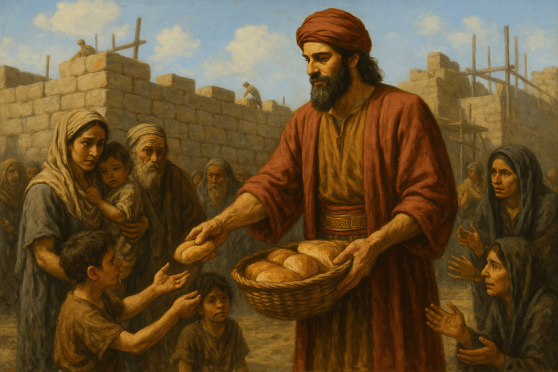
Jewish rabbis call Nehemiah’s response in today’s chapter mussar. It’s an ethical rebuke that is intended to restore community, not merely punish. Nehemiah not only rebukes the nobles and wealthy money lenders, calling them to repent and follow God’s law, but he once again leads by example. As the Emperor’s right-hand man, Nehemiah had wealth and resources at his disposal. Nehemiah acts out of the generosity that is at the heart of God’s laws. He channels his stipend and food allowance into generously feeding others. He refuses to place more of a tax burden on the people.

As I meditated on today’s chapter in the quiet this morning, it struck me that yesterday’s chapter was about external opposition from neighboring enemies. Today’s chapter is about the enemy within. Yes, it was corruption within the Hebrew people, but it was even deeper than that. It was selfish ambition, greed, and lust for power that had penetrated the hearts and minds of the Hebrew nobles, merchants, and ruling class. It is that same selfish ambition, greed, and lust for power that fuels all human empires, while God’s Kingdom cries out for love, justice, hospitality, and generosity.

Human empire is typically thought of on a global and national scale, but I’m reminded this morning that it also exists on a personal scale. When selfish ambition, greed, and the desire for power are in the driver’s seat of my heart and mind, then my own life, home, family, and business become Tom’s little personal empire. In contrast, Jesus sent His Spirit to dwell within me and He made me and my body His temple. I am God’s Kingdom on earth. I am to live out God’s principles of love, justice, hospitality, and generosity. I can’t do that if I’m more concerned about Tom’s little personal empire.

Lord, help me be a Nehemiah.

If you know anyone who might be encouraged by today’s post, please share.

Promotional graphic for Tom Vander Well's Wayfarer blog and podcast, featuring icons of various podcast platforms with a photo of Tom Vander Well.
These chapter-a-day blog posts are also available via podcast on all major podcast platforms including Apple, Google, and Spotify! Simply go to your podcast platform and search for “Wayfarer Tom Vander Well.” If it’s not on your platform, please let me know!
Logo of Bible Gateway with an open book icon and the text 'Bible Gateway'

Cutting In at the Cultural Dance

Cutting In at the Cultural Dance (CaD Matt 10) Wayfarer

As you enter the home, give it your greeting. If the home is deserving, let your peace rest on it; if it is not, let your peace return to you. If anyone will not welcome you or listen to your words, leave that home or town and shake the dust off your feet.
Matthew 10:12-14 (NIV)

Other than a four-year collegiate sojourn in the Chicago area, I have lived in Iowa my entire life. I just read an article a few weeks ago about the fact that Iowa has among the happiest people in the world. You’ll never read that or hear about it in the news. Every year you’ll hear the major news streams buzz about Scandinavian countries and Bhutan being the happiest places on earth, but that whole thing (like most things coming out of the main stream press these days) is a complete sham.

Of course, happy places have their quirks, and so it is with living in the midwest. For example, there is an etiquette to visiting others and being visited. When you arrive, it’s customary to bring something with you for your host. Typically it is food of some kind. Wine is what Wendy and I most often bring with us when invited to another home for dinner. I once invited a musician over to the Vander Well Pub for a pint. He brought the entire collection of his jazz combo’s CDs as a gift. There were, like, six of them. Awesome. I love jazz.

There is also an unspoken but well-worn tradition of guests leaving a host’s home here in Iowa. You don’t just leave. There’s a type of dance you do that begins with non-verbal signals to everyone that it’s about time to leave. This proceeds to small verbal hints like saying, “Well, this has been lovely. Thank you.” Then there’s the rising from your seat and continued banter as you make your way toward the entrance. More conversation. More giving of thanks and offers to reciprocate. The host makes a show of sending you home with the leftovers of whatever food you brought, which must be rebuffed. The promise of returning your casserole dish is given, by which you turn it into an invitation to have your hosts over to your house. You put your coat and shoes on as the conversation continues and discussion of possible future get-togethers commences. If you know your hosts well, you might experience a series of good-bye hugs during this entire culturally choreographed good-bye dance. It can sometimes take upwards of a half-hour from the first non-verbal hint you’re ready to leave to the point you are in your car driving home.

I thought of this as I read today’s chapter. Jesus sends The Twelve out into towns and villages to proclaim the good news that the Kingdom of God has come near. Jesus gives them instructions for entering and leaving hosts’ homes and tells them to bring their “Greeting” which in the Jewish tradition of the day meant bringing the blessing of “Shalom” which translates as “peace” but means so much more than that. Jesus then offers instructions for when the disciples are not welcome or if the hosts turns on them once they hear the message the disciples bring with them. If that happens, Jesus tells them to let their “shalom” return to them, shake it off, and go on their way.

Sometimes on this chapter-a-day journey I run across a passage and God’s Spirit whispers to my spirit that I need to spend some time meditating on that. So it was with these verses I pasted at the top of today’s post. I have never once heard a sermon given on these instructions of Jesus. They are verses that I myself have read countless times without even giving them consideration. Yet there is something there in the being a guest and how I enter and leave another person’s home that I think is worth more consideration.

When I enter another person’s home, what do I bring with me? I’m not talking about a casserole, dessert, or bottle of wine, but shalom. Do I bring a blessing? Do I enter with God’s peace and presence to gift to those who invited me in? What spiritual blessing can I gift and impart to my host and their family? In the quiet this morning, I find myself needing more time to meditate on these instructions and to consider what it might mean for me and Wendy, especially in light of the well-worn cultural dance of entering and leaving here in Iowa. I’ve learned along my life journey that sometimes one has to do something novel in order to “cut in” during a deep-seated cultural dance.

If you know anyone who might be encouraged by today’s post, please share.

These chapter-a-day blog posts are also available via podcast on all major podcast platforms including Apple, Google, and Spotify! Simply go to your podcast platform and search for “Wayfarer Tom Vander Well.” If it’s not on your platform, please let me know!

Choosing Humility

Choosing Humility (CaD Lk 14) Wayfarer

“But when you are invited, take the lowest place, so that when your host comes, he will say to you, ‘Friend, move up to a better place.’ Then you will be honored in the presence of all the other guests. For all those who exalt themselves will be humbled, and those who humble themselves will be exalted.”
Luke 14:10-11 (NIV)

Before getting into today’s chapter, a quick update from the Vander Well homefront. As faithful readers know, I love my morning quiet time, and it’s out of that morning quiet that these chapter-a-day posts spring. Just a few nights ago, our daughter and her family moved back to the States from the U.K.. As in, they moved moved…into our house…for the indeterminate future. Ya-Ya and I are so very excited about this. After our grandkids lived an ocean away for five years, we are over the moon to have them just an arm-length away from a cuddle or a hug. However, the empty nest will be a three-generation household for a while with grandchildren whose bodies are still on UK time, where midnight to us is 6:00 a.m. to their wee brains. So, my morning quiet the past few days has turned into playtime and doing the Macarena.

So, please know that my chapter-a-day posts may be published sporadically for at least a few weeks until the holidays are over and life settles into a routine for the household. And, they may be a little more sporadic after that. It’s semi-controlled chaos for the near future. Thank you for your patience and understanding.

Speaking of hospitality. In today’s chapter, Jesus is a dinner guest at the home of a “prominent” local Pharisee. Jesus is still drawing crowds that number in the thousands and so the Pharisee’s dinner attracts a lot of locally prominent people. I find it fascinating that one host found Jesus to be a rude and impudent guest, but the invitations kept coming with different results.

At this particular dinner, Jesus watches as guests clamored and connived for the “seats of honor” at their host’s table. Jesus used the moment to teach a lesson. Basically, if you take a place of honor for yourself and your host tells you to move to the foot of the table because someone more important deserves the seat of honor, your desire to be seen as the most prominent person in the room will turn into the exact opposite. You’ll be embarrassed in front of everyone as you slink to the only open seat as far from the seat of honor as possible. If, however, you are content to take that seat at the foot of the table and your host says, “No, my friend, come sit at my right hand at the head of the table,” then everyone at the dinner will notice as you are escorted to a place of honor.

What fascinated me this morning, is that later in the chapter Jesus seems to extend this same lesson about humility when He turns to the crowds and says, “Whoever does not carry their cross and follow me cannot be my disciple.” This very well-known statement of Jesus loses the power of its meaning when Jesus said it to the crowds.

The Romans who were in control of the country were able to rule their empire for centuries, in part, because they found the most cruel and heinous ways of suppressing dissent, crime, and rebellion. Romans would tie a person to the back of two different chariots and then drive them in opposite directions until the person was quite literally pulled apart. Other victims of Rome would have molten metal poured into their mouths. One of Rome’s more creative means of torture and executions was to tie a person into a huge sack with a snake, a monkey, a dog, and a rooster and then throw the whole sack into the river. The animals would tear the person apart in their terror as they all drowned. According to the ancient philosopher, Seneca, however, it was crucifixion that was the worst torture of all.

“Is there really such a thing as a person who would prefer wasting away in pain on a cross – rather than dying quickly? Would anyone be willing to choose to be fastened to that cursed tree, especially after the beating that left him deathly weak, deformed, swelling with vicious welts on shoulders and chest, and struggling to draw every last breath?”
Seneca, Moral Letters, 101

In separate writings, Seneca described how each crucifixion could vary depending on the executioner, with different ways to sadistically amp up the pain and suffering of the victim.

“I see right in front of me different kinds of crosses made by different people. Some hang their victims upside down. Some impale them through the private parts. Others stretch out their arms onto forked poles.I see ropes, whips, and tools of torture crafted for specific limbs and joints.
Seneca, Dialogue, To Marcia on Consolation, 6.20

In Jesus’ day, crucifixion was a very common and public spectacle. Romans typically had people crucified on the road just outside a town or city. As Jesus and His followers made their way to Jerusalem, town-by-town, they would pass crucified individuals tortured and hanging on crosses that they were humiliated and forced to carry themselves to the place of their execution. I think it very reasonable that Jesus may have been making his way walking out of town with His disciples, entourage, and crowds when they came upon the sight of a criminal carrying his cross under Roman guard. I can imagine this sight caused Jesus to turn to the crowds and say: “And whoever does not carry their cross and follow me cannot be my disciple.”

There is a connection between this moment and His teaching at the Pharisee’s dinner party. Jesus said that humbly accepting the lowest position, even at the risk of social humility was what His followers should do. He then doubles down on this teaching by pointing to a bloody victim of torture, in complete agony, dragging the cross on which he will be killed, and says, “this is what you must do to be my disciple.”

In the few seconds of quiet I had this morning between the unrelenting barrage of a six-year-old’s questions and dancing the Macarena, I found myself thinking about my own willingness to choose humility. In a world that is all about popularity, likes, followers, status, and influence, how do I willingly choose into the lowest rung, the foot of the table, or carrying a cross today? On this day and the upcoming weekend of semi-controlled chaos, holiday festivities, family gatherings, friend gatherings, and hoop-la, how can I tangibly choose the attitude and consequential behaviors Jesus desires of me?

Have a very Merry Christmas, my friend. Thank you for reading, and following, and listening. I am grateful for you. If you don’t see a daily post in the weeks ahead, just know I’m probably doing the Macarena with my grandkids.

If you know anyone who might be encouraged by today’s post, please share.

Violent Times

Violent Times (CaD Jud 19) Wayfarer

In those days Israel had no king.
Judges 19:1 (NIV)

I observe of late that I live in violent times. Violent crime is on the rise in cities along with snatch-and-grab gang robberies. Political extremists on both sides call for violence against their enemies on social media, and political protests on both sides have turned violent. We are all aware of the latest in a long string of mass school shootings that occurred just a few weeks ago. A few months ago, in Green Bay Wisconsin of all places, a woman high on meth strangled her lover during sex, then dismembered the man and hid the pieces throughout his mother’s basement, leaving his head in a bucket. The murderer appears to have found pleasure in the act. She asked the police officers who took her into custody if they “knew what it was like to love something so much that you kill it.” The first time I read about it, I found the details so disturbing that it was hard to stomach.

That gruesome event was brought to mind as I read today’s chapter. This chapter is another one of the more difficult ones to stomach in all of the Great Story. An unnamed Levite finds himself and his concubine the guests of a fellow Hebrew in the town of Gibeah. In an act that is a direct parallel to what happened to Lot in the city of Sodom in Genesis 19, a bunch of men of the town beat on the door of the host and demand that the Levite be sent out to take part in their ancient version of a rave. The Levite sends his concubine out to appease them. After being gang-raped through the night, he finds her dead on the threshold of the host’s door the next morning. Appalled by what has happened, he cuts her body into twelve pieces and disperses the parts to the twelve Hebrew tribes to shock the nation and explain what had happened.

So, why is this even in the Great Story, and what am I supposed to glean from this? Meditating on this question, I came to a couple of conclusions in the quiet this morning.

First, the author includes this horrific story for a reason and he gives me the clue in the first line of the story: “In those days Israel had no king.” This is a line the author has repeated in each of the last two chapters. This is the theme of his book’s epilogue. He is sharing with his readers the social breakdown that occurred when there was no strong civic or religious authority.

Second, the entire story is about hospitality in the ancient Near East, which was a social expectation of such magnitude in that culture that we can’t really relate to it today. The Levites’ father-in-law in the first half of the chapter exemplifies “go the extra mile” hospitality to his guest. This stands out in stark contrast to his host in Gibeah in the gruesome second half of the chapter who should have protected his guest and not allowed the concubine’s rape to happen.

Finally, the bloody act of the Levite in dismembering his concubine’s body and sending it to the tribes was a call to action. It was meant to shock the nation into doing something about what was happening in their society.

This brings me back to my own times, in which I don’t have to look very hard to find acts of violence not that much different than the ones in today’s chapter. And, in the Levite’s call to action, I hear echoes of what our society is proclaiming right now: “We have to do something!”

So what do I take away from this?

Personally, I’m reminded of the human need for authority in both my social and spiritual life. Being a follower of Jesus means that Jesus and His teachings are my spiritual compass. As I submit to doing my best to follow His example and His teaching, I find myself with spiritual and moral guardrails on my thoughts, words, relationships, and actions. This even includes honoring, and being subject to, my civic authorities. Without those moral guardrails, I can only imagine how my life might cycle out of control.

But also, as a citizen of this representative republic, I play a part in this society and I need to do my part to participate in the civic and social process by speaking out, letting my voice be heard, and voting for strong leaders who will lead by action and example.

By the way, I voted yesterday.

If you know anyone who might be encouraged by today’s post, please share.

Divine Hospitality

Divine Hospitality (CaD Gen 18) Wayfarer

The Lord appeared to Abraham near the great trees of Mamre while he was sitting at the entrance to his tent in the heat of the day. Abraham looked up and saw three men standing nearby. When he saw them, he hurried from the entrance of his tent to meet them and bowed low to the ground.

He said, “If I have found favor in your eyes, my lord, do not pass your servant by. Let a little water be brought, and then you may all wash your feet and rest under this tree. Let me get you something to eat, so you can be refreshed and then go on your way—now that you have come to your servant.”

Genesis 18:1-5 (NIV)

I walked into the small hut. There was no door that I recall, nor was there more than opening for a window. I was in a remote, mountainous region on the island of Mindanao in the Philippines. My interpreter, Victorino, explained that the hut belonged to the local pastor who ministered to villages in the area. We were guests in their home, the local parsonage.

The pastor and his wife were so excited to host us for lunch, and they went out of their way to be so very hospitable. They wanted us to see the large piece of linoleum that had been placed over the dirt floor. Victorino explained that it was likely a scrap that had been salvaged from a landfill near the city, but to our hosts it was a meaningful upgrade to their normal living conditions.

Our lunch consisted of pulled chicken freshly butchered, rice, fresh fruit harvested by hand nearby, and simple sandwiches comprising of white bread onto which butter had been spread and sugar sprinkled over it. The humble meal, Victorino explained, was a lavish feast in our hosts personal economy. They were sacrificing themselves to give us the very best they could afford.

I will never forget that experience. It was humbling. I couldn’t help but think of Jesus pointing out that the poor widow offering her only pennies at the temple was a far greater divine gift than the tithe of abundant riches offered by the wealthy. The meal in that hut was divine hospitality.

Today’s chapter tells of Abraham experiencing what scholars call a theophany, an experience in which God appears to a human in human form. Abraham greets them with gracious hospitality. Abraham makes sure his guests have shade from the sun and water to wash their sandaled feet. Sarah uses enough flour to make 60 loaves of bread, and a calf is slaughtered for the feast (a rare treat in that time).

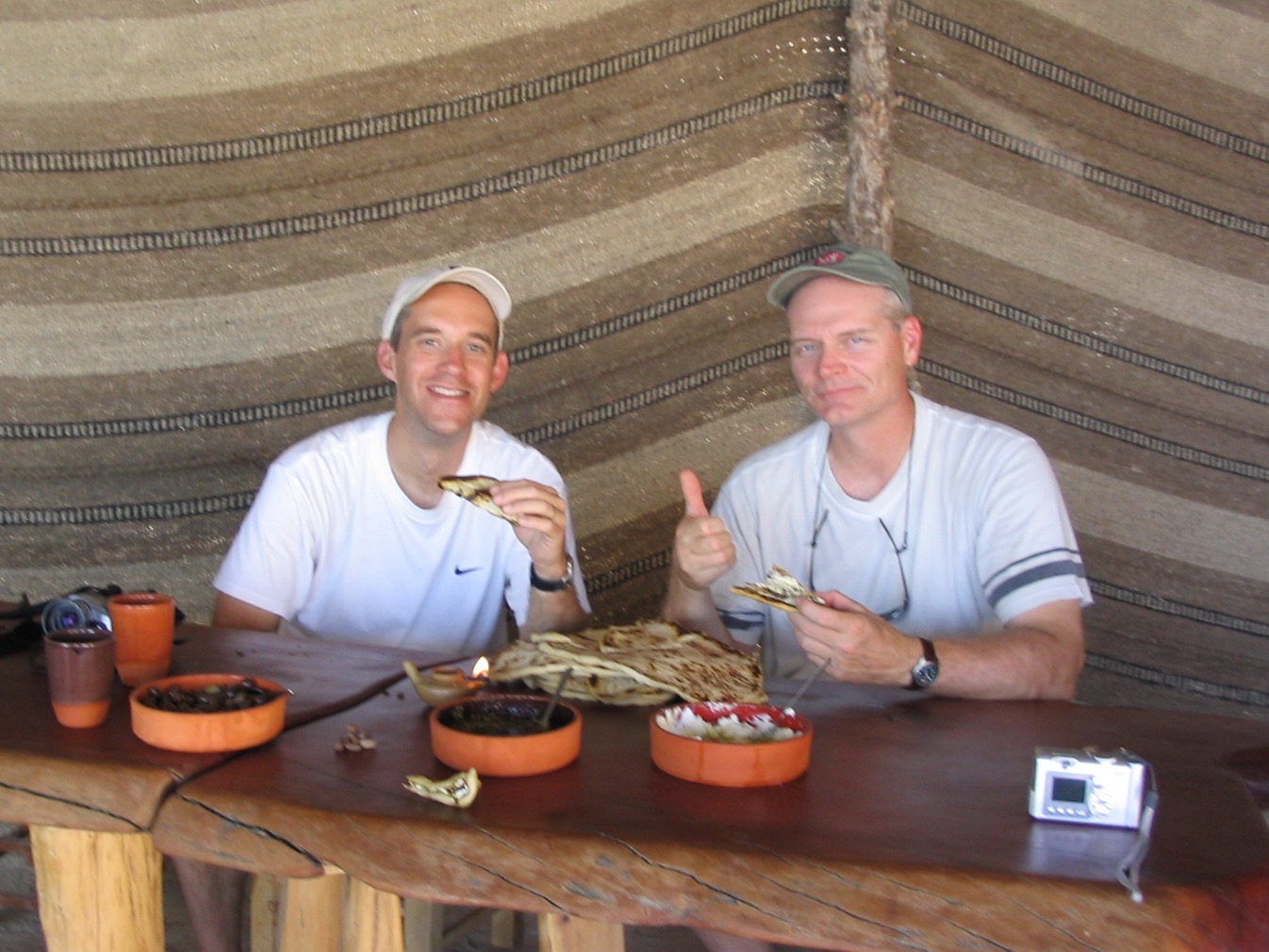
As I read the chapter, I couldn’t help but recall memories of the incredible hospitality I’ve experienced in other cultures. The Philippine parsonage was just one example. There’s the Arab restaurant owner in Bethlehem during the intifada who, while his fellow countrymen treated me with contempt and threats, quite literally begged me to come into his shop where I was treated with what felt like royal hospitality. Then the experience in Nazareth village in which I was able to experience ancient hospitality much like Abraham in today’s chapter. A shelter for shade, fresh baked pita break made as Sarah likely would have made it thousands of years ago, and fresh olives and olive oil (see featured photo of this post).

My parents modeled hospitality as I was growing up. Everyone was welcome in our home, including friends who would stop by even when me and my siblings weren’t home. Everyone was offered my mother’s home cooking or baking. My parents loved talking to our friends, and our friends obviously felt loved, welcomed, and embraced.

Wendy and I have tried to continue the same kind of hospitality that was modeled for me by my parents, the same kind of generous hospitality we have experienced from others, and the hospitality that God desires from every follower of Jesus. I am reminded that I never know when I might experience a heavenly visitor in disguise, like Abraham:

Do not forget to show hospitality to strangers, for by so doing some people have shown hospitality to angels without knowing it.
Hebrews 13:2 (NIV)

As I close out this work week, I am humbled not only in remembering the hospitality I’ve experience from others, but also in considering the opportunities Wendy and I have to continue growing in generous hospitality, sharing all with which we’ve been generously blessed with others.

If you know anyone who might be encouraged by today’s post, please share.

“LandBNB.ORG”

Dear friend, you are faithful in what you are doing for the brothers and sisters, even though they are strangers to you. They have told the church about your love. Please send them on their way in a manner that honors God.
3 John 5-6

A few months ago our friend asked to use our house to throw a semi-surprise party for his wife. It was a blast. This past Saturday, Wendy and I were blessed to host members of her family from out of town for lunch. Tonight we have friends staying with us for the night in our home. This Friday evening a small group of Wendy’s oldest and dearest friends are having a girls’ night at our house. Had it not been for the COVID-19 pandemic, this weekend would have been our little town’s annual Tulip Time festival. Our house would typically have been filled with family for the weekend.

Hospitality is something that Wendy does extremely well, and something that we enjoy doing together. One of the motivating factors for building our house was the simple ability to provide hospitality for others. Relatives, friends, children, friends of children, and even friends of friends have stayed with us. The blessing is ours.

The realities of the Jesus movement in its first 300 years are typically lost on modern readers. The tens of thousands of Jesus’ followers met regularly in people’s homes scattered across the Roman Empire. Communication was poor making organization and oversight difficult, and sometimes impossible. That’s why much of what we refer to as the “Books” of the New Testament are actually letters that were written to be delivered, read, and sometimes copied and broadcast to all the other house churches of all the other believers. The letters would have to be carried, and the deliverer(s) (for safety is was common to send two) would need lodging and food. Inns were not great places in those days and typically doubled as brothels. It was imperative that the network of house churches double as the “LandBnB.org” of that day, offering safe lodging and hospitality for fellow believers.

Today’s chapter is another short letter that tradition ascribes to John. It is essentially a letter of recommendation for Demetrius to a house church leader named Gaius. The letter commends Gaius for his reputation as a Five-Star hospitality provider (compared to the One-Star rating John gave to another house church leader named Diotrephes). His letter provided Gaius with John’s Five-Star rating of Demetrius as a guest.

In the quiet this morning I find myself thinking about the gift and art of hospitality. Sure, AirBnB and others have turned many private residences into pseudo-inns for profit. That’s cool, but that’s not the kind of hospitality out of generosity that John was calling upon from Gaius. The “LandBnB.org” that John and early believers depended upon was a non-profit enterprise founded on generosity. Providing a warm and comfortable place that’s generously given with hospitable blessing truly is, I believe, a spiritual gift. And, as Wendy and I have discovered, the profit is joy.

Everyone Welcome (…or not)

Do not forget to show hospitality to strangers, for by so doing some people have shown hospitality to angels without knowing it.
Hebrews 13:2 (NIV)

When I was young, my parents continually told me and my siblings “Your friends are always welcome in our house.” They meant it. I can remember nights when entire groups of my brothers’ friends would show up. My brothers weren’t home, but their friends would sit around the living room with my parents for long chats. As the youngest sibling, I observed the warmth of my parents hospitality and the effect on those high schoolers.

As I got older, I never hesitated to offer to have an impromptu social at our house with entire throngs of my friends. Wendy has convinced me, in retrospect, that it would have been more respectful if I had actually called my parents to ask permission or to give them a little warning. My parents, nevertheless, always laughed and rolled with it. I even told college friends to call my parents if they needed a place to crash on their drive home to the west coast. That happened, and my parents still enjoy telling the story.

I endeavored to have the same hospitality that I witnessed in my parents. I want our home to be a place of welcome, warmth, conversation, and love. I never want visitors to feel like a burden.

Along my life journey I’ve come to realize that hospitality is not a strong suit of my culture. I’ve attended predominantly black churches and received warm welcome that I knew would not be equally reciprocated if they came to my church on Sunday. I grieve this truth.

When I travelled in the middle east I regularly encountered the unbelievable hospitality of Muslims whom I expected to treat me like an enemy. Our daughters have experienced the same in their travels and missions overseas. I will never forget our daughter’s observation that the most Christ-like people she’d encountered were not her missions team, but a Muslim shopkeeper and his wife who invited her to dinner. Once again, we know in our hearts that our foreign hosts would likely not receive an equally hospitable welcome in our community. I grieve this truth.

This morning I’m thinking about my own posture towards hospitality. It’s easy to be hospitable to people of my choosing, with whom I am comfortable. I am reminded of Jesus’ parable of the Good Samaritan. In Jesus’ estimation, the one who truly loved his neighbor was the one who showed sacrificial hospitality to a perfect stranger in need who didn’t look like him, come from the same community as him, or believe the same things. I confess this morning that if you measure my hospitality by Jesus’ definition, I am found wanting.

Lord, have mercy on me.

I have some work to do.

A Table Prepared for All

On this mountain the Lord Almighty will prepare
    a feast of rich food for all peoples,
a banquet of aged wine—
    the best of meats and the finest of wines.
Isaiah 25:26 (NIV)

I love a great dinner party. We have become such a fast food, quick serve, grab-a-snack culture that it’s rare to really enjoy a feast any more. I had a friend tell me that she and her family finished Thanksgiving dinner in 10 minutes. There’s something wrong with this picture.

A great dinner party starts early with a drink and an appetizer. People mingle. There’s light conversation. Guests begin to unwind. It moves on to a table that’s prepared. Things are laid out. Everything you need for the evening is set before you. The plates, knives, forks, spoons, and glassware are a road map to the feast. There is salad and/or soup before the main course. The main course follows after and is perfectly proportioned with complementary dishes. There is an aperitif to cleanse the palate before moving on to dessert. And, there are wines served to compliment each course. By the time dessert is served you have been on a journey. A feast is to be savored, en-joy-ed along with the company and conversation around the table.

I love that God’s word picture of what’s-to-come is a feast. It’s the word picture He gave Abraham when first introducing Himself in Genesis 18. It’s the word picture Jesus gives in Revelation of the relationship He desires with every one. A dinner party. A leisurely meal with good food and good fellowship around the table.

I am struck this morning that Isaiah’s prophetic feast is for all people. So often the image of God we project to the world is that of a miserly monarch condemning the many to save the exclusive few. But Isaiah’s prophetic image is a feast of salvation for all people and all nations. When Jesus picked up and riffed on this word picture in his parable of the wedding feast he speaks of inviting those who you’d least expect to have a seat at the table, the master’s servants grabbing anyone and everyone off the street and ushering them to the table.

This morning I’m thinking about dinner parties, feasts, and a God who desires the communal oneness that is experienced with good food, good wine, and good relationship around a table well prepared.

chapter a day banner 2015

“Iowa Nice”

They claim to know God, but by their actions they deny him.
Titus 1:16a

There is this thing we call “Iowa Nice.” It’s an attitude, really. There are no classes that teach it, and no strict definition. It’s a generalization that comes through the generations. It comes up out of the soil and permeates our being, though it’s not universal. While there are always a few bad corn kernels in every bushel, the people of Iowa are pretty hospitable folk. We’re happy to help if you need it. We are kind and accommodating, even to strangers. We’re just…well…nice.

I thought about Iowa nice this morning as I read Paul’s letter to Titus. Paul had left Titus on the island of Crete to organize the various groups of Jesus followers into some semblance of organization. Titus’ job was to appoint “Overseers” (think Pastor) who would “manage the household” of believers and “Elders” who were spiritually mature leaders. Paul provides qualifications, but then acknowledges Titus’ challenge to find such individuals among the Cretans.

The people of Crete did not have a great reputation. In contrast to “Iowa Nice,” Paul quotes a Cretan prophet who claims: “Cretans are always liars, evil brutes, lazy gluttons.” Yikes. Titus is to find, among this group, those who are hospitable, self-controlled, and upright. You can almost hear Paul’s subtext: “Good luck with that.” Among Paul’s disparaging descriptive remarks about many of the Cretans is the fact that they “claim to know God, but by their actions deny them.”

What a great reminder this morning as I head into the week of our local Tulip Time festival here in Pella. I am not perfect, to be sure, but I would hope that I my actions will always bear witness to the faith that I claim – not deny it. I and my fellow residents will spend three entire days this week playing host to thousands of visitors and treating them to a generous dose of “Iowa Nice.” My desire is that my hospitality will always be a reflection of Jesus, who exemplified hospitality when He welcomed this stranger into His family.

chapter a day banner 2015Featured Image (and necklace) via Anatomical Element

The Lost Art of Hospitality

Welcome mat
(Photo credit: Lynn Kelley Author)

Chapter-a-Day Genesis 19

Then [Lot] welcomed them and bowed with his face to the ground. “My lords,” he said, “come to my home to wash your feet, and be my guests for the night. You may then get up early in the morning and be on your way again.” Genesis  19:1b-2a (NLT)

As I started reading the chapter this morning I was struck by Lot’s hospitality, which parallel’s Abraham’s hospitality from the previous chapter:

My lord,” [Abraham] said, “if it pleases you, stop here for a while. Rest in the shade of this tree while water is brought to wash your feet. And since you’ve honored your servant with this visit, let me prepare some food to refresh you before you continue on your journey.”

About ten years ago I spent a short period of time in Israel and was struck by the tradition of hospitality that is shown by the cultures there. When I read about the way Abraham and Lot welcomed and honored their guests, it feels very much the same as the way I was treated by complete strangers in some of my travels. Taylor and Clayton reported similar experiences from their travels in Morocco and Uganda. Hospitality towards strangers and guests is a time-honored tradition.

As I look back over my lifetime and observe some of the drastic changes I’ve witnessed in our own culture, the loss of hospitality is one of them. I’m still proud of “midwest nice” that you’ll still find in our small town here in Iowa, yet when I remember the way my grandparents regularly welcomed visitors into their home I am struck at how different it was. The coffee pot was always on in the morning and the tea kettle in the afternoon. There were always treats ready for guests, and there were always guests.

Even in my childhood and youth the welcome sign was always out at our home. My parents used to say to us “your friends are always welcome here,” and they were. Friends would stop by for a visit even if we kids weren’t home. They knew my mom would feed them and they would be treated like honored guests.

Perhaps what I experienced was the exception not the rule, but I don’t think so. I tend to think that we shut ourselves in our warm homes in the winter and our air conditioned homes in the summer. We lock the door and socialize with others in front of a computer screen. Meanwhile, the art and tradition of hospitality – of welcoming one into your home and caring for them with honor and grace – has been slowly lost despite the fact that God’s Message hearkens to the previous two chapters we’ve read and calls us to perpetuate the very practice:

Don’t forget to show hospitality to strangers, for some who have done this have entertained angels without realizing it! Hebrews 13:2 (NLT)

I have tried to perpetuate the spirit of hospitality in our own home, though when I think back to the experiences of my childhood I realize that I haven’t always been as fine a host as the examples I was given. It’s a good reminder for me today.

If you’re in the area, stop on by. I’ll start a pot of coffee and the tea kettle will be boiling.