Tag Archives: Equality

“Yeah, but…”

They said, “When the Lord commanded my lord to give the land as an inheritance to the Israelites by lot, he ordered you to give the inheritance of our brother Zelophehad to his daughters. Now suppose they marry men from other Israelite tribes; then their inheritance will be taken from our ancestral inheritance and added to that of the tribe they marry into. And so part of the inheritance allotted to us will be taken away.”
Numbers 36:2-3 (NIV)

When I present customer service training I’ve learned that every customer service skill is likely going to be challenged. A hand will go up in the air. When I call on my class member I typically year, “Yeah, but Tom…”

Now I simply call them, “Yeah, buts.” They are the typical excuses or exceptions to the general customer rule that cause people not to want to follow the rule.

The book of Numbers ends with a “Yeah, but….”

Just a few chapters ago God instructed Moses to allow Zelophahad’s daughters to inherit their father’s allotment of the Promised Land. It was a radical and revolutionary moment in history when women were suddenly given a level of equality no one could have expected.

In today’s final chapter, the men of the tribe approach Moses and say, “Yeah, but Mo, what if Zelo’s daughters marry into another tribe? By law their land would then get absorbed into the ownership of their husband’s family and now our tribe’s land becomes part of another tribe’s allotment. Doesn’t seem fair.”

Moses went before God and God provided a compromise. God did not want land being exchanged between tribes. Every tribe was to get their equitable and divinely appointed allotment of land to divide between the families of that tribe, and the land must stay with the tribe. So, Zelo’s daughters were required to marry a man from a family within their tribe if they wanted to retain ownership.

In the quiet this morning, my heart is split in two directions of thought and emotion.

I love that God has radically broken normal human protocol to divinely advance the female cause. The “Yeah, but…” that is raised is a legitimate legal question. Jewish rabbinical thought through history views God’s response as a balance of the individual rights of the daughters and the community rights of their tribe. The marriage requirement for the daughters was not seen as punishment but as a balance of justice for the daughters and order in the integrity of the tribe and its allotment. God’s divine decree is dynamic as it engages human concerns and balances the competing “good” of individuals and groups.

At the same time, as a student of history, I’m well aware that today’s chapter reflects a well-worn pattern in which men fight female rights and equality. Today’s chapter was just the first “Yeah, but…” to God’s divine decree of female land ownership. Through history, patriarchal male lawyers continued to chip away at it with their legal judgments. They increased the primacy of male heirs. They created marriage and dowry systems that channeled legal ownership to the control of male family members and circumvented the Zelophahad’s Daughter’s rule. They narrowed the circumstances in which the rule was applied and created legal loopholes by which the rule could be effectively bypassed.

The further I get in my journey the more appreciation I have for the women in my life. I love the radical move God made in naming and giving rights to Zelophahad’s daughters. I love that Jesus repeatedly broke patriarchal cultural convention to have relationship with women, even unacceptable women. Mary Magdalene, the Samaritan woman at the well, the woman who’d been bleeding for 12 years, and the woman caught in adultery to name a few. I love that Jesus made way for women to have a seat at the table and that in Christ there is no male and female.

In the long arc of the Great Story I see the Kingdom of God perpetually pushing against the curse of sin and the patriarchal nature of humanity that flows from that curse. Over my journey, my desire had continued to grow to do all I can to push into the equality of God’s Kingdom and impede the flow of sin’s curse and the inequality that it has shackled humanity with since the Garden.

If you know anyone who might be encouraged by today’s post, please share.

Promotional graphic for Tom Vander Well's Wayfarer blog and podcast, featuring icons of various podcast platforms with a photo of Tom Vander Well.
These chapter-a-day blog posts are also available via podcast on all major podcast platforms including Apple, Google, and Spotify! Simply go to your podcast platform and search for “Wayfarer Tom Vander Well.” If it’s not on your platform, please let me know!
Image of a Bible with an open page in an orange icon format, representing a digital Bible or a Bible app.

God’s Radical Decision for Women

So Moses brought [the case raised by Zelophehad’s daughters] before the Lord, and the Lord said to him, “What Zelophehad’s daughters are saying is right. You must certainly give them property as an inheritance among their father’s relatives and give their father’s inheritance to them.
Numbers 27: 5-7 (NIV)

The Hebrew tribes are camped on the Jordan River across from Jericho. On the other side of the Jordan lies the Promised Land. The time has come to take possession and everyone in the camp is talking about the land that their tribe and their families will eventually be given. The idea of land to farm and graze and a homestead for the family and future generations to live and flourish has been a common human dream throughout history.

This is a moment of promise for the Hebrews. At Mt. Sinai almost 40 years earlier God gave them a vision for this moment. He gave them his guidebook for life and community with God and others in Leviticus. God told the Hebrews that He was going to show them His ways and they would be an example to all the other nations, empires, and peoples of His ways. This included radical new ideas like a sabbath day of rest, the care for strangers, societal protection for the poor and vulnerable, and being a nation with no human king, pharaoh, or emperor.

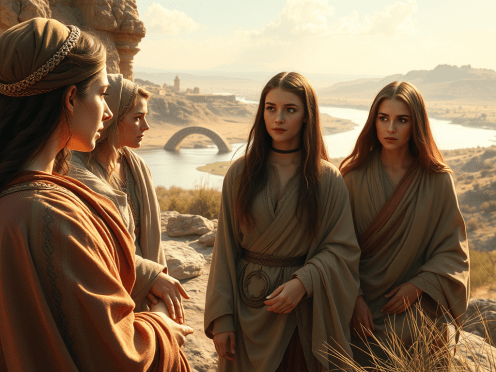
Now, at this very moment of history on the edge of fulfilled promise of a land to call one’s own, one of the most amazing stories in the entirety of the Great Story takes place. It is a prime example of God wanting things to be different than human defaults. It is a tale no one taught or talked about in all my many years of sermons and Bible classes. It is the story of Zelophehad’s daughters.

At this moment when everyone is thinking about the land they will be given, the daughters realize they have a problem. Their father died and he had no sons. It’s just the sisters. The ancient near east, especially Mesopotamia, the nations and people groups were staunchly patriarchal. Women had no autonomy. They owned no land. They could inherit no land. Everything was legally channeled through the males in the family.

So, with divine chutzpah, the daughters approach Moses and the elders of the community. This in itself was a radical departure from cultural norm. Women didn’t participate in the meetings of the elders or the formal business affairs of the community. Nevertheless, the daughters broke protocol and they made their case before Moses. They had listened and embraced what God had said at Sinai and what Torah taught about God caring about the marginal, societal protection for the vulnerable, and justice. Why should another family get their family’s promised plot of the Promised Land simply because they had no brother?

Then something more amazing happens. Moses takes the daughters’ case before God. God quickly and unequivocally decides for the daughters. Women can inherit land and own it. God sides with women and demands that it become the law of His people. While there were other ancient cultures in which women had the right to own and inherit land (Egypt being prime among them) the right typically had certain patriarchal limits. Never before had there been a divine decree that simply and directly conferred upon women the right to inherit and own their family property. This was radical.

Remember, in the Great Story everything is connected. What God is doing with physical inheritance here in Numbers is the same thing He will do with spiritual inheritance through Christ:

“Now if we are children, then we are heirs—heirs of God and co-heirs with Christ…” Romans 8:17 (NIV)

“There is neither Jew nor Gentile, neither slave nor free, nor is there male and female, for you are all one in Christ Jesus.” Galatians 3:28 (NIV)

There are two main themes that flow out of my meditation on Zelophehad’s daugthers in the quiet this morning.

First, I love the holy audacity of the daughters to step-up at the right moment and stand for what was right. It echoes the same chutzpah I see in Wendy and in our daughters. I love it. I love their heart for what’s just for everyone. I love that God blessed their courage and that God divinely cut against what was entrenched human cultural tradition. I hear echoes of the prophet Isaiah: “Your ways are not my ways.”

Second, history has taught me that human defaults and entrenched human culture traditions never change easily. In just a few chapters, the men will find a way to use human legal means to hem in the radical rights God has just granted to women. Early Christian “fathers” made similar moves to hem in the spiritual equality Jesus brought to the table. The tension remains to this day. I don’t think the tension will ever abate this side of eternity because it is connected to the consequences of the Garden in just the third chapter of the Great Story.

But, I can embrace God’s heart. I can embrace and celebrate what He did for the daughters of Zelophehad thousands of years ago and all the women their precedent effected through the centuries. I can embrace and celebrate what Christ did in bringing women to the table as full and equal heirs of God’s Kingdom. And, where it is in my ability I can speak and act in supporting and encouraging that spiritual reality and all that it means.

If you know anyone who might be encouraged by today’s post, please share.

Promotional graphic for Tom Vander Well's Wayfarer blog and podcast, featuring icons of various podcast platforms with a photo of Tom Vander Well.
These chapter-a-day blog posts are also available via podcast on all major podcast platforms including Apple, Google, and Spotify! Simply go to your podcast platform and search for “Wayfarer Tom Vander Well.” If it’s not on your platform, please let me know!
Logo of Bible Gateway, featuring an open book icon and the name 'Bible Gateway' in bold font.

The “Divine Right” (to Be Equal)

Brothers and sisters, think of what you were when you were called. Not many of you were wise by human standards; not many were influential; not many were of noble birth. But God chose the foolish things of the world to shame the wise; God chose the weak things of the world to shame the strong. God chose the lowly things of this world and the despised things—and the things that are not—to nullify the things that are, so that no one may boast before him.
1 Corinthians 1:26-29 (NIV)

Wendy and I have a guest room that we’ve been decorating with a UK theme. We’ve loved our trips to the UK and thought it would be kind of fun (“cheeky,” even) to channel that into our home. On one of the walls we’ve hung portraits of royalty as well as some of our favorite British writers and actors. Of course, we felt the need to separate the portraits with the royals (and a couple of Prime Ministers) on one side and the those low-life, “commoner” artist types on the other 😉

Having grown up in a representative republic like America, the notion of royalty is a bit of romantic idea and the stuff of nostalgia for us. For most of human history, however, the idea of people being better than others simply because of the blood in their veins and the family into which they were born was part of the fabric of every day life. And, going all the way back to ancient rulers, it was commonly believed that there was some sort of divinity that marked the distinction. Rulers often claimed to be gods themselves. The idea of monarchs ruling by “divine right” was popularly held (mostly by the royals themselves) until recently.

Even in the times of Jesus and the early Jesus Movement, the notion of “divine” rulers was popular. One of the reasons the early believers were executed or thrown into the Roman circus to be eaten by lions for the sake of entertainment was that they refused to swear that Caesar was god.

In today’s chapter Paul is quick to reference that the believers in Corinth were not people of wealth and influence. For the most part they had little status in the eyes of the world. He reminds them, however, that they are highly esteemed by God.

We easily forget that one of the things that made the early Jesus Movement so radical was that everyone could freely accept the gift of salvation offered by Jesus. Everyone was equally a member of the body of Christ. Spiritual gifts were bestowed on every believer by Holy Spirit, and when the Spirit came upon a group of believers everyone manifested the experience regardless of gender, age, ethnicity, or social standing. When believers met together for a love feast and to share in the ritual of the Lord’s supper everyone was welcome at the table. If a slave and the slave’s master were both believers, they had equal status at the table of Jesus’ followers.

This morning I find myself meditating on the reality that as the Jesus Movement became the institutional church and gained both power and influence, it quickly abandoned its egalitarian roots and developed rigid systems of hierarchy and status that exist to this day. In personal practice and in my, admittedly small, circles of influence I am consciously trying to lead us back to the egalitarian spiritual roots of the Jesus Movement where everyone is of equal status in the body of Christ and where everyone is welcome at the table. We’ll let the ancient notion of “divine” rulers  or those of higher or more noble “status” be simply a bit of nostalgia on our guest room wall.

Speaking of that. One of the decorative touches we want to make to our guest room is a collage of postcards from the UK. If I have any readers from across the pond who would like to contribute, we would be both humbled and blessed to have you send us a postcard (or two, or three!). Simply drop it in the mail it to:

Tom & Wendy Vander Well
c/o Intelligentics
801 Franklin St. #526
Pella, IA 50219 U.S.A.

Tomorrow begins the Thanksgiving holiday here in the U.S. Please know that I am truly thankful for you who faithfully, or occasionally, (or even rarely) read my posts. Cheers!

Faith, Following, and Fairness

Is it not lawful for me to do what I wish with what is my own? Or is your eye envious because I am generous?’
Matthew 20:15 (NASB)

During my lifetime I have observed that fairness and equality have increasingly become societal expectations. There are certainly worthwhile issues to be addressed and ills to be confronted, but I have observed that expectations of fairness and equality can easily expand to encompass almost every area of life. It seems at time as though we want same-ness. Everyone should have the same, make the same, look the same, enjoy the same.

On my spiritual journey I have come to accept that the overarching fairness I observe us striving for does not exist in God’s economy. Everyone has access to the Life, love, grace, mercy, and forgiveness which Jesus purchased through His death and resurrection. Once on the path of following Jesus, however, I discover that God never promised that all followers would all enjoy the same lot in life, be called to the same path, or have the same purpose. In fact, God’s self-revelation gives evidence to infinite and creative diversity in being, calling, giftedness, purpose, and experience. The Trinity itself reveals unity in diversity; Three distinct persons – One God.

In today’s chapter Jesus tells a simple parable that addresses this very issue. A vineyard owner hires workers throughout the day. Some in early morning, late morning, noon, afternoon, and some more for the last hour of the work day. The owners agreed to pay them each the same wage. At the end of the day the laborers who worked all day are indignant that the workers who only worked one-hour received the same amount of money.

Hire a lawyer! Call the Labor Board! Organize a union!

That’s not fair!

But, Jesus points out that each laborer readily agreed to the wage when they began. The issue, then, was not the fairness of the employer but the envy of the workers.

In find it ironic that Matthew follows this parable with the story of Jesus’ own disciples having conflict over who among them were Jesus’ favorites and who would get positions of honor in God’s Kingdom. Jesus response matched the parable He’d just told: “Don’t worry about each other’s rewards; Focus on the job you’ve each been called to do.” 

This morning I am reminded once again that my job is not to concern myself with comparisons to everyone else. My focus is to be on my personal relationship with God, existing in the flow of God’s Spirit, faithfully walking the path God places before me, and fulfilling my role to the best of my ability. When I embrace and embody my unique person and purpose, I contribute to the unity of God’s Kingdom.

“Haves” and “Have Nots”

temple curtain tornSo he measured the area on all four sides. It had a wall around it, five hundred cubits long and five hundred cubits wide, to separate the holy from the common.
Ezekiel 42:20 (NIV)

We talk a lot in our culture about the “haves” and “have nots.” With a presidential election gearing up, we’re going to have plenty more inundation of pundits and politicos barking and bantering about social equality, racial equality, financial equality, and gender equality.  I believe the never ending struggle within to place ourselves above others, to suppress others, and to criticize and belittle those who look, think, act, and believe differently is evidence of what took place in the Garden of Eden. It is first and foremost a spiritual problem.

Religion also has its share of “haves” and “have nots.” The reality is that organized religion has proven over history to illustrate the very thing it says it’s trying to resolve. The sin problem manifests itself acutely in the very people and institutions who try to address it. We see a hint of the issue in today’s chapter.

The temple was arranged, by design, with areas for the “holy” and the “common” or “unholy.” Over time this separation of the “holy” from the “unholy” created social strata which resulted in all sorts of social issues. The Jews of Jesus’ day were notorious for taking on a mantel of holiness which publicly covered the darkness in their souls, and placing themselves above others. Jesus reserved his hottest, most righteous anger for the most religious people:

“You’re hopeless, you religion scholars and Pharisees! Frauds! You keep meticulous account books, tithing on every nickel and dime you get, but on the meat of God’s Law, things like fairness and compassion and commitment—the absolute basics!—you carelessly take it or leave it. Careful bookkeeping is commendable, but the basics are required. Do you have any idea how silly you look, writing a life story that’s wrong from start to finish, nitpicking over commas and semicolons?

“You’re hopeless, you religion scholars and Pharisees! Frauds! You burnish the surface of your cups and bowls so they sparkle in the sun, while the insides are maggoty with your greed and gluttony. Stupid Pharisee! Scour the insides, and then the gleaming surface will mean something.

“You’re hopeless, you religion scholars and Pharisees! Frauds! You’re like manicured grave plots, grass clipped and the flowers bright, but six feet down it’s all rotting bones and worm-eaten flesh. People look at you and think you’re saints, but beneath the skin you’re total frauds.” Matthew 23:23-28 (MSG)

It was this problem that Jesus’ came to address. The parable of the Good Samaritan is core to what Jesus was about, which is to actually, tangibly love those who think, speak, look, act, and believe differently. To love even those who hate you and consider you their enemy. To place others ahead of ourselves.

In the Hebrew temple was a giant curtain that hid the “holy of holies” from the “holy place.” It was a place where only the high priest was allowed and only on certain occasions. Three of four of Jesus’ biographers (Matthew the tax collector, John Mark, and Dr. Luke) record that when Jesus died on the cross that curtain in the temple split right down the middle. No more separation. No more religious “haves” and “have nots.” Jesus came to be the sacrificial lamb, to pay the penalty for our sin, so that holiness would be available to anyone who wants it – not based on what we do or don’t do, say or don’t say, think or don’t think, but based on Jesus simply making it available as an undeserved gift.

It is what we do with that gift, or rather what it does in us, that makes the difference.