Tag Archives: Jezebel

Kingdoms Fall

Kingdoms Fall (CaD Ezk 26) Wayfarer

 therefore this is what the Sovereign Lord says: I am against you, Tyre, and I will bring many nations against you, like the sea casting up its waves.
Ezekiel 26:3 (NIV)

This past Sunday I delivered a message among my local gathering of Jesus’ followers and I voiced the fact that the entire Great Story from Genesis to Revelation is really about the conflict between God’s Kingdom and human empire.

Human history is a study in the rise and fall of human empires. Some are long-lasting like that of the Byzantine Empire which lasted of 1100 years. The rise and fall of the Third Reich in the 20th century was, by grateful comparison, a blip on the radar at 25 years.

When it comes to the ancient Hebrew prophets, it’s really about human empires, and there was a slew of them rising and falling during the period of the prophets from 875-430 B.C. When reading the prophets like Ezekiel, it helps to have some historical context to inform the reading of the text.

The Kingdom of Tyre (modern day Lebanon) was a prominent and wealthy trading port north of Israel. There were actually two cities. One was a fortified island just off the main land. The other was on the mainland itself. The Kingdom was known for their cedar forest and those cedars were exported by kings in the region for their pet building projects. Solomon used the cedars of Tyre for building his temple.

The relationship between ancient Israel and Tyre was testy. Evil Queen Jezebel was a princess of Tyre who was married to Ahab as a political alliance. She famously tried to rid Israel of the worship of Yahweh and import her native Baal worship. God raised up the prophet Elijah to oppose Jezebel and things didn’t end well for her.

Today’s chapter is the first of three prophetic messages against Tyre. In Ezekiel’s day, prophesying the fall of Tyre would probably have made his listeners laugh. Tyre seemed indestructible. First, it was a major trade port, the source of tremendous wealth, and strategic trade partner with it’s ships bringing in goods from all over the Mediterranean and northern Africa. Then, of course, was the fact that it was two cities. If you destroyed the mainland city, you still had to figure out how to lay siege to the island city.

Ezekiel prophesies that “many nations” would come against Tyre and lay siege to it. Verses 8-9 are a very succinctly detailed description of the stages of siege warfare in that day (Ezekiel and his fellow exiles were living witnesses of how it worked):

He will ravage your settlements on the mainland with the sword

A big part of the success of siege warfare on a walled city was to starve the people inside. The army would start by getting control of the settlements around the city that helped provide crops and food inside the city. This broke off supply lines and starvation would ultimately occur within the walled city.

he will set up siege works against you, build a ramp up to your walls and raise his shields against you.

The next phase of the siege was to get to the top of the walls to take out the city’s defenses. Defenders would stand on the wall and shoot down at the sieging army or pour boiling oil on top of them. A ramp was typically constructed leading up a section of the city wall and “siege towers” would be constructed and rolled up the ramp to get to the top of the wall and eliminate the defenders there.

He will direct the blows of his battering rams against your walls and demolish your towers with his weapons.

Once in control of the top of the wall, the siege army could concentrate on breaking down a section of wall so that the army could flood in. There were multiple ways they could accomplish this. The gates were so fortified that sometimes it was easier to ram through a weaker section or to dig a tunnel under the wall to weaken the wall and cause it to collapse.

Ezekiel’s prophecy was actually fulfilled. Nebuchadnezzar laid siege to Tyre for thirteen years. He destroyed the city on the mainland and was particularly ruthless given how long it took. Babylon didn’t have a lot of experience with naval warfare and he failed to take the island city. A hundred or so years later Alexander the Great would come through and finish the job. He was even more ruthless than Nebuchadnezzar, and historians were aghast at the slaughter. He killed 10,000 men, women, and children, sold 30,000 into slavery, and had all the young men of fighting age crucified.

In the quiet this morning, it leaves me pondering the rise and fall of empires. My friend, Chuck, was head of marketing for Billy Graham films when they made The Hiding Place. It’s the story of Corrie Ten Boom whose family helped hide Jews from the Nazis. Her whole family were sent to concentration camps. She was the only one who survived, released from the camp because of a clerical error. When Chuck asked her why she wanted to make a movie of her story she answered, “To prepare American Christians for what they are going to have to go through someday.”

Chuck told me this when I was in high school. It’s seemed crazy back then. After the last eight years or so, I’m not so sure. I am pretty sure that it’s much like the people of Ezekiel’s day thinking he was crazy to predict the fall of Tyre. History teaches me that kingdoms rise and kingdoms fall. Sometimes the fall is sudden and unexpected. Who knows what the future holds. I prefer to know and trust Who holds the future.

If you know anyone who might be encouraged by today’s post, please share.

Jezebel’s Epic End

“Throw her down!” Jehu said. So they threw her down, and some of her blood spattered the wall and the horses as they trampled her underfoot.
2 Kings 9:33 (NIV)

I have long been a fan of Francis Ford Coppola’s Godfather trilogy for the epic story it tells across life and generations. Over the years, Wendy and I have enjoyed introducing friends to the original film over a feast of spaghetti and cannoli, complete with some good Italian red wine.

One of the things that makes a great story is when it is layered with truth and meaning. Epic stories are mines that yield new treasure each time you descend into them. With each telling they reveal something you hadn’t seen before. Yet, even with all of the layers of meaning the narratives of great stories are typically built on something quite simple.

The Godfather epic might be summed up with Jesus’ simple words to his disciple, Peter: “Put your sword back where it belongs. All who use swords are destroyed by swords.” It is a generational tale in which the characters give themselves to “the sword” with what they believe are the best of intentions to protect those they love dearest. Their course, however, only serves to destroy the very things they tried to protect.

This came to mind in the quiet this morning as I read today’s chapter in the handwritten text of The St. John’s Bible. The stories of the ancient kings of Israel and Judah are epic stories, though I find that I have to move beyond the scribe’s text and descend into the story before I begin to see the layers.

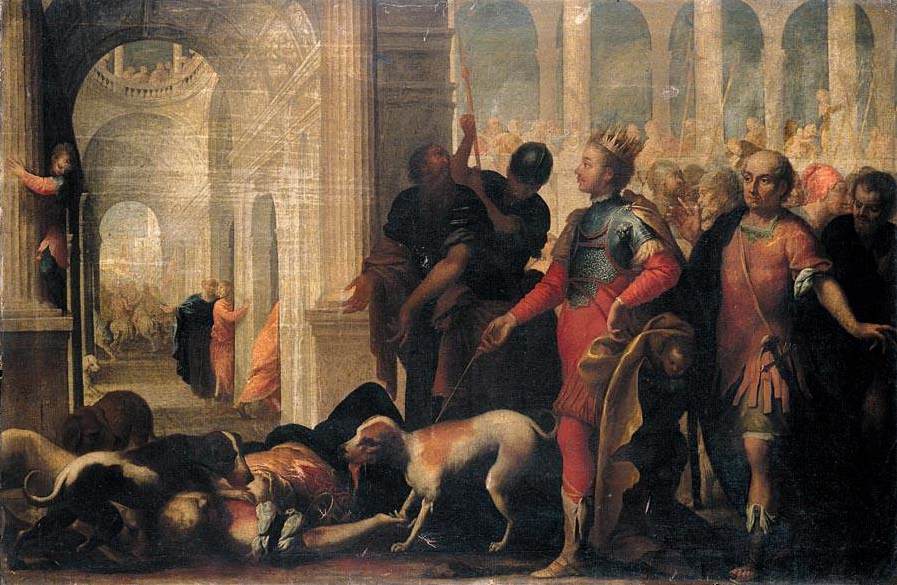
The story of King Ahab and Queen Jezebel, belongs in the same genre of epic stories of those who live and die by the sword. Their tale is about lust for power, corruption, vengeance and blood.  Today’s chapter is the closing scene on their story. Ahab is dead and Jezebel feels her power slipping away as the leader of a coup d’état reaches her stronghold. Jezebel goes back to her tried and true playbook, putting on her make-up and doing her hair so as to seduce her way out of the corner where her own nefarious actions have placed her. But true to Jesus’ observation, the way of the sword ends badly for those who follow that path. The power of seduction fades and becomes impotent. Jezebel’s very own servants, no doubt weary of her wickedness, are only too willing to join the coup, chuck her out the window, and watch the dogs devour her dead flesh.

This morning I’m thinking about epic stories and the way they reveal truths about life and soul. This week at the lake Wendy and I enjoyed much conversation with our adult daughters. Along the meandering path of our discussions was the observation that we humans never seem content with “enough.” Vito Corleone and Jezebel followed the insatiable way of the sword, violently taking all they could for themselves believing that it would provide security of position and provision. They ignored the reality that when you violently take from others there will eventually be others who will violently take it from you.

Elijah, the Spaghetti Western, and Me

28857-man-with-no-nameThe Lord said, “Go out and stand on the mountain in the presence of theLord, for the Lord is about to pass by.”

Then a great and powerful wind tore the mountains apart and shattered the rocks before the Lord, but the Lord was not in the wind. After the wind there was an earthquake, but the Lord was not in the earthquake. After the earthquake came a fire, but the Lord was not in the fire. And after the fire came a gentle whisper. When Elijah heard it, he pulled his cloak over his face and went out and stood at the mouth of the cave.

Then a voice said to him, “What are you doing here, Elijah?”
1 Kings 19:11-12 (NIV)

Elijah is such an intriguing character. His personality seemed uniquely created to be the person God needed. He appears on the scene like Clint Eastwood‘s “man with no name” in Sergio Leone‘s spaghetti westerns. Out of the wild comes this charismatic loner displaying miraculous qualities and a passion for God. He seems invincible. Outnumbered 450 to 1, Elijah gets into a spiritual shoot-out with the prophets of Baal and, thanks to a heaven-sent fiery climax, he finds himself the last man standing. It’s the stuff of a Hollywood action blockbuster.

Then, the story takes an unexpected twist. The invincible hero does a complete 180 degree turn and becomes shockingly human.  Fresh from the miraculous victory at Mount Carmel, Elijah learns that Queen Jezebel has put a price on his head and he withers on the vine. After three years of famine, scratching out an existence in the wilderness, and the big showdown on Carmel, God’s heroic prophet is physically, mentally, and spiritually shot. He shows the all too familiar human qualities of fear, anxiety, depression, despair, and suicide.

Elijah runs away. He gives up. He throws in the towel, lays down to die, and begs God to bring the end quickly. He then goes on a self-pitying pilgrimage to the mountain of God. Upon his arrival, there is a cyclonic wind, a great earthquake, and a raging fire. God was nowhere to be found in the cataclysmic manifestations.

God appears in a whisper, and asks His man a profoundly simple question: “What are you doing here?

I find in this story of Elijah so much of my own frail humanity. I experience amazing, miraculous moments along the journey and then seem to forget them when petty anxieties paralyze me. I have episodes of victorious faith, then run from the next challenge. Given to blind, self-centric drama I fail to see all that God is doing in and through those around me while I project the weight of the world on my  own shoulders, blow my own problems grossly out of proportion, and then slink into a corner to obsess and lick my petty emotional wounds.

Lord, have mercy on me, a sinner.

And yet, I am strangely encouraged by Elijah’s story. I am no different than this hero of the faith. Human frailties are common to every spiritual hero, because every hero is limited by his or her own humanity. The question is not whether I will experience common human episodes of fear, anxiety, insecurity, despair, depression, self-pity, weakness, and conflict. We all experiences these things. The question is how I will respond when they happen. And, they will happen. Too often I pray for and expect God to send dramatic winds of change, a seismic shift in circumstance, or a explosive miracle to sweep away my humanity. I am beginning to learn that what I need to listen for is God’s still, small voice meeting me right where I am, in the midst of my all too human condition.

The Intriguing Person of the Prophet Elijah

The upper part of The Transfiguration (1520) b...
The upper part of The Transfiguration (1520) by Raphael, depicting Christ miraculously discoursing with Moses and Elijah. (Photo credit: Wikipedia)

So [Elijah] did what the Lord had told him. He went to the Kerith Ravine, east of the Jordan, and stayed there. The ravens brought him bread and meat in the morning and bread and meat in the evening, and he drank from the brook. 1 Kings 17:5-6 (NIV)

The prophet Elijah is one of the most intriguing characters in the entirety of God’s Message. He appears out of nowhere, has a brief ministry marked by miraculous events, confronts the evil and powerful King Ahab and Queen Jezebel of Israel, and then disappears in a whirlwind.

Most people don’t realize it, but Elijah also figures into Jesus’ life and teachings. When asked who people that Jesus was, his followers respond that Elijah was a trending vote getter. Jesus told His followers that John the Baptist was the person of Elijah returned to restore all things. On the mount of transfiguration when Jesus was revealed in His glory, Elijah appeared with Him. Jesus referred to Elijah in His teaching on multiple occasions. While hanging on the cross, witnesses thought Jesus was calling out to Elijah.

As I read today’s chapter, I found it interesting that the miracles of Elijah seemed to strongly parallel the miracles of Jesus. The widows flour and oil never ran dry, much like the baskets filled with bread and fish when Jesus fed the crowds with His all you can eat fish fry by the Sea of Galilee. When Elijah takes the dead widow’s son into an upper room and bring’s the boy back to life, it is eerily reminiscent of Jesus going into the room of Jairus’ dead daughter bringing her back to life.

One of the things I have come to appreciate more and more in my sojourn through God’s Message is the connections, parallels, foreshadowing, and recurring themes that stretch across the entirety of the story that God has told and is still telling. I love that God is both an artist and an author. He is telling a story. It is His-story.

Chapter-a-Day 2 Chronicles 17

[Jehoshaphat] was single-minded in following God. 2 Chronicles 17:6a (MSG)

When reading 2 Chronicles, it’s important to remember that the nation of Israel was divided in two parts. While we are reading about the kings of Judah (the southern part), the events we read about in the books of the Kings is happening simultaneously in the northern kingdom. Sometimes the parallel events have light to shed on our reading.

Reading about Jehoshaphat’s single-minded devotion to God is a stark contrast to King Ahab, who was on the throne of the northern kingdom of Israel during that time. While Jehoshaphat led the people in devotion to God alone, the prophet Elijah gathered the people of the northern kingdom together and called them to account for their double mindedness:

Elijah challenged the people: “How long are you going to sit on the fence? If God is the real God, follow him; if it’s Baal, follow him. Make up your minds!” 1Kings 18:21 (MSG)

The human eye cannot see darkness unless it is contrasted by light. In the light of Jehospaphat’s devotion, the darkness of Ahab and Jezebel came into greater focus. When we are single-minded in following God, we become the “light of the world” and the darkness stands in stark contrast to our thoughts, words, and love in action.

Today, I’m thinking about my own life. How single-minded am I? Is my life the light that God intends? Do my thoughts, words, and actions stand in contrast to the darkness – or does it all just sort of blend together in a shade of gray?

Creative Commons photo courtesy of Flickr and WTLphotos

Chapter-a-Day 2 Kings 9

Jehu looked up at the window and called, "Is there anybody up there on my side?" Two or three palace eunuchs looked out.

He ordered, "Throw her down!" They threw her out the window. Her blood spattered the wall and the horses, and Jehu trampled her under his horse's hooves2 Kings 9:32-33 (MSG)

Jezebel was a piece of work, and it's no wonder that 21 centuries later her name is synonymous with a wicked, conniving woman. Today's chapter, the story of her demise, reads like a Hollywood script. Having controlled the nation through her weak husband, then each of two dutiful sons, her political power has finally waned. The handwriting is on the wall.

The balance of power has shifted and she cannot rely on the strength of men to protect her, so she grasps at her last remaining line of defense: her sexuality. God's message does not record her age, but I picture Jezebel an old woman, aged beyond her years by her hard living and sexual promiscuity. She puts on her sexiest make-up and outfit like the tragic Norma Desmond getting ready for Mr. Demille's close-up in Sunset Boulevard. Her intense sexuality and well-honed seductive charms have manipulated men her entire life, so she deludes herself into thinking it will work again. This time, however, she stands at the window looking the part of the fool. Her make-up is clown-like. Her charms powerless.

The newly appointed King, Jehu, merely has to call up to Jezebel's servants. Her evil ways have turned even her closest servants against her, waiting merely for the right moment to turn on her. Jezebel's long, hard ride at the pinnacle of regional power was suddenly over. Her family killed or murdered, she finds herself utterly alone to face righteous anger.

Those who live hard, fall hard. It's not just in Hollywood movies. The story of Jezebel is revisited every day in our lives and in lives around us. What a good reminder that the life choices we make today will have consequences further down the journey.

Chapter-a-Day 1 Kings 21

Rings of influence. Ahab, pushed by his wife Jezebel and in open defiance of God, set an alltime record in making big business of evil. 1 Kings 21:25 (MSG)

Our lives are influenced by those with whom we surround ourselves, and few people, if any, influence our lives as much as the person we marry. Jezebel gets a bad rap, and deservedly so. Yet, Ahab's weakness created a black hole which Jezebel filled with her own brand of evil. Had Ahab cultivated a heart for God and developed character qualities of selflessness, righteousness and strength, the story may have been quite different.

Every marriage is a perpetually reciprocal affair in which man and woman influence and affect one other. Both partners bear responsibility for the motives, thoughts, words and actions which affect themselves, their partner, and the whole of the relationship. Ahab and Jezebel each bore responsibility for the evil that eminated out of their reign and relationship.

God, help me cultivate a heart for you and to bear the fruit of the Spirit in my own life, so that my wife, my marriage, my family, my children, my friends and my community will be nourished, refreshed, and strengthened.