Tag Archives: Nebuchadnezzar

Inclusive vs. Exclusive

Exclusive vs. Inclusive (CaD Matt 9) Wayfarer

But the Pharisees said, “It is by the prince of demons that he drives out demons.”
Matthew 9: 34 (NIV)

In yesterday’s post, I wrote about the spiritual revival that broke out while I was in high school. I wrote about the fact that I was merely an observer of the revival because I had insulated myself inside of my fellow holy huddle with other believers.

I’d like to unpack that experience a bit further as I meditate on today’s chapter. In it, Jesus begins to experience opposition from the institutional religious leaders of His day. They have their own holy huddle going.

I have observed along my spiritual journey the difference between an inclusive spirit and an exclusive spirit.

An inclusive spirit is one that is outreaching, arms wide open in anticipation of God who can do exceeding, abundantly beyond all that we ask or imagine. An inclusive spirit fully embraces the Apostles Creed when it says “I believe in the holy catholic church,” which means the expansive true church made up of all believers of every nation, tribe, language, race, people, and denomination of which God alone truly knows the number and the full membership. An inclusive spirit sees God working in His enemies like Nebuchadnezzar, the Roman Centurion in yesterday’s chapter, and Saul of Tarsus, and drawing them to Himself. An inclusive spirit understands that Jesus is not slow in returning, but rather patient wanting everyone (including my personal enemies) to repent and believe.

An exclusive spirit, on the other hand, is one that feels that it is right and only those who agree are acceptable. An exclusive spirit has arms extended in a defensive and warning posture. Only those who pass the litmus test, are pure in their doctrinal agreement, and visibly shun unacceptable actions, words, beliefs, and political/social affiliations are accepted in. Most people are excluded, and exclusive thinkers are convinced that God thinks and acts in lock-step with them.

Jesus was being inclusive when, in yesterday’s chapter, He healed the Roman Centurion’s servant and handed His enemy an invitation to the feast of Abraham, Isaac, and Jacob in God’s Kingdom. Jesus was being inclusive when He and His disciples feasted at Matthew’s house with unacceptable tax collectors (e.g. politically incorrect Roman collaborators) and their sinful social circle. He was certainly being inclusive when He called Matthew to become one of The Twelve.

His political and religious opponents were exclusive in their thinking. They alone were exclusively “God’s people,” “Children of Abraham,” and anyone who disagreed or believed differently was obviously not “of God.” Jesus refused to walk, speak, act, and believe in lock-step with their exclusive religious world-view. Therefore He could not be of God despite the miracles He performed. If He is not of God, then He must be of Satan.

So, in the quiet this morning, I look back at that revival in high school. It taught me another important spiritual lesson. Yes, I missed out on being a part of it because I was too busy in the exclusivity of my holy huddle. At the same time, me thinking that I needed to be a part of it is a different brand of exclusive thinking. God was doing something amazing and He didn’t need me to be involved. He was working through others whom He had prepared, raised up, and through whom He was flowing. I could be envious, jealous, and think (exclusively) that anything I wasn’t a part of doesn’t count. I could also open my arms, rejoice, and embrace that God was at such powerful work in others all around me. I chose the latter.

The further I get in my journey, the more open my spirit has become to God doing whatever He wants to do in whomever He wants to do it in order for all things to work together for good and accomplish His ultimate purposes in this Great Story. I long ago took off my Junior Holy Spirit badge pretending that I had exclusive rights, insight, or editorial control of that Story for myself or anyone else. The result is that I approach each day of this journey with a sense of awe and wonder.

God, what are you going to do today?

I’m open.

Surprise me.

If you know anyone who might be encouraged by today’s post, please share.

These chapter-a-day blog posts are also available via podcast on all major podcast platforms including Apple, Google, and Spotify! Simply go to your podcast platform and search for “Wayfarer Tom Vander Well.” If it’s not on your platform, please let me know!

Kingdoms Fall

Kingdoms Fall (CaD Ezk 26) Wayfarer

 therefore this is what the Sovereign Lord says: I am against you, Tyre, and I will bring many nations against you, like the sea casting up its waves.
Ezekiel 26:3 (NIV)

This past Sunday I delivered a message among my local gathering of Jesus’ followers and I voiced the fact that the entire Great Story from Genesis to Revelation is really about the conflict between God’s Kingdom and human empire.

Human history is a study in the rise and fall of human empires. Some are long-lasting like that of the Byzantine Empire which lasted of 1100 years. The rise and fall of the Third Reich in the 20th century was, by grateful comparison, a blip on the radar at 25 years.

When it comes to the ancient Hebrew prophets, it’s really about human empires, and there was a slew of them rising and falling during the period of the prophets from 875-430 B.C. When reading the prophets like Ezekiel, it helps to have some historical context to inform the reading of the text.

The Kingdom of Tyre (modern day Lebanon) was a prominent and wealthy trading port north of Israel. There were actually two cities. One was a fortified island just off the main land. The other was on the mainland itself. The Kingdom was known for their cedar forest and those cedars were exported by kings in the region for their pet building projects. Solomon used the cedars of Tyre for building his temple.

The relationship between ancient Israel and Tyre was testy. Evil Queen Jezebel was a princess of Tyre who was married to Ahab as a political alliance. She famously tried to rid Israel of the worship of Yahweh and import her native Baal worship. God raised up the prophet Elijah to oppose Jezebel and things didn’t end well for her.

Today’s chapter is the first of three prophetic messages against Tyre. In Ezekiel’s day, prophesying the fall of Tyre would probably have made his listeners laugh. Tyre seemed indestructible. First, it was a major trade port, the source of tremendous wealth, and strategic trade partner with it’s ships bringing in goods from all over the Mediterranean and northern Africa. Then, of course, was the fact that it was two cities. If you destroyed the mainland city, you still had to figure out how to lay siege to the island city.

Ezekiel prophesies that “many nations” would come against Tyre and lay siege to it. Verses 8-9 are a very succinctly detailed description of the stages of siege warfare in that day (Ezekiel and his fellow exiles were living witnesses of how it worked):

He will ravage your settlements on the mainland with the sword

A big part of the success of siege warfare on a walled city was to starve the people inside. The army would start by getting control of the settlements around the city that helped provide crops and food inside the city. This broke off supply lines and starvation would ultimately occur within the walled city.

he will set up siege works against you, build a ramp up to your walls and raise his shields against you.

The next phase of the siege was to get to the top of the walls to take out the city’s defenses. Defenders would stand on the wall and shoot down at the sieging army or pour boiling oil on top of them. A ramp was typically constructed leading up a section of the city wall and “siege towers” would be constructed and rolled up the ramp to get to the top of the wall and eliminate the defenders there.

He will direct the blows of his battering rams against your walls and demolish your towers with his weapons.

Once in control of the top of the wall, the siege army could concentrate on breaking down a section of wall so that the army could flood in. There were multiple ways they could accomplish this. The gates were so fortified that sometimes it was easier to ram through a weaker section or to dig a tunnel under the wall to weaken the wall and cause it to collapse.

Ezekiel’s prophecy was actually fulfilled. Nebuchadnezzar laid siege to Tyre for thirteen years. He destroyed the city on the mainland and was particularly ruthless given how long it took. Babylon didn’t have a lot of experience with naval warfare and he failed to take the island city. A hundred or so years later Alexander the Great would come through and finish the job. He was even more ruthless than Nebuchadnezzar, and historians were aghast at the slaughter. He killed 10,000 men, women, and children, sold 30,000 into slavery, and had all the young men of fighting age crucified.

In the quiet this morning, it leaves me pondering the rise and fall of empires. My friend, Chuck, was head of marketing for Billy Graham films when they made The Hiding Place. It’s the story of Corrie Ten Boom whose family helped hide Jews from the Nazis. Her whole family were sent to concentration camps. She was the only one who survived, released from the camp because of a clerical error. When Chuck asked her why she wanted to make a movie of her story she answered, “To prepare American Christians for what they are going to have to go through someday.”

Chuck told me this when I was in high school. It’s seemed crazy back then. After the last eight years or so, I’m not so sure. I am pretty sure that it’s much like the people of Ezekiel’s day thinking he was crazy to predict the fall of Tyre. History teaches me that kingdoms rise and kingdoms fall. Sometimes the fall is sudden and unexpected. Who knows what the future holds. I prefer to know and trust Who holds the future.

If you know anyone who might be encouraged by today’s post, please share.

Trust the Story

Trust the Story (CaD Ezk 17) Wayfarer

“‘This is what the Sovereign Lord says: I myself will take a shoot from the very top of a cedar and plant it; I will break off a tender sprig from its topmost shoots and plant it on a high and lofty mountain.’
Ezekiel 17:22 (NIV)

As I write this, the 2024 Presidential election is 47 days away. Yesterday morning, Wendy and I found ourselves finding other news to read. We are so tired of reading about the election and the prognostications about what will or won’t happen if one candidate or the other wins. There’s also the daily clairvoyant journalistic pieces about our enemies and what they must be thinking and preparing for should one candidate or the other win. It reminds me of 2004 when The Guardian published a piece about official predictions that in less than 20 years major European cities will drown under rising seas and Britain will become a Siberian-like climate. Well, it’s now 2024.

Editors know fortune telling and doomsday predictions always make good click-bait.

The political intrigue is, of course, real. Nations and empires are always posturing and looking out for their own interests. This has always been true in human history. Ezekiel’s prophetic message in today’s chapter is predicated on it.

Jerusalem and the nation of Judah happened to lie right at the crossroads between empires. Egypt to the southwest, Babylon and Assyria to the northeast, and the infant Greek and Roman empires soon to be birthed to the northwest. Empires, of course, compete with one another in a global game of King of the Mountain to control the most territory and wealth. As Ezekiel is writing the two super powers are Babylon and Egypt. Babylon has the upper-hand and Jerusalem is a vassal state of the Babylonian empire with a treaty to be loyal subjects.

The king in Jerusalem is a man named Zedekiah. He’s playing political poker and has gone all-in with Egypt, breaking his treaty with Babylon. Interesting to note that some scholars claim that treaties like that between the king of Babylon and the King of Judah were vows made to their respective deities, such as, “May my Lord slay me if I break this treaty.”

What’s fascinating about Ezekiel and the other prophets of his day, is that God is spiritually at work behind the scenes of the history taking place. The book of Daniel makes it clear that God is at work in the person of Babylon’s King Nebuchadnezzar. God is taking an intimate interest in the individuals and the empires.

In today’s chapter, Zeke’s message is an allegory addressing Zedekiah’s betrayal of his treaty with Nebuchadnezzar. God takes Zed’s betrayal personally and considers that Zed had broken a covenant with God himself, lending credence to the notion that when he swore an oath of loyalty to Nebuchadnezzar it was an oath made to the Lord. Once again, Zeke is delivering bad news. Jerusalem and Zedekiah will pay the consequences for Zedekiah’s bad gamble.

For the second chapter in a row, however, Zeke’s message ends with a Messianic prophecy of hope. God declares that He Himself will plant a sprig on top of the mountains of Israel that will grow into a proverbial Tree of Life. It’s branches will bear fruit (sound familiar?) and “bird of every kind” will nest in it and find shelter in its branches.

As a disciple of Jesus, I once again find in Ezekiel’s prophetic message some comfort in our own crazy political climate. I do believe that all of human history is part of the ebb and flow of the Great Story that God has authored from Genesis to Revelation. I do believe as a disciple of Jesus that my citizenship is ultimately in God’s Kingdom, and that I have a responsibility on this earthly journey to respect the human authority under which I reside. I’m called to honorably live and participate as a citizen. If I really believe what I say I believe, then I can trust that no matter what happens 47 days from now it is part of the Story.

I trust the Story.

If you know anyone who might be encouraged by today’s post, please share.

Blind


Blind (CaD Ezk 12) Wayfarer

I will spread my net for him, and he will be caught in my snare; I will bring him to Babylonia, the land of the Chaldeans, but he will not see it, and there he will die.
Ezekiel 12:13 (NIV)

I have been experiencing acute frustration of late with multiple situations in life. Despite stark differences in the situations, there is a common thread woven into each one. People who are blind to the implications and consequences of their own words and actions. At best, this leads to foolishness. At worst, it can be incredibly destructive.

The ancient King Zedekiah had a similar malady. Babylon had already successfully attacked Jerusalem. Ezekiel and his fellow Hebrew exiles in Babylon were part of the spoils of the first defeat. But the Babylonians didn’t destroy Jerusalem at first. They wanted to control it as a vassal state, squeeze more money out of it in taxes and tributes, and command the remaining Hebrews. Zeke and the first wave of exiles were, in a sense, hostages to help ensure the loyalty of the Hebrews still living in Jerusalem.

Zedekiah, the King back in Jerusalem was a poor leader who was blind to his own foolish actions. First, Zedekiah refused to heed the warnings of the prophet Jeremiah and others. He continued to allow the Temple to be used as a carnival of pagan idols and worship despite God’s warning of the consequences of His wrath for doing so. Second, when a new Pharaoh rose to power in Egypt, Zed saw it as an opportunity to create an alliance with Egypt to win independence from Babylon. It was one of the most foolish miscalculations in history.

In today’s chapter, God tells the prophet Ezekiel to act out a little performance art piece in front of all his fellow exiles. He packs his things as if he’s going on a journey, digs a hole in the wall, crawls through it, with his things and wanders off. And, God tells him to cover his face while he does it so that he can’t see.

God anticipates, the reaction of all his fellow Hebrews as he acts out this strange pantomime. He tells Zeke to prepare for them to ask, “Dude! What are you doing?!”

The prophesy was about Zedekiah. He will pack his things and be taken into exile, but “he will not see it.”

2 Kings 24-25 tells the rest of the story. When Nebuchadnezzar, King of Babylon, learns of Zedekiah’s treachery, he acts quickly. The Babylonians march on Babylon for the second time, lay siege to it, and eventually take it by force. This time, the city is completely destroyed along with Solomon’s Temple, and most of the citizens are slaughtered. As for Zedekiah? He is forced to watch the Babylonians murder his children with his own eyes. They then plucked out his eyes so that it was the last thing he ever sees. The Babylonians then bring the blinded Zedekiah back to Babylon.

There are different kinds of blindness. Zed was spiritually blind to the terrible consequences that pagan worship had wreaked on the culture and life of Jerusalem. He was deaf to the prophets trying to get him to open the eyes of his heart to see the truth. Zed was situationally blind to the political realities around him. The new pharaoh was never going to be strong enough to defeat the Babylonians, and he wasn’t strong enough to protect Zed from Nebuchadnezzar’s wrath. His physical blindness was a tragic reminder.

In the quiet this morning, as I meditated on these things, I heard the words of a confidant yesterday as I vented my frustration with one of those situations I mentioned at the beginning of this post.

“He doesn’t see it,” my friend said to me emphatically referencing an individual whose blindness to the consequences of his actions were making me want to pull my hair out. “He doesn’t see it,” my friend repeated, adding, “and he never will.” Wendy made the same observation.

Ugh!

I am reminded this morning that even Jesus experienced similar frustration with His disciples and His people: “You unbelieving and perverse generation,” Jesus said, “how long shall I stay with you? How long shall I put up with you?

It gives me a little comfort to remember that Jesus knows my frustration even as He calls me to exhibit the spiritual fruit of patience, kindness, gentleness, and self-control with those who frustrate me. It also reminds me that I have had my own bouts with spiritual and situational blindness along the way, and God has always been patient with me.

If you know anyone who might be encouraged by today’s post, please share.

Best of 2023: #10 Culture and Compromise

Culture and Compromise (CaD Dan 3) Wayfarer

Shadrach, Meshach and Abednego replied to him, “King Nebuchadnezzar, we do not need to defend ourselves before you in this matter. If we are thrown into the blazing furnace, the God we serve is able to deliver us from it, and he will deliver us from Your Majesty’s hand. But even if he does not, we want you to know, Your Majesty, that we will not serve your gods or worship the image of gold you have set up.”
Daniel 3:16-18 (NIV)

I’ve recently been devouring a series of fictional spy thrillers by one of my favorite authors writing under a pen name. In one of the books, the author uses a real event from post-World War II history as a backdrop to one of the stories. As a lover of history, I was amazed that I don’t ever remember learning about it. Scholars have said it is the most horrific example of human cruelty in the 20th century, ranking its intensity as worse than the Holocaust though its scope was relatively small.

In Communist Romania, Pitesti Prison was the center of an experimental “re-education system” that was focused on mainly young men who politically opposed the Communist regime. Many of them did so because of their Jewish or Christian faith. No one knows how many victims were subjected to the horror. Estimates range from 780 to 5,000. It lasted from 1949-1951. The experiment’s goal was to re-educate prisoners into discarding past religious convictions and ideology, and, eventually, to alter their personalities to the point of absolute obedience. It systemically tortured subjects both psychologically and physically. Subjects were forced to identify those among their torturers who were less brutal or more indulgent in their torture. Public humiliation was used to get subjects to denounce all personal beliefs, loyalties, and values, which included sacrilegious and blasphemous rituals meant to mock the actual religious rituals the victims had originally held dear. The descriptions of the torture and humiliation are so horrific that I refuse to even describe them.

The past few days, the Pitesti Prison experiment has come to mind as I read about the “re-education” that the ancient Babylonians put Daniel and his friends through. Obviously, their experience as described in the past two chapters has been fairly benign, intended to identify the best-of-the-best for key roles in the King’s administration. But that doesn’t mean it didn’t have its dangers.

History is filled with stories of rulers with absolute power who entertained themselves by making subjects do unimaginable things and killing individuals in horrific ways for sport. The ancient Assyrians and Babylonians were known for their brutality. It’s one of the reasons they successfully conquered so much territory in building their empires.

Today’s chapter is one of the most famous stories within the Great Story. The king sets up a giant image out on a plain and demands everyone to bow down and worship it. The re-educated captives from Judah, Shadrach, Meshach, and Abednego, refuse to do so in obedience to the Law of Moses: “You shall have no other gods before me. You shall not make for yourself an image in the form of anything in heaven above or on the earth beneath or in the waters below. You shall not bow down to them or worship them.”

The king, furious over their refusal, threw the three of them into a giant furnace (likely used in the forging and erecting of the giant statue). The king looks into the furnace to watch them burn only to see them hanging out with a fourth individual the king describes as “a son of the gods.” God miraculously protects the boys and Nebuchadnezzar promotes them.

In the quiet this morning, I find myself continuing to contemplate the idea of loving one’s enemy or enemies, and maintaining one’s faith even in the midst of an antagonistic culture. I’m eternally grateful not to have been subjected to an experience like Pitesti Prison or its ancient Babylonian equivalent. Nevertheless, I must consider – even in a relatively free and tolerant culture – how much I’m willing to compromise with popular culture and when I must draw the line because of the convictions of my faith. Shadrach, Meshach, and Abednego were given a very clear line by King Nebuchadnezzar along with very stark consequences for non-capitulation. Along my spiritual journey, I’ve found it difficult when the lines of compromise are vague and the consequences seemingly non-existent.

If you know anyone who might be encouraged by today’s post, please share.

Culture and Compromise

Culture and Compromise (CaD Dan 3) Wayfarer

Shadrach, Meshach and Abednego replied to him, “King Nebuchadnezzar, we do not need to defend ourselves before you in this matter. If we are thrown into the blazing furnace, the God we serve is able to deliver us from it, and he will deliver us from Your Majesty’s hand. But even if he does not, we want you to know, Your Majesty, that we will not serve your gods or worship the image of gold you have set up.”
Daniel 3:16-18 (NIV)

I’ve recently been devouring a series of fictional spy thrillers by one of my favorite authors writing under a pen name. In one of the books, the author uses a real event from post-World War II history as a backdrop to one of the stories. As a lover of history, I was amazed that I don’t ever remember learning about it. Scholars have said it is the most horrific example of human cruelty in the 20th century, ranking its intensity as worse than the Holocaust though its scope was relatively small.

In Communist Romania, Pitesti Prison was the center of an experimental “re-education system” that was focused on mainly young men who politically opposed the Communist regime. Many of them did so because of their Jewish or Christian faith. No one knows how many victims were subjected to the horror. Estimates range from 780 to 5,000. It lasted from 1949-1951. The experiment’s goal was to re-educate prisoners into discarding past religious convictions and ideology, and, eventually, to alter their personalities to the point of absolute obedience. It systemically tortured subjects both psychologically and physically. Subjects were forced to identify those among their torturers who were less brutal or more indulgent in their torture. Public humiliation was used to get subjects to denounce all personal beliefs, loyalties, and values, which included sacrilegious and blasphemous rituals meant to mock the actual religious rituals the victims had originally held dear. The descriptions of the torture and humiliation are so horrific that I refuse to even describe them.

The past few days, the Pitesti Prison experiment has come to mind as I read about the “re-education” that the ancient Babylonians put Daniel and his friends through. Obviously, their experience as described in the past two chapters has been fairly benign, intended to identify the best-of-the-best for key roles in the King’s administration. But that doesn’t mean it didn’t have its dangers.

History is filled with stories of rulers with absolute power who entertained themselves by making subjects do unimaginable things and killing individuals in horrific ways for sport. The ancient Assyrians and Babylonians were known for their brutality. It’s one of the reasons they successfully conquered so much territory in building their empires.

Today’s chapter is one of the most famous stories within the Great Story. The king sets up a giant image out on a plain and demands everyone to bow down and worship it. The re-educated captives from Judah, Shadrach, Meshach, and Abednego, refuse to do so in obedience to the Law of Moses: “You shall have no other gods before me. You shall not make for yourself an image in the form of anything in heaven above or on the earth beneath or in the waters below. You shall not bow down to them or worship them.”

The king, furious over their refusal, threw the three of them into a giant furnace (likely used in the forging and erecting of the giant statue). The king looks into the furnace to watch them burn only to see them hanging out with a fourth individual the king describes as “a son of the gods.” God miraculously protects the boys and Nebuchadnezzar promotes them.

In the quiet this morning, I find myself continuing to contemplate the idea of loving one’s enemy or enemies, and maintaining one’s faith even in the midst of an antagonistic culture. I’m eternally grateful not to have been subjected to an experience like Pitesti Prison or its ancient Babylonian equivalent. Nevertheless, I must consider – even in a relatively free and tolerant culture – how much I’m willing to compromise with popular culture and when I must draw the line because of the convictions of my faith. Shadrach, Meshach, and Abednego were given a very clear line by King Nebuchadnezzar along with very stark consequences for non-capitulation. Along my spiritual journey, I’ve found it difficult when the lines of compromise are vague and the consequences seemingly non-existent.

If you know anyone who might be encouraged by today’s post, please share.

Once in a While, I’ve Gotta Stop Looking at my Feet

“Announce and proclaim among the nations,
    lift up a banner and proclaim it;
    keep nothing back, but say,
‘Babylon will be captured;”
Jeremiah 50:2a (NIV)

Just yesterday I read an article about living in the later stretches of life’s journey. A few years ago I would have simply passed that article by. All of a sudden, it seems more relevant.

When I was a young man, I remember our (somewhat) annual family gatherings at the lake. I would never have imagined during that stage of the journey that my folks would buy a place here, that I would eventually own it, and what life would be like spending chunks of each summer living, working, and hosting family and friends here. In those days, I was just trying to get through each day and living week-by-week. I gave little thought to anything beyond the stretch of the journey I was in at that moment. My eyes were focused on my feet as I put one foot in front of the other.

Today’s chapter of Jeremiah’s prophetic anthology is a fascinating. For most of the 50 chapters through which we’ve waded, the nation of Babylon and King Nebuchadnezzar have been prophetically revealed as “God’s servant” gobbling up both Judah and the surrounding nations. Now, Jeremiah’s vision extends further down life’s road when Babylon will be defeated and suffer the same treatment they’ve dished out for years. At that time, the remnant of God’s people will return to their land. Jeremiah looks beyond the next chapter of the story to the subsequent chapters and the events in the plot line.

As a young man I had experienced relatively little of Life’s journey. Without the perspective that comes from experience, I found myself myopically focused on the day-to-day and the next milestone in view. The further I progressed and experienced more and more distinct stages of life, the more capable I’ve become at looking ahead. I can see past today. I can look past the next milestone. I can begin to envision that there’s not only a new chapter of life after this one, but also another one after that, and one after that. It doesn’t mean that I worry about the future, mind you. As Jesus reminded us in yesterday’s post, those tomorrows will take care of themselves. It is what it is. What will be will be. It does, however, give my today some much needed perspective.

This morning I’m reminded of a few specific stages of Life’s road that I thought would never end. There have been stages which required so much thought, energy, emotional, and spiritual resources that I couldn’t see beyond them. I can imagine that those taken captive by Nebuchadnezzar and hauled off to Babylon felt that way in the midst of their exile. But Jeremiah’s message in today’s chapter stood as a reminder that there’s more to the story. Past this chapter of the story is another chapter, and then another, and another.

I can’t always see what lies ahead on Life’s road, but I’ve learned that it’s wise to stop looking at my feet from time to time. One in a while I need to look up, look out, and search the horizon. I can’t see clearly what’s coming, but I need the reminder that there’s more to the story. I will get there.

As for today? Press on.

A Tyrant, My Faith, and Possibility

“I will summon all the peoples of the north and my servant Nebuchadnezzar king of Babylon,” declares the Lord, “and I will bring them against this land and its inhabitants and against all the surrounding nations.”
Jeremiah 25:9 (NIV)

On my spiritual journey I’ve had the opportunity to worship with, and serve among, a wide variety of denominational groups. Methodist, Regular Baptist, American Baptist, Presbyterians, Quakers, and Reformed denominations to name the major ones, though the list expands to everything from Roman Catholic to Pentecostal when you consider a vast number of smaller experiences and events. I’ve observed along the way that most institutions dedicated to the notion of following Jesus, along with their respective followers, are reductionist in their faith.

Take the little town where I live, for example. The town was settled by one group of Jesus followers who were led to America from the Netherlands by their pastor. Not long after settling the group split. With time, the two groups split again. Most often, divisions were predicated on some minor disagreement in doctrinal belief. Eventually, some groups aligned with one denominational institution while others joined another. Rinse and repeat. Eventually there are over twenty different shades of the same belief system; Small groups of seemingly homogeneous people who have boxed themselves in their respective neighborhood church entrenched in their firm belief that the way they dot the “i” on their doctrinal statement or the music they sing on Sunday is the correct way.

The problem with this systemic pattern, I’ve come to believe, is that eventually my understanding of God’s designs and purposes get reduced right along side my insistence that my particular corner of truth is the correct way. It’s so easy to get lulled into believing and accepting that God’s official stamp of approval is really only good in my particular box. God can’t possibly bless or be at work in the box across the street where they dot their doctrinal “i” with little happy faces. [cue: rolling of the eyes] (“Goodness, where’s their sense of holiness and propriety?”)

As I journey through God’s Message time and time again I’m always struck at how expansive God’s purposes and designs really are. In today’s chapter, God calls the Babylonian King Nebuchadnezzar “my servant” and when I read the book of Daniel I find God going to great lengths to reveal Himself to the pagan monarch from “outside” God’s people, to humble Nebuchadnezzar, and to draw the Persian king in. In other words, God is working outside the box and outside the defined lines of “God’s people.” God uses and cares about an evil, arrogant, murderous tyrant who is so deceived as to believe himself a god. God expresses a genuine desire for Nebuchadnezzar to know Him.

This morning in the quiet I’m thinking about all of the different shades of denominational institutions I’ve experienced and the ways in which I saw God at work in and through each and every one of them. I’m also thinking about specific individuals with whom I shared each of those stretches of my faith journey; Individuals who isolated themselves within their denominational box to the point of believing that God could not, would not possibly bless those outside their particular box.

Lord, have mercy on us.

The further I get in my own journey the less reductionist, and more expansive my faith has become. I realize that the eyes of my heart are in the process of increasingly seeing that the divine dance of Father, Son, and Holy Spirit reaches further, has far greater design, and pulls in far more people from every walk of life than I can possibly know or imagine.

Who can possibly be saved?” Jesus’ disciples asked Him.

With man, it is impossible,” Jesus replied, and then He continued: “But, with God all things are possible.”

I don’t want my faith shrinking into the belief that it’s impossible that God would dance in the lives of others simply because they are different from me, hold to different traditions, have radically different views on religion/doctrine/life/economics/politics, or live a very different life style than mine. I want my own faith dancing and growing into the possibilities that God is dancing with the Nebuchadnezzars of my day (and in my life) as His Great Story continues to be revealed day-by-day, moment-by-moment.

Unexpected Twists of Plot

“But I know where you are
    and when you come and go
    and how you rage against me.
Because you rage against me
    and because your insolence has reached my ears,
I will put my hook in your nose
    and my bit in your mouth,
and I will make you return
    by the way you came.
Isaiah 37:28-29 (NIV)

Things did not look hopeful for the residents of Jerusalem. The city was under siege by the Assyrians. The trash-talking parley of the Assyrian field commander had instilled fear in the hearts of the men on the walls, standing in defense of the city. Inside Jerusalem’s temple courts the king of Judah, Hezekiah, held conference. The ancient prophet Isaiah was there. Once again, we have a front row seat, and eye-witness account of history.

There are two things I find fascinating about the events described in today’s chapter.

First, Isaiah repeats an earlier prophetic message: The Assyrians had been acting as agents of God. Even the field commander in yesterday’s chapter claimed that they were acting at the behest of Israel’s God:

“‘Furthermore, have I come to attack and destroy this land without the Lord? The Lord himself told me to march against this country and destroy it.'”

One of the lessons that I have learned along my journey through God’s great story is that things aren’t always as cut and dried, black and white, or simple as some would like it to be. God using the “bad guys” as His agents? Really?!

This isn’t the only place in the Great Story in which this happens. The subsequent Babylonian empire would also be prophetically tapped as God’s agents. Reading the story of Daniel, we find that God took keen and special interest in Nebuchadnezzar, the evil king of Babylon. In the story of Israel’s greatest King, David, God seemingly pulls his support of the sitting King (Saul) and sends the anointed King David as a mercenary to fight for Israel’s enemies.

The second thing that strikes me in today’s chapter is the eucatastrophic deliverance of Jerusalem. Isaiah tells King Hezekiah that the Assyrians had been acting as agent’s of God, but now the jig was up and God was going to deliver Jerusalem from Assyria’s hands. At the moment when things seemed darkest for the people of Jerusalem, hope was going to miraculously break.

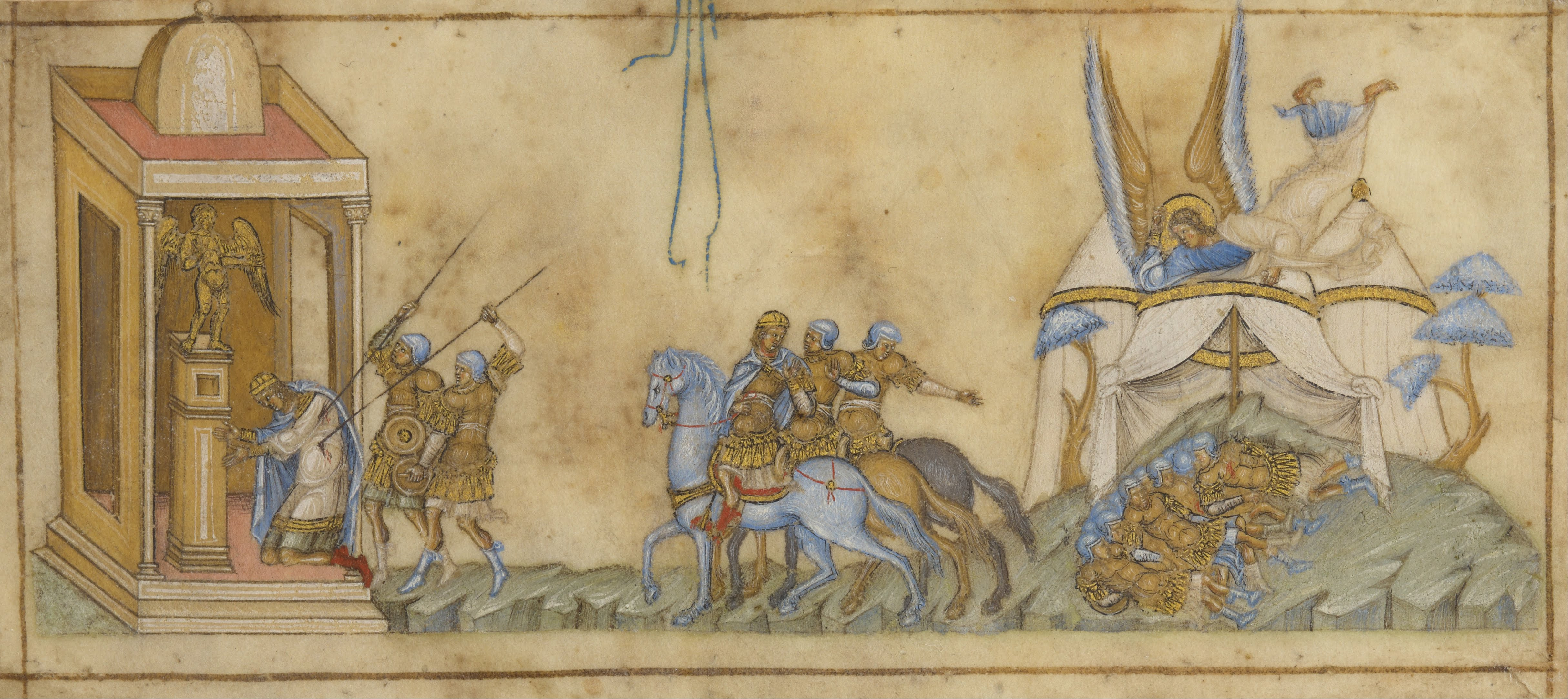
The next morning when light dawns, the Assyrian army were all laying dead.

The Assyrians had actually divided their army to conquer two different cities. King Sennacherib was laying siege to Lachish while his field commander was laying siege to Jerusalem. Isaiah records that when Sennacherib hears of the mysterious death of his forces at Jerusalem he withdraws from the region and heads home.

This morning I’m once again reminded not to place God in a box. I don’t completely understand why the Author of Life uses certain characters such as Nebuchadnezzar and Sennacherib in the plot line of the Great Story. I don’t understand why God miraculously delivers Jerusalem from Assyria and then allows Babylon to destroy it. It reminds me, however, to hold on loosely in judgement of current events on a grand scale. The Great Story is often a thriller with unexpected plot twists. Just ask the Assyrian field commander.

Words That Reach to What Was, and Is, and Yet Will Be

How you have fallen from heaven,
    morning star, son of the dawn!
You have been cast down to the earth,
    you who once laid low the nations!
You said in your heart,
    “I will ascend to the heavens;
I will raise my throne
    above the stars of God;
I will sit enthroned on the mount of assembly,
    on the utmost heights of Mount Zaphon.
I will ascend above the tops of the clouds;
    I will make myself like the Most High.”
But you are brought down to the realm of the dead,
    to the depths of the pit.
Isaiah 14:12-15 (NIV)

The language of God is metaphor, and metaphors (e.g. word pictures) are layered with meaning. That’s what makes them so powerful as a tools of communication. Their meaning resonates far deeper and reaches much further. Metaphors are layered with meaning. Like God, you keep mining the depths only to find there is more there than you ever realized before.

That is often what makes the words of the ancient prophets both confusing and powerful. Take the words from today’s chapter pasted above as an example.

Let’s start with the first layer of meaning: Isaiah’s prophecy concerning Babylon. Babylon was an aspiring superpower and becoming the largest city on Earth. Babylon was swallowing up peoples and territories. Babylon was swelling with pride at its greatness. One day its king, Nebuchadnezzar, would literally fulfill the sentiments cited by Isaiah (Read Daniel 4).

But let’s also go back in time and remember the root of Babyl-on. Think Babel. The story in Genesis 11. The people said, “Let’s make a city with a tower that reaches to the heavens and make a name for ourselves.” It’s the same root of pride. The same sentiment.

Let’s go back further to the Garden, where the serpent tempted Eve and Adam with the notion that they could eat the fruit and “be like God.”

Many commentators have said that Isaiah’s prophecy reaches further back and refers to Satan, or Lucifer, who tradition tell us was God’s most beautiful angel. Lucifer wanted to be like God and was cast from heaven to inhabit death. Again, the sentiment is the same. Wanting to ascend to the place of God. The same sentiment with which he tempted Adam and Eve.

Think forward to the prophecies of John in Revelation, in which he sees a woman, “Babylon the Great,” sitting on a beast covered in blasphemies.

Things that were. Things that are. Things that yet will be. The thread is the same: that which sets itself to ascend in its pride and become God, therefore diminishing God of all that God is (and was, and is to come).

And that’s where my heart settles in its meditation this morning. Where do the seeds and fruit of pride – those same seeds of Lucifer, of Adam, of Nebuchadnezzar, and of Babylon – show their roots in my heart and life? In what ways do I seek to be god of my life, my relationships, my spouse, my children, my business, my house, my possessions? Where does my pride ascend in thinking I create, conquer, possess, control, and/or dominate?

In what ways do I, in contrast to John the Baptist, seek to become more and make Jesus less?

Isaiah was writing about the nation of Babylon, but his word picture is layered with so much more meaning. His word picture stretches back before creation. It stretches forward to that which yet will be. It stretches forward in time to this morning, in this place, at this moment and ask this person to contemplate both the evidence of my pride, and my desperate need to seek humility.