Tag Archives: Focus

Finishing Well

…so I sent messengers to them with this reply: “I am carrying on a great project and cannot go down. Why should the work stop while I leave it and go down to you?”
Nehemiah 6:3 (NIV)

It’s Friday morning. Where did the week go? I confess that when I woke at 5:00 this morning to continue writing and moving my book project forward, I felt a strong desire to roll over. I’m finishing up the sixth of eight chapters in the manuscript. I can see the finish line. Sometimes the hardest part of a project is getting through the long slog in the middle. I’m feeling it.

I love it when I read the morning’s chapter and it’s as if God tailored it for this exact moment in time. As I waded into Nehemiah’s wall building project, I found him at exactly the same place I am. The wall is nearing completion. The doors and gates have yet to be placed and set, but the 2.5 mile long wall that was 40 feet tall and eight feet thick has been repaired and restored.

Jerusalem’s enemies have not given up on thwarting the project but they have switched tactics. Threats of attack didn’t work, so now they turn to deception. First they try to lure Nehemiah to a “meeting” under a false pretense of working out their differences. Next, they send a false messenger with a made up story hoping to lure Nehemiah into doing something they use as bad press against him.

Once again, Nehemiah displays characteristics that have made him the right man for this job and are the foundations of this projects success.

Focus. Nehemiah refuses to get distracted from the task at hand. We live at a time when endless distraction sits in the palm of our hand and is never more than an arm’s reach away. Nehemiah’s response to his detractors provides a great example for me to follow. “I’m focused on a great project! Why should I allow myself to be distracted? I find it interesting that they requested a meeting four times and four times he had to repeat himself. The temptations of distraction don’t go away. Dogged determination is required to stay focused.

Faith. Prayer has been ever present in Nehemiah’s story. Nehemiah was always talking to God, asking for God’s help, and affirming his trust in God’s strength and provision. In today’s chapter, Nehemiah’s popcorn prayer is a simple one I could bear to repeat like a mantra in my current long slog and in the midst of every challenging stretch of this earthly journey: “Now strengthen my hands.”

Finishing Well. By the end of today’s chapter, the wall is completed. Nehemiah’s focus and faith led to the wall being rebuilt in a miraculous 52 days. It’s one thing to start a wall; it’s another to complete it. Faithfulness isn’t measured by enthusiasm at the beginning but by integrity at the end.

I’m drawing inspiration and motivation from Nehemiah’s success in the quiet this morning. The finish line is still sitting out there on the horizon for my current project. Nevertheless, I’m glad I rolled out of bed this morning instead of rolling over. The slog continues. I need to stay focused.

“Now, Lord, strengthen my hands.”

If you know anyone who might be encouraged by today’s post, please share.

Promotional graphic for Tom Vander Well's Wayfarer blog and podcast, featuring icons of various podcast platforms with a photo of Tom Vander Well.
These chapter-a-day blog posts are also available via podcast on all major podcast platforms including Apple, Google, and Spotify! Simply go to your podcast platform and search for “Wayfarer Tom Vander Well.” If it’s not on your platform, please let me know!
An illustration of a person writing in a notebook, symbolizing creativity and commitment to a project.

Spiritual Senses

“For we live by faith, not by sight.”
2 Corinthians 5:7 (NIV)

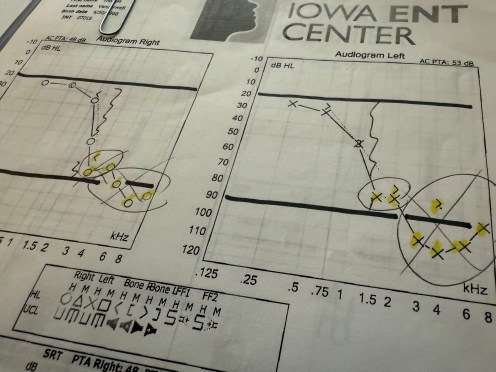
I have genetic hearing loss that is slowly and surely progressing as I age. Wendy and I play a daily game called, “Did He Hear Me or Not?” I’m really good at fooling her. I’m a trained actor. She always wins in the end, though. I eventually always ask her a question that she’s already answered just minutes before. Oops.

Over the years, I have prayed many times for healing. I have had multiple people approach me to ask if they could pray for my hearing to be restored. It has yet to happen this side of heaven.

I had a friend who recently asked me about my feelings regarding my diminished auditory capacities. As annoying as it is (and it is annoying for me and those who have to live with me), I have also pondered my physical hearing loss from a spiritual perspective. I think it might be very possible that as my physical hearing dulls my spiritual hearing becomes more sharpened. I answered my friend by telling him that if I had to choose between clearly hearing the world around me or clearly hearing God’s Spirit, I will choose God’s Spirit every time.

I recently got a pair of “smart glasses.” The technology is still relatively new and growing, but there are already devices on the market that translate what is said into closed captioning that appears on the inside lens of a pair of glasses. I’ve got my eye on this. It could eventually be a game changer for me.

In yesterday’s chapter, Paul told Jesus’ disciples in Corinth that he fixes his eyes not on what is seen but what is unseen. It is very much the same thing I’ve come to understand about hearing. There are physical senses and there are spiritual senses. Jesus taught that we should make it a priority to seek after God’s kingdom and store up treasure there. This requires having spiritual sight, and fixing my eyes on what is unseen.

In today’s chapter, Paul continues to riff on this metaphor. Throughout his letter, Paul references “other teachers” among the Corinthians who have been critical of Paul and his entourage. Paul describes these other teachers as ones who “peddle God’s word for profit” (2:17). Paul famously worked a day job wherever he went, plying his family’s tent-making trade, so that he wouldn’t be a financial burden on the local gathering of believers. Others, however, made the teaching circuit and demanded healthy compensation for teaching the local believers. In today’s chapter, he describes these individuals as those who “take pride in what is seen.”

Paul, however, says that he and his companions “live by faith, not sight.” His eyes are focused on what is unseen, trusting that God will take care of his daily physical needs. He suffers physical troubles as He travels and shares Jesus love and message, but he’s not worried about that. Yes, he groans under the burden of it, but he spiritually considers how temporary it is in comparison to the eternity awaiting him. The eyes of his spirit are fixed on the eternal, and it gives him a different perspective of what is physically seen and experienced.

As I ponder this in the quiet this morning, I am reminded that being a follower of Jesus can really be boiled down to this one simple metaphor. It’s the same question I ended with yesterday. It continues to resonate and reverberate in my soul this morning.

Earth or Heaven?
Physical or spiritual?
Temporal or eternal?

Will I live this temporal, physical life on earth today with spiritual senses fixed on Jesus’ eternal truth and the heavenly investment He asks me to make? Or, will I mindlessly be fixated on what I physically see, hear, crave, feel, and need?

My spiritual ears hear God’s Spirit urging me toward the former.

I think my physical ears hear Wendy in the kitchen starting to make breakfast, indicating it’s time to end this post.

I’m not sure, though. My physical hearing is always suspect. My spiritual hearing, however, always proves to be more accurate.

If you know anyone who might be encouraged by today’s post, please share.

These chapter-a-day blog posts are also available via podcast on all major podcast platforms including Apple, Google, and Spotify! Simply go to your podcast platform and search for “Wayfarer Tom Vander Well.” If it’s not on your platform, please let me know!

The Microscope & the Wide-Angle Lens

“He sent his servants to those who had been invited to the banquet to tell them to come, but they refused to come.”
Matthew 22:3 (NIV)

Along my journey, I have experienced many meetings in which what is really going on is not apparent to the casual observer or to those who might read a transcript of the meeting. What is really going on is happening in the sub-text of the words and the passive aggressive interplay between conflicting participants within the meeting. It happens in business. It happens in family. It happens in church. It happens in politics. It happens in community organizations. It’s part of any human system.

In Jerusalem, it is the biggest week of the year. It’s Passover week. The city is packed with Jewish pilgrims from all over the world who have come to celebrate the biggest festival of the year at the Temple, the epicenter of Judaism. Every day the courts of the Temple are packed with crowds. This year, everyone is buzzing about this preacher from the sticks, up north in Galilee. There was a big parade on Sunday when He came to town. Some say He’s the Messiah. He raised a guy from the dead just a week before in Bethany, just a few miles away.

This is the scene of today’s chapter and tomorrow’s. This is the final week of Jesus’ ministry. We’re in the home stretch and everything in these final chapters leads to the cross and the empty tomb. It’s important that I ponder all of the words and events of these next few chapters in this context to get at what is really going on. There is a conflict brewing between Jesus and the religious, political, and commercial power brokers in the Temple.

In today’s chapter, Matthew shares five episodes:

Jesus tells a parable that points a finger at the religious leaders and their ecclesiastical forebears throughout history. The parable is fascinating because it sums up the relationship between God and His people through the entire Great Story to this point, and it foreshadows what is about to happen as Jesus’ Message expands beyond the boundaries of Judaism and to all peoples and nations. What His enemies hear is Jesus’ sharp criticism. It is truth, but it is offensive. Jesus takes the opening round. His opponents are 0 and 1 and it prompts them to counter.

The next three episodes Matthew shares are different constituencies of Jesus’ enemies coming to debate Jesus and trap Him into saying something they can use to dismiss Him, criticize Him, and tell the crowds why He is wrong. Matthew is careful to point out that these constituencies, though rivals within the religious power structure, are working together behind the scenes against Jesus.

First, it’s the most popular and powerful political party within the religious power structure: the Pharisees. They try to play on people’s hatred of Rome and Roman taxes. They ask Jesus about paying taxes. Jesus famously asks whose head is on the coin and then says, “Give to Caesar what is Caesar’s, and to God what is God’s.” Ouch 0-2.

Next, it’s the rival political party in the religious power structure: the Sadducees. They are a smaller faction, but the High Priest is from this faction. It’s the old guard, the conservatives, who wield power and hang their hats on a religious belief that there is no life after death. They try to trap Jesus in a doctrinal debate about resurrection. Jesus responds with a scriptural argument for which they have no answers. His rivals are now 0-3.

Finally, they send a hot-shot lawyer to argue a legal matter of religious Law. Jesus handles the question easily.

Jesus deftly navigates every one of the their three (there’s that number again) argumentative mine fields. Adding on Jesus initial critical parable, His enemies are 0-4. They’re humiliated in front of the biggest crowds the Temple will see all year on their home court. They’re pissed off.

The chapter then ends with Jesus going back on the offensive. He refuses to let His enemies lick their wounds. He throws out a debate question of His own to which they have no good answer. They finish today’s chapter 0-5.

In the quiet this morning, I find myself reminded of my observation that most people take the episodes in any given chapter and focus on them individually. Even teachers and preachers do this regularly in messages. Just yesterday I gave the first of three weekly messages that I was assigned. Each week I’m assigned one episode from Luke’s version of Jesus’ story. It’s like looking at one of the five episodes in today’s chapter under a microscope to find the lesson within. There is a lesson there, of course. Metaphor is layered with meaning. For me, however, the most powerful spiritual lesson in today’s chapter is not under the microscope but in the wide-angle lens.

Jesus is touching on historic themes and realities that are rooted in Genesis, present in God’s relationship with the Hebrew people from Exodus through Malachi, and are foundational to the very conflict in which He’s engaged. The humiliating defeat is going to ramp up His opponent’s hatred of Jesus. Jesus is pushing all of their buttons.

Let me clue you in on tomorrow’s chapter. Jesus is not going to relent. He’s going to double-down.

He’s going to seal His own fate.

But there is something larger going on in today’s chapter that did begin in Genesis and will end with a new beginning at the end of Revelation. If I miss this, then I’m missing a major spiritual lesson. It is the spiritual lesson I find that I perpetually need on a Monday morning as I look at the task list for the coming week on my earthly journey. I can focus my spiritual microscope in on this week, this life, these current circumstances as if it’s the most important thing or the only thing. Or, I can look at this week with a wide-angle lens and understand that this week is part of a larger story of what God is doing in me in my life, and my story’s role in the larger story of what God is doing in the Great Story.

Suddenly, I see my week with a renewed perspective.

If you know anyone who might be encouraged by today’s post, please share.

These chapter-a-day blog posts are also available via podcast on all major podcast platforms including Apple, Google, and Spotify! Simply go to your podcast platform and search for “Wayfarer Tom Vander Well.” If it’s not on your platform, please let me know!

Focus

Focus (CaD 1 Chr 8) Wayfarer

Ner was the father of Kish, Kish the father of Saul, and Saul the father of Jonathan, Malki-Shua, Abinadab and Esh-Baal.
1 Chronicles 8:33 (NIV)

I often get asked if I play golf. Our house sits nestled in a neighborhood on a golf course with the clubhouse just a couple of blocks away, so it’s a natural question for people to ask. My answer is that I’m a once-a-year charity best-ball tournament golfer. My goal in this once-a-year charity best ball tournament is to have ONE of my shots over 18 holes be the “best ball” of our foursome. If I do that. I consider it a win.

I do know a lot of people who are avid golfers, and I know it can be addicting for some people. Along my life journey, I’ve met a person or two who were obsessed. It was all they talked about and it was where all of their time and money went. I remember one person whose marriage was on the rocks because his wife considered herself a “golf widow.” Yikes!

I’ve observed along life’s road that you can tell a lot about a person by observing where they invest their time and energy, and what they like to talk about.

In today’s chapter, the Chronicler turns his genealogical focus on the Hebrew tribe of Benjamin. What’s odd about this is that he already listed the tribe of Benjamin in yesterday’s chapter seven (7:6-12) squeezed between the tribes of Issachar and Naphtali. Now he circles back to give a much more extensive look at Benjamin. Why?

The Chronicler is sitting in the rebuilt Jerusalem where the rebuilt Temple stands. He is among many former citizens of the southern kingdom of Judah who have returned from exile in Babylon. As he writes this retrospective history of his people, he is trying to make sense of where he and his people stand at this moment of their Great Story and their relationship with God. We learn a lot about where his mind is focused based on where he spends his genealogical time and energy.

For example, the Chronicler chose to begin his vast genealogical research focused on the tribe of Judah, even though Judah was the fourth oldest of Jacob’s sons. Judah was the largest tribe, made up the majority of the southern kingdom of Judah, and was the tribe from which King David came. He now focuses on Benjamin because when the kingdom split into the northern kingdom of Israel and the southern kingdom of Judah, the tribe of Benjamin stuck with Judah. It was from the tribe of Benjamin that Israel’s first king, Saul, emerged as well as Saul’s son Jonathan who played a large role in David’s story as David’s best friend. Many of the exiles returning from Babylon were from the tribe of Benjamin, perhaps even the Chronicler himself.

In the quiet this morning, I find myself meditating on focus. I’m not an obsessed golfer, but that’s not to say I don’t have other obsessions. I still make daily choices about where I spend my time, attention, and resources. What are they? What do they reflect about me and my life priorities?

If you know anyone who might be encouraged by today’s post, please share.

Prisoner of Whom?

For this reason I, Paul, the prisoner of Christ Jesus for the sake of you Gentiles….
Ephesians 3:1 (NIV)

One’s perspective makes all the difference.

Having just journeyed through the season of Lent, I was reminded time and time again that Jesus’ betrayal, arrest, suffering and execution had been predicted. Jesus knew what was going to happen, and He made it clear to His followers. Despite this foreknowledge of what was to happen, Luke writes the Jesus “Jesus resolutely set out for Jerusalem.” (9:51)

Jesus wasn’t the victim. He was driving the events that happened. He was on a mission.

As I’ve been studying the events surrounding Paul in the Book of Acts, there is a very clear parallel to Jesus’ story. Paul was a citizen of Rome. It was a rare status that afforded him all sorts of privileges. When Paul was arrested and put on trial, he could have easily gotten off. Instead he appealed his case to Caesar assuring that he would be taken prisoner to Rome. As he waited for his trial before the leader of the Roman Empire, he wrote letters. Ephesians is one of them.

I couldn’t help but notice in today’s chapter that Paul doesn’t call  himself a “prisoner of Rome,” but rather a “prisoner of Christ Jesus.” Paul, like Jesus whom he followed, does not see himself as a victim of circumstances, but a servant of Christ. He’s not a victim. He’s on a mission. There is no moaning about his imprisonment. He tells the believers in Ephesus not to be discouraged by his sufferings. The entire chapter is focused on God’s eternal, cosmic, Spirit-ual, Level 4 power:

  • God’s grace given me through the working of his power” (vs. 7)
  • boundless riches of Christ” (vs. 8)
  • God, who created all things” (vs. 9)
  • the manifold wisdom of God” (vs. 10)
  • “[God] from whom every family in heaven and on earth derives its name” (vs. 15)
  • out of his glorious riches he may strengthen you with power through his Spirit” (vs. 16)
  • how wide and long and high and deep is the love of Christ” (vs. 18)
  • this love that surpasses knowledge” (vs. 19)
  • him who is able to do immeasurably more than all we ask or imagine, according to his power that is at work within us” (vs. 20)

This morning in the quiet I’m thinking about the perspective with which I approach my own circumstances. Am I walking this life journey as a person who happens to claim to be a follower of Jesus but then lives my life as if I’m a victim of random earthly circumstance? Or, am I on a mission, as well? Like Jesus, like Paul, is my faith-journey propelling me to a larger purpose and mission rooted in Level 4 power and purpose?

Your mission, should you choose to accept it….”

The Implosion of Evil

The Ammonites and Moabites rose up against the men from Mount Seir to destroy and annihilate them. After they finished slaughtering the men from Seir, they helped to destroy one another. When the men of Judah came to the place that overlooks the desert and looked toward the vast army, they saw only dead bodies lying on the ground; no one had escaped.
2 Chronicles 20:23-34 (NIV)

In our modern, twenty-first century enlightened world we rarely talk about the nature of evil. I find that, even among those who are followers of Jesus, there is a reticence to even think of the concept of evil. Jesus quite regularly referenced evil. The word or variation is used seven times in Jesus’ Sermon on the Mount.

Over the years Wendy and I have noticed a theme among epic stories regarding the nature of evil: evil eventually destroys itself from within. Sometimes, left to itself, evil naturally implodes. Tolkien used this device multiple times in his stories and it came to mind this morning as I read today’s chapter. As Merry and Pippin are captives of the Orcs it is an internal fight between factions of Orcs and Grishnakh’s lust that ultimately allow for their escape. Likewise, as Frodo and Sam attempt steal their way into Mordor through the stronghold of Cirith Ungol, a massive fight between two companies of Orcs destroy one another and allow the Hobbits to escape.

In today’s chapter we find a similar story from Judah’s history. A coalition of enemy armies are gathered to march against Judah and Jerusalem. King Jehoshaphat assembles all the people to seek the Lord. They pray, they fast, they humble themselves. God speaks through the prophet that the battle belongs to God and He will deliver. The people respond in praise. The coalition of enemy armies turn on each other and destroy one another so that when the army of Judah arrives, they find a field of dead bodies.

This morning in the quiet as I mull these things over I’m reminded of C.S. Lewis’ admonishment about the two mistakes one can make about the exploration of evil. One, he said, is to ignore it. The second is to get too deep and take it too seriously. The people of Judah didn’t ignore the threat facing them but focused their energies on seeking after God, trusting, and following. Before the threat could become a battle, the evil had imploded within. I never want to be naive, ignorant, or blind to the reality of evil that exists in our world. Neither do I want to give into fear or be overwhelmed by it:

This is what the Lord says to you: ‘Do not be afraid or discouraged because of this vast army. For the battle is not yours, but God’s.

Once in a While, I’ve Gotta Stop Looking at my Feet

“Announce and proclaim among the nations,
    lift up a banner and proclaim it;
    keep nothing back, but say,
‘Babylon will be captured;”
Jeremiah 50:2a (NIV)

Just yesterday I read an article about living in the later stretches of life’s journey. A few years ago I would have simply passed that article by. All of a sudden, it seems more relevant.

When I was a young man, I remember our (somewhat) annual family gatherings at the lake. I would never have imagined during that stage of the journey that my folks would buy a place here, that I would eventually own it, and what life would be like spending chunks of each summer living, working, and hosting family and friends here. In those days, I was just trying to get through each day and living week-by-week. I gave little thought to anything beyond the stretch of the journey I was in at that moment. My eyes were focused on my feet as I put one foot in front of the other.

Today’s chapter of Jeremiah’s prophetic anthology is a fascinating. For most of the 50 chapters through which we’ve waded, the nation of Babylon and King Nebuchadnezzar have been prophetically revealed as “God’s servant” gobbling up both Judah and the surrounding nations. Now, Jeremiah’s vision extends further down life’s road when Babylon will be defeated and suffer the same treatment they’ve dished out for years. At that time, the remnant of God’s people will return to their land. Jeremiah looks beyond the next chapter of the story to the subsequent chapters and the events in the plot line.

As a young man I had experienced relatively little of Life’s journey. Without the perspective that comes from experience, I found myself myopically focused on the day-to-day and the next milestone in view. The further I progressed and experienced more and more distinct stages of life, the more capable I’ve become at looking ahead. I can see past today. I can look past the next milestone. I can begin to envision that there’s not only a new chapter of life after this one, but also another one after that, and one after that. It doesn’t mean that I worry about the future, mind you. As Jesus reminded us in yesterday’s post, those tomorrows will take care of themselves. It is what it is. What will be will be. It does, however, give my today some much needed perspective.

This morning I’m reminded of a few specific stages of Life’s road that I thought would never end. There have been stages which required so much thought, energy, emotional, and spiritual resources that I couldn’t see beyond them. I can imagine that those taken captive by Nebuchadnezzar and hauled off to Babylon felt that way in the midst of their exile. But Jeremiah’s message in today’s chapter stood as a reminder that there’s more to the story. Past this chapter of the story is another chapter, and then another, and another.

I can’t always see what lies ahead on Life’s road, but I’ve learned that it’s wise to stop looking at my feet from time to time. One in a while I need to look up, look out, and search the horizon. I can’t see clearly what’s coming, but I need the reminder that there’s more to the story. I will get there.

As for today? Press on.

Driven to Distraction

They sent to me four times in this way, and I answered them in the same manner.
Nehemiah 6:4 (NRSV)

For the last couple of years our local gathering of Jesus’ followers have been encouraged to pray about and choose a word that will be a theme for their year. My word for this year is “focus.”

Focus has been an interesting theme as I celebrate my half-century in this life journey, as an empty nest offers increased margins of time and resources, and as I am meditating on the reality of being on the downhill side of this life journey. I am ever and increasingly mindful that while my margins may have expanded in the micro sense, in the macro sense I am working with slowly depleting resources of time and energy.

We’re now almost half-way through the year and I’ve been spending some moments meditating on how my focus is going.  I have to confess that it’s not good. As I think about how I need and desire to focus my time, energy, and resources I find that life serves up a never-ending stream of distractions. I am so easily distracted in a million different ways. Between social media, technology, entertainment, television, games and events there is an endless supply of good and fascinating things on which I can focus my time and attention.

In today’s chapter, Nehemiah is desperately trying to focus on the project he’s been called to complete. He wants to get the wall rebuilt and the gates in place. He’s close to having the job done. Now, he is repeatedly harassed by critics and enemies who want to meet with him. He’s attacked with slander and gossip which requires him to address the lies and rumors. His life is threatened and he’s urged to sequester himself in the temple to be safe. Distractions. Distractions. Distractions.

Nehemiah’s response to these distractions was consistent. First, he took everything to God. He prayed for the work on which he needed to focus, and asked for God’s strength. He handed his troubles and enemies over to God and relegated justice to higher authority. And, he stayed focused on the work.

At the end of today’s chapter:

So the wall was finished on the twenty-fifth day of the month Elul, in fifty-two days. And when all our enemies heard of it, all the nations around us were afraid and fell greatly in their own esteem; for they perceived that this work had been accomplished with the help of our God.

Today, I’m thinking again about my focus. The great thing about having a theme or a goal is that it becomes a point of reference. I may get off course or distracted, but simply having “focus” as my word of the year keeps calling me back from distraction. I can’t do anything about what’s past, but I have a new day, a clean day in front of me. And, on June 21 in Iowa, it’s a long day.

Time to focus.

Flexibly Staying the Course

And Joshua said to them, “Do not be afraid or dismayed; be strong and courageous; for thus the Lord will do to all the enemies against whom you fight.”
Joshua 10:25 (NRSV)

Just the other night Wendy and I were with some friends and we recounted a period of time when we all worshiped together in the same church service. During this particular period of time the leaders loved having a catch phrase or motto that would be touted as the theme of whatever new initiative happened to spring into the leaders’ heads. There would be banners and bookmarks and an official launch of the great new theme. And, it would last for a mere few weeks until the next great theme came a long. There was a lot of laughter around the table as we recounted a number of themes and catch phrases that had been raised and then abandoned shortly thereafter when the next “it” theme came along.

In today’s chapter, I found it fascinating to find Joshua still clinging to the word God had given him back in the first chapter. “Be strong and courageous. Don’t be afraid or discouraged.” We’re ten chapters and several battles (both won and lost) into the story. Joshua’s theme, however, has not changed with the winds of war or shifting sands of the landscape. In fact, Joshua makes a point of ensuring that  the theme is not forgotten. He takes the opportunity of victory to call the nation together and remind them to keep focused on that which God had said to him from the beginning.

Today I’m thinking about the challenge of staying the course amidst a culture of social media, news media, web content and trending topics that reduce our attention spans to mere moments. As a leader in family, business, church and community I’m thinking about my role in helping groups and individuals remain focused on vision, values, goals, and objectives. Like Joshua, I want to hold course to the vision, even while I remain flexible in adapting to ever-changing circumstances around me.

chapter a day banner 2015

Doom and Gloom from Zeph to CBS

“That day will be a day of wrath,
    a day of distress and anguish,
a day of ruin and devastation,
    a day of darkness and gloom,
a day of clouds and thick darkness….”
Zephaniah 1:15 (NRSV)

Wendy and I start most mornings with coffee, breakfast and the newspaper. We read through the news and discuss world events. We  talk about the elections and the latest prognostications from modern-day prophets on the editorial pages. More often than not we  chuckle at the horror, the doom, and the gloom that we find there.

There is something innately human about the way we flock to bad news. News outlets know that we, like lemmings, will be drawn and to blood (10 Dead in Latest Rampage) and fear (Study Shows Water Will Kill You). Publications on the left know that their readers are motivated by fear of the right (Ted Cruz Wants to Arm Babies!) and publications on the right know that readers are motivated by fear of the left (Hillary’s Secret E-mails Gave ISIS Our Nuclear Protocols!). What’s more, fear sells papers and draws viewers which generate advertising dollars. And fear creates lucrative financial opportunities (Do Cell Phones Breed Brain Worms? Congress Earmarks Funds for Research).

Be afraid. Be very, very afraid.

The ancient prophets were also doom and gloom-ers. Read today’s chapter and it’s enough to motivate a call to your physician for a prescription of Zoloft. The scenes of devastation that Zephaniah pictures are horrific, much like the scenes of devastation described by CBS Sunday Morning this past Sunday in their predictions of the earthquake,  “The Big One,” that will someday hit the Pacific northwest.

The thing is, there is truth in the doom and gloom. Read the historic accounts of Judah’s siege and devastating defeat to the Babylonians and all of a sudden Zephaniah seems fairly prescient. When you think about 15,000 dead in the Japanese earthquake and tsunami five years ago, the predictive doom and gloom for Seattle and Portland become more than mere yellow journalism.

History is full of tragedy, destruction, war, famine, suffering, and death. It has always been part of the human experience and it always  will. The question is not whether bad things will happen but how I will respond when they do. I can obsess in fear about what might happen in the future, or I can be wise in how I walk life’s journey on this day. I can choose to focus on anxiety-producing “what ifs” regarding tomorrow, or I can choose to focus on being a person of love, joy, peace, patience, and kindness today.

This morning, on this day, I am focused on Jesus’ words:

“Give your entire attention to what God is doing right now, and don’t get worked up about what may or may not happen tomorrow. God will help you deal with whatever hard things come up when the time comes.” Matthew 6:34 (MSG)