Tag Archives: Hearing

Spiritual Senses

“For we live by faith, not by sight.”
2 Corinthians 5:7 (NIV)

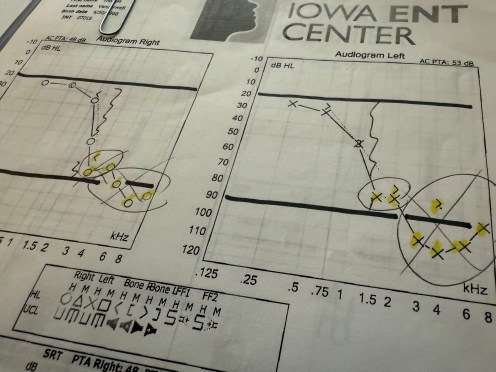
I have genetic hearing loss that is slowly and surely progressing as I age. Wendy and I play a daily game called, “Did He Hear Me or Not?” I’m really good at fooling her. I’m a trained actor. She always wins in the end, though. I eventually always ask her a question that she’s already answered just minutes before. Oops.

Over the years, I have prayed many times for healing. I have had multiple people approach me to ask if they could pray for my hearing to be restored. It has yet to happen this side of heaven.

I had a friend who recently asked me about my feelings regarding my diminished auditory capacities. As annoying as it is (and it is annoying for me and those who have to live with me), I have also pondered my physical hearing loss from a spiritual perspective. I think it might be very possible that as my physical hearing dulls my spiritual hearing becomes more sharpened. I answered my friend by telling him that if I had to choose between clearly hearing the world around me or clearly hearing God’s Spirit, I will choose God’s Spirit every time.

I recently got a pair of “smart glasses.” The technology is still relatively new and growing, but there are already devices on the market that translate what is said into closed captioning that appears on the inside lens of a pair of glasses. I’ve got my eye on this. It could eventually be a game changer for me.

In yesterday’s chapter, Paul told Jesus’ disciples in Corinth that he fixes his eyes not on what is seen but what is unseen. It is very much the same thing I’ve come to understand about hearing. There are physical senses and there are spiritual senses. Jesus taught that we should make it a priority to seek after God’s kingdom and store up treasure there. This requires having spiritual sight, and fixing my eyes on what is unseen.

In today’s chapter, Paul continues to riff on this metaphor. Throughout his letter, Paul references “other teachers” among the Corinthians who have been critical of Paul and his entourage. Paul describes these other teachers as ones who “peddle God’s word for profit” (2:17). Paul famously worked a day job wherever he went, plying his family’s tent-making trade, so that he wouldn’t be a financial burden on the local gathering of believers. Others, however, made the teaching circuit and demanded healthy compensation for teaching the local believers. In today’s chapter, he describes these individuals as those who “take pride in what is seen.”

Paul, however, says that he and his companions “live by faith, not sight.” His eyes are focused on what is unseen, trusting that God will take care of his daily physical needs. He suffers physical troubles as He travels and shares Jesus love and message, but he’s not worried about that. Yes, he groans under the burden of it, but he spiritually considers how temporary it is in comparison to the eternity awaiting him. The eyes of his spirit are fixed on the eternal, and it gives him a different perspective of what is physically seen and experienced.

As I ponder this in the quiet this morning, I am reminded that being a follower of Jesus can really be boiled down to this one simple metaphor. It’s the same question I ended with yesterday. It continues to resonate and reverberate in my soul this morning.

Earth or Heaven?
Physical or spiritual?
Temporal or eternal?

Will I live this temporal, physical life on earth today with spiritual senses fixed on Jesus’ eternal truth and the heavenly investment He asks me to make? Or, will I mindlessly be fixated on what I physically see, hear, crave, feel, and need?

My spiritual ears hear God’s Spirit urging me toward the former.

I think my physical ears hear Wendy in the kitchen starting to make breakfast, indicating it’s time to end this post.

I’m not sure, though. My physical hearing is always suspect. My spiritual hearing, however, always proves to be more accurate.

If you know anyone who might be encouraged by today’s post, please share.

These chapter-a-day blog posts are also available via podcast on all major podcast platforms including Apple, Google, and Spotify! Simply go to your podcast platform and search for “Wayfarer Tom Vander Well.” If it’s not on your platform, please let me know!

God’s Base Language

God’s Base Language (CaD Mrk 8) Wayfarer

Aware of their discussion, Jesus asked them: “Why are you talking about having no bread? Do you still not see or understand? Are your hearts hardened? Do you have eyes but fail to see, and ears but fail to hear?
Mark 8:17-18 (NIV)

I’ve recently begun listening to a brilliant and fascinating podcast series about what “mountains” represent throughout the Great Story. It reminds me a lot of three messages I gave a year or so ago as part of a series exploring the seven “I Am” statements that Jesus made (e.g. “I am the gate,” “I am the bread of life,” “I am the resurrection and the life”). With each of those messages, I unpacked that the metaphors Jesus was using (bread, gate, resurrection) were metaphors that are woven throughout the entire Great Story from Genesis to Revelation. To understand the power and completeness of what Jesus was claiming with those statements, I have to understand each metaphor in the context of the entire Great Story.

Those who have followed this blog for any length of time are probably sick of me saying this, but God’s base language is metaphor. A metaphor is simply something that represents something else. In his letter to the followers of Jesus in Rome, Paul explains that creation itself is a metaphor of who God is, it is an expression of God’s very person. How often did Jesus use creation and every day pieces of life as a teaching device? Mustard seeds, weather, pearls, sheep, sons, gates, shepherds, wine, debt, and bread.

In today’s chapter, Jesus makes a simple statement to His disciples in telling them to watch out for the “yeast” of the Pharisees and of Herod. Remember, it’s become plain to the disciples through their recent experiences that the Pharisees are actively working against Jesus, and they all know that Herod had recently executed Jesus’ cousin, John the Baptist, at the whim of his step-daughter. The disciples, however, are perplexed. They think Jesus’ is somehow upset with them for forgetting to buy enough bread for their cruise across the Sea of Galilee.

I picture Jesus rolling His eyes and slapping His forehead in frustration.

These are good Jewish boys who have been brought up in the Hebrew tradition and learning the Law of Moses. The Law of Moses is repeatedly clear about eating unleavened bread, bread made without yeast. It’s an important part of the most important ritual in the Jewish tradition: the Passover seder. Jesus had also used yeast in His teaching. Why?

It’s so simple it’s profound. Anyone who has baked bread knows that you take this tiny amount of yeast in order to get a large amount of dough to rise. I get it that most readers today may have never baked bread, but for Jesus and the disciples, the act of baking bread was as daily a routine as brewing coffee or tea is today. They all knew the concept that a little bit of yeast spreads to a whole lot of dough. So, the “yeast” of the Pharisees and of Herod was their hard hearts, their refusal to repent, their clinging to the things of this world like wealth and power, and the resulting outcomes of each of their forms of evil. It was the same evil but wore the different cloaks of human government and religion.

The disciples were struggling to understand that to get at who God is and what God is about, one must learn and know God’s base language of metaphor.

In the quiet this morning, I’m grateful for the dawn of this new day, which is a daily metaphor of resurrection. I’m also grateful for my warm office and my Pella windows as I hear the icy winter wind howling against them right behind me, which is a metaphor of God’s provision and protection. That icy wind of winter is an annual metaphor of death which is a natural part of life, what Jesus called me to in today’s chapter, and what physically awaits me at the end of this earthly journey. Along this life journey, I’ve learned that God is speaking to me everywhere, every day, through every thing. It’s all connected. I just had to learn to hear and interpret the language God speaks everywhere, every day, at all times.

If you know anyone who might be encouraged by today’s post, please share.

These chapter-a-day blog posts are also available via podcast on all major podcast platforms including Apple, Google, and Spotify! Simply go to your podcast platform and search for “Wayfarer Tom Vander Well.” If it’s not on your platform, please let me know!

Seeing and Believing

Seeing and Believing (CaD Jhn 9) Wayfarer

Jesus said, “For judgment I have come into this world, so that the blind will see and those who see will become blind.”
John 9:39 (NIV)

A few weeks ago there was a congressional hearing regarding prejudice, specifically anti-semitism, on college campuses. The Presidents of three elite universities were asked simple, direct questions. Their responses were evasive, murky, and unclear. Two of the three resigned in subsequent weeks.

These events came to mind today as I read today’s chapter. This is the third chapter in a row in which John gives witness to the rising conflict between the religious leaders in Jerusalem and Jesus. The religious leaders were elite, educated, and wealthy. They occupied the highest rung of their society. Jesus was a sharp contrast. Jesus had no formal or elite education in the established educational system. Jesus was not wealthy, and He depended on the generosity of others to fund His traveling ministry. Jesus lived and operated in the rural, backwater regions of the country.

John carefully chose the healing of a blind man as one of the seven miracles, or “signs” as he chooses to call them, as it fits perfectly with the narrative on multiple levels. In the previous chapter, Jesus refers to Himself as “the Light of the World” multiple times. As if to literally prove His point, today’s chapter begins with Jesus healing a man who had been blind since birth. Out of the darkness of his blindness, the man can see for the first time in his life.

This event led to three hearings before the elite, educated, powerful religious leaders. The first was with the former blind man himself who recounted the event of his healing. There is division among the religious leaders. Some are entrenched in their fundamentalist belief that the fact Jesus performed this miracle on the Sabbath (the religious “day of rest”) negates the “godliness” of the miracle. Others argue that the very act of giving sight to a man born blind can only come from God.

Then, something fascinating happens. These educated elites ask the formerly blind beggar his opinion, but they aren’t happy when the man proclaims Jesus a prophet. Some of the religious leaders are so adamant in their disbelief of Jesus that they choose to believe that the blind man is lying about being blind since birth.

Hearing number two is with the blind man’s parents. John records that they are “afraid” of the religious leaders and the power these elites have to excommunicate them from the synagogue and socially ostracize them. This is another clear indicator of toxic fundamentalism. The elite few at the top of the food chain use power and fear to control the masses. In this instance, the parents testify that their son was born blind, but when it comes to his healing and his testimony about Jesus, the parents know the narrative their overseers want to hear. They deftly plead the fifth and deflect to their adult son.

The blind man is called back before the leaders for the second time. It’s classic. The dumb, poor beggar responds to the repeated questions with wisdom and reason. He makes the leaders look foolish in the mental gymnastics they are exercising to justify their unbelief. The result is what one might expect from humiliated fundamentalist elites. They insulted him, threatened him, and threw him out.

John then records that Jesus introduces himself to the formerly blind man. The man proclaims his personal belief that Jesus was the Son of Man, and he worships Jesus. Jesus then proclaims that He came “so that the blind will see and those who see will become blind.”

A couple of thoughts in the quiet this morning. First, I love the progression of the formerly blind man’s faith. He begins not knowing who Jesus was or who healed him. He then calls Jesus a man, then progresses to calling Jesus a prophet. Finally, he meets Jesus personally and places his faith in Jesus as the Messiah and worships Him. Healing the man’s physical blindness led to the healing of his spiritual blindness. Jesus not only opened the man’s physical eyes, but his spiritual eyes as well. Which leads me to my second thought.

Along my spiritual journey, I have encountered religious, label-wearing Christians who I observed to be spiritually blind. I have also encountered individuals who claim no faith label but I observe that they clearly see the heart and Spirit of Jesus’ teaching. This is a constant reminder to me that every person is having their own conversations with Life and that God’s Spirit is perpetually at work to open the eyes of our spirits to see the Light of the World. Today’s chapter is a reminder that staunch, educated religious people can be spiritually blind while humble, uneducated and irreligious individuals can have spiritual sight that is 20/20.

A friend once asked me about my increasingly poor hearing. I told him that if my impaired physical hearing contributes to being able to hear spiritual things with greater clarity, I will always choose the latter.

If you know anyone who might be encouraged by today’s post, please share.

Spiritual Sight and Hearing


Spiritual Sight and Hearing (CaD 1 Sam 3) Wayfarer

The boy Samuel ministered before the Lord under Eli. In those days the word of the Lord was rare; there were not many visions.

One night Eli, whose eyes were becoming so weak that he could barely see, was lying down in his usual place. The lamp of God had not yet gone out, and Samuel was lying down in the house of the Lord, where the ark of God was.
1 Samuel 3:1-3 (NIV)

One day Jesus and his closest followers were along the lake shore. Jesus had just addressed a crowd of people who had come to hear Him speak. His message consisted of a string of parables. Afterward, His followers asked why He told parables. This was His reply:

“Because the knowledge of the secrets of the kingdom of heaven has been given to you, but not to them. Whoever has will be given more, and they will have an abundance. Whoever does not have, even what they have will be taken from them. This is why I speak to them in parables:

“Though seeing, they do not see;
    though hearing, they do not hear or understand.

In them is fulfilled the prophecy of Isaiah:

“‘You will be ever hearing but never understanding;
    you will be ever seeing but never perceiving.
For this people’s heart has become calloused;
    they hardly hear with their ears,
    and they have closed their eyes.
Otherwise they might see with their eyes,
    hear with their ears,
    understand with their hearts
and turn, and I would heal them.’

Jesus was clear about the fact that there are different kinds of seeing and hearing. The physical sense of sight is obvious, but Jesus spoke of spiritual sight and hearing, as well. Today’s chapter provides an illustration.

The author of Samuel begins today’s chapter with three subtle statements about vision:

In those days the word of the Lord was rare; there were not many visions.

Here he refers to spiritual visions, prophetic words, and dreams. From a historical timeline, we are at end of the time of the Judges. We just went through the book of Judges on this chapter-a-day journey last month. There were some great stories and lessons, but there was little evidence in the text of prophets, dreams, or spiritual visions. Spiritual vision waned after Moses and Joshua’s conquest.

Eli, whose eyes were becoming so weak that he could barely see. (Physical)

Next, the author immediately mentions the high priest, Eli’s, waning physical vision. Having just told of God’s judgment on Eli and his sons in yesterday’s chapter, this might also be a not-so-subtle foreshadowing that the light is going out on his time as high priest. It also serves as a contrast to the boy, Samuel, whose spiritual eyes are about to be opened.

The lamp of God had not yet gone out. (Metaphorical)

The final in the author’s trinity of word images is the lampstand that stood in the Holy Place of the Tabernacle. As the night wore on and morning approached the flame would dim, though it was unlawful to let it go out before dawn according to the Law of Moses. The author metaphorically tells me, as the reader, that while spiritual sight may have dimmed, it had not gone out. Samuel is about to have his spiritual eyes opened.

The trinity of images is followed by a trinity of instances in which Samuel’s spiritual ears are opened. He hears God calling his name, but he thinks it’s Eli. Once Eli tells Samuel that it’s God and how to respond to God’s call, God tells Sam that the prophesied doom on Eli and his house is about to come true.

For Eli and his sons, the Light is going out.

For Samuel, his spiritual ears and eyes have been opened. The Light has just dawned.

The author also makes an important observation between the second and third instances of God’s calling to Samuel:

Now Samuel did not yet know the Lord: The word of the Lord had not yet been revealed to him.

Along my spiritual journey, I have learned that spiritual hearing and spiritual sight require both God and me. There is a “revealing” that comes from God. Samuel had been raised in the Tabernacle. He was there day and night serving God and Eli, yet he “did not yet know the Lord” and God had not yet opened Samuel’s spiritual eyes and ears. In the same way, it is possible to go to church every Sunday, hear the message, and participate in the service without ever knowing the Lord or having spiritual eyes that see or spiritual ears that hear.

But Jesus said there’s also a part I play in this revealing. Jesus told His followers to ask, to seek, and to knock. My spiritual pursuit of God plays a part in the opening of my spiritual senses. When I ask I will receive. When I seek I will find. When I knock doors open to reveal things I hadn’t seen or heard before.

In the quiet this morning, I’m reminded of a friend who sat across my desk and asked me about the tinnitus and genetic hearing loss with which I’ve struggled for many years. I have asked for healing in prayer. I have sought the healing prayers of others, and I have had strangers approach me saying that they were led to pray for my ears to be healed. To this point, my prayers have not resulted in the restoration of my physical hearing.

My friend asked me how I felt about that.

I responded by explaining that I’m not certain that there isn’t a relationship between the physical and spiritual. As my physical hearing wanes, I feel that my spiritual hearing has become more acute. If I were to choose between the two, I’ll choose acute spiritual hearing every single time. I’ll continue to seek both and echo Eli’s response in today’s chapter: “He is the Lord; let him do what is good in his eyes.”

If you know anyone who might be encouraged by today’s post, please share.

Being Watchful

people in a mall

Devote yourselves to prayer, being watchful and thankful.
Colossians 4:2 (NIV)

Back in college I had an assignment for my Acting I class that took me to the local mall. The assignment was simply to watch people. Not just to merely look at them, but to really watch them. Acting is about creating believable characters on stage, so our assignment was to watch how real people walk. We were to observe how different people move and carry themselves. What are their quirks? How do they relate to other people.

I thought about that assignment as I read the admonition to be watchful in today’s chapter. I have found that people largely make their way through life’s journey unaware. People are neither observant nor considerate of others. I find people giving little thought to what is happening around them nor how they are engaged in what is happening.

Jesus was fond of saying, “They who have ears, let them hear.” The lesson is clear that there is a difference between merely hearing and really listening and understanding what is going on around you. We just finished going through the Book of Acts and it ended with Paul quoting the prophet Isaiah on this same subject:

“You will be ever hearing but never understanding;
    you will be ever seeing but never perceiving.”
For this people’s heart has become calloused;
    they hardly hear with their ears,
    and they have closed their eyes.

Today, I’m thankful for my education in theatre and the life lessons it provided, such learning to be watchful, observant, and considerate of what is happening around me. I am thinking about my progressive hearing loss, how each year the whole world sounds a little bit more like Charlie Brown’s teacher, and how important it is for me to consciously listen. I’m thinking about my need to be more watchful and aware of others, their circumstances, and their needs.

A lot of Words

source: disowned via Flickr

I too will have my say;
I too will tell what I know.
For I am full of words,
and the spirit within me compels me;
Job 32:17-18 (NIV)

Wendy and I often joke about the differences between men and women when it comes to words. I have heard it said, and perhaps it’s an old wives tale, that women have more words than men. Yet, I am reminded of Tolkien’s wisdom when he wrote, “Pay heed to the tales of old wives. It may well be that they alone keep in memory what it was once needful for the wise to know.” 

There are often nights, especially when I’ve been on the road for a week and Wendy has been sequestered along at home, that our heads hit the pillows yet a steady stream of conversation emanates from Wendy’s side of the bed. I quietly strain to maintain consciousness. Wendy will turn and see my struggle and laugh.

“Can you tell that I still have a lot of words?” she’ll ask.

I nod silently.

“But you’ve been gone all week and I haven’t had anyone to talk to!” she’ll exclaim as she cuddles in next to me.

Just the other night at a Christmas party, I realized that it’s not just a Mars and Venus issue. I have grown quieter in social settings over the years. When I was younger I had a lot more words. I was a steady stream of youthful conversation, wisdom, and diatribes. I speak less today than I did back then. I tend to ask more questions. I ponder more. I mull things over more in my head. Words are more precious to me than they used to be, and they carry more meaning for me. I am more mindful of wasting them.

In today’s chapter, we unexpectedly meet a devout young man named Elihu (his name means “He is my God”). Elihu has been waiting in the wings listening to Job and his three friends debate. The young man finally speaks, and he is honest when he says, “I am full of words.” We’re going to get five straight chapters of his youthful exuberance starting today.

Today, Elihu has me thinking about words. Despite my speaking less than I used, I still feel like I talk more than is good for myself or others. I’m pondering the wisdom of knowing when to speak and when to be silent. As we enter a week full of family and friends, I want to hear more and speak with purpose.

The Medium of the Message Matters


Woman of Tekoa before King David (source: wikipedia)

Now Joab son of Zeruiah perceived that the king’s mind was on Absalom. Joab sent to Tekoa and brought from there a wise woman. He said to her, “Pretend to be a mourner; put on mourning garments, do not anoint yourself with oil, but behave like a woman who has been mourning many days for the dead. Go to the king and speak to him as follows.” And Joab put the words into her mouth. 2 Samuel 14:1-3 (NSRV)

A few weeks ago, while Wendy and I were spending a few days at the lake, we watched the movie 12 Years a Slave. In case you’ve been hiding in a cave this past year and have not heard of it, the Academy Award winning movie is based on a book written during the abolition movement in America and is the autobiography of a free African American living in the north who was kidnapped, smuggled to the south and sold into slavery. His story was so powerful, and so powerfully told, that Wendy and I sat speechless on the couch as the credits rolled, tears streaking down our cheeks. Our hearts had been rent. It was, for me, a history lesson, a parable about the human condition, and a call to continue opening my eyes, my mouth, my pen and my wallet to address similar injustices that still exist in this world today.

One of the reasons I love the arts, and the dramatic arts in particular, is their ability to communicate spiritual truths and move people to action in a way that no other mode of communication does. During one of the final read-throughs of my script Ham Buns and Potato Salad before we went into production this last year one of the female readers, emotionally shaken by the story, exclaimed that we had better have counselors available at the back of the theatre because of the emotions and painful memories it might bring up for audience members. I was taken aback by her strong emotional response after simply being part of a table reading of the script. That’s the power of a story well told. As a writer, it gratified me to know that the story had effectively reached at least one person.

Today’s chapter is one that I studied in depth while pursuing my theatre degree in college. It is, arguably, the only story of acting told throughout the entirety of the Bible. Joab needed to get through to King David. Perhaps he’d seen how Nathan’s story of the rich man stealing the poor man’s only lamb had gotten through to the king. David couldn’t see his blind spot if you tried to reveal it to him plainly, but when you cloaked it in a metaphorical story, he could see his own situation clearly. Joab decides to hire an actor, costume her in mourning clothes, use a little make-up to make it look like she’d been grieving, and gave her a script to follow. She played the part brilliantly. What impresses me is that she took the part and nailed the role knowing that the King, once it was revealed that he’d been conned, could easily have ordered her death for tricking him.

I believe that we don’t give enough thought to how we communicate. Not only on a corporate level, but also on an interpersonal one. Most every human conflict can be traced back to a break down in communication. I believe equally that the hope of redemption and restoration hinges on our ability to communicate, not only clearly, but in multiple channels and mediums. By capably utilizing diverse mediums of communication we can reach each diverse audience member through a medium, perhaps the only medium, through which they can hear and receive the Message.

Enhanced by Zemanta

Chapter-a-Day Luke 9

Christ in the House of Martha and Mary
Image via Wikipedia

The apostles returned and reported on what they had done. Jesus took them away, off by themselves, near the town called Bethsaida. Luke 9:10 (MSG)

One time when Jesus was off praying by himself, his disciples nearby…. Luke 9:18a 9 (MSG)

About eight days after saying this, he climbed the mountain to pray…. Luke 9:28a (MSG)

Jesus often used the phrase “he who has ears, let him hear.”

Listen.
Be open.
Pay attention.
Keep your antennae up.

Earlier this year, I told Wendy that I wanted to be more intentional in spending time together in prayer. As we’ve spent hours in the car between home and the lake, I’ve attempted to prompt us to spend a little of that time praying together.

This past week my daughter Taylor and I were doing a study wrapped around the painting Christ in the House of Mary and Martha by Johannes Vermeer. In the course of our conversation, I once again felt the conviction to be less of a busy-Martha and more Mary-like in spending time with Jesus, sitting and listening and spending time in conversation.

Today, as I read the chapter I couldn’t help notice the recurring theme of Jesus getting away by himself to pray.

I find that lessons from God’s message are sometimes those things which are woven through the text; His callings then weave those lessons through life in a recurring theme. I’ve found that when God promps me, it often comes in whispers as a still-small voice, but we have to quiet our lives enough to hear them (and, if you’re like me, turning your hearing aid on helps, as well).

I hear you, God. I hear you.

Enhanced by Zemanta