Tag Archives: Loss

Spiritual Senses

“For we live by faith, not by sight.”
2 Corinthians 5:7 (NIV)

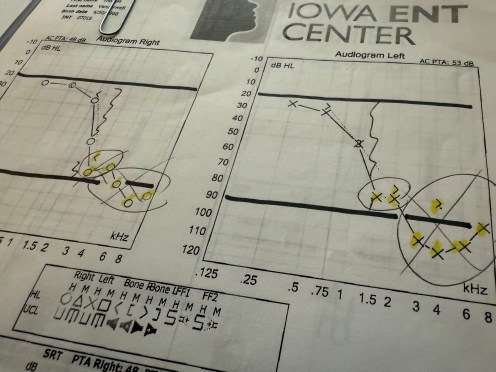
I have genetic hearing loss that is slowly and surely progressing as I age. Wendy and I play a daily game called, “Did He Hear Me or Not?” I’m really good at fooling her. I’m a trained actor. She always wins in the end, though. I eventually always ask her a question that she’s already answered just minutes before. Oops.

Over the years, I have prayed many times for healing. I have had multiple people approach me to ask if they could pray for my hearing to be restored. It has yet to happen this side of heaven.

I had a friend who recently asked me about my feelings regarding my diminished auditory capacities. As annoying as it is (and it is annoying for me and those who have to live with me), I have also pondered my physical hearing loss from a spiritual perspective. I think it might be very possible that as my physical hearing dulls my spiritual hearing becomes more sharpened. I answered my friend by telling him that if I had to choose between clearly hearing the world around me or clearly hearing God’s Spirit, I will choose God’s Spirit every time.

I recently got a pair of “smart glasses.” The technology is still relatively new and growing, but there are already devices on the market that translate what is said into closed captioning that appears on the inside lens of a pair of glasses. I’ve got my eye on this. It could eventually be a game changer for me.

In yesterday’s chapter, Paul told Jesus’ disciples in Corinth that he fixes his eyes not on what is seen but what is unseen. It is very much the same thing I’ve come to understand about hearing. There are physical senses and there are spiritual senses. Jesus taught that we should make it a priority to seek after God’s kingdom and store up treasure there. This requires having spiritual sight, and fixing my eyes on what is unseen.

In today’s chapter, Paul continues to riff on this metaphor. Throughout his letter, Paul references “other teachers” among the Corinthians who have been critical of Paul and his entourage. Paul describes these other teachers as ones who “peddle God’s word for profit” (2:17). Paul famously worked a day job wherever he went, plying his family’s tent-making trade, so that he wouldn’t be a financial burden on the local gathering of believers. Others, however, made the teaching circuit and demanded healthy compensation for teaching the local believers. In today’s chapter, he describes these individuals as those who “take pride in what is seen.”

Paul, however, says that he and his companions “live by faith, not sight.” His eyes are focused on what is unseen, trusting that God will take care of his daily physical needs. He suffers physical troubles as He travels and shares Jesus love and message, but he’s not worried about that. Yes, he groans under the burden of it, but he spiritually considers how temporary it is in comparison to the eternity awaiting him. The eyes of his spirit are fixed on the eternal, and it gives him a different perspective of what is physically seen and experienced.

As I ponder this in the quiet this morning, I am reminded that being a follower of Jesus can really be boiled down to this one simple metaphor. It’s the same question I ended with yesterday. It continues to resonate and reverberate in my soul this morning.

Earth or Heaven?
Physical or spiritual?
Temporal or eternal?

Will I live this temporal, physical life on earth today with spiritual senses fixed on Jesus’ eternal truth and the heavenly investment He asks me to make? Or, will I mindlessly be fixated on what I physically see, hear, crave, feel, and need?

My spiritual ears hear God’s Spirit urging me toward the former.

I think my physical ears hear Wendy in the kitchen starting to make breakfast, indicating it’s time to end this post.

I’m not sure, though. My physical hearing is always suspect. My spiritual hearing, however, always proves to be more accurate.

If you know anyone who might be encouraged by today’s post, please share.

These chapter-a-day blog posts are also available via podcast on all major podcast platforms including Apple, Google, and Spotify! Simply go to your podcast platform and search for “Wayfarer Tom Vander Well.” If it’s not on your platform, please let me know!

Taking the Loss

Taking the Loss (CaD 1 Cor 6) Wayfarer

The very fact that you have lawsuits among you means you have been completely defeated already. Why not rather be wronged? Why not rather be cheated?
1 Corinthians 6:7 (NIV)

John Sexton, former President of New York University, wrote a book that I have in my personal library entitled, Baseball as a Road to God. In the book, Sexton shares the many things that the game and spirituality share. This includes things like faith, doubt, miracles, conversion, and the sacred. I agree with him. There are many spiritual lessons to be learned from the game

Every year, each major league team has its ups and downs. Every team, even the best ones, occasionally end up on the wrong end of a blowout. The sting of getting shellacked often gives way to some much needed comic relief when managers reach the point where they don’t want to waste any of their pitchers arms in what they know is going to be a defeat. They take the loss and place an infielder or outfielder on the mound to do the best they can. It makes for some funny moments and match-ups.

For those who are highly competitive, this strategy just feels wrong. The truth is that it’s a very wise move. It’s about the proper use of energy and resources in a 162 game season. Some days it’s best to take the loss and save your bullpen for tomorrow.

I have also learned that I sometimes have to do the same thing in life. It particularly occurs when I’ve been wronged by another person. Believe me, I feel the anger, the hurt, and the desire for vengeance and justice. Along life’s road, I began to ask myself about the usefulness of all those negative emotions along with wisdom of spending my energy focused on the person who wronged me. Often, the wrong I experience is relatively petty and small in the grand scheme of life, and I have much better things to do with my time, energy, and resources. Sometimes forgiveness feels like I’m letting my enemy off the hook, when the truth is that it’s freeing me to use my thoughts, energy, and resources more productively.

For those who have a heightened sense of justice, this just feels wrong.

In today’s chapter, Paul addresses his fellow Jesus followers in Corinth who were experiencing all sorts of conflicts between one another. Some of them had even escalated to the point where believers were suing one another. He asks the same question: Why not rather be wronged? Why not rather be cheated? I can descend into anger, hatred, slander, and a lust for retribution, but all of those are character qualities Jesus teaches me to avoid at all costs. Choosing to switch the focus of my thoughts and energy towards ultimately more profitable, productive, and spiritually healthy pursuits is strategically the wise move. Life is a long season.

I’m reminded of two episodes in Jesus ministry. In one, the people of a town tell Jesus that they want nothing to do with Him. He and His followers were not welcome. In the other, Jesus’ disciples hear that someone who isn’t officially part of Jesus’ ministry was spreading Jesus’ teaching and even casting out demons. In both of these instances, Jesus’ disciples wanted to pursue their anger and indignation. They wanted Jesus to call down fire from heaven to burn up the town that rejected them. They wanted to go find that man who was doing their job without permission and tell him to cease and desist. In both episodes, Jesus told his disciples to let it go and take the loss. He had more important and more strategically productive ways to focus their time, energy, and resources.

In the quiet this morning, as I’ve meditated on these things, my mind has conjured up the names and faces of individuals who wronged me along life’s road. Some of them are distant memories. One or two are so recent that I still feel the internal struggle and the desire for justice and vengeance. I realize, however, that I have never regretted taking the loss with those former experiences and in fact it was the best decision for me in the long run. That helps me with the sting of my more recent experiences.

I’ve only got so much time, energy, and resources in my personal bullpen. I need to use them wisely. It’s a long season.

If you know anyone who might be encouraged by today’s post, please share.

These chapter-a-day blog posts are also available via podcast on all major podcast platforms including Apple, Google, and Spotify! Simply go to your podcast platform and search for “Wayfarer Tom Vander Well.” If it’s not on your platform, please let me know!

“Perhaps…”

"Perhaps…" (CaD Phm 1) Wayfarer

Perhaps the reason he was separated from you for a little while was that you might have him back forever— no longer as a slave, but better than a slave, as a dear brother.
Philemon 1:15-16 (NIV)

Just this morning I received an unexpected text from a friend asking Wendy and me to pray. Life has thrown one of those wicked curveballs and suddenly everything in life is reeling in ways that feel completely out of control. As I confessed in a poster a few days ago to having a pretty miserable week myself, I’m feeling acute empathy for my friend. Prayers have commenced for them.

When life throws a wicked curve, I always find myself asking some of the same questions:

“How did we get here?”

“Why is this happening?”

“God?! What are you doing? Don’t you care?!”

“Where is this going to lead?”

Today’s chapter is a letter that Paul wrote from prison to a wealthy friend and fellow believer. His name was Philemon (hence the title of the epistle), and he was a good friend of Paul’s, a financial supporter of Paul, and Paul had previously lived as a guest in Philemon’s home.

Philemon had a slave named Onesimus. Long story short, Onesimus stole from Philemon and made a run for freedom. While we don’t know the back story of the relationship between Onesimus and Philemon, I can assume that Onesimus’ actions amounted to throwing a wicked curveball at Philemon and his household. It would not surprise me if Philemon had written Onesimus off and harbored ill feelings towards him.

What happens next is amazing. The runaway Onesimus somehow runs right into Paul. How and why, we don’t know, but Paul graciously takes Onesimus under his wing, Onesimus becomes a believer, and Paul comes to consider the runaway his “son.”

This very tender letter is sent to Philemon in the very hands of the runaway, Onesimus. The runaway slave arrives at his former owner’s house, letter in hand. I can only imagine what emotions each of them was feeling at this reunion.

I love Paul’s letter when he communicates that perhaps there was a divine purpose in Onesimus running away. Perhaps that needed to happen so that he could run into Paul and become a believer, and ultimately bring about an unforeseen reunion, restoration, and a redemptive ending to an otherwise wicked curveball situation.

I have written many times in these posts about the Chain Reaction of Praise that Wendy and I have been practicing for years. In the heat of the moment when the curveball comes at us in what appears to be a total strikeout, we step away from the plate, take a deep breath and consciously move into “perhaps” mode. We may not see clearly, in that moment, how God might redeem our circumstances. It might even feel hopeless. But time and time again we have experienced God ultimately redeeming circumstances in ways we could never have imagined, and weaving purpose into our stories that were impossible to see when we were initially reeling in the circumstances.

In the quiet this morning, I find myself recounting all of the wicked curve balls life has thrown at me. I find myself remembering what it felt like in the moment, as well as the redemptive endings that eventually occurred in each one. In doing so, it reminds me that there is a “perhaps” to my miserable week. I just don’t see it yet.

Note to my regular readers, listeners, and subscribers!
I am taking a three week vacation starting next week. While I’m gone, I’m going to be republishing the top fifteen chapter-a-day posts from 2023 as determined by the total number of page views and podcast plays. We’ll start at number 15 next Monday and end up with number 1 on Friday, February 16. See you in a few weeks!

If you know anyone who might be encouraged by today’s post, please share.

Humiliating Defeat

Humiliating Defeat (CaD 2 Ki 14) Wayfarer

Jehoash king of Israel replied to Amaziah king of Judah: “You have indeed defeated Edom and now you are arrogant. Glory in your victory, but stay at home! Why ask for trouble and cause your own downfall and that of Judah also?”
2 Kings 14:9-10 (NIV)

There are certain things that one simply experiences and knows from growing up and living in Iowa. For example, there’s the sport of wrestling. For whatever reason, the sport of wrestling is a thing in our state. Our major universities have long histories of success in the sport, and they’ve produced some of the most dominant wrestlers in history.

When I was growing up, wrestling was part of the required P.E. curriculum in the Middle School years. When you’re the youngest of four children, that means that older siblings came home and taught what they’d learned. I had never really wrestled in any official capacity, but I knew a few things from what my siblings taught me. I remember being paired up with partners in P.E. class and whoever my partner was, I had a pretty easy time of it.

Then we were allowed to challenge others in the class while the entire class looked on. I chose to challenge one of my classmates who was about my size. I figured I would at least be able to hold my own. What I didn’t know is that the guy I chose was already an accomplished wrestler and would go on to be a formidable wrestler in high school. It took less than five seconds for him to pin me. It was total humiliation.

It’s funny the things that I remember, and that still come to mind, over forty years later. There have been moments along my life journey when I experienced humiliating defeats and crashes of different kinds. Moments of shame are hard for me to forget. They have definitely served a purpose, however.

In today’s chapter, King Amaziah of Judah finds himself flying high after defeating the army of Edom. Feeling good about his victory, he challenges the Kingdom of Israel to a battle. Jehoash, King of Israel, tells Amaziah to reconsider and gives him the opportunity to withdraw the challenge, but Amaziah will have none of it. It does not go well for him. It ended up a humiliating defeat and Amaziah’s own people eventually turned on him and killed him.

In yesterday’s post, I wrote about the seasons of life. In the ebb-and-flow of the journey, I have experienced seasons of victory in which I felt on top of the world. It’s easy for me to think I’m going to stay there or fly even higher. Eventually, life always hands me a loss.

I also wrote yesterday that I’ve learned to embrace every season for what it is. Seasons of loss, defeat, shame, or humiliation are good soil for growing faith, humility, perseverance, and proven character. The “mountain-top” soil isn’t suited to grow those things.

In the quiet this morning, I’m praying a word of gratitude for the defeats, losses, and humiliating moments along my life journey. They’ve taught me a lot, including when to be content with life’s victories and appreciate how transient they can be. I’m also saying a prayer for my classmate who humiliated me on the wrestling mat (Yes, Wendy, I still remember his name!). I hope he’s in a good place on his own life journey.

If you know anyone who might be encouraged by today’s post, please share.

Lamentations (Dec 2021)

Each photo below corresponds to the chapter-a-day post for the book of Lamentations published by Tom Vander Well in December of 2021. Click on the photo linked to each chapter to read the post.

Lamentations 1: Blue Christmas

Lamentations 2: How I Should Grieve!

Lamentations 3: “Yet This I Call to Mind”

Lamentations 4: It Stinks to Be Right

Lamentations 5: A Different Spirit of the Season

Of Rubble and Restoration

Of Rubble and Restoration (CaD Ps 126) Wayfarer

Those who sow with tears
    will reap with songs of joy.

Psalm 126:5 (NIV)

I had a great conversation recently with a gentleman who shared with me some of his life story. It read like a roller coaster of ups and downs in business from the luxuries of being at the helm of successful corporate ventures to the bitter pill of his own companies that failed terribly and lost him everything. As he reaches the twilight of his vocational journey, I observed a deep joy within him for all that he’d experienced and also deep wisdom sourced in the lessons of both successes and failures.

As I mulled over what he told me, it reminded me of my own dad who I observed navigating his own vocational highs and lows as I was growing up. There is so much I observed in my parents that I never fully appreciated until I was a husband and father trying to provide for my family and make my own way through vocational peaks and valleys. It’s in adulthood that I finally appreciated all of the joys of vocational success, all the anxieties of job changes, and all the pain of business failures.

Today’s chapter, Psalm 126, isn’t fully understood outside of the context of history. In 586 B.C. the Hebrew people had their own “lost everything” moment. Their nation was plundered, their capital city destroyed, and their temple was desecrated and reduced to rubble. Most of the people were taken into captivity and exile. For a generation, they were forced to make a new life for themselves in a foreign land left to wonder if they would ever return to their own land and rebuild their home. Those not taken into captivity were left to try and survive amidst the rubble and the carnage. Some were reduced to cannibalism just to survive.

One of those left behind was the prophet, Jeremiah. The book we call Lamentations is his poetic expression of grief at the devastation he witnessed when Jerusalem was destroyed:

“This is why I weep
    and my eyes overflow with tears.
No one is near to comfort me,
    no one to restore my spirit.
My children are destitute
    because the enemy has prevailed.”

At the same time, it was at this rock-bottom, lost-everything moment when Jeremiah’s faith was activated and he discovered this thing called hope:

Yet this I call to mind
    and therefore I have hope:
Because of the Lord’s great love we are not consumed,
    for his compassions never fail.
They are new every morning;
    great is your faithfulness.
I say to myself, “The Lord is my portion;
    therefore I will wait for him.”

In 538 B.C. the first wave of exiles were allowed to return and begin rebuilding Jerusalem and the temple and for the next 100 years the restoration continued as more and more exiles returned.

Today’s chapter was a song likely written from the pinnacle of Jerusalem’s restoration and the realization of Jeremiah’s hope. As I go back and reread the lyrics, I imagine being the descendant of Jeremiah singing those lyrics on my pilgrimage to the Passover festival knowing that I was experiencing the realization of what the prophet could only dream.

As I meditated on this, I thought of my grandparents being newlyweds and starting a family during the Great Depression. I know their stories. They shared with me how little they had, how hard they struggled, and I got to observe them en-joy-ing the goodness they experienced in their later years, long after those tragic times. It strikes me that my generation is probably the last generation to have known that generation and to have personally heard their stories.

In the quiet this morning, I find myself reflecting on the highs and lows of this life journey. There’s so much joy, faith, and hope to be found in life’s dark valleys if I choose to seek it. Wisdom is there if I open my heart to hear her speak to me. There is also so much to celebrate when the road of life winds its way up the next mountain and that dark valley is a distant memory and life lesson. That’s the waypoint from which the lyrics of Psalm 126 spring.

The “Bitter Defeat Blues”

The "Bitter Defeat Blues" (CaD Ps 60) Wayfarer

Give us aid against the enemy,
    for human help is worthless.

Psalm 60:11 (NIV)

Anyone who knows me and Wendy or who has followed this blog for any length of time knows that we love baseball. In particular, we’re Cubs fans, but the truth is that we really enjoy the game. In fact, when we’re at the lake during the summer I love going out on the deck, turning on the audio of the game, and then filling out my scorecard while I have a pint and a stogie. I’m such a geek.

What is ironic is that I was terrible at baseball as a kid. I was always relegated to the outfield, which we all know is purgatory in pee-wee little league, or else I was on the bench. I once considered writing a Cubs blog entitled Sliver Butt with the tag line “from benchwarmer to bleacher bum.” Another irony is that it was while I rode the bench while I played for the Pirates in Beaverdale Little League that I sat next to one of the coach’s wives who had the scorebook and she was keeping score. I was mesmerized by all the marks, symbols, and secret code she used to keep track of the game. I only got one hit that I can remember in two years of little league, but hey, I learned how to keep score!

The other major memory I have from my two-year career in Little League was the devastating loss my pee-wee team suffered. I played for the pee-wee Cardinals, which was a bad omen in and of itself, but we were terrible. There was this one game when we were playing one of the best teams and we were ahead by a ton of runs going into the final inning. I remember being so excited that we were finally going to win a game against a really good team, and then they rallied in the bottom of the final inning and beat us. I remember breaking down in tears in the backseat of our Volkswagen on the way home. I was convinced God hated me.

You’re probably wondering where on earth I’m going with this.

Today’s chapter, Psalm 60, is a song of lament that David wrote after suffering a bitter defeat. The song was intended for the entire nation to sing the blues.

If you listen to my podcast Time (Part 1) I made the case that I think the entire Great Story, the whole of human history, is like one giant, spiritual life-cycle. On this macro-spiritual level, humanity went through its own version of infancy, terrible twos, childhood, pre-adolescence, and etc. As I read David’s “Bitter Defeat Blues” this morning it read a bit like a kid in pee-wees crying in the back of mom’s Volkswagen, convinced that losing was a sign that God hates me, God has abandoned me, and God is punishing me. In retrospect, I know that’s not true, but I had to work through that. I had to grow. I had to mature in my understanding.

One of the other things David’s “Bitter Defeat Blues” had me thinking about this morning is Wendy and our daughters. Being the only male in the household for many years, I have come to appreciate that there are certain sections of the Great Story that just don’t resonate with women. While most guys can easily read passages about battles, banners, and the blood of enemies and it resonates in our wild-at-heart spirits, I’ve learned that most women simply go, “ew” and then skip over to be captivated by the story of Ruth or Esther. I get it.

Nevertheless, from this waypoint on Life’s journey, I find David’s song today is less about an actual battle than it is about feelings of loss, defeat, and despair. Those can be found in infertility, the disintegration of a relationship, a divorce, the death of a loved one, being unemployed, an appliance breaking down, or the cheesecake you made for a special guest falling. Everyone has “Why me God?” moments and they come in sizes from individual travel pack small to mongo Costco-sized huge.

At the end of David’s song today, even in the midst of defeat, he is already beginning the process of moving on. He is moving past the loss. He’s already proclaiming confidence that this defeat is not the end and God will help him and nation process the pain, press on, fight another day, and put this one in the review mirror.

That’s a lesson for me crying in my pee-wee little league uniform, but it’s still a lesson for me today in my company’s logo-wear. As I journey through life the defeats grow in proportion with me. I still have to process the pain. I still have to find the faith to press on to the higher, deeper, and more mature things God is calling me to seek and to find.

“Buck up, Tommy. Mom’s got lemon cake waiting for you at home.”

Have a great weekend, my friend.

Losing the Truth of Loss

Losing the Truth of Loss (CaD Ex 22) Wayfarer

You shall not wrong or oppress a resident alien, for you were aliens in the land of Egypt. You shall not abuse any widow or orphan. If you do abuse them, when they cry out to me, I will surely heed their cry; my wrath will burn, and I will kill you with the sword, and your wives shall become widows and your children orphans.
Exodus 22:21-24 (NRSVCE)

I find it fascinating, as I read the laws of Moses in today’s chapter, that the Hebrews were commanded by God to take care of foreigners living among them, and to take care of socially and economically disadvantaged groups within their society. By the time Jesus arrived on the scene some 1500 years later, the Temple in Jerusalem had become a religious racket (which is why Jesus drove the currency exchange vendors out of the Temple). The religious system prescribed through Moses had become an institution that made money for the the chief priests and religious leaders who then leveraged their power and authority to line their own pockets at the expense of their own people, while they prejudicially looked down on anyone who wasn’t one of them. They religiously kept the rules that made them look pious while finding excuses for ignoring those that might require real compassion and generosity.

One of the reasons the early Jesus Movement grew so rapidly was the fact that Jesus’ followers were radically challenging the social structures of the day. There were no church buildings. They met in homes around the supper table and, at that table, everyone was welcome to sit together. Both women and men, Jews and non-Jews, and even slaves were welcomed to sit at the table with their master. Beyond that, the followers of Jesus took care of those who were socially and economically disadvantaged in the society of that day including widows, orphans, and lepers.

When Christianity became the state religion of Rome a few hundred years later, the Jesus Movement became a powerful religious and political institution almost overnight. The good news is that Christians would no longer be persecuted and fed to the lions in the Roman Circus. The way was paved for sincere teachers and theologians to meet together, debate, and establish core doctrines. With the authority of the Roman Empire, there was an opportunity for real change.

Interestingly enough, what followed was ironically similar to the very things Jesus criticized in the religious leaders of His own people. The movement moved from the supper tables in peoples homes to churches and cathedrals, which required a lot of money. Generosity to disadvantaged groups was curtailed as funds were shifted to lining the pockets of the church leaders and their churches and residences. Women were once again diminished as male dominance was established within the institution. Those who threatened the emerging orthodoxy, like the desert fathers and mothers, were branded heretics and either killed or forced to flee. Leadership positions in the church suddenly became positions of socio-economic and political power that were bought, sold, and traded by rich, powerful, and connected families. That’s how we eventually ended up with an eleven-year-old pope (Pope Benedict IX).

In the quiet this morning, I find myself asking a lot of questions. Our local gathering of Jesus’ followers has spent the last year grappling with the mega-trends we’re seeing in our culture and our world. There are fewer and fewer individuals claiming to be Christians. Churches, especially here in rural and small-town America, are closing for lack of members. Christianity is no longer accepted as the prevailing cultural worldview in our culture, and there is open and growing antagonism as the historic sins and failings of church institutions spark anger and resentment in many circles. Meanwhile, around the world, Christians are being persecuted and killed without earning much attention.

As a follower of Jesus, I find myself wondering if all of this is simply going to lead Jesus’ followers back to our roots. The history of the Hebrews and the history of Christianity both reveal to me that when the heart of God’s message to care for strangers, aliens, and disadvantaged groups is lost amidst the desire for social, economic, and political power, then there is a loss of spiritual potency and legitimacy. I can’t help but believe that the loss of cultural prominence is actually the road back to spiritual progress. The way of Jesus has always been about letting go, giving up, and leaving behind. The diminishment of self for the gain of others is not an optional path for those followers of Jesus who want an advanced spiritual placement. It’s foundational to being a follower at all:

“and whoever does not take up the cross and follow me is not worthy of me. Those who find their life will lose it, and those who lose their life for my sake will find it.”

-Jesus

I think that this has been lost. I confess that as I reflect on my own journey it’s clear that I am as guilty as anyone.

My heart and mind return to yesterday’s post. I want to stop being an ally to Jesus’ teachings and become an accomplice in putting them to work in tangible ways.

If you know anyone who might be encouraged by today’s post, please share.

The End of the Line

In the ninth year of Hoshea, the king of Assyria captured Samaria and deported the Israelites to Assyria.
2 Kings 17:6 (NIV)

In this life, some things end. That’s the simple truth of the matter. Along this life journey I’ve come to the realization that we human beings like to feel a sense of the eternal amidst the temporal. We like things to remain fairly stable. We are lulled into a state of accepting that what has been always will be…

  • I will always live here…
  • I will always have this job…
  • We will always be together…
  • We will always be friends…
  • My parents will always stay together…
  • My children will outlive me…

And then suddenly, things end. Relationships end, jobs go away, homes are destroyed, people move away, churches split, companies are acquired, and so on, and so on, and so on.

World rocked. Equilibrium off. Heart breaking. Mind spinning.

Life changing.

In today’s chapter, we get to the end of the line for the northern Kingdom of Israel. For 190 years they had existed through a roller coaster succession of monarchs. Hoshea would be the final king. The Assyrian empire lays siege to Israel’s capital city, Samaria. It is destroyed, plundered, and the Israelites taken back to Assyria as slaves. Using the ancient playbook of conquest, the Assyrians move a melting pot of other immigrants peoples into the neighborhood to ensure that the Israelites left behind don’t unite in rebellion against the Empire. It is the end of the Kingdom of Israel.

As I read and mull over this morning’s chapter, I’m reminded of our chapter-a-day journeys through the prophets who warned that this was coming. For those who had ears to hear, the warning signs were there. Amidst the chaos, grief and questions that arise when things end, we can often look back with 20-20 hindsight and see that the signs were all there. In our desire for the eternal amidst the temporal we simply choose to ignore them.

I’m also mulling over the lessons that I’ve learned both in my journey through God’s Message and my journey through life. Things must end for us to experience new beginnings. In order for there to be resurrection, something must die. God even wove this truth into His artistic expression of creation. The seasons teach us that the new life and recurring promises of spring don’t happen with out the long death of winter. In summer Iowa has such lush green landscape with deep blue skies that it almost creates a new color all its own. But eventually we reach the end of the line. Lush green corn turns to ugly brown stalks, and the blue skies give way to the dull gray snow clouds of winter. And then it happens again, and again, and again. Old things pass away, then new things come.

For the people of Israel, this chapter of life is ended. But the story isn’t over. The prophets predicted this, as well. A new chapter has begun. Perhaps unexpected. Perhaps unwanted. Perhaps scary and unnerving. Yet that’s why we love great stories. They take us to unexpected places and new experiences we hadn’t dreamed or imagined. But we don’t get there without journeying through the end of the previous chapter(s).

Mourning…and Moving On

The Israelites wept for Moses in the plains of Moab thirty days; then the period of mourning for Moses was ended.
Deuteronomy 34:8 (NRSV)

Wendy and I enjoyed watching Joe Maddon take over as manager of the Chicago Cubs this year. He brings a lot of fun and laughter to the clubhouse, keeping things light and his players relaxed. “It’s just baseball brother,” Joe says, “never let the pressure exceed the pleasure.” And so, the Cubbies have enjoyed petting zoos, magicians, pajama parties, and a rookie Disney princess dress up day.

As silly as some of it seems, I have also observed some simple wisdom in some of Joe’s clubhouse rules. For example, when the Cubs win, Joe lets the players party and enjoy the victory for 30 minutes. There’s a disco ball and loud music and dancing and a raucous party…for 30 minutes. Then, it’s on to preparations for the next game. Likewise, when the Cubs lose, Joe allows the team to grieve and groan and grumble. A black cloud of mourning the loss can hang in the clubhouse…for 30 minutes. Then, it’s on to preparations of the next game.

In today’s chapter, Moses’ death is followed by a period of national grieving…for 30 days. Then, the mourning ended and it was time to move on to the next chapter of their lives and the conquest of Canaan. As wise King Solomon put it, “there is a time to mourn, and a time to dance.” But, in either case, it’s only for a time.

Today, I’m reminded that there is wisdom in grieving for a time. I’m sure that being swept in the NLCS will be mourned by all of the Cubs this year, and the pain of it will be felt for the rest of their lives. Still, there’s another season for which to prepare. Mourn the loss, but then you’ve gotta move on.

Likewise, we all experience tragedy and loss along our life journeys. The pain will be with us to the end, but at some point the period of mourning has got to end, and the next stretch of the journey has to begin.