Tag Archives: The Chosen

Matthew the Quirk

Matthew the Quirk (CaD Matt 1) Wayfarer

Thus there were fourteen generations in all from Abraham to David, fourteen from David to the exile to Babylon, and fourteen from the exile to the Messiah.
Matthew 1:17 (NIV)

Like millions of others around the world, Wendy and I have become enamored with The Chosen, a crowdfunded, independent production that is a modern retelling of Jesus’ story. If you haven’t watched it, I highly recommend it. I also recommend that you push through the first three or four episodes which provide a lot of backstory for that may not seem to be going anywhere when you first watch it. Trust me. If you watch the first three seasons and then go back and watch the first three episodes you’ll see a million things that the writers were telling you before you could actually see them.

One of the more creative choices that the writers of The Chosen have made is to make the character of Matthew a young man on the spectrum. Matthew is brilliant. He is gifted with numbers, which is why the Romans love him as a tax collector. However, the writers have chosen to portray the young disciple as socially awkward. Wendy and I even wondered if they chose to portray him with a mild form of Asberger’s. At any rate, it was an interesting choice.

What we know is definitely true from Matthew’s biography of Jesus is that Matthew loved numbers. The ancient Hebrews loved numbers. The letters of the Hebrew alphabet performed double duty, representing numbers as well as letters. Because of this, there are all sorts of patterns in the Hebrew text of the Great Story that are completely lost when you translate the text into English. And yet, some of them still remain.

In his introductory chapter, Matthew displays his love of numbers. Three times (three is the number of God, the Trinity: Father, Son, and Holy Spirit) Matthew uses the word Messiah (the Greek word Christos) in introducing Jesus.

He also provides a genealogy of Jesus, tracing Jesus’ lineage all the way back to Abraham. There are some fascinating and curious aspects to the genealogy he provides. Before I get to that, I’d like to share one more clip from The Chosen in which Matthew shares with Philip what it fees like to be an outcast. In context, Matthew is both an outcast as a Roman collaborator and because of the fact that he is on the spectrum (Note: You might have to click the link and watch it on YouTube. It doesn’t seem to want to play as an embedded object).

Matthew chooses to list women in the lineage of Jesus. That was certainly not customary in the patriarchal culture of the day. Of course, Jesus had an entire entourage of women who followed Him along with The Twelve, provided financially for His ministry, and served in caring for their daily needs. Of the women Matthew mentions:

Rahab: A non-Hebrew prostitute who sheltered Joshua and Caleb in the spying out of Canaan and Jericho. She was spared from the conquest of Jericho and accepted into the community of Hebrews.

Ruth: A non-Hebrew woman who, after being widowed, followed her mother-in-law (Ruth) back to Israel and was redeemed by, and married to, a Hebrew man named Boaz.

Bathsheba: The adulterous mistress of King David whose husband David had murdered in order to have her as his own.

Women, non-Hebrew Gentiles, a prostitute, and an adulterous mistress. Not quite the glowing personages one might choose to include in the ancestry of the Son of God.

Matthew goes on to list three (the number of God) sets of fourteen (two sets of seven, the number of completion) generations (a total of six sets of seven or twice the number three for a total of three meaningful subsets) that cover the span of Hebrew history from Abraham to Jesus.

Matthew also introduced the reader to a systemic pattern of “Fulfillment” that he will use over, and over, and over again in his biography of Jesus:

“All this took place to fulfill what the Lord said through the prophet…”
Matthew 1:27

Matthew is a numbers guy, a systems guy, and in the Jesus Story he sees patterns that tie the entire Great Story together.

Next March I will celebrate the 20th anniversary of this chapter-a-day blogging journey which I started with a bit of a shrug and an attitude of “Hey, why not?” in March of 2006. In recent years, I’ve tended to trek through one of the four Jesus biographies (a.k.a. Gospels, or “good news”) in the Great Story each Lent season (40 days leading to Easter) and Advent season (40 days leading to Christmas). I noticed yesterday that we trekked through Mark, Luke, and John last year but it’s been three years since our last sojourn through Matthew.

So, in the quiet this morning, I’m excited to metaphorically lace ‘em up and revisit our systemic, numbers guy Matthew’s recollections and first-person account of being among Jesus’ core followers. I’m excited to take a fresh look at the Jesus Story from his unique perspective. My mind and heart are open to what new things I might discover this time through.

I love that God uses the uniqueness of every individual’s experience, personality, giftedness, and temperament for the good of the whole. It reminds me that even I, with my own individual and unique bents and quirks, have a role to play in this Great Story if only I will embrace it and choose in like Matthew did that fateful day when Jesus happened to pass by his Tax Collection booth and said, “Follow me.”

If you know anyone who might be encouraged by today’s post, please share.

These chapter-a-day blog posts are also available via podcast on all major podcast platforms including Apple, Google, and Spotify! Simply go to your podcast platform and search for “Wayfarer Tom Vander Well.” If it’s not on your platform, please let me know!

“Acky”

“Acky” (CaD Lev 15) Wayfarer

“‘You must keep the Israelites separate from things that make them unclean, so they will not die in their uncleanness for defiling my dwelling place, which is among them.’”
Leviticus 15:31 (NIV)

Wee ones are hilarious as they are developing their vocabularies. A few I remember from our girls was that an umbrella was a “rainbrella” (made sense). When grandma was having a heat flash and suddenly her face was covered with sweat, she was “raining.” When something was dirty or nasty or something you shouldn’t touch, it was “acky.” This, as I recall, became a euphemism for when they did the number two in their diapers. They would tell me they were “acky.”

Today is the last of several chapters regarding the distinctions of “clean” and “unclean” that God gave the ancient Hebrews. These distinctions were part of system of rituals and offerings given to newly appointed priests. God was preparing the ancient Hebrews to live in community with God dwelling in the center of their camp in a traveling tent temple. A Holy God, Creator of the heavens and the earth who created human beings. When they were deceived and disobeyed God’s one prohibitive command, they became “unholy.” A series of judgments followed and they were sent from God’s presence.

A Holy God desires only holy things to be in His presence.

A good parent teaches a their young child that we can’t abide with “acky” in any of its forms in our home community. Mom and Dad won’t put up with it. It could be a poopy diaper, it could be dirty hands and clothes after playing outside, or it could be that gross moldy leftover in the fridge. If it’s “acky” then we need to avoid it and clean it up. We want a clean and healthy house.

God is teaching His toddler children the same spiritual lesson through daily life rituals. And, as I pondered these things in the quiet this morning I was reminded that the ritual cleansing for most of these forms of “acky” were as simple as washing up. The ritual “uncleanness” lasted no more than the end of the day. Being unclean wasn’t a condemnation. The cleansing wasn’t punitive. The entire was system was about what was good for the community and God not being able to abide “acky” in His people and His presence at the tent temple

Today’s final chapter of “unclean” distinctions is all about human “discharges” that made a person ritually unclean. It included both male sexual discharge and female bleeding that happens with her monthly menstrual cycle. As I read the part about men being unclean for the rest of the day after having sex, I couldn’t help but laugh. I am quite sure that his was a “thing” between Hebrew dudes in the day.

Hey Josh? Want to grab some grilled goat poppers and wine in the market with me and the bros?”

“Nah! I’m ‘unclean ’til evening,’ if you know what I mean.”

“Ha! Good for you, dude!”

Joking aside, the downside of the ritual distinctions came when the realities of living in a fallen world of sickness and death made being ritually clean impossible. Such as a woman who because of a medical issues has been vaginally bleeding continuously for twelve years. There was no easy ceremony. Being ritually clean was impossible. This was a tragic circumstance.

When Jesus arrives on the scene a thousand years later, He makes it clear that it was exactly these kinds of tragic situations that He came to “clean up” once, and for all. His sacrifice would provide a way for anyone, now matter how perpetually unclean, to be washed in Living Water, to be made holy, and to have God’s Spirit take up residence inside them.

This larger spiritual truth is beautifully embodied in the story of the woman who had been bleeding for twelve years. Perpetually unclean, she was an outcast. Her family kicked her out. She had no friends, no life, and no hope. Her perpetual, “ritual” uncleanness made her every day existence unbearable. In desperation, she throws a Hail Mary. She thinks to herself that if she could just touch the hem of Jesus’ cloak, perhaps she would be healed like all the others she’d seen Him heal.

Driven by her faith, she pushed her way to Him through the crowd that was pressed in like a can of sardines. In doing so, she was making everyone she touched ritually unclean, and if they found out the consequences could be socially (and perhaps physically) lethal. Jesus doesn’t even know that she is there until her fingers touch his cloak and He feels the holy flow of divine power. She knew better than anyone else that she was “unclean.” Her faith in what Jesus could do for her forever healed her.

The beauty of her story is that it points to the larger spiritual lesson that God has forever been telling from the beginning of the Great Story. Our sin is “acky” and can’t be abided in God’s House. We can no more clean up our own sin than our two-year old granddaughter could change her own diaper. No, someone has to do that for her. That’s what Jesus came to do through His sacrificial death on the cross and resurrection.

Jesus cleaned up my perpetual, spiritual “acky” condition, and then He came to abide in me.

If you’ve never seen it, may I highly recommend that you watch this compilation of scenes from The Chosen that tells the story of the woman who was bleeding for twelve years? It’s well done, and captures the heart of what I’ve been trying say better than I could ever write it. Have a good weekend, my friend.

If you know anyone who might be encouraged by today’s post, please share.

These chapter-a-day blog posts are also available via podcast on all major podcast platforms including Apple, Google, and Spotify! Simply go to your podcast platform and search for “Wayfarer Tom Vander Well.” If it’s not on your platform, please let me know!

“Just Believe”

Overhearing what they said, Jesus told him, “Don’t be afraid; just believe.”
Mark 5:36 (NIV)

In our daily prayer together, Wendy and I try to regularly be grateful and recount all of the ways God has blessed us. I don’t do it because “giving thanks” is a command. I do it because when I stop for a moment to consider how blessed we really are, I am both grateful and humbled. And, I need a daily dose of gratitude and humility as much, if not more, than the small bowl of vitamins and supplements Wendy puts in front of me each morning.

As I get close the back-end of my sixth decade on this earthly journey, I have a lot of life and life experiences upon which to reflect. There are numerous waypoints on life’s road where my family and/or I have faced failures, tragedies, challenges, loss, struggles, and needs. In fact, I’m quite sure I have quite enough stories to take up a good part of your day and bore you to tears. After all, Jesus Himself told His followers, “In this world you will have troubles.” We all have them, don’t we?

In today’s chapter, Jesus confronts a trio of individuals in their very different but very real troubles. The first is a demon-possessed man, the second is a woman with a medical condition in which she had been bleeding for twelve-years which made her ritually unclean perpetually and a social outcast. Then there is a leader of the local synagogue who had a young daughter near death. Struggle and suffering come in many forms in this life, don’t they?

As Jesus is walking with the anxious father, word arrives from his household that his daughter had passed away. It was too late. Jesus happened to still be speaking with the woman healed from her bleeding. He was telling her that her faith had been the agent of her healing as He overhears the bad news the father just received. Jesus turns to the grieving father and immediately says, “Don’t be afraid; just believe.”

What a learning moment. The woman’s faith had precipitated her miraculous healing. The father had seen it. He was standing right there. Now Jesus calls on him to have the same kind of faith that the woman had. Not just the faith for healing from a medical condition, but faith to bring his daughter back from death.

One of the things that I’ve discovered along my life journey is that faith grows with every waypoint on life’s road in which one is required to trust and God is faithful in providing, healing, and delivering. By regularly recounting those waypoints and expressing gratitude for God’s faithfulness I am strengthening my faith for the unknown troubles, tragedies, and challenges that may be awaiting me just ahead. With them continually fresh in my memory it’s much more likely that I will react to the next challenge by hearing Jesus words, “Don’t be afraid; just believe” in my heart with faith and reacting with faith rather than fear.

By the way, Angel Studios’ production The Chosen did a masterful job of portraying the events in today’s chapter of the woman’s healing and the little girl’s rising. If you have a few minutes, it’s worth a watch. (There’s a link to it in the description of today’s podcast episode).

If you know anyone who might be encouraged by today’s post, please share.

The Deeper Need

The Deeper Need (CaD Lk 5) Wayfarer

When Jesus saw their faith, he said, “Friend, your sins are forgiven.”
Luke 5:20 (NIV)

I have a sticker on my iPad cover of Caravaggio’s The Calling of Matthew. It’s one of my favorite works of art both because no artist has brought the dramatic moment to life than then the troubled Italian. And, it’s one of my favorite stories in all of the Great Story because of what it represents.

In today’s chapter, Jesus continues his Miracle Ministry Tour as the crowds of followers continue to grow. Twice, again, in today’s chapter Luke mentions the swelling and astonished crowds as Jesus prompts a miraculous catch of fish, heals a leper and then a man with paralysis.

But underneath the obvious miracles and the public spectacle, Jesus begins to hint at something deeper.

When the paralytic man is lowered through the roof to reach Jesus, Jesus initiates the encounter, not by healing his physical paralysis, but by forgiving his sins and healing what sin had done to his soul. For the first time, the religious leaders get bent out of shape, because they know only God can forgive sins. Jesus uses the conflict as a teaching moment, healing the man’s physical paralysis as well.

In the very next episode Luke shares, Jesus calls the local tax collector to be one of his disciples. Remember that Jesus’ base of operations in Capernaum is a diverse population of both Jews and non-Jewish (aka Gentile) residents who were Greek an/or Roman pagans. Levi was considered a traitor by his fellow Jews because he worked for Rome and got rich off the taxes he charged and collected. I’ll bet Levi made sure Peter made a hefty tax payment on that miraculous catch from earlier in the chapter. Jesus’ choice of Levi (aka Matthew) could not have been popular with his growing crowd of Jewish followers.

Jesus, however, ignores His Jewish critics and visits Levi’s house for a dinner party. Being a tax collector Levi rubbed shoulders with other tax collectors as well as prominent Romans and Greeks who were pagans who also lived in Capernaum. Jesus’ own people considered these people dirty and socially unacceptable. Simon, James, and John would never have crossed the threshold of Levi’s doors so as to show consideration for the Roman traitor or to be contaminated by the Gentile “dogs” he considered friends.

But Jesus did. I think The Chosen captures the moment well:

Once again, the good Jewish religious leaders are appalled by this Miracle Man. He certainly does miraculous things, but He refuses to stay in the well established and accepted Jewish lane.

Jesus response? “The healthy (God’s people) don’t need a doctor, but the lost sheep (Levi) and sinners (Levi’s Gentile friends) do.” Jesus’ choice to dine with Levi and his Gentile friends would have made Him a pariah to his Jewish followers, but would have won a lot of friends among their Gentile neighbors who were typically treated with contempt by the Jewish residents.

In both the forgiving of the paralytic, the calling of Levi, and his attendance at Levi’s dinner party, Jesus is firing a shot across the bow of the religious establishment. He can heal people all day long, but a paralytic who now walks makes just another walking sinner in need of a remedy for his spiritual affliction. Jesus’ mission is to bring spiritual freedom and healing to every tribe and nation and people and language.

In the quiet this morning, I confess that for many years I ran in certain Christian circles, and the religious establishment among those Christian circles were no different than the Jewish establishment of Jesus’ day. I was told to avoid modern-day Levis and their non-Christian ilk, just like Jesus. The further I got in my journey as a disciple of Jesus, the further away I was led from those religious establishments.

I love that Jesus was so bold in crossing religious and cultural boundaries right out of the gate. I love God’s heart, that all the way back in Genesis looked at everything that He created and loved it. Being a disciple of Jesus has led me to believe that any human religion that does not reflect the love of God for all of His creation does not reflect the heart of God.

If you know anyone who might be encouraged by today’s post, please share.

Peeps and Projections

Peeps and Projections (CaD Job 23) Wayfarer

“If only I knew where to find him;
    if only I could go to his dwelling!”

Job 23:3 (NIV)

It’s been a lovely and lazy Labor Day weekend for Wendy and me. For years, we’ve had a standing date with some of our favorite peeps at the lake. After years of doing it together, it’s has become an annual waypoint to mark both the change of seasons and as well as another year on this life journey. It’s always a joy.

As I had kind of switched off from my normal routine, one of the things I allowed myself to do was to explore a little more deeply into social media. I read things people were posting and tweeting, and then read replies. I read things from “influencers” on both sides of the political spectrum. It didn’t take long for me to back out and walk away. I was appalled at what I read. All of it.

One of the things that stood out to me on my brief sojourn into the medium was the projections individuals make about those with whom they disagree. It’s not just the name calling, the demonizing, and what is ass-u-med about others that struck me (though that’s bad enough). It was also the simplistic projection of motives that amazed me. How easily we follow media into reducing complex issues and individuals into simple binaries in which we feel justified judging, hating, and dismissing.

One of the things that I’ve always loved about Jesus’ choice of The Twelve was the fact that He chose both a liberal Roman sympathizer (Matthew) and a militant ultra-conservative (Simon the Zealot). There’s a brilliant scene in The Chosen in which Jesus sends out The Twelve on assignment. The whole scene is brilliant and worth 15 minutes of your time, but around the 11:30 mark in the clip Jesus pairs Matthew and Simon together for the journey. It’s classic:

This all came to mind this morning as I read Job’s response to his friend, Eli’s, latest discourse. What struck me about Job’s commentary were the projections Job was casting on God. The most stark projection was that God was somehow in hiding from Job:

“But if I go to the east, he is not there;
    if I go to the west, I do not find him.
When he is at work in the north, I do not see him;
    when he turns to the south, I catch no glimpse of him.”

This is such a stark contrast to the lyrics of David’s psalm 139:

Where can I go from your Spirit?
    Where can I flee from your presence?
If I go up to the heavens, you are there;
    if I make my bed in the depths, you are there.
If I rise on the wings of the dawn,
    if I settle on the far side of the sea,
even there your hand will guide me,
    your right hand will hold me fast.

All of the Great Story sides with David on this one. In his letter to Jesus’ followers in Colossae, Paul reveals Jesus as the force that holds all matter in the universe together (Col 1:17). In short, there is no where that one can hide from God. God is omnipresent. Asking for God to be present is sort of like asking oxygen to be present. The very request ignores an obvious reality.

ln view of this, it seems that Job’s suffering and his tragic circumstances have created in him a case of acute spiritual myopia. I can see the symptoms throughout the chapter. Not only does Job project that God is somehow in hiding, but he also projects that God has it out for him (vs. 14), that God wants to cause more bad things to happen to him (vs. 14).

Not that I blame Job for this. The Great Story also reveals that trials and sufferings are part of the process of spiritual formation and maturation. Job’s acute spiritual myopia is simply a symptom of this process. Struggle is a natural part of the growth process.

In the quiet this morning, I think back to this weekend with our peeps. Ten years ago our friends were struggling through pregnancies, babies, and young children. The establishing of careers and settling of homes. They are now struggling through the parenting of teenagers and preteens, mid-course career choices, and the impending realities of kids in college and aging parents. What I observed, however, was just how much each of our friends have grown, matured, and changed in that time. Each is more self-aware. Wisdom has been gained. Perseverance, patience, faith, and hope are present in each of them in greater measure. Perhaps most important, love is present in greater measure. I observe that we more intimately know both one another’s strengths and weaknesses. In this knowledge, we are able to serve one another out of our strengths, and shore up one another in their weaknesses.

I contrast this with Job and his three amigos. When it comes to my struggles in life, I’m glad we have great friends. Instead of pointing fingers, casting blame, and projecting assumptions, they reach out with gracious and generous helping hands.

If you know anyone who might be encouraged by today’s post, please share.

The “Portion of Jacob”

The "Portion of Jacob" (CaD Jer 10) Wayfarer

He who is the Portion of Jacob is not like these,
    for he is the Maker of all things,
including Israel, the people of his inheritance—
    the Lord Almighty is his name
.
Jeremiah 10:16 (NIV)

Wendy and I have really enjoyed the first three seasons of The Chosen. We have found this cinematic retelling of the Jesus story as amazing as the story of its crowd-funded making. We both honestly felt like it took about three episodes of Season 1 for the writing and story to catch its stride, but from that point on we’ve been enthralled.

One of the things that we both love about this production is the way that it is telling the story. Many of the well-known cinematic retellings of the past have confined themselves to only those episodes and words which are recorded in the books of Matthew, Mark, Luke, and John. The Chosen, on the other hand, has remained true to these episodes while imagining the storylines of the characters around Jesus. In doing so, it places the episodes into the context of real, ordinary, daily lives of those involved – lives that are just like mine or yours. In the most recent third season, Peter and his wife are having marriage problems and a personal crisis that Jesus seems to completely ignore, James (who walks with a permanent limp) struggles with Jesus sending him out on a mission to heal others when Jesus has never once addressed James’ obvious handicap, and Matthew returns to Capernaum to face his estranged parents whose lives have been ruined because of his collaboration with the Romans as the local tax collector.

One of the other subtle things that I have loved about The Chosen is that the writers observe that Jesus loved nicknames. In the show, within The Twelve, He refers to “Big James” and “Little James.” Then there’s Simon the Zealot who is given the moniker “Zee” while the other Simon has yet to be given his nickname “Rocky” (the literal translation of “Peter”). I can’t wait to see how and when they work that one into the story.

I have observed many times along this chapter-a-day journey that God has always loved names and nicknames. As I’ve always said, God’s base language is metaphor. The nicknames that Jesus gave to His followers and that God gave to characters throughout the Great Story usually had a metaphorical meaning pointing to their character or transformation. The myriad of names of God used throughout the Great Story are a testimony to the power of metaphor to give us an increased understanding and appreciation for God, who cannot be truly understood within the limits of my finite mind.

In today’s chapter, I was intrigued by a moniker of God that I never remember noticing before. Jeremiah refers to God as “the Portion of Jacob.” There is only one other time in the entire Great Story in which this name of God is used when Jeremiah uses it again in chapter 51.

And so, in the quiet this morning I sat with and meditated on this nickname, “Portion of Jacob.” Of all the great ancestral heroes of Jeremiah and the Hebrews, Jacob is among the most intriguing. Jacob (which means “deceiver”) was a liar and a deceiver. His is a story of lowly person struggling against his place in life and one who wrestled with God. And yet, God shows Jacob unmerited favor and grace. God uses Jacob despite his flaws. God does not abandon Jacob, but continually humbles and hones Jacob throughout his story.

What a great metaphor for the very people, Jacob’s people, whom Jeremiah describes in today’s chapter. Jeremiah has six times (FYI: in numerology, six is the number of sinful man) described his people as deceitful to this point in the anthology of his messages. Jerry could have chosen to identify God as the God of Abraham, Isaac, Moses, or David. He chooses instead a moniker for God that he alone uses in all of the Great Story. God is the “Portion of Jacob,” the God of the deceitful, rebellious, hard-hearted people who descended from Jacob the deceiver who wrestled with God.

As I pondered this, I was reminded of many of the characters in the Great Story whose earthly lives and paths wound through rebellion, sin, and scandal. I thought of people in my own circles of influence who could be tagged as the spiritual descendants of Jacob the deceiver based on their own scandalous and tragic actions. I couldn’t help but think about my own stretches on this life journey, like those I’ve recently referenced, in which my own actions warranted being identified as a spiritual child of Jacob.

But, that’s the subtle beauty and the meaning of Jeremiah’s nickname for God, which is likely lost on most readers as it’s been lost on me until this morning. God graciously loved and used Jacob despite his very obvious human flaws. Jeremiah is pleading with his flawed and rebellious people to spiritually return to the God who will graciously welcome a repentant prodigal. God graciously loved me despite my own years of wrestling. God calls me to be gracious with those who are in their own stretch of life walking in the shoes as spiritual children of Jacob.

Lord, have mercy on me, a sinner.

If you know anyone who might be encouraged by today’s post, please share.

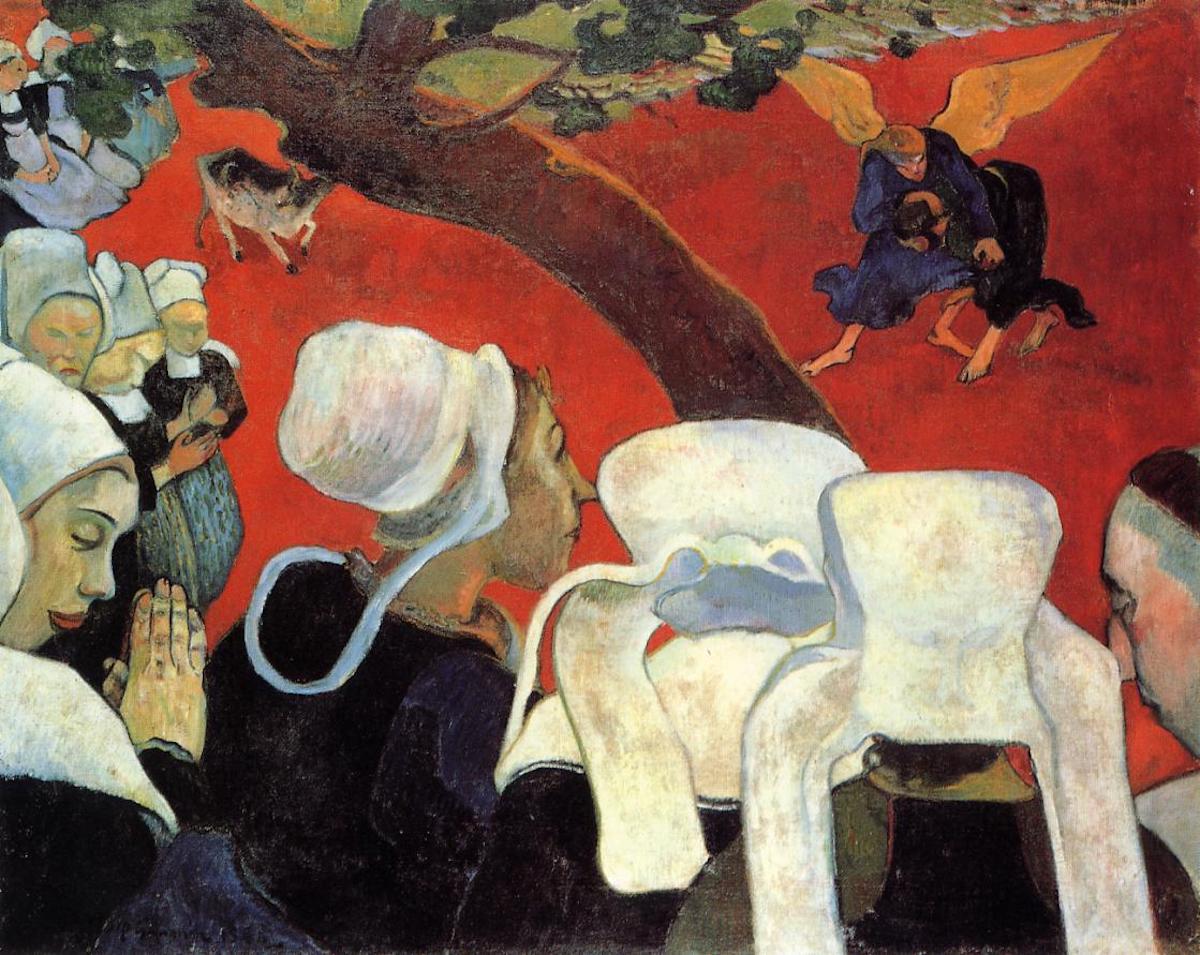
Today’s featured image is The Vision after the Sermon (Jacob wrestling with the Angel) by Paul Gaugin. Public domain. Scottish National Gallery, Edinburgh, UK.

Rules and Principles

Rules and Principles (CaD 1 Sam 21) Wayfarer

So the priest gave [David] the consecrated bread, since there was no bread there except the bread of the Presence that had been removed from before the Lord and replaced by hot bread on the day it was taken away.
1 Samuel 21:6 (NIV)

I once attended a local gathering of Jesus’ followers that belonged to a particular denomination. The denomination was hundreds of years old, and over those years the leaders of this denomination established a set of rules and regulations regarding everything from how the local gathering should be governed, how meetings were to be handled, and even how one goes about both personal and corporate worship.

There was in this particular gathering a man whose family had been members of this denomination for generations. He had the denominational rule book practically memorized, and he let everyone know it, all the time, by bringing it up whenever he sensed that one of the rules and regulations was being broken.

I confess: I found him annoying.

I have one vivid memory of him questioning something I did, pointing to the denominational regulation manual and expressing that I may have gone afoul of its religious code (as he interpreted it). I pointed him to the scripture that directly motivated my actions. It was obvious that he was zealously studying and following the denominational rules, but he was oblivious to God’s fundamental life principles.

In today’s chapter, David begins his life on the lam. King Saul wants him dead. David’s first stop is in the town of Nob. Nob is where the Hebrew’s traveling tent Temple, known as the Tabernacle (from the time of their Exodus out of Egypt) is set up. David talks to the high priest and expresses his need for food and a weapon. While it is not explicit in the text of today’s chapter, David will quickly be joined in the wilderness by his brothers and men who are loyal to him. They’ll need food. The sword of Goliath is there in the Tabernacle, which David takes. The only food available for David to take is the bread that has been consecrated to the LORD as part of the temple’s regular thanksgiving offering ritual. The high priest allows David to take it for himself and his men.

About a thousand years later after this incident, Jesus will be cornered by the religious rule-keepers regarding the fact that His disciples break the rules by picking grain to eat on the Sabbath day of rest.

Jesus answered them, “Have you never read what David did when he and his companions were hungry? He entered the house of God, and taking the consecrated bread, he ate what is lawful only for priests to eat. And he also gave some to his companions.” Then Jesus said to them, “The Son of Man is Lord of the Sabbath.”

Jesus’ point is that there are fundamental principles on which the laws were given. Chief among them are principles of love for God and loving others as you love yourself. There is also the law of life. David was in dire straits and the compassionate thing to do was give the consecrated bread to David for him and his men to stay alive as he flees into the Judean wilderness, even though it was going against the established religious ritual protocol. To put in terms of Jesus’ Beatitudes (Matt 5:3-12) it was the “pure in heart” thing to do, and it was the “merciful” thing to do, and those things supersede ritual protocol.

One of the things I love about Jesus was the fact that He was constantly ignoring the religious thing to do in order to carry out the right thing to do. I endeavor to always follow in Jesus’ footsteps, even if/when it completely ignores religious rules and regulations.

If you know anyone who might be encouraged by today’s post, please share.