Tag Archives: Jeremiah 10

The “Portion of Jacob”

The "Portion of Jacob" (CaD Jer 10) Wayfarer

He who is the Portion of Jacob is not like these,
    for he is the Maker of all things,
including Israel, the people of his inheritance—
    the Lord Almighty is his name
.
Jeremiah 10:16 (NIV)

Wendy and I have really enjoyed the first three seasons of The Chosen. We have found this cinematic retelling of the Jesus story as amazing as the story of its crowd-funded making. We both honestly felt like it took about three episodes of Season 1 for the writing and story to catch its stride, but from that point on we’ve been enthralled.

One of the things that we both love about this production is the way that it is telling the story. Many of the well-known cinematic retellings of the past have confined themselves to only those episodes and words which are recorded in the books of Matthew, Mark, Luke, and John. The Chosen, on the other hand, has remained true to these episodes while imagining the storylines of the characters around Jesus. In doing so, it places the episodes into the context of real, ordinary, daily lives of those involved – lives that are just like mine or yours. In the most recent third season, Peter and his wife are having marriage problems and a personal crisis that Jesus seems to completely ignore, James (who walks with a permanent limp) struggles with Jesus sending him out on a mission to heal others when Jesus has never once addressed James’ obvious handicap, and Matthew returns to Capernaum to face his estranged parents whose lives have been ruined because of his collaboration with the Romans as the local tax collector.

One of the other subtle things that I have loved about The Chosen is that the writers observe that Jesus loved nicknames. In the show, within The Twelve, He refers to “Big James” and “Little James.” Then there’s Simon the Zealot who is given the moniker “Zee” while the other Simon has yet to be given his nickname “Rocky” (the literal translation of “Peter”). I can’t wait to see how and when they work that one into the story.

I have observed many times along this chapter-a-day journey that God has always loved names and nicknames. As I’ve always said, God’s base language is metaphor. The nicknames that Jesus gave to His followers and that God gave to characters throughout the Great Story usually had a metaphorical meaning pointing to their character or transformation. The myriad of names of God used throughout the Great Story are a testimony to the power of metaphor to give us an increased understanding and appreciation for God, who cannot be truly understood within the limits of my finite mind.

In today’s chapter, I was intrigued by a moniker of God that I never remember noticing before. Jeremiah refers to God as “the Portion of Jacob.” There is only one other time in the entire Great Story in which this name of God is used when Jeremiah uses it again in chapter 51.

And so, in the quiet this morning I sat with and meditated on this nickname, “Portion of Jacob.” Of all the great ancestral heroes of Jeremiah and the Hebrews, Jacob is among the most intriguing. Jacob (which means “deceiver”) was a liar and a deceiver. His is a story of lowly person struggling against his place in life and one who wrestled with God. And yet, God shows Jacob unmerited favor and grace. God uses Jacob despite his flaws. God does not abandon Jacob, but continually humbles and hones Jacob throughout his story.

What a great metaphor for the very people, Jacob’s people, whom Jeremiah describes in today’s chapter. Jeremiah has six times (FYI: in numerology, six is the number of sinful man) described his people as deceitful to this point in the anthology of his messages. Jerry could have chosen to identify God as the God of Abraham, Isaac, Moses, or David. He chooses instead a moniker for God that he alone uses in all of the Great Story. God is the “Portion of Jacob,” the God of the deceitful, rebellious, hard-hearted people who descended from Jacob the deceiver who wrestled with God.

As I pondered this, I was reminded of many of the characters in the Great Story whose earthly lives and paths wound through rebellion, sin, and scandal. I thought of people in my own circles of influence who could be tagged as the spiritual descendants of Jacob the deceiver based on their own scandalous and tragic actions. I couldn’t help but think about my own stretches on this life journey, like those I’ve recently referenced, in which my own actions warranted being identified as a spiritual child of Jacob.

But, that’s the subtle beauty and the meaning of Jeremiah’s nickname for God, which is likely lost on most readers as it’s been lost on me until this morning. God graciously loved and used Jacob despite his very obvious human flaws. Jeremiah is pleading with his flawed and rebellious people to spiritually return to the God who will graciously welcome a repentant prodigal. God graciously loved me despite my own years of wrestling. God calls me to be gracious with those who are in their own stretch of life walking in the shoes as spiritual children of Jacob.

Lord, have mercy on me, a sinner.

If you know anyone who might be encouraged by today’s post, please share.

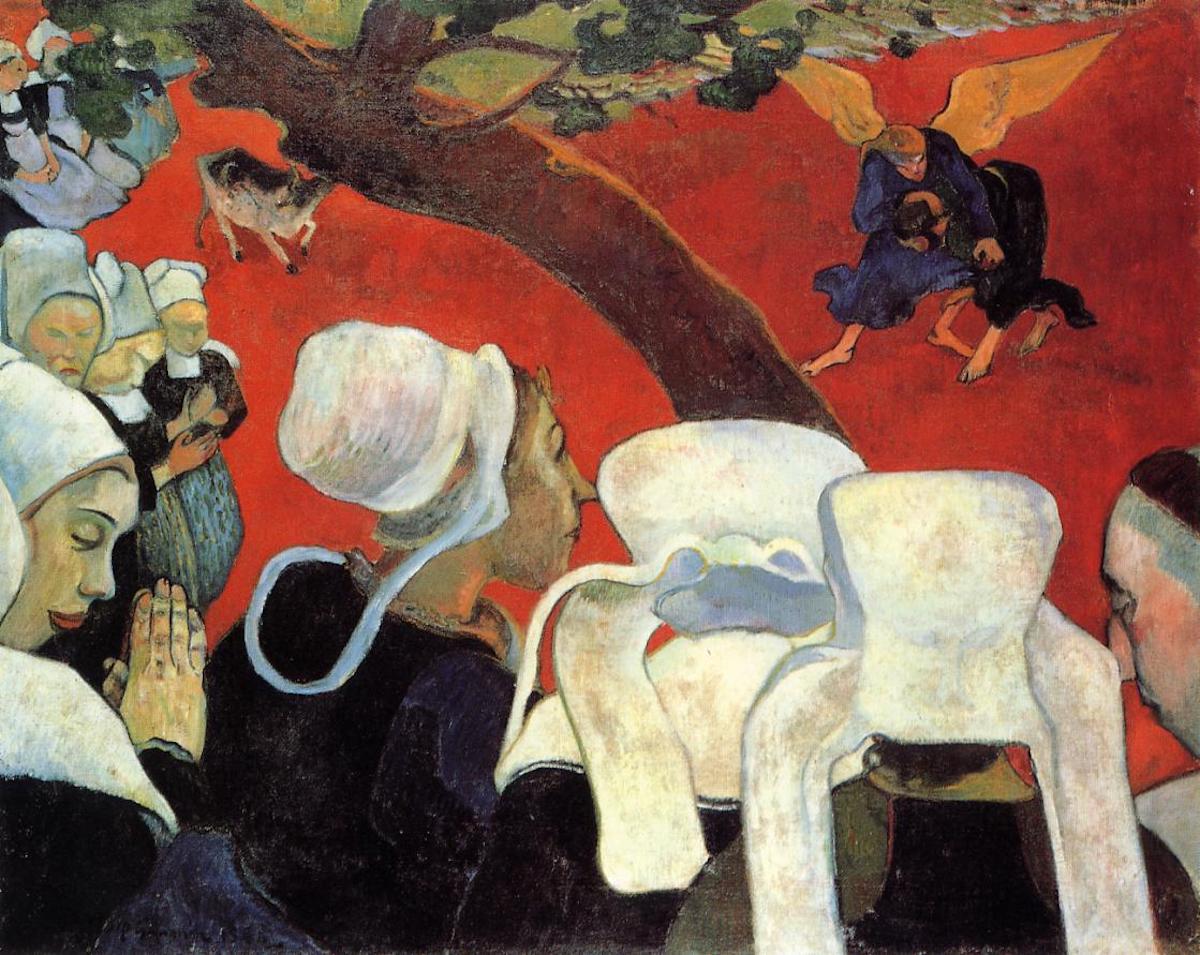
Today’s featured image is The Vision after the Sermon (Jacob wrestling with the Angel) by Paul Gaugin. Public domain. Scottish National Gallery, Edinburgh, UK.

Grab Your Bug-Out Bag!

“Gather up your bundle from the ground,
    O you who live under siege!
For thus says the Lord:
I am going to sling out the inhabitants of the land
    at this time….”
Jeremiah 10:17-18 (NRSVCE)

Among the sub-culture of the “wild-at-heart” man’s man is a thing known as a bug-out bag. There was a lot of buzz about it among some of the guys in my circles a few years back. The bug-out bag is a single duffle or backpack (you have to be able to carry it) that contains what you need to survive should nuclear war, EMP grid blackout, Zombie apocalypse, or other kind of Mad Max or Hunger Games type dystopia become a sudden reality. The bug-out bag contains things you need to survive like water, food, and the means to create shelter. Oh, and a weapon to kill Zombies or hunt down your next meal is always a wise choice. For the record, I don’t have a bug-out bag so I guess Wendy and I are screwed should any of the aforementioned events transpire.

Life in Jeremiah’s day was infinitely more precarious that the one we live in today. As a human being you’d be fortunate to survive infancy, and if you did survive into your teens you could expect the average life-span to be around 30 years. Disease, famine, and local wars were a constant threat. At that time in history local city-states and tribal kingdoms were being swallowed up by rapidly growing regional empires who had begun to perfect their tactics of military aggression, siege warfare, and political assimilation. The Assyrian and Babylonian empires were chief among them.

Jeremiah’s broken-record prophesies were not really that crazy to the people of his day. The Assyrians and Babylonians had a reputation for ruthlessness that was well-known and well deserved. Assyria had already destroyed their cousins in the northern kingdom of Israel (Jerusalem was part of the southern kingdom of Judah). The prevailing tactic of regional Empires was to take over the city, plunder anything valuable, kill the leaders and take the best and brightest hostage (FYI: Daniel was one of these). So, when Jeremiah wrote in today’s chapter that the people of Jerusalem should grab their bug-out bags, they knew what he was talking about (and it wasn’t a Zombie apocalypse).

For those reading along with this chapter-a-day journey, it should also be noted that Jerusalem had been attacked just a generation before by the Assyrians. In that day the Jerusalem was miraculously spared as the enemy army was mysteriously wiped out overnight (2 Kings 19). This, of course, made Jeremiah’s prophetic task more difficult. The people of Jeremiah’s day believed that God would miraculously save them just as He had done before.

This morning I’m thinking about all the doomsday predictions I’ve heard across my lifetime. From Christian teachers and their mesmerizing interpretations of Revelation to economists warning of global monetary collapse to environmentalists warning of a coming ice age (that was the prediction I heard in elementary school) or global warming meltdown. With the proliferation of voices via the internet there is no lack of fear-inducing doomsday predictions to go around. It’s easy to fall down the rabbit-hole of fear.

When confronted with doomsday predictions I find myself trying to be discerning. I can’t do anything about the timing of events in Revelation so I might as well focus each day on loving others as Jesus calls me to do and not worry about that which I can’t control. I believe God calls us to care for the Earth, so Wendy and I try to be good stewards of natural resources, recycle, and make wise choices for the sake of the environment whenever we can. Yet, once again, there is only so much I can do on a personal level and what will be is out of my control. It seems a waste of mental and emotional energy to live in perpetual fear of that which I don’t know and can’t control.

I confess, however, that the notion of having a bug-out bag (with a compass and one of those giant Rambo-like survival knives) does stir my manly spirit. “Arrrggghh!”

Chapter-a-Day Jeremiah 10

Which Way?
Image by StarrGazr via Flickr

It’s because our leaders are stupid.
   They never asked God for counsel,
And so nothing worked right.
   The people are scattered all over.
Jeremiah 10:21 (MSG)

I had a really nice conversation with an old friend yesterday. He is a University professor with high academic degrees and is working on two books he is writing while on sabbatical. As our conversation wandered here and there we ruminated on different life experiences. We both shared that the further we get in the journey, the more sure we are of what we don’t know.

When I was younger, I was more sure of my own strength and understanding. Now, I am convinced that I know very little in the grand scheme of things. I am slower to judge. I am slower to react. I am less given to rash decisions. I am continually reminded of my need to be reliant on God’s counsel, God’s strength, God’s wisdom, and God’s provision [and to be sure to listen carefully to my wife].

Today, I’m heading out determined to seek God’s counsel throughout my day.

Enhanced by Zemanta