Tag Archives: Outcast

Matthew the Quirk

Matthew the Quirk (CaD Matt 1) Wayfarer

Thus there were fourteen generations in all from Abraham to David, fourteen from David to the exile to Babylon, and fourteen from the exile to the Messiah.
Matthew 1:17 (NIV)

Like millions of others around the world, Wendy and I have become enamored with The Chosen, a crowdfunded, independent production that is a modern retelling of Jesus’ story. If you haven’t watched it, I highly recommend it. I also recommend that you push through the first three or four episodes which provide a lot of backstory for that may not seem to be going anywhere when you first watch it. Trust me. If you watch the first three seasons and then go back and watch the first three episodes you’ll see a million things that the writers were telling you before you could actually see them.

One of the more creative choices that the writers of The Chosen have made is to make the character of Matthew a young man on the spectrum. Matthew is brilliant. He is gifted with numbers, which is why the Romans love him as a tax collector. However, the writers have chosen to portray the young disciple as socially awkward. Wendy and I even wondered if they chose to portray him with a mild form of Asberger’s. At any rate, it was an interesting choice.

What we know is definitely true from Matthew’s biography of Jesus is that Matthew loved numbers. The ancient Hebrews loved numbers. The letters of the Hebrew alphabet performed double duty, representing numbers as well as letters. Because of this, there are all sorts of patterns in the Hebrew text of the Great Story that are completely lost when you translate the text into English. And yet, some of them still remain.

In his introductory chapter, Matthew displays his love of numbers. Three times (three is the number of God, the Trinity: Father, Son, and Holy Spirit) Matthew uses the word Messiah (the Greek word Christos) in introducing Jesus.

He also provides a genealogy of Jesus, tracing Jesus’ lineage all the way back to Abraham. There are some fascinating and curious aspects to the genealogy he provides. Before I get to that, I’d like to share one more clip from The Chosen in which Matthew shares with Philip what it fees like to be an outcast. In context, Matthew is both an outcast as a Roman collaborator and because of the fact that he is on the spectrum (Note: You might have to click the link and watch it on YouTube. It doesn’t seem to want to play as an embedded object).

Matthew chooses to list women in the lineage of Jesus. That was certainly not customary in the patriarchal culture of the day. Of course, Jesus had an entire entourage of women who followed Him along with The Twelve, provided financially for His ministry, and served in caring for their daily needs. Of the women Matthew mentions:

Rahab: A non-Hebrew prostitute who sheltered Joshua and Caleb in the spying out of Canaan and Jericho. She was spared from the conquest of Jericho and accepted into the community of Hebrews.

Ruth: A non-Hebrew woman who, after being widowed, followed her mother-in-law (Ruth) back to Israel and was redeemed by, and married to, a Hebrew man named Boaz.

Bathsheba: The adulterous mistress of King David whose husband David had murdered in order to have her as his own.

Women, non-Hebrew Gentiles, a prostitute, and an adulterous mistress. Not quite the glowing personages one might choose to include in the ancestry of the Son of God.

Matthew goes on to list three (the number of God) sets of fourteen (two sets of seven, the number of completion) generations (a total of six sets of seven or twice the number three for a total of three meaningful subsets) that cover the span of Hebrew history from Abraham to Jesus.

Matthew also introduced the reader to a systemic pattern of “Fulfillment” that he will use over, and over, and over again in his biography of Jesus:

“All this took place to fulfill what the Lord said through the prophet…”
Matthew 1:27

Matthew is a numbers guy, a systems guy, and in the Jesus Story he sees patterns that tie the entire Great Story together.

Next March I will celebrate the 20th anniversary of this chapter-a-day blogging journey which I started with a bit of a shrug and an attitude of “Hey, why not?” in March of 2006. In recent years, I’ve tended to trek through one of the four Jesus biographies (a.k.a. Gospels, or “good news”) in the Great Story each Lent season (40 days leading to Easter) and Advent season (40 days leading to Christmas). I noticed yesterday that we trekked through Mark, Luke, and John last year but it’s been three years since our last sojourn through Matthew.

So, in the quiet this morning, I’m excited to metaphorically lace ‘em up and revisit our systemic, numbers guy Matthew’s recollections and first-person account of being among Jesus’ core followers. I’m excited to take a fresh look at the Jesus Story from his unique perspective. My mind and heart are open to what new things I might discover this time through.

I love that God uses the uniqueness of every individual’s experience, personality, giftedness, and temperament for the good of the whole. It reminds me that even I, with my own individual and unique bents and quirks, have a role to play in this Great Story if only I will embrace it and choose in like Matthew did that fateful day when Jesus happened to pass by his Tax Collection booth and said, “Follow me.”

If you know anyone who might be encouraged by today’s post, please share.

These chapter-a-day blog posts are also available via podcast on all major podcast platforms including Apple, Google, and Spotify! Simply go to your podcast platform and search for “Wayfarer Tom Vander Well.” If it’s not on your platform, please let me know!

Touch and Cleansing

“Anything that an unclean person touches becomes unclean, and anyone who touches it becomes unclean till evening.”
Numbers 19:22 (NIV)

There is an old saying that “cleanliness is next to godliness” and the saying may well be rooted in the religious rituals God gave to the ancient Hebrews in the book of Numbers. The theme of today’s chapter are the things that made one “unclean” and the rituals for making them “clean” again. While there is certainly spiritual metaphor at work here, there is also practical application for keeping a nation of nomads alive approximately 3500 years ago.

Throughout today’s chapter I got the sense of reading an ancient hygiene manual. Being around things like dead bodies (which may carry all manner of contagion) make a person “unclean.” You had to remain outside the camp for seven days (we call that quarantine), ritually wash, and then wash your clothes before you could be enter the camp once more. Through the ritual, God protects the community from that which could harm it.

By the time Jesus arrived on the scene in history 1500 years later, the “clean” and “unclean” designations of Moses’ law had morphed into systemic religious and social prejudice. Rules had been made to define the rules. Religious Hebrews weren’t using the “unclean” designation to protect the community, but to separate themselves from lower class individuals and those with whom they didn’t want to mix socially.

Read Jesus’ story and you’ll find that time and time again He was breaking the rules. He broke the rules for working on the Sabbath. He touched that which the Hebrew religious leaders said was “unclean” (e.g. a leper, a woman bleeding, a woman caught in adultery).

One of the most powerful stories is when a leper falls before Jesus and says, “If you want to, you can make me clean.”

He didn’t say “you can heal me” or “you can take my leprosy away” or “you can make me whole.” He said you can make me “clean.”

The leper was an outcast, and he was required to shout “Unclean!” wherever he went so that everyone else could avoid him. No one was to touch him. Every day the social system ensured that he repeatedly confirm his unworthiness, dishonor, and shame. All day, every day he would repeat “Unclean! Unclean! Unclean!” and watch people’s faces contort with disgust. He would watch mothers hurrying their children away from him. He watch people cross the street to walk on the other side of the road. This is why you still hear the phrase “social leper” in context of a person who has become an outcast of society.

Matthew is careful to record (Matthew 8:3) that Jesus reached out and touched the leper. This was not a casual touch. This was breaking the rules. This was supposed to mean that Jesus would be unclean, too. But Jesus’ touch healed the man’s leprosy. The touch made him clean.

This morning I’m reminded of the many times and circumstances along my life journey when I’ve felt unclean. Despite the common misperception of those who’ve never really read the story, Jesus didn’t come to perpetuate systemic uncleanliness. He didn’t come to double down on societal rules, stigmas, and shame. He didn’t come to tell me how terrible, unworthy, and unclean I am. I’m well aware of my uncleanliness without having to be reminded.

Jesus came to reach out with grace and love and compassion and power. Jesus came to touch the unclean person and make them clean. Present company included.

If you want to…

The person who has the leprous disease shall wear torn clothes and let the hair of his head be disheveled; and he shall cover his upper lip and cry out, “Unclean, unclean.” He shall remain unclean as long as he has the disease; he is unclean. He shall live alone; his dwelling shall be outside the camp.
Leviticus 13:45-46 (NRSV)

I have a nasty cold. You don’t want to shake my hand.”

It’s not uncommon to hear that phrase when greeting someone during cold and flu season. With all we know about germs, bacteria, and viruses, it’s considered courteous and a socially appropriate way to show concern for, and protect the health of, another person. We don’t even think that much about it.

Today’s lengthy chapter is fascinating when I consider what scant medical knowledge must have existed when these laws about visible infections were given thousands of years ago. The prescribed actions in today’s chapter describe a systematic diagnosis of symptoms, the quarantine of infected individuals, the destruction of infected clothing, and the public communication of such infections so as to protect the larger community from transmittal.

What was considered necessary for the health and welfare of the society could also be incredibly shaming for the infected person. You were expected to make yourself look sick and disheveled so others could spot you and would want to avoid you. You were to proclaim loudly and repeatedly “Unclean!” so that others could stay away. How awful for those who lived their entire lives in such a way. I can’t imagine what it would do to my soul to live life always on the periphery of “normal” society, continually repelling people with my appearance and forever announcing to people who I was “unclean.” Talk about tragic.

It brings to mind this morning one of my favorite stories about Jesus. It happens so quickly that it is often forgotten among the wondrous things Jesus did on his miraculous mystery tour:

Then a leper appeared and went to his knees before Jesus, praying, “Master, if you want to, you can heal my body.”

Jesus reached out and touched him, saying, “I want to. Be clean.”

I think about this leper in terms of today’s chapter with its rigid legal and religious societal prescription. This is a person who has been alienated from family and society, perhaps their whole lives. This is a person who has had people perpetually avoid them, look at them in disgust, and treat them with contempt. This is a person who may very well have not felt the touch of another human being for as long as they could remember. No warm hugs, no human intimacy, no loving caress of a mother or spouse. This is a person who, in word and action, has been repeatedly fed a message by society: “I don’t want to see you. I don’t want to touch you. I don’t want you near me or my loved ones.”

Imagine this wounded soul coming to Jesus at the height of Jesus’ popularity. The crowds were enormous.

“Unclean!” the person shouts hoarsely as the crowds part. Mothers protect their children and hurry them away. People look away in disgust. Shouts and insults erupt as the “normal” people urge this person to leave and get away from them. Perhaps a few even picked up stones to throw in order to physically drive the leper away from them.

But Jesus watches quietly as the leper kneels and proclaims a simple statement of faith. “If you want to, you can make me clean.”

Then Jesus reaches out and touches the leper. “I want to,” Jesus says.

This morning I am thinking about my leprous soul that no one sees. I am thinking about the many ways I am “unclean” and infected with envy, hatred, prejudice, and pride. I am thinking of the ways I secretly identify with the leper, and all the ways I don’t have a flipping’ clue.

Jesus, If you want to, you can make me clean.

chapter a day banner 2015

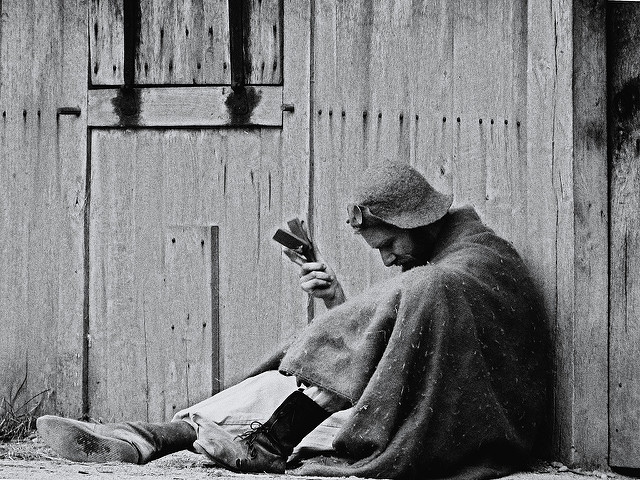
featured image by Hans Splinter via Flickr

Chapter-a-Day 2 Kings 7

Muchado1lr It happened that four lepers were sitting just outside the city gate. They said to one another, "What are we doing sitting here at death's door? If we enter the famine-struck city we'll die; if we stay here we'll die. So let's take our chances in the camp of Aram and throw ourselves on their mercy. If they receive us we'll live, if they kill us we'll die. We've got nothing to lose."  2 Kings 7:3-4 (MSG)

My wife and I are theatre people, and we have a love for the works of Shakespeare. We've been in productions of his works and have seen them produced in various settings. One of the things that makes the famous Bard's plays so timeless is the way he grasps the human condition and turns very common themes into both comedic and tragic plots and characters.

One of the themes we have noticed in Shakespeare's works is the way the archetype character of "the fool" ends up being the one who sees things to which the strongest heroes are blind. In Shakespeare's world, the fool often speaks with the greatest wisdom.

I have seen a similar theme throughout God's message. God delights in using the weakest, smallest, least important people to do great things. In today's chapter, it was four lepers who lived in the no man's land between the city wall (which they could not enter because of their disease) and the seiging Aramean army who surrounded the town. The lepers, in their desperation, had wisdom to see their only hope and grasp at it. They were rewarded with provision of the choicest plunder. Had the king or his guards discovered the empty Aramean camp themselves, the poor lepers would have been lucky to get some of the left-over scraps tossed to them from the city wall.

God delights in using the least important, weakest, most unlikely characters to do His will. Perhaps, like the lepers, it is because they have the least to lose in worldly standing.

Note to those reading this post Facebook: please forgive the spacing and formatting problems that occur in the auto-import from the original blog post.