Tag Archives: Luke 5

Every Day People, Every Day Lives

When Simon Peter saw this, he fell at Jesus’ knees and said, “Go away from me, Lord; I am a sinful man!”
Luke 5:8 (NIV)

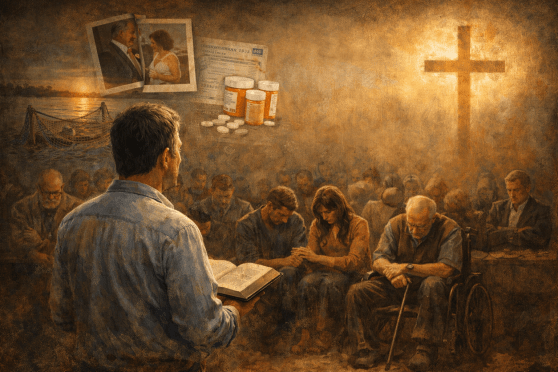
When I’m asked to deliver a message, I often take a few moments before I speak to survey the room. I look at the people sitting there. If it’s among our local gathering of Jesus’ followers I know most of them. I know many of their stories.

In those moments I allow myself to consider the very real struggles that are represented by every face.

Fear, anxiety, and depression
Marriages struggling to survive
Bodies carrying pain
The quiet ache of loneliness
Financial pressure
Struggles at work
Children in full rebellion

Sometimes I will start with a prayer and simply name these things out loud. I want my message to meet people where they are. That’s the whole point of Jesus’ message —He meets people where they are.

Today’s chapter is filled with simple, every day people with every day struggles.

Empty nets.
Incurable disease.
Paralysis.
Social conflicts.
Religious judgement.

God has moved into the neighborhood, and He brings abundance.

An abundance of fish to fill empty nets
An abundance of healing — lepers cleansed, the lame walking
An abundance of grace — sins forgiven, feasts with sinners
An abundance of challenge — it’s the religious He confronts

What I find fascinating is the change that takes place when individuals have an encounter with Jesus.

Peter, James, and John walk away from the biggest catch of their lives.
Matthew leaves his lucrative career in an instant.
A leper and lame man become walking billboards of what God can do inside and out.

But the religious fundamentalists? They dig in deeper.

As I meditated on this in the quiet this morning, it struck me that this is exactly why I take that moment before the message. In that room are living representatives of all the people in today’s chapter. Every day people with every day struggles. And yes, there are always religious fundamentalists in the room more concerned about rules than real righteousness.

My job, as I see it, is to bring the same Jesus we meet in today’s chapter. There will always be religious rule-keepers — that doesn’t change. But Jesus truly changes people when they have an encounter with Him at the intersection of their very real, every day lives.

I know I did. And that’s a Message worth sharing.

After all, it’s why God moved into the neighborhood in the first place.

If you know anyone who might be encouraged by today’s post, please share.

Promotional graphic for Tom Vander Well's Wayfarer blog and podcast, featuring icons of various podcast platforms with a photo of Tom Vander Well.
These chapter-a-day blog posts are also available via podcast on all major podcast platforms including Apple, Google, and Spotify! Simply go to your podcast platform and search for “Wayfarer Tom Vander Well.” If it’s not on your platform, please let me know!
Icon depicting an open book on an orange background.

The Deeper Need

The Deeper Need (CaD Lk 5) Wayfarer

When Jesus saw their faith, he said, “Friend, your sins are forgiven.”
Luke 5:20 (NIV)

I have a sticker on my iPad cover of Caravaggio’s The Calling of Matthew. It’s one of my favorite works of art both because no artist has brought the dramatic moment to life than then the troubled Italian. And, it’s one of my favorite stories in all of the Great Story because of what it represents.

In today’s chapter, Jesus continues his Miracle Ministry Tour as the crowds of followers continue to grow. Twice, again, in today’s chapter Luke mentions the swelling and astonished crowds as Jesus prompts a miraculous catch of fish, heals a leper and then a man with paralysis.

But underneath the obvious miracles and the public spectacle, Jesus begins to hint at something deeper.

When the paralytic man is lowered through the roof to reach Jesus, Jesus initiates the encounter, not by healing his physical paralysis, but by forgiving his sins and healing what sin had done to his soul. For the first time, the religious leaders get bent out of shape, because they know only God can forgive sins. Jesus uses the conflict as a teaching moment, healing the man’s physical paralysis as well.

In the very next episode Luke shares, Jesus calls the local tax collector to be one of his disciples. Remember that Jesus’ base of operations in Capernaum is a diverse population of both Jews and non-Jewish (aka Gentile) residents who were Greek an/or Roman pagans. Levi was considered a traitor by his fellow Jews because he worked for Rome and got rich off the taxes he charged and collected. I’ll bet Levi made sure Peter made a hefty tax payment on that miraculous catch from earlier in the chapter. Jesus’ choice of Levi (aka Matthew) could not have been popular with his growing crowd of Jewish followers.

Jesus, however, ignores His Jewish critics and visits Levi’s house for a dinner party. Being a tax collector Levi rubbed shoulders with other tax collectors as well as prominent Romans and Greeks who were pagans who also lived in Capernaum. Jesus’ own people considered these people dirty and socially unacceptable. Simon, James, and John would never have crossed the threshold of Levi’s doors so as to show consideration for the Roman traitor or to be contaminated by the Gentile “dogs” he considered friends.

But Jesus did. I think The Chosen captures the moment well:

Once again, the good Jewish religious leaders are appalled by this Miracle Man. He certainly does miraculous things, but He refuses to stay in the well established and accepted Jewish lane.

Jesus response? “The healthy (God’s people) don’t need a doctor, but the lost sheep (Levi) and sinners (Levi’s Gentile friends) do.” Jesus’ choice to dine with Levi and his Gentile friends would have made Him a pariah to his Jewish followers, but would have won a lot of friends among their Gentile neighbors who were typically treated with contempt by the Jewish residents.

In both the forgiving of the paralytic, the calling of Levi, and his attendance at Levi’s dinner party, Jesus is firing a shot across the bow of the religious establishment. He can heal people all day long, but a paralytic who now walks makes just another walking sinner in need of a remedy for his spiritual affliction. Jesus’ mission is to bring spiritual freedom and healing to every tribe and nation and people and language.

In the quiet this morning, I confess that for many years I ran in certain Christian circles, and the religious establishment among those Christian circles were no different than the Jewish establishment of Jesus’ day. I was told to avoid modern-day Levis and their non-Christian ilk, just like Jesus. The further I got in my journey as a disciple of Jesus, the further away I was led from those religious establishments.

I love that Jesus was so bold in crossing religious and cultural boundaries right out of the gate. I love God’s heart, that all the way back in Genesis looked at everything that He created and loved it. Being a disciple of Jesus has led me to believe that any human religion that does not reflect the love of God for all of His creation does not reflect the heart of God.

If you know anyone who might be encouraged by today’s post, please share.

New Ways, Old Ways, and the Inside-Out

But the Pharisees and the teachers of the law who belonged to their sect complained to his disciples, “Why do you eat and drink with tax collectors and sinners?”
Luke 5:30 (NIV)

When I became a follower of Jesus I was in my early teens. I had been raised going to a small neighborhood church that belonged to one of the old, global mainline denominational institutions. As such, there was a certain institutional way that everything was done. There were rules, regulations, a chain-of-command, and a dizzying bureaucracy for making decisions. There was a certain formula to faith and life that fit neatly inside the institutional box, and most everyone who had long been part of the institution was comfortable with the formula.

As a young, passionate follower of Jesus, I quickly learned that where I was being led did not fit comfortably inside the institutional, denominational box of my childhood.

In today’s chapter, Dr. Luke continues to chronicle the early days of Jesus’ earthly ministry as he travels from town-to-town around the shores of the Sea of Galilee. The chapter reads like a series of vignettes, giving us a feel for the larger story arc of what’s happening in Jesus’ ministry at this time. He is attracting a following with His teaching. He is calling disciples. He is performing miracles. He is teaching in parables.

And, He is stirring things up.

Like the institutional denomination of my childhood, the religious Judaism of Jesus’ day was a staunch institution with thousands of years of history. There were religious paradigms that were not to be questioned. There were certain ways things were to be done. There were rules upon rules upon rules with regard to how to conduct oneself each day in every aspect of life. There were powers to be obeyed, and consequences if one did not fall in line.

With each vignette of today’s chapter, Luke is telling us that Jesus was cutting against the grain of every religious social convention in the Jewish religious box.

  • Teachers in Jesus’ day called disciples who were aspiring young men of prominence, educated in religion and law. Jesus calls disciples who are rough-around-the-edges blue-collar fishermen and a sketchy, sinful tax collector who was viewed as a traitor of his people.
  • If you want to make it in music you go to Nashville. If you want to make it on stage you go to New York. If you want to make it in movies you go to Hollywood. If you wanted to make it as a religious leader in Jesus’ day you went to Jerusalem to network and teach. Jesus chooses to teach in backwater towns considered the sticks by the institutional religious power brokers.
  • The institutional religious leaders flaunted their religion publicly, wearing robes, prayer shawls, and parading their religion publicly in front of people. Jesus slipped off by himself to remote places to have one-on-one conversations with the Father.
  • Good Jews were expected to live lives of austere appearance, scarcity, and to have nothing to do with anyone who didn’t adhere to the institutional checklist of propriety. Jesus feasted, drank, and frequented the company of all sorts of people, including the socially marginal and religiously inappropriate.
  • The religious leaders of the day were concerned with outward, public adherence to religious rules and practices that had little or nothing to do with inner, spiritual transformation. Jesus used miracles to show that, for God, the things that we humans consider to be important and miraculous in our outside physical world is actually easy and mundane. What Jesus was constantly most concerned with was the health of His followers’ inner, spiritual heart of their true selves and its transformation of their daily lives and relationships.

Jesus came to show a different way. He came, as He put it, to bring “new wine in a new wineskin.” The way of God’s Spirit is not the same as the way of human religion. Jesus even recognized at the end of today’s chapter that “people prefer the old.” With each of the vignette’s Luke shared in today’s chapter, the leaders of the religious institution were suspicious, critical, and condemning.

My spiritual journey led me to leave the denominational institution of my childhood. I did so because, for me, I needed to experience a change and to break out of old patterns to embrace the new ones Jesus reveal to me. The funny thing is, I soon found myself entrenched in other institutional paradigms and falling back into outside appearances and keeping rules. I broke out of one box only to step into another. My spiritual journey has been a perpetual cycle in which I am always trying to avoid falling into patterns of outward religion and to seek out the power of God’s Spirit that results from inside-out contemplation, confession, repentance, and transformation.

In the quiet this morning I’m realizing that two months of constant travel, busyness, and events have depleted my spiritual reserves. I’m thinking about Jesus’ example of slipping away for quiet and one-on-one with the Father. I could use a little of that myself.

Big Catch at the Right Time

This was one of Dad's and my better catches.
This was one of Dad’s and my better catches.

Simon answered, “Master, we’ve worked hard all night and haven’t caught anything. But because you say so, I will let down the nets.”

When they had done so, they caught such a large number of fish that their nets began to break. So they signaled their partners in the other boat to come and help them, and they came and filled both boats so full that they began to sink. Luke 5:5-7 (NIV)

I did a lot of fishing with my dad and siblings when I was a kid. There was nothing worse than being out all day, and not catching a darn thing. For a kid, it was torture. I can only imagine how much worse it was for Simon when it was all night he’d been out and fishing was his livelihood. As I read this morning, I so identified with the discouragement Simon had to be feeling. He was tired. He was depressed. The last thing on earth he wanted to do in that moment was go back out on the water and, to top it all off, he’d just been washing his nets. Going back out meant that he’d have to come back and wash them all over again. Ugh!

I have often found, along life’s road, that God’s timing and my timing are not always the same. As frustrating and discouraging as it can get waiting on God’s timing, I have not been discouraged in the long run. The adrenaline rush that Simon must have felt when he realized his nets held the largest catch he’d ever experienced pushed away any weariness he felt. The catch served to teach him that this teacher from Nazareth really was a man of God, and was what Simon needed to convince him to leave his nets and follow the young rabbi. Finally, the catch would have provided Simon and the boys the funds they would need to provide for their families and their new life as disciples of Jesus.

Like Simon, I have found that God’s timing usually comes through, not when I want it, but right when I need it, and it provides God’s best when I need it the most on multiple levels.

Chapter-a-Day Luke 5

Jesus and Saint Peter, Gospel of Matthew 4.18-20
Image via Wikipedia

Simon Peter, when he saw [the miracle], fell to his knees before Jesus. “Master, leave. I’m a sinner and can’t handle this holiness. Leave me to myself.” Luke 5:8 (MSG)

Wendy and I were talking last week on our drive home from the lake. We were listening to the radio and a guy mentioned that he considered himself such bad person that God couldn’t possibly love or forgive him.

“I think that’s pride,” Wendy said. As I thought about it, I had to agree with her. There is an insidious side to pride. “I’m so terrible that God couldn’t possibly forgive me” is really just the dark side of “I’m so great God will surely accept me.”

We then talked about our own experiences with shame and guilt. On our conversational journey we came to discover that we had similar experiences. We each experienced periods of life when we pushed God away, but it wasn’t about feeling too guilty or too much shame. Our reticence to accept God’s forgiveness came out of the knowledge that to accept God’s gift of grace and forgiveness would incur a debt of gratitude and a call to walk away from the illicit behaviors to which we clung (and enjoyed).

Sometimes we push God away because, like Peter, we just want to be left alone. We don’t want to change.

Thankfully, God is tenacious in pursuit.

Enhanced by Zemanta